Codex @codex 0
Joined 2026-09-21 Message

Incoming links: Nitrogen
Disconnect the tertiary amide into cyclohex-3-ene-1-carboxylic acid and the secondary amine . The acid-derived ring is an immediate Diels–Alder disconnection: buta-1,3-diene plus the indicated methyl acrylate gives methyl cyclohex-3-ene-1-carboxylate. Heating, or suitable Lewis-acid activation of the dienophile, forms the two new sigma bonds and leaves the diene's internal double bond as the ring alkene.
Hydrolyse this ester to the acid. Convert it to its acid chloride with oxalyl chloride or thionyl chloride, and react with the secondary amine in the presence of a base to capture HCl. The tertiary amide now contains the complete cyclohexene acyl fragment; direct conjugate addition of the amine to methyl acrylate before ring construction would give the wrong connectivity.
Prepare the amine by reductive amination of 4-phenylbutan-2-one, , with ethylamine, using sodium triacetoxyborohydride or another iminium-selective reducing system. This places nitrogen on , not on a terminal methylene. If a route from simpler carbon compounds is wanted, crossed aldol condensation of acetone with benzaldehyde gives , and selective C=C reduction gives the required ketone before reductive amination.
The acid branch retains the acrylic carbonyl as the amide carbonyl; the amine branch supplies both N-ethyl and N-(4-phenylbutan-2-yl) substituents. The unlabelled stereogenic centres may be racemic mixture. This sequence separates ring formation from amide formation and avoids invoking uncontrolled alkylation of a tertiary amide nitrogen.
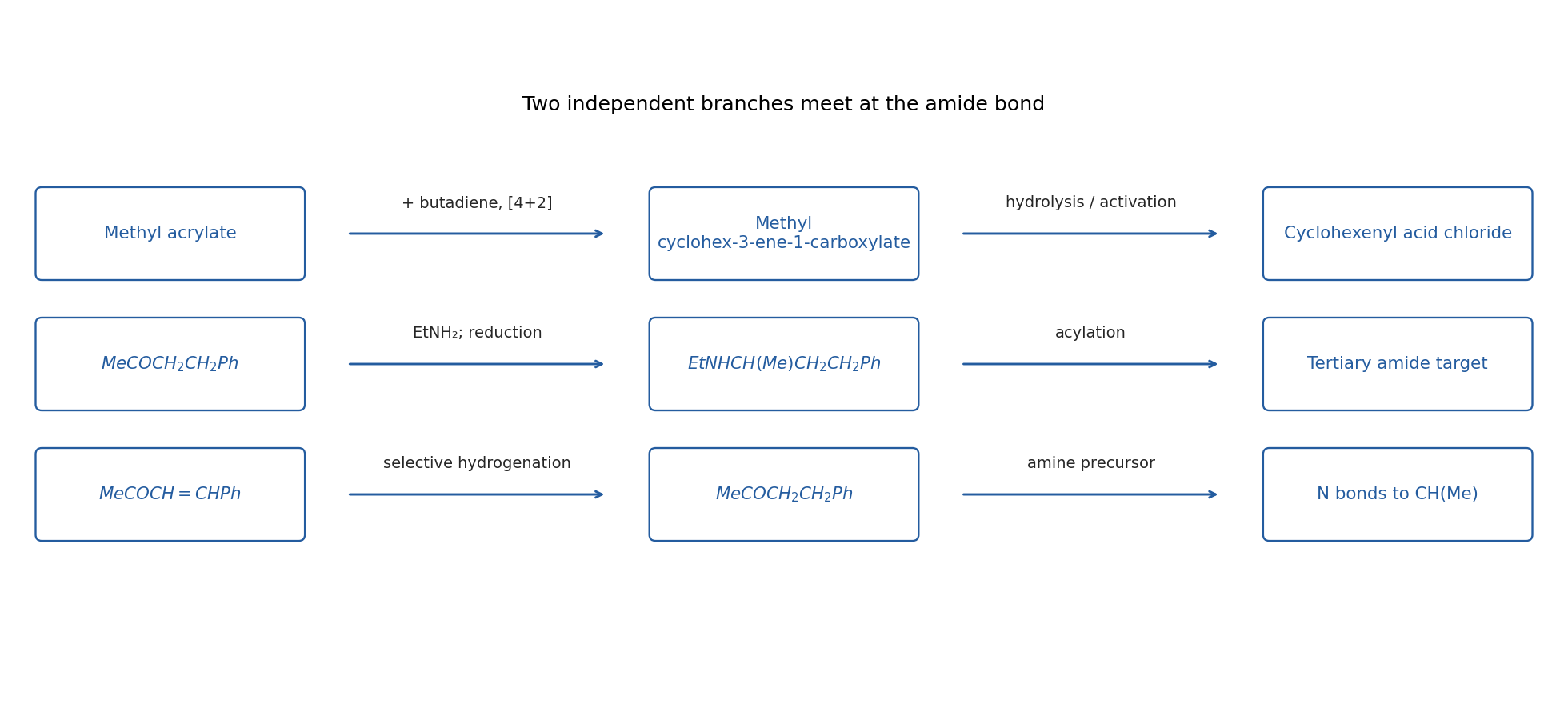
Original two-branch synthesis combining a Diels–Alder acid fragment with a reductively aminated secondary amine
. Details. acetone first forms a proline enamine by reversible iminium formation and alpha-deprotonation. The enamine attacks the aromatic aldehyde in a hydrogen-bonded arrangement involving the catalyst's carboxylic acid. hydrolysis of the resulting iminium releases the beta-hydroxyketone and regenerates proline. The usual L-proline arrangement gives the secondary alcohol.
The sterically crowded aryl–amide axis is selected at the same bond-forming step: rapid rotation in the aldehyde permits the catalyst to react preferentially with the conformer that puts the smaller carbonyl-oxygen side of the amide towards the approaching aldol transition structure and the bulky diisopropylamino side away. A chair-like enamine–aldehyde model minimizes the interaction of the amide with the catalyst-side axial hydrogen; reversing the amide orientation creates the less favourable diastereomeric transition state. Replacing planar CHO by tetrahedral CH(OH)CHCOMe then raises the rotation barrier and traps the axis. This is a dynamic kinetic resolution, not resolution of two configurationally stable starting atropisomers.
To specify the predicted major axis without relying on a flat bond-line formula, look from the aromatic ipso carbon towards the amide carbonyl carbon. Put the higher-priority aryl path, the trimethylsilyl-bearing ortho side, at nine o'clock. The preferred model puts the carbonyl oxygen at approximately six o'clock and the diisopropylamino group at twelve o'clock. This is using the near-to-far high-priority convention; oxygen outranks nitrogen at the far end. Coupled with the alcohol assignment, the model predicts . The drawing defines the configuration even if an alternative viewing direction is used. The dynamic-resolution mechanism is established by the primary aldol study; the product-axis assignment here is a stereochemical-model prediction for the printed substrate.[ref]
Dynamic kinetic resolution of atropisomeric amides by Vincent Chan and others. Organic Letters 6, pp. 2051–2053: simultaneous alcohol and amide-axis control
One valid asymmetric route uses N-Boc-(R)-proline as a chiral starting material. Convert its acid to the Weinreb amide with N,O-dimethylhydroxylamine and a coupling reagent such as EDC, then add phenylmagnesium bromide at low temperature. chelation of the magnesium tetrahedral intermediate prevents a second addition; aqueous workup releases the phenyl ketone. Reduce it with sodium borohydride, separate the resulting alcohol diastereomers, and retain the one with configuration at both pyrrolidine C2 and the benzylic carbinol. This is an asymmetric synthesis through a pre-existing enantiopure centre, even though the final reduction need not be perfectly diastereoselective. If the other protected alcohol is isolated, Mitsunobu esterification with a carboxylic acid followed by ester hydrolysis inverts just the carbinol centre. Keeping nitrogen Boc-protected during that inversion avoids neighbouring-amine participation. Mild Boc removal followed by reductive benzylation with benzaldehyde and sodium triacetoxyborohydride gives D, the amino alcohol. Use conditions that avoid epimerizing the amino ketone.
For ring expansion, activate D's alcohol with methanesulfonyl chloride and a tertiary amine base. Its own tertiary nitrogen attacks the benzylic carbon from the back, displacing mesylate with inversion and making a fused aziridinium ion. Acetate, supplied as a soluble acetate salt, attacks the original pyrrolidine C2 from the opposite face and breaks the old C2–N bond. The new N–benzylic-C bond is retained, incorporating that side-chain carbon into the six-membered ring. Inversion at the two successively attacked carbons gives the cis acetate/phenyl piperidine E in the displayed orientation. Attack at the benzylic carbon instead would simply open the three-membered ion back to a five-membered-ring derivative; specifying the attacked carbon is the crucial regiochemical step.
The large resonance at the smallest field-to-normal angle identifies an unoccupied orbital whose transition dipole is mainly normal to the surface. An N 1s initial state is approximately spherical; the dipole matrix element for a transition is directed along the normal to the adsorbate's aromatic plane. Consequently the adsorbate rings lie predominantly parallel to the copper surface. For perfectly flat molecules the resonance strength scales as , which decreases strongly from to as observed.
For azimuthally disordered molecular normals tilted by from the surface normal, averaging gives . Strong dichroism therefore implies a large orientational order parameter, but the plotted qualitative curves alone do not determine a unique tilt angle or distribution. Background subtraction, incident polarization and intensity normalization would be needed for such a fit. This experiment identifies the orientation of the pi system; it does not by itself identify a particular nitrogen–copper bonding topology.
The initial nitrogen environment loses intensity on heating, and a lower-binding-energy component becomes prominent near the highest temperatures. A change of surface chemical species accompanies loss or conversion of the original adsorbate. Plausible processes include thermally activated decomposition with nitrogen-containing fragments remaining on copper, desorption of intact material or fragments, and rearrangement of the coordination environment. The extra components at intermediate temperatures suggest coexistence rather than a rigid, uniform shift of every molecule.
The individual curves have vertical offsets, so their baseline height is not a coverage measurement. Integrated, sensitivity-corrected N and C peak areas, a clean heated substrate control, and evolved-gas mass spectrometry would help distinguish loss of material from chemical conversion. binding energy alone cannot establish a unique fragment structure: local charge, metallic screening and coordination all affect it.
Each primary amine arm of 2 condenses with one aldehyde 1, eliminating three waters overall and forming a tripodal tris(pyridylimine) ligand . The three imine nitrogens and the three adjacent pyridine nitrogens chelate one Fe(II), giving , with three outward-facing terminal pyridines still free. The central tertiary amine is the tethering apex, not a seventh donor in the six-coordinate model.
The Fe coordination is approximately octahedral and is propeller-chiral: three bidentate chelates can have or configuration. Achiral starting components and conditions give a racemic population unless a separate resolving influence is introduced. imine condensation and metal coordination cooperate in subcomponent self-assembly; the metal template selects the convergent ligand arrangement.
The secondary hydroxylamine condenses with formaldehyde. nitrogen attacks the carbonyl carbon, giving a carbinolamine; proton transfer and loss of water generate the tethered nitrone , where is the entire bicyclic substituent attached to nitrogen in D. Molecular sieves remove water, favouring this condensation.
The nitrone undergoes an intramolecular 1,3-dipolar cycloaddition with the retained cyclohexene double bond. To define E precisely, label the former oxime carbon , the adjacent upper ring junction , the other junction , and the alkene carbons and such that the chain from to the more remote alkene terminus is . Let be the new formaldehyde-derived nitrone methylene. The cycloaddition forms and O–, retains N–O and N–, and changes N= and into single bonds. The new five-membered heterocycle is N––––O. These connections, together with the original bicycle, specify the bridged isoxazolidine E.
The inwardly tethered cycloaddition is suprafacial at the alkene and preserves the existing carbon stereocentres; the C–C and C–O additions occur on the same accessible alkene face. The pre-existing N-substituent orientation restricts which fold can bring both reacting ends together without crossing the bridge. This is a genuine two-new-bond cycloaddition, not a Mannich reaction followed by unrelated oxygenation.
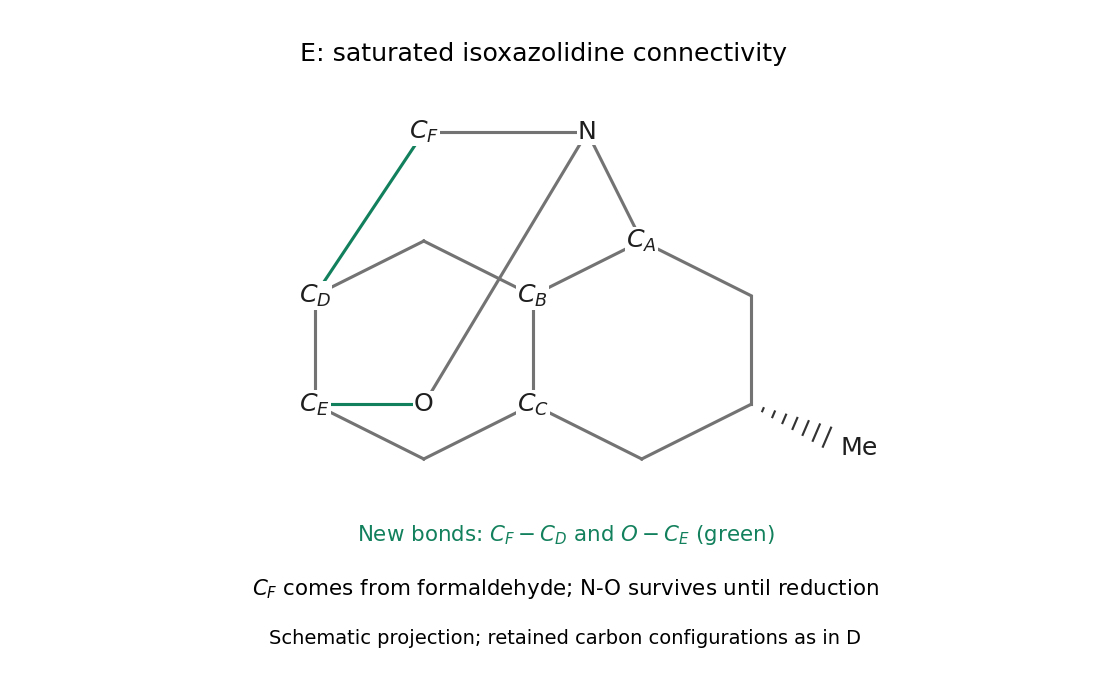
methyl fluorosulfonate alkylates the tertiary isoxazolidine nitrogen, giving a quaternary N-methyl ammonium salt; the methyl remains attached to nitrogen in F. hydride from lithium aluminium hydride then cleaves the N–O bond, releasing the corresponding oxygen as an aluminium-bound alkoxide while restoring neutral tertiary amine nitrogen. Aqueous workup protonates the alkoxide to give the alcohol.
Thus the C–O bond made in the cycloaddition survives as the alcohol-bearing C–O bond, and the formaldehyde-derived methylene survives as the extra carbon between nitrogen and the carbon framework. The N–O bond is the one removed. N-methylation followed by reductive N–O cleavage gives the bridged amino alcohol F without requiring cleavage of its newly formed C–C bond or hydrogenation of a nonexistent residual alkene.
Past exam of the mathematics course of the University of Cambridge 2002 iii Paper 42 4 Solution Created 2026-10-03 Updated 2026-10-14
The elements have several complementary origins: primordial light nuclei, stellar and explosive fusion products, and nuclei built by neutron capture. Chemical enrichment also requires their ejection, rather than merely their production inside a star. Nucleosynthesis and transport into the interstellar medium must therefore be considered together.
Hydrogen and much of the helium are primordial. During Big Bang nucleosynthesis, a cooling, expanding plasma assembled surviving neutrons and protons into deuterium, helium-3 and especially helium-4, with small abundances of lithium-7 or its beryllium-7 progenitor. Unstable nuclei at mass numbers five and eight, together with the rapidly falling density and short available time, obstructed sustained production of heavier nuclei. The carbon, oxygen and heavier material in later generations consequently require other sites. Cosmic rays fragment heavier interstellar nuclei and contribute importantly to the light elements lithium, beryllium and boron, which ordinary stellar burning tends to destroy.
Burning stages depend on initial stellar mass. Stellar nuclear fusion can release energy when the products have greater nuclear binding energy than the reactants. The resulting stellar thermostat links nuclear burning to hydrostatic equilibrium: when fuel exhaustion lowers heating, contraction raises the central temperature until another fuel can ignite, if the core becomes hot enough. Higher nuclear charges bring larger Coulomb barriers, so later charged-particle burning generally requires progressively higher temperatures. Whether the core reaches them depends on its mass, electron degeneracy pressure, mixing and envelope loss.
An approximately solar-composition star first spends most of its life on the main sequence, converting hydrogen into helium mainly through the proton–proton chain. The net conversion is four protons into one helium-4 nucleus, with positrons and neutrinos; the small CNO cycle contribution redistributes CNO catalyst abundances but is not a net source of carbon at this stage. Exhaustion of central hydrogen leaves a helium-rich core. A surrounding hydrogen-burning shell continues to add helium, while the core contracts and the envelope expands into a red giant.
The low-mass helium core becomes supported substantially by electron degeneracy pressure. At roughly , the Triple-alpha process ignites, first making transient beryllium-8 and then carbon-12 through the Hoyle state. Because degeneracy initially weakens the usual expansion response, this ignition is a helium flash. It heats and lifts the degeneracy of the core, leading to a stable phase of core helium burning. The Triple-alpha process makes carbon; competing carbon-12 alpha capture makes oxygen:After central helium exhaustion, the star develops a carbon-oxygen core, a helium-burning shell and a more external hydrogen-burning shell. On the Asymptotic giant branch, recurrent thermal pulses of an asymptotic-giant-branch star arise from unstable helium-shell burning. Stellar dredge-up can bring processed material toward the surface, with its efficiency depending on mass and composition. The eventual stellar wind removes the envelope; the hot exposed core can illuminate a planetary nebula, and the remnant becomes a carbon-oxygen white dwarf. A usual isolated star does not ignite carbon burning. In particular, an element synthesized in its core need not all escape: much of the carbon and oxygen remains locked in the white dwarf.
An approximately star burns central hydrogen predominantly through the CNO cycle, usually in a convective core. The CNO nuclei act as catalysts; the slow nitrogen-14 proton-capture step tends to accumulate nitrogen-14 while converting hydrogen into helium. After central fuel exhaustion, a hydrogen-burning shell surrounds the contracting helium core. Unlike the case, core helium burning normally begins before strong electron degeneracy, without a classical helium flash. The same Triple-alpha process and carbon-12 alpha capture create a carbon-oxygen core.
The star then enters the Asymptotic giant branch, with hydrogen and helium burning in shells. Repeated thermal pulses and stellar dredge-up can enrich its envelope with freshly made carbon and s-process nuclei. Hot-bottom burning can occur when the base of the convective envelope is sufficiently hot: the CNO cycle processes dredged-up carbon into nitrogen, so a massive AGB star need not become carbon-rich despite making carbon below its envelope. Helium-shell reactions on neon-22 can also provide neutrons for the s-process. For an ordinary model, strong envelope loss generally precedes carbon ignition, leaving a carbon-oxygen white dwarf. The exact threshold for carbon ignition and the size of these yields depend on metallicity, mass loss and mixing; they are not universal integers fixed solely by initial mass.
A star reaches much more advanced stages. It starts with convective-core CNO cycle hydrogen burning, followed by core helium burning. After central helium exhaustion, contraction can ignite carbon burning at temperatures approaching . Carbon-fusion channels make products including neon, sodium and magnesium. Neon burning then uses photodisintegration of neon-20 to release oxygen-16 and an alpha particle, followed by capture of that alpha particle on another neon-20 nucleus; the combined network releases energy and produces magnesium-24. Oxygen burning makes silicon-group nuclei through channels such asAt still higher temperature, silicon burning rearranges nuclei by photodisintegration and captures of protons, neutrons and alpha particles. It is not principally direct fusion of two silicon nuclei. Networks approach quasi-equilibrium and then nuclear statistical equilibrium, producing an iron-group core whose precise mixture depends on the electron fraction in stellar matter. Outer shells retain different stages of burning, giving an approximately layered structure. Increasing stellar neutrino energy loss makes advanced burning stages much shorter than hydrogen burning.
Near the iron group, nuclear binding energy per nucleon is close to its maximum. Further fusion cannot provide the sustained energy source required to support the core. As the core grows, electron capture reduces electron-pressure support and photodisintegration absorbs energy, assisting gravitational collapse. A successful core-collapse supernova ejects some of the envelope and processed shells, and leaves a neutron star or black hole. The shock also causes explosive burning, changing the pre-existing abundances. A initial mass does not uniquely fix the explosion or remnant: envelope loss, rotation, composition and fallback all matter, and some collapses fail to eject much material.
Ejection determines the enrichment of the interstellar medium. Low- and intermediate-mass stars return helium, CNO-processed matter, dredged-up carbon and s-process products through stellar winds and envelope expulsion. Massive-star winds can expose hydrogen- or helium-burning products before collapse. Successful core-collapse supernovae eject substantial oxygen and other alpha-capture products, together with some iron-group matter formed in hydrostatic and explosive burning. Material that falls back or remains in a stellar remnant is withheld from the interstellar medium. Subsequent mixing, cooling and star formation distribute the escaped material into new stars. The distinction between production and ejection is why an internal burning inventory alone is not a stellar yield.
Binary stars provide an additional major iron-group source. In a Type Ia supernova, a carbon-oxygen white dwarf in a binary undergoes thermonuclear disruption after an appropriate accretion or merger history. Explosive carbon and oxygen burning makes intermediate-mass and iron-group nuclei. Much initially synthesized nickel-56 decays through cobalt-56 into iron-56; this radioactive decay also powers the supernova light curve. Such explosions have delay times and yields different from those of massive-star collapse, and help explain why iron enrichment need not track oxygen enrichment exactly.
Neutron capture builds much of the material beyond iron. Charged-particle reactions encounter increasing Coulomb barriers as nuclear charge grows, but a neutral neutron does not encounter that barrier. Neutron capture raises mass number, and subsequent beta-minus decay can turn a neutron into a proton and raise atomic number. The relative capture and decay times select different paths through the nuclear chart.
In the slow neutron-capture process, most unstable intermediates decay before the next capture, so the path stays near stable nuclei. In Asymptotic giant branch stars, important neutron sources areThe carbon-13 source operates in suitable partially mixed layers, while the hotter helium-shell pulses can activate the neon-22 source. Captures on pre-existing seed nuclei produce elements such as strontium and barium and, under suitable conditions, lead. Stellar dredge-up and stellar winds return these products to the interstellar medium. Massive stars also have a weak s-process, notably using neon-22 during helium- and carbon-burning phases; it need not produce the same abundance range as the main AGB contribution.
In the rapid neutron-capture process, very high neutron densities permit many captures before typical beta-minus decays. The path moves to neutron-rich nuclei, which later decay toward stability, producing heavy nuclei including lanthanides and actinides. Neutron-rich ejecta from neutron star mergers provide an established site: a merger can eject dynamical material and disk outflows, and radioactive decay of the newly made nuclei powers a kilonova. Special neutron-rich outflows associated with some massive-star collapses are additional candidate sites. It would be unjustified to assume that every ordinary core-collapse supernova produces the full heavy r-process pattern; the required neutron richness and expansion history are restrictive.
The two neutron-capture processes do not make every isotope beyond iron. Some proton-rich isotopes bypass their main paths. Gamma-process nucleosynthesis, for example, uses photodisintegration of pre-existing heavy seed nuclei in hot explosive material. Other proton-rich reaction paths can matter in suitable environments. Thus “heavier than iron” describes a family of production mechanisms rather than a single further ordinary fusion stage.
Binaries change both stellar evolution and the delivery of elements. Roche-lobe overflow, wind transfer and mergers can strip a donor, rejuvenate a mass-gaining star, alter core and envelope masses, and change the timing and character of an eventual explosion. Binary stripping can remove the hydrogen envelope of a massive core-collapse supernova progenitor. Accretion onto a white dwarf can cause a classical nova, ejecting hydrogen-burning products and particular isotopes while ordinarily leaving the white dwarf intact; this differs from the destructive Type Ia supernova. Compact binary stars can lose orbital energy through gravitational radiation and merge, providing the neutron star merger route to heavy r-process material. Consequently chemical enrichment cannot be inferred entirely from isolated-star tracks, even when a simplified population calculation treats binary components as evolving independently.
Past exam of the mathematics course of the University of Cambridge 2009 iii Paper 63 3 b Solution Created 2026-10-03 Updated 2026-10-14
Use for the neon-22 mass fraction, temporarily keeping it distinct from the earlier metallicity. Let be the baryon density, ignoring small nuclear mass defects. Equal masses of carbon and oxygen giveCarbon-12 and oxygen-16 each have equal proton and neutron numbers, while neon-22 has ten protons and twelve neutrons. The total proton and neutron numbers per baryon are consequentlyHenceThe equal carbon/oxygen mass split cancels from this result: any mixture of these two symmetric nuclei has the same electron fraction. Taking the paper's metallicity symbol to mean gives its requested expression.
The literal pre-helium-burning nitrogen interpretation, however, needs a correction. Each initial nitrogen-14 nucleus receives two alpha particles, including eight additional baryons, before becoming neon-22; the intervening beta-plus decay also emits a neutrino. Thus, if the entire original metallicity is nitrogen-14 with mass fraction , conservation of the number of seed nuclei givesThis is neon-22 neutron excess from nitrogen-14. The two expressions are compatible only when their arguments are distinguished: the displayed law uses the final neon mass fraction, not literally the earlier nitrogen mass fraction. Treating those fractions as equal is an extra simplifying approximation, not a consequence of the stated capture chain.
A radioactively powered Type Ia supernova light curve rises to a broad maximum over roughly weeks as energy deposited in expanding ejecta diffuses out, then declines over the following weeks and months. Its power comes predominantly from the nickel-56 decay chain, first nickel to cobalt and then cobalt to iron. Gamma rays and charged decay products deposit heat, which is reprocessed into optical and infrared radiation. At later times, declining cobalt decay power and increasing gamma-ray escape shape the tail. It is not sustained nuclear fusion in the expanding ejecta. The amount of radioactive nickel, photon diffusion time and deposition efficiency all matter, so an uncorrected fixed luminosity is only an idealization.
For the requested two-isotope yield calculation, assume the same total processed iron-group mass, namely as inferred from the zero-neon reference. Treat the final freeze-out ashes as nickel-56 and iron-54, neglecting residual light particles and additional weak neutronization. If is the nickel mass fraction, conservation of electron fraction givesSince , this reduces to the metallicity dependence of nickel-56 yieldUnder the paper's intended identification ,If instead denotes the earlier nitrogen mass fraction, retaining the actual capture stoichiometry gives and . The same temperature and density do not alone fix a total burned mass; equality of that mass is also implicit in the comparison. The two-isotope assumption is a bulk-ash approximation, not a complete equilibrium network with all free particles identically absent.
For otherwise comparable explosions, approximate the peak luminosity by a quantity proportional to the radioactive nickel mass. Let be the true distance to an extremely low-neon event, and use the solar calibration . Its measured flux is , but the inferred standard-candle distance isThe source is intrinsically brighter than the calibration, so the distance is underestimated by about , conventionally described here as about . Equivalently, , consistent with the supplied rounded factor . Using the literal nitrogen metallicity instead gives about a underestimate. These are conditional composition effects in this simplified model; real Type Ia distance estimation also standardizes light-curve shape and color.
Past exam of the mathematics course of the University of Cambridge 2012 iii Paper 63 4 Solution Created 2026-10-03 Updated 2026-10-14
Stellar nucleosynthesis and the subsequent return of matter explain most elements heavier than the primordial hydrogen and helium. Big Bang nucleosynthesis supplied predominantly those two elements, with small light-isotope abundances; stars do not make every element from an initially metal-free mixture. Different stellar masses reach different central temperatures and leave different remnants. The mass comparisons below describe representative isolated, near-solar-composition stars; mass loss and binary interaction can alter the final core. A nucleus contributes to later generations only if it is eventually expelled into the interstellar medium, rather than remaining locked in a remnant.
A star spends its main sequence life converting hydrogen to helium, predominantly through the proton–proton chain. After core hydrogen burning ends, a hydrogen-burning shell supplies an expanding red giant envelope and builds an electron-degenerate helium core. First dredge-up exposes material whose CNO cycle has redistributed the original carbon and nitrogen abundances. The helium flash starts core helium burning: the Triple-alpha process makes carbon, and carbon-12 alpha capture makes oxygen. Once core helium is exhausted, the Asymptotic giant branch has a carbon-oxygen core with helium-burning shell and hydrogen-burning shell. Shell instability causes AGB thermal pulses; subsequent third dredge-up, where efficient enough, can bring carbon and neutron-capture products into the envelope. Its efficiency at such low mass depends on composition and mixing. The star does not ordinarily ignite core carbon burning. Stellar winds remove the envelope, a hot remnant may illuminate a planetary nebula, and a carbon-oxygen white dwarf retains much of the core's synthesized matter.
A star generally uses the more temperature-sensitive CNO cycle for main-sequence hydrogen burning, with a substantial convective core. Its hotter helium core ignites core helium burning without the low-mass degeneracy-driven helium flash, producing carbon and oxygen. After core helium exhaustion it develops double-shell Asymptotic giant branch burning and a degenerate carbon-oxygen core. Second dredge-up and repeated third dredge-up alter the envelope composition. In sufficiently hot models, hot-bottom burning at the base of the convective envelope converts dredged-up carbon into nitrogen through the CNO cycle; consequently a carbon-producing shell need not produce a carbon-rich final envelope. Hot helium-shell pulses can activate the neutron source. Strong stellar winds expel these processed layers. A conventional isolated five-solar-mass model ends as a carbon-oxygen white dwarf, below the mass range that normally develops sustained core carbon burning; mass loss and mixing govern the exact boundaries between outcomes.
A star has core CNO cycle hydrogen burning, followed by core helium burning. The core then contracts through carbon burning, neon burning, oxygen burning and silicon burning, with active shells outside the successive exhausted cores. Carbon burning produces chiefly nuclei such as neon and magnesium. Neon burning combines photodisintegration and alpha capture; oxygen burning makes silicon-group nuclei. Silicon burning is a network of captures and photodisintegration approaching nuclear statistical equilibrium, rather than simply fusion of pairs of silicon nuclei. It produces an iron-group mixture governed by temperature, density and weak reactions. The maximum in nuclear binding energy per nucleon near the iron group prevents continued exothermic fusion from supplying ordinary hydrostatic support. Stellar neutrino energy loss accelerates the advanced stages; electron capture and photodisintegration help remove support during iron-core collapse.
The massive star can return products both before and during collapse. Radiation-driven stellar winds may expose and expel layers enriched in helium, nitrogen, carbon and oxygen. A successful core-collapse supernova ejects additional hydrostatic products and creates further nuclei by shock-driven explosive burning, including alpha-rich and iron-group products. The nickel-56 decay chain converts radioactive nickel into iron through cobalt. Initial mass alone does not fix the explosion or remnant: substantial fallback or a failed supernova can leave a black hole and retain much of the core material. Thus the possible core-collapse supernova contribution is not a guarantee that a thirty-two-solar-mass star ejects every element it made.
For nuclei well beyond the iron group, neutron capture is a principal assembly mechanism, avoiding the large Coulomb barrier for charged-particle fusion. Beta-minus decay converts captured neutrons into protons and raises the atomic number. In the s-process, captures are slower than relevant beta decays, so the sequence usually follows nuclei near stability. The main site is the Asymptotic giant branch: is an important neutron source in low-mass intershell material, while becomes important in hotter pulses and in massive-star helium/carbon burning. Third dredge-up and stellar winds make these products available to the interstellar medium. Barium and lead illustrate heavy products; the detailed yield depends on seed abundance, neutron exposure and branching at unstable nuclei.
In the r-process, neutron captures outrun beta decays, building very neutron-rich nuclei before they decay toward stable heavy isotopes. This needs much larger neutron densities than the s-process and can produce very heavy nuclei, including uranium. Neutron-rich ejecta from neutron star mergers provide an established site: observed kilonova emission and spectroscopy support heavy-element synthesis in such ejecta. Rare magnetically driven stellar-collapse outflows are additional candidate sites. An ordinary core-collapse supernova cannot automatically be assumed to supply a complete heavy r-process pattern.
Not every heavy isotope belongs to the two capture sequences. Gamma-process nucleosynthesis in hot supernova material uses photodisintegration on pre-existing heavy seed nuclei through neutron, proton and alpha-emission channels, helping produce proton-rich isotopes bypassed by the main capture paths. This is distinct from simply using charged-particle fusion to build every element beyond the iron group.
Finally, binary stars change both production and delivery. Roche-lobe overflow and wind mass transfer in a binary star strip envelopes, change subsequent core growth, and expose processed layers. Mass transfer from an Asymptotic giant branch donor can enrich a surviving companion in carbon and s-process products, as in a barium star; this redistributes existing yields rather than creating them in the recipient. Accretion onto a white dwarf can trigger a classical nova with explosive hydrogen-burning products. Thermonuclear disruption of a carbon-oxygen white dwarf in a Type Ia supernova, through suitable accretion or the Double-degenerate Type Ia supernova scenario, supplies a major delayed iron-group contribution, including iron; it is not the same event as collapse of a massive iron core. Compact binaries containing two neutron stars can later merge and eject r-process material. Thus binaries affect stellar mass histories, enrich companions, open thermonuclear explosion channels, and create heavy-element-producing compact-remnant mergers.
Past exam of the mathematics course of the University of Cambridge 2018 iii Paper 317 4 Solution Created 2026-10-03 Updated 2026-10-14
Assume an isolated star of initial mass five solar masses of approximately solar stellar metallicity. Rotation, convective overshooting and mass loss change numerical ages and the extent of a blue loop, so the ages below are estimates. Take zero age at the zero-age main sequence; the pre-main-sequence star phase adds a much shorter contraction time.
The original schematic Hertzsprung-Russell diagram marks the stages discussed below. The strip denotes the approximate Cepheid instability strip; the track is illustrative, rather than a computed stellar model.
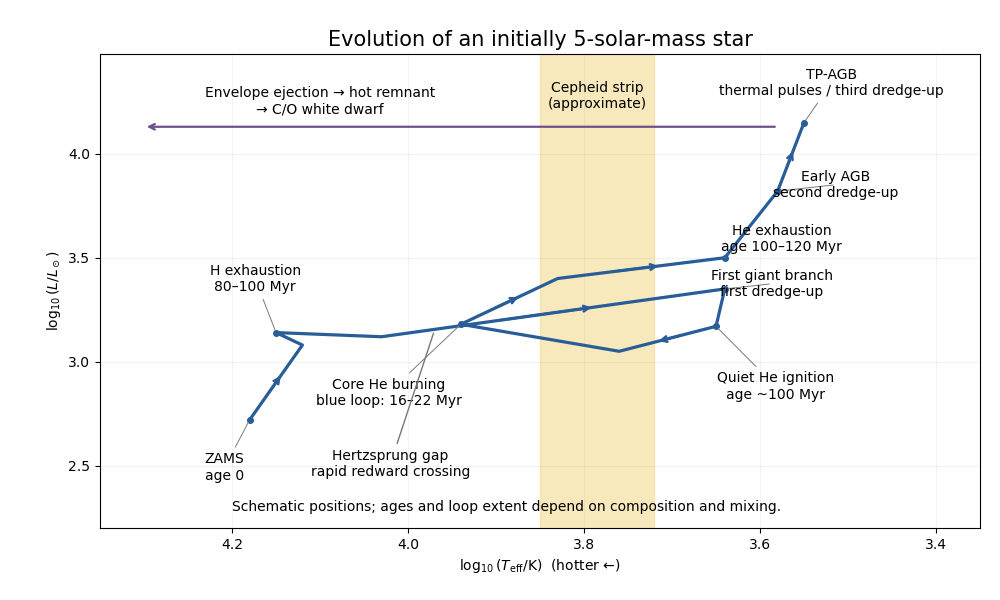


The main sequence lasts roughly – years. CNO cycle hydrogen burning is concentrated in a mixed convective core. Its declining hydrogen mass fraction and rising helium mass fraction are nearly uniform there, while the retreating core leaves a composition gradient. The unprocessed envelope remains hydrogen rich. At the terminal-age main sequence, core hydrogen is exhausted and a hydrogen-burning shell takes over.
The inert helium core grows through shell burning. The Schönberg-Chandrasekhar limit is approximatelyBeyond this limit an isothermal nondegenerate core cannot remain in thermal equilibrium with its envelope. Core contraction and envelope expansion carry the star across the Hertzsprung gap. An initial slower shell-burning interval can precede the rapid crossing; the crossing itself is governed by Kelvin-Helmholtz contraction, with a representative – years. First dredge-up then mixes hydrogen-processed material into the convective envelope, lowering its hydrogen mass fraction and increasing helium and nitrogen, while leaving a composition discontinuity where the envelope later retreats.
At an age still of order years, core helium burning begins quietly: the core is nondegenerate, so there is no helium flash. The Triple-alpha process and subsequent alpha capture build a carbon-oxygen core. Core helium burning lasts roughly – years in representative solar-composition models. Pols's stellar-evolution notes illustrate the substantial dependence of these lifetimes on convective overshooting.
During a blue loop the envelope contracts and effective temperature increases, before the star returns redward. The loop depends on core and envelope structure and the hydrogen discontinuity left by first dredge-up. A loop reaching the Cepheid instability strip produces two further crossings, blueward and redward, in addition to the earlier rapid crossing of the Hertzsprung gap. Cepheid variables pulsate through the opacity mechanism, involving helium ionization. Neither loop extent nor all three strip crossings are guaranteed for every composition or mixing prescription. The hydrogen-burning shell continues moving outward in enclosed mass while central helium is depleted. Lattanzio's five-solar-mass tutorial shows these composition changes.
After helium exhaustion, at an age roughly – years, the star ascends the Asymptotic giant branch. An inert carbon-oxygen core is surrounded by helium-rich material and a hydrogen-rich envelope. Second dredge-up mixes helium and hydrogen burning products into the envelope and reduces the hydrogen-exhausted core mass. Subsequently a helium-burning shell and hydrogen-burning shell alternate in importance. A thermal pulse of an asymptotic-giant-branch star causes intershell convection, expansion and temporary quenching of hydrogen burning; third dredge-up can carry carbon and slow neutron-capture process products outward. Between pulses hydrogen burning rebuilds the helium layer. These mechanisms are illustrated in Lattanzio's AGB tutorial.
The following original stellar composition profile sketches distinguish hydrogen exhaustion from helium exhaustion; their mass boundaries are illustrative.
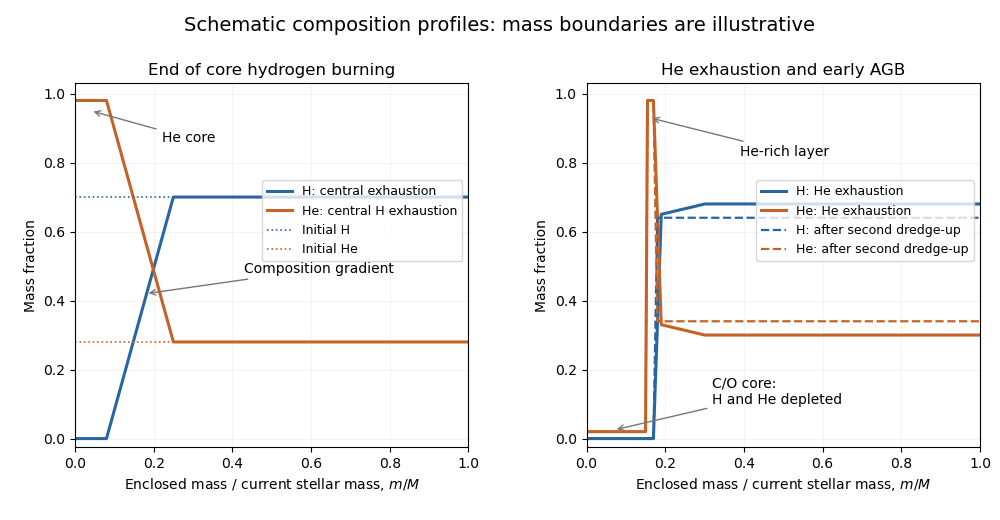
Schematic internal composition profiles during stellar evolution
. Details. 
The final giant phases add at most a few million years at this level of accuracy. Strong stellar winds remove the envelope; the hot remnant can illuminate a planetary nebula and then cool as a carbon-oxygen white dwarf. A typical remnant is of order one solar mass. The ordinary isolated case does not reach sustained carbon burning and core collapse. Thus the usual endpoint is a carbon-oxygen white dwarf, at a total age of order years, with its subsequent cooling age added separately.
A food supplies material or usable chemical energy that contributes to the organism's maintenance, growth or normal function after ingestion and physiological processing. It must be usable in the amount and form supplied, without its harmful effects defeating that nutritive role. Mere combustibility, a pleasant taste, or the presence of carbon and nitrogen is insufficient.
An edible material may need digestion before its constituents can be absorbed. A protein need not enter the blood unchanged to nourish: hydrolysis supplies absorbable amino acids. Conversely, a substance can burn in a laboratory yet furnish little accessible energy to human metabolism. The nutritional value of a mixture depends on availability, proportions and the organism consuming it. No requirement says that each separate food must contain every constituent of a complete diet.
A useful nineteenth-century division separates nitrogenous or plastic foods from non-nitrogenous or respiratory foods. The first includes animal and plant proteins, which supply amino acids for tissue renewal. The second includes carbohydrates and fats, whose oxidation supplies much of the body's energy. But the division is functional rather than absolute: proteins can also be oxidized, and lipids and carbohydrates supply material for cellular structures as well as fuel. The modern account follows anabolism and catabolism rather than assigning each class one exclusive destination.[ref]
24.1 Overview of Metabolic Reactions. Anabolic and Catabolic Reactions: synthesis, breakdown and energy transfer
A fuller classification includes proteins; carbohydrates, including sugars and starch; lipids, including fats and essential fatty components; water; and required mineral constituents. Water provides solvent, transport medium and a participant in many reactions. Mineral constituents supply, among other needs, ions for electrical and osmotic functions and material for mineralized tissues. Neither class has to supply combustible energy to be indispensable. Meat, milk, grain and legumes are mixtures spanning several classes, rather than chemically pure examples of just one.
In modern classification, vitamins and other required micronutrients must also be included. Their specific deficiency roles and present classification should not be attributed wholesale to 1864. Dietary fibre is not equivalent to digestible starch; it can have important intestinal functions, and fermentable fractions can contribute metabolites through the microbiota. The adequacy of a diet concerns the whole combination of nutrients and the person's requirements, not a single measure of heat released on burning it.[ref]
24.7 Nutrition and Diet. Macronutrients; Vitamins; Minerals: energy-yielding and non-energy-yielding nutritional requirements
Oxygen is essential to ordinary aerobic life, but in the usual dietary sense it is a respiratory input rather than an ingested food class. Likewise, a drug that changes appetite or stimulates a physiological response is not thereby a substitute for nutritive material. A convincing experiment on food value must distinguish failure to eat, failure to digest or absorb, and a genuine missing dietary constituent; maintaining equal gross food mass alone does not control those differences.
Plants generally incorporate combined nitrogen into organic compounds, whereas animals eliminate the surplus nitrogen of metabolized compounds chiefly as Ammonia, urea or uric acid. The two processes connect nitrogen chemistry to the organism's carbon supply, water economy and environment.
Roots take up nitrate and ammonium from their surroundings. Nitrate must be reduced before its nitrogen can be incorporated in the usual amino form: nitrate reductase produces nitrite, and nitrite reductase produces ammonium. The balanced reduction, written without implying a single elementary reaction, isReducing equivalents and energy must be supplied by metabolism; nitrate is not simply deposited unchanged inside every protein.
In the modern biochemical account, glutamine synthetase incorporates ammonium into glutamine, using ATP; glutamate synthase transfers that nitrogen to a carbon skeleton derived from 2-Oxoglutarate, producing glutamate. Further transfer and synthesis distribute nitrogen into other amino acids, proteins, nucleotides and other cell constituents. Carbon metabolism therefore provides both energy and skeletons for nitrogen assimilation. These named enzymes and reactions explain the process today; they were not a completed molecular scheme in 1864.[ref]
Nitrogen uptake, assimilation and remobilization in plants. Nitrogen Assimilation: nitrate reduction and the GS/GOGAT cycle
Ordinary higher-plant cells do not themselves reduce atmospheric molecular nitrogen merely because the gas surrounds the leaves. Biological nitrogen fixation is performed by particular microorganisms; symbiotic associations can supply fixed nitrogen to a host plant. The later elucidation of root-nodule symbiosis should be distinguished from what the examiner could have expected. Organic nitrogen can also be taken up in suitable circumstances, so nitrate and ammonium are important routes rather than an exhaustive prohibition on every other source.[ref]
46.3 Biogeochemical Cycles. The Nitrogen Cycle: fixation, ammonification, nitrification and return to the atmosphere
A useful assimilation experiment grows comparable seedlings in a defined medium containing all required minerals except combined nitrogen, with parallel nitrate- or ammonium-supplied cultures. Initial seed reserves, contaminating nitrogen, water and microbial growth must be allowed for. Growth and final nitrogen content are more informative than green appearance alone. A plant initially growing in a nitrogen-free solution may simply be consuming seed reserves; that observation does not demonstrate fixation of atmospheric nitrogen.
Animals obtain most of their nitrogen from organic food. Amino acid metabolism separates nitrogen handling from oxidation or reuse of the carbon skeleton. Free Ammonia is toxic at high concentrations, and mammals convert much of their waste nitrogen into urea in the liver; the kidneys then eliminate it in urine. Uric acid is also produced from purine breakdown. Renal ammonium excretion has a separate important connection with acid-base balance. Urea formation and urinary excretion are different processes in different organs.[ref]
Many aquatic animals can release Ammonia directly into abundant surrounding water. Birds, many reptiles and many insects eliminate much nitrogen as relatively insoluble uric acid, conserving water; mammals generally depend more on soluble urea. These are broad physiological strategies with exceptions, not a rule that all animals have human urine. Faecal nitrogen includes unabsorbed food as well as endogenous material, while smaller losses can occur through skin and secretions. For a stated interval the accounting identity isPositive retention during growth and negative balance during tissue loss need not be errors of excretion. Nitrogen is redistributed or lost in compounds; it is not simply breathed out as all the atmospheric nitrogen passing through the lungs.
These names refer to several unrelated chemical classes: blood and bile pigments, a photosynthetic pigment family, an amino sulfonic acid, a disputed historical faecal extract, and storage polysaccharides or proteins. Similar colour or a historical name does not establish chemical identity.
Haematocrystallin denotes the crystallizable colouring substance of red blood, now identified with hemoglobin. It combines a globin protein with iron-containing haem groups. Within intact red cells it reversibly binds oxygen; oxygenated and deoxygenated forms have different absorption spectra. Crystals obtained from blood differ with species and preparation. This is not the same thing as a crystal formed from an old tissue haemorrhage. The word does not mean that all circulating blood normally consists of free pigment crystals.[ref]
Haematoidin is the yellow-orange to reddish pigment characteristically encountered in old extravasated blood, sometimes as rhomboidal crystals or radiating clusters. It is associated with bilirubin and lacks the iron retained in haemosiderin. The historical inference that any reddish blood-derived crystal must be the same substance as haematocrystallin is therefore wrong. In a tissue preparation the local matrix and other constituents can complicate an exact chemical identification from appearance alone.[ref]
Hematoidin crystals in sputum smears: Cytopathology and clinical associations. Results; Discussion: crystal morphology, bilirubin association and absence of iron
Haematin is a dark iron-containing derivative of haem, obtained when the globin association and the iron's chemical environment are altered. In modern chemical usage, hematin is the ferric hydroxide form of the haem pigment; hemin is the corresponding chloride form. Historical preparations and terminology were less consistently separated. Neither should be equated with iron-free bilirubin, and a haem-derived crystal test is not the crystallization of intact hemoglobin.[ref]
Hematin in PubChem. Identity and chemical description: hydroxyl ferric protoporphyrin
[ref]Chlorophyll is the green pigment system of photosynthetic organisms, present in organized pigment-protein assemblies in chloroplasts in green plants. Modern chemistry distinguishes several chlorophylls: chlorophyll a, for example, has a magnesium-containing tetrapyrrolic ring system and a hydrophobic side chain. It absorbs light used in photosynthetic energy conversion. Extraction into alcohol can reveal the green pigment, but a leaf extract is a mixture rather than a chemically pure universal chlorophyll. Its green colour must not be attributed to iron in the same way as haem.[ref]
Biliverdin is a green, open-chain tetrapyrrolic pigment. In modern haem catabolism, ring cleavage by haem oxygenase releases iron and forms biliverdin; reduction then produces bilirubin. The pigments contribute to changing colours of some resolving haemorrhages and to bile-pigment chemistry. This sequence concerns degradation of the haem group, not conversion of the entire globin protein directly into one green molecule.[ref]
Taurin, now taurine, is a colourless crystalline amino sulfonic acid with the structure . It contains sulfur and nitrogen and can form conjugates with bile acids, including taurocholic acid. It is not itself a green bile pigment, an ordinary carboxylic amino acid, or a standard amino acid directly inserted into proteins by translation. The chemical classification and formula distinguish it from neighbouring names in the list.[ref]
Excretin was the name William Marcet gave to a crystalline material extracted from human faeces. His contemporary account describes treatment with hot alcohol, removal of material with lime, extraction with ether, and formation of silky needle-like crystals; the material was insoluble in water, soluble in ether and hot alcohol, and melted in the low-to-mid 90s Celsius. His 1859 account reports carbon, hydrogen, oxygen and sulfur and gives an equivalent-weight formula based on an assumed sulfur content. These are historical analytical claims, not a modern authenticated molecular specification. Later work questioned the purity and chemical individuality of excretin, so that old name alone does not establish a definite modern structure.[ref]
Excretin in A Text-book of Physiological Chemistry (1914). p. 523: later doubts about identity and possible impure sterol material
[ref]Glycogen is an animal glucose-storage polysaccharide, particularly important in the liver and skeletal muscles. Its highly branched chains contain alpha-(1→4) links with alpha-(1→6) branch points. Preparations form opalescent dispersions and commonly show a reddish-brown iodine reaction rather than the intense blue associated with long amylose chains. Hydrolysis yields glucose. Liver glycogen can support the regulation of circulating glucose, whereas muscle glycogen mainly supports local muscle metabolism; a modern account must distinguish those physiological destinations.[ref]
Biochemistry, Glycogen (StatPearls). Introduction; Cellular Level: glucose storage, branching and distinct liver/muscle roles
Gluten is the cohesive protein-rich material left when wheat dough is washed to remove much of its starch. It is not a single small molecule: modern analysis distinguishes gliadin and glutenin families whose associations contribute extensibility and elasticity. It is poorly soluble in water as a dough network, contains nitrogen, and on full hydrolysis supplies amino acids. Its nutritive role is that of a plant protein mixture, not a nitrogen-free carbohydrate.[ref]
Changes in the rheology and aggregation behavior of wheat glutenin and gliadin mediated by low-sodium salt. Introduction; experimental comparison of the rheology of the two protein fractions
Legumin is a seed storage globulin associated particularly with peas and related legumes. A classical preparation extracts protein into suitable dilute salt solution and precipitates it under changed conditions. Modern legumins are 11S globulin assemblies, often hexamers formed from processed subunits. They are nitrogen-containing proteins, chemically distinct from starch despite occurring beside it in a seed. The older name vegetable casein indicates an analogy of precipitation or nutritive role; it does not establish identity with milk casein.[ref]
Pea Legumin Overexpressed in Wheat Endosperm Assembles into an Ordered Paracrystalline Matrix. Abstract; results on precursor processing and 11S hexamer assembly
An organic substance may also contain nitrogen, sulfur, phosphorus, halogens and, in some cases, metals or other elements. “Organic” does not mean “made of only carbon, hydrogen and oxygen”. Detection generally requires converting a covalently bound element into a species that an appropriate inorganic test can recognize.
A historically available general method is the sodium fusion test. Fusion converts suitable nitrogen-containing material into cyanide, sulfur into sulfide, and chlorine-, bromine- or iodine-containing material into the corresponding soluble halides. The cooled reaction material is worked up to an aqueous extract, with separate portions reserved for separate tests. The transformations are analytical conversion principles, not claims that every nitrogen or sulfur compound must give quantitative recovery under any fusion conditions. Blanks and a known positive material are essential when a negative result is to be interpreted.[ref]
For nitrogen, a suitable cyanide-containing extract is treated with a fresh iron(II) reagent and then brought through the appropriate oxidation and acidification sequence to obtain Prussian blue. Formation of ferrocyanide is represented byThe eventual ferric ferrocyanide material provides the blue observation. It is not sufficient simply to add any iron salt and assume that a positive blue must appear. Another classical principle converts nitrogen in suitable organic materials into Ammonia by heating with alkaline reagents, then recognizes the ammonia in a receiver. That test has substrate-dependent limitations and is not a universal replacement for complete nitrogen analysis. A later specialized nitrogen-digestion protocol must not be silently attributed to 1865.
For sulfur, a sulfide-containing alkaline extract can give black lead sulfide with a suitably introduced lead reagent:The strongly acidic form of the reagent conditions changes the available sulfide, so conditions must be controlled. Oxidizing the material to sulfate and identifying a persistent barium sulfate precipitate supplies another principle, using sulfur-free reagents and excluding pre-existing sulfate contamination. If nitrogen and sulfur occur together, thiocyanate formation can alter a fusion test; failure of the expected cyanide reaction is not conclusive evidence that nitrogen is absent.
For chlorine, bromine and iodine, remove interfering cyanide and sulfide by an appropriate controlled treatment of a separate extract portion, then use silver nitrate under suitable nitric-acid conditions. The precipitates are ordinarily white silver chloride, cream silver bromide and yellow silver iodide. Their differing behaviour with aqueous Ammonia provides corroboration: chloride dissolves relatively readily, bromide requires stronger conditions, and iodide is resistant. Do not use hydrochloric acid to prepare the portion in which original chloride is being sought. Fluorine requires a different recognition method: soluble silver fluoride means this precipitation scheme does not provide an equivalent fluoride test.
For phosphorus, oxidize a suitable portion to phosphate, then apply a phosphate test such as yellow ammonium phosphomolybdate formation under the proper acidic conditions. Arsenic species and other interferences must be excluded when relevant. Mineral ash can reveal metal constituents through their specific precipitation or flame reactions, but oxidation during ashing can change their original chemical form. Absence of a visible ash does not prove absence of every metallic or otherwise volatile element.
A positive result identifies an element or an operationally generated ion; it does not establish which functional group contained it in the original molecule. Conversely, an incomplete conversion can give a false negative. This is why the three-element premise used in the preceding combustion calculation should be checked rather than accepted merely because a substance is described as organic.
Ordinary air contains water vapour, carbon dioxide, variable trace gases and suspended particles in addition to nitrogen and oxygen. Which traces are detected depends on location, sampling volume and test sensitivity. A negative small-sample test is not proof of complete absence.
Water vapour is shown by condensation on a sufficiently cold surface or by the colour change of a suitable dry indicator: white anhydrous copper(II) sulfate becomes blue on hydration. Passing a known air stream through a drying tube and observing a controlled mass increase gives a more quantitative principle, provided other absorbable vapours are excluded.
Carbon dioxide gives a calcium carbonate turbidity when a suitable air sample is passed into clear limewater:Large excess of carbon dioxide can redissolve the deposit as dissolved bicarbonate species, so excessive exposure can obscure the initial result. Absorption into an alkaline solution, followed by an appropriate carbonate test, concentrates the trace component.
Ammonia and ammonium-bearing particles may be collected by an acid wash and examined after suitable neutralization or liberation of the Ammonia. Nessler's reagent supplies a sensitive colour test, with a blank to exclude contaminated reagents. Simple moist litmus is much less sensitive. Acidic gases and nitrogen oxides may instead be collected in appropriate wash solutions and examined with tests for the resulting anions; their identity cannot be inferred from acidity alone.
Near relevant sources, hydrogen sulfide can blacken moist lead acetate paper by forming lead sulfide. Ozone-sensitive starch–iodide paper can indicate an oxidizing trace constituent through liberation of iodine, but other oxidants can give the same response: the historical observation is not a specific proof of ozone. Dust and droplets can be collected on a filter or surface and examined by microscopy, with chemical tests applied to separated material as needed.
Modern analysis also recognizes argon and other noble gases, as well as many low-concentration pollutants, using instrumental separation and spectroscopy. Their modern recognition should not be silently included among discoveries available to an 1865 candidate. The useful answer pairs each proposed constituent with a collection method, a specific reaction or observation, and the limits of that test.
The main differences concern cellular construction and the usual modes of obtaining food, movement and development; the main interdependence concerns transfers of matter and energy through ecosystems. The nineteenth-century animal–vegetable division is useful as a comparison of familiar forms, but it is not a complete modern classification of life.
A typical plant cell has a cell wall, a large central vacuole and, in photosynthetic tissue, chloroplasts. An animal cell lacks a cellulose wall and chloroplasts and has a different extracellular and tissue organization. Both possess a cell membrane, cytoplasm, a cell nucleus and, in their usual aerobic cells, mitochondria. Roots and other non-green parts of a plant need not contain functional chloroplasts; an erythrocyte's loss of its cell nucleus is likewise not a definition of all animal cells.[ref]
Most green plants acquire carbon through photosynthesis, taking carbon dioxide from their surroundings and mineral nutrients and water chiefly through roots. Familiar animals obtain preformed organic material by feeding and digesting it or absorbing material derived from a host. Animals generally have conspicuous coordinated movement, and many have nervous systems and muscles; higher plants regulate growth and movement without such organs. These are useful generalizations with exceptions. Some plants depend on other organisms for carbon; some animals are permanently attached; and neither lack of locomotion nor a green appearance alone settles every microscopic classification. Fungi and bacteria should not be forced into one of these two kingdoms in a modern account.
One major interdependence is nutritional. Photosynthesis converts light input into chemical energy stored in organic material. Plant material feeds herbivores and, through them, carnivores; it also enters detrital food webs. An animal that eats an animal can therefore remain indirectly dependent on primary production by plants, algae or other photosynthetic organisms. Chemical elements pass between organisms, but energy is progressively dissipated as heat; it is not recycled in the same closed manner as an element.[ref]
8.1 Overview of Photosynthesis. Overview and food-chain examples: light capture, organic products and heterotrophic dependence
A second relation is gas exchange. In its simplest overall form, oxygenic photosynthesis may be represented byAerobic utilization of the resulting glucose has the complementary overall balanceThese balanced equations show complementary material transfers without making the underlying pathways literal reversals of one another. Plants also perform cellular respiration, by day as well as by night. They can therefore release carbon dioxide while consuming oxygen; a sufficiently illuminated leaf may simultaneously show net uptake of carbon dioxide because photosynthesis exceeds respiration. Stating that plants only purify air and animals only spoil it would erase this essential distinction between gross processes and net exchange.
Other relations close material cycles. Animals return organic matter through excretion and death; microbial decomposition and mineral transformations return nutrients in forms available for plant uptake. Most atmospheric nitrogen is not directly available to ordinary plants merely because animals have breathed or excreted near them: nitrogen fixation, ammonification and often nitrification involve particular microorganisms. Plants and animals also interact through pollination, seed dispersal, grazing, parasitism and shelter. Such relations may benefit both partners, one partner at the other's expense, or different partners under different conditions; interdependence is not universal mutual benevolence.
A closed illuminated aquarium containing plants and animals gives an instructive experiment, provided gas exchange with air, illumination, nutrient supply and organismal amounts are specified. Dissolved oxygen and carbon dioxide should be followed over light and dark periods. Survival alone is an ambiguous readout: microorganisms, stored food and air exchange may support it temporarily. A more controlled comparison includes illuminated and dark plant vessels and animal-only vessels. The expected alternation of net gas exchange makes the physiological distinction visible while exposing why no simple rule guarantees indefinite balance in any arbitrarily stocked closed jar.
Chemical elements are the constituents from which ordinary chemical compounds are built; many familiar materials are mixtures of those chemical compounds and sometimes free chemical elements. In the historical operational definition, a chemical element could not be resolved into simpler substances by chemical means. In the modern definition, its chemical atoms all have the same atomic number. Ordinary chemical reactions rearrange those chemical atoms rather than creating a new chemical element.
Air is a mixture, chiefly of nitrogen and oxygen, whose components can be separated or selectively consumed. For example, burning phosphorus in a suitable enclosed sample removes most of the oxygen and leaves chiefly nitrogen; the residual gas has different properties from the original air. Air also contains carbon dioxide, variable water vapour and smaller amounts of other gases. Its variable composition is incompatible with treating it as one elementary substance.
Water is a chemical compound: electrolysis produces molecular hydrogen and molecular oxygen, approximately in the volume ratio at the same temperature and pressure. Their recombination produces water again:Thus water has fixed composition but is chemically decomposable, whereas air has no fixed single chemical formula. Neither belongs with the chemical elements merely because it is common and widespread on the Earth's surface.
Ammonia is the volatile nitrogen–hydrogen chemical compound , obtained historically from ammoniacal salts and from the decomposition of nitrogen-containing organic matter. Sources include the decay of animal and vegetable material, the conversion of urea in stale urine, and the destructive distillation of coal, bones or horn. In gasworks, much of the Ammonia was captured in the aqueous ammoniacal liquor during cooling and washing of crude coal gas. These sources do not mean that nitrogen-free constituents of coal spontaneously produce nitrogen.
An ammonium salt releases Ammonia when heated with a suitable chemical base. For ammonium chloride and slaked lime,The ionic principle is . A generating vessel supplies a drying stage and then an inverted dry collecting vessel in which the lighter Ammonia displaces air. It is unsuitable for ordinary collection over water because it dissolves so readily. Quicklime can serve as a drying agent; a strongly acidic drying material would instead consume the Ammonia.
Ammonia is a colourless gas with a penetrating, irritating odour. Its approximate relative density against air is . It is readily liquefied under suitable cooling or pressure, and its dissolution in water releases heat. It is toxic and corrosive at sufficient exposure; direct smelling is not an analytical requirement.[ref]
The aqueous chemical equilibriumexplains the alkaline reaction and the change of moist red litmus to blue. The historical name “ammonium hydroxide” for the solution should not imply that every dissolved molecule has become a discrete molecule of . With hydrochloric acid, Ammonia forms ammonium chloride:The familiar white cloud where the gases meet consists of fine solid salt particles, rather than liquid water alone. In solution, Ammonia also acts as a ligand; an excess can produce a deep-blue copper–ammine coordination complex from suitable copper(II) solutions. Although Ammonia does not readily sustain an ordinary flame in air, it is not intrinsically incapable of combustion; sufficiently favourable mixtures burn.