Write . Since is a unit vector, the equation becomes . Thus ranges over the two-dimensional orthogonal complement of : the locus is an affine hyperplane through , with unit normal . Conversely, every such vector satisfies the equation. Its perpendicular distance from the origin is ; is the signed distance in the chosen normal direction.
The normal vector must be parallel to , and the plane must contain . Therefore one choice isThe nonzero scalar triple product ensures . Replacing both and by their negatives describes the same affine hyperplane.
Two directions in the plane are and . Their cross product is a normal vector. Moreover,so cannot vanish. The required unit normal and offset areTaking dot products with gives the same offset for all three points.
This plane contains the direction and is parallel to . Put . Its scalar triple product with is again , proving . HenceThe dot product with vanishes, while the dot products with and equal after normalization. These verify both incidence and parallelism.
The periodically extended is even, so every sine coefficient is zero. With the convention , the Fourier coefficients areFor the second integral, two applications of integration by parts give . ConsequentlyThe periodic extension is continuous even at the joined endpoints, where both one-sided values equal . The pointwise convergence of a piecewise smooth Fourier series therefore gives the displayed values throughout the interval; the coefficient bound also gives uniform convergence by the Weierstrass M-test. Setting and then yields
At an interior local extremum of a differentiable function, . The second-derivative test classifies a stationary point: a positive second derivative gives a strict local minimum, and a negative second derivative gives a strict local maximum. A zero second derivative is inconclusive: , , and at zero illustrate a minimum, a maximum, and neither.
For , the real domain has . Its partial derivatives are and . At they equal and , respectively. Thus implicit differentiation gives , and the tangent line is
For two independent smooth constraints , the tangent direction is orthogonal to both gradients. At a constrained stationary point, the gradient of the objective is also orthogonal to that direction, hence lies in their span: . This is the two-constraint Lagrange multiplier condition. Alternatively, distance extrema on a central plane section of an ellipsoid follow from a two-dimensional eigenvalue problem.
Minimizing distance is equivalent to minimizing . Put and . The Lagrange multiplier equations areAdding the latter two gives . If , those equations give ; the constraints then give and . Otherwise and . The ellipsoidal constraint gives , and henceThe intersection is compact. The two constraint gradients are independent there: if , then , and forces , contradicting . Thus every global extremum is among these candidates. Taking square roots gives
Let . Positivity allows the squared integral to be written as a first-quadrant double integral. In polar coordinates the Jacobian determinant is , soUsing integration by parts, with the boundary term vanishing at both endpoints,The substitution also gives the two antiderivativesThese values also follow from the Gaussian moment recurrence and can be checked by differentiation.
The upper boundary follows until its intersection with at , then follows the hyperbola to . The lower boundary is . Therefore the two vertical-slice descriptions are , , and , .
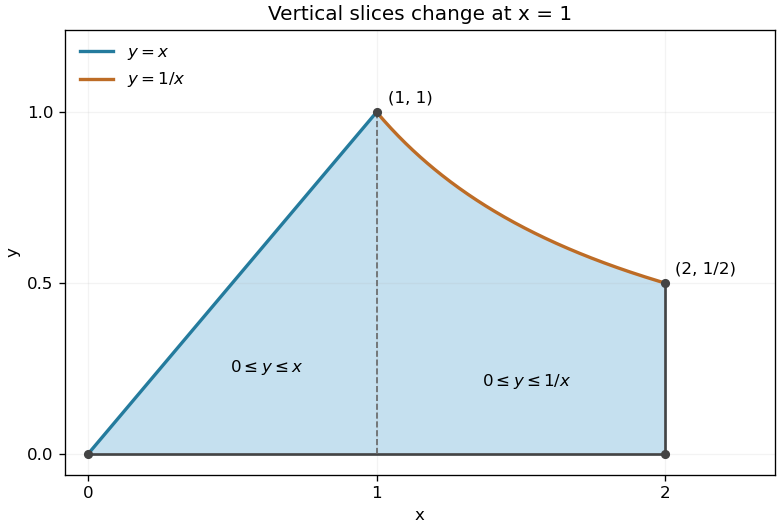

Integrating with respect to first reduces the double integral toUsing the antiderivatives from part (a),
Direct matrix multiplication givesConsequently , the Cayley-Hamilton theorem for its characteristic polynomial . Rearranging gives , so
For and , the outer products areTheir inner product is zero and both squared norms are two. Thus and are orthogonal spectral projectors, with . Since and , the eigenvalues are , , andMultiplying these decompositions uses and , , giving the identity matrix.
On an interval avoiding , separation of variables gives, for ,Absorb the sign into the integration constant and include the equilibrium solution by allowing . The complete real family isEach solution is considered on a connected interval in , where the original equation is defined.
Divide by on an interval where it is nonzero. For the resulting first-order linear differential equation, use the integrating factor , since . The right-hand side after division is also , soThe identity shows never vanishes on the interval, givingAn integrating factor may have either fixed sign; if obtained by integrating , the real logarithm is .
The Bernoulli differential equation becomes linear after : multiplying by gives . A quadratic particular solution is , while the homogeneous solution is . The initial condition gives and . HenceThe denominator is positive for all real , since . Thus this initial value problem has the displayed solution on the entire real line. The separate solution does not satisfy its initial condition.
Let . The orthogonality condition gives : this is the nilpotent part of a transvection when both vectors are nonzero. In two dimensions,Expanding its determinant, the fourth-degree terms cancel:These formulas also cover either vector being zero.
Since , nilpotence already gives . Explicitly, in index notation,Thus , or equivalently . Here is the Kronecker delta.
For the specified coordinate vectors,Choose the orthogonal matrix representing a quarter-turn,Then and direct matrix multiplication gives . Thus these two shear mappings are orthogonally similar.
In Cartesian components, , soIt cannot be a conservative vector field. For the second field, put . Its gradient is . This smooth global scalar function proves is conservative, with . The following path integrals exhibit the different behavior directly.
Parametrize the segment by , . Its tangent is and , so . Hence its line integral isFor the other line integral, and . ThusThis also equals the change in , by the fundamental theorem for line integrals.
On each of the two radial legs, is perpendicular to the tangent. Each contribution is zero, giving . This differs from the straight-path answer, confirming path dependence.
For , use with decreasing from one to zero, followed by with increasing from zero to one. The two contributions areThey cancel: . This agreement is a consequence of the conservative vector field property already proved, rather than evidence sufficient by itself to establish it.
Put and . For , partial differentiation givesThe heat equation therefore requires , giving on an interval not containing . A decaying spatial Gaussian function uses , so there.
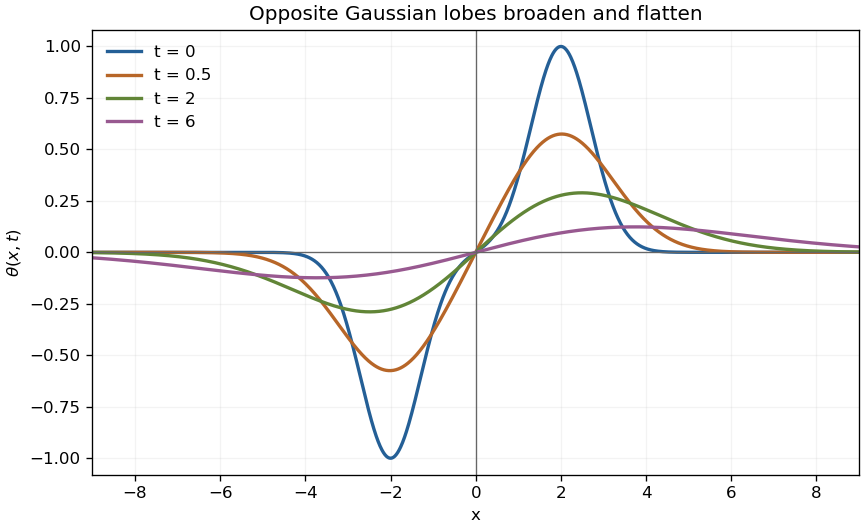
The initial profile is a difference of two translated Gaussian functions. Set , and , with respective constants and . The superposition principle givesThis is an odd pair of Gaussian profiles under diffusion, obtained from Gaussian initial data for the heat equation. It is odd in , vanishes at zero, is positive for and negative for . The two lobes broaden and decrease in height, and at every fixed as . Their extrema move; they do not remain exactly at .

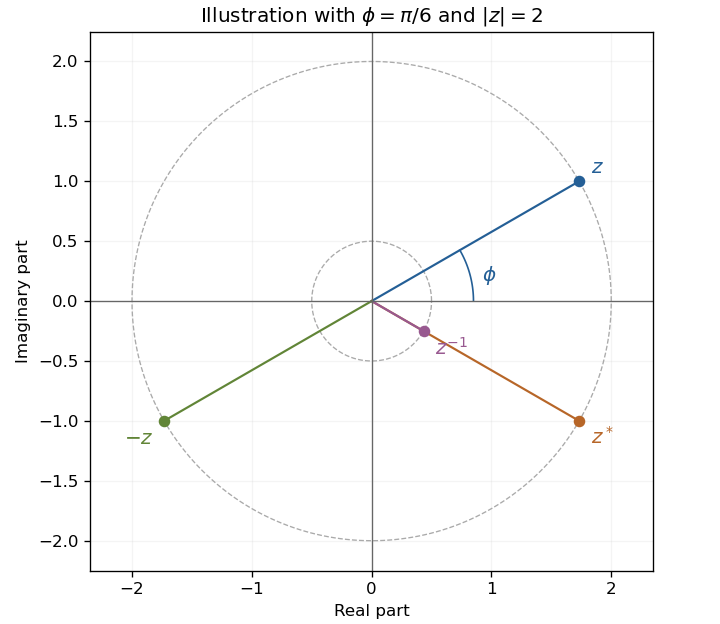
Complex conjugation reverses the argument, reciprocation also inverts the modulus, and multiplication by adds to the argument. With all arguments chosen in and ,Thus is in the first quadrant, and lie on the same fourth-quadrant ray at radii two and one-half, and is diametrically opposite .

Euler's formula and its version with giveSquaring and comparing real and imaginary parts with yields the double-angle formulas
Factor from the numerator and denominator:For , the tangent ranges over all positive real values. Thus . Using the principal complex logarithm,The real part ranges over the entire real line, while the imaginary part is fixed: the locus is the horizontal line . Any other fixed logarithm branch gives the parallel line for one integer ; allowing every branch gives the union of those lines.
For , the two ordinary differential equations have solutionsTheir products and solve Laplace's equation, since the two second derivatives contribute opposite terms. For , both factors are linear functions. This is separation of variables with positive, negative and zero separation constants.
The zero value at removes the even factor in , and the zero value at removes the even factor in . Up to multiplicative constants, the nonzero separated modes areThe zero-separation case also supplies . Each is a harmonic function and vanishes on both axes.
For the first family, vanishing at requires , so is a positive integer. The second family would require , impossible for real ; the mode also fails unless its coefficient is zero. Conveniently normalized surviving modes areAt , these become the Fourier sine series basis functions .
Expand the constant right-edge value in a Fourier sine series. Its coefficients areThe superposition principle combines the normalized modes, givingThis is a harmonic function in a rectangle with one constant boundary value, with the coordinate roles interchanged. The series and its derivatives converge uniformly on compact subsets of , so it satisfies Laplace's equation there. It vanishes on the other three edges and approaches one at every interior point of the right edge. At the two right corners the one-sided prescribed values disagree; no continuous extension can satisfy both. The stated open-edge condition avoids that incompatibility, and isolated corner assignments do not change the bounded interior Dirichlet problem.
Three vectors in three-dimensional Euclidean space are non-coplanar precisely when their scalar triple product is nonzero. Put . In particular, . The identity for cross products with a common vector givesFor completeness, this follows from the vector triple product identity: writing gives , with and . Therefore the new scalar triple product isThus are non-coplanar, or equivalently linearly independent.
Take the dot product of the equation with . Since , we obtain . Next take its cross product with and apply the vector triple product identity:Substitute and the known dot product, then rearrange:Here the vectors and are real, so the denominator is positive. The formula also covers , giving . To check existence as well as uniqueness, write its numerator as . The vector triple product identity gives , so . Substitution verifies the original equation. This is an instance of the inverse of a scalar plus a cross-product operator.
Let be the given integral. Its integrand extends continuously to , with value . The Leibniz integral rule includes both the moving upper endpoint and the derivative of the integrand. For it givesConsequentlyThe zero case follows directly from near zero: expand and integrate up to . Equivalently, the change of variables gives , whose derivative is the same expression, interpreted continuously at zero. This substitution works for negative as an oriented integral too.
Use the complex exponential representation of cosine. For real and , exponential decay makes the improper integral absolutely convergent, andFor the second integral, use differentiation under the integral sign with respect to . The minus sign is essential: . HenceTo justify this step near any fixed , restrict . The absolute value of the differentiated integrand is at most , an integrable bound, so dominated convergence permits the differentiation. At the answers reduce to and , respectively.
Use spherical polar coordinates with measured from the positive axis and around that axis:The standard full-space ranges are , , . The factor is the absolute Jacobian determinant and gives the volume element.
The mass density becomes . Integrate it over the sphere using the spherical polar coordinates and volume element above:The angular integral is , since . ThereforeThe term proportional to contributes zero by reflection across the equatorial plane. Thus the answer is also the volume times the average mass density . The undefined direction at the origin affects a single point and has no effect on this volume integral.
In the first octant, spherical polar coordinates have and . The charge density is . Hence the total electric charge isThe three factors are , , and , respectively. For the middle integral, set to obtain . Thus
The number of successes has a binomial distribution. Each arrangement of successes and failures has probability by independence, and the binomial coefficient counts the arrangements. ThereforeThe final equality is the binomial theorem. Writing as a sum of independent Bernoulli random variables gives its expectation and variance: , . Thus the matching normal distribution hasThe normal approximation is appropriate when both expected counts and are sufficiently large; large alone is insufficient if is extremely close to zero or one.
For the guessing student, , , . Therefore the expected number of correct answers is , and , . The inclusive integer range becomes after the continuity correction. Standardizing the normal distribution givesHere , and the last step uses the supplied bound. The approximate probability is . The normal approximation provides the requested conclusion; as a separate check, summing the five exact binomial probabilities gives approximately , also exceeding one half.
The required matrix form of the linear system isSubtract the first row from the third and expand the determinant along the resulting row:Thus the linear system has a unique solution, for every real , precisely when .
For , the second equation gives . Subtracting the first equation from the third gives , and the first equation then determines :For , the first and third left-hand sides are identical but their right-hand sides are and . HenceFor , subtracting the first equation from the third gives . The first equation now gives , while the second requires . ConsequentlyThe free variable in a linear system in the consistent singular case describes a line of solutions. These direct reductions distinguish an inconsistent linear system from one with infinitely many solutions, which a zero determinant alone cannot do.
Compute the curl component by component from the given vector field:For example, and . Its divergence isas expected because the divergence of a curl is zero.
Take counterclockwise when viewed from positive , the disc upward oriented, and the hemisphere outward oriented. These choices give both surfaces the same positive boundary orientation. Parametrize by , . On it, and , so the line integral isOn , use polar coordinates and . Since there, the surface flux isOn the unit hemisphere, the outward unit normal vector is . Since , we have . In spherical polar coordinates, and , giving the explicit surface integralIndeed the inner integral is .
These equalities illustrate Stokes theorem twice: and either upward or outward spans the oriented circle , so each surface flux equals the same line integral. For the divergence theorem, close the upper half-ball by adjoining the downward oriented base, namely . Its outward surface flux isThe minus sign on the base is required because its outward normal vector points down. Reversing a specified orientation reverses that integral's sign.
The characteristic equation of the associated homogeneous linear ordinary differential equation is , so the complementary function is . For a particular solution, try . Substitution gives , so , . The unrestricted solution is thereforeIts derivative at zero is . The single prescribed condition imposes and leaves one arbitrary constant. Thus the most general permitted solution isThere is no condition fixing , so the remaining arbitrary constant is essential.
Write with . By the chain rule,The terms involving cancel in the original ordinary differential equation, leavingOn each interval where , the transformed linear ordinary differential equation is . Its characteristic equation has roots , yieldingDirect substitution shows these expressions also extend smoothly through and satisfy the original equation there. The two constants describe the general solution on any interval where the coordinate substitution is invertible.
Articles were limited to the first 100 out of 134 total.
Articles by others on the same topic
There are currently no matching articles.