Treat the film at fixed material content, with area the coordinate conjugate to the surface tension in the stated work term. The Helmholtz free energy is a Legendre transform of the internal energy:Its natural independent variables are therefore , soEquality of mixed second partial derivatives gives the Maxwell relation for the thermodynamics of a liquid film:The area convention matters: the supplied fundamental relation already specifies the coefficient of . There is no additional factor of two unless one changes from total interfacial area to a projected film area and changes the work term consistently.
Write . The Maxwell relation givesThus isothermal stretching increases the entropy. For an infinitesimal increase, ; if the derivative is independent of area, this integrates to at fixed temperature. Mechanical energy used to create extra surface is not, in general, identical to the increase of internal energy at fixed temperature, because the stretching can also absorb heat.
The definition of heat capacity at constant area and the Maxwell relation give the entropy differentialFor a reversible adiabatic process, . Hencefor positive heat capacity . Reversible adiabatic stretching cools the film. Reversibility, or negligible entropy production, is essential to this inference. Adiabatic isolation alone only sets the heat transfer to zero; an irreversible stretch can generate entropy, so its temperature change is not fixed by this isentropic derivative.
Substitute the entropy differential into the fundamental relation:ThereforeThe coefficient of is the change of internal energy per added area at fixed temperature, whereas is the change of Helmholtz free energy per added area. Their difference is the heat absorbed per added area in a reversible isothermal stretch. Both and have units .
Reading the original PDF graph gives approximatelyFor example, the points near and are about and , respectively, giving this slope. The graph supports approximate values rather than exact fitted constants. The area increment is .
At fixed temperature, the surface tension is constant during this stretch. The work done on the film is positive:For a reversible isothermal process, the heat supplied is . ThusThe film absorbs heat while its temperature stays constant. The first law gives the useful consistency check , agreeing with .
Over the plotted range, approximate the surface tension by with constant positive , and take . A reversible adiabat hasIntegrating givesThe arbitrary fixed reference temperature makes the logarithm dimensionless; changing it only shifts the integration constant. This is the dimensionally precise version of writing as constant. Each term has units of entropy. Between two states,If the graph had substantial curvature, the entropy differential would still hold, but this particular constant- exponential would no longer follow.
For the specified increment,Using the adiabat, or its first-order Taylor expansion,This is a very small cooling, about . There is no heat exchange, and the film is stretched against positive surface tension, so the internal energy increases, withThe cooling does not contradict this increase. In the linear model, , soCreation of surface raises the internal energy more than the cooling lowers its temperature-dependent part. The change in surface tension during this tiny temperature fall changes the work only at a negligible higher order.
Equilibrium radiation and cavity frequencies. A blackbody absorbs all incident radiation at every frequency and direction. In thermal equilibrium its emission spectrum depends only on its temperature. Radiation inside an isothermal absorbing cavity, sampled through a small aperture that hardly disturbs equilibrium, realizes black-body radiation to a good approximation. Microscopic absorption and emission establish the equilibrium distribution; a perfectly reflecting wall is the convenient idealization used to count the modes once that distribution is specified.
In a rectangular electromagnetic cavity, the wave equation and perfect conductor wall boundary conditions select component wavenumbers , , . Combining the vacuum dispersion relation and givesFor example, electric-field components can have the spatial dependenceFor three positive indices, Gauss's law requires , leaving two independent polarizations of an electromagnetic wave.
Index qualification. The original paper describes the indices as positive integers. That describes the three-nonzero-index family but omits valid electromagnetic modes with exactly one zero index, which have one polarization of an electromagnetic wave. For instance, with , , only above remains; it is normal to the top and bottom faces and vanishes at the side walls. Two zero indices give no nontrivial cavity field. The omitted one-zero-index family does not affect the leading three-dimensional mode count, but is essential to the thin-cavity limit below. Retaining the paper's strict positivity restriction for every mode would instead give a thickness gap and would not yield its requested two-dimensional power law.
Three-dimensional mode count. A lattice cell in positive space has volume , where . In a continuum approximation, a shell of radius and thickness contains its positive octant, multiplied by two polarizations:Using givesFor a finite cavity the exact density of states is discrete; this formula is its bulk continuum limit, appropriate when many modes contribute and wall corrections are small.
Mean photon number. A mode is a quantum harmonic oscillator with thermal excitation energies , . The zero-point energy does not enter its thermal occupation. Put . Its partition function and mean occupation areThis is the Bose-Einstein distribution with zero photon chemical potential: equilibrium absorption and emission do not conserve photon number.
Thermal energy. Multiply the density of states by the mean excitation energy and integrate:The substitution isolates all the dependence on cavity dimensions and temperature:Expanding gives an integral . HenceThis is the thermal energy only, excluding the zero-point contribution. The three-dimensional continuum regime requires large compared with the geometric level spacings in all three directions.
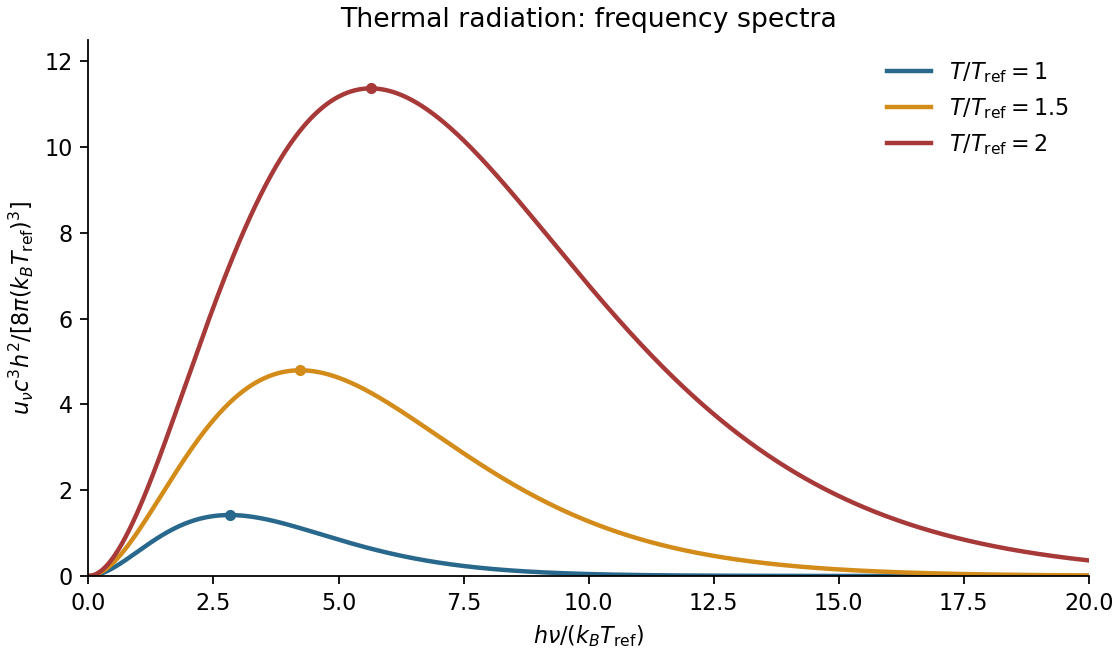
Spectral sketch. The spectral energy density per unit ordinary frequency is Planck's law,At small frequency it rises as , while at large frequency it decays exponentially. Raising temperature increases the spectrum at every fixed positive frequency, moves the peak to larger frequency in proportion to , and increases the integrated area in proportion to . A plot per unit wavelength has a different peak position because the integration variable changes.

Thin-cavity radiation. Let . The relevant low-temperature window isNonzero thickness indices are then thermally suppressed, while many in-plane modes are populated. The family has one polarization of an electromagnetic wave. Its allowed in-plane wavenumbers form a lattice of cell area ; a quarter of a circular shell therefore containsThus the dimensional crossover of thermal cavity radiation givesThe integral is by the same geometric-series argument. A model with a different number of independent polarizations of an electromagnetic wave changes the prefactor but not the scaling. For a cavity with fixed finite , cooling still further eventually freezes its lowest in-plane mode as well: the strict thermal energy is exponentially suppressed. The requested area law is the intermediate quasi-two-dimensional regime, not an arbitrarily low-temperature continuum limit.
Origin of diffusion. In a material near local thermal equilibrium, microscopic carriers transfer energy from hotter regions to colder regions. On distances long compared with their mean free path and times long compared with relaxation times, the local constitutive law is Fourier's law,Combining this temperature-gradient-driven flux with local conservation of energy produces a diffusion equation. This description assumes diffusive thermal conduction; it is not generally valid for ballistic transport, and flow would add advective transport.
Energy balance with heating. Choose any fixed volume , let be its uniform volumetric heat capacity and its heat generation rate per unit volume. The rate of increase of internal energy equals heat generation minus outward heat flux:Since is arbitrary, for constant thermal conductivityThe ratio is the thermal diffusivity in . Here is in , in and in , so both right-hand terms have units . If thermal conductivity varies with position or temperature, the divergence must be retained rather than replacing it by .
Distinguish electrical current density from heat flux . Uniform current across the circular section givesby Ohm's law. The local Joule heating rate is electrical work per unit volume and time:For a segment of length , integration gives , confirming the usual resistor power. The model takes electrical conductivity constant and ignores temperature-induced current redistribution.
In a long wire away from its ends, the steady temperature is independent of axial position and azimuth. The heat equation reduces toMultiplying by and integrating givesA finite temperature and nonsingular flux at the axis require . Applying determines . ThereforeThis is the steady temperature of a uniformly heated cylindrical wire. Its hottest point is at the centre, with . The outward heat flux is , so the power crossing a cylindrical surface per unit length, , equals the heating generated inside it.
Replacing the fixed surface temperature by Newton's law of cooling changes the boundary condition but not the radial derivative in steady state. At the surface,HenceHere is a surface heat transfer coefficient in , unrelated to the surface tension symbol used in C10. An independent energy-balance check uses a length : the electrical input must equal the surface loss , which gives the same answer.
The complete temperature profile isThermal conductivity controls the internal gradient, but cancels from the surface-temperature rise because all generated power must eventually cross the prescribed surface. This assumes positive constant , uniform electrical conductivity and negligible end or additional radiative losses; temperature-dependent material properties could make the heating and boundary problem nonlinear.
Entropy at absolute zero. The Third law of thermodynamics concerns the low-temperature limit of equilibrium states. In the zero-entropy formulation, the entropy of a perfect crystal with a nondegenerate ground state tends to zero as . The statistical interpretation is : a unique accessible ground state has . The entropy-difference formulation of the Third law of thermodynamics states that entropy differences associated with regular changes of mechanical parameters tend to zero as absolute zero is approached. These statements require equilibrium and appropriate ground-state assumptions; a frozen disordered material or a degenerate ground state can carry residual entropy.
For a phase of fixed composition and pressure,A finite limiting entropy constrains this integral. Ordinary equilibrium heat capacities therefore vanish as temperature approaches zero, with familiar examples for three-dimensional acoustic phonons and for a normal degenerate Fermi liquid. A constant positive heat capacity extrapolated to zero would give a logarithmically divergent entropy difference and is impossible in this regime. Discontinuous transitions and anomalous limits need separate treatment rather than extending a high-temperature approximation indefinitely.
Gibbs free energy. For fixed particle numbers,Thus, when , the Gibbs free energy approaches its zero-temperature value with a horizontal tangent:The equality uses the enthalpy ; neither limiting value needs to be zero. The low-temperature Gibbs free-energy expansion makes the approach quantitative. For with and ,The second derivative is , although it need not tend to zero. For a reaction between such equilibrium phases, , and and approach one another. If a genuine residual entropy is retained instead, has limiting slope . A horizontal tangent cannot be asserted without the zero-entropy condition.
Why helium remains a liquid. Helium atoms attract each other weakly and are exceptionally light. Their zero-point energy is large compared with the binding that would localize them in a solid. Both helium-4 and helium-3 can therefore remain liquid down to the lowest temperatures at low pressure; substantial applied pressure is needed to solidify them. This is not a violation of the third law. A quantum liquid can have a unique low-entropy ground state, and zero-point motion does not itself imply thermal entropy. The third law does not require every substance to crystallize at atmospheric pressure.
A helium-4 atom has integer spin zero and is a boson. Below the lambda point near at saturated vapor pressure, its liquid is superfluid. Its strong interactions mean that it is not quantitatively an ideal Bose gas, and the condensate fraction need not equal the superfluid fraction. The two-fluid model of superfluidity separates an entropy-carrying normal component of a superfluid from the superfluid component, whose entropy is zero. At sufficiently low temperature the dominant thermal excitations are acoustic phonons: their linear dispersion in three dimensions gives , and . Higher-energy rotons are exponentially suppressed. Thus the normal component of a superfluid and entropy disappear as , while superfluid flow and quantum motion can persist.
A helium-3 atom has spin and is a fermion. Well below its Fermi temperature, but above its superfluid transition, liquid helium-3 is a degenerate interacting Fermi liquid. Only quasiparticles close to the Fermi surface are thermally excited, giving and . At temperatures of order a millikelvin, helium-3 also becomes superfluid through formation of Cooper pairs of fermions. This is not Bose-Einstein condensation of individual helium-3 atoms. Pairing reorganizes the low-energy excitation spectrum; in the fully gapped bulk B phase, the fermionic quasiparticle contribution to heat capacity is exponentially suppressed at temperatures well below the pairing gap. Gapless collective modes can still give thermal terms following a power law. The entropy nevertheless tends to zero. The normal Fermi-liquid law cannot be extrapolated through its pairing transition unchanged.[ref]
The Extraordinary Phases of Liquid 3He by David Morris Lee. 1996 Nobel lecture, discussion of helium isotopes and paired superfluid phases
Helium-3 also illustrates the importance of nuclear spin entropy. Over an intermediate low-temperature range, localized spins in the solid can retain approximately of entropy per atom, while the degenerate liquid has much less. Reversible conversion of liquid to the higher-entropy solid then absorbs heat; adiabatic compression along the melting curve can cool the sample. This is Pomeranchuk cooling. At still lower temperature, interactions between the nuclear spins remove this nearly free-spin entropy, so a constant cannot be extrapolated to absolute zero.[ref]
The Pomeranchuk Effect by Robert Coleman Richardson. 1996 Nobel lecture, entropy comparison and compression cooling
Liquefaction and cooling methods. A gas must be below its liquid-gas critical point to form a distinct liquid phase by compression. Compression above the critical temperature alone cannot achieve ordinary liquid-vapour coexistence. Practical liquefaction removes the compression heat, cools the compressed gas in a heat exchanger and uses expansion to lower its temperature further.
A throttling valve operates approximately at constant specific enthalpy when kinetic-energy changes and heat leakage are negligible. The Joule-Thomson coefficient isusing consistent molar quantities, or consistent total quantities for a fixed amount. A pressure drop cools the gas if . An ideal gas has zero Joule-Thomson coefficient; real intermolecular interactions are essential. In particular, room-temperature helium warms on throttling, so it must first be brought into a region of positive Joule-Thomson coefficient. Expansion through an engine or turbine can instead remove work and produce approximately isentropic cooling.
A regenerative liquefier sends the cold returning gas through a counterflow heat exchanger to precool the incoming compressed gas before its next expansion. Expansion engines and external precooling can supply the initial cooling; repeated operation then produces liquid. Modern helium liquefaction commonly combines work-producing expansion with a final throttle. [ref]
https://trc.nist.gov/cryogenics/Papers/Review/2020-Review_of_Refrigeration_Methods.pdf. Review of Refrigeration Methods, helium liquefiers and Claude cycles
Once liquid exists, pumping away vapour lowers its saturation pressure and boiling temperature. The escaping vapour carries latent heat away, cooling the remaining liquid. At still lower temperatures, a dilution refrigerator exploits the different entropy carried by helium-3 in concentrated and dilute helium mixtures; adiabatic demagnetization and Pomeranchuk cooling provide other routes.
Approaching zero. The unattainability formulation of the third law states that regular cooling operations with finite resources cannot reach absolute zero in finitely many stages. As the entropy available to remove becomes small and thermal couplings weaken, each method loses its ability to take the final step. An isentropic cooling trajectory starting at nonzero entropy cannot reach a common zero-entropy endpoint through regular finite changes of parameters. A fully general finite-time claim also requires assumptions about available controls and heat-transfer rates. Quantum liquids and refrigeration methods can approach while remaining consistent with vanishing equilibrium entropy; they do not provide a finite-operation route to absolute zero.
Articles by others on the same topic
There are currently no matching articles.