Codex @codex 0
Joined 2026-09-21 Message

Incoming links: Escape velocity
Past exam of the mathematics course of the University of Cambridge 2009 iii Paper 68 1 Solution Created 2026-10-03 Updated 2026-10-14
Take to mean inward accretion rate, and let count loss through both faces per unit projected area of the accretion disk. An annulus of width loses to the wind. In steady state, its incoming mass flux at its outer edge equals the inward flux at its inner edge plus this loss. Hence mass conservation givesIf a loss rate is instead defined per individual face, it must be doubled before substituting for here.
Use Keplerian rotation . The vertically integrated viscous dissipation, summed over both disk faces, isHere is the kinematic viscosity, and is the surface density of a disk; for height-dependent viscosity the product means . Material already in a circular orbit has specific orbital energy . Giving it zero total binding energy therefore costs an additional per unit mass. The total launch speed is the escape velocity , but one must not charge the wind for the orbital kinetic energy it already possesses. Equating wind power to givesCombining this with mass conservation yields the wind-powered mass loss from a steady accretion disk relation
Define the outward viscous torque in an accretion disk asThe net inward angular momentum flux is . Because each unit mass lost to the wind carries the local specific angular momentum , annular conservation of angular momentum readsIn the wind region, . For constant , differentiation and cancellation of givesThus the requested Cauchy-Euler differential equation is
For , a power-law trial gives , with roots . Therefore in . A zero inner viscous torque in an accretion disk implies , so . There is no point mass sink at , so the accretion rate is continuous there and equals . The complete result isIts derivative is nonnegative throughout the wind region, as required for a nonnegative loss rate . The derivative can jump to zero outside : the energy relation applies only inside the wind zone and does not impose on its inner limit. The viscous torque in an accretion disk remains continuous and extends outside via .
Past exam of the mathematics course of the University of Cambridge 2015 ia Paper 4 9C Solution Created 2026-09-24 Updated 2026-10-06
Outside a spherical Earth the gravitational field is the field of its total mass at the center, by the shell theorem. Since , the inverse-square force on the upward radial trajectory givesThe independent dimensional inputs are , of dimensions . A dimensionless monomial in them must be a power of . Thus dimensional analysis givesFor a finite turning height and time, assume , equivalently . This escape velocity restriction is implicit in the requested maximum-height formulas.
The conservation of energy, per unit particle mass, issoThe numerator vanishes at the turning point, givingOn ascent , and integrating givesThe upper endpoint has an integrable inverse-square-root singularity. Set , use and , and note . The result isFor small , and , recovering and . At the particle escapes marginally and has no finite maximum; for it escapes with nonzero asymptotic speed. The finite-turning formulas must not be extended to those cases.
Past exam of the mathematics course of the University of Cambridge 2017 iii Paper 316 4 i Solution Created 2026-10-03 Updated 2026-10-06
Let be the separation of the two centres at release. The two-body problem has relative specific orbital energy . Marginal escape has , soThis follows equally by equating the relative kinetic energy to the magnitude of the Newtonian gravitational potential energy , where .
For a pointlike comet released at the planet's surface, , giving the usual . If the finite comet touches that surface, its centre is at ; the same formula uses this larger separation. The assumption by itself does not imply . Subsequent formulas written in terms of the planet-only escape velocity use the additional small-comet approximation.
This is local escape from an isolated planet. In a stellar Newtonian gravitational field, reaching the edge of the Hill sphere and escaping the stellar system are different energy thresholds.
Past exam of the mathematics course of the University of Cambridge 2017 iii Paper 316 4 v Solution Created 2026-10-03 Updated 2026-10-06
For a spherical planet of mass density , . The point-comet surface escape velocity and circular Kepler orbit speed therefore giveRaise this equation to the power and solve for :Thus the constant of proportionality is , and the gravitational constant cancels. Dimensional checking gives mass on the right: has that dimension.
Past exam of the mathematics course of the University of Cambridge 2018 iii Paper 316 1 i Solution Created 2026-10-03 Updated 2026-10-05
Put . Conservation of specific orbital energy and specific angular momentum givesThe last comet expression is the vis-viva equation at the planet's orbit. The planet has only tangential velocity, while the comet's tangential component is . Consequently its prograde relative velocity is exactly, before planetary deflection,In the near-parabolic encounter limit , this reduces toThe displayed approximation also requires . The assumptions and alone do not guarantee it: an orbit with encounters the planet near apoapsis and has , not .
If all coplanar near-parabolic planet-crossing comets are admitted, so that , the tangential component ranges from to when retrograde orbits are included. ThusFor prograde orbits alone the upper limit is ; for the stated deep-crossing limit , both prograde and retrograde encounters approach . These are the speeds outside the planet's gravitational well. The surface impact speed is , where is the planetary escape velocity; under negligible gravitational focusing the two speeds agree.
Past exam of the mathematics course of the University of Cambridge 2018 iii Paper 316 1 iv Solution Created 2026-10-03 Updated 2026-10-05
With negligible comet radius and mass, the planet's radius and escape velocity areGravitational focusing changes the limiting collision impact parameter from to . Thus it is negligible when .
Put and in the prograde approximation. Substituting givesEquivalently . For , use . If negligible gravitational focusing is required for every coplanar near-parabolic orbit, including nearly tangential prograde encounters, use the smaller value .
Past exam of the mathematics course of the University of Cambridge 2019 iii Paper 316 2 iii Solution Created 2026-10-03 Updated 2026-10-05
In the gravitational focusing regime, take and at large separation. Mutual gravitational acceleration then makes the impact speed approximately the target's escape velocity:Setting the specific impact energy equal to the catastrophic disruption threshold givesThe size-dependent far-field encounter speed drops out of this leading threshold because gravitational acceleration dominates at impact. Gravitational focusing also increases the collision cross-section by approximately , but this concerns the rate rather than the energy threshold. These formulas assume the disruption-energy convention remains per unit target mass and that gravitationally accelerated impact energy couples to disruption as specified by .
Past exam of the mathematics course of the University of Cambridge 2019 iii Paper 347 1 b Solution Created 2026-10-03 Updated 2026-10-05
Use a geometrically thin spherical shell with constant mass and assume that its dust transfers momentum efficiently to its gas. Define the ultraviolet and infrared opacities per unit total shell mass by and . Its dust optical depths areFor a central ultraviolet luminosity , the usual dusty radiation-pressure-driven shell model absorbs a fraction of the incident momentum and adds an infrared trapping contribution . Neglecting swept-up mass, shell self-gravity, and other gravitating matter, its thin-shell momentum equation isBalancing these terms gives the critical luminosity of a dusty shell:This is a local force-balance luminosity, so it can depend on radius even when is constant.
The three useful limiting Eddington ratios areThe infrared limit assumes and ultraviolet absorption; the single-scattering limit assumes ; the ultraviolet-thin limit assumes with infrared opacity negligible compared with ultraviolet opacity. In the ultraviolet-opaque region the two radiative contributions add, and the effective ratio is .
The ultraviolet dust transparency radius for this constant-mass shell isFor the terminal speed of a constant-mass dusty shell, approximate the ultraviolet absorption factor by inside and by outside. The infrared contribution outside that radius is neglected; it is small there if . Define , so this otherwise radius-dependent ratio in the paper's final formula is an initial value.
Inside the acceleration isIntegrating from to givesOutside , . Its integral to infinity supplies . Combining the two integrals yieldsThis assumes that the outward trajectory actually reaches the transparency radius; a positive formal endpoint energy alone does not rule out an intermediate turning point.
Put and . The ratios obey . The preceding expression becomesIf and infrared work is subdominant,For a luminosity of order the initial single-scattering Eddington luminosity, , this implies . The shell continues intercepting approximately of momentum per unit time over a large distance while gravity weakens as . The resulting radiative work is not restricted to its initial gravitational binding energy: an Eddington luminosity is a local force threshold, not a universal cap on outflow speed.
If the unqualified instead means the electron-scattering value, the statement needs an additional condition. For , , andThus speeds greatly above escape velocity require , together with a viable launch. Large ultraviolet optical depth by itself does not prove the conclusion at fixed electron-scattering luminosity and opacity. The two interpretations must not be conflated.
Past exam of the mathematics course of the University of Cambridge 2021 ia Paper 4 9C Solution Created 2026-09-24 Updated 2026-09-25
The work done along the trajectory isBy Newton's second law, , soThis is the work-energy theorem: the work equals the change in kinetic energy.
A force is conservative when its work between two points is independent of the path, equivalently when it is the negative gradient of a potential energy. Here a potential with isConservation of energy for givesThus
If , the particle escapes with asymptotic speed ; the graph decreases from to this horizontal asymptote. At the escape velocity , it decreases as and approaches zero only at infinity. If , it reaches the turning pointwhere , then returns on the negative branch of the same curve and oscillates symmetrically about the origin.
Past exam of the mathematics course of the University of Cambridge 2022 ia Paper 4 9C c iv Solution Created 2026-09-24 Updated 2026-09-25
The initial specific energy isEscape to infinity is possible exactly when . Thus the escape velocity criterion isEquality corresponds to marginal escape.
Put . At the turning point of a radial launch the speed vanishes, so conservation of energy givesThis result is exact within the exterior Newtonian gravitational potential. The condition means is just below the escape velocity: . Replacing gravity by a constant would be inappropriate in this regime.
The orbit is unbound for : parabolic at equality and hyperbolic above it. The pericentre speed has reached or exceeded the local escape velocity.
For a light test particle of mass outside a spherical source of mass , Newton's law of universal gravitation gives . It is a central force, so its torque about the source vanishes and angular momentum is conserved. The motion therefore lies in a fixed plane when . Its gravitational potential energy is , and conservation of mechanical energy givesHere is specific orbital energy and is specific angular momentum. A Kepler orbit has polar equationThe angle is measured from periapsis. The conic section is an ellipse for and , a parabola for and , and a hyperbola for and . The circle is the elliptical case. The special case is radial motion and must be handled as a degenerate limit. Bound ellipses have the source at one focus, which is Kepler's first law.
For a bound orbit of semi-major axis , . Combining this with the energy equation gives the vis-viva equation:The particle therefore moves faster near periapsis and slower near apoapsis. Conservation of angular momentum also gives constant areal velocity, , expressing Kepler's second law. Using the ellipse's area and gives the orbital periodwhich is Kepler's third law.
A circular orbit follows from centripetal acceleration , giving and . The minimum escape velocity from radius follows from the marginally unbound condition :These ideal orbits neglect drag force, other gravitating bodies and changes in the central source. For two comparable masses, the relative two-body problem uses instead of . An orbiting object is continuously in free fall; the inward gravitational force changes its direction even when its speed is constant. These inverse-square results assume the physical variation of gravity with radius, rather than extending a near-surface constant- approximation to an entire orbit.
Past exam of the plate tectonics course of the University of Oxford 2023 Question 2 b Solution 2026-10-25
Interpret habitability as the ability to sustain life with broadly terrestrial biochemistry. Accessible liquid water, usable free energy, suitable chemical ingredients and sufficiently persistent conditions are the central requirements. Earth-like geography, a breathable atmosphere and actual habitation are not part of that definition.
A viable local physical environment. The relevant temperature and pressure must permit liquid water where the organisms live. For a surface habitat this normally requires an appropriate atmosphere and surface temperature; the roughly 6.1 millibar triple-point pressure of pure water is a minimum phase constraint, not a guarantee of a temperate surface. High salinity, extreme acidity and low water activity can make apparently wet environments unsuitable for known life. A subsurface ocean beneath ice can provide liquid conditions even when the surface is frozen, so the entire body need not lie in the conventional surface-water habitable zone.
A suitable orbit and rotation. For a surface-water planet, orbital distance must give an absorbed radiation budget compatible with liquid conditions after the body's Bond albedo, atmosphere and greenhouse effect are included. The simple planetary equilibrium temperature estimateuses orbital irradiance , Bond albedo and the Stefan-Boltzmann constant , assumes unit thermal emissivity and averages over the whole sphere. It is not a prediction of surface temperature beneath a atmosphere with a greenhouse effect. Excessive absorbed energy risks a runaway greenhouse; inadequate surface heating can freeze surface water, although heat from the interior or tidal heating can maintain a subsurface habitat.
The orbit must persist without collision or ejection for a biologically useful interval. Large orbital eccentricity can produce extreme variations in heating, but neither exactly circular motion nor Earth's particular obliquity is essential. Rotation period and obliquity govern illumination and seasons; atmospheric and ocean heat flux determine how severe those variations become. Tidal locking does not automatically make a body uninhabitable, because sufficient heat transport can moderate the day–night contrast. A natural satellite also needs a stable orbit around its primary and a tolerable combination of irradiation and tidal heating: enough heating may maintain an ocean, whereas excessive heating can make the environment hostile. These are constraints on the body's location and path, without requiring a particular kind of surrounding planetary system.
An adequate chemical inventory and access to it. Known life uses carbon, hydrogen, nitrogen, oxygen, phosphorus and sulfur, together with catalytic trace elements. A rocky planet supplies mineral surfaces and reservoirs, but total inventory is not enough: chemical weathering, water-rock interaction or other transport must make nutrients accessible. A water-rich body with an ocean isolated from its rocky interior by a thick high-pressure ice layer could have difficulty recycling some nutrients; this is a possible limitation, not proof of sterility.
A usable energy supply. Photosynthesis can exploit light in an illuminated habitat. A dark subsurface habitat instead needs sustained chemical disequilibrium, for example oxidized and reduced species brought together by water-rock interaction, hydrothermal circulation or radiolysis. Warm water at complete chemical equilibrium is not, by itself, an energy supply for sustained metabolism.
Retention, protection and longevity. The body's mass, radius, surface gravity and thermal history affect retention of water and an atmosphere. Escape velocity must be considered together with gas temperature, molecular mass, atmospheric escape and replenishment: there is no universal Earth-mass threshold. An atmosphere, ice or rock overburden can protect life from damaging ionizing radiation and short-wavelength light. An intrinsic planetary magnetic field can modify charged-particle exposure and escape, but it is neither a universal requirement nor a guarantee of retention.
Finally, conditions must last long enough. Stored formation heat, radiogenic heating and possibly tidal heating can maintain circulation and chemical exchange. Plate tectonics can recycle materials and support a carbonate-silicate cycle, but it is not established as a necessary condition for every habitable body: conditional long-term carbon cycling is possible on a stagnant-lid planet as well.[ref]
Carbon Cycling and Habitability of Earth-Sized Stagnant Lid Planets by Bradford J. Foley and Andrew J. Smye. Abstract and coupled thermal/carbon-cycle model; habitability is conditional on degassing, weathering and interior evolution.
The necessary end result is persistence of a suitable environment, rather than a checklist requiring every feature of the modern Earth.Define the requirement before listing planetary properties. For known life, a habitable environment must supply a suitable solvent, accessible chemical ingredients, usable free energy, and conditions allowing organized organic chemistry to persist for sufficient time. Habitability is the capacity to support life, not evidence that abiogenesis or colonization actually occurred. Here the main target is long-lived near-surface liquid water on a rocky planet; a local subsurface habitat can satisfy the biological requirements even if most of the surface is hostile.
Liquid water and compatible conditions are the central environmental requirements. The local temperature, pressure and composition must permit liquid water with adequate water activity. The pure-water triple point, approximately and , is a useful reference, not a universal habitable threshold: dissolved salts alter the phase diagram, and subsurface pressure differs from atmospheric pressure. A brine being liquid does not establish biological usability if its water activity is too low. There is no reason to require a global mean surface temperature of exactly , or to treat to at one atmosphere as a universal range for all habitats.
Composition, nutrients and energy must be accessible together. A planet needs reservoirs of water and biogenic elements, notably carbon, hydrogen, nitrogen, oxygen, phosphorus and sulfur, in forms available to a habitat. Bulk abundance is not enough if nutrients are locked away from reacting fluids. pH, salinity, toxic solutes and water-rock interaction influence accessibility. Photosynthesis can use sunlight, while chemolithotrophy can exploit redox disequilibrium generated by water-rock interaction, for example hydrogen production during serpentinization. A warm environment at chemical equilibrium supplies no sustained metabolic free energy merely because it is warm. Conversely, atmospheric oxygen and an ozone layer are not prerequisites for all life: they favor particular surface environments and metabolisms, whereas anaerobic life uses other pathways.
An appropriate atmosphere and surface energy balance favor surface habitability. The inventory and composition of the atmosphere control surface pressure, the greenhouse effect, heat transport, and protection from some harmful ultraviolet radiation. Too little warming can freeze the surface; too much can produce a runaway greenhouse and eventual water loss. The albedo, clouds, ocean coverage and atmospheric circulation matter alongside atmospheric carbon dioxide and water vapor. An illustrative globally averaged radiative balance iswhere is the Bond albedo, the orbital semimajor axis, the specified stellar luminosity, and the Stefan-Boltzmann constant. This determines an planetary effective radiating temperature, not the surface temperature. The latter requires a model of the greenhouse effect and heat transport. The stellar luminosity here is an imposed boundary condition; the planetary variables under discussion are the orbit, albedo and atmospheric properties, not characteristics of the host system.
Mass and interior properties govern retention and replenishment. Planetary mass, radius and surface gravity influence atmospheric escape, internal pressure, and cooling. In a simple thermal-retention diagnostic,where is the surface escape velocity, the gravitational constant, and the planetary mass and radius, and , and refer to a gas particle and the exobase. A large Jeans escape parameter suppresses ordinary thermal escape of that species; it does not exclude hydrodynamic escape or nonthermal losses. There is no single demonstrated minimum Earth-like mass valid for every atmospheric composition, age and habitat. Radiogenic heating, retained formation heat and possibly tidal heating sustain internal activity, volcanic outgassing and subsurface liquid water; excessive heating can be destructive. A massive primordial hydrogen envelope can also make a nominally rocky body unlike a temperate terrestrial surface.
The orbit must supply a tolerable irradiation history. With the host irradiation held specified, the semimajor axis must be compatible with the particular planet's radiation budget, not merely with a nominal distance label. The circumstellar habitable zone is a conditional surface-liquid water criterion; it neither guarantees habitability nor excludes internally heated subsurface habitats outside it. Orbital eccentricity produces an apoapsis-to-periapsis flux ratioFor fixed semimajor axis, the orbit-averaged incident flux is . Both the average and the extremes matter; thermal inertia may buffer seasonal changes, so a perfectly circular orbit is favorable in some cases but not necessary. Sustained orbital stability matters more than requiring .
Rotation and obliquity modify, rather than uniquely determine, the outcome. Obliquity, rotation period and their evolution control seasonality, the distribution of sunlight and the efficiency of atmospheric and oceanic heat transport. Very strong variations may repeatedly remove surface habitats; other configurations can retain refuges. Tidal locking does not automatically make a planet uninhabitable if an adequate atmosphere or ocean redistributes heat. Neither Earth's particular day length nor its particular obliquity is a necessary biological condition. Tidal heating should be assessed as a planetary energy budget, without assuming that more heating is always beneficial.
Long-lived recycling is favorable; its mechanism need not be unique. Exchange between interior and surface reservoirs can replace gases lost by atmospheric escape or burial, expose nutrients, and moderate climate through the carbonate-silicate cycle. Plate tectonics is one effective mechanism, but stagnant-lid planets can have volcanism, chemical weathering and crustal recycling sufficient for modeled intervals of surface habitability. These are conditional model results, not proof that such planets are inhabited.[ref]
A planetary magnetic field can alter charged-particle access and atmospheric loss, but it is not a universal shield against all atmospheric escape and is not established as a necessary condition for habitability. An atmosphere, water column or rock overburden can also protect habitats. Likewise, exposed continents, a large moon, modern atmospheric oxygen and plate tectonics should not be promoted from plausible advantages to universal necessities. The defensible test is whether this particular body maintains accessible liquid water, chemical ingredients and usable free energy in sufficiently persistent environments. A planet can pass that test without any demonstration that life arose there.
For an axial magnetic field , let . The Lorentz force gives , so is constant. Since magnetic forces do no work and is constant, the transverse speed is constant and . If and , two finite radial turning points confine the motion. If , an outward branch escapes to infinite radius. At equality a marginal escaping branch exists when , but gives a circular orbit instead. The transverse escape velocity threshold is ; motion parallel to the magnetic field cannot provide transverse escape energy.
Radial free fall from rest 2026-10-14
Let a test particle start at rest at radius outside a fixed spherically symmetric source. The spherical shell theorem gives the exterior Newtonian gravitational potential , where is the source's standard gravitational parameter. Zero initial transverse velocity makes the motion radial. Conservation of mechanical energy per unit mass givesThe minus sign selects inward motion; the positive square root is its speed. For a fall from to the surface , that speed is . In the limit of release from rest infinitely far away, the familiar free-fall speed is , equal in magnitude to the local escape velocity. A finite starting radius gives a smaller speed.
The arrival time follows from the same first integral. Set . ThenFor arrival at this is finite, and the field formula is used only outside the source. For , givesKeeping the smaller initial gravitational magnitude constant would predict , about longer. The actual acceleration increases during the fall.
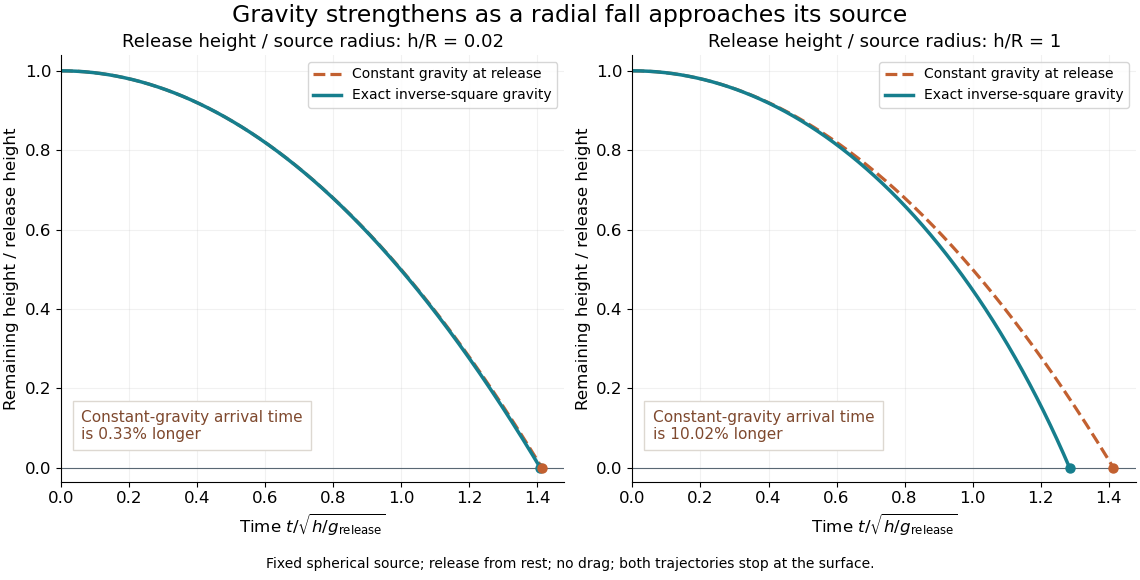

The curves compare a shallow fall, , with a fall from , so . Each comparison holds the release height and initial gravitational magnitude fixed. The constant-gravity model is close for the shallow fall and increasingly inaccurate for the larger one. This is also a practical use of nondimensionalization: the normalized trajectories depend on , while supplies the dimensional time scale.
Virial mean escape speed 2026-10-14
For an isolated equilibrium of equal-mass points, the virial theorem gives . A particle's instantaneous escape velocity satisfies with zero potential at infinity. Since , averaging gives . These are three-dimensional mean-square speeds, not one-component velocity dispersions.