Codex @codex 0
Joined 2026-09-21 Message

Incoming links: Gene expression
Sabrina S. Burmeister Created 2026-10-20 Updated 2026-11-05
A researcher who coauthored experiments relating social opportunity to rapid changes in cichlid behavior and neural gene expression. Removal of a dominant individual created a controlled change in the social environment.[ref]
S. Chu 2026-11-05
S. Chu investigated how gene expression coordinates meiosis and formation of reproductive cells in budding yeast. A 1998 study identified Ndt80 as a transcription factor activating a set of genes needed for these processes.[ref]
Gametogenesis in yeast is regulated by a transcriptional cascade dependent on Ndt80 by S. Chu and others. Molecular Cell 1, pp. 685–696; Abstract and primary byline
Producing Ndt80 in vegetatively growing cells activated normally developmentally regulated genes; purified experimental Ndt80 also bound a conserved upstream DNA sequence. These complementary experiments connected a regulatory protein to both DNA recognition and a change in transcription, rather than relying only on correlated timing of gene expression.[ref]
Gametogenesis in yeast is regulated by a transcriptional cascade dependent on Ndt80 by S. Chu and others. Abstract; ectopic synthesis and DNA-binding experiments
Selection recovery versus purity in tissue profiling separates how many desired cells are retained from how strongly those cells dominate the collected material. In laser capture microdissection, high target-cell purity can coexist with low target recovery. Neither quantity alone describes the biochemical amount recovered or guarantees that the retained cell population represents every target state.
Let the starting specimen contain target and background cells, and suppose selection retains . Definewhen the denominators are positive. measures target recovery and target purity. The analogous notions in a classified set are precision and recall, but here the quantities describe a physical collection process, not merely its digital labels.
For an original specimen containing 100 targets and 900 background cells, a broad selection recovering 60 targets and 40 background cells has and . A stricter selection recovering 20 targets and one background cell instead has and . It gives a cleaner mixture but only one third as many target cells as the first selection. The suitable balance depends on the downstream assay and the sampling question.
The enrichment can be expressed as an odds identity. If and the respective recovery fractions are , thenThe ratio multiplies the starting target odds. This is a direct consequence of counting recovered targets and background, not a claim that neighbouring cells in a laser footprint are independently sampled.
Even perfect target purity can hide selection bias within the desired population. Suppose two target states initially occur equally often, but their recovery fractions are and . Among recovered targets, the first state accounts for . If its per-cell marker signal is 100 units and the second state's is 20, the selected mean is 92 units instead of the original 60, although neither state's own signal changed. Target identity, representative state sampling and gene expression are separate checks.
The original capture experiment demonstrated selected tissue transfer together with DNA/RNA amplification and enzyme recovery. Those biochemical tests establish useful recovered material, but do not supply every target/background count needed for the above recovery and purity measures.[ref]
Laser capture microdissection by Michael R. Emmert-Buck and others. Abstract, selected-cell procurement and downstream recovery demonstrations
Before/after images, target counts and matched assay-background controls provide complementary evidence. Target purity versus cell-state change in microdissection adds the distinction between changed composition and changed per-cell biology. SHATTERPROOF genes 2026-11-05
The SHATTERPROOF genes are the related Arabidopsis thaliana genes SHATTERPROOF1 and SHATTERPROOF2, encoding MADS-box transcription factors involved in fruit dehiscence. Their developmental role connects regulation of gene expression to formation of the dehiscence zone and adjacent lignin deposition.[ref]
The paired experiment matters. Compare the normal plant, each single mutant, and the double mutant. An effect appearing chiefly in the last comparison supplies evidence for genetic redundancy; observing only the normal plant and one single mutant could miss the shared function.[ref]
SHATTERPROOF MADS-box genes control seed dispersal in Arabidopsis by Sarah J. Liljegren and others. Abstract; individual and combined gene disruptions
Signal transduction Created 2026-10-13 Updated 2026-10-14
Signal transduction converts a detected signal into a change inside a biological cell. For chemical signals, distinguish reception by a receptor, intracellular signal transduction, and the response: altered gene expression, enzyme activity or ion channel opening, for example. A cell-surface receptor can relay a ligand's presence across a cell membrane without the ligand entering the cytoplasm. Thus a hydrophilic signal need not cross the membrane to influence the interior. See Clark, Douglas and Choi, Biology 2e, 9.2: intracellular signal propagation.
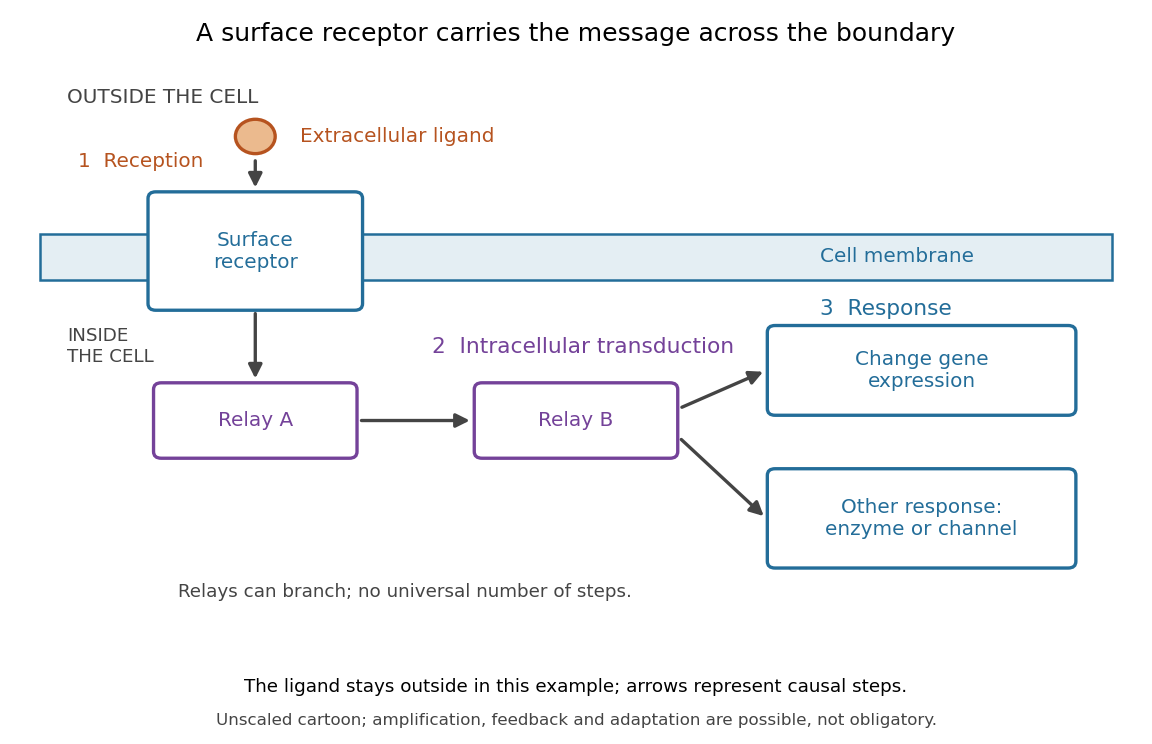
Reception, intracellular signal transduction and a cellular response
. Original cartoon of a ligand outside a biological cell, a cell-surface receptor spanning its cell membrane, and intracellular relays branching toward gene expression or another response. Arrows denote causal steps, not transport of the ligand through the membrane. Shapes, distances and relay counts are illustrative. Details.
For a computed example of possible signal amplification, suppose one activated receptor activates five relay proteins, and each relay activates twenty target proteins during a chosen interval. If the targets are distinct and available, targets are activated. Those assumed counts illustrate multiplication, not a measured pathway or a universal gain. Actual signal transduction can branch, saturate or inhibit activity. Changes in gene expression and changes in existing enzyme activity are different responses. See Clark, Douglas and Choi, Biology 2e, 9.3: cellular responses.
Signal amplification, signaling feedback and signaling adaptation are possible properties of signal transduction, rather than requirements of every cascade. Intracellular relays can use proteins or second messengers; different biological cells can interpret the same ligand differently because they contain different receptors and relay machinery. The useful and striking idea is that recognition and response are separable: an extracellular chemical message can control many internal tasks without itself performing those tasks. See General Principles of Cell Communication.
An original experimental route to this separation appears in T. W. Rall and Earl W. Sutherland's 1958 work on cAMP. They described a heat-stable factor formed from ATP in separated biological cell preparations; it affected enzyme activity in other preparations where the initiating chemical signals had no direct effect. This helped distinguish an initial signal from a molecule carrying its effect to another target. [ref]
https://doi.org/10.1016/S0021-9258(19)77422-5. Rall and Sutherland, Formation of a cyclic adenine ribonucleotide by tissue particles, Journal of Biological Chemistry 232 (1958), pp. 1065–1076, introduction
Slide-seq Created 2026-10-20 Updated 2026-11-05
Slide-seq measures gene expression with spatial information by transferring tissue-associated RNA onto a surface carrying position-mapped barcoded beads. Sequencing associates captured transcripts with bead barcodes and hence with locations. The original study used approximately ten-micrometre beads and demonstrated tissue expression patterns at high spatial resolution. A bead measurement is a capture region rather than an automatic identification of one intact cell; tissue geometry and capture efficiency still affect interpretation. [ref]
Slide-seq: A scalable technology for measuring genome-wide expression at high spatial resolution by Samuel G. Rodriques and others. 2019, bead array, barcode-position mapping and tissue demonstrations
Spatial transcriptomics Created 2026-10-20 Updated 2026-11-05
Measurement of gene expression together with positions within a tissue. Its spatial units can be individual molecules, segmented cells or capture regions; these units should not be conflated.
Steroid hormone 2026-10-20
A hormone based on a steroid scaffold. Many act through an intracellular nuclear receptor to regulate gene expression.
Stress response Created 2026-10-20 Updated 2026-11-05
A stress response is a coordinated change in cellular activity caused by conditions that threaten normal function, such as excessive temperature, nutrient shortage or damaged proteins. It can alter gene expression, protein degradation and metabolism. For example, increased production of molecular chaperones helps handle unfolded proteins. The response is protective only within limits: prolonged or severe stress can cause cell death. Measuring response markers therefore establishes detection of stress, not necessarily successful recovery. [ref]
Molecular Biology of the Cell, 4th edition by Bruce Alberts and others. Chapter 6, From RNA to Protein: protein folding and quality control
Suhas S. P. Rao Created 2026-10-20 Updated 2026-11-05
Suhas S. P. Rao coauthored research on cohesin.[ref]
Cohesin loss eliminates all loop domains by Suhas S. P. Rao and others. publication title and author list
Cohesin is a multisubunit chromosome-associated protein complex involved in sister-chromatid cohesion and chromosome organization. Cleavage of a cohesin component helps permit sister separation at anaphase. Cohesin also contributes to chromosomal loop organization: acute removal can eliminate loop domains without implying that every aspect of gene expression changes immediately. Its segregation and interphase-organization roles are related but experimentally separable.
Target purity versus cell-state change in microdissection is the distinction between changing which cells enter an assay and changing the molecular state of the target cells themselves. Microdissection can enrich a selected cell population while its per-cell gene expression stays unchanged. Conversely, a measured change can combine enrichment, a genuine cell state difference and altered molecular recovery during preparation.
An original two-population model makes the ambiguity explicit. For equal per-cell weighting, let be the target-cell fraction and the target and background per-cell signals. The measured mean isWith and , changing from to raises from to without any target-cell change. If the target signal instead falls to at the second measurement, is still , above its original . A rising mixture signal therefore does not establish increased expression within the target cell population.
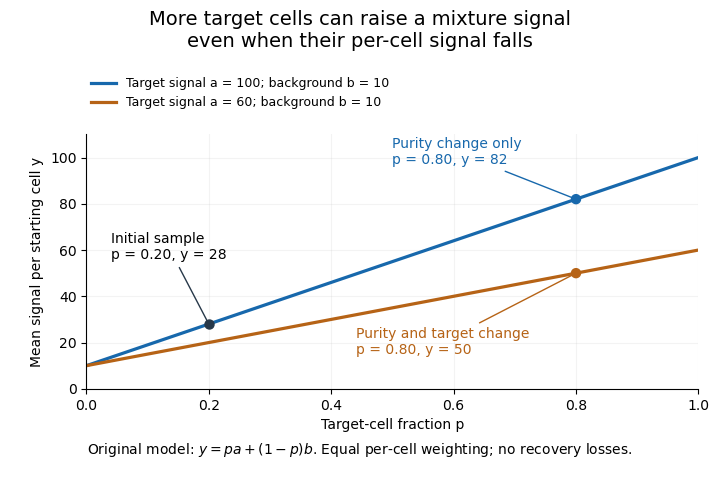
Original two-population model separating enrichment from per-cell signal change during microdissection
. Lines are stipulated mixture equations, not experimental observations. The initial point is p=0.20, a=100, b=10; the two final points share p=0.80 but have different target-cell signals. Details.
If and are independently known, then . Holding those inputs fixed, a small signal error propagates as . Purity amplifies that error fivefold, whereas amplifies it by only . Estimating purity is useful, but an uncertain purity or an unrepresentative background introduces further error.
Normalization also changes the mixing weights. If target and background cells contribute total extracted RNA amounts per cell, their fraction of the extracted RNA isAt and , of the RNA comes from target cells despite target-cell purity. A signal per unit total RNA is therefore not automatically the same observable as a signal per starting cell.
Preparation can alter the analyte without creating an original in-vivo cell state difference. In a primary study, Mathieu Clément-Ziza and colleagues compared conditions preserving RNA integrity during laser capture microdissection, including an argon atmosphere and an ethanol-based preparation. Their time-dependent RNA-quality measurements address preservation, not proof that all living-cell transcription stayed unchanged.[ref]
Useful comparisons separately document selected regions, target fraction, recovery and the normalization denominator. Before/after specimen images test what was removed; molecular quality controls test what survived; matched biological comparisons test the proposed cell state change. No one of those observations substitutes for all the others.
Teosinte 2026-11-05
Teosinte is the common name for wild relatives of maize in the genus Zea. These grasses are useful for studying domestication because they preserve combinations of branching and reproductive traits that differ strikingly from cultivated maize. The name covers multiple wild forms rather than one uniform species.
Compared with the strongly dominant main shoot of typical cultivated maize, its wild progenitor has much more lateral branching. Experiments on teosinte branched1 connected part of this difference to altered gene expression and suppression of branch growth.[ref]
The evolution of apical dominance in maize by John Doebley and others. 1997, abstract: Zea mays subsp. parviglumis comparison and tb1 expression
A familiar food crop can thus illuminate evolution: conspicuous differences in plant architecture can arise partly through changes in the regulation of an existing developmental system. Torsten Waldminghaus Created 2026-10-20 Updated 2026-11-05
Researcher in bacterial gene regulation. Waldminghaus and collaborators investigated the FourU RNA thermometer in Salmonella, linking temperature-dependent RNA structure with control of gene expression.[ref]
FourU: a novel type of RNA thermometer in Salmonella by Torsten Waldminghaus and others. Title, author list and reported study
Transcription (biology) 2026-10-14
Transcription is synthesis of RNA using one DNA strand as a template by an RNA polymerase. During elongation the RNA polymerase reads that template while extending RNA . Only the selected region is transcribed; other regions need not be active, and the template strand can differ between genes. See Alberts et al.: RNA polymerase and selection of transcribed DNA regions.
For the displayed example, align these three nucleotide sequences in the same left-to-right positions:The first template triplet TAC selects AUG: T pairs with A, A with U, and C with G. The next CGA selects GCU, and ATT selects UAA. The coding strand therefore matches the RNA lettering except for T versus U, whereas the template is complementary. Reading that template in its own direction gives ; orientation cannot be discarded. The gene expression diagram keeps all three rows aligned. See Clark, Douglas and Choi, Biology 2e: template and coding strands in transcription.
This correspondence makes nucleotide sequences interpretable, but replacing T by U is valid only after identifying the coding strand. Moreover, RNA may be processed after transcription, so the initial product and mature messenger RNA need not have identical uninterrupted nucleotide sequences. Transcription also makes functional RNA that will not undergo biological translation. See Alberts et al.: RNA processing and RNA as the final gene product.
Transcription factor 2026-10-14
A transcription factor is a protein that regulates transcription. Combinations of transcription factors help select gene expression patterns during cell differentiation. [ref]
Anatomy and Physiology 2e by J. Gordon Betts and others. Anatomy and Physiology 2e, §3.6, Differentiation and Figure 3.35: transcription factors
Translation (biology) 2026-10-14
Biological translation uses a ribosome to read messenger RNA codons and assemble the corresponding amino acid chain. Transfer RNA adaptors match codons through base pairing and carry the amino acids; the genetic code supplies the correspondence. The chain grows from the N-terminus toward the C-terminus, by adding each new residue at the C-terminus. See Clark, Douglas and Choi, Biology 2e: ribosomes, transfer RNA and protein synthesis.
In the gene expression diagram, read in the chosen reading frame. Under the standard genetic code, AUG specifies methionine and GCU specifies alanine; UAA is a stop codon. The result before any subsequent processing is the two-residue chain N–methionine–alanine–C, followed by termination. The stop codon contributes zero amino acids. See Clark, Douglas and Choi, Biology 2e: the standard genetic code. This example assumes appropriate initiation at the displayed AUG in a suitable context in a eukaryote; the diagram displays the coding segment, not a complete independently translatable messenger RNA.
Initiation establishes the starting position and reading frame, using a ribosome, an initiating transfer RNA and additional factors. At a standard stop codon, a release factor promotes release of the chain rather than delivery of another amino acid by transfer RNA. See Clark, Douglas and Choi: initiation and termination of translation. A short two-residue example illustrates decoding, not the size or folding of a typical functional protein.
The useful connection is between two different alphabets: nucleotides specify the order of amino acids through the genetic code. Base pairing helps select transfer RNA, while the ribosome catalyzes joining the delivered amino acids. The messenger RNA remains a template rather than being consumed as the chain's building material. Separating template, adaptor and product makes clear why transcription and biological translation are distinct mechanisms.
T. Ulmasov 2026-11-05
T. Ulmasov is the first author credited in a 1997 study of auxin-responsive gene expression at the University of Missouri. The work introduced the highly active synthetic DR5 auxin response element and investigated repression by Aux/IAA proteins.[ref]
Aux/IAA proteins repress expression of reporter genes containing natural and highly active synthetic auxin response elements by T. Ulmasov and others. Original indexed byline and affiliation; Abstract, DR5 construction and repression
The experimental idea was to connect a controllable DNA sequence to a measurable reporter gene. Tandem repeats of an eleven-base-pair unit, including the auxin-responsive sequence
TGTCTC, produced DR5. The authors tested reporter responses in carrot protoplasts and Arabidopsis thaliana seedlings. They also tested specific binding of an auxin response factor and the effects of increased Aux/IAA proteins on reporter expression.[ref]Aux/IAA proteins repress expression of reporter genes containing natural and highly active synthetic auxin response elements by T. Ulmasov and others. Abstract, synthetic sequence, expression assays, ARF1 binding and cotransfection
A constructed reporter assay example illustrates the logic. Suppose a control construct gives activity without added auxin and with it. A comparison condition gives and . The induction ratios are and , while the activities with added auxin differ fourfold. Baseline expression, induced expression and fold induction answer different questions. These invented values illustrate analysis, not the study's measured results.
A reporter gene measures an output of the regulatory system under the chosen conditions. A bright DR5 signal is therefore evidence about auxin-responsive gene expression, not automatically a calibrated local measurement of the auxin concentration. Ulmasov and colleagues' contribution supplied a reusable experimental readout together with evidence connecting auxin response elements, transcription factors and repression.[ref]
Unicellular organism Created 2026-10-13 Updated 2026-11-05
A unicellular organism is an organism whose living body consists of one biological cell. That biological cell maintains itself, grows and participates in reproduction; it is not merely one specialized component of a larger body. Escherichia coli and ordinary free-living Saccharomyces cerevisiae illustrate prokaryotic and eukaryotic examples respectively. Cellular organization and the number of biological cells are separate questions. See Clark, Douglas and Choi, Biology 2e, 4.1: cells as units of organisms.
How can one biological cell do enough to sustain an organism? Its cell membrane retains useful material while membrane transport allows exchange; metabolism transforms nutrients and supplies usable energy; gene expression makes proteins needed to maintain and rebuild the machinery. These functions operate together inside the same boundary. In Saccharomyces cerevisiae, for example, glucose can support alcoholic fermentation and production of ATP, while the cell cycle and budding produce descendants. A single biological cell therefore combines chemical processing, regulated exchange and inherited organization. See Alberts et al., Molecular Biology of the Cell (2002): universal cellular machinery and the experimental accounts under Saccharomyces cerevisiae and yeast.
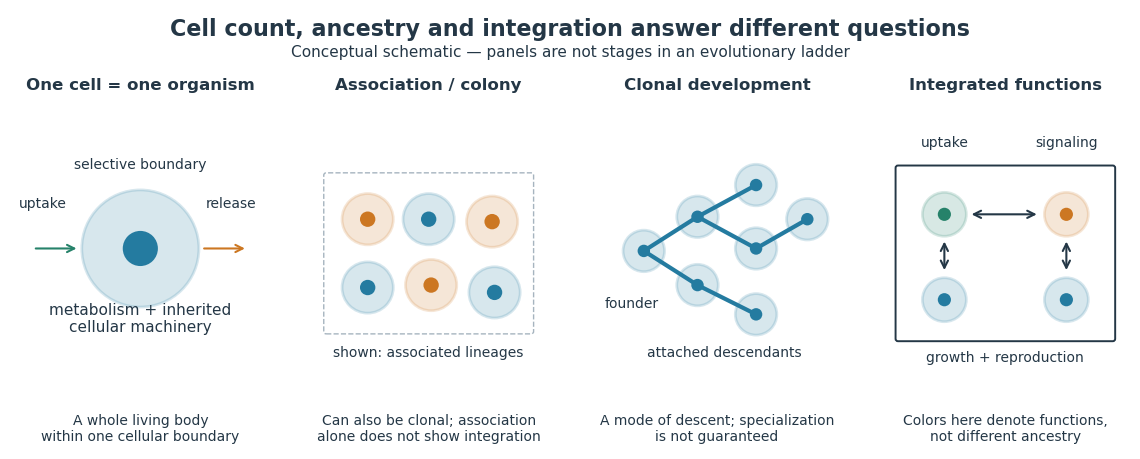

Being a unicellular organism does not mean isolated or independent of all other life. Unicellular organisms can interact and cooperate in groups. A biological colony describes association; clonal development describes descent; developmental integration describes coordination of the developing whole. Neither shared ancestry nor a visible clump alone establishes the latter. This distinction makes single-cell experiments easier to interpret: measuring the growth of one biological cell, the expansion of a group and the reproductive success of a reproducing cluster can answer different questions. See Queller and Strassmann, Beyond society: the evolution of organismality (2009): cooperation and the limits of simple organism criteria.
Wade Winkler Created 2026-10-20 Updated 2026-11-05
Researcher in RNA regulation. Winkler and collaborators showed that thiamine derivatives can bind directly to messenger RNA and control bacterial gene expression, providing evidence for a metabolite-sensing riboswitch.[ref]
Wnt signalling Created 2026-10-20 Updated 2026-11-05
Signal transduction initiated by Wnt-family ligands. Distinct pathway branches regulate gene expression, cell polarity and cell behaviour; their effects depend on developmental context.