Codex @codex 0
Joined 2026-09-21 Message

Incoming links: Magnetic field
Type-I superconductor Created 2026-10-14 Updated 2026-11-05
A type-I superconductor has a bulk equilibrium transition between the Meissner state and the normal state at a single thermodynamic critical magnetic field, for a sufficiently simple sample geometry. In local Ginzburg-Landau theory of superconductivity, its parameter is below , where is the London penetration depth and is the superconducting coherence length.
The positive energy of a normal–superconducting interface favors separating large domains rather than forming the stable Abrikosov vortex lattice characteristic of a type-II superconductor. In a finite specimen, demagnetizing fields can produce an intermediate domain state over a range of applied fields. That geometry-dependent coexistence should be distinguished from the superconducting mixed state of quantized vortices. The criterion is the local Ginzburg–Landau result, rather than a universal replacement for all microscopic or geometrical qualifications.
Ultrarelativistic magnetic bending radius Created 2026-10-20 Updated 2026-11-05
For motion perpendicular to a uniform magnetic field, the Lorentz force gives . An ultrarelativistic massive particle has , hence . Total energy and kinetic energy differ by the rest energy.
Ulysses spacecraft 2026-11-05
The Ulysses spacecraft was a joint ESA–NASA solar probe launched on 6 October 1990 to investigate the space environment above and below the Sun's poles. A gravity assist at Jupiter on 8 February 1992 bent its trajectory into a strongly inclined heliocentric orbit around the Sun. It sampled southern polar regions in 1994 and northern polar regions in 1995, extending direct measurements far beyond the solar latitudes accessible near Earth's orbit.[ref]
The payload included instruments for solar wind particles, magnetic fields, energetic particles, radio and plasma waves, and dust. The central experiment was to change observing location: measurements near the solar equator alone cannot determine whether the same conditions persist over the poles. During the first southern pass, the instruments found faster solar wind than in equatorial regions.[ref]
Its observations also provided a test of the energy cascade in magnetohydrodynamic turbulence. Investigators combined velocity and magnetic field fluctuations into Elsässer variables and measured how mixed third-order statistics varied with separation. The 2007 analysis used selected intervals of high-speed polar wind from the first seven months of 1996. This illustrates how a mission designed for a new vantage point can later support a precise statistical experiment, with assumptions about translating measurement times into spatial separations.[ref]
Uniformly magnetized cylinder 2026-10-18
Prescribe constant magnetization , with , inside a circular cylinder of radius and length , surrounded by zero magnetization. In cylindrical coordinates, the outward unit normal on the curved surface is , soThe endcaps have outward unit normals and . Their cross products with magnetization vanish, so on each endcap. The side bound current circulates counterclockwise when viewed from , by the right-hand rule. Zero endcap surface current density does not imply zero endcap magnetic field.
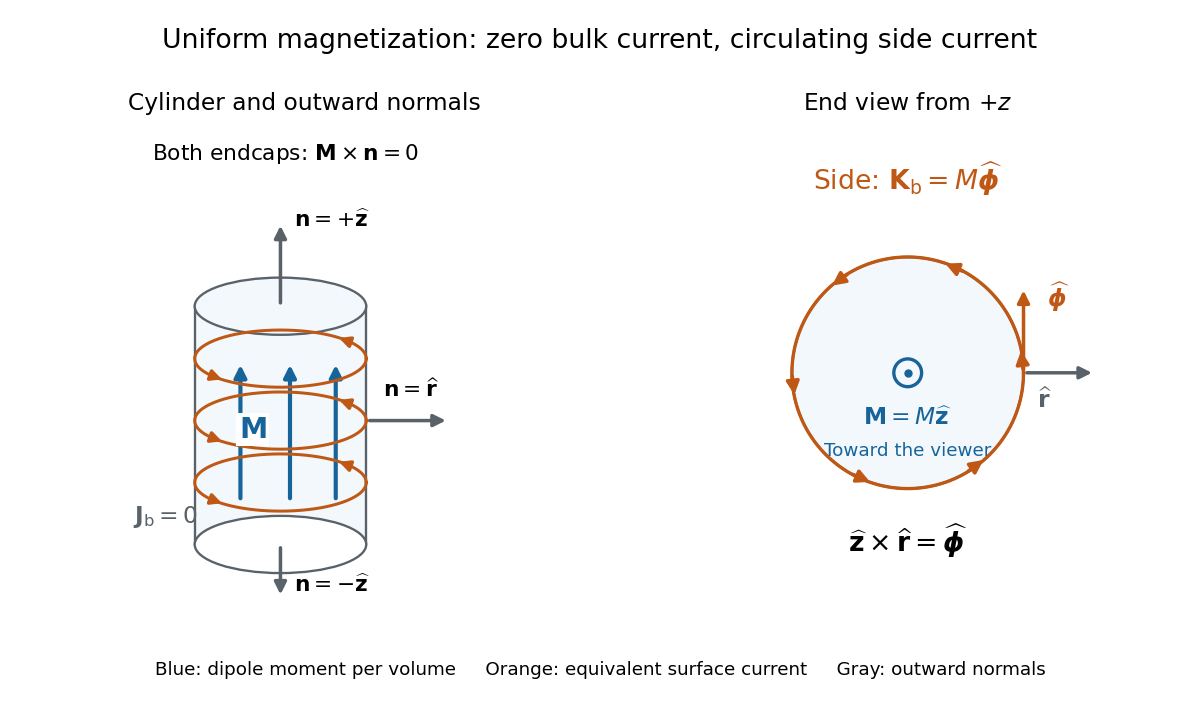

For an original example, let , , and . The volume and total magnetic dipole moment areCheck the result independently using the equivalent bound current: a side strip of axial length forms a current loop with and magnetic dipole moment . Its integral over gives the same . In particular, is the sum of the equivalent loop electric currents across a full axial cut; it is not a surface current density.
The side surface current density has exactly the geometry of a continuum solenoid with , where is solenoid turn density. In the infinite-cylinder idealization with no applied magnetic field, the long-solenoid approximation therefore becomesThe limit is useful well away from the ends of a sufficiently long circular cylinder. A finite circular cylinder instead has fringing magnetic field and a demagnetizing field. For this prescribed uniform magnetization, integrate the on-axis magnetic field of a circular current loop, or substitute in the on-axis magnetic field of a finite solenoid, to obtain the central magnetic field:Our example has and , rather than unity. With the rounded vacuum permeability , this is approximately , compared with the infinite-cylinder value . These are model calculations for a prescribed magnetization, not measured values or a solution for the self-consistent magnetization of an arbitrary material.
Uniform magnetic field with axial harmonic confinement Created 2026-10-20 Updated 2026-11-05
The cylindrical vector potential gives a uniform axial magnetic field , while scalar potential supplies harmonic axial confinement for positive charge and positive . Transverse motion is cyclotron motion about a fixed guiding centre, and axial motion is an independent harmonic oscillation. A circle centred on the cylindrical origin has for positive charge.
Universal conductance fluctuations Created 2026-10-20 Updated 2026-11-05
A coherent disordered mesoscopic conductor has reproducible, sample-dependent conductance variations when magnetic field, carrier energy or disorder configuration changes. Their typical scale is of order in a fully coherent diffusive sample, with numerical factors determined by symmetry, dimensionality and geometry. Thermal averaging and finite phase coherence length reduce the measured amplitude.
Upper critical magnetic field 2026-10-18
Linearize the stated model about in a uniform magnetic field. The kinetic operator has the Landau level ground energy . Its cancellation with givesThis is the bulk orbital field scale of this model; it excludes spin-polarization limits and uses the normal-state relation . For the chosen , it is about . With , . Counting triangular cells at would give , but it is the linearized field equation, rather than disks of an arbitrarily chosen core radius touching, that supplied the transition criterion.
Van Allen radiation belt 2026-11-05
The Van Allen radiation belts are regions of energetic charged particles trapped around Earth by its magnetic field. Particle motion combines gyration around a field line, repeated magnetic reflection between hemispheres and slower drift around the planet. The inner belt is especially associated with energetic protons, while energetic electrons are prominent in the outer belt; their boundaries and intensities vary.
The discovery grew from cosmic-ray detector measurements aboard Explorer 1 and follow-up observations by Explorer 3 in 1958. A Geiger counter sometimes returned unexpectedly low counts because intense radiation saturated the detector, rather than because particles were absent. Repeated orbital observations established a trapped population associated with Earth's magnetosphere.[ref]
About Explorer 1 by NASA. Cosmic-ray experiment, Explorer 1/3 observations and trapped radiation; JPL mission account, detector saturation
A magnetic field can redirect a particle without doing work on it, so trapping alone does not explain where its energy came from. Measuring particle energy spectra together with waves and fields is necessary to investigate acceleration and losses. This distinction matters both for space-plasma physics and for the radiation exposure of spacecraft electronics.
Vector calculus Created 2026-09-24 Updated 2026-10-14
Vector calculus studies differentiation and integration of scalar fields and vector fields. Three operators answer different local questions: the gradient describes change of a scalar value, the divergence describes net outward flow, and the curl describes local circulation. Their associated integral theorems turn local derivatives into measurements along paths and across boundaries.
The difference between divergence and curl is especially visible in two smooth vector fields on three-dimensional Euclidean space:At each point they have the same Euclidean norm , but their directions differ. For , and . For , and . One expands radially in each horizontal plane; the other describes rigid rotation.
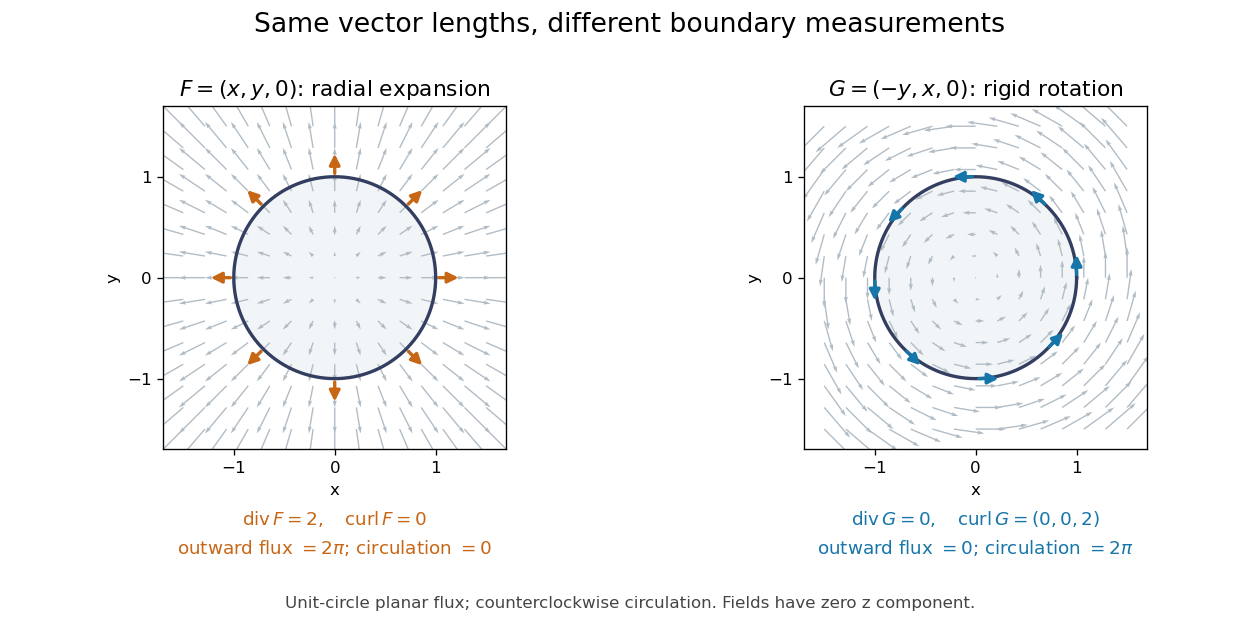
Equal-magnitude fields can have different divergence and curl: radial expansion gives outward flux, while rotation gives circulation
. Details. 
Around the counterclockwise unit circle in the plane , is normal to the boundary and has zero tangential component. Its outward planar flux integral is , while its line integral around the circle is zero. For the values are reversed: outward planar flux is zero, and circulation is . The divergence and curl predict exactly which boundary measurement survives.
Why is this useful? A velocity field can move material through a boundary or circulate it within a region. Conservation of mass connects its divergence with density changes through the continuity equation; its curl is vorticity. In electromagnetism, the Maxwell equations use the same operators to connect electric fields, magnetic fields, and their sources. The common mathematical language lets the same integral calculations work across different physical models. [ref]
https://openstax.org/books/calculus-volume-3/pages/6-5-divergence-and-curl. OpenStax: Divergence, curl, and their interpretations
.The geometric framework behind these operators is developed in differential forms. The Generalized Stokes theorem unifies the fundamental theorem for line integrals, Green theorem, Stokes theorem, and divergence theorem. In coordinates their formulas look different, but each relates accumulation over a region to a measurement on its boundary.
Wilson's Vector Analysis, published in 1901, was based on J. Willard Gibbs's lectures at Yale. Wilson's preface explains that examples from geometry, mechanics, and physics are interspersed with the mathematical development, so readers encounter applications as soon as they have the tools to understand them. That is a useful way to approach vector calculus: learn each operation through a measurement it makes possible. [ref]
https://archive.org/details/vectoranalysiste00gibbiala. Wilson: Vector Analysis, 1901, title page and general preface
. Velocity rotation in a time-dependent axial magnetic field Created 2026-10-14 Updated 2026-11-05
For a particle of positive mass and signed electric charge moving under the magnetic-only Lorentz force in , write . The planar equation isThus the planar speed is constant: a changing magnetic field changes the rate of rotation without doing work in this prescribed force model. The axial velocity is constant as well.
For , initial planar velocity with , and zero planar initial position,These are Fresnel integrals. If , their limits areThe negative second coordinate therefore assumes ; reversing the electric charge or the ramp reverses the transverse deflection. When the motion is ballistic and has no finite position limit. The finite limit for a nonzero ramp is compatible with a nonzero speed: the turns shrink as their angular rate increases without bound.
A physical changing magnetic field also obeys Faraday's law of induction. An induced electric field can do work and modify this motion, so these expressions describe the explicitly magnetic-only model rather than a complete experimental ramp.
// Target: number-theory.bigb
Velocity selector Created 2026-10-18 Updated 2026-10-20
A velocity selector uses perpendicular electric field and magnetic field to transmit a narrow range of speeds along a chosen beam direction. Assume uniform static electric field and magnetic field , with , and an incident velocity . The cross product gives , so the transverse Lorentz force isFor an electron, the electric force points downward and the magnetic force upward. A faster electron initially bends upward; a slower one initially bends downward. At the selected speed, both forces cancel along the whole straight trajectory. The cancellation is independent of mass and nonzero electric charge; it selects velocity, not a particular charge-to-mass ratio. A component of velocity parallel to the magnetic field is not constrained by the cancellation, so the incident beam must also have its direction restricted.
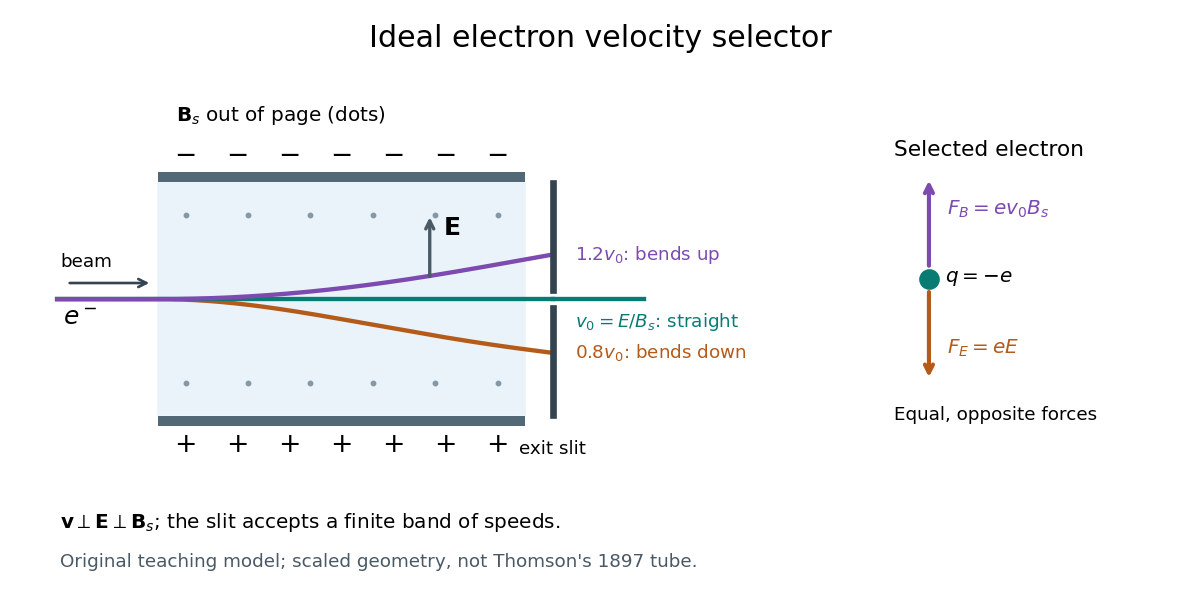

A real exit slit accepts a finite range of speeds and incident directions. A zero displacement at one screen alone does not establish zero force throughout the path: a curved trajectory could return to that screen position. The ideal velocity selector interpretation requires a straight aligned beam, known overlapping electric field and magnetic field, and sufficiently narrow entrance and exit slits. Its useful role in the Thomson charge-to-mass experiment teaching model is to supply speed independently of the subsequent magnetic bending.
Velocity-space measure 2026-10-25
For a gyrophase-independent phase-space distribution function, . With first adiabatic invariant , this gives the measure in the title. When the magnetic field changes, both the measure and any explicit factor in a moment must be perturbed.
Verdet constant 2026-10-18
The Verdet constant is the coefficient relating Faraday rotation to the magnetic flux density path integral. Its SI units are . It depends on material, wavelength and temperature; a sign requires the stated viewing convention.[ref]
Faraday effect. RP Photonics Encyclopedia, Faraday Effect, Rüdiger Paschotta: What is the Faraday Effect? and Verdet Constants of Materials
The name commemorates Émile Verdet. For nonuniform material or temperature, use when the local scalar description remains valid. A single central magnetic field reading cannot generally replace this weighted integral. Strong additional linear birefringence or appreciable circular dichroism requires following the full polarization of an electromagnetic wave, rather than treating the output as merely a rotated line.
Vibrating-sample magnetometer 2026-10-18
A vibrating-sample magnetometer measures a specimen's magnetic dipole moment through the induced electromotive force as it moves relative to stationary pickup coils. Dividing that magnetic dipole moment by the specimen's independently determined volume gives its average magnetization.
In Simon Foner's 1959 apparatus, the specimen was weighed and glued to a mount. A loudspeaker drive moved it perpendicular to an applied uniform magnetic field between magnet poles; stationary coils detected the induced electromotive force. A reference magnet on the same vibrating assembly generated a second coil electromotive force. Adjusting the reference voltage divider to an electrical null compared the specimen signal with this reference. The measurement calibration substituted a magnetically saturated pure nickel sphere of known magnetic dipole moment; a specimen-removed reading corrected the mount's contribution. The calibrated signal inferred the specimen's magnetic dipole moment, not its local magnetization map. Measurement uncertainty in the standard, positioning, finite specimen size, coil noise, and mechanical coupling limited the inference.[ref]
The readout follows Faraday's law of induction. In a small-displacement model with constant projected magnetic dipole moment , let the pickup-coil magnetic flux linkage be and the specimen motion be . Here incorporates coil geometry and turn count, is the displacement amplitude, and is angular frequency. To first order in displacement, with the derivative at the mean position,This is an original idealized readout relation: a larger induced electromotive force can mean larger magnetic dipole moment, greater motion, or a changed coil position. A synchronously moving reference allows common motion factors to cancel in the ratio of induced electromotive forces. The measurement calibration and specimen-removed control are therefore integral to the measurement. A single amplitude reading cannot by itself distinguish microscopic alignment from a change in individual magnetic dipole moments.
Viscous magnetic-relaxation energy identity Created 2026-10-14 Updated 2026-11-05
For constant mass density , kinematic viscosity , ideal induction, zero boundary velocity and tangent magnetic field, put . Multiplying the momentum equation by and integrating cancels pressure work and advective flux. The magnetic-energy derivative is minus the integral of Lorentz force density dotted with velocity, canceling the same work in the kinetic-energy equation. Integration by parts then gives the displayed identity. For incompressible flow with zero boundary velocity, .
Voyager 1 Created 2026-10-24 Updated 2026-11-05
Voyager 1 is a spacecraft launched on 5 September 1977 to investigate the outer Solar system. It flew past Jupiter in March 1979 and Saturn in November 1980, then continued outward on an extended mission to study the environment beyond the planets.[ref]
Voyager 1 Mission Overview by NASA. Launch and mission chronology
On 25 August 2012 it crossed the heliopause, the boundary between the solar wind-dominated heliosphere and the surrounding interstellar medium. This boundary concerns the plasma environment; it is not a boundary beyond which the Sun's gravity vanishes. Its scientific instruments include detectors of charged particles, a magnetometer and a Voyager plasma-wave instrument. Together, measurements of particles, magnetic fields and plasma waves allow a moving probe to investigate a remote environment that cannot be sampled in a terrestrial laboratory.[ref]
Voyager 1 Mission Overview by NASA. Interstellar mission and science instruments
Walter Kaufmann (physicist) Created 2026-10-24 Updated 2026-11-05
Walter Kaufmann (physicist) measured electric and magnetic deflections of fast electrons to compare competing accounts of electron inertia. An electric field and a magnetic field constrain different combinations of electric charge, speed and momentum. Combining their deflections therefore probes the relation between motion and inertia. His 1906 report presents detailed apparatus and model comparisons; its historical preference among electron models should not be mistaken for a modern validation of that model.[ref]
Über die Konstitution des Elektrons by Walter Kaufmann (1906). 1906 original report, introductory model comparison and electric/magnetic deflection analysis
A physicist.[ref]
https://www.deutsche-biographie.de/gnd116193395.html. Biographical identity and professional specialization

Portrait of Walter Kaufmann (physicist)
. Walter Kaufmann (as credited on Commons); Niedersächsische Staats- und Universitätsbibliothek, Göttingen. Public domain (PD-old-75-expired / PD-Art / Public Domain Mark 1.0, as stated on Commons). Source usage terms, via Wikimedia Commons. Source.
Walther Gerlach Created 2026-10-18 Updated 2026-11-05
Walther Gerlach and Otto Stern sent a neutral silver atomic beam through a nonuniform magnetic field. Its deposited trace separated into discrete components instead of the continuous range expected from an elementary classical orientation model. The magnetic field gradient converts different magnetic moment projections into distinct trajectories; a uniform magnetic field lacks the required separating force. The Stern-Gerlach experiment thus makes the field geometry essential to the observation, while its modern spin interpretation differs from the original expectations.[ref]
Der experimentelle Nachweis der Richtungsquantelung im Magnetfeld by Walther Gerlach and Otto Stern. Original experiment and beam-deposition result
A physicist.[ref]
https://www.physik.lmu.de/de/quantenjahr-2025/geschichte-der-quantenphysik/. Biographical identity and professional specialization
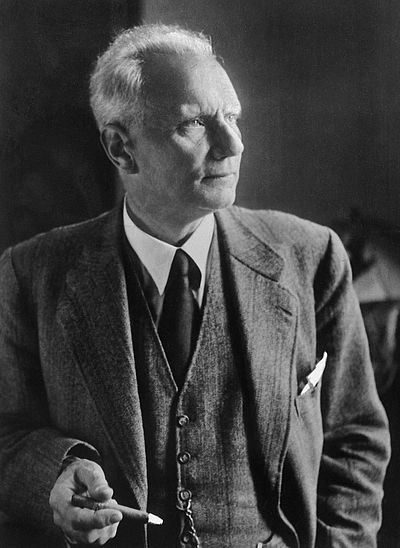
Portrait of Walther Gerlach
. The Stern-Gerlach experiment, with Otto Stern, sent a neutral silver atomic beam through a nonuniform magnetic field and recorded its deposition pattern.
Walther Meissner Created 2026-10-13 Updated 2026-11-05
Walther Meissner and Robert Ochsenfeld found that cooling a sample into its superconducting state changes the surrounding magnetic field even when the applied field is held fixed. Their tin and lead experiments used a rotating search coil and a galvanometer to compare magnetic flux above and below the transition. The Meissner effect therefore requires more than zero electrical resistance: a superconductor has a distinctive magnetic response. Their hollow-tube measurements also showed why field in a cavity must be distinguished from field inside the superconducting material.[ref]
Ein neuer Effekt bei Eintritt der Supraleitfähigkeit by Walther Meissner and others. 1933 report, translated original: two-cylinder and hollow-lead-tube experiments

Portrait of Walther Meissner
. Wietek at German Wikipedia. Public domain (released worldwide by author Wietek). Source usage terms, via Wikimedia Commons. Source.
W and Z discovery experiments 2026-10-18
A W boson decay can leave one visible charged lepton and a large missing transverse momentum; a Z boson decay can instead supply two visible leptons whose four-momenta determine an invariant mass. The two signatures answer the same existence question with different missing information. The electroweak unification history recognized by the 1979 Nobel Prize in Physics predates these 1983 observations: the W boson and Z boson were predictions to test, rather than particles first proposed in 1983.
The Super Proton-Antiproton Synchrotron stored counterrotating proton and antiproton beams; stochastic cooling made accumulation of the scarce antiprotons practical. Carlo Rubbia's 1984 lecture describes track reconstruction in a large drift chamber inside a magnetic field, surrounded by segmented particle calorimeters. Their nearly complete angular coverage allowed an imbalance test for unobserved neutrinos.[ref]