An Euler pseudoprime is an odd composite number with satisfying , where the right side is the Jacobi symbol. A weaker convention requires only ; it is distinguished below. A strong pseudoprime, with and odd, satisfies or for some .
By the Chinese remainder theorem for unit groups, the unit group modulo is . Modulo , . Thus the only possible sign in is positive. Modulo , writing for a primitive root, the condition is , equivalently . Consequently has multiplicative order dividing in each factor. Its square is either or in each factor, but these signs must agree: modulo , the Legendre symbol is for square and for square , and the same is true modulo . The Euler pseudoprime condition additionally requires the product of those Legendre symbols to be . HenceEach sign has two roots modulo each prime, hence four roots modulo . There are eight pseudoprime bases modulo under the Jacobi symbol convention. Under the weaker sign-only convention there are instead sixteen pseudoprime bases, since the two signs of the squares need not agree; the stated equivalence therefore specifically uses the Jacobi symbol convention.
For the strong pseudoprime condition, . Since the unit group has exponent of a finite group , the only possibilities are or . The six pseudoprime bases are . For example , while has but . Thus the strong-pseudoprime pseudoprime bases are not a subgroup.
Let be the closed unit disc and setThe displacement bound gives , so is continuous. The Brouwer fixed-point theorem applies because is nonempty, compact and convex. At a fixed point , . Therefore .
For arbitrary , the continuous map satisfies . Applying the preceding Brouwer fixed-point theorem argument with this positive bound gives . Hence , and is surjective.
Let and defineThen everywhere, but is not in the image of a function. The map is discontinuous at , giving a bounded-displacement map which is not surjective.
Identify a binary word with its coefficient polynomial in . A cyclic code is exactly an ideal of : closure under multiplication by is closure under cyclic shift. Its inverse image in the principal ideal domain has a unique monic generator polynomial of a cyclic code dividing . PutThe cubics have no root in , hence are irreducible polynomials. The eight monic divisors yield all binary cyclic codes of length seven. A code generated by has basis and dimension , with the zero code treated separately.
For the dual of a cyclic code, let . Orthogonality of coefficient vectors to all cyclic shifts gives the generator . Here . Thus the complete pairing, with the respective dimensions, isThese are respectively the whole-space/zero, even-weight/repetition, and two Hamming code/binary simplex code pairs. The reciprocal formula follows because the product of a word polynomial and the reversed polynomial of an orthogonal word has zero coefficients in all cyclic positions; the resulting inclusion has the correct complementary dimension, hence is equality.
In strict Chomsky normal form, every production of a context-free grammar is or , with nonterminal symbols and a terminal symbol. Such a derivation cannot produce the empty word: it starts with one nonterminal symbol, and every step either increases the symbol count or replaces one symbol by one symbol. The context-free language , generated by , is therefore not generated by any strict CNF grammar.
The convention matters: extended Chomsky normal form permits with excluded from right-hand sides. Under that convention every context-free language has such a grammar, so the requested example would not exist.
Their intersection is . Suppose satisfied the pumping lemma for context-free languages with length . In a decomposition with and , the window cannot meet both the and blocks. Pumping down changes at least one count and leaves at least one count unchanged. Thus the three counts are unequal, or the word order is invalid, contrary to the pumping lemma for context-free languages. Hence CFLs are not closed under intersection.
Context-free languages are closed under union: use a new start symbol with alternatives for two renamed context-free grammars. If they were closed under complement in , De Morgan's laws would givecontradicting the preceding intersection example. Therefore some CFL has a non-context-free complement. This is an existence argument; it does not assert that both complements of the particular are non-context-free.
A concrete choice is . Words outside form a regular language. Among words inside it, membership in means the first two counts or the last two counts differ. Each unequal-count comparison has a context-free grammar: for with , use , ; for , replace by . Append any number of 's, or prefix any number of 's for the analogous comparison. Taking these unions gives a context-free language whose complement is the non-context-free equal-three-count language. These productions are definitions of the example, not a restriction to strict Chomsky normal form.
Write for the log-likelihood and for the score function. Newton method uses the Observed Fisher information ; Fisher scoring uses the Fisher information .
For independent responses in an exponential family, with fixed dispersion parameter and fixed weights , a canonical link function gives andThe last matrix depends on but not on the responses, so taking its expectation leaves it unchanged. Hence the two updates are identical, wherever this Fisher information matrix is invertible. Equivalently both solve the same iteratively reweighted least squares problem. This statement concerns the regression coefficients at a fixed dispersion parameter; a joint update of an unknown dispersion parameter need not have identical observed and expected full Fisher information matrices.
In the birth-death master equation, The upward jump has rate and the downward jump rate , so the first two jump moments per unit time are and . The second-order Kramers-Moyal expansion gives the diffusion approximation of a birth-death processFor the associated Fokker-Planck equation, integrating by parts with vanishing moment boundary terms gives . Taking yieldsFor example, if , then , while the variance satisfies . The two boxed moment equations also follow exactly from the discrete Markov jump-process generator, since quadratic functions have no higher jump terms. A reflecting diffusion confined to can have extra boundary contributions; the formal approximation near extinction is not an exact replacement for the discrete process.
After division by , the coefficients are and . At , and are analytic functions, so is a regular singular point. Its indicial equation is . There are no other finite singular points of a differential equation. At infinity the regular singular point criterion for a second-order equation would require , but ; hence infinity is an irregular singular point.
Substituting reduces the equation to , soA linearly independent pair is and . Their Wronskian is . The second has a removable singularity at and value , whereas the first has a simple pole, agreeing with the two characteristic exponents at a regular singular point, . The integer difference does not require a logarithm. At infinity has an essential singularity, consistent with the irregular singular point; the existence of the simpler solution does not make infinity regular.
Liouville integrability on a -dimensional symplectic manifold means that there are functionally independent first integrals, including , whose pairwise Poisson brackets vanish. Near a compact connected regular common level set, the Arnold-Liouville theorem gives action-angle variables with , periodic modulo , , and .
For a frozen mass, the turning point is . The action variable isAdiabatic invariance of the action holds to leading order when the mass varies slowly compared with an orbital period, away from degenerating orbits. Keeping fixed givesFor this agrees with and .
Chemical equilibrium imposes . For blackbody photons, . Define the positive Hydrogen binding energy by , approximately . Multiplying the two Maxwell-Boltzmann distribution number densities and dividing by the neutral-hydrogen density givesUse and to obtain the Saha ionization equationThe assumptions are nonrelativistic, dilute, nondegenerate species at a common temperature, ground-state hydrogen with the stated degeneracy factors, negligible mass correction in the prefactor, and sufficiently rapid reactions to maintain chemical equilibrium.
The baryon-to-photon ratio is extremely small, of order . Thus even when the typical photon energy is below , the high-energy tail of the blackbody radiation contains enough photons above the ionization energy to reionize almost every newly formed hydrogen atom. Cosmological recombination becomes effective only when this exponentially small tail is also small compared with the baryon-to-photon ratio. Consequently recombination occurs at a temperature much lower than , consistent with . The exact freeze-out history also depends on reaction rates and expansion; the equilibrium estimate explains the large suppression of the temperature.
Set and define the continued fraction convergents byThe recurrence reverses the sign of , whose initial value at is . Hence . Every common divisor of divides this number, proving .
Let . Solving the given Möbius transformation for the complete quotient and rationalizing givesThereforeThe denominator is , so both are integers. The algebraic norm denominator is nonzero because is an irrational number.
Use the periodic continued fraction . A direct matrix argument avoids any assumption about the parity of the period. LetPeriodicity says that fixes as a Möbius transformation, while takes to . Thus has integer entries and fixes . Equating rational and irrational parts in gives . ConsequentlyThe eigenvalue of on is its denominator ; this uses and , including the one-term period. The corresponding eigenvalue of is . If the algebraic norm is , square this unit; otherwise keep it. In either case there is a unit of algebraic norm with integer . Its powers have integer coefficients and algebraic norm , and are distinct since strictly increases. Hence Pell's equation has infinitely many integer solutions.
The continued fraction convergents of begin . The last one yieldsChanging either sign gives another valid integer solution.
A many-one reduction is a total computable function with . If is recursively enumerable, compute and run a semidecision procedure for on that value. It halts exactly when , so is recursively enumerable. Totality of is essential to this argument.
The S-m-n theorem says that parameters can be compiled effectively into program indices: for a standard effective numbering, there is a total computable function with for partial computable functions of arguments.
Write , a recursively enumerable halting problem. If is recursively enumerable, make a program with parameter which ignores its input and runs a semidecision procedure for , halting when that procedure halts. By the S-m-n theorem its index is total computable and . Conversely, implies that is recursively enumerable by the previous construction. Thus .
Use uniform finite-stage enumerations and . Define a uniformly recursively enumerable setThe S-m-n theorem supplies a total computable index function with . If is finite of size , then , so is recursive. If is infinite, then for every a sufficiently late stage has both and , while no is ever enumerated. Hence , which is not recursive. Therefore . As usual the effective numbering indexes all programs; if malformed codes are included, send them to a fixed index of .
A fraction of adults survives each time step; is the adult mortality fraction. Adults produce larvae, which mature one step later with recruitment reduced by adult-dependent competition through . Eliminating larvae gives the second-order difference equationAt an equilibrium point, either orOnly nonnegative populations are admissible. At extinction the Jacobian matrix is and its characteristic polynomial is . Its positive root exceeds exactly when . For both roots have modulus less than ; at the roots are , so linearization is marginal. On the nonnegative state space extinction is still attracting at this equality: if two consecutive adult values are bounded by , the next is at most , with strict decrease away from zero; the maximum of two consecutive adult values strictly decreases after two steps whenever it is positive; continuity on its bounded state region then excludes a positive limiting maximum. Thus the extinction equilibrium point is unstable exactly when the positive equilibrium point exists, with equality understood through nonlinear rather than strict linear stability.
At the positive equilibrium point, the trace and determinant of the Jacobian matrix are and . The Jury stability criterion for requires , and . The strict linear stability analysis conditions areFor there is no upper bound on ; for the stable region is .
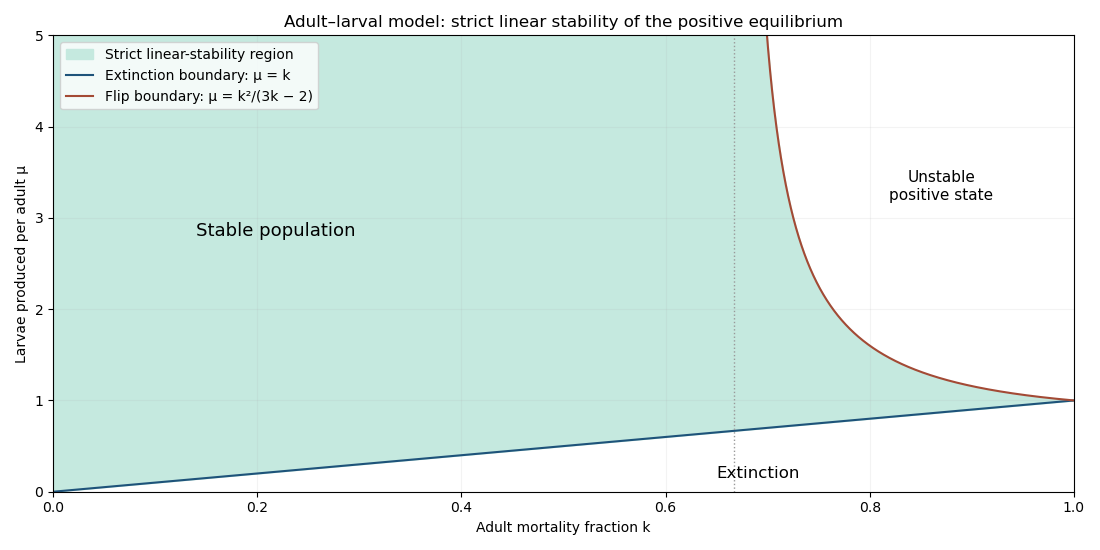
Stability regions and equilibrium branches
. At the lower boundary , the positive equilibrium point merges with extinction, with a multiplier and slow recovery. At the upper boundary a multiplier reaches (the other is ), giving alternating adult/larval fluctuations. The nonlinear map confirms a supercritical period-doubling bifurcation, as follows. For , put and . A nonconstant period-two adult sequence satisfies and . Subtracting and adding these equations givesThus positive unequal values emerge for , with amplitude proportional to . The two larval phases are . If are the trace and determinant of the two-step Jacobian matrix, direct multiplication givesAt onset and , so the other two strict Jury stability criterion inequalities hold for sufficiently small positive . Hence just beyond the upper boundary, a stable period-two population cycle replaces the stable equilibrium. This is a local conclusion, not stability for arbitrarily large reproduction rates.
At the upper boundary itself, the positive equilibrium point is still locally asymptotically stable, despite its multiplier . To decide this equality case, apply the centre manifold theorem for a discrete dynamical system. Put and write the centre graph as with . If the reduced map is , its invariance equation is . Expanding the original recruitment map and this equation through cubic order givesConsequently . The stability at a nondegenerate flip bifurcation criterion shows algebraic attraction on the centre direction; the transverse multiplier has modulus less than one. Including this boundary, the complete local asymptotic-stability condition for a positive population is thereforeThe shaded figure shows the strict linear-stability region; its upper boundary adds this nonhyperbolic attracting case.
Demographic stochasticity near the lower boundary can lead to absorption at extinction; near the upper boundary it excites alternating fluctuations and can blur the deterministic period-doubling bifurcation. These qualitative predictions depend on the chosen stochastic recruitment and mortality rules.
With constant masses, differentiate the moment of inertia twice:For each pair, and . Hence its contribution is . Summing over unordered pairs gives . Time-averaging over yieldsFor a bound system with , or a stationary equilibrium with zero average left-hand derivative, the limit is the virial theoremBounded spatial extent together with bounded velocities suffices for the derivative condition; possible gravitational collisions must be excluded or otherwise regularized.
For the initially homogeneous sphere, and . Conservation of energy and the virial theorem imply , hence . With the usual homologous-sphere approximation, , soThese are the conventional collapse estimates. A final virial equilibrium is not, by itself, guaranteed to remain homogeneous: if , the actual relation is with . Thus the factor of two applies exactly to the gravitational radius, and to the outer radius only under the stated structural approximation.
Here “non-interacting” means collisionless apart from gravity. Baryonic gas can collide, convert ordered motion to thermal energy, and radiate it. If radiative cooling is effective, the fixed-energy virial state loses pressure support and contracts further. Baryonic cooling can destabilize the collisionless virial state; baryons are not inevitably unstable if cooling is slow or heating and pressure support maintain equilibrium.
Zorn lemma states that a partially ordered set in which every chain in a partially ordered set has an upper bound has a maximal element. Include the empty chain in a partially ordered set, so the hypotheses imply that the set is nonempty. Suppose there were no maximal element. Every chain in a partially ordered set has an upper bound , and some ; therefore the set of elements strictly above every member of is nonempty. The axiom of choice selects one such element for each chain in a partially ordered set (and an element of when is empty).
By Hartogs theorem, there is an ordinal which does not inject into . Transfinite recursion defines for all : previous elements form a strictly increasing chain in a partially ordered set, including at limit ordinal stages. All are distinct, giving the forbidden injection. This proves Zorn lemma; the choice of is the use of the axiom of choice.
Apply Zorn lemma to linearly independent subsets of over , ordered by inclusion. A union along a chain in a partially ordered set is linearly independent because each finite linear relation occurs in one member of that chain in a partially ordered set. A maximal independent set spans , since a vector outside its span could be adjoined. Thus has a Hamel basis over .
For a finite basis, the Steinitz exchange lemma proves equality of basis sizes. This also rules out an infinite basis when a finite spanning set exists: write each member of the finite spanning set using finitely many elements of another basis; their finite union spans, and independence leaves no other basis elements. If a basis is infinite with cardinality , the finite-support description of every vector and countability of giveHere infinite cardinal arithmetic uses the axiom of choice. Thus any infinite basis has cardinality , proving all bases have the same cardinality. The zero space has its unique empty basis.
A graph Ramsey number is the least such that every red-blue edge colouring of the complete graph has a red or a blue . At a vertex in , either at least neighbours have red incident edges or at least have blue incident edges. In the first case find a red and adjoin the vertex, or a blue ; the second case is symmetric. ThusStarting with and , induction gives the binomial upper bound for a Ramsey numberFor the lower construction, partition vertices into two classes of size , colour inside-class edges red and between-class edges blue. Red cliques have at most vertices, and the blue graph is bipartite, so has no odd cycle.
Conversely, a graph without an odd cycle is bipartite: in each connected component colour vertices by the parity of the length of a path from a root; differing path parities would give an odd closed walk, hence an odd cycle. On vertices one of the two blue bipartition classes has at least vertices. Every edge within it is red, giving a red . Thus is the exact threshold for this alternative.
Write , where since is a finite-dimensional vector space over its prime field. Every nonzero element satisfies by Lagrange theorem, so is exactly the splitting field of over . The derivative is , making it a separable polynomial. Thus the extension is a normal field extension and a separable field extension, hence a Galois extension.
The finite-field Frobenius automorphism fixes and has . If with , all elements would be roots of the degree- polynomial , impossible. It has order , equal to the degree of the Galois extension. Therefore
Over ,Both quadratics have discriminant , a nonsquare in , so are irreducible polynomials. Both split in the same quadratic finite field . Consequently . Its generator is the finite-field Frobenius automorphism , acting as a product of two transpositions on the four roots.
The polynomial has values at respectively, modulo . Thus has no root and is an irreducible polynomial over . One root generates ; all its Frobenius conjugates are there, so this is its splitting field. Hence , generated by , a 3-cycle on the roots.
Over , the polynomial factors as . Since is not a square modulo , the last factor is an irreducible polynomial. The splitting field is , so . The finite-field Frobenius automorphism fixes and swaps the other two roots.
Burnside's theorem states that every finite group of order is solvable, where are primes and are nonnegative integers. In particular, a nonabelian simple group cannot have order divisible by only one or two distinct primes.
Conjugation by partitions into orbits. Each non-singleton orbit has size divisible by , by the orbit-stabilizer theorem. The singleton orbits are exactly . Since is divisible by , . This set contains , so .
For the deduction we also give the representation-theoretic ingredient behind Burnside's theorem: a nonabelian finite simple group has no nontrivial conjugacy class of prime power size. Here is a proof, so no stronger theorem is being assumed without justification. Suppose has class size . For an irreducible character of degree coprime to , the class sum acts as the scalar , which is an algebraic integer: the class sum has an integer-entry matrix in the regular representation, which contains every irreducible representation, so this scalar is an eigenvalue of an integer-entry matrix. Also is an algebraic integer. Bezout's identity then makes an algebraic integer. All its algebraic conjugates have modulus at most , because character values of a representation are sums of roots of unity. An algebraic integer with this property is zero or a root of unity: the monic polynomials of all its powers have uniformly bounded integer coefficients, so two powers must coincide unless it is zero.
Every nontrivial irreducible representation of a simple group is faithful. If were a root of unity, equality in the triangle inequality would force its representing matrix to be scalar, hence central, impossible. Thus whenever , except for the trivial character of a representation. Orthogonality of the identity column and the column in the character table now givesThis would make an algebraic integer, contradicting the fact that rational algebraic integers are integers. The same proof covers class size directly through triviality of the center.
If an abelian subgroup had index , every would have , making its class size a divisor of , a contradiction. Such a exists: if , then is a nontrivial p-group, whose center is nontrivial by the first argument with . Therefore a nonabelian simple group has no abelian subgroup of prime power index.
Multiplicativity of the determinant gives and , so is a linear character. Its finite image is a cyclic group of roots of unity. If it contains , its order is and the character of a representation maps onto . The kernel of a group homomorphism is the preimage of its identity, so is a normal subgroup of index . The subgroup itself need not have index .
By Cauchy theorem for groups, a group of order has an involution . In the regular representation, left multiplication by is a permutation consisting of disjoint transpositions, so its determinant is when is odd. The preceding argument gives a normal subgroup of index two.
For a nonabelian simple group of order below , Burnside's theorem requires at least three distinct prime factors. An odd order with three factors is at least . An even order with exactly one factor of has a normal subgroup of index . Thus its order must be divisible by and by at least two odd primes. Below the only possibility is , since the next is . Hence .
Use singular homology with integer coefficients. The Künneth theorem for triangulable spaces gives a split short exact sequence with tensor terms and torsion terms . When one factor's homology groups are free abelian, the torsion terms vanish and the tensor map is an isomorphism.
The circle has and all other groups zero. Inductively, the homology groups of a torus are free, andPascal's identity givesGeometrically the generators correspond to choosing of the circle factors and taking their product, consistent with the cellular model having one -cell for each such subset and cancelling opposite boundary faces.
The real Stone-Weierstrass theorem says that a real subalgebra which contains the constants and separates points is dense in for the uniform norm, when is compact Hausdorff space. If is also closed, . The complex version needs closure under complex conjugation; that extra condition is unnecessary here.
Since a subalgebra is closed under addition and scalar multiplication, the given absolute-value property yieldsThe same identity with a minus sign gives . These are pointwise operations on real-valued continuous functions.
Let be disjoint closed subsets of . They are compact. For each , the Hausdorff space condition gives disjoint open neighbourhoods . For fixed , finitely many cover ; intersect the corresponding and take the union of those to obtain disjoint open sets and . Finitely many cover . Their union and the intersection of the corresponding are disjoint open neighbourhoods of . The case of an empty set is immediate. Hence is a normal topological space.
Urysohn lemma states that in a normal topological space satisfying , disjoint closed sets admit a continuous function with on and on .
For , , giving an upper bound for the operator norm. By Urysohn lemma, there is with . Then has uniform norm and . Thus every distinct pair has operator norm , andThe stated hypotheses also permit a singleton . Then there are no distinct pairs, so the infimum is under the extended-real convention, or undefined as a real number. This edge case cannot be assigned the value .
Dominated convergence makes continuous, and . Smooth compactly supported functions are dense in . Their Fourier transforms decay at infinity by integration by parts, so uniform approximation proves the Riemann-Lebesgue lemma: .
For density, smooth compactly supported functions are also uniformly dense in by cutoff and mollification. Each such target is a Schwartz function; its inverse Fourier transform is another Schwartz function, hence belongs to , and Fourier inversion recovers . Therefore the image of a function of is dense in .
The Fourier inversion theorem says that if , then agrees almost everywhere with the inverse integral of . If , this applies and gives almost everywhere. Hence the Fourier transform is injective as a map of equivalence classes, with dense image in .
Integrating the exponential gives the Fourier transform of an interval indicatorThe value at zero is the removable limit, for .
For , the convolution equals the length of the overlap of two intervals:It is continuous and compactly supported, with . Inverse Fourier transform turns this convolution into a product, soThis function is bounded near zero and at infinity, hence lies in . Fourier inversion, or the convolution theorem applied first to the integrable interval indicators, gives .
If the bounded injective Fourier transform were surjective, the open mapping theorem for Banach spaces would make its inverse bounded, yielding . But the preceding have uniform norm , whereas diverges.
For a quantitative lower bound, on we have . On each interval , . For these intervals lie below for large , soThis contradicts boundedness of the inverse. Therefore the Fourier transform has proper dense image in .
Set . Its complex gradient is , never zero on : simultaneous zero would give , which is not on the curve. The complex implicit function theorem therefore gives a one-dimensional complex manifold, hence a Riemann surface. Where use as coordinate, and where use ; the transition maps and both projections are holomorphic.
For , a ramification point of a holomorphic map has and with . In the coordinate , , giving ramification index . Thus there are such points, and their branch points are the th roots of unity.
For , a ramification point of a holomorphic map has . In the coordinate , , giving ramification index at both points and branch points .
Write . At infinity set , ; then . At there are two smooth points, , and is a local coordinate. The extended has a simple pole at each, so neither is ramified. The degree-two Riemann-Hurwitz formula for the map to the Riemann sphere gives , henceThe list for above concerns the original affine Riemann surface; on the compactification its poles at the two added points have order and are additionally ramified if .
For algebraic varieties that are irreducible topological spaces, a rational map is an equivalence class of morphisms on nonempty open subsets of , with two representatives equivalent if they agree on a nonempty open intersection. Such subsets are dense. A birational map has a rational inverse; equivalently it restricts to an isomorphism between dense open subsets. In function field language it induces an isomorphism over the ground field.
Articles were limited to the first 100 out of 182 total.
Articles by others on the same topic
There are currently no matching articles.