A unit vector is a vector of norm one in a normed vector space. For a nonzero vector , vector normalization produces one by dividing by . In a real Euclidean space, this keeps the direction and removes the magnitude. The zero vector cannot be normalized because its norm is zero.
For with Euclidean norm , the corresponding unit vector isThe Euclidean vector can therefore be reconstructed as : size and direction are distinct pieces of information. The standard basis vectors are familiar unit vectors, but a unit vector need not point along a coordinate axis.
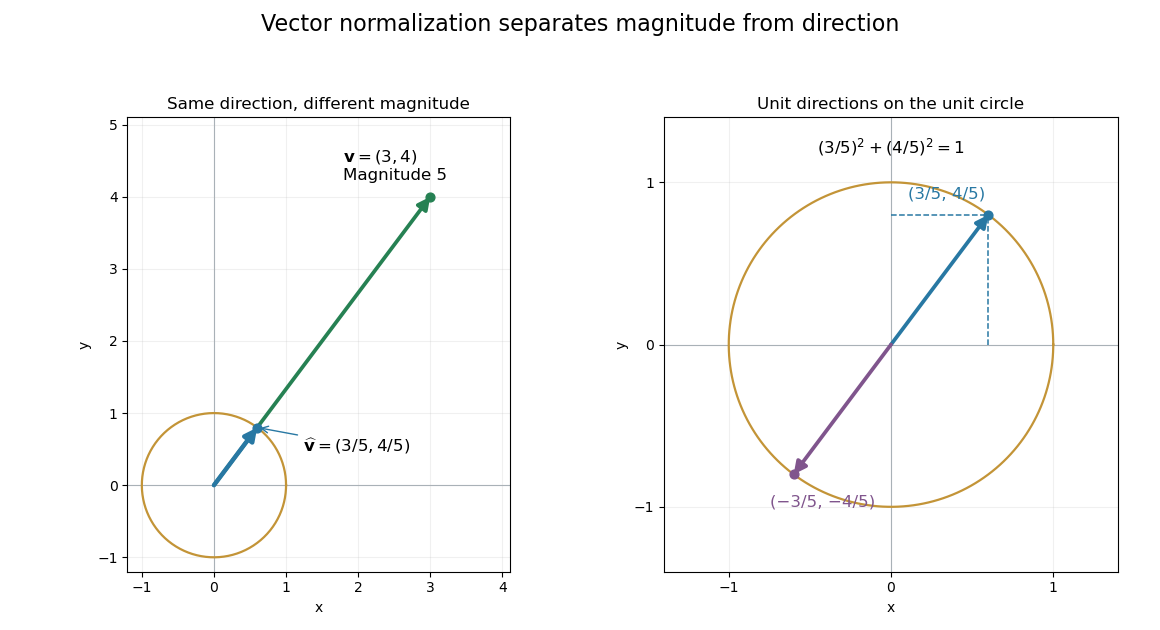
Normalization keeps direction and places the endpoint on the unit circle
. The original Euclidean vector has magnitude . Its vector normalization lies on the unit circle. The enlarged right panel also shows its negative, which has the same Euclidean norm and the opposite direction. Details.Vector normalization converts a nonzero vector in a normed vector space into a unit vector. Absolute homogeneity of a norm givesThe direction is unchanged by multiplying by a positive real scalar. For , and ; for a negative real scalar, . Thus and normalize to the same unit vector, while normalizes to its negative. This decomposition is useful for specifying a direction independently of a force, velocity or displacement magnitude.
In a complex normed vector space, a nonzero complex scalar instead gives . The remaining complex argument is not removed by normalization. For a pure quantum state, vectors differing only by this overall global phase represent the same physical state; vector normalization alone does not identify them.
Vector normalization is not a linear map. With and ,Consequently, adding individually normalized directions does not generally give the direction of the original vector sum. Compute the intended vector sum first, then normalize it if it is nonzero. Cancellation is a further boundary case: has no normalized direction even though both nonzero summands do. A numerical algorithm must check that case before dividing by the norm.
Articles by others on the same topic


A unit vector is a vector that has a magnitude of exactly one. Unit vectors are typically used to indicate direction without regard to magnitude. In mathematical terms, a unit vector is often denoted with a "hat" symbol, such as \(\hat{u}\). For any vector \(\mathbf{v}\), the unit vector in the direction of \(\mathbf{v}\) can be computed by dividing the vector by its magnitude (or length).