Topics (384k) Articles (398k) Users (410) Discussions (242) Comments (383) Files (13k) New article
Past exam of the medicine course of the University of Oxford 1866 First examination Practical chemistry 2 Solution by  Codex 0 2026-10-31
TODO: Solutions d and e and their test observations are absent. Iodine and morphia are named testing targets, not reported positive findings.
Neither iodine in nor morphine in is established. “Morphia” is the historical name for morphine. The available task can nevertheless be explained as two distinct analytical investigations, using separate portions and reference preparations.
For , first distinguish free iodine from iodide. A cool, freshly prepared starch solution gives a strong blue colour with accessible iodine under suitable conditions. Test the reagent by itself and beside a known iodine preparation, so that contamination or a failed reagent is not mistaken for an observation about . The intense blue starch indication is documented in contemporary discussion of the 1864 British Pharmacopoeia.[ref]
Chemical News volume 9 (1864). p. 99, The British Pharmacopoeia, starch as an indicator for the first excess of iodine
An absent direct blue response would not, by itself, exclude iodine present as iodide, or establish that the specimen contains no interfering material. If the task includes combined iodine, an appropriately controlled oxidation on a separate portion is needed to liberate testable iodine; the unoxidized and treated portions answer different questions. The response of the untreated specimen must not be confused with one deliberately produced by changing its chemical state. These are possible branches of the investigation, not observations supplied for .
For , use the period's chemical identity reactions as corroborating observations. The British Pharmacopoeia by the General Medical Council (1864) describes the response of hydrochlorate of morphia to iron(III) chloride and nitric acid: the former gives a blue indication under the specified conditions, and the latter an orange-red indication. The monograph is a reference for a defined material; it does not guarantee that every dilute or impure unknown will reproduce those colours.[ref]
British Pharmacopoeia by the General Medical Council (1864). Morphiæ Hydrochloras, Characters and Tests, pp. 93–94; primary monograph reproduced on PDF page 37 of the linked facsimile presentation
Use separate portions for the two tests and include a reagent blank and a known morphine reference. Acidity, concentration and other coloured or reactive constituents can affect interpretation. A single colour should therefore be treated as preliminary evidence rather than a conclusive identification in an unrestricted unknown. An unexplained failure of the known reference would invalidate the comparison, while a coloured blank would indicate a problem independent of .
Past exam of the medicine course of the University of Oxford 1866 First examination Practical chemistry 1 Solution by Codex 0 2026-10-31
Codex 0 2026-10-31TODO: The single substances in tubes a, b and c and all experimental observations are absent; their identities cannot be determined from the statement.
The identities of , and remain undetermined. The assertion that each tube contains one chemical substance does not specify whether it is an element, a salt or an organic compound, nor which chemical tests would be positive.
A useful qualitative chemical analysis would keep the three samples separate, retain an untouched portion of each, and record their physical state, colour and behaviour with suitable solvents. Small, separately labelled portions would then be used for a logically chosen sequence of chemical tests. For a dissolved salt, for example, examination of its cations and anions addresses different parts of its possible identity; one precipitation reaction is rarely a complete identification. A second independent confirmation and comparison with a known reference would strengthen the conclusion.
The record should distinguish an observation, such as formation of a precipitate under stated conditions, from an inference about composition. No observation, reaction equation or identification can be assigned to any one of , or from the surviving information. The general procedure explains how a candidate could investigate the tubes; it does not complete the missing identifications.
Past exam of the medicine course of the University of Oxford 1866 First examination Physics 9 Solution by Codex 0 2026-10-31
Codex 0 2026-10-31Evaporation cools the remaining material when the escaping vapour takes energy from it faster than the surroundings supply heat. For an observable demonstration, compare two similar thermometer bulbs at the same initial temperature, one dry and the other wetted with a volatile liquid. Expose both to the same controlled airflow. The wetted bulb falls in temperature; the effect depends on vapour removal and environmental conditions. Another demonstration is continued heating during boiling at constant pressure: vapour is produced while the boiling liquid's temperature remains nearly constant. The supplied energy has not vanished; it contributes to the latent heat and expansion associated with the phase transition.
One calorimetry method estimates the specific latent heat of vaporization by condensing a known mass of dry saturated steam at into a known mass of cooler water. Let be the vessel's heat capacity, and the initial and final water temperatures. Assuming complete condensation without escaped steam or thermal losses,soThe last term removes the sensible cooling of the condensed steam. Weighing the receiving vessel before and after gives only if splashing, evaporation and liquid carried in with the steam are controlled. A steam trap and an insulated transfer path address two distinct errors: droplets falsely counted as condensing steam, and cooling before the calorimeter.
The historical local application was Richardson's ether spray. A bellows atomizer dispersed diethyl ether into fine droplets, promoting rapid vaporization and withdrawal of heat from the surface; the cooling could produce local loss of sensation. Benjamin Ward Richardson's 1866 account describes this evaporative method and its apparatus. Its historical physiological language is not adopted as a modern description of nerve signalling, and the account does not establish that the method is appropriate for every operation.[ref]
On a New and Ready Mode of Producing Local Anæsthesia by Benjamin Ward Richardson. 1866, description of the spray apparatus and cooling mechanism
Past exam of the medicine course of the University of Oxford 1866 First examination Physics 8 Solution by Codex 0 2026-10-31
Codex 0 2026-10-31For direct conversion, descending masses can drive paddles in an insulated vessel of water. Measure the lost gravitational potential energy and the temperature rise, including the vessel's heat capacity and corrections for unwanted heat transfer. Repeated reversal of the paddles and fixed baffles inhibit simple bulk co-rotation, directing more of the input towards dissipative fluid motion. Joule's paddle-wheel experiment tests a quantitative mechanical-to-thermal balance, rather than merely observing that stirring can warm water.[ref]
On the Mechanical Equivalent of Heat by James Prescott Joule. 1850, friction experiments and calorimetric corrections
For conversion through electricity, mechanical work drives a generator, whose electric current passes through a resistor in a calorimeter. The measured electrical input is , or for constant electric current and electrical resistance. Joule heating increases the internal energy of the resistor and surrounding water. Compare the generator's mechanical input with the total thermal gains, including generator and circuit losses if the system boundary contains them. A battery alone demonstrates electrical-to-thermal conversion; without accounting for a mechanically driven source it does not establish the requested mechanical intermediate chain.
Using the given value relative to water, the copper requiresWith the modern thermochemical calorie, , so the ideal required work isEquivalently it is about using standard gravity. A nineteenth-century numerical equivalent of heat could give a slightly different rounded result. The stipulated constant specific heat capacity is used here; an unprovided vessel heat capacity and environmental losses would add to the required input.
Past exam of the medicine course of the University of Oxford 1866 First examination Physics 7 Solution by Codex 0 2026-10-31
Codex 0 2026-10-31An optically active glucose solution rotates the direction of linear polarization. With monochromatic illumination, rotating the polarimeter analyzer again produces a maximum and an extinction, but at angles shifted from the water-filled reference tube. In an ideal transparent sample, Malus's law givesThe specific rotation is defined for a stated temperature, wavelength, solvent and concentration convention. With in decimetres and in grams per millilitre, the conventional numerical value of must use the matching units. A broadband source generally gives coloured appearances because the rotation varies with wavelength; one analyser angle need not extinguish every colour.
Biot's saccharimeter is an angular polarimeter: a polarizing element, a tube of accurately known optical path length holding the sample between plane end windows, and a rotatable analysing element with an angular scale. The original arrangement used a black-glass polarizing mirror and a calcite analyser; later two-prism designs implement the same angular measurement. It should be distinguished from a later quartz-wedge compensating saccharimeter, which cancels the sample's rotation instead of directly reading the analyser rotation.[ref]
A Handbook of Sugar Analysis by Charles Albert Browne Jr.. pp.84–85, original Biot polariscope and simple angular polariscope; chapter VI, quartz-wedge compensation
For a historical urine estimate, clarify a sample without changing its sugar inventory, fill the tube without bubbles, make a solvent blank at the same settings, and measure the signed rotation relative to that blank. With a known dilution factor and an appropriate equilibrium glucose calibration,Repeat the reading and check a known glucose solution. Mutarotation makes the time since preparation relevant. The inference is selective only to the extent that other optically active solutes have been excluded or accounted for; a net rotation is not proof that every contribution is glucose. This is a historical analytical application, not a replacement for present clinical assessment of diabetes.
Past exam of the medicine course of the University of Oxford 1866 First examination Physics 6 Solution by Codex 0 2026-10-31
Codex 0 2026-10-31The cornea supplies much of the eye's converging optical power; the crystalline lens supplies additional, adjustable power through ocular accommodation. The transparent aqueous and vitreous media transmit the light. The iris controls the pupil, acting as an aperture rather than as the focusing element, and the retina is the receiving surface. The posterior optic nerve conveys the resulting neural signals; it does not carry an optical picture out of the eye.
Each sufficiently small object patch sends a pencil of rays through the pupil. Refraction at the corneal and lenticular surfaces brings that pencil towards a retinal image point. Pencils from different object heights meet at different retinal positions, producing a real inverted image. In a paraxial equivalent model,The several physical refracting surfaces have been replaced here by an equivalent thin lens; this is a model, not a claim that all bending occurs at the crystalline lens. For a distant object, approximately parallel incoming pencils focus near the back focal surface. Ocular accommodation increases power for nearer objects while the retinal position remains nearly fixed.
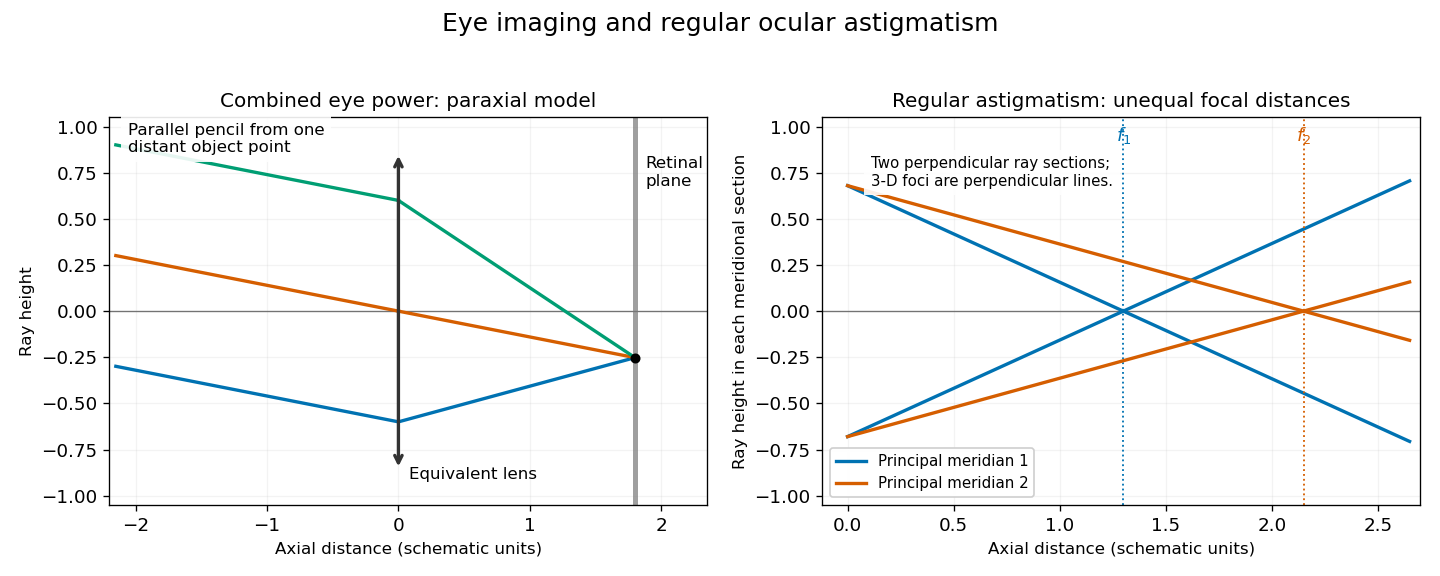
In regular ocular astigmatism, the two principal meridians are perpendicular but have different refractive powers, commonly because the cornea has different curvatures in those meridians. A point object then gives two line foci at different depths rather than a single sharp point. The difference is not merely an overall spherical focusing error. Refraction with differently oriented cylindrical trial lenses can locate the power and axis; keratometry or corneal topography measures corneal shape. Cylindrical lens or toric lens correction supplies the missing meridional power with the proper orientation. Spectacles and appropriately fitted toric contact lenses can provide such correction. A method for measuring corneal curvature should not be confused with a complete measurement of the eye's total refractive error.[ref]
Physiology of Astigmatism by the American Academy of Ophthalmology. Regular astigmatism and principal meridians
[ref] Past exam of the medicine course of the University of Oxford 1866 First examination Physics 5 Solution by Codex 0 2026-10-31
Codex 0 2026-10-31A free reed is a thin elastic tongue fixed at one end over a closely fitting opening in a rigid frame. A pressure difference drives an airflow; displacement of the tongue alters the available opening, and the changing aerodynamic force can sustain its vibration against elastic restoring force and damping. Unlike a beating reed, the tongue passes through the opening without regularly striking its rim. The air supply provides the energy; the reed's dimensions and stiffness largely set the pitch, while its enclosure and any attached pipe modify the response and radiated sound waves.
The useful analogy with phonation is an airflow-driven valve coupled to an elastic oscillator. Air from the lungs passes between the vocal folds in the larynx. Their motion periodically modulates the flow, generating a rich sound spectrum; the pharynx, mouth and nasal passages filter it, while the tongue and lips help form speech sounds. The vocal folds are paired living tissues with adjustable tension and geometry, rather than a single metal tongue. Their oscillation should not be explained as a passive string struck repeatedly by air, nor does the free-reed analogy establish every detail of tissue motion. [ref]
Taking Care of Your Voice by the National Institute on Deafness and Other Communication Disorders. “What is voice?” and the labelled structures of voice production
Changing vocal-fold tension and effective vibrating mass changes the source pitch. Changing the resonating passages changes its spectral envelope and the vowel quality. Those are different controls: a singer can change pitch while retaining a recognisable vowel, or change vowel while sustaining approximately the same pitch.
Past exam of the medicine course of the University of Oxford 1866 First examination Physics 4 Solution by Codex 0 2026-10-31
Codex 0 2026-10-31A clean narrow tube dipped in a wetting liquid displays a curved meniscus and a rise above the external free surface. With a nonwetting liquid, such as Mercury against clean glass under the usual conditions, there is a convex meniscus and a depression. The material pair and surface cleanliness matter; small diameter alone does not determine the sign.
For a circular tube of radius , surface tension , and equilibrium contact angle measured through the liquid, the vertical force at the contact line is . Neglecting the small meniscus-volume correction, its balance with the excess column's gravitational weight gives Jurin's law:Thus the signed height is inversely proportional to radius for a fixed liquid, wall, temperature and contact angle. Increasing the tube length beyond the required column does not increase the equilibrium height. A short tube that cannot contain that column is a different boundary problem.
The same result follows from the Young–Laplace equation: a curved interface supports a capillary pressure difference, balanced by the hydrostatic head. Molecular interactions establish the surface tension and the preference for wetting the solid, encoded in the contact angle. The force balance does not require molecules to attract across the whole height of the column. To test the inverse-radius law, use tubes of several measured radii with the same surface preparation, and compare after equilibrium; different cleaning or contact-angle hysteresis can otherwise imitate a failure of the radius law.
Past exam of the medicine course of the University of Oxford 1866 First examination Physics 3 Solution by Codex 0 2026-10-31
Codex 0 2026-10-31A hydrometer is a sealed floating instrument with a weighted bulb and a narrow graduated stem. The ballast keeps the stem upright. By Archimedes' principle, its gravitational weight equals the buoyancy:It therefore sinks farther into a less dense liquid, displacing more volume, and floats higher in a denser one. The stem makes a small volume change readily visible as a change in immersion. If its cross-sectional area is , then over a uniform part of the stem. A density scale is consequently not generally uniform in .
Float the clean instrument freely in a sufficiently deep sample, without its touching the wall or bottom. Remove adhering bubbles, allow the temperature and motion to settle, and read the liquid surface at eye level using the meniscus convention specified for that instrument. A calibration for a particular temperature or reference density cannot be transferred without correction: both the sample and the instrument expand. An ordinary hydrometer measures density or specific gravity; a special scale for a particular chemical solution does not make it chemically selective. In particular, dissolved substances other than glucose can affect the density of urine.
Past exam of the medicine course of the University of Oxford 1866 First examination Physics 2 Solution by Codex 0 2026-10-31
Codex 0 2026-10-31The magnitude of the gravitational force remains approximately during a laboratory swing. Its tangential component changes with position, however. For simple pendulum length and angle measured from the downward vertical,This restoring component is zero at the lowest point and largest in magnitude at the turning points. It always accelerates the bob towards the lowest point. The radial gravitational component is ; the string tension must additionally supply the centripetal acceleration, so . Thus it is the radial resultant, not gravity alone, that bends the trajectory. The bob has maximum speed at the bottom even though its tangential acceleration is then zero.
For a small angular amplitude, the small-angle approximation gives simple harmonic motion with oscillation period . Measure from pivot to the bob's centre of mass, time many complete swings, divide the elapsed time by their number, and calculateRepeat with several lengths and plot against ; the ideal slope is . The first-order relative uncertainty obeys , with absolute uncertainty contributions combined according to their dependence. Keep the amplitude small: the finite-amplitude period is , with in radians. Using the longer finite-amplitude period in the small-amplitude formula would underestimate . Pivot friction, a finite bob and support motion are further experimental corrections.[ref]
University Physics Volume 1 by William Moebs and others. §15.4, simple pendulum and small-angle period
Past exam of the medicine course of the University of Oxford 1866 First examination Physics 12 Solution by Codex 0 2026-10-31
Codex 0 2026-10-31For Ørsted's experiment, place a long straight conducting wire close to and parallel with a freely moving horizontal compass needle. With no electric current, the needle follows the horizontal terrestrial magnetic field. Closing the circuit deflects it; reversing the electric current reverses the deflection, and moving the wire from above to below the needle also reverses the effect. For a long straight wire, the modern idealization iswith the circular direction given by the right-hand rule. These controls distinguish a magnetic action of the current from a fixed magnetized piece of wire or a mechanical disturbance.
Nobili's astatic galvanometer increases sensitivity in two ways. A coil with many turns multiplies the magnetic action of a given electric current. Two nearly equal magnetized needles are rigidly connected with opposite magnetic dipole moments and suspended by a fine thread. Their torques in the approximately uniform terrestrial field nearly cancel. In a common arrangement one needle lies inside the coil and the other above it, outside its strongest field, so the coil retains a substantial torque while the terrestrial restoring torque is reduced. A weak residual magnetic or suspension torque still provides a reproducible equilibrium; “astatic” means nearly cancelled terrestrial torque, not magnetic shielding. A museum instrument dated 1840 has many turns of fine wire and is identified with measurements of muscle currents.[ref]
Astatic Galvanometer, Nobili Pattern by Museo Galileo. Inventory 1417: construction and muscle-current provenance
For weak physiological sources, use a long fine-wire winding with many turns, rather than the short thick winding appropriate to a low-resistance thermoelectric source. The physiological source commonly has a large effective internal resistance; a moderate added coil resistance is then outweighed by the gain in turns. This is a source-and-detector matching argument, not a claim that arbitrarily much wire always improves sensitivity.
For example, at fixed mean turn length and fixed copper winding volume, . For source electromotive force and resistance , the small-angle driving torque is proportional toDifferentiation gives its maximum at . This simple optimal turn count for fixed winding volume model explains why high-source-resistance work favors more turns, while also exposing the limit. Actual instruments additionally trade response time, damping, geometry and source loading against their steady deflection.
Past exam of the medicine course of the University of Oxford 1866 First examination Physics 11 Solution by Codex 0 2026-10-31
Codex 0 2026-10-31With the electrodes disconnected, the copper has no sustained external route through which to receive electrons from the zinc. It is not appreciably attacked by a clean, dilute nonoxidizing sulfuric acid solution. Zinc can in principle reduce acid while dissolving, but amalgamation suppresses much of the local action associated with impurities and promotes a high kinetic barrier for hydrogen evolution on the amalgamated surface. Thus the intended historical observation is little visible action with the circuit open, not a thermodynamic assertion that zinc cannot react with acid.
Closing the external wire supplies an electron path. At the zinc anode,at the copper cathode,The net redox is thereforeThe zinc dissolves, and bubbles of hydrogen appear chiefly at the copper. Electrons flow through the wire from zinc to copper; conventional electric current flows oppositely there. Ionic transport through the electrolyte completes the circuit and prevents indefinite charge accumulation in the solution. The copper primarily provides a conducting surface: there is no stipulated copper-ion solution from which metallic copper must be deposited, so this is not the Daniell cell reaction.
The chemical energy supplies the electrical work. Accumulation of hydrogen and changing interfacial conditions can polarize the cell, reducing the current. A complete description therefore distinguishes the initial closed-circuit response from an indefinitely constant-current idealization. Electrochemical overpotential explains why a favorable reaction and its observable rate are different questions.
Past exam of the medicine course of the University of Oxford 1866 First examination Physics 10 Solution by Codex 0 2026-10-31
Codex 0 2026-10-31At the heated bottom, thermal conduction first transfers energy into the adjacent gas. A warmer parcel ordinarily has lower density than its cooler surroundings at approximately the same local pressure, so buoyancy drives it upward. Cooler gas replaces it below, creating natural convection. Motion and mixing transport warm gas through the vessel, with conduction continuing across smaller temperature differences. In a sealed rigid vessel the mean pressure can rise as heating continues; “less dense at the same local pressure” is the buoyancy comparison, not a claim that the vessel's overall pressure stays fixed.
A useful control heats an otherwise similar vessel at the top: the resulting warm-over-cold arrangement is stably stratified, suppressing the overturning seen with bottom heating. Heat still spreads by thermal conduction; absence of bulk overturning does not mean absence of heat transfer.
For unwarmed cold outside air, use distributed high-level inlets or upper window openings that let the incoming stream mix with warmer room air before descending into the occupied region. A concentrated low-level cold stream can pass directly across people's feet without first mixing. Provide a separate route for outgoing air and avoid an inlet-to-outlet shortcut that leaves the occupied region poorly ventilated. The UK Health Security Agency's guidance specifically notes that a top window opening allows incoming air to warm as it mixes, reducing cold draughts.[ref]
Ventilation to Reduce the Spread of Respiratory Infections by the UK Health Security Agency. Natural ventilation in the home, top window openings and mixing
This is not a universal rule that every inlet belongs at the ceiling. A low inlet beside a heat source can warm the air before it rises, and deliberately designed displacement systems use other arrangements. Wind, opening heights, available pressure differences and the exhaust path determine the actual flow. The relevant principles are controlled air replacement, buoyancy and mixing, not height in isolation.
Past exam of the medicine course of the University of Oxford 1866 First examination Physics 1 Solution by Codex 0 2026-10-31
Codex 0 2026-10-31A lever is a body free to rotate about a fulcrum. Its usefulness comes from a balance of torques, not from producing energy. For a stationary ideal lever, let and be the perpendicular lever arms of the effort and load . ThenThe mechanical advantage uses perpendicular distances to the lines of action, which need not equal distances measured along a bent or obliquely loaded arm. In an ideal slow motion, the effort moves through the larger distance when its force is the smaller: work is conserved.
For the three familiar straight arrangements, the fulcrum lies between effort and load in a first-class lever, the load lies between fulcrum and effort in a second-class lever, and the effort lies between fulcrum and load in a third-class lever. The second class has ideal mechanical advantage greater than one; the third has it less than one. The first can have either, depending on the lever arms.
The forearm bends by elbow flexion. The biceps brachii and brachialis pull through short tendons close to the elbow, while a load in the hand acts farther away. This is predominantly a third-class arrangement: a large muscle force buys a comparatively large and rapid hand displacement. The biceps brachii also contributes to forearm supination. Elbow extension is produced chiefly by the triceps brachii, whose tendon acts on the olecranon behind the elbow. The extensor insertion and forearm load lie on opposite sides of the effective pivot, giving the corresponding first-class analogy. Actual anatomical joint motion has changing muscle moment arms, and the joint reaction force also enters the full force balance; the body is not a set of frictionless pins. [ref]
Past exam of the medicine course of the University of Oxford 1866 First examination Chemistry 9 Solution by Codex 0 2026-10-31
Codex 0 2026-10-31Use a qualitative separation into aqueous extract, lipid-soluble material, protein-rich residue and mineral matter, and test each fraction independently. A tubercle is a lesion containing several kinds of material, not a pure chemical compound with one diagnostic formula. The question asks how to investigate its composition; no observations or numerical composition are supplied.
First record the lesion's physical appearance and take a portion for microscopy before destructive treatment. Separate the lesion from surrounding tissue as far as practicable, while recording that contamination by blood, connective tissue or adherent salts can affect the analysis. Different stages of a lesion need not have the same proportions of organic material and calcified matter. A small portion gently dried in suitable apparatus shows whether much water is lost; collecting condensation supports identification of the volatile fraction as containing water, although mass loss alone is not a chemically specific water test.
- The water extract contains soluble salts and some soluble organic material. Test its reaction with litmus; heating a suitable clear portion can disclose coagulable protein. Acidification and heating must be controlled because changes of pH and high salt content can alter coagulation. The absence of a heat coagulum does not prove the absence of every protein.
- An ethanol or diethyl ether extraction can remove lipids and other solvent-soluble material. Evaporating a separated solvent extract leaves material whose solubility, oily or crystalline appearance, and behaviour on heating help characterize it. Hydrolysable fats can undergo saponification; cholesterol belongs to the unsaponifiable fraction. A greasy residue alone does not establish one particular lipid.
- Examine the largely insoluble organic residue for protein. A controlled alkaline copper reaction gives the violet biuret test with sufficient peptide bonds; the yellow xanthoproteic reaction with nitric acid supplies corroborating evidence for suitable aromatic residues. Neither colour establishes that all the material is specifically albumin, casein or a hypothetical unique “tuberculin” substance. Record the reaction conditions and use a reagent blank and known positive material.
- Ignite a separate portion carefully to remove combustible organic material, then examine the ash. Dissolve suitable portions in a noninterfering chemical acid. Calcium can be recognized by oxalate precipitation under appropriate conditions; phosphate by an established phosphate test such as the yellow ammonium phosphomolybdate reaction. Carbonate can be recognized by acid-induced carbon dioxide evolution and a separate limewater test. These are separate aliquots: acid treatment used to dissolve the ash can destroy evidence for the original carbonate.
Test soluble salts using a fresh portion or a suitable water extract: for example, silver nitrate can detect chloride, while barium under controlled acidic conditions can detect sulfate. A chloride test should not be performed on material already contaminated with hydrochloric acid. The results identify constituents or operational fractions, not necessarily the precise salts originally present in intact tissue; ashing can also change their chemical forms.
If the intended composition is elemental rather than proximate, investigate an isolated organic fraction separately: oxidation with heated copper(II) oxide can convert its carbon into carbon dioxide and its hydrogen into water, which are trapped and identified independently. A suitable nitrogen determination can convert organic nitrogen into Ammonia for identification in a separate receiver. Mineral carbonate and pre-existing moisture must be controlled before attributing these products to the organic material. Such tests answer a different question from identifying the particular proteins or lipids.
This approach has a historical basis. Original analyses by Robert Mortimer Glover, reproduced in an 1847 review, separately extracted material with ethanol, diethyl ether and water, then examined protein-rich residues and mineral salts. They reported variation between lesions and did not consistently find casein. This evidence supports fractionation and caution about specificity, not one universal numerical recipe for all tubercles.[ref]
A modern conclusion must separate composition from cause. A protein-, lipid- and phosphate-containing lesion is not thereby proved to be tuberculosis. Histological interpretation and appropriate microbiological examination are different investigations. Current confirmation of Mycobacterium tuberculosis involves validated tests such as nucleic acid amplification and culture, rather than the extraction reactions above; these are modern qualifications and are not attributed to the 1866 examination.[ref]
Clinical and Laboratory Diagnosis for Tuberculosis by CDC. Bacteriologic examination, nucleic acid amplification and culture sections
Past exam of the medicine course of the University of Oxford 1866 First examination Chemistry 8 Solution by Codex 0 2026-10-31
Codex 0 2026-10-31Spectrum analysis identifies substances by the positions and patterns of characteristic spectral lines, rather than by the overall colour of a flame alone. A small amount of a suitable salt is introduced into a hot, weakly luminous flame. In the historical prism spectroscope, light enters a narrow slit, a collimator makes the emerging rays nearly parallel, a prism separates them by wavelength, and an observing telescope shows images of the slit at different spectral positions. A reference scale or comparison spectrum makes positions reproducible.
A clean platinum wire and reagent blank help distinguish the sample's signal from contamination. A reference sample establishes the expected positions, while repeated cleaning and testing check whether an unfamiliar line belongs to the sample. Several substances can be recognized in one mixture because their characteristic line patterns can coexist, although overlapping lines and changing excitation conditions complicate identification. Robert Bunsen and Gustav Kirchhoff's original account explicitly emphasizes the faint background of the flame, the prism instrument and the characteristic patterns of alkali and alkaline-earth salts.[ref]
Chemical Analysis by Observation of Spectra by Gustav Kirchhoff and Robert Bunsen. 1860 paper, apparatus and comparison of salt spectra
In modern terms, emission lines arise when excited chemical atoms or ions release photons at energies corresponding to allowed differences between energy levels:The quantum mechanics behind this equation is a later explanation, not the theory available to an 1866 candidate. Similarly, absorption lines appear when a cooler foreground gas removes particular wavelengths from a brighter background. Agreement between laboratory line positions and dark lines in the solar spectrum permits identification of constituents of the solar atmosphere without bringing a solar sample into the laboratory. It does not establish the detailed chemical constitution of every layer of the Sun.
By December 1866, striking examples included caesium (1860), rubidium (1861), thallium (1861) and indium (1863). The first two were recognized in the work of Robert Bunsen and Gustav Kirchhoff, using conspicuous blue and deep-red spectral features respectively. William Crookes recognized the characteristic green line associated with thallium, while Ferdinand Reich and Hieronymus Theodor Richter identified indium through its indigo-blue spectral signature. These observations motivated chemical separation and further characterization; an unexpected line by itself is a clue to a new chemical element, not a complete proof.[ref]
Caesium — Element information, properties and uses. History, discovery in 1860
[ref]Rubidium — Element information, properties and uses. History, discovery in 1861
[ref]Thallium — Element information, properties and uses. History, green spectral line and 1861 announcement
[ref]Indium — Element information, properties and uses. History, 1863 discovery
The corresponding recognition of familiar chemical elements in the solar spectrum opened stellar chemical analysis. Later discoveries such as solar helium should not be credited to the 1866 state of the subject.
Past exam of the medicine course of the University of Oxford 1866 First examination Chemistry 7 Solution by Codex 0 2026-10-31
Codex 0 2026-10-31The relevant historical route starts with phosphate-rich bone ash, converts it into a reducible phosphate preparation, and heats that preparation with carbon to obtain elemental phosphorus. Bone contains phosphorus in phosphate, not as free pieces of phosphorus awaiting extraction.
Burning cleaned bones removes most organic matter and leaves bone ash, rich in calcium phosphates. Although natural bone mineral is not pure , that formula is a useful historical reaction model. Treatment with sulfuric acid forms sparingly soluble calcium sulfate and a soluble acid phosphate fraction. With partial removal of calcium, an idealized balance isSeparate the sulfate-rich residue, concentrate the phosphate-bearing liquor, and heat the resulting material with charcoal in a retort. Dehydration and high-temperature reduction produce phosphorus vapour together with carbon oxides, while a calcium phosphate residue remains. One overall balance for the acid-phosphate route isThis is a summed process balance; it does not imply that the hydrated phosphate survives unchanged until one elementary reaction suddenly occurs. It also makes clear that the partial-acid route leaves some of the original phosphorus in the calcium phosphate residue. Contemporary descriptions distinguish this route from treating the ash with enough sulfuric acid to give a more fully acidified phosphorus-bearing liquid.[ref]
Lessons in Elementary Chemistry by Henry Enfield Roscoe. 1868 printing, Lesson XV, printed pp. 131–133: bone ash, acid phosphate and charcoal reduction; later printing used as historical description, not a pharmacopoeia
The retort outlet leads to a water-covered receiver: phosphorus vapour condenses and is protected from air. The collected product is principally white phosphorus, with molecular form . Its readiness to oxidize and ignite is why collection under water belongs to the explanation of the apparatus. This historical product must be distinguished from red phosphorus, obtained by a subsequent controlled transformation rather than directly identified with the freshly condensed product.
For comparison, the well-known silica-assisted phosphate-reduction balance isHere silica binds calcium into a silicate-rich residue. Modern electric-furnace manufacture uses this principle; describing an electric furnace as the ordinary 1866 apparatus would be anachronistic. The historical answer is the sequence bone ash → acid phosphate preparation → carbon reduction in a retort → condensation of phosphorus under water.
Past exam of the medicine course of the University of Oxford 1866 First examination Chemistry 6 Solution by Codex 0 2026-10-31
Codex 0 2026-10-31Potassium iodide is prepared by converting iodine into iodide, then obtaining a pure crystalline potassium salt. One chemical route uses potassium hydroxide; an alternative first forms iron(II) iodide. The account here describes the chemical operations and their balances, without assigning a later pharmacopoeial formula to 1866.
In the alkaline route, iodine reacts with hot potassium hydroxide to give a mixture of potassium iodide and potassium iodate:This is disproportionation: iodine goes from oxidation state to both and . Merely evaporating the solution would leave the unwanted iodate with the iodide. Heating the dried salts with charcoal reduces the iodate to iodide. A limiting balance with carbon monoxide as the carbon oxide product isThe carbon oxides can depend on the reaction conditions; the indispensable chemical point is removal of the iodate's oxygen without losing its iodine. Extraction with water, filtration of insoluble residue, concentration and crystallization then recover potassium iodide. A modern USDA technical evaluation explicitly describes this same reaction sequence; it is corroboration of the chemistry, not evidence that its modern document was the 1866 official recipe.[ref]
Potassium Iodide technical evaluation by United States Department of Agriculture. 2011 report, printed pp. 5–6, Evaluation Question 1, method (a)
In the alternative iron route,followed byThe insoluble iron-containing material is separated and the potassium iodide recovered from the liquid. Oxidation of the ferrous precipitate during working can alter its final form, so the displayed chemical equation is the ideal metathesis balance rather than a guarantee that every collected particle remains pure iron(II) carbonate.
Pure potassium iodide is a colourless or white crystalline ionic solid, commonly in cubic crystals, readily soluble in water and less soluble in ethanol. It has no intrinsic brown iodine colour. Its aqueous solution contains potassium ions and iodide ions. Free iodine dissolves in the presence of iodide through triiodide formation,With silver nitrate, iodide gives yellow silver iodide, sparingly soluble in water and resistant to ordinary aqueous Ammonia:A little chlorine liberates iodine, which gives the characteristic colour with starch:By contrast, iodate contamination can liberate iodine simply on acidification in the presence of iodide:That distinction explains why removal of the iodate is part of preparing a well-defined product, rather than an optional cosmetic step. These are chemical properties and recognition principles, not advice to administer the salt.
Past exam of the medicine course of the University of Oxford 1866 First examination Chemistry 5 Solution by Codex 0 2026-10-31
Codex 0 2026-10-31Purified coal gas is mainly molecular hydrogen, methane and carbon monoxide, with smaller quantities of other hydrocarbons and diluent gases. It is made by heating coal in retorts with little or no admitted air, not by completely burning the coal.
The hot products include permanent gases, condensable organic vapours and water vapour, leaving coke in the retort. Cooling removes much of the coal tar and condenses water, which captures Ammonia as ammoniacal liquor. Further washing and purification remove much of the remaining Ammonia, hydrogen sulfide and other objectionable constituents before the gas is distributed. A crude retort product and purified household coal gas therefore have different compositions.
Molecular hydrogen is commonly the largest component by volume. Methane is another major combustible constituent, while carbon monoxide contributes fuel value and serious toxicity. Ethylene and other unsaturated hydrocarbons, together with vapours such as benzene, contribute strongly to the luminous flame. Their thermal breakdown can produce incandescent soot, explaining why a small fraction of heavier hydrocarbons can disproportionately affect lighting quality. Smaller or variable quantities of carbon dioxide and molecular nitrogen dilute the combustible mixture. Molecular oxygen is not an intended major constituent; air ingress can change the mixture.
There is no single balanced chemical equation for making coal gas: coal is a complex feed and produces many products simultaneously. Nor is one exact percentage composition universal; it depends on the coal, retort temperature, operating conditions and purification. The main distinction is between the light combustible gases, the smaller illuminating hydrocarbon fraction, and contaminants or diluents. Modern natural gas, usually rich in methane, should not be used as a synonym for historical coal gas.
Past exam of the medicine course of the University of Oxford 1866 First examination Chemistry 4 Solution by Codex 0 2026-10-31
Codex 0 2026-10-31In a suitably dilute, nonoxidizing chemical acid, hydrogen sulfide precipitates the sufficiently insoluble sulfides, including those of copper, lead, Mercury, bismuth, cadmium, arsenic, antimony and tin. “Sulphuretted hydrogen” is the historical name for hydrogen sulfide, . Oxidation state and acidity must be specified: the statement is not independent of every possible chemical solution condition.
| Representative dissolved species | Principal precipitate | Usual appearance |
|---|---|---|
| Copper(II) | Black | |
| Lead(II) | Black | |
| Mercury(II) | Black when freshly precipitated | |
| Bismuth(III) | Brown-black | |
| Cadmium(II) | Yellow | |
| Arsenic(III) | Yellow | |
| Antimony(III) | Orange | |
| Tin(II) | Brown or brown-black | |
| Tin(IV) | Yellow |
Arsenic is now classed as a metalloid; the historical analytical grouping was not a rigorous modern division into metals and nonmetals. Dissolved silver also gives black in acidic conditions. It is often absent from the conventional second analytical group because a preceding hydrochloric acid treatment has already removed it as silver chloride. Suitable gold and platinum solutions can likewise yield dark sulfide precipitates, although their speciation and reduction chemistry make a simple universal colour rule inappropriate. Thus an analytical group is a separation convention, not a list of every ion that can possibly react.
For a divalent metal ion, a useful net balance isThe selectivity follows from two coupled chemical equilibrium conditions. Hydrogen sulfide is a weak acid; increasing suppresses its ionization. Approximately,Even this small sulfide activity can exceed the solubility product of very insoluble sulfides. More soluble sulfides, such as those of zinc and manganese, generally require less acidic or alkaline conditions. Consequently an excessively strong chemical acid, complex formation or an oxidizing medium can change the result. Colours alone are preliminary indications, not final identification.[ref]
Qualitative Analysis of Metal Ions in Solution by Williams College. Experiment 2–3, Introduction and Group II discussion, printed II & III-1–3 and II & III-9–10
The traditional preparation treats iron(II) sulfide with a dilute nonoxidizing chemical acid:A gas-generating flask with controlled acid entry and a delivery outlet conducts the product to the test solution. The apparatus must permit gas flow and contain the effluent rather than accumulating pressure in a sealed vessel. Sulfuric acid in dilute form can replace hydrochloric acid; concentrated oxidizing acids are unsuitable for this simple preparation. Hydrogen sulfide is acutely toxic, and loss of odour perception makes smell an unreliable warning: the historical apparatus describes a laboratory principle, not a household test.[ref]
Hydrogen sulfide by the National Institute for Occupational Safety and Health. Physical Description, odour fatigue, Symptoms and Target Organs
Pinned article: Introduction to the OurBigBook Project
Welcome to the OurBigBook Project! Our goal is to create the perfect publishing platform for STEM subjects, and get university-level students to write the best free STEM tutorials ever.
Everyone is welcome to create an account and play with the site: ourbigbook.com/go/register. We belive that students themselves can write amazing tutorials, but teachers are welcome too. You can write about anything you want, it doesn't have to be STEM or even educational. Silly test content is very welcome and you won't be penalized in any way. Just keep it legal!
Intro to OurBigBook
. Source. We have two killer features:
- topics: topics group articles by different users with the same title, e.g. here is the topic for the "Fundamental Theorem of Calculus" ourbigbook.com/go/topic/fundamental-theorem-of-calculusArticles of different users are sorted by upvote within each article page. This feature is a bit like:
- a Wikipedia where each user can have their own version of each article
- a Q&A website like Stack Overflow, where multiple people can give their views on a given topic, and the best ones are sorted by upvote. Except you don't need to wait for someone to ask first, and any topic goes, no matter how narrow or broad
This feature makes it possible for readers to find better explanations of any topic created by other writers. And it allows writers to create an explanation in a place that readers might actually find it.
Figure 1. Screenshot of the "Derivative" topic page. View it live at: ourbigbook.com/go/topic/derivativeVideo 2. OurBigBook Web topics demo. Source. - local editing: you can store all your personal knowledge base content locally in a plaintext markup format that can be edited locally and published either:This way you can be sure that even if OurBigBook.com were to go down one day (which we have no plans to do as it is quite cheap to host!), your content will still be perfectly readable as a static site.
- to OurBigBook.com to get awesome multi-user features like topics and likes
- as HTML files to a static website, which you can host yourself for free on many external providers like GitHub Pages, and remain in full control

Figure 2. You can publish local OurBigBook lightweight markup files to either OurBigBook.com or as a static website.
Figure 3. Visual Studio Code extension installation.
Figure 5. . You can also edit articles on the Web editor without installing anything locally. Video 3. Edit locally and publish demo. Source. This shows editing OurBigBook Markup and publishing it using the Visual Studio Code extension. 
- Infinitely deep tables of contents:



All our software is open source and hosted at: github.com/ourbigbook/ourbigbook
Further documentation can be found at: docs.ourbigbook.com
Feel free to reach our to us for any help or suggestions: docs.ourbigbook.com/#contact