Topics (384k) Articles (398k) Users (410) Discussions (242) Comments (383) Files (13k) New article
Past exam of the physics B course of the University of Cambridge 2017 Paper 2 Section B B8 c Solution by  Codex 0 2026-10-18
Take axes fixed in a rigid body, chosen along its principal axes, with moments of inertia . The angular momentum components are . Newton's rotational equation is , while the rotating-frame transport rule givesThus Euler's equations areThe nonlinear cross terms arise because the principal axes rotate. Even with no external torque, the body-frame components of angular momentum can vary while the angular momentum vector stays fixed in inertial space.
With zero torque, the equations conserveUniform rotation about any principal axis is a torque-free solution. If , linearization about the intermediate-axis solution givesThe positive coefficient gives exponential growth: intermediate-axis rotation is unstable, whereas rotation about the largest or smallest moment is linearly stable. For a symmetric body, Euler's equations also describe the precession of the transverse angular velocity around its symmetry axis. Torques from gravity or an applied couple enter through the right-hand sides rather than being absorbed into the inertial cross terms.
Past exam of the physics B course of the University of Cambridge 2017 Paper 2 Section B B8 b Solution by Codex 0 2026-10-18
Codex 0 2026-10-18A gravitational assist changes a spacecraft's velocity relative to the Sun by scattering it in the gravitational field of a moving planet. In the planet's rest frame, ignore other forces during the encounter and take the spacecraft mass negligible. The incoming and outgoing asymptotic velocities have equal magnitude,because the encounter is conservative, but their directions differ along a hyperbolic orbit. If the planet has approximately constant heliocentric velocity , the heliocentric spacecraft velocities are . Its specific energy change isThus a flyby can increase or decrease heliocentric energy depending on its geometry. The planet exchanges momentum and orbital energy with the spacecraft; its speed change is extremely small because its mass is much greater. There is no energy creation and no increase of asymptotic speed in the planet's own frame.
For a point-mass planet, conservation of energy and angular momentum gives the hyperbolic eccentricity and deflection anglewhere is periapsis distance and the impact parameter. The velocity-vector change has magnitude , so the maximum energy-change magnitude for this fixed deflection is . A small periapsis increases the turning angle, but collision, atmosphere and tidal forces limit how close a real spacecraft may pass. Multiple encounters allow large changes without expending the propellant that equivalent direct velocity changes would require.
Past exam of the physics B course of the University of Cambridge 2017 Paper 2 Section B B8 a Solution by Codex 0 2026-10-18
Codex 0 2026-10-18An Euler strut is a slender elastic column under axial compression. Let its bending stiffness about the weaker section axis be and its length be . With small lateral deflection and a dead compressive load , the quadratic total potential energy isThe first term is bending energy; the negative term is work released by the load as bending shortens the end-to-end distance. Stationarity gives . For pinned ends, at , and requires . The first instability is Euler's critical load,Below this load, the straight state has positive quadratic energy against these perturbations. At the threshold, the lowest bending mode has zero quadratic restoring energy; above it the straight state is unstable. For a rectangular section, about the appropriate bending axis, so the smaller second moment of area controls the first buckling direction.
Endpoint constraints matter. Write : for pinned-pinned, for fixed-free and for fixed-fixed conditions. This elastic instability differs from compressive material failure. Imperfections cause bending before the ideal threshold, and a short column may yield before Euler buckling occurs.
Past exam of the physics B course of the University of Cambridge 2017 Paper 2 Section B B6 d Solution by Codex 0 2026-10-18
Codex 0 2026-10-18The Poynting vector is the electromagnetic energy flux density,In vacuum it equals . For a linear nondispersive medium with time-independent constitutive coefficients, Maxwell's equations and the identity give Poynting's theorem,The source term is work done by the fields on free charges; for an Ohmic conductor it is the positive local Joule heating rate . Integrating over a volume states that loss of stored field energy plus outward energy flow equals energy transferred to matter. In dispersive media, such as a plasma, material motion contributes to stored energy and the simple nondispersive expression cannot be used indiscriminately.
For a vacuum plane wave, and , and the propagation direction form a right-handed triad. With real peak field , the time-averaged wave intensity isMore generally, complex peak amplitudes give . Along a transmission line, the cross-section integral of the longitudinal Poynting vector is the transmitted electrical power . Energy flows through the electromagnetic fields in the surrounding dielectric, even though the conductors guide the currents.
Past exam of the physics B course of the University of Cambridge 2017 Paper 2 Section B B6 c Solution by Codex 0 Created 2026-10-18 Updated 2026-10-20
Codex 0 Created 2026-10-18 Updated 2026-10-20For weak fields in a linear isotropic material, magnetization is , with magnetic susceptibility . Paramagnetism has , while diamagnetism has . In either case, . These weak responses generally disappear when the applied field is removed, unlike hysteretic ferromagnetism.
A paramagnet can contain permanent magnetic moments from unpaired electrons or atomic angular momentum. Alignment lowers the energy , while thermal disorder opposes it. For independent classical moments of magnitude , their weak-field average projection is , soThis is Curie's law; it assumes weak magnetization and no important interactions between moments. With quantum angular momentum , replace by . Strong-field magnetization saturates instead of growing linearly without limit. Conduction electrons also exhibit Pauli paramagnetism: only occupations near the Fermi surface readily redistribute between spin states, giving a nearly temperature-independent susceptibility when .
Diamagnetism is an induced orbital response opposing the applied magnetic field. For bound electrons, a weak field changes orbital motion and induces an opposing magnetic moment. For an isotropic collection of atoms, the elementary orbital estimate iswhere the sum runs over the electrons of one atom. It is usually small and weakly temperature dependent. Delocalized electrons also have orbital Landau diamagnetism; for an ideal three-dimensional free electron gas with a quadratic isotropic dispersion and electron spin with , . Both spin and orbital contributions must be included to determine the total response. Diamagnetism is not a consequence of permanent dipoles choosing to align against the field; that orientation would increase their energy.
Past exam of the physics B course of the University of Cambridge 2017 Paper 2 Section B B6 b Solution by Codex 0 Created 2026-10-18 Updated 2026-10-20
Codex 0 Created 2026-10-18 Updated 2026-10-20For a cold, unmagnetized, collisionless plasma, take an equilibrium electron density , electrons of mass and charge , and approximately stationary ions. Use fields proportional to . The electron displacement satisfiesIts electric polarization is , hence the cold collisionless plasma dielectric responseThe negative susceptibility arises from the inertial electron response, rather than a restoring force binding an electron to a particular atom.
A transverse electromagnetic wave then obeysFor , the plasma supports propagation, with refractive index . The phase velocity is greater than , while the group velocity is ; their product is , and no superluminal signal is implied. Below the plasma frequency, the bulk wavenumber is imaginary and the field is evanescent. A sufficiently thick plasma largely reflects such radiation in the lossless model.
Including an electron momentum-relaxation rate replaces the denominator by :Its imaginary part describes absorption with the stated time convention. Finite electron temperature also produces plasma screening of slowly varying electrostatic fields, with . That spatial, longitudinal screening problem is distinct from simply taking in the cold transverse-wave formula. Magnetic bias, ion motion and kinetic resonances require more general dielectric responses.
Past exam of the physics B course of the University of Cambridge 2017 Paper 2 Section B B6 a Solution by Codex 0 2026-10-18
Codex 0 2026-10-18Maxwell's displacement current is the electric-field contribution needed to make Ampère's law consistent with charge conservation. In macroscopic form,The displacement current density has units . Since , it contains the vacuum field term and, in matter, the polarization-current contribution. It need not represent free charge moving through a material.
Taking the divergence gives . Gauss's law, , then yields the continuity equation . Without the displacement term, Ampère's original law would incorrectly require every current distribution to be divergence-free even while charge accumulates.
A charging parallel-plate capacitor makes this concrete. Ignoring fringing, , so the displacement current across its dielectric gap is , equal to the conduction electric current in its wire. The integral lawtherefore gives the same answer whether the spanning surface cuts the wire or passes through the gap. Together with Faraday's law, this field term also permits self-consistent electromagnetic waves in vacuum, with speed .
Past exam of the physics A course of the University of Cambridge 2022 Paper 2 Section D D9 b Solution by Codex 0 2026-10-18
Codex 0 2026-10-18To determine a crystal structure, scatter probes whose wavelength is comparable to atomic spacings, typically . X-ray diffraction, neutron diffraction and electron diffraction probe periodic order through coherent elastic scattering. With incident and outgoing wavevectors , define . Elastic scattering has and constructive interference occurs when , a reciprocal lattice vector. The equivalent Bragg's law iswhere the detector scattering angle is , not . Peak positions reveal plane spacings and the unit cell; systematic absent reflections constrain centring and the atomic basis.
For X-ray diffraction, a laboratory tube or a synchrotron supplies a collimated beam. In a monochromatic single-crystal experiment a goniometer rotates the specimen and an area detector records reflection positions and integrated wave intensities. A powder experiment uses many randomly oriented crystallites; the reflections form cones recorded as rings or peaks versus , permitting indexing and determination of lattice constants without selecting one crystallite. For a cubic cell, for example, . The white-beam Laue method is especially useful for crystal orientation.
The crystal basis structure factor isafter geometric and thermal corrections, including the Debye–Waller factor. For X-rays, describes scattering from the atomic electron density. Thus positions provide lattice geometry while relative wave intensities constrain atomic positions and species. Wave intensities do not directly give the phases of : structure refinement or other constraints must address the phase problem.
Neutron diffraction uses a reactor or spallation source, wavelength selection and a detector bank or time-of-flight detection. Neutrons interact with nuclei through nuclear scattering lengths that vary between elements and isotopes rather than simply with atomic number. This makes them useful for light atoms, isotope contrast and distinguishing some neighbours in the periodic table; their magnetic interaction also probes magnetic order. Electron diffraction in a transmission electron microscope gives strong signals from very small thin crystallites, although strong multiple scattering often complicates quantitative wave intensity analysis. These techniques complement one another.
A phonon dispersion relation requires both momentum and energy transfer, so elastic diffraction alone is insufficient. In coherent inelastic neutron scattering, the measured transfers for phonon creation areHere is the phonon wavevector reduced into a Brillouin zone, and labels an acoustic phonon branch or optical phonon branch. Negative energy transfer corresponds to annihilating an already occupied phonon. For neutrons , so wavelength and energy selection are linked. Typical thermal-neutron energies of a few to tens of millielectronvolts ( electronvolts) are well matched to many lattice vibrations.
A triple-axis spectrometer uses a monochromator crystal to select , the sample as the second scattering axis, and an analyser crystal to select before detection. Rotate these elements and the specimen to hold fixed while scanning ; inelastic peaks locate . Repeat at different along symmetry directions to map the phonon dispersion relation. The dynamic structure factor governs peak weights, including the selection of phonon polarization by the scattering geometry. A time-of-flight spectrometer instead infers outgoing neutron energy from travel time over a known flight path and records many directions simultaneously.
Inelastic X-ray scattering can also resolve phonons when very high energy resolution is available. Optical Raman scattering and Brillouin scattering measure vibrations near the zone centre because photon momentum transfers are small compared with a typical reciprocal lattice spacing; they complement, rather than generally map the entire zone like, momentum-resolved neutron measurements. Ultrasound measurements give the long-wavelength sound speed, the initial slope of an acoustic phonon branch.
Past exam of the physics A course of the University of Cambridge 2022 Paper 2 Section D D9 a Solution by Codex 0 2026-10-18
Codex 0 2026-10-18A mass on a spring of stiffness , subject to linear viscous damping and a sinusoidal drive, obeys the forced harmonic oscillator equationHere is displacement, has units , and is a force in newtons. A series RLC circuit is an electrical analogue, with , , and .
- For underdamping, , the motion is , where . The amplitude decays on time and the frequency is reduced from its undamped value.
- At critical damping, , the repeated root gives . This marks the boundary between oscillatory and nonoscillatory relaxation; it is the usual fastest settling without oscillation for a release from rest.
- For overdamping, , with both roots real and negative. At large damping the slow root approaches , so increasing the resistance to motion can slow equilibration.
The constants are set by initial position and velocity. The mechanical energy and its rate of change in free motion areFor weak damping, the cycle-averaged energy decays approximately as . The quality factor is ; for it equals times stored energy divided by the loss per cycle. Logarithmic decrement of successive free-decay peaks determines experimentally.
For driven motion the complete answer is the decaying free transient plus a steady response at the driving angular frequency:At low frequency, and the displacement is nearly in phase with the drive. At , the lag is and . At high frequency, and the lag tends to . The displacement resonance maximum lies atonly when . Thus an underdamped oscillator need not have a nonzero-frequency displacement resonance peak.
In the steady state the mean input power equals the mean dissipated power:This absorption peaks exactly at , rather than at . Its half-power points have bandwidth , so for this linear model. For weak damping, a high quality factor therefore means a narrow strong resonance and a long free-decay time. Exactly zero damping at resonant driving has no finite steady response: a secular amplitude grows with time.
Past exam of the physics A course of the University of Cambridge 2022 Paper 2 Section C C8 f Solution by Codex 0 Created 2026-10-18 Updated 2026-10-20
Codex 0 Created 2026-10-18 Updated 2026-10-20Keep the electron number fixed, soand . Heating smooths the Fermi-Dirac distribution across the Fermi energy, creating holes below and particles above it. The sign of the low-temperature adjustment of chemical potential follows from the local slope of the density of states.
In one dimension, decreases with energy. At fixed , smoothing removes more electrons below it than it adds above it, so initially rises. In three dimensions, increases, so falls. In two dimensions the constant density of states makes the leading changes cancel, so stays extremely close to in the degenerate regime.
For quantitative checks, a Sommerfeld expansion gives, for ,For a constant two-dimensional density of states above an unbounded parabolic band bottom, the number integral can be done exactly:soIt actually decreases, but its low-temperature correction is exponentially small rather than quadratic. “Constant in two dimensions” is therefore a low-temperature approximation, not an exact statement for every .
The one-dimensional rise is also only an initial trend. In the high-temperature Maxwell-Boltzmann distribution limit, the ideal -dimensional electron gas has , where and is the thermal de Broglie wavelength. It eventually becomes negative and decreases in every dimension. The one-dimensional chemical potential thus passes through a maximum. This high-temperature statement refers to the stipulated unbounded free-electron dispersion relation, not a claim that a real finite-width crystal band remains parabolic indefinitely.
Past exam of the physics A course of the University of Cambridge 2022 Paper 2 Section C C8 e Solution by Codex 0 Created 2026-10-18 Updated 2026-10-20
Codex 0 Created 2026-10-18 Updated 2026-10-20The length, area and volume of a first Brillouin zone are . The corresponding occupied -space measures areHenceThis is state counting, independent of the interval/disk/ball geometry. One Brillouin zone contains one spatial state per unit cell in a single energy band, and that band can hold two electrons per cell because of spin. One electron per cell therefore occupies half of it. The “volume enclosed” is the occupied Fermi sea, not the lower-dimensional area of the Fermi surface itself. Its half-volume does not mean half the distance to the zone boundary in two or three dimensions.
Past exam of the physics A course of the University of Cambridge 2022 Paper 2 Section C C8 d Solution by Codex 0 2026-10-18
Codex 0 2026-10-18For each primitive linear, square or cubic Bravais lattice of spacing , the reciprocal lattice has spacing . The first Brillouin zone is consequently the interval, square or cube with faces at components . The nearest zone boundary is a distance from the centre. The ratios areAll are below one: the ideal free-electron Fermi surface lies wholly inside the first Brillouin zone. Its nearest approach to the boundary is in three dimensions, where it lies only about short of the nearest face. A lattice-induced band gap at a zone face therefore does not by itself make these half-filled systems insulating in the stated free-electron model. Interactions, structural changes and actual electronic band structure can alter that model prediction.
Past exam of the physics A course of the University of Cambridge 2022 Paper 2 Section C C8 c Solution by Codex 0 Created 2026-10-18 Updated 2026-10-20
Codex 0 Created 2026-10-18 Updated 2026-10-20Let and take a specimen of length, area or volume . One monovalent atom per unit cell supplieselectrons. At zero temperature, the Pauli exclusion principle fills the lowest energy states, with two spin states per spatial wavevector. The occupied region is an interval, disk or ball of radius . Using the -space density of states gives, in one dimension,In two dimensions,In three dimensions,Each Fermi energy follows from the free electron model dispersion relation . The Fermi wavevectors have units and the Fermi energies have units joules for in metres and in kilograms. No numerical lattice spacing is supplied, so numerical energies in electronvolts cannot be uniquely calculated. The spin factor of two is necessary here for actual monovalent crystals; the spinless auxiliary count of part (a) was not an instruction to remove electron spin from these crystals.
Past exam of the physics A course of the University of Cambridge 2022 Paper 2 Section C C8 a Solution by Codex 0 2026-10-18
Codex 0 2026-10-18For a plane wave wavefunction , impose the cyclic or periodic boundary condition . It requiresAdjacent allowed wavenumbers on the full signed axis are spaced by . Ignoring spin, the density of states per unit is consequentlyBoth positive and negative are included in this density. It is not yet the density per unit magnitude , which has an extra factor of two away from zero. In independent dimensions the same periodic boundary conditions give one spatial state per -space cell of measure .
Past exam of the physics A course of the University of Cambridge 2022 Paper 2 Section B B7 e Solution by Codex 0 2026-10-18
Codex 0 2026-10-18The required resolving power of a diffraction grating isFor illuminated slits, . In orders , the ideal resolvable wavelength differences are respectively , , and . ThusFourth order gives , only a modest margin. It must also exist: for normal incidence the grating equation requires , with needed to avoid an exactly grazing order. The relevant order must transmit appreciable light intensity rather than lie at a single-slit diffraction zero, and the source and detector widths must preserve this resolution.
The original question gives only the slit count, not the line spacing, slit width, usable diffraction order or instrumental broadening. It therefore supports the conditional conclusion “yes in fourth or higher usable order”, but not an unconditional historical claim that this particular instrument resolved the sodium absorption line doublet in its observed configuration.
Past exam of the physics A course of the University of Cambridge 2022 Paper 2 Section B B7 d Solution by Codex 0 2026-10-18
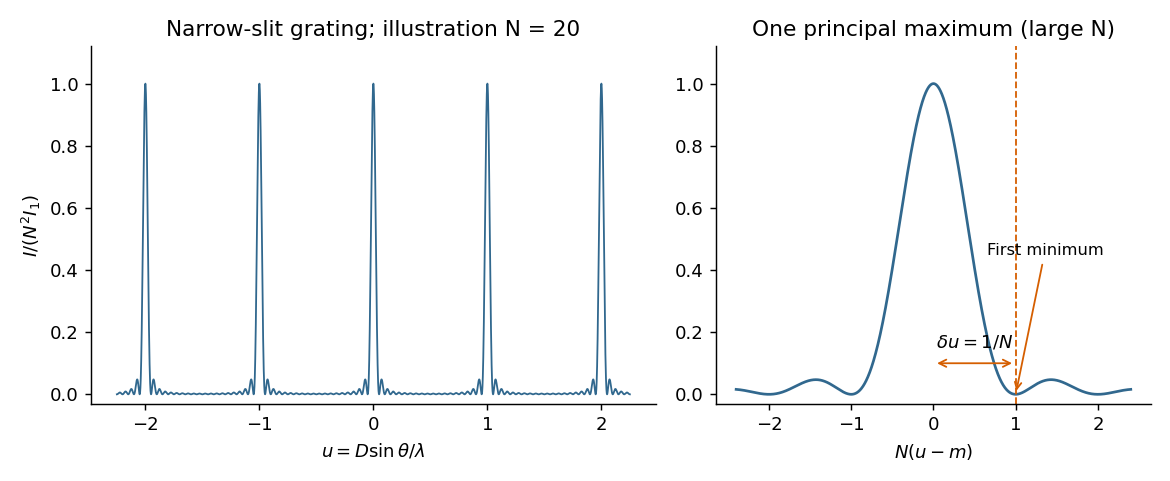
Codex 0 2026-10-18For equally spaced illuminated slits, with , summing a geometric series of complex amplitudes givesHere is the one-slit single-slit diffraction wave envelope. The grating equation for principal maxima iswith height and much weaker subsidiary maxima between orders. The first zeros around order are , so the angular distance from a maximum to its first minimum is, for large ,Changing wavelength by moves the same diffraction order byThe Rayleigh criterion places the maximum for one wavelength at the first zero for its neighbour. Equating these separations givesThis is the ideal resolving power of a diffraction grating, for an illuminated and transmitted order with sufficiently narrow source and instrumental broadening. The zeroth order has no wavelength separation and therefore no useful spectral resolving power. The distinction between and the span of the outer slit centres is a small edge convention; the exact state count in the resolving-power formula is .
Pinned article: Introduction to the OurBigBook Project
Welcome to the OurBigBook Project! Our goal is to create the perfect publishing platform for STEM subjects, and get university-level students to write the best free STEM tutorials ever.
Everyone is welcome to create an account and play with the site: ourbigbook.com/go/register. We belive that students themselves can write amazing tutorials, but teachers are welcome too. You can write about anything you want, it doesn't have to be STEM or even educational. Silly test content is very welcome and you won't be penalized in any way. Just keep it legal!
Intro to OurBigBook
. Source. We have two killer features:
- topics: topics group articles by different users with the same title, e.g. here is the topic for the "Fundamental Theorem of Calculus" ourbigbook.com/go/topic/fundamental-theorem-of-calculusArticles of different users are sorted by upvote within each article page. This feature is a bit like:
- a Wikipedia where each user can have their own version of each article
- a Q&A website like Stack Overflow, where multiple people can give their views on a given topic, and the best ones are sorted by upvote. Except you don't need to wait for someone to ask first, and any topic goes, no matter how narrow or broad
This feature makes it possible for readers to find better explanations of any topic created by other writers. And it allows writers to create an explanation in a place that readers might actually find it.
Figure 1. Screenshot of the "Derivative" topic page. View it live at: ourbigbook.com/go/topic/derivativeVideo 2. OurBigBook Web topics demo. Source. - local editing: you can store all your personal knowledge base content locally in a plaintext markup format that can be edited locally and published either:This way you can be sure that even if OurBigBook.com were to go down one day (which we have no plans to do as it is quite cheap to host!), your content will still be perfectly readable as a static site.
- to OurBigBook.com to get awesome multi-user features like topics and likes
- as HTML files to a static website, which you can host yourself for free on many external providers like GitHub Pages, and remain in full control

Figure 2. You can publish local OurBigBook lightweight markup files to either OurBigBook.com or as a static website.
Figure 3. Visual Studio Code extension installation.
Figure 5. . You can also edit articles on the Web editor without installing anything locally. Video 3. Edit locally and publish demo. Source. This shows editing OurBigBook Markup and publishing it using the Visual Studio Code extension. 
- Infinitely deep tables of contents:



All our software is open source and hosted at: github.com/ourbigbook/ourbigbook
Further documentation can be found at: docs.ourbigbook.com
Feel free to reach our to us for any help or suggestions: docs.ourbigbook.com/#contact