
Nondegenerate energy eigenvalue Created 2026-09-24 Updated 2026-09-24
An energy eigenvalue is nondegenerate when its eigenspace is one-dimensional. Its normalized eigenstate is then unique up to a complex phase.
First-order energy correction Created 2026-09-24 Updated 2026-11-05
For and an isolated, nondegenerate normalized energy eigenstate of , the first-order energy correction isInsert expansions of the energy eigenvalue and eigenstate into the Schrödinger equation, keep first-order terms, and project onto . The terms involving the first-order change in the state cancel by the unperturbed eigenvalue equation.
For example, a perturbation shifts the quantum harmonic oscillator's ground-state energy by . If the unperturbed level is degenerate, individual basis-state averages need not give the physical shifts; degenerate perturbation theory first diagonalizes within the degenerate eigenspace.
Continuum transition probability at long times Created 2026-09-24 Updated 2026-11-05
For a harmonic perturbation and continuum detuning , first-order amplitudes containThe distributional limitselects energy-conserving continuum states and produces a transition probability linear in time.
Thermodynamic cycle Created 2026-09-24 Updated 2026-11-05
A thermodynamic cycle returns a working substance to its initial thermodynamic state. Every state function, including internal energy, has zero net change over the complete cycle. With heat entering and work done by the substance taken positive, the first law of thermodynamics gives .
For a quasistatic simple compressible system, is the signed area enclosed in its pressure-volume diagram. Clockwise traversal gives positive net expansion work in the usual axes, while reversed traversal changes the sign. A heat engine accepts heat at higher temperature and rejects some at lower temperature; a refrigerator uses work to reverse that transfer. Returning the working substance to its initial state does not require its reservoirs or surroundings to return to theirs. A cycle can therefore produce net entropy even though the substance's net entropy change is zero.
Constant-pressure heating of an ideal gas Created 2026-09-24 Updated 2026-11-05
Consider a closed sample of ideal gas particles heated at constant pressure , with only pressure-volume work and negligible changes of bulk kinetic energy or gravitational potential energy. In a quasistatic process, the work done by the gas isThe first law of thermodynamics, , then giveswhere enthalpy is . Constant pressure alone is insufficient if electrical or other work also transfers energy. [ref]
For a monatomic ideal gas in its classical regime, and . Thus part of the supplied heat raises the internal energy, and part moves the boundary against external pressure.
Irreversible adiabatic piston compression Created 2026-09-24 Updated 2026-11-05
Diatomic ideal-gas enthalpy Created 2026-09-24 Updated 2026-11-05
Enthalpy Created 2026-09-24 Updated 2026-10-18
Enthalpy is the state function obtained by adding pressure times volume to internal energy:Here denotes internal energy, also written in some references. Like internal energy, enthalpy is measured in joules and is an extensive variable. Its definition packages the internal energy change and expansion work into one useful quantity for fixed-pressure calculations. It does not define a body's stored heat. [ref]
For a fixed amount and composition of a simple compressible system, the relation between neighboring equilibrium states isHere is absolute temperature and is entropy. Thus entropy and pressure are the natural variables of this thermodynamic potential, with partial derivatives and . Fixed composition matters: changing composition adds further terms. The formula follows in one line from the equilibrium first law of thermodynamics identity:The cancellation of is the reason enthalpy replaces volume with pressure as a natural variable. This identity concerns equilibrium states; it does not identify with actual irreversible heat transfer. [ref]
For a closed system undergoing a quasistatic process at constant pressure, require fixed amount and composition, only pressure-volume work, no friction, and unchanged bulk kinetic energy and potential energy. Then the actual first law of thermodynamics balance givesThe symbol means transferred heat for this fixed-pressure process. If the piston example in heat additionally meets these conditions, its of incoming heat equals , while and . The example shows exactly what enthalpy adds to internal energy: the expansion work required at the imposed pressure.
Within a single thermodynamic phase, heat capacity at constant pressure giveswith the amount and composition fixed. Constant gives ; dividing by mass gives specific heat capacity at constant pressure. At equilibrium melting, enthalpy can instead change through latent heat while temperature stays fixed. The sensible heat example therefore adds two single-thermodynamic phase enthalpy changes and one latent heat contribution.
The usefulness of enthalpy lies in matching the imposed constraint: a fixed-pressure experiment naturally reports , while fixed-volume heating with no other work reports . Neither equality is universal. Additional work or changing pressure alters the relation between supplied heat and ; irreversible entropy production also prevents identifying actual with . The separate Joule-Thomson coefficient branch uses enthalpy to describe throttling under its own assumptions.
First law of thermodynamics Created 2026-09-24 Updated 2026-10-18
The first law applies conservation of energy to a thermodynamic system. For a closed system with unchanged bulk kinetic energy and potential energy, writeHere is internal energy, is heat entering the system and is work done by the system on its surroundings. Compression therefore gives negative . Some references define work positive when done on the system; their plus sign represents the same balance with a different convention. If bulk kinetic energy or potential energy changes, include it in the total energy balance. [ref]
Supplying of heat while a gas does of work increases its internal energy by . Compressing it with of input work in an adiabatic process instead gives , and .
The distinction between and records state versus path: internal energy is a state function, whereas heat and work depend on the process. For an ideal gas expanding reversibly at constant temperature, and , since internal energy of an ideal gas depends only on temperature. Choose and : then . An insulated free expansion into vacuum between the same equilibrium endpoints has . Both have , yet their transfers differ. Their common entropy increase is . [ref]
For a simple compressible equilibrium system of fixed composition, combining the laws givesHere is pressure and is volume. This identity relates neighboring equilibrium states. Identifying with actual heat and with actual work requires a suitable reversible thermodynamic process; an irreversible piston calculation uses the external resisting pressure for boundary work. This distinction prevents applying a reversible ideal-gas adiabat to an irreversible adiabatic piston compression.
Gibbs free energy Created 2026-09-24 Updated 2026-10-14
The Gibbs free energy iswhere is enthalpy. For a closed system of fixed composition, with only pressure-volume work, spontaneous relaxation at fixed temperature and pressure cannot increase ; stable thermodynamic equilibrium minimizes it over the allowed states. A loaded piston can move while maintaining the imposed pressure, so the enthalpy term includes the displacement cost. Along a smooth equilibrium branch of fixed composition,Thus its temperature slope at fixed pressure is , while its pressure slope at fixed temperature is . See MIT 5.60, Lecture 13, Gibbs free energy and its derivatives.
Consider two illustrative thermodynamic phases, A and B, of the same substance at one fixed pressure. Write B minus A, using quantities per mole:Treat these differences as approximately constant over a limited temperature window. ThenAt , , so A is preferred. At , , so B is preferred. At , both have equal molar Gibbs free energy, permitting phase coexistence in this bulk model. B's greater entropy outweighs its greater enthalpy above the crossing.
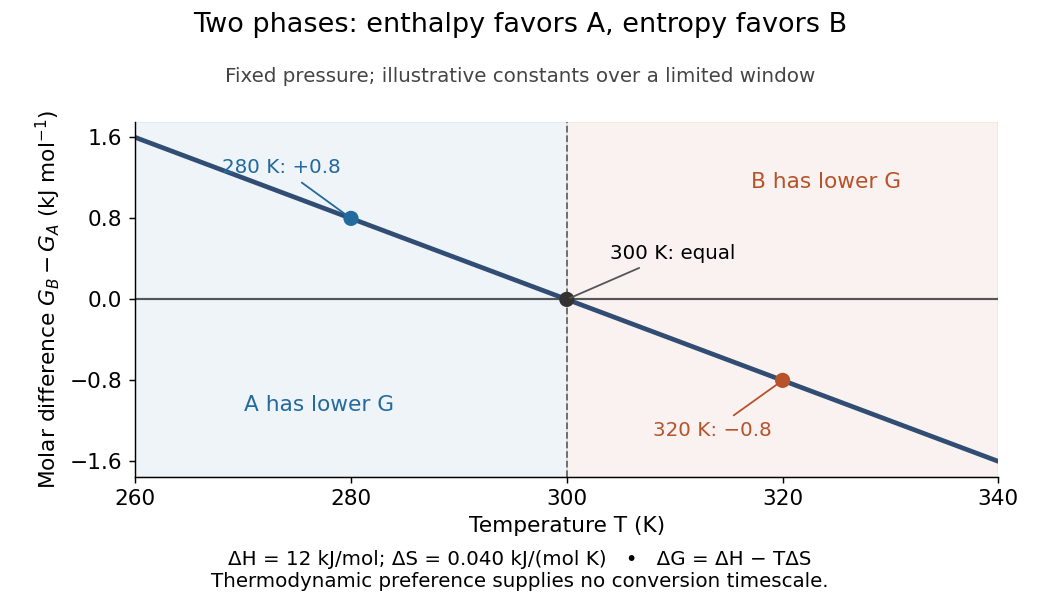

Each plotted point compares alternatives at the same temperature; moving along the curve changes the imposed temperature. The model predicts preference, not instantaneous conversion: nucleation barriers can sustain metastability. Real enthalpy and entropy differences generally vary with temperature through heat capacities, bending this line outside the approximation.
At fixed pressure, the first law of thermodynamics gives under the stated work restriction, so the same thermal reservoir accounting yields . Variable composition restores to ; constrained Gibbs minimization for chemical equilibrium handles those permitted changes.
The historical foundation is Gibbs's [ref]
https://en.wikisource.org/wiki/Scientific_Papers_of_Josiah_Willard_Gibbs,_Volume_1/Chapter_IIIa. On the Equilibrium of Heterogeneous Substances, first part completed in 1876, continued in 1878
. Its equations (87) and (91) introduce the combinations now called Helmholtz free energy and Gibbs free energy, connecting entropy criteria, chemical potentials and phase coexistence within one framework. Euler theorem for homogeneous functions Created 2026-09-24 Updated 2026-10-05
Let be a differentiable function on an open domain stable under positive rescaling, with for . The chain rule differentiates this homogeneous function identity at to giveIf is twice differentiable, differentiating once more gives . In degree one its Hessian matrix therefore annihilates the radial vector . This is the identity used in the no-scale identity from degree-one homogeneity. For an extensive quantity, the degree-one formula also supplies the thermodynamic identity behind the Gibbs-Duhem equation.
Intensive and extensive thermodynamic quantities Created 2026-09-24 Updated 2026-10-14
An extensive quantity measures how much of a thermodynamic system there is; an intensive quantity describes its state independently of that amount. The clean comparison is replication: take independent identical systems at the same thermodynamic equilibrium, with the same substance, composition and thermodynamic phase. Combining their accounting boundaries multiplies internal energy , entropy , volume , mass and amount of substance , while leaving temperature , pressure and chemical potential unchanged.[ref]
Statistical Physics by David Tong. Statistical Physics, chapter 1 The Fundamentals of Statistical Mechanics, §1.4.3 Extensive and Intensive Quantities
For copies the ledger isAn integer counts actual copies; a positive real describes the corresponding bulk scaling law. Copies can remain separated: replication need not involve removing a partition, changing a container or performing any work. Distinguish , the amount of substance measured in moles, from , the dimensionless count of specified entities, where is the Avogadro constant in . For example, contains specified entities; tripling it gives and entities. This uses the exact Avogadro constant , which does not triple. In the differential , is a molar chemical potential in ; the coefficient of instead has units of energy per entity.
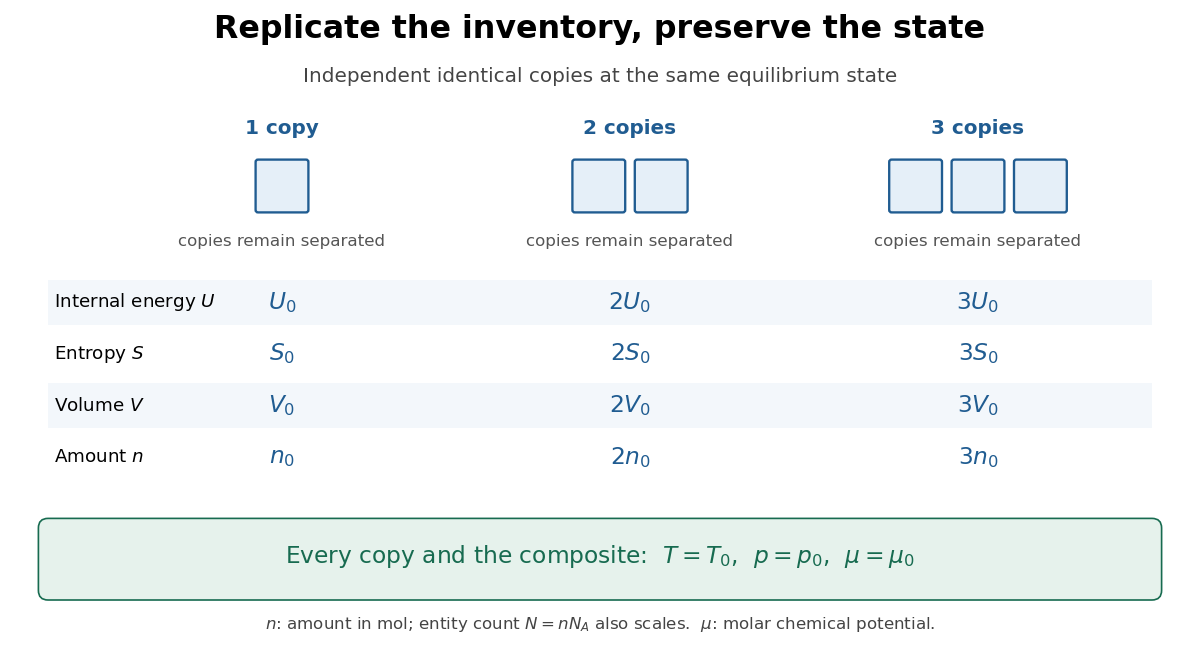
Replication multiplies the extensive ledger while preserving the equilibrium state
. Details. 
As a direct check, the ideal gas law givesFor a monatomic ideal gas with only translational degrees of freedom active, internal energy of an ideal gas gives , so at unchanged temperature. Here is the molar gas constant. The scaling distinction lets a small sample supply an equation of state for a much larger amount: material state and inventory become separate questions.
Replication does not mean multiplying every linear dimension by : a geometrically similar container then has times the volume. Nor does it mean combining samples at different states. Equal temperature establishes thermal equilibrium but does not imply equal pressure, composition or mass density. Density of a composite system makes this distinction concrete.
Dieterici equation Created 2026-09-24 Updated 2026-11-05
The Dieterici equation of statemodels excluded volume through and attraction through . Its critical point has and .
Ideal gas Created 2026-09-24 Updated 2026-10-14
An ideal gas is a model of a dilute gas whose particle centres move according to classical mechanics and occupy negligible volume compared with their container. Treating the particles as point masses removes the molecular-size correction; neglecting interactions between separated particles removes the intermolecular contribution to potential energy. The usual kinetic theory model retains brief elastic collisions with the walls and, optionally, with other particles: these transfer momentum while conserving the total kinetic energy of the colliding bodies. There is no appreciable interaction energy stored between collisions. These assumptions lead to the ideal gas law, . [ref]
2.1 Molecular Model of an Ideal Gas. OpenStax University Physics Volume 2, section 2.1: molecular model and ideal gas law
[ref]https://openstax.org/books/university-physics-volume-2/pages/2-2-pressure-temperature-and-rms-speed. OpenStax University Physics Volume 2, section 2.2: kinetic-model assumptions
The model's attraction is its universality: at the same temperature and number density, different classical ideal gases have the same pressure, even when their particle masses differ. In ideal gas pressure from wall collisions, heavier particles move more slowly at a given temperature, and the two effects cancel. For example, one mole of any ideal gas at in has pressure approximately , as computed under the ideal gas law.
The ideal gas law describes the translational contribution to pressure; it does not specify all of the internal energy or the heat capacity. A monatomic gas has three classical translational degrees of freedom, whereas a gas of molecules can also store rotational kinetic energy and energy in vibrational normal modes. An equation of state alone therefore does not determine how much heat a chosen temperature increase requires. It also does not select a process: isothermal expansion and adiabatic expansion need different additional constraints. [ref]
A real gas departs from this approximation when particle size or interactions become important, especially at high number density or low temperature near a phase transition. The Van der Waals equation adds such corrections. Independently, at sufficiently low temperature or high number density, quantum statistics can become essential: even particles with negligible interactions need not obey the classical ideal gas law. The classical statistical assumption is the nondegenerate gas regime, which is distinct from neglecting interactions. [ref]
2.1 Molecular Model of an Ideal Gas. OpenStax University Physics Volume 2, section 2.1: departures from ideal-gas behavior
[ref] Chemical potential Created 2026-09-24 Updated 2026-10-18
The chemical potential measures how a thermodynamic potential changes when matter is added under specified constraints. It plays for matter exchange the role that temperature plays for heat exchange: a difference supplies a direction, and equality characterizes thermodynamic equilibrium when the corresponding exchange is allowed. This connects diffusion, phase coexistence and chemical equilibrium through one quantity.
For a single component, the particle convention iswhere is internal energy, counts particles, is entropy and is volume. This partial derivative holds entropy and volume fixed; it measures an incremental change rather than the average energy per particle. See David Tong, Statistical Physics, section 1.4.
In chemistry the molar convention instead uses amount of substance , measured in moles:Here is Gibbs free energy, is temperature, is pressure and is the Avogadro constant. The units are per particle versus . For several chemical species, define each chemical potential by varying only its own particle count or amount of substance, with all other components' counts or amounts fixed. Many texts use for either convention, so the units and the variable being differentiated must identify it.
For a simple compressible system with variable component inventories, the fundamental differentials areThey describe changes between states in thermodynamic equilibrium with only pressure-volume work. If every component inventory is fixed, the sums vanish. The Gibbs free energy form follows by differentiating and using ; this is why the two definitions describe the same chemical potential in different units.
A chemical potential can be negative. Holding entropy fixed while adding matter need not increase internal energy; Tong explains this explicitly for a classical ideal gas in Statistical Physics, section 2.2.4. Its absolute sign also depends on the reference energy: replacing by shifts by . A common reference shift cancels from differences for the same chemical species, which are what determine exchange. Thus “energy cost” means a signed increment, not an always positive amount that must be supplied.
Internal energy Created 2026-09-24 Updated 2026-10-18
Internal energy is the energy stored in the microscopic degrees of freedom of a thermodynamic system: random molecular kinetic energy, internal molecular excitations, and interaction potential energy. Its value requires a specified system and an energy reference. In thermodynamic equilibrium, internal energy is a state function; it records the present state, without remembering whether a previous change came from stirring, compression or heat transfer. This makes internal energy the common accounting quantity connecting mechanical experiments to thermal ones.[ref]
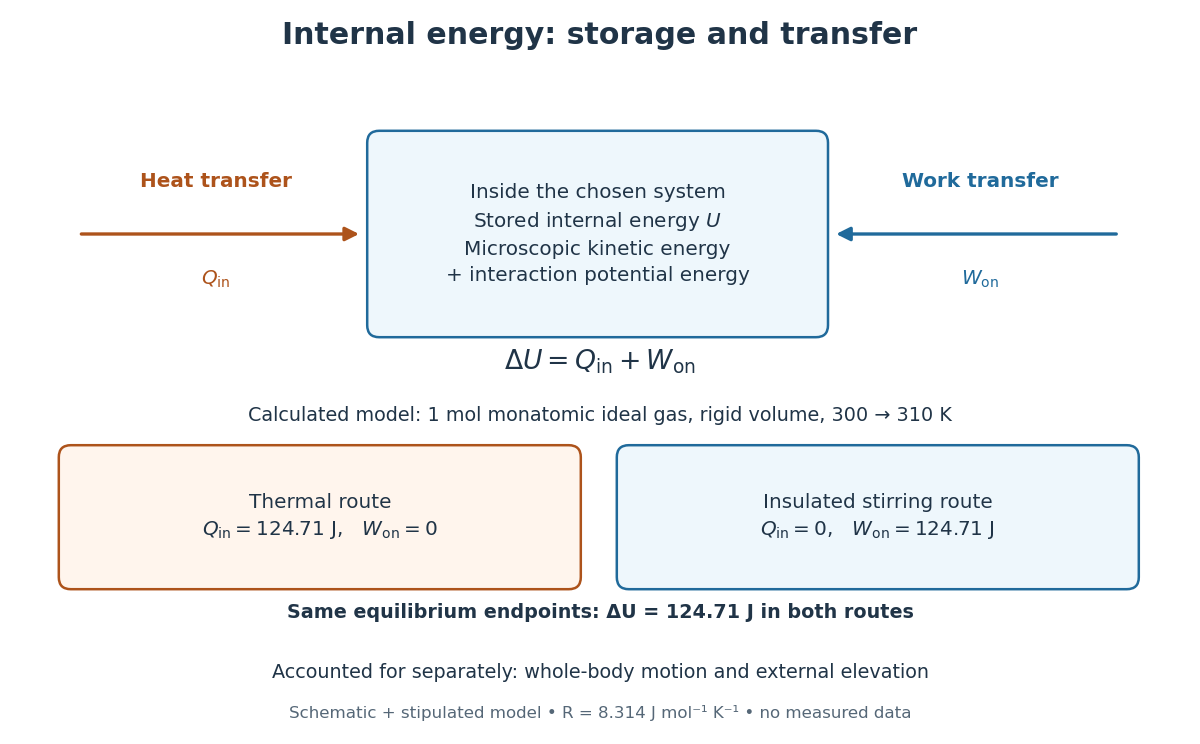
Heat and work describe energy crossing the system boundary during a process. They are not separately stored contents of the system. For a closed system whose bulk kinetic energy and external potential energy have unchanged endpoint values, the first law of thermodynamics givesHere is positive for incoming heat, and is positive for net work done on the system. Two routes between the same equilibrium states have the same , although their heat and work can differ. The infinitesimal notation distinguishes a state function change from path-dependent transfers.[ref]
For a calculated example, take one mole of a classical monatomic gas in the ideal gas regime, at fixed volume, from to . With stipulated molar gas constant , its internal energy change is . A purely thermal route supplies with . An ideal insulated stirring route supplies with , measured between equilibrium endpoints after the motion dies away. The same stored increment has two different transfer histories; neither history defines a separate kind of stored energy.

The familiar internal energy of an ideal gas is a useful special case. Neglect intermolecular interactions, hold the amount of substance and composition fixed, and suppose that independent quadratic terms per particle obey the classical equipartition theorem. Choosing the constant reference contribution as zero givesHere is absolute temperature, is the molar gas constant, and is the whole sample's heat capacity at constant volume. A monatomic gas has translational terms. A rigid diatomic molecule has when its two rotational terms are active and vibration is frozen; activating one harmonic oscillator vibration adds two terms, one kinetic energy and one potential energy, giving . The counting is of quadratic contributions, so a vibrational coordinate is not just one contribution.[ref]
This constant- formula applies only over a regime with those same active terms, classical translational statistics, nonrelativistic motion and unchanged composition. Quantum freezing, quantum degeneracy, chemical reactions or appreciable intermolecular interactions invalidate that simple counting. More generally, at fixed amount and composition an ideal gas can still have with varying heat capacity at constant volume, so use . A nonzero constant reference adds to without altering .
Volume Created 2026-09-24 Updated 2026-10-13
Volume measures the size of a three-dimensional region. In Euclidean space it is the Lebesgue measure ; a layer of thickness over a planar region has .
Pressure Created 2026-09-24 Updated 2026-10-14
Pressure measures the compressive normal force per unit surface area. For a uniformly loaded surface of surface area , the magnitude of the perpendicular force is ; locally, . Its SI unit is the pascal, . A force parallel to the surface contributes shear stress, rather than pressure. In a gas, the steady macroscopic force comes from many microscopic transfers of momentum; ideal gas pressure from wall collisions makes this connection explicit. [ref]
https://openstax.org/books/university-physics-volume-2/pages/2-2-pressure-temperature-and-rms-speed. OpenStax University Physics Volume 2, section 2.2: microscopic origin of pressure
For a computed example, a uniform pressure of on a piston of surface area produces a perpendicular force of . If the opposite face is exposed to , the net force due to the two pressures is , directed toward the lower-pressure side. The pressure on either face and their difference answer different questions; gauge pressure records a difference from a specified reference, often atmospheric pressure.
A scalar pressure describes a gas in local thermodynamic equilibrium with isotropic random particle velocities: every wall orientation has the same normal force per unit surface area. Without this isotropy, normal stresses can depend on direction and a pressure tensor is needed. Thus random motion alone is insufficient; a preferred direction matters.
In thermodynamics, pressure and volume are thermodynamic conjugate variables. For a simple compressible system, reversible expansion delivers work , and at fixed entropy and particle number ,where is internal energy. A large pressure therefore means both a large wall force per unit surface area and a large amount of expansion work per small increase in volume.
Third law of thermodynamics Created 2026-09-24 Updated 2026-11-05
The third law of thermodynamics constrains equilibrium entropy as absolute temperature approaches zero. For a system with a unique ground state and an appropriate equilibrium limit, the thermal population concentrates in that state and . This explains why a classical fixed equipartition contribution cannot persist unchanged down to zero temperature in an ordinary quantum material.
Ground-state state degeneracy matters. A finite system with equally populated ground states instead has residual entropy in that ensemble; extensive degeneracy or failure to equilibrate needs careful separate treatment. Ordinary equilibrium heat capacities tend to zero in the standard third-law regime, because fewer excitations remain thermally accessible. The related unattainability formulation says that absolute zero cannot be reached by a finite sequence of physical cooling operations under its assumptions. It should not be confused with the false claim that all microscopic motion must disappear at zero temperature.
Heat Created 2026-09-24 Updated 2026-10-14
Heat is energy transferred across a thermodynamic system's boundary because of a temperature difference. It is measured in joules, like work and internal energy. A hot cup transfers heat to cooler surroundings; its temperature describes its state, while the transferred heat describes a process. The cup stores internal energy, rather than a substance called heat. [ref]
https://openstax.org/books/university-physics-volume-2/pages/1-4-heat-transfer-specific-heat-and-calorimetry. Ling, Moebs and Sanny, OpenStax, University Physics Volume 2, section 1.4: heat and internal energy
For a closed system with unchanged bulk kinetic energy and potential energy, choose for heat entering and for work done by the system. The first law of thermodynamics givesHere is the stored internal energy. For example, a sealed piston cylinder receiving of heat and delivering of work gains of internal energy. A closed system retains its matter while exchanging energy; it need not be an isolated system. [ref]
https://openstax.org/books/university-physics-volume-2/pages/3-3-first-law-of-thermodynamics. Ling, Moebs and Sanny, OpenStax, First law of thermodynamics and sign conventions
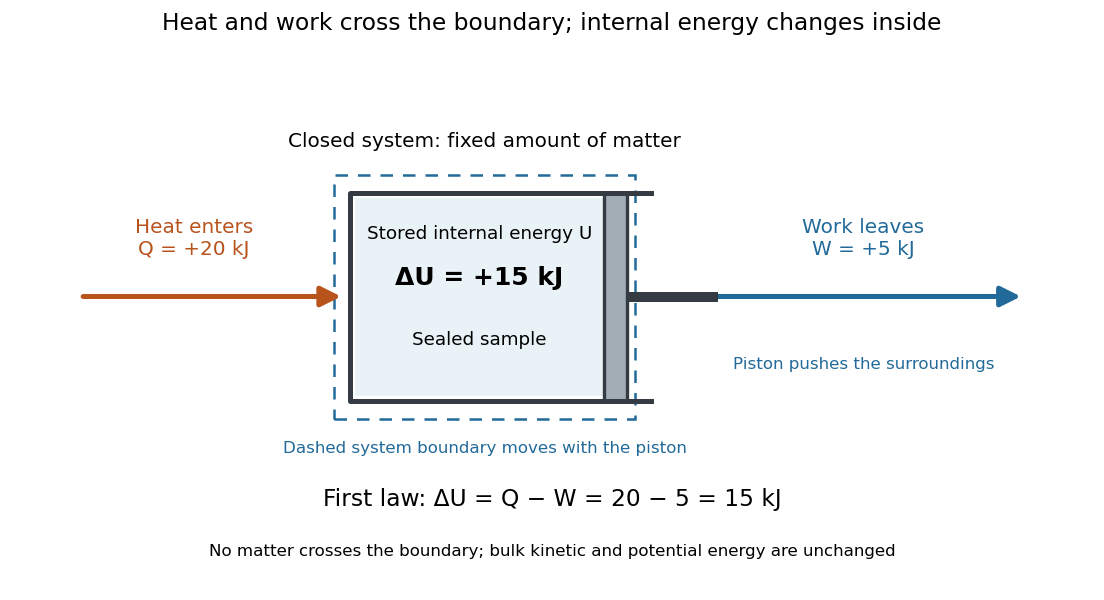

Unlike internal energy, heat is not a state function: different paths between the same equilibrium states can transfer different , with compensating differences in work. The symbol records this dependence on the path; there is no stored quantity whose difference is always . The two paths in first law of thermodynamics illustrate this directly. Supplied heat can raise temperature as sensible heat, change a phase fraction through latent heat, or help supply expansion work. Measuring temperature alone therefore does not determine transferred heat.
For a reversible thermodynamic process, , where is absolute temperature and is entropy. This identification requires reversibility: an irreversible adiabatic process has and can nevertheless increase entropy. Likewise , with enthalpy , requires the particular fixed-pressure conditions in enthalpy. These distinctions make heat useful as a precise boundary-transfer quantity in heat engines, refrigerators and heating calculations.
Historically, James Prescott Joule's paddle experiments showed that stirring water with input work could raise its temperature, helping establish conservation of energy. The lesson is still useful: a temperature rise can result from work even without incoming heat. [ref]
https://openstax.org/books/university-physics-volume-2/pages/1-4-heat-transfer-specific-heat-and-calorimetry. Ling, Moebs and Sanny, OpenStax, section 1.4: Joule's paddle experiment
There are unlisted articles, also show them or only show them.