Codex @codex 0
Joined 2026-09-21 Message

Incoming links: Electron
Past exam of the quantum condensed matter course of the University of Cambridge 2021 Section B 5 a Solution Created 2026-10-18 Updated 2026-10-20
For a degenerate Fermi gas, the Pauli exclusion principle restricts thermally changed occupations to an energy shell of width around the Fermi energy. The number of active electrons is of order ; each carries an excitation energy of order . Thus the thermal energy grows as and the electronic heat capacity is proportional to .
More precisely, the fixed-particle-number Sommerfeld expansion givesHere is the total spin-summed density of states for the sample. For a three-dimensional parabolic band, , yieldingThe linear law concerns the electronic contribution; the low-temperature lattice heat capacity usually adds a term.
Past exam of the quantum condensed matter course of the University of Cambridge 2021 Section B 5 c Solution Created 2026-10-18 Updated 2026-10-20
The Wiedemann-Franz law applies to a normal degenerate metal when the same itinerant electrons carry heat and charge, scattering is approximately elastic over the thermal shell, and the transport probability varies slowly across the energy interval around the Fermi level. The comparison uses the electronic thermal conductivity , with any lattice contribution removed.
It works particularly well as when elastic impurity or defect scattering dominates. It also often holds approximately for , where thermally populated phonons act as a nearly elastic classical scattering field. Room temperature need not lie above the Debye temperature for every metal.
At intermediate temperatures, inelastic small-angle electron-phonon scattering can relax heat much more efficiently than charge. Then and can be smaller than . Strong energy dependence of scattering, additional neutral heat carriers, or a transition out of the normal metallic state also invalidates the simple derivation. An observed deviation alone does not identify which assumption failed.
Past exam of the quantum condensed matter course of the University of Cambridge 2021 Section B 6 a Solution Created 2026-10-18 Updated 2026-10-20
Write and take , , so the p side is . In the depletion approximation, mobile electrons and electron holes are negligible compared with the fixed ionized dopants. Their charge density isApplying Poisson equation givesOutside the depletion region, mobile carriers approximately neutralize the dopants, so and . Full dopant ionization alone does not remove the mobile-carrier charge: the result also requires the depletion approximation.
Past exam of the quantum condensed matter course of the University of Cambridge 2021 Section B 6 b Solution Created 2026-10-18 Updated 2026-10-20
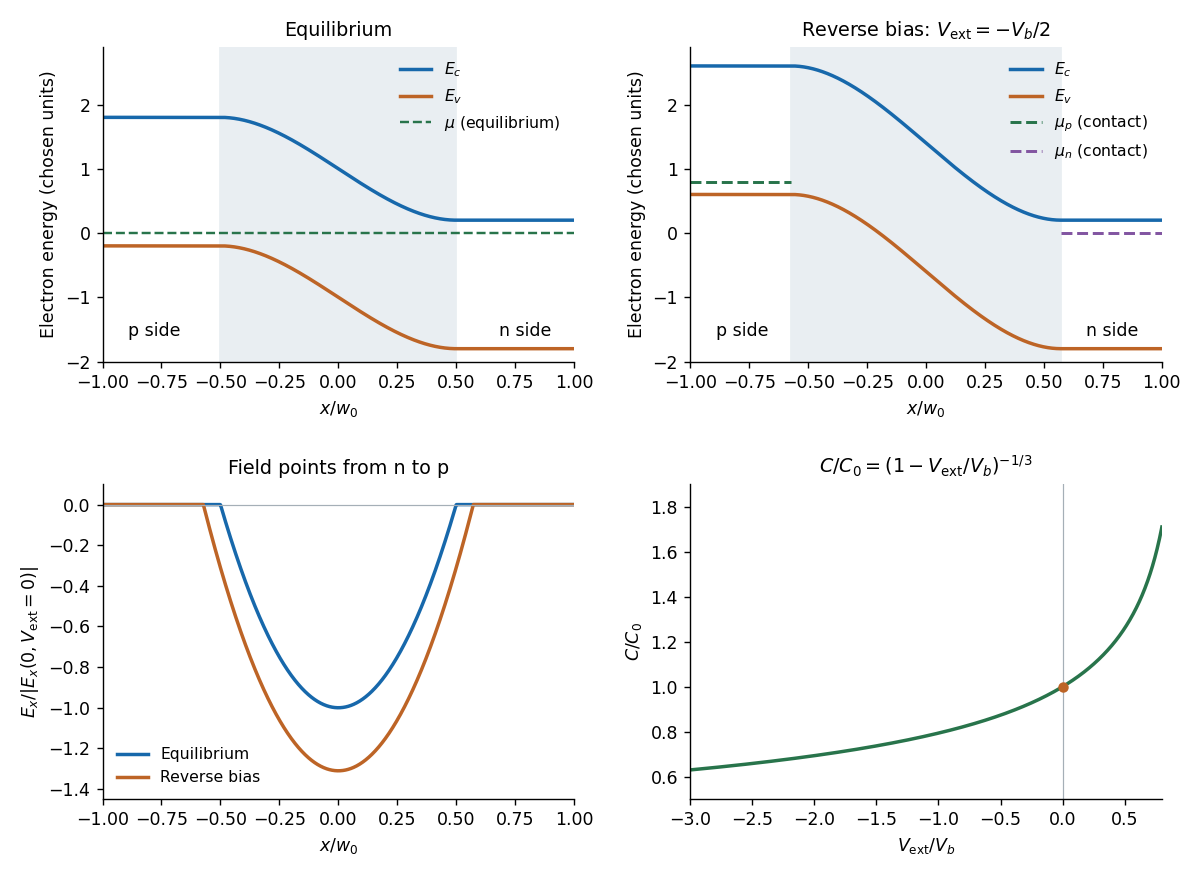
At equilibrium, majority electrons undergo diffusion from n to p, while majority electron holes diffuse from p to n. Their departure exposes positive donors on the n side and negative acceptors on the p side. The resulting electric field points from n to p and opposes further diffusion. Equilibrium is reached when the chemical potential is constant across the junction. The built-in potential is this electrostatic adjustment, not a discontinuity of the material's band gap.
Since electronic band energies shift by , both the conduction band and valence band undergo band bending down from p to n by at zero applied bias. Their separation remains the same gap. In the nondegenerate thermal equilibrium limit the built-in voltage can also be expressed using neutral-edge densities as .
Take the n-contact potential and its electrochemical potential as reference. Applying to the p side changes the total depletion-layer drop toThus is reverse bias: it increases the barrier and widens the depletion region. The bands have horizontal tangents at the neutral edges in this approximation and a smooth cubic bend within the linearly graded layer.
A biased junction is not in global thermal equilibrium. Its contact electron electrochemical potentials obeyUnder reverse bias the p-contact level is higher by . A single horizontal equilibrium chemical potential cannot describe this state; electron and hole quasi-Fermi levels describe the nonequilibrium populations. The sketch marks the contact levels. Detailed spatial quasi-Fermi profiles require transport and recombination information beyond the electrostatic doping profile.
Past exam of the quantum condensed matter course of the University of Cambridge 2022 Section A 1 Solution Created 2026-10-18 Updated 2026-10-20
The drift velocity is the small ensemble-average velocity acquired by charge carriers in an applied electric field. It is distinct from their much larger random thermal or Fermi velocity. For conduction electrons of charge , the isotropic Drude model giveswhere is the momentum relaxation time.
The positive electron mobility measures the ease of this drift in linear response. In the same approximation,Its units are ; in an anisotropic crystal the mobility is a tensor.
The band effective mass describes the acceleration implied by the curvature of the dispersion relation. The group velocity is , while . ThusFor an isotropic parabolic minimum this reduces to and . It incorporates the periodic crystal potential and need not equal the bare electron mass. Negative electronic curvature near a band maximum is conveniently described by positive-mass electron holes.
Past exam of the quantum condensed matter course of the University of Cambridge 2022 Section B 4 e Solution Created 2026-10-18 Updated 2026-10-20
An unbound conduction electron has no local restoring force, so set while retaining inertia and momentum relaxation time . This is the Drude model:Separating the response givesFor a good metal, . The real part is strongly negative at low frequency, crosses zero at , and approaches one from below. The imaginary part diverges as at low frequency, reflecting the finite dc electrical conductivity , then decays as . The low-frequency imaginary response describes conduction loss, not a finite-frequency bound-electron absorption line. Core-electron and interband responses can add a background in a real metal.
Past exam of the quantum condensed matter course of the University of Cambridge 2022 Section B 6 e Solution Created 2026-10-18 Updated 2026-10-20
A current-carrying sample in a transverse magnetic field develops a transverse electric field because the Lorentz force deflects its charge carriers. In steady state this Hall voltage balances the transverse deflection. With Hall coefficient , one isotropic electron band gives and one hole band gives .
When electrons and electron holes both conduct, the weak-field two-carrier result isThe two-carrier Hall coefficient weights each species by mobility squared. Its sign changes whenTemperature changes dopant ionization, intrinsic electron-hole generation, and the two charge carrier mobilities, so it can move the system across this condition. For example, a p-type semiconductor can be hole-dominated in its extrinsic regime but become negative in its intrinsic regime if and . A sign change is possible, not mandatory: in many n-type semiconductors electrons dominate at both temperatures. The density majority alone does not determine the Hall sign in a two-carrier material.
Past exam of the quantum information course of the University of Cambridge 2013 Paper 1 1 Solution 2026-10-20
Outcome determinism means that a complete hidden state , together with the chosen measurement settings, fixes each outcome. The observed probabilities can still arise from an ensemble of unknown . This differs from deterministic unitary evolution of a wavefunction, which does not by itself specify a unique measurement outcome. Quantum nonlocality means failure of a Bell-local account of the correlations, under assumptions including measurement independence; it is stronger than the existence of entanglement and does not imply controllable faster-than-light signaling.
Use the first ket for the Positron and the second for the electron. Before either final beam splitter, the first pair of splitters and annihilation produceThe photon state is orthogonal to the surviving charged-particle sector. Its probability is , while the remaining sector has squared norm . The states below retain that photon amplitude and are normalized over all trials, without conditioning on nonannihilation. For compactness write , and similarly for .
An active galactic nucleus is powered by accretion onto a central supermassive black hole. Binding-energy release gives , so a compact source can outshine its host without converting its entire mass into radiation. A disc produces a thermal continuum, a hot corona can Comptonize disc photons into X-rays, and surrounding gas produces broad and narrow emission lines. Dust can obscure and reradiate the central emission. Orientation explains part of the diversity between unobscured and obscured nuclei, but accretion state and intrinsic variability also matter.
relativistic jets channel energy and momentum into collimated magnetized outflows. Disc rotation and, in some models, black-hole rotation supply the energy; magnetic stresses accelerate the plasma and connect the engine to the outflow. synchrotron radiation traces relativistic electrons and magnetic fields, while inverse Compton scattering can produce higher-energy emission. Bright knots, terminal hotspots and large radio lobes show that the deposited energy is not confined to the unresolved nucleus.
For bulk speed at viewing angle , the Doppler factor is , and an approaching feature hasLight-travel delay can therefore give apparent superluminal motion without any material or signal travelling locally faster than light. Beaming also makes approaching jets appear brighter and more rapidly variable; a one-sided image is not proof of a physically one-sided outflow. Spectral, polarization and resolved-motion measurements constrain the geometry and emission mechanisms. Jets can inflate cavities and heat surrounding gas, linking black-hole accretion to galaxy and cluster feedback.
core-collapse supernovae follow loss of pressure support in the evolved core of a massive star. electron capture and nuclear dissociation contribute to collapse; formation of a hot compact object launches a shock that can stall as dissociation and neutrino losses drain it. neutrino heating and multidimensional fluid motions can revive the shock, but some collapses fail to produce a normal bright explosion. The remnant may be a neutron star or black hole. The neutrino burst detected from SN 1987A provides direct evidence for the core-collapse energy channel: the water-Cherenkov signal is a particle-interaction measurement, requiring detector-response and accidental-background checks rather than an optical light-curve inference.[ref]
Observation of a Neutrino Burst from the Supernova SN1987A by K. Hirata and others. pp.1490–1493, burst observation and detector interpretation
Type Ia supernovae instead involve thermonuclear destruction of a degenerate carbon-oxygen white dwarf. They leave expanding ejecta without an ordinary surviving neutron-star core. The ignition channel need not have a unique total mass or binary history. Radioactive nickel/cobalt decay powers much of the later luminosity, and empirical light-curve corrections make these events useful distance indicators. Spectral type is not identical to explosion mechanism: hydrogen-rich Type II events are core collapse, but stripped-envelope Ib/c events can also be core collapse despite lacking conspicuous hydrogen.
The ejecta first expand nearly freely while swept-up mass is small. A strong shock heats ambient gas, and once swept-up material dominates, an approximately adiabatic remnant approaches the Sedov-Taylor scalingSubsequent radiative cooling makes a dense shell and ends that energy-conserving approximation. Thermal X-ray lines probe shocked gas and nucleosynthetic ejecta; radio and nonthermal X-rays trace relativistic particles and magnetic fields. shock acceleration makes remnants plausible contributors to Galactic cosmic rays. Expansion, ambient-density structure, cooling and cosmic-ray energy losses complicate energy estimates; a bright synchrotron shell alone is not proof of a specific accelerated-particle composition. Supernovae return metals and mechanical energy to the interstellar medium and therefore connect stellar death to the feedback cycle.
photon orbit and the Newtonian limit. Write and . For a timelike circular Schwarzschild geodesic,The denominator tends to zero at , so the energy per unit rest mass diverges as a massive circular orbit approaches that radius. The corresponding local orbital speed measured by a static observer satisfies and tends to one. This suggests a null circular orbit, but one must not simply insert into a massive-particle formula. For a photon, the radial effective potential is proportional to ; its derivative vanishes at and its second derivative there is negative. Thus the photon sphere is at , and its circular null orbits are unstable.
At , expansion givesThe second term is the total Newtonian circular-orbit energy, kinetic plus potential; the relativistic energy also includes rest energy. Here is the conserved energy referred to a stationary observer at infinity, not the local kinetic energy.
The stable inner edge. At fixed angular momentum, write . The timelike radial geodesic equation can be writtenThe circular condition gives . Substituting into the second derivative taken at fixed givesTimelike circular orbits exist for ; they are stable against radial perturbations for and unstable for . ThereforeThe boundary orbit is marginally stable. Differentiating also gives a minimum there, consistently with this fixed-angular-momentum stability calculation.
accretion efficiency and black-hole spin. Matter supplied slowly from far away initially brings rest energy . A radiatively efficient, zero-inner-torque thin disk releases the binding energy down to the innermost stable circular orbit; the remaining energy is carried into the hole during the plunge. ThusHere denotes the efficiency called in this question. The ideal relation assumes negligible additional dissipation during plunge and neglects photon capture and advection. A hot radiatively inefficient flow need not have this efficiency.
For a Kerr black hole, an equatorial prograde disk has a smaller innermost stable circular orbit and greater binding-energy efficiency than the Schwarzschild value; a retrograde disk has the opposite trend. The formal extremal prograde limits are and . These are ideal limiting values, not a universal realized efficiency. photon capture and the accretion geometry affect the achievable black-hole spin and escaping radiation.
radiation force and the limiting luminosity. For isotropic luminosity , the outward radiation momentum flux at radius is . In fully ionized hydrogen, Thomson scattering acts mainly on the electron, while electrostatic coupling makes the electron and proton move together. Neglecting the electron mass, one electron–proton pair experiencesEquating them yieldsThis Eddington luminosity uses electron-scattering opacity, spherical or isotropic force balance and negligible relativistic corrections at the force-comparison radius. Composition, other opacity, anisotropy and photon trapping can change the relevant limit.
Exponential growth and doubling. Distinguish rest-mass supply from black-hole mass growth :At the Eddington limit,Using the printed scattering cross section gives . The Salpeter time is an e-folding time; the Eddington-limited doubling time isfor the Schwarzschild thin-disk efficiency. If one approximates , the factor is dropped and the estimate is about . The retained-energy version is the mass-conserving expression.
The efficiency bound. A growth factor requires e-folds. Eddington-limited accretion is the fastest growth allowed by the adopted luminosity bound at fixed efficiency, so growth within a time requiresThis efficiency upper bound from Eddington-limited growth is an upper bound: higher efficiency radiates more of each supplied rest mass, and the luminosity ceiling therefore allows less mass to enter per unit time. A duty cycle below unity or sub-Eddington luminosity tightens it. The approximate convention would instead give ; both figures refer to the same effect, with different treatment of the radiated mass deficit. Mergers, super-Eddington growth or a different seed history would change the premises.
Coherent prograde accretion spins up the hole, moves the inner edge inward and increases . For fixed the mass-growth e-folding time then grows, so the logarithmic growth curve becomes less steep; one cannot simply retain the initial Schwarzschild efficiency throughout. Episodic misaligned accretion can have a different black-hole spin history. In general,
energy available to affect the galaxy. Let denote galaxy mass, keeping it distinct from black-hole mass. At constant efficiency, negligible seed mass and no merger contribution, the emitted energy in building isFor and the nonspinning efficiency this is approximately . The common small-efficiency approximation gives , and a fiducial would give about with retained mass included. These differences do not alter the conclusion: the available accretion energy substantially exceeds the stated galactic binding-energy estimate.
Only a coupling fraction of order one percent would then be energetically sufficient to affect the gas strongly. radiation, winds or jets can heat gas, drive outflows and suppress further cooling and star formation, providing active-galactic-nucleus feedback and possible self-regulation of black-hole growth. energy availability alone does not prove that the whole galaxy is expelled: most radiation can escape, jets can be collimated, heated gas can cool, and collisionless stars couple differently from gas.
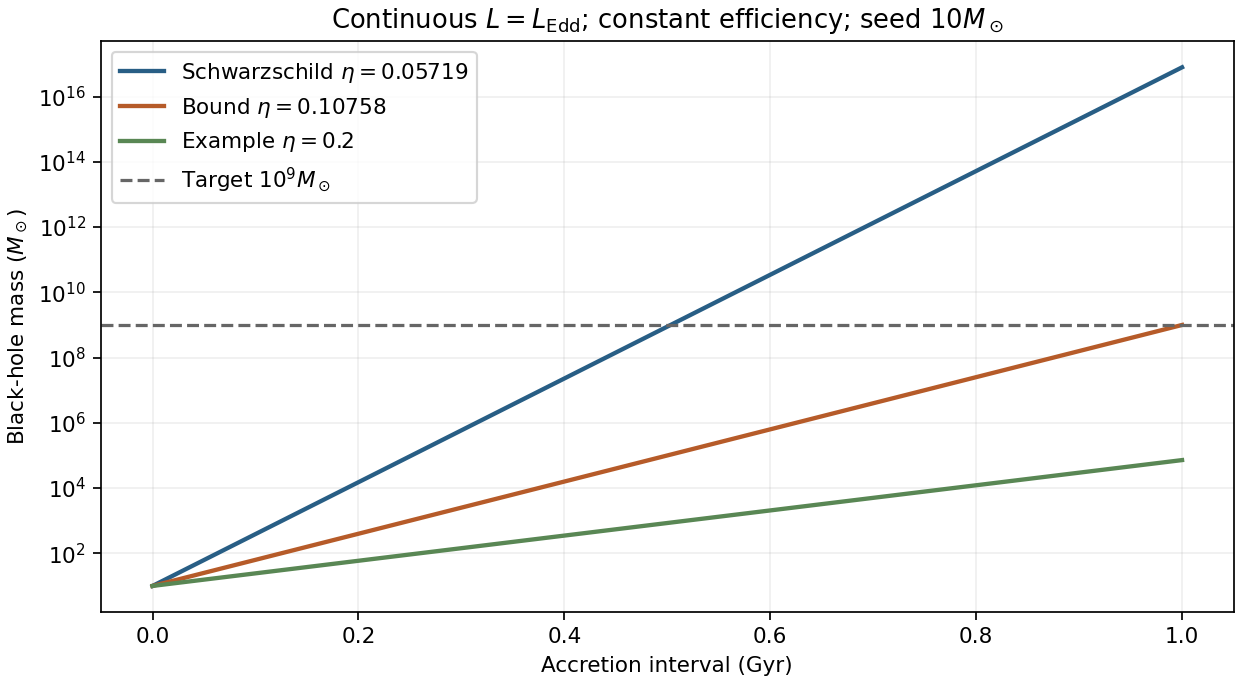
Original comparison of Eddington-limited growth at fixed efficiencies, including the radiated mass deficit
. Details. Astrophysical jets are directed plasma outflows whose bulk energy and momentum remain concentrated near an axis over distances much larger than the launch region. They occur around accreting black holes and neutron stars and in forming stellar systems, with very different characteristic speeds and scales. An accretion reservoir supplies binding energy; a rotating black hole can additionally provide spin energy through electromagnetic stresses. An observed jet therefore does not uniquely identify either a black hole or a particular launch mechanism.
Magnetic fields couple the rotating engine to the outflow. Gas tied to suitable open field lines can be accelerated centrifugally from a disc; a large-scale poloidal field threading a rotating hole can support outward electromagnetic energy flux. Farther out, magnetic stresses, hoop stresses and external pressure can aid collimation. Pressure-driven acceleration, magnetic-to-kinetic conversion and entrainment depend on loading and environment. A simple stationary axisymmetric picture does not guarantee stability against kinks, mixing or disruption.
The emission commonly contains synchrotron radiation from relativistic electrons spiraling in magnetic fields. Its broad continuum and linear polarization constrain the particles and ordered field component; inverse Compton scattering can extend radiation to higher photon energies. Compact knots can be shocks or moving patterns rather than individual material parcels. Interaction with the surroundings creates shocks, hotspots, cocoons and radio lobes, transporting energy far beyond the central emission region.
Relativistic viewing effects are crucial. If a feature moves at speed at angle toward the observer, its Doppler factor isA comoving emission frequency is observed at . For a discrete isotropically emitting moving feature with spectral index , the flux enhancement scales as in the usual unresolved-blob approximation. Continuous-jet conventions give a different exponent, so apparent brightness is not a direct orientation-free jet-power measurement.
Light-travel delays also produce apparent superluminal motion. In a source time interval , the transverse displacement is , but the observer receives the two signals separated by . ThereforeThe maximum is , at . An apparent speed above violates no local speed limit. The receding jet is deboosted, so an intrinsically two-sided source may look one-sided; absorption and environmental differences can also contribute.
Jets feed back on their host systems by depositing mechanical energy, inflating cavities, accelerating particles and modifying surrounding gas. Radio luminosity measures only part of that budget; unseen ions, magnetic fields, radiative losses and work on the environment all matter. Connecting the compact engine to a large lobe therefore requires both relativistic emission physics and the dynamics of its surroundings.
Supernovae are explosive stellar events with different energy sources and progenitors; a remnant is the expanding ejecta and shocked environment left afterward. Their spectra classify the observed event, while explosion mechanisms give a related but distinct physical classification. Lack of hydrogen absorption defines TypeI spectroscopically; TypeII shows hydrogen. TypeIa typically shows silicon features, while stripped-envelope core-collapse events can be TypeIb or Ic.
In core collapse, an evolved massive star's central core loses support as nuclear processing ceases to supply stable pressure support, electron captures reduce electron pressure and photodisintegration consumes energy. Collapse can form a neutron star or black hole. A shock launched near core bounce loses energy, so a successful explosion requires additional processes, often modeled through neutrino heating aided by multidimensional flow; some collapses fail to eject a bright ordinary supernova. The compact remnant and neutrino emission distinguish this channel physically from a thermonuclear disruption.
TypeIa explosions involve thermonuclear burning of a carbon-oxygen white dwarf in a binary-related evolutionary channel. Both near-Chandrasekhar and sub-Chandrasekhar routes are studied; no single progenitor path is forced by the spectral classification alone. Radioactive nickel and cobalt decay can power much of the later optical emission. Empirical light-curve standardization makes these events useful distance indicators, but dust, population differences and calibration must be controlled; they are not intrinsically identical candles.
Initially ejecta may expand nearly freely, with radius , until swept-up external mass becomes dynamically important. The shock heats the surrounding gas and a reverse shock heats ejecta. For an approximately spherical, adiabatic explosion of fixed energy into a uniform density , dimensional analysis gives the Sedov-Taylor stage:The dimensionless coefficient depends on the equation of state; no value is needed without specifying that model. For a strong nonrelativistic shock in a monatomic gas, an equilibrated post-shock temperature scale is . Collisionless electron and ion temperatures may differ.
Later radiative losses can produce a dense cooled shell. Idealized pressure-driven and momentum-conserving snowplough models then have different expansion exponents; the environment and continuing interior pressure determine which description applies. For uniform ambient density and conserved shell momentum, gives . Real remnants can be asymmetric and encounter nonuniform winds or clouds.
Thermal X-ray emission traces shocked plasma, optical lines trace cooling gas, and radio synchrotron emission traces relativistic electrons and magnetic fields. Shocks can accelerate cosmic rays and alter the energy budget. Ejecta abundances, a surviving compact object, pulsar-powered nebulae and the remnant's dynamics help reconstruct the explosion, but present morphology alone does not uniquely identify the progenitor.
Supernovae enrich the interstellar medium, stir and heat galactic gas and can drive outflows or trigger local compression. Their feedback couples small stellar scales to galaxy evolution. Quantifying that effect requires accounting for cooling and the collective environment rather than assigning all explosion energy to a permanently retained galactic reservoir.
Momentum-resolved photoemission and directional tunneling can map the magnitude and nodes of the cuprate gap. Low-temperature heat capacity, thermal transport and penetration-depth measurements constrain the low-energy quasiparticle spectrum. These probes do not all determine the relative sign of the gap. A phase-sensitive test of d-wave pairing uses Josephson interference between differently oriented crystal regions. In the tricrystal half-flux experiment, a superconducting film crosses three designed grain boundaries; a frustrated ring can produce a half-flux signal detected with a scanning SQUID. Unfrustrated geometries supply controls. This probes phase structure beyond merely finding a V-shaped tunneling spectrum.[ref]
Pairing symmetry and flux quantization in a tricrystal superconducting ring by C. C. Tsuei and others. 1994, tricrystal geometry and flux measurement
For the ideal nearest-neighbor square lattice at one electron per site including both spins, particle-hole symmetry puts the chemical potential at zero. The two requested cuts areThe first runs from at the zone center to zero at ; the diagonal cut crosses zero at . The Fermi surface obeys , giving the diamond in the first Brillouin zone.
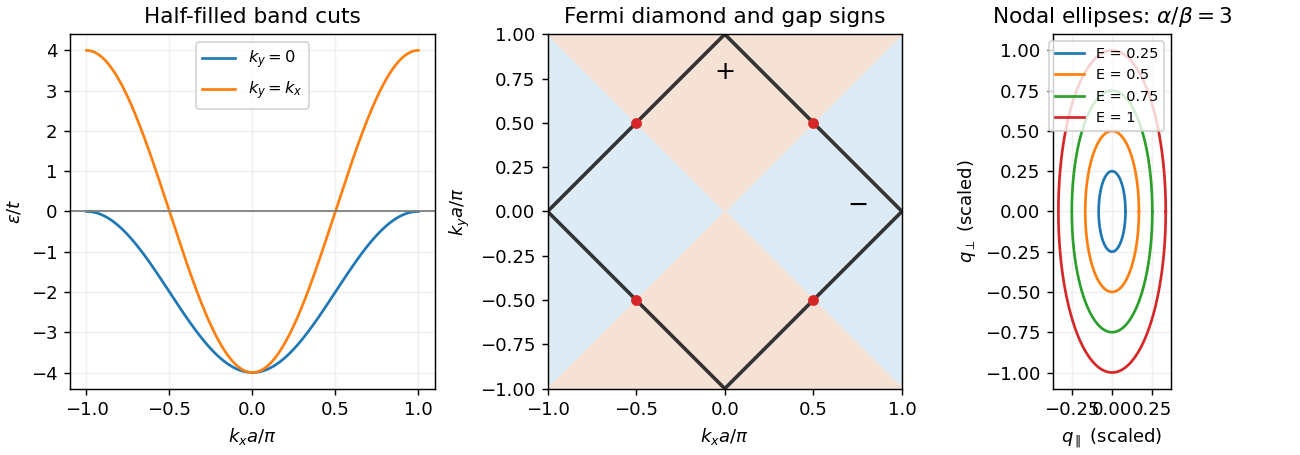
Half-filled square-lattice band cuts, diamond Fermi surface and anisotropic nodal quasiparticle contours
. Details. Near the specified node define andExpanding giveswhere and . ThereforeThere are four such nodes. An energy contour about one node encloses momentum area . Counting all four nodes and two independent spin quasiparticles, with one state per of momentum area per unit real-space area, gives the positive-excitation count and nodal quasiparticle density of states in a two-dimensional d-wave superconductorThis counts thermally excitable Bogoliubov modes, including particle-like and hole-like excitations, not the electron-addition spectral density alone. That distinction prevents a factor-of-two ambiguity. It is a per-layer result; dividing by the layer spacing gives the corresponding volume density in the independent-layer approximation.
The thermal energy density above its zero-temperature value follows from Fermi occupation:ThusThis clean nodal contribution assumes small compared with the scale over which linearization fails; impurity states and other excitations can add further terms.
In the vortex state, each flux quantum occupies area of order , so . Outside a core of radius , the phase flow has magnitude in the simple circular-cell estimate, with and condensed-pair mass . Its cell average isThe signed vector average can vanish around a vortex; the relevant quantity is a typical magnitude or Doppler shift, not a net transport velocity. Flow shifts nodal energies by order . Because the zero-field nodal density of states is linear in energy, averaging the magnitude of these shifts produces a residual density of states proportional to . The resulting Volovik effect givesThis is the clean semiclassical nodal regime, at temperatures below the field-induced Doppler scale and in an appropriate mixed-state field range. Core states, disorder, Zeeman splitting and screening can modify it. Its replacement by a square root of applied field additionally assumes the mean induction tracks that field away from the lower-critical-field onset; it is not an exact all-field law.
In BCS theory, pairing mixes an electron state with a hole in its opposite-momentum partner. For a uniform spin-singlet gap, the uniform Bogoliubov--de Gennes Hamiltonian gives the momentum-pair eigenproblemHere . A fermionic Bogoliubov quasiparticle is a coherent particle–hole combination, withFar above the Fermi surface the excitation is mostly particle-like; far below it is mostly hole-like; at the two weights agree. The transformation preserves the fermionic canonical anticommutation relations. Its mean-field particle-number mixing does not mean that the full physical theory violates charge conservation.
For a fully gapped isotropic state, the minimum single-quasiparticle energy is , while creating a pair of quasiparticles costs at least . This produces suppressed low-temperature thermal populations, an activated electronic heat capacity and a gap feature in superconducting tunneling. Gap nodes in an unconventional state instead allow low-energy excitations, changing the temperature dependence. These fermionic excitations are distinct from collective phase and amplitude oscillations of the paired condensate.
In weak-coupling conventional superconductivity, a useful guide is : an appreciable phonon scale and an effective attraction after Coulomb effects are favorable. A large density of states at the Fermi level can strengthen pairing, while light constituent masses can raise relevant phonon frequencies. Increasing electron–phonon coupling without limit is not a general strategy: lattice instabilities, competing order and changes to the phonon spectrum constrain it, and stronger coupling requires treatment beyond the simple exponential expression.
For unconventional high-temperature superconductivity, strong electronic interactions and magnetic fluctuations can support sign-changing pairing, as in d-wave superconductivity. Layered structures and proximity to magnetic order may enhance useful correlations, but can also promote competing insulating or density-wave states. Sufficient mobile-carrier phase stiffness is needed to turn pairing into coherent superconductivity; strong pairing alone does not guarantee a large transition temperature. Disorder that is relatively harmless to an isotropic conventional pair state can be pair-breaking for sign-changing gaps. There is no universal recipe established by these qualitative conditions: the pairing interaction, symmetry, carrier density, competing phases and phase coherence must all be considered.
A neutral superfluid can select a phase of its complex order parameter, breaking a global symmetry. A spatially uniform change of that phase costs no energy. Slowly varying changes therefore produce a gapless Goldstone mode. For a dilute weakly repulsive Bose gas, the Bogoliubov quasiparticle dispersion isso at long wavelengths, with . Density and phase fluctuations are canonically coupled components of this sound branch, rather than two independent positive-frequency modes. Superfluid helium and dilute atomic condensates supply neutral examples, although the dilute-gas formula is not quantitatively valid for strongly interacting liquid helium.
In a superconductor, the pair field is charged and its phase couples to the electromagnetic gauge field. Only combinations such as are physically meaningful. The Anderson-Higgs mechanism in a superconductor produces electromagnetic screening and removes the neutral sound mode as an independent gapless charged-density oscillation. In a homogeneous three-dimensional continuum, long-range Coulomb forces give a longitudinal plasma gap, approximately at small . The static transverse response gives the Meissner effect andwhen counts superconducting electrons of effective mass . Counting pairs instead uses density , charge and mass , giving the same stiffness. The condensate amplitude may also have a gapped Higgs mode, but that amplitude oscillation is distinct from the electromagnetic Higgs mechanism. Local gauge transformations remain a redundancy; this is not spontaneous breaking of an observable local symmetry in the same sense as the neutral global phase symmetry.
A bosonic coherent state is an annihilation-operator eigenstate,It has , a selected complex amplitude, and Poisson-distributed particle number. A coherent-field condensate variational state extends this construction to a spatial field with . Evaluating a normal-ordered interacting Bose Hamiltonian in that state gives a classical-field energy functional; its variational equation is the Gross–Pitaevskii equation. This connects a macroscopic phase to interference, quantized circulation and neutral Josephson effects. A fixed-number condensate instead has vanishing one-point field expectation; off-diagonal long-range order identifies the condensate without requiring exact number fluctuations.
The BCS ground state has the pair-coherent formIt is a product of Cooper-pair pseudospin coherent states: each paired momentum sector mixes its empty and doubly occupied configurations. The anomalous pair expectation is , while an ordinary single-electron expectation vanishes by fermion parity. Pair operators are not unrestricted canonical boson operators, so this state must not be identified with a naive oscillator coherent state of individual electrons. Number projection gives a fixed-even-number description with pair correlations. Phase differences between condensates enter the Josephson effect; in a charged condensate that phase difference must be gauge invariant.
The t-J model approximates the low-energy sector of a repulsive Hubbard model with near one electron per site. Large on-site repulsion suppresses double occupancy. Virtual hopping out of and back into that low-energy sector produces antiferromagnetic superexchange with . One conventional effective Hamiltonian iswith projected electron operator . At half filling, nearest-neighbor hopping cannot move an electron without entering a forbidden doubly occupied state, leaving the leading spin-exchange model. Doped holes can move and couple the charge dynamics to these spin correlations. Additional terms, including three-site processes at order , are omitted in this simplified Hamiltonian.
The exchange term energetically favors a nearest-neighbor spin singlet. With in the no-double-occupancy subspace, . A square-lattice pairing ansatz can therefore use bond singlets with opposite signs along the two axes. This d-wave bond order hasIt changes sign under a quarter-turn and vanishes along the zone diagonals. It is an even-parity, spin-singlet pairing pattern, not a statement of triplet pairing or necessarily broken time reversal. Phase-sensitive interference experiments distinguish this sign structure from a merely anisotropic nonnegative gap in cuprate superconductors.[ref]
Pairing symmetry and flux quantization in a tricrystal superconducting ring by C. C. Tsuei and others. 1994 phase-sensitive tricrystal test
The model captures strong local repulsion, antiferromagnetism and mobile doped carriers. Its interacting phase diagram is not solved by writing down the Hamiltonian: a mean-field d-wave ansatz is a proposed approximation, not a proof that every parameter choice has that exact ground state or a complete microscopic explanation of every high-temperature superconductor.
The electron-phonon interaction lets one electron polarize the ionic lattice and another interact with that delayed deformation. Phonon-mediated electron attraction acts over energy transfers below a characteristic phonon scale. Pairing additionally requires a net attractive interaction in some allowed pairing channel after screened Coulomb repulsion is included. In the conventional weak-coupling situation, retardation separates the low phonon scale from the much larger electronic scale, reducing the effective repulsion. The Cooper instability then makes a Fermi surface unstable to an arbitrarily weak net attraction in the idealized channel; finite temperature cuts off its logarithmic enhancement.
In BCS theory, a momentum-independent pairing amplitude within the cutoff obeys a self-consistency equation containing , with quasiparticle energy . At a continuous transition, take . A constant effective density of states and coupling combine into , while the band bottom truncates the negative-energy side at , with . This gives the supplied linearized gap equation. Its integrand is even, so withit becomes . If both cutoffs are much larger than , the given large-cutoff integral gives . Consequently the asymmetric-cutoff BCS transition temperature isFor , this reduces to ; for , it is . The second limit requires as well as . Weak at fixed nonzero supplies that limit, but taking afterward need not preserve it.
For a three-dimensional spin-degenerate parabolic electron band in the degenerate regime,DefineHolding the other model parameters fixed givesThus the log-log slope is below the cutoff-density scale and zero above it. For the specified parameters,This density crossover of a fixed-coupling BCS cutoff model is the requested prescribed model. A real three-dimensional parabolic band also has a changing density of states, so keeping constant as density varies is an additional imposed assumption, not a consequence of that dispersion.
For noninteracting spinless bosonic pairs, mass and density , homogeneous ideal Bose gas condensation givesUsing the supplied integral gives . Its slight difference from the more precise is consistent with the rounded integral. Write . On the low-density branch,Since , no part of the high-density plateau exceeds . The formal crossing condition isThe crossing occurs near and .
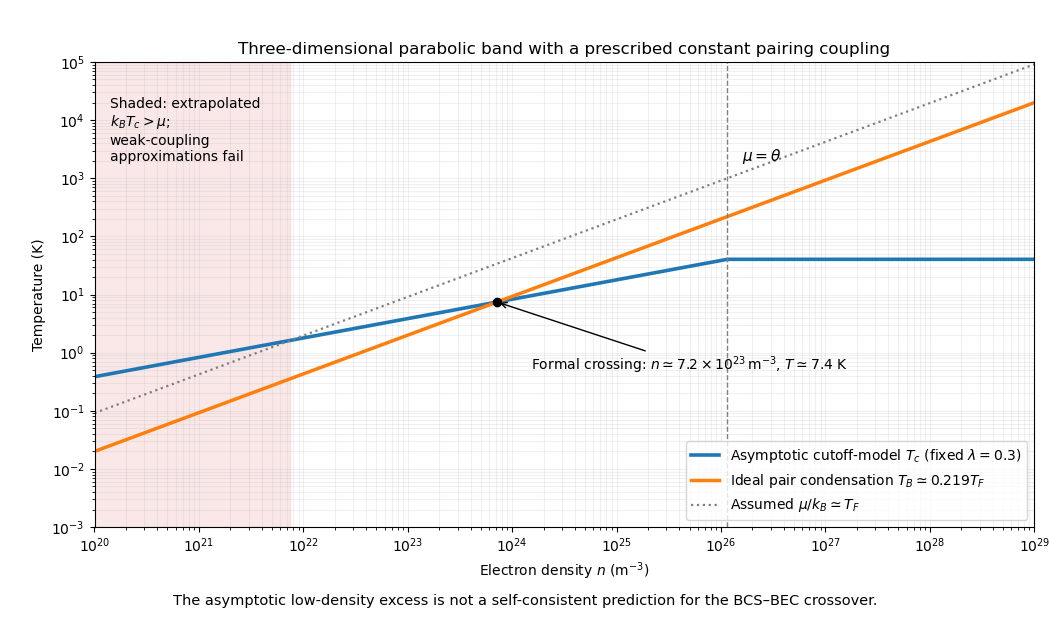


The apparent low-density excess should not be read as a reliable transition above the ideal condensation scale of preformed pairs. On this extrapolation grows without bound, violating the degenerate-gas and large-lower-cutoff approximations. It reaches one already near ; well before using an arbitrarily small density, the chemical potential, pairing, density of states and pair fluctuations need a self-consistent treatment. The asymptotic formula and ideal-boson curve compare two stipulated models, rather than solving the full BCS-BEC crossover.