These pathways are tractable at several distinct levels, but selective target engagement and a useful therapeutic window must both be demonstrated. A G protein-coupled receptor acts as a guanine nucleotide exchange factor for a heterotrimeric G protein: release of GDP permits GTP binding, changing the interactions of both the G protein alpha subunit and Gβγ with effectors. GTPase-activating proteins, including regulators of G protein signalling, accelerate return to the GDP-bound state. Gαs can stimulate adenylyl cyclase, Gαi can inhibit it, and Gαq can activate phospholipase C, linking receptor occupancy to different intracellular responses. The related small GTPases, such as Ras, also alternate between GDP- and GTP-bound states, but are monomeric switches with different activators and effectors. Strategies effective against one family cannot simply be assumed to work against the other.
The receptor is often the most accessible intervention point. An orthosteric antagonist competes with the endogenous ligand; an agonist activates a deficient response, while a partial agonist can produce an intermediate response and antagonize a higher-efficacy agonist. For example, beta-adrenergic receptor blockade reduces adrenergic stimulation of the heart. However, conserved binding pockets make receptor-subtype selectivity difficult, and the same receptor can have useful and harmful functions in different tissues. An allosteric modulator binds elsewhere and changes the affinity or efficacy of the endogenous ligand. This can exploit a less conserved pocket and preserve the timing of endogenous release; it does not automatically confer tissue specificity or a ceiling on toxicity. Structural studies of the beta-2 adrenergic receptor show why stabilizing particular receptor conformations can change coupling rather than merely change occupancy.[ref]
Structural insights into the dynamic process of β2-adrenergic receptor signaling by Aashish Manglik and others. Conformational intermediates examined by spectroscopy
biased agonism aims to favour one signalling output over another, for example G protein activation relative to arrestin recruitment. An opioid study found that TRV130 combined analgesia with reduced respiratory and gastrointestinal effects in rodent comparisons with morphine.[ref]
A G protein-biased ligand at the μ-opioid receptor is potently analgesic with reduced gastrointestinal and respiratory dysfunction compared with morphine by Scott M. DeWire and others. Preclinical signalling and equianalgesic comparisons
The inference that bias itself causes improved safety requires caution: different assays have different amplification and receptor reserve. Later direct measurements showed that low intrinsic G protein efficacy can explain favourable profiles of several proposed biased opioids.[ref]Low intrinsic efficacy for G protein activation can explain the improved side effect profiles of new opioid agonists by Alexander Gillis and others. Comparison of intrinsic efficacy and apparent bias
A convincing experiment therefore compares ligands with a common reference, matched receptor abundance and time courses, and proximal measurements of both pathways; it then tests benefit and toxicity at comparable effective exposures. An arrestin recruitment assay alone cannot predict an entire clinical adverse-effect profile.Direct inhibition of the switch is also possible. Competing at a nucleotide-binding site is difficult because intracellular nucleotides are abundant and binding is tight. Nevertheless, an alternative pocket can trap a particular state. YM-254890 binds an interdomain cleft of Gαq and inhibits nucleotide exchange by stabilizing the GDP-bound arrangement. Structural analysis, exchange measurements and tests against other G protein families connect binding to mechanism, rather than inferring Gαq inhibition from a fall in a distant calcium response.[ref]
Structural basis for the specific inhibition of heterotrimeric Gq protein by a small molecule by Akiyuki Nishimura and others. Structure and biochemical inhibition of GDP release
This illustrates chemical tractability, although inhibiting a widely used Gα family could impair normal signalling in many tissues. Targeting an interaction with a particular receptor, exchange factor or effector may give greater contextual selectivity.A complementary example is covalent inhibition of mutant Ras. AMG 510 exploits a pocket adjacent to cysteine 12 in KRAS G12C and favours the inactive GDP-bound protein. Its mutant-selective chemistry avoids requiring a nucleotide competitor, and biochemical, cellular and animal experiments connected the compound with suppression of signalling and tumour growth.[ref]
The clinical KRAS(G12C) inhibitor AMG 510 drives anti-tumour immunity by Jude Canon and others. Mutant-selective binding and antitumour experiments
This solution depends on the reactive cysteine and the accessibility of the trapped state; it is not a universal inhibitor of all Ras mutations. Exchange activity, pathway feedback, alternative signalling and additional mutations can change sensitivity. Moreover, a monomeric Ras inhibitor is evidence about a broader GTPase strategy, not evidence that all heterotrimeric G proteins have equivalent pockets.Other possible interventions include blocking selected Gβγ–effector contacts, enhancing a suitable GTPase-activating protein, preventing cell membrane recruitment, or inhibiting a downstream enzyme. Each trades accessibility against specificity: a downstream convergence point can bypass an inaccessible upstream lesion, but may suppress useful signals from many receptors. To select between these strategies, establish the disease-dependent molecular state, measure direct binding and exchange or hydrolysis, and confirm the predicted proximal output. Use an inhibitor-resistant rescue allele, an isogenic target-negative control, and counterscreens against related switches and unrelated cytotoxicity. Follow this with target engagement in the relevant tissue and measurements of normal physiological responses. The strongest therapeutic case combines a drug-accessible pocket or interface with a disease-specific dependence; pathway membership alone is insufficient.
weak biomolecular binding is useful because it makes molecular recognition reversible, responsive to concentration and compatible with rapid exchange. Here “weak” describes a relatively high dissociation constant for an individual biomolecular contact, not the fundamental weak force. For a simple reversible association ,Here is the association rate constant and is the dissociation rate constant. The bound fraction assumes free is known and binding sites are equivalent and independent; the lifetime assumes a single exponentially dissociating state without rebinding. A contact with is half occupied at a free partner concentration of , but only about 1% occupied at . Recruiting the partners to a cell membrane or scaffold can therefore turn binding on locally without changing their chemistry. Importantly, the same can result from different on- and off-rates: weak equilibrium binding does not by itself prove rapid dissociation.
This responsiveness supports signalling. Short recognition motifs in disordered regions can bind adaptor domains with modest affinity. A phosphorylation event can create a docking motif; subsequent dephosphorylation removes it. Partners can then exchange rather than remain permanently trapped in one complex. Several individually selective contacts allow the same protein to be recruited in different combinations and at different times. Sequence-specific hydrogen bonding, electrostatic complementarity and shape recognition still discriminate between partners, even when total binding free energy is modest. Conversely, nonspecific contacts can be useful during a search: reversible association with DNA confines a DNA-binding protein near possible targets, provided escape is fast enough to avoid sequestration on incorrect sites.
Weak contacts also solve turnover problems. An enzyme must stabilize a productive substrate arrangement and the transition state, yet release its product. Excessively tight ground-state or product binding can slow the overall cycle. A chaperone must capture exposed hydrophobic surfaces but subsequently release a client for folding or transfer. Thus maximal affinity is generally not the design objective; relative affinities and switching kinetics must match the sequence of tasks. Energy-consuming cycles can bias capture and release, while each individual binding step remains reversible.
Several weak contacts can collectively give strong, selective attachment through avidity. Once the first contact forms, tethering presents a second partner at an effective local concentration . In a simple two-contact model, the relative statistical weight of the doubly bound state contains a factor . Geometry, linker flexibility and accessibility determine this factor, so affinities cannot simply be added. Breaking one contact need not release the whole assembly; rapid local rebinding can stabilize an otherwise short-lived complex. Yet removing a modification or changing geometry can disassemble it. This is useful for a reversible scaffold, cell attachment or recognition of a particular pattern of modifications.
The yeast inhibitor Sic1 gives a particularly instructive example of weak recognition creating a regulatory threshold. Multiple phosphodegrons contribute to recognition by Cdc4, the substrate receptor of a ubiquitin ligase. Accumulation of phosphorylation can make degradation strongly responsive to cyclin-dependent kinase activity, whereas replacing the distributed weak recognition system by an overly strong motif can compromise appropriate timing.[ref]
Multisite phosphorylation of a CDK inhibitor sets a threshold for the onset of DNA replication by Piers Nash and others. Sic1 phosphodegrons, Cdc4 binding and cell-cycle threshold
The benefit is therefore a controlled decision, not merely stronger binding after adding more sites. The mechanism also illustrates why affinity measurements on one isolated peptide need not predict full-length substrate behaviour.Multivalent weak interactions can additionally produce a collective assembly transition. Experiments with nephrin, the adaptor Nck and N-WASP showed concentration- and valency-dependent assembly coupled to actin regulation.[ref]
Phase transitions in the assembly of multivalent signalling proteins by Pilong Li and others. Reconstitution of multivalent signalling assemblies
biomolecular phase separation can locally concentrate reaction partners while allowing exchange with the surroundings. However, visible droplets or fluorescence recovery alone do not establish that a cellular structure is a functional liquid phase. Reconstitution should vary concentration and valency, measure partitioning and reversibility, and include binding-defective mutants. Cellular tests must establish the relevant endogenous concentrations and show that disrupting the proposed contacts changes function without simply destroying the protein.Experimentally, isothermal titration calorimetry can estimate binding thermodynamics, while surface plasmon resonance or solution kinetic measurements can resolve association and dissociation. For weak contacts, high concentrations make aggregation, nonspecific surface binding and ligand depletion important controls; a failure to retain a complex during purification is not proof that it never forms. Measurements in dilute solution should be compared with full-length partners, cell membranes or scaffolds where appropriate. Weak interactions provide adjustable, combinatorial recognition; localization, multivalency and regulated modification convert that flexibility into reliable biological behaviour.
A defensible answer is a measured lower bound for a specified biological sample, accompanied by detection limits and unresolved ambiguities. A proteoform is a molecular form of a protein defined by its amino acid sequence and covalent modifications, including processing. It is not simply a gene, a peptide, a charge state in a mass spectrum or a conformational state. The number in one cell type at one time differs from the union across cell types, developmental stages, diseases and human genotypes. Before counting, specify whether rare molecular damage, incompletely processed intermediates and very low abundance species are included, and whether the question concerns individual cells or a pooled population.
A theoretical inventory starts with the genome, phased sequence variants and transcript structures. whole-genome sequencing identifies coding variation; RNA sequencing, especially full-length long-read sequencing, can connect alternative exons within individual transcripts. ribosome profiling supplies evidence that candidate reading frames are translated. However, an RNA isoform is not proof of a stable protein, and none of these methods alone establishes the combination of post-translational modifications on the mature chain. A schematic upper bound iswhere indexes distinct sequence forms and site permits an unmodified state plus mutually exclusive modified states. This assumes independence between sites and that every combination is realizable. Steric constraints, processing, mutually exclusive pathways and low occupancy invalidate that assumption in real cells. Multiplying all documented sites therefore estimates a possible space, not the number that exists.
bottom-up proteomics provides a broad experimental survey. Extract proteins under conditions that minimize proteolysis and preserve labile modifications; fractionate, digest with complementary proteases, and analyse peptides by liquid chromatography-mass spectrometry and tandem mass spectrometry. Search against a sample-specific sequence database and relevant modification hypotheses, then validate sites with diagnostic fragments and, where needed, synthetic standards. Modification-specific enrichment increases sensitivity but changes the sampled population and cannot supply an unbiased count by itself. Control peptide- and protein-level false discovery rates, distinguish unique from shared peptides, and report ambiguously localized modifications explicitly. Enlarging a search to every possible modification greatly increases the chance of a convincing but incorrect match.
The central limitation is loss of linkage. Suppose sites A and B occur on different digestion products. A mixture containing equal amounts of unmodified and doubly modified chains gives 50% modification at each site. A different mixture containing equal amounts of A-only and B-only chains gives exactly the same site occupancies, but contains different intact forms. No amount of more precise measurement of these two isolated peptides distinguishes the populations. A spanning peptide, a larger linked fragment or intact-chain evidence is required.
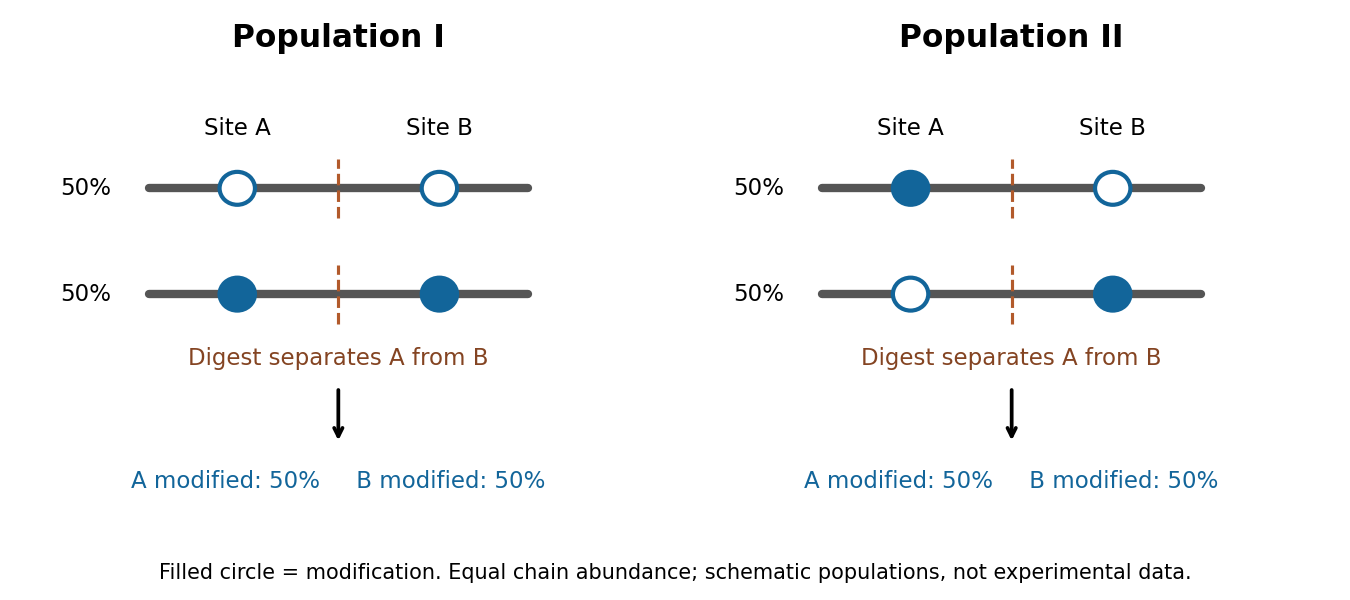

top-down proteomics addresses this by separating and measuring intact proteins before fragmenting their selected ions. High-resolution intact mass constrains the total composition, while sequence fragments connect modifications to the same molecule and localize them. Electron-based fragmentation can help retain modifications lost during energetic fragmentation. middle-down proteomics uses larger fragments to recover partial linkage when complete intact-chain characterization is difficult. John C. Tran and colleagues demonstrated discovery-scale intact-protein analysis, illustrating that sequence variants and modification patterns can be mapped together rather than reconstructed solely from disconnected peptides.[ref]
Mapping intact protein isoforms in discovery mode using top-down proteomics by John C. Tran and others. Intact-protein fractionation and identification of linked isoforms
Intact mass alone remains insufficient: positional isomers with the same mass require informative fragmentation or additional separation, and one envelope can contain unresolved forms.A practical programme would combine these measurements across well-defined human cell populations, using biological replicates, standardized handling and a documented range of physiological perturbations. It would use sequence-resolved RNA data to constrain searches, broad bottom-up data to locate promising variation, and targeted top-down or middle-down analysis to establish co-occurrence. Spike-in proteins spanning abundances and sizes would measure extraction loss and detection sensitivity. Time courses, immediate protein denaturation, protease and phosphatase inhibition, and processing blanks would help distinguish cellular modification from oxidation, protein deamidation or cleavage during preparation. Very large, hydrophobic and scarce proteins require specific extraction and separation strategies; their absence from a spectrum cannot be treated as biological absence.
Bulk and single-cell measurements answer different questions. A bulk sample may show two proteoforms expressed in different cells; it does not show that both occur in each cell. Conversely, detecting two modifications in one cell does not demonstrate that they occupy the same protein molecule. Single-cell sensitivity and molecular linkage must therefore be evaluated separately. Quantitative standards and targeted follow-up can establish whether a new low-abundance assignment is reproducible rather than a one-off incorrect match.
Finally, merge identifications by molecular identity rather than by peptide count, search-engine entry or ion charge. Record fully characterized forms separately from groups sharing an unresolved mass or site pattern, and control identification error at the proteoform level. Plot discovery against sampling depth, tissues and perturbations; any extrapolation to unseen forms requires explicit assumptions about abundance and sampling heterogeneity. Sequence prediction supplies candidates, peptide analysis supplies coverage, and intact or linked-fragment evidence establishes combinations. A universal exact count cannot be inferred by multiplying modification sites or summing database entries.
I would increase the supply of correctly matured translation elongation factor P in a bacterial production system whose target proteins contain EF-P-sensitive proline motifs. This is a concrete proposal to relieve a catalytic bottleneck while preserving the machinery that selects the correct aminoacyl-tRNA. Its benefit should be tested for the chosen products rather than asserted for every protein or organism.
The rationale is that adjacent prolines are difficult substrates for peptide-bond formation. EF-P binds the ribosome near the peptidyl-tRNA and assists productive peptide-bond formation at susceptible sequences. Lili K. Doerfel and colleagues used defined biological translation reactions and engineered substrates to connect EF-P with rapid synthesis through consecutive prolines; Susanne Ude and colleagues showed relief of polyproline-dependent stalling and physiological regulation of the bacterial protein CadC.[ref]
EF-P is essential for rapid synthesis of proteins containing consecutive proline residues by Lili K. Doerfel and others. Defined peptide-bond formation and proline-containing substrates
[ref]Translation elongation factor EF-P alleviates ribosome stalling at polyproline stretches by Susanne Ude and others. Polyproline stalls and CadC expression
Increasing functional EF-P is therefore mechanistically different from weakening decoding discrimination or accelerating rejection-sensitive steps indiscriminately.I would first establish the limiting step in a reconstituted bacterial biological translation system, holding the mRNA, ribosome concentration, initiation factors, charged tRNA supply and energy regeneration constant. Titrate correctly modified EF-P against the unmodified or inactive factor. For an Escherichia coli production strain, coordinate EF-P expression with its native maturation enzymes: increasing an inactive, insufficiently modified pool may add burden without relieving stalls. Introduce the change in a tunable manner and verify both EF-P abundance and its modification state by targeted mass spectrometry. This is an engineering proposal based on demonstrated factor function; the cited experiments do not establish that overexpression will improve every industrial production strain.
A simple throughput calculation makes the scope explicit. If a ribosome needs for ordinary elongation and termination, and an additional at susceptible stalls, the completion capacity of productive ribosomes is approximatelyThis neglects initiation limitation, traffic and variation between ribosomes. As an illustrative calculation, reducing stall time from 20 s to 2 s when the remaining cycle takes 30 s raises the capacity by at unchanged quality. A product without substantial EF-P-sensitive stalls would show little direct benefit. Moreover, extra ribosomes do not necessarily increase output if they collide behind a slow site; relief of the bottleneck may free ribosomes as well as accelerate individual chains.
Preserving error control requires more than measuring total protein. aminoacyl-tRNA synthetase editing controls charging identity, while ribosomal initial selection and kinetic proofreading help discriminate cognate from near-cognate tRNAs. These should remain intact. If an independent per-residue missense probability is for a chain of length , the error-free fraction is approximately ; even a small per-residue deterioration can matter for a long protein. EF-P acts principally on difficult peptidyl transfer, but altered dwell times can still change ribosomal frameshifting, folding and quality control. The proposal promises a testable route to low-error acceleration, not an automatic absence of side effects.
The central controls would use the same target sequence, promoter and untranslated regions with or without added active EF-P. An inactive or maturation-defective factor tests whether catalytic assistance, rather than nonspecific protein overexpression, accounts for the gain. A motif-free reporter tests specificity. A proline-substitution reporter can test the mechanism, but cannot substitute for testing the unchanged production target because it changes the product itself. Measure growth and resource burden and include several EF-P doses: excessive factor supply may become inhibitory or wasteful. Use matched biological replicates and establish that mRNA abundance or stability has not changed enough to explain the result.
Measure elongation using time-resolved synthesis and normalized ribosome profiling, looking for relief at the predicted stall sites and reduced collisions. Profiling alone does not measure completed protein flux. Pulse–chase measurements and calibrated mass spectrometry of full-length products should establish completion, while an activity assay tests correct folding. fluorescence alone is inadequate because fluorophore maturation and degradation also affect signal. Separate assays should quantify missense incorporation, stop-codon readthrough and frameshifts, with positive error controls and detection limits. Mass-spectrometric error measurements require standards because erroneous and correct peptides need not ionize equally.
Finally, compare soluble active yield, not just synthesis speed: some pauses aid cotranslational folding, and relieving them can lower useful output. If substrate or charged tRNA supply becomes limiting, rebalance those components rather than weakening kinetic proofreading. A successful result is a reproducible increase in completed, correctly folded target molecules per unit time, with no material increase in independently measured error classes. Extension to other sequence bottlenecks would require their own mechanistic diagnosis.
NMR of membrane proteins became practical through coordinated improvements in sample preparation, isotope labelling, relaxation control, instrumentation and solid-state methods. The obstacle is not simply that cell membranes are insoluble. Hydrophobic surfaces must remain shielded, while the protein must retain function and form a sufficiently homogeneous sample. In solution, the protein plus its detergent or lipid assembly tumbles slowly; rapid transverse relaxation then broadens resonances until assignments and structural restraints become difficult to obtain.
Recombinant expression and controlled isotope labelling allow selective observation of the protein against its environment. Uniform nitrogen-15 and carbon-13 labelling supports multidimensional assignments. deuteration reduces much proton–proton dipolar relaxation; reintroducing selected protons or labelled methyl groups retains sensitive reporters while limiting the relaxation network. selective methyl labelling is particularly useful for large complexes, but the sparse reporters do not automatically supply enough restraints for a unique complete structure. Exchangeable amide protons may also need back-exchange after growth in deuterated medium, and buried sites can exchange incompletely. Sample production, rather than the spectrometer alone, is therefore a central technical development.
The membrane mimic must balance biological fidelity and spectroscopic tractability. Detergent micelles shield hydrophobic surfaces and can produce relatively small assemblies; inappropriate detergents may alter packing, activity or oligomeric state. bicelles combine bilayer-forming lipids with components that stabilize their edges, and lipid bilayer nanodiscs use a scaffold to enclose a bilayer patch. Smaller, well-defined nanodiscs reduce the additional rotational burden. Franz Hagn and colleagues engineered optimized small nanodiscs and obtained high-resolution NMR information on the membrane protein OmpX, connecting scaffold design with a more tractable lipid-embedded sample.[ref]
Optimized phospholipid bilayer nanodiscs facilitate high-resolution structure determination of membrane proteins by Franz Hagn and others. Small scaffold design and OmpX structure determination
No mimic is automatically native: compare ligand binding, transport or catalytic activity with an appropriate cell membrane preparation, and check concentration-dependent aggregation and oligomerization.transverse relaxation-optimized spectroscopy selects a slowly relaxing component of a coupled spin system. For suitable nuclei and fields, dipolar and chemical shift anisotropy contributions partly cancel for one component while reinforcing others. Combined with deuteration, this preserves narrower lines in systems that would otherwise be inaccessible. The original TROSY experiments established the relaxation-interference principle rather than merely increasing signal by averaging longer.[ref]
Attenuated T2 relaxation by mutual cancellation of dipole-dipole coupling and chemical shift anisotropy indicates an avenue to NMR structures of very large biological macromolecules in solution by Konstantin Pervushin and others. Theory and experimental demonstration of relaxation interference
Methyl-based variants exploit favourable methyl relaxation properties and selective labelling. Increasing magnetic field improves sensitivity and frequency dispersion, but also changes relaxation contributions; it is not correct to assume that every resonance becomes narrower at every higher field.High-field magnets, stable radiofrequency electronics and cryogenic detection probes increase accessible sensitivity and resolution. Three-dimensional and higher-dimensional experiments spread overlapping signals and connect resonances through known covalent pathways. Once assignments are secure, nuclear Overhauser effects provide distance information, while residual dipolar couplings and paramagnetic relaxation enhancement can add orientational and longer-range constraints. chemical shift perturbations report changes in local environment on ligand binding, but do not by themselves determine a contact geometry. Each additional measurement restricts the structural model in a different way, which is particularly valuable when only a sparse set of membrane-protein resonances remains visible.
solid-state nuclear magnetic resonance provides a complementary route that does not require rapid overall tumbling. proteins can be studied in bilayers or other immobilized assemblies, using pulse sequences and sample orientation or magic angle spinning to control anisotropic interactions. The magic angle satisfies , giving . Spinning averages appropriate orientation-dependent terms, while decoupling, isotope dilution or deuteration and fast spinning reduce broadening from dense spin networks. Proton detection at very high spinning rates improves sensitivity; Loren B. Andreas and colleagues demonstrated structures of fully protonated proteins using fast-spinning proton-detected experiments, an important general methodological advance rather than a demonstration that every cell membrane sample is thereby solved.[ref]
Structure of fully protonated proteins by proton-detected magic-angle spinning NMR by Loren B. Andreas and others. Proton detection with approximately 100 kHz magic-angle spinning
dynamic nuclear polarization can additionally enhance signal through electron-to-nuclear polarization transfer, although radicals and cryogenic conditions can affect line widths and the conformational states observed.The outcome is both structural and functional information. Spectra can distinguish conformations, map ligand responses and measure exchange even when no single static structure describes the system. Empty micelles or scaffold-only nanodiscs help identify environmental signals; unlabelled samples, independent assignments and distance-restraint validation guard against incorrect peaks and overfitting. Compare preparations and activity before and after long acquisitions, because aggregation or degradation can selectively remove signals. A missing peak may reflect exchange broadening or overlap, not an absent residue. The enabling combination is a functional and homogeneous cell membrane environment with an isotope and pulse-sequence strategy matched to the size and dynamics of the assembly; solution and solid-state NMR cover complementary regimes.
Biophysical measurements show that enzymes occupy enzyme conformational ensembles; establishing which motions control function requires linking those ensembles to particular kinetic steps. Motions range from picosecond side-chain fluctuations to microsecond–millisecond loop rearrangements and slower domain transitions. They can govern substrate access, productive alignment, chemistry or product release. These roles must be distinguished: the steady-state turnover rate describes the entire catalytic cycle and need not equal the rate of bond making or breaking.
crystallography identifies the structural framework and can reveal alternative loop positions or ligand-dependent states. Room-temperature measurements and time-resolved experiments can capture changes hidden by a single cryogenic model. Nevertheless, a displacement parameter combines motion, static disorder and modelling uncertainty, and a series of structures is not itself a trajectory or a rate measurement. Spectroscopic measurements in solution are particularly useful because they measure fluctuations and exchange while the enzyme remains in a defined chemical state.
nuclear magnetic resonance resolves dynamics at individual sites. longitudinal nuclear spin relaxation and transverse relaxation and heteronuclear nuclear Overhauser effects constrain fast fluctuations; a model-based protein NMR order parameter describes the amplitude of bond-vector motion after accounting for overall tumbling. NMR relaxation dispersion measures how exchange contributes to relaxation as refocusing conditions change. A two-state analysis can constrain an exchange rate , state populations and a chemical shift difference. Measurements at multiple fields and temperatures help separate these parameters, but alternative models and insensitive time windows remain limitations. The inferred minor-state chemical shifts can be compared with separately characterized ligand-bound structures; one should not equate a dispersion curve with a fully resolved molecular movie.
In dihydrofolate reductase, relaxation measurements detected sparsely populated states related to other intermediates of the catalytic cycle, supporting a pre-existing landscape from which ligand binding can select conformations.[ref]
The dynamic energy landscape of dihydrofolate reductase catalysis by David D. Boehr and others. Relaxation dispersion across catalytic intermediates
This connects conformational selection with enzymatic progression without excluding subsequent induced fit. In cyclophilin A, comparison of the free enzyme and catalytic conditions showed an intrinsic network of conformational exchange whose rates were associated with turnover.[ref]Intrinsic dynamics of an enzyme underlies catalysis by Elan Z. Eisenmesser and others. NMR comparison of free enzyme and catalytic exchange
Matching rates is informative but not sufficient to prove that a particular motion limits chemistry: the measured exchange may be a coupled consequence, or another step can occur on a similar timescale.Kinetic methods provide the essential bridge. stopped-flow mixing follows a rapid fluorescence or absorbance response after substrate addition; rapid quench-flow terminates reactions at selected delays and measures chemical products. Binding, conformational change and chemical conversion can thus be fitted to competing kinetic schemes rather than all assigned to a single observed exponential. A pre-steady-state burst can reveal fast chemistry followed by slower release, although its amplitude also depends on the active enzyme fraction and mechanism. temperature jumps perturb an existing equilibrium on shorter timescales and expose relaxation back toward it. isotope substitution can help identify a chemical step, but changes in observed isotope effects must be interpreted within the complete kinetic scheme.
Single-molecule Förster resonance energy transfer adds information lost in population averages. A donor–acceptor pair reports a distance-sensitive efficiency,where the characteristic distance depends on the dyes and their photophysical environment. Trajectories can reveal state dwell times, heterogeneous pathways and ordering of domain transitions relative to a turnover reporter. Labels must preserve activity; donor-only and acceptor controls, corrections for detection efficiencies, and tests for blinking or bleaching are necessary. A FRET change can arise from dye orientation or local quenching, so corroborating distances or structural data are required before assigning a specific domain movement. A mean efficiency also cannot simply be converted into the mean molecular distance because the relation is nonlinear.
hydrogen-deuterium exchange mass spectrometry maps changes in protection and solvent accessibility across an enzyme, usefully locating regions altered by substrate binding or mutation. Exchange also depends on hydrogen bonding, local opening equilibria and chemical conditions, so it is not a direct universal clock for internal motion. molecular dynamics can connect observed sites to candidate atomic pathways and predict further tests. Its force field, sampling and treatment of chemistry limit inference; a conventional classical trajectory does not demonstrate bond-breaking kinetics by itself.
Causal perturbation is stronger than correlation when coupled to these measurements. In the DHFR “dynamic knockout” study, the N23PP/S148A variant retained a closely similar active site ground-state structure but lost much active site millisecond exchange and showed slower hydride transfer. The S148A comparison was especially informative: it also altered the large closed-to-occluded transition yet retained more exchange and much faster chemistry.[ref]
A dynamic knockout reveals that conformational fluctuations influence the chemical step of enzyme catalysis by Gira Bhabha and others. Figures 3–4 and mutant comparison of hydride-transfer rates
This argues against identifying the gross loop transition itself as the obligatory chemical event. Controls must still examine stability, binding, active site geometry and altered electrostatic or solvation ensembles: a mutation is not an isolated dial for “motion”.A coherent mechanistic account therefore combines structural states, populations, exchange rates, independently resolved chemical kinetics and perturbations that make successful predictions. In an activated-rate description , changing access to productive arrangements can alter the relevant free-energy barrier or pre-equilibrium population. Motions do not provide a new energy source outside thermal fluctuations and chemical free energy. Internal motions can gate access, organize reactive configurations and permit release; which role matters is an experimental question for each enzyme and each step.
A DNA library synthesis method determines which variants can be reached, how often they are sampled, and which evolutionary paths remain available. The nominal number of DNA molecules is less informative than the distribution of functional amino acid sequences presented to the assay. directed evolution couples diversification to a genotype-phenotype linkage, screening or selection, and recovery of successful genotypes. Construction controls the accessible moves through protein sequence space and therefore interacts with assay capacity, starting sequence and epistasis; it is part of the evolutionary strategy rather than an interchangeable preliminary step.
error-prone PCR explores substitutions throughout an existing gene without requiring prior structural knowledge. R. Craig Cadwell and Gerald F. Joyce demonstrated controlled PCR mutagenesis using a ribozyme sequence, establishing a general route for generating variant templates.[ref]
Randomization of genes by PCR mutagenesis by R. Craig Cadwell and Gerald F. Joyce. Altered PCR fidelity and distribution of mutations
For protein evolution, polymerase preferences, sequence context and the genetic code make amino acid changes uneven: a substitution requiring two nucleotide changes is less accessible than a single-base neighbour. Increasing the mutation rate reaches more distant variants but often increases inactive products and makes attribution difficult. Insertions and deletions can also change the reading frame. Existing useful sequence combinations are usually retained at a low mutation load, but extensive remodelling is hard to reach by successive selections if intermediate genotypes are deleterious.An idealized Poisson distribution with mean mutation count makes this trade-off quantitative:At , about 37% of molecules have no change and 37% have one; at , only about 5% are unchanged and about 80% contain two or more changes. This is a planning model, not a guarantee that a real PCR DNA library is unbiased or independent at every site. Early PCR events can generate many related descendants, and the number of nucleotide mutations is not the number of distinct amino acid substitutions.
Oligonucleotide-directed saturation mutagenesis concentrates the assay budget at specified sites, for example an active site pocket or an interface. degenerate codons are convenient but biased. NNK and NNS each encode 32 codons, including one stop codon, with unequal multiplicities for different amino acids. At independently synthesized sites the ideal fraction lacking these introduced stops is , even before assembly errors or deleterious substitutions. A DNA library of amino acid combinations can therefore contain many redundant codons and uneven representation. Trinucleotide mixtures assemble complete chosen codons and can exclude stops, equalize amino acid sampling, or deliberately favour a chemically relevant subset. Bernhard Virnekas and colleagues developed such trinucleotide phosphoramidites for mixed-oligonucleotide synthesis.[ref]
Trinucleotide phosphoramidites: ideal reagents for the synthesis of mixed oligonucleotides for random mutagenesis by Bernhard Virnekas and others. Whole-codon synthesis for controlled amino-acid mixtures
Controlled diversity is valuable, but restricting sites according to an incomplete structural model can miss beneficial remote mutations.DNA shuffling offers a different move: genetic recombination among already useful or homologous sequences. Random fragmentation followed by annealing and polymerase extension reconstructs genes from overlapping parental fragments. Willem P. C. Stemmer demonstrated reassembly and genetic recombination, including chimeric sequences, providing a practical route to combine sequence blocks rather than relying only on isolated substitutions.[ref]
DNA shuffling by random fragmentation and reassembly: in vitro recombination for molecular evolution by Willem P. C. Stemmer. Fragmentation, gene reassembly and recombinant products
This can unite improvements acquired in separate lineages and remove unwanted changes by genetic recombination with a parent. However, crossovers favour compatible homologous regions, closely related parents may add little diversity, and breaking a coadapted combination can lower fitness. Positive or negative epistasis means the fitness of a recombinant cannot be predicted by adding the effects of its parental substitutions.Designed synthetic genes and pooled oligonucleotide assembly can specify more extensive combinations, deletions, insertions or carefully chosen paths between distant sequences. This can test combinations inaccessible to single-base steps and explicitly balance beneficial candidates against exploratory variants. The cost is that synthesis, assembly and amplification introduce errors and abundance differences; a designed sequence is not necessarily a correctly constructed or well represented molecule. Long constructs may need assembly from overlapping fragments, and different fragment yields can skew the DNA library. A finite screen also prevents exhaustive exploration simply by purchasing a larger pool.
Sampling makes these differences concrete. If a target variant has DNA library frequency , screening independent clones finds it with probabilityFor equally frequent variants, the expected number of distinct variants observed is . Screening 1000 clones from a uniform two-site amino acid DNA library with visits about 92% of the variants on average; from a three-site DNA library with , it visits only about 12%. These are expected fractions, not probabilities that every variant has been sampled. Roughly clones give a 95% chance of observing one specified rare variant when is small. Synthesis bias and clonal duplication can make the effective coverage substantially worse.
The course of evolution should therefore be planned alongside screening. Begin with a mutation load or site set that the assay can actually cover, sequence the unselected DNA library to measure mutation spectra, stop frequency, parental carry-over and representation, and compare those frequencies with selected output. Use matched expression conditions and retain genotype-phenotype linkage: selection for growth, expression or display can otherwise enrich a variant that performs poorly as a purified enzyme. Reconstruct hits independently, sequence the complete gene, measure soluble protein and validate the desired activity or specificity at controlled protein concentration. Include parental and known inactive controls and, where relevant, more than one substrate or environmental condition. Subsequent rounds can recombine verified hits, adjust mutation load or target sites suggested by the first round. The best synthesis method maximizes useful, testable diversity under the assay budget and enables appropriate paths through the fitness landscape; maximal random diversity alone is not the objective.
Articles by others on the same topic
There are currently no matching articles.