
The fixed common temperature, rigid external container and fixed particle numbers on either side make the total Helmholtz free energy the appropriate thermodynamic potential. Let the barrier have cross-sectional area , and let increasing expand the left compartment. Then and . At fixed temperature and particle number, , soThus mechanical equilibrium, , makes stationary. The physical force on the barrier towards increasing is . If the barrier is displaced slightly from , strict mechanical stability requires a restoring force:ConsequentlyThe Taylor expansion proves that thermodynamic equilibrium is a strict local minimum of the Helmholtz free energy, rather than merely a stationary point.
For individually stable gases, the positive isothermal compressibilities make the sign especially transparent:If these inequalities hold throughout the accessible interval, is a strictly convex function and an interior stationary point is the unique global minimum of the Helmholtz free energy. Stability at one point alone proves only the local statement. A vanishing restoring derivative describes marginal stability and requires examining higher-order terms.
Past exam of the thermal and statistical physics course of the University of Cambridge 2019 Section B 6 Solution Created 2026-10-18 Updated 2026-10-20
Occupation and the two-dimensional Fermi energy. For an independent single-particle state, the Fermi-Dirac distribution isThe chemical potential enforces the chosen mean particle number through , including spin states in the sum. It is common to all states in particle-exchange equilibrium and must generally change with temperature or field when the total mean number is held fixed. At zero temperature, the distribution becomes a Heaviside step function at the Fermi energy.
Let the sample area be and let be its internal spin spin degeneracy. In the continuum limit, filling the disk givesThereforeFor spin-half fermions with both spin states available, and ; for a spin-polarized gas . The question does not specify the area or spin degeneracy, so these conventions must be stated rather than extracting an energy from alone. Although the original text calls momentum, the supplied dispersion makes it a wave vector; physical momentum is . The result agrees with the constant two-dimensional free-electron density of states. Discrete level spacings in a finite sample would require a specified boundary spectrum.
One level occupied on average. Write and . The two mean spin occupations areImposing gives , hence . Thus, for every positive temperature,The total magnetic moment is . ConsequentlyThis is the grand-canonical spin susceptibility of a half-filled single level. Empty, singly occupied and doubly occupied orbital states are allowed in the grand canonical ensemble. At zero field, the singly occupied configurations together have probability , explaining the factor of two relative to one permanent spin-half moment. If exactly one electron were required at all times, a canonical two-state partition function would instead give and . That different answer does not implement the stated average-number constraint.
Density-of-states formula for the susceptibility. Here is the zero-field single-spin density of states. Regard its argument as the full spin-shifted energy. The shifted functions are , soThe total number is even in ; thus at fixed total number on a smooth branch. More directly, terms from cancel in the spin difference because the two densities coincide at zero field. To first order,It follows thatFor a physical energy band, take to vanish below its lower edge. Provided the endpoint term vanishes, integration by parts also givesThis form displays the positive response and the narrow thermal window around . A sharp band edge is included by the corresponding distributional derivative in the first expression. The susceptibility defined here is the derivative of total magnetic moment with respect to , with units ; it is not automatically a dimensionless SI volume susceptibility. A density-of-states convention per unit volume likewise gives a response per unit volume. These are the field conventions for magnetic susceptibility.
Chemical potential at fixed number. Define the integrated single-spin state countThe probability kernel has unit integral, mean , and variance . Using integration by parts,Expand about . The linear term integrates to zero, while givesThis is the number form of the Sommerfeld expansion. Since at zero temperature, set with :ThereforeThe coefficient can be obtained directly. With ,For example, the sum follows by expanding on , using the evenness of the kernel and integrating each exponential. Thus . A density of states increasing with energy gives a downward quadratic chemical-potential shift. For the constant two-dimensional density of states that shift vanishes to this order; a finite lower band edge still allows exponentially small corrections.
Low-temperature susceptibility at fixed number. Apply the same kernel expansion to itself:The shift of must be retained in the first term. Writing and similarly for its derivatives,ConsequentlyThis is the fixed-number low-temperature Pauli susceptibility. The contribution is thermal broadening at fixed chemical potential; the contribution enforces fixed total number. Both are needed. If the density of states were instead defined with both spin directions included, the prefactor would be absorbed into that definition. Only the spin response has been calculated; no orbital magnetic response is included.
The expansion assumes , sufficient smoothness near the Fermi energy, and a temperature small compared with the energy scale over which changes or encounters a band edge. It does not apply unmodified at a singular density of states. For the ideal two-dimensional parabolic band, , so the leading Pauli response is temperature independent, consistently with the earlier state count.
Availability and total entropy. The reservoir changes by and . Its particle number and the system's particle number are fixed. The reservoir's first law of thermodynamics therefore givesAdd the system's entropy change. Because are constant,Thus define the availabilityAn additive constant in is immaterial; its value above the equilibrium reference is the exergy. The Second law of thermodynamics gives , hence . A stable equilibrium maximizes total entropy over the allowed variations and therefore minimizes . The environmental enter this definition even when the system has not yet reached their values. Because both thermal and mechanical exchanges are allowed, equilibrium here includes mechanical balance; equality of temperatures alone does not ensure the minimum.
Probability and curvature. For a fixed value of a macroscopic coordinate , let count the compatible system microstates. The product of the system and reservoir multiplicities isAll factors independent of enter a normalization constant, givingHere is the constrained or effective availability for this coordinate, including the multiplicity of any eliminated variables. A nonuniform coordinate measure must likewise be retained or incorporated in that effective availability.
At a stable interior minimum, and . Its Taylor expansion givesKeeping the quadratic term yields a normal distribution,This is availability curvature and equilibrium fluctuations. The quoted fluctuation formula holds at quadratic order in the Gaussian fluctuation approximation; it is not an exact identity for an arbitrary nonlinear . Higher terms can shift the mean away from its most probable value .
Bubble equilibrium. Keep the number of air molecules fixed and include the surface energy in the system's total internal energy. For constant surface tension , this contribution is , with no surface entropy under the stated approximation. Its differential isHenceIndependent thermal and volume variations give andThe air pressure is evaluated at ; since the bubble is closed it generally depends on volume, so this equation is implicit until an air equation of state is supplied. For a sphere, , , and the pressure jump becomes , the Young–Laplace equation for a single gas–liquid interface. There is no second surface as in a thin soap film.
Isothermal volume fluctuations. With the air maintained at , eliminate its entropy in favor of its Helmholtz free energy:The identity givesUsing the curvature result,These are the volume fluctuations of a closed gas bubble. Stability requires the denominator to be positive. The negative surface contribution reflects the concavity of ; gas compression supplies the positive restoring curvature. For ideal air, , and mechanical equilibrium reduces the denominator toThe units are consistent: is pressure, so has units , the units of a volume variance. Holding externally fixed while varying would remove the gas-compression term and change this stability problem; that is not the fixed-particle-number situation here.
Numerical size of the fluctuations. The volume conversion is important:Use the specified , and . ThenWith the Boltzmann constant ,Thus the fractional root mean square fluctuation and fractional variance are respectivelyThe absolute root mean square fluctuation is . The very small fractional value supports the local Gaussian fluctuation approximation. This estimate neglects exchange of dissolved air, variations of surface tension, shape fluctuations and temperature fluctuations, consistently with the prescribed fixed-number, isothermal bubble model.
Canonical probabilities. A canonical ensemble describes a system of fixed particle number and fixed external parameters such as volume, weakly coupled to a much larger thermal reservoir. They exchange energy and reach thermal equilibrium, while the reservoir's temperature stays effectively constant. The interaction energy is negligible in the state counting. The combined isolated system is described by equal probabilities for its accessible microstates.
If its total energy is , the probability of a particular system microstate is proportional to the reservoir multiplicity at . Writing that multiplicity as , expand its entropy:The large-reservoir limit suppresses the higher terms. Normalization therefore givesThe sum counts individual microstates; when grouping them by energy, their state degeneracies must be included. This is the canonical partition function.
Classical orientational heat capacity. Hold the magnetic field fixed. Orientations of the magnetic dipole moment have the solid angle measure . With , the angular partition function isChoosing a normalized angular measure would remove , with no effect on the energy derivatives. Differentiating at fixed ,The angular average is the Langevin function. Since ,This is the heat capacity of a classical magnetic dipole, in for one magnetic moment. The word specific here refers to that single moment; independent magnetic moments have times this heat capacity. At the energy is independent of orientation and , obtained by the continuous limit. At fixed nonzero , the classical low-temperature limit instead gives .
Equipartition and its proof. The equipartition theorem states that an independent quadratic term in a classical Hamiltonian, with , contributes to its mean energy. One needs a canonical measure that factors as times the measure of the remaining variables, convergence of the integrals, and vanishing boundary terms. The coordinate must not be restricted by a thermally important hard boundary or a coupled constraint.
For , integration by parts givesIntegrate over all other variables and divide by . It follows thatThe same reasoning applies to quadratic momenta among the canonical variables. It is the number of quadratic energy contributions that is counted, not an unrestricted count of coordinate labels.
Two soft orientational directions. When , the moment is concentrated near alignment. Introduce local Cartesian coordinates in the tangent plane and . To leading order,The two quadratic terms each contribute , soThis agrees with the exact angular calculation. Treating alone as one Cartesian quadratic variable would miss the measure and the second tangent direction. There are no extra rotational kinetic terms in the stipulated Hamiltonian; adding such terms would be a different model.
Quantum spin one. The spin projections are , with . Put , where is the gyromagnetic ratio. The three energies are , irrespective of the sign of . Relative to the ground state they are . Thus, with ,Differentiation, or the canonical energy fluctuation identity , givesIn the requested limit,This spin-1 paramagnet has a nondegenerate ground state and a finite spectral gap. Excitations are exponentially rare, so its heat capacity tends to zero. Classical orientational equipartition assumed a continuum of arbitrarily small excitation energies; that assumption fails when . This is a change in the accessible state spectrum, not a violation of the equipartition theorem within its classical domain.
Use the classical dilute-gas conventionso the second virial coefficient has units of volume. The Mayer f-function formula for an isotropic pair potential isOnly separations smaller than contribute. Define and substitute , so :This is the second virial coefficient of a bounded cubic repulsion. For every finite positive , , so . There is no finite positive Boyle temperature. At high temperature, expanding the exponential givesThus the intended limiting statement isAt the other extreme the classical expression tends to , the hard-exclusion value for separation . This is a check on the integral, not a claim that a real molecular gas stays classical at arbitrarily low temperature. A molar virial expansion would instead use .
Measure single-particle energy from the lowest state and write , with . In a homogeneous system, the number of wavevector states in a thin spherical shell is proportional to . Changing variables from to gives the density of states per unit spatial volume,where is the area of the unit sphere in dimensions; an additional internal state degeneracy would multiply this expression by a constant.
The Bose-Einstein distribution has . At saturation, , the maximum excited-state number density isOnly the lower endpoint can cause divergence. There the integrand is proportional toThe improper integral converges precisely when its power exceeds . ThusWhen , the divergence is logarithmic; when , it is a power divergence. In either case the excited states can accommodate any fixed finite density at every positive temperature, so there is no bulk Bose-Einstein condensation at nonzero temperature.
For completeness, putting and using the Gamma function and Riemann zeta function givesAt fixed density , the right-hand side reaches at ; below it the excess particles occupy the lowest state, with condensate fraction . This is Bose condensation with power-law dispersion in the homogeneous thermodynamic limit. A finite vessel or a trapping potential changes the low-energy state count and must not be silently substituted for that setting.
Use the Gibbs-Duhem equation for a homogeneous, extensive, single-component thermodynamic phase:At fixed temperature, this becomes , with number density . Separately, at fixed particle number,The chain rule along the same isothermal process in the equation of state now givesConsequentlyThis is isothermal compressibility from chemical-potential response. Since chemical potential has units of energy per particle, the right-hand side has units of volume per energy, or , as required. The derivation assumes a smooth bulk equation of state; changing the fractions of coexisting thermodynamic phases at fixed pressure needs separate treatment.
Order parameter and the free-energy landscape. In Landau theory, take a scalar magnetization component at fixed volume and composition. It is an order parameter: its nonzero spontaneous value distinguishes an ordered phase with ferromagnetism from the symmetric high-temperature phase. One first constructs a constrained order-parameter free energy at specified magnetization by summing over microscopic states compatible with it. An external magnetic field is an independent control, so it can also appear in that constrained function. For a total magnetic moment the conjugate term is ; if is a magnetization density, the total-energy term is , or in free-energy density. Minimizing over then yields the equilibrium thermodynamic potential as a function of the imposed field.
Thus treating both and as arguments of a Landau function does not treat them as independent natural variables of the already-minimized equilibrium free energy. The first is the fluctuating or constrained order parameter, and the second its conjugate field.
At zero field, reversal symmetry requires , excluding odd powers. Near a continuous transition, assume the homogeneous constrained free energy is analytic for small , that the quadratic coefficient crosses zero linearly, and that the quartic coefficient is positive. ThenThe temperature is where the zero-field quadratic coefficient vanishes and spontaneous ordering begins in this approximation. Higher powers are negligible sufficiently close to it; spatial fluctuations are neglected in this mean-field treatment.
Stationarity gives . Above , the only minimum is at zero. Below it, zero becomes a maximum and two minima appear:The two signs describe spontaneous symmetry breaking: they are the average magnetizations in the symmetry-broken pure phases. A strictly finite system at exactly zero field samples the two wells symmetrically and has ensemble average . A spontaneous pure-phase value is defined by selecting a phase, for example taking the thermodynamic limit before removing a small field. This qualification distinguishes a minimum's location from the average over a symmetric two-well distribution.
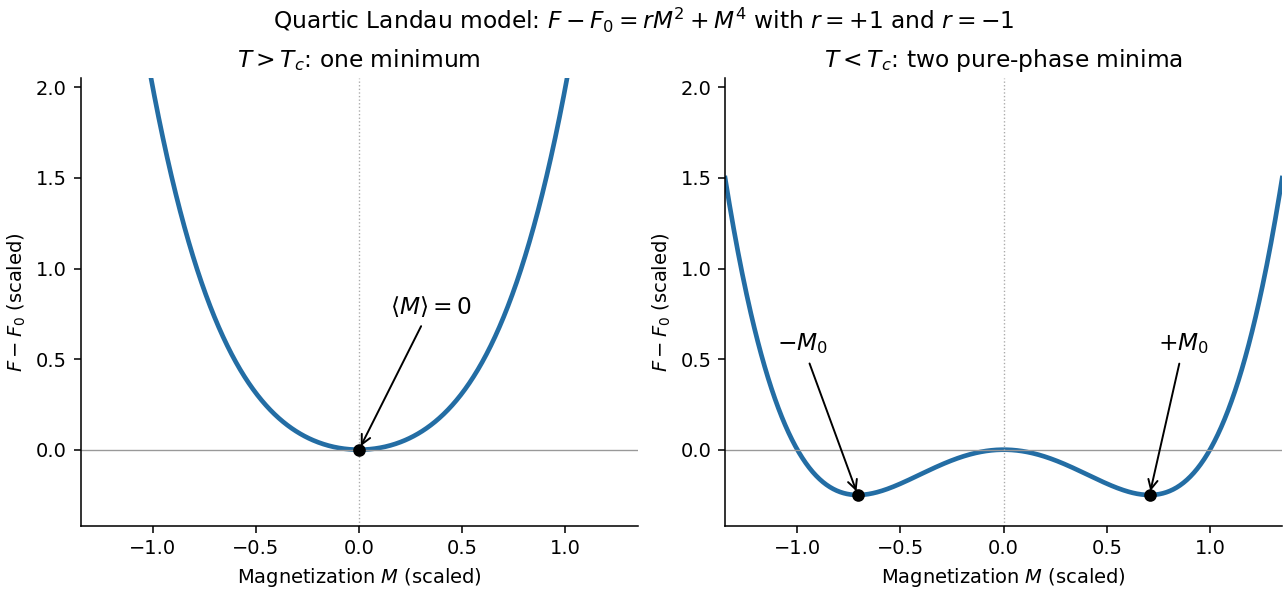
Quartic Landau free energy above and below the transition, showing the disordered and symmetry-broken minima
. Details. 
Minimum free energy and the heat-capacity jump. At a nonzero minimum, . Substituting this value givesHencewhile above the transition. Take the temperature derivatives only after minimizing, so the equilibrium order parameter is allowed to change with temperature. With ,ThereforeThis is the heat-capacity jump in quartic Landau theory. The entropy is continuous at , so there is no latent heat. If denotes free-energy density rather than total free energy, these expressions denote heat capacity per unit volume with the same normalization.
Stabilizing a tricritical expansion. At a tricritical point, the quartic coefficient is tuned to zero at the same point where the quadratic coefficient changes sign. Reversal symmetry still excludes odd powers. The next available stabilizing term is thereforeA negative or vanishing leading sextic coefficient would not stabilize this truncation for large ; a higher positive term would then be needed and the present tricritical form would be insufficient. The ordinary quartic theory has a continuous transition for , while a stabilized theory with can have a first-order transition. Their meeting at zero field is what makes the simultaneous tuning tricritical.
The tricritical minimum. At zero field and , stationarity givesThe nonzero solutions are minima: their curvature is . Put . Since at stationarity,ThusThe order parameter now vanishes as rather than the quartic theory's square root.
Heat-capacity singularity. Define , so the ordered-side singular free energy is . Its derivatives areConsequentlyThis is the tricritical heat-capacity amplitude in a sextic Landau expansion. It is positive on the ordered side and diverges as , rather than remaining a finite jump. This value of the heat-capacity critical exponent is the mean-field result along the path keeping the quartic term zero; a detuning to ultimately restores ordinary quartic behavior. Fluctuation corrections to the mean-field theory are not included in the stipulated polynomial minimization.
Classical translational statistics. Write the number density as and the thermal de Broglie wavelength as . Quantum exchange is negligible when wave packets rarely overlap:The equivalent state-counting statement is that the mean occupation of each thermally relevant one-particle state is much smaller than one. The equations in this question count one internal species; with equally populated spin states the relevant density per species is .
Let be the dimensionless quantum gas fugacity, with the lowest one-particle energy chosen as zero. Both quantum distributions can be writtenIf , then for all , recovering Maxwell–Boltzmann statistics. Conversely, low occupation even at the spectrum's bottom requires for bosons or for fermions; either condition impliesA single high-energy state can be sparsely occupied even in a degenerate gas, so the condition must hold across the relevant spectrum, not just for one arbitrarily chosen energy. Also, classical translational statistics does not imply that all internal excitation energies or other quantum effects can be ignored.
Grand partition function, density and pressure. Noninteracting particles have independent occupations of each one-particle state. Put . Summing the allowed occupations givesThereforeThe grand potential is for this homogeneous gas. Replacing the sum by and using givesThe mean number is , givingFor bosons, the grand sum requires when the ground energy is zero. A macroscopic condensate at the limiting must be separated from the continuum integral in the condensed phase. The following small- calculation is in the normal, nondegenerate regime, so that complication does not enter.
Density expansion and inversion. Expand the occupation as a geometric series:The Gaussian wavevector integral for its th term isIt follows thatFor the inverse series, put and try . Substitution gives , henceThe leading equality directly connects the density and occupancy criteria for classical behavior.
Pressure and its first quantum correction. Expanding the logarithm in the pressure expression gives one extra factor compared with the density series:Insert the inverse series. To second order in ,ThusThe first quantum correction at fixed density and temperature isIt is negative for bosons and positive for fermions, and vanishes in the classical density limit.
Virial coefficient. Define the number-density virial expansion byThe coefficient has units in this convention. Comparing terms givesThis is the exchange contribution to the second virial coefficient. It arises without a pair-interaction potential; the underlying gas is noninteracting. A molar-density convention would multiply this by the Avogadro constant. For equally populated internal species, exchange occurs within each species and the coefficient in terms of total density is smaller by a factor .
Why the two signs differ. Bosonic exchange symmetry enhances the probability of nearby identical bosons, whereas fermionic exchange symmetry suppresses nearby identical fermions in the same internal state. In the dilute regime, the normalized equal-time pair detection correlation isThe exchange part follows by squaring the Gaussian one-particle coherence factor . At zero separation this gives for bosons and for one-component fermions. Integrating the exchange pair weight provides a direct coefficient check:Bunching therefore acts like an effective statistical attraction in the dilute equation of state, lowering the pressure needed at fixed density. Exclusion acts like an effective statistical repulsion, raising it. Neither description asserts an actual interparticle force. Different internal fermion species do not exclude each other from a common spatial location in the same way, explaining the importance of the species convention.
Past exam of the thermal and statistical physics course of the University of Cambridge 2018 Section B B2 Solution Created 2026-10-18 Updated 2026-10-20
Fermion occupation and ordinary metallic heat capacity. The Fermi-Dirac distribution for a single-particle state isAt low temperature it changes appreciably only in an energy window of width of order about . If the full density of states is smooth and nonzero there, only about states change population. Each excited particle or hole carries energy of order relative to the Fermi surface, so is of order . Differentiation therefore gives .
More precisely, the fixed-number Sommerfeld expansion givesHere includes all counted internal species. This argument requires and a density of states varying slowly across the thermal window; a band edge or vanishing density of states can change the power law.
Two-dimensional linear dispersion at zero chemical potential. Let count identical positive-energy branches, keeping the state-counting convention explicit. The number of wavevector states in a ring of radius is . With , this givesAt , the thermal energy of this branch isThe dimensionless integral is . Differentiating givesThis is the heat capacity for a two-dimensional linear fermion dispersion. A physical neutral particle–hole-symmetric Dirac cone also has electron holes in its filled negative-energy band. Their excitation energy gives an equal contribution, doubling for the same cone count. The scaling is unchanged. For a positive-energy-only gas, holding allows its mean particle number to vary; a neutral two-band surface instead maintains zero net excess charge as electron–hole pairs are thermally excited. These conventions should not be conflated when specifying an exact coefficient.
Nonzero chemical potential. The ordinary metallic regime isThe thermal window then lies far from the cone tip. Since , its fractional change across that window is only of order . Treating it as locally constant restores the Sommerfeld result . When is comparable to or larger than , the window probes the vanishing density of states near the tip and crosses toward the neutral behavior, provided the linear dispersion remains valid.
Bulk phonons and the surface-to-bulk comparison. For the topological insulator model, assume bulk electronic excitations are frozen out while the conducting surface remains active. In three dimensions, acoustic phonons have a density of modes proportional to . Normalize the Debye spectrum to modes:The thermal part of the energy isAt , extending the upper integration limit to infinity introduces an exponentially small error. With and ,Temperature-independent zero-point energy makes no contribution to this heat capacity. The requested ratio consequently scales asFor a fixed shape and composition, and , so the ratio grows as . Smaller samples and lower temperatures favor the surface contribution. It dominates if the dimensionless right-hand side, including its state-counting prefactor, exceeds unity. This is the surface-electron and bulk-phonon heat-capacity crossover.
The continuum electronic law also requires a thermal energy larger than the surface finite-size level spacing, of order . The phonon continuum has its own finite-size cutoff. Therefore dominance obtained by formally taking cannot always be inferred from the two continuum power laws alone.
There is a numerical-normalization qualification in the paper. Combining the explicit one-positive-branch result above with the conventional -mode Debye normalization gives ratio prefactor ; including electron holes doubles it. For , this is approximately before that doubling, rather than the supplied . The problem specifies neither a cone/spin multiplicity that equates these nor another mode normalization. Its supplied prefactor is therefore used as the stipulated approximation for the requested numerical estimate, rather than claimed as an exact consequence of the single-branch count.
Numerical estimate. A cubic sample of volume has side . Counting the conducting surface on all six faces givesFor one atom per cubic cell of side ,Use and . Inserting the stated , and into the paper's supplied prefactor givesThus bulk phonons dominate at this temperature in this estimate. If only one face contributes, the ratio is ; if there are chemical atoms per unit cell, divide the corresponding estimate by . These geometrical and crystallographic factors are not supplied explicitly.
With the same prefactor and geometry, extrapolating would suggest equality near . However, the surface finite-size scale is already of order for this specimen. That extrapolated crossover lies outside the continuum electronic regime, so it is not a reliable prediction of the sample's ultimate lowest-temperature heat capacity.
Gibbs free energy and its minimum. For fixed atom number , there are sites andconfigurations with indistinguishable vacancies. Their configurational entropy is . Relative to the vacancy-free Gibbs free energy , creating vacancies costs energy and pressure-volume work . Put . ThenAt leading thermodynamic order, Stirling's approximation givesThe minimum obtained from the stationary point below isIf the perfect crystal's internal energy and other entropy are chosen as zero, its pressure term is . More generally the information given fixes the vacancy contribution rather than the absolute bulk free energy. The pressure-volume term must be retained because the number of sites, and hence the volume, changes.
Equilibrium vacancy population. Differentiating the extensive free energy at fixed givesThe stationary point is consequently the unique interior minimum. Write ; its condition is , giving the requested thermodynamic result for equilibrium vacancies with variable lattice size,Substitution back into cancels the terms containing and yields the boxed minimum. In the dilute-defect limit , . The Bose-like denominator is a consequence of the changing number of lattice sites and combinatorial entropy; it does not assert that vacancies here are an ideal gas of bosonic particles.
There is a finite-size correction to a variable-site vacancy model if “average” is interpreted exactly. The microscopic count written above gives the relative isothermal-isobaric sumsoIts relative equilibrium free energy is . Thus the source's numerator is correct to leading extensive order, but is not the exact finite- mean for that stated configuration count. A free-energy minimum is likewise not generally identical to the mean of a finite distribution. These distinctions vanish relatively as .
Thermal volume. Each atom or vacancy occupies volume , so at the same thermodynamic accuracyFor the exact counting model, replace by in . The vacancy-free limit is as . This model isolates expansion from vacancies, taking and constant; it omits ordinary phonon thermal expansion. Its growth at high temperature should not be extrapolated to arbitrarily large vacancy fractions in a stable crystal, and is essential for a normalizable variable-site ensemble.
Component chemical potentials. Define the per-spin quantum concentration . For a classical component with one-particle potential energy , the local Helmholtz free energy density is . Its derivative with respect to number density gives the full local chemical potential, including the magnetic energy. With the up state defined as the lower level,The Bohr magneton is a magnetic moment; is an energy. The factor two for the two spin states is not already included in .
Total equilibrium chemical potential. If spin conversion is allowed, a particle can be added in either spin state at the same equilibrium free-energy cost. Thusnot their sum or zero. The total particle number, or a reservoir, fixes this common value; the supplied information does not specify a numerical chemical potential. A useful local expression is , with , whose density dependence is found below.
Why it is uniform and common. Moving a small number of one species from to changes the free energy by . If this difference were nonzero, a transfer could lower the free energy. Equilibrium under diffusion therefore requires each full chemical potential to be spatially constant. A spin flip transferring from down to up similarly changes free energy by , proving equality when spin relaxation is permitted. This is chemical equilibrium of a classical spin gas. Mere thermal contact at fixed separate spin populations would not enforce the latter equality; full spin equilibrium is the necessary assumption. A spatially varying magnetic field is balanced by a spatially varying density, not by a varying full chemical potential.
Magnetization. Invert the component equations at the common :The two levels have moments and along the field. The magnetization, magnetic moment per unit volume, is thereforeIts SI units are . This expression neglects interactions and magnetic feedback of the gas on the specified external field.
High-temperature response. For , and , yieldingAt fixed number density, this is the Curie law: the susceptibility with respect to is . The conventional dimensionless susceptibility with respect to is approximately when . At fixed , however, changes with temperature, so itself need not scale simply as . The moment per particle has the Curie behaviour; the density constraint must be stated.
Total density. Adding the two populations givesFor a finite container and fixed , normalization gives . In a weak field the leading density is uniform, with changes only of order . Particles preferentially occupy regions where the magnitude of the field lowers one of the spin energies, even though the common chemical potential remains uniform.
Quanta of collective motion. An elementary excitation is a low-energy departure from the many-body ground state that can often be treated as a quasiparticle. Near an ordered equilibrium, small collective motions form normal modes. Quantization turns a harmonic mode of frequency into bosonic excitations with energy . Their number is not an independently conserved thermodynamic variable in equilibrium, so their chemical potential is zero andHere labels branches, and contains the ground-state contribution, including phonon zero-point energy where appropriate. The approximation is useful while interactions and damping of the excitations are weak enough that the modes remain identifiable.
Phonons. A phonon is a quantum of an elastic lattice-vibration mode. Long-wavelength acoustic phonon branches have , with one longitudinal and two transverse polarizations in a three-dimensional monatomic solid. A multi-atom primitive cell can also support optical phonon branches, generally with nonzero frequency at . Linear acoustic dispersion gives , so the energy integral has and the heat capacity obeys the Debye law. In the Debye model,At temperatures high compared with all phonon energies but below structural changes, the classical harmonic limit gives approximately . Optical modes are frozen out at temperatures well below their gaps.
Spin waves. A spin wave is a spatially varying collective precession of ordered spins; its quantum is a magnon. In a simple isotropic ferromagnet, a long-wavelength gapless branch has energy , where the spin stiffness has units . State counting gives . For one isotropic branch in three dimensions,This exponent is specific to a gapless quadratic ferromagnetic branch. Long-wavelength antiferromagnetic spin waves can be linear and instead give a heat-capacity law in three dimensions. Magnetic anisotropy or an applied field can open a gap, causing activated behaviour at still lower temperatures. Near a magnetic ordering transition, a dilute noninteracting spin-wave description is no longer adequate.
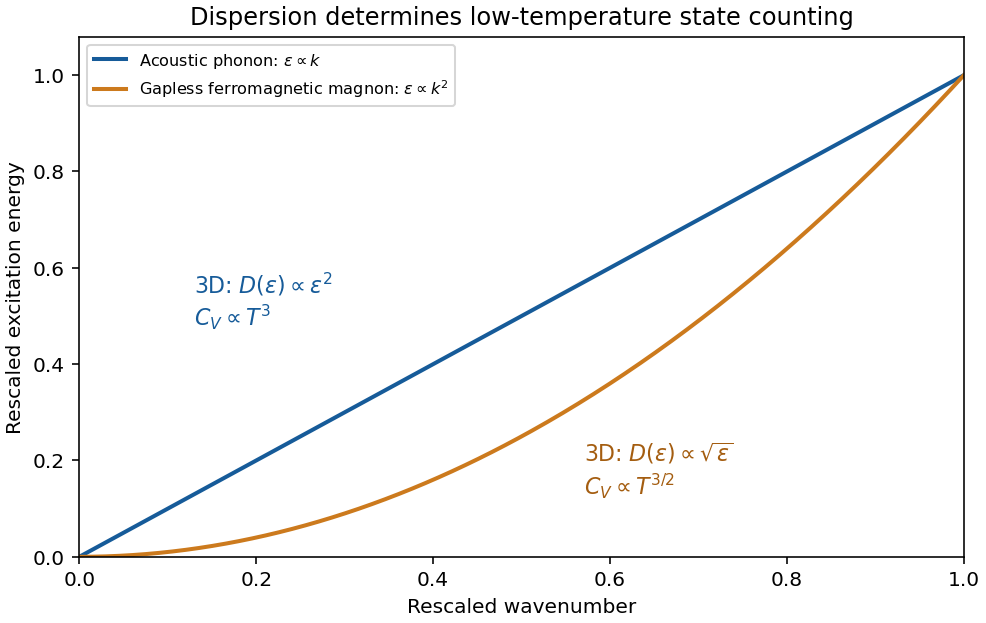
Original schematic linear acoustic-phonon and quadratic ferromagnetic-magnon dispersions with their three-dimensional low-temperature heat-capacity powers
. Details. 
These examples illustrate the low-temperature energy of gapless bosonic excitations: for in dimensions, , hence and . The exponent records both the spatial dimension and the dispersion, making calorimetry a probe of elementary excitations.
Excited-state saturation. Consider first a uniform three-dimensional noninteracting gas of identical spinless bosons in a large box. Set the one-particle ground energy to zero. The Bose-Einstein distribution is , with quantum gas fugacity . For dispersion , the excited density of states isUsing the thermal de Broglie wavelength , integration givesThe polylogarithm is . Its finite value at implies a maximum excited population , with . Once this is less than , the excess particles occupy the ground state macroscopically. This is Bose-Einstein condensation, rather than occupation of a state by merely one or a few atoms.
Transition and condensate fraction. Setting the saturation number equal to gives the homogeneous ideal Bose gas condensation temperatureBelow this temperature, approaches zero from below in the thermodynamic limit, and particle conservation givesAbove there is no macroscopic condensate and adjusts to keep fixed. At finite , the chemical potential remains slightly below the ground energy and the transition is rounded.
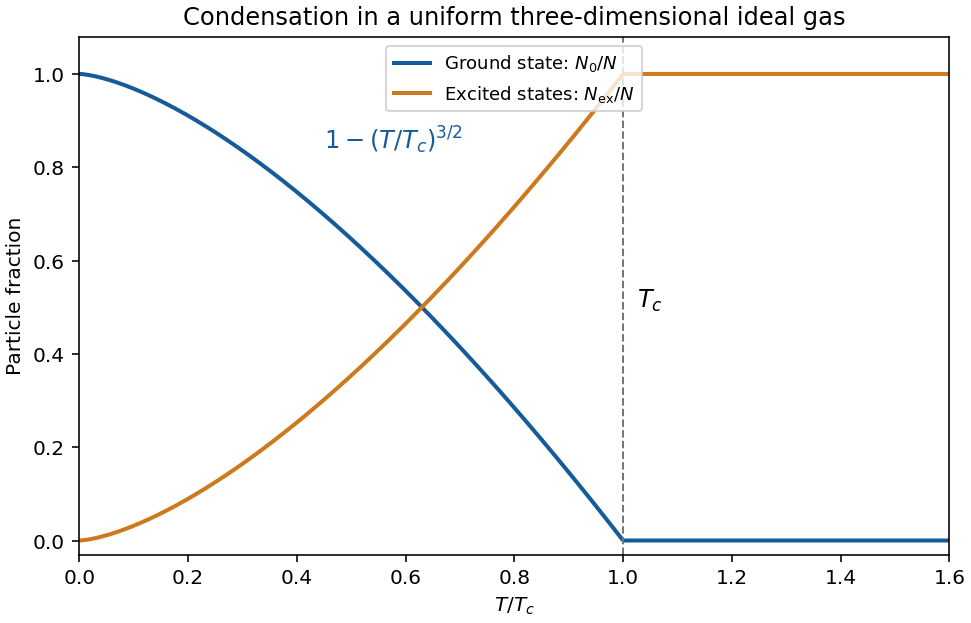
Original uniform ideal-gas condensate fraction and schematic accumulation in the lowest state below the critical temperature; the exponent is for a three-dimensional box
. Details. 
Energy and the role of geometry. The excited-state internal energy isThe zero-energy condensate contributes no term to this energy in the ideal model. Below ,Condensation depends on low-energy state counting: for a uniform quadratic-dispersion gas, a finite-temperature bulk condensate requires spatial dimension greater than two. A trap changes the density of states and therefore the temperature law; a three-dimensional harmonic trap gives a cubic, rather than , condensate-fraction exponent. Finally, an ideal-gas condensate should not automatically be called a superfluid: its free quadratic spectrum has zero critical speed by the Landau criterion. Interactions matter for the robust collective-flow properties of real dilute condensates.
Structure through pair correlations. For a homogeneous isotropic monatomic liquid of number density , the radial distribution function is defined byIt compares the conditional density around a tagged particle with the bulk density. A repulsive core makes close neighbours unlikely; a first peak identifies a preferred coordination shell, and damped peaks at larger radii describe short-range order. Far away, in the bulk limit. Unlike a crystal, an ordinary liquid has no indefinitely repeated positional order. An ideal uncorrelated gas has away from the tagged particle. The shell factor must not be confused with itself.
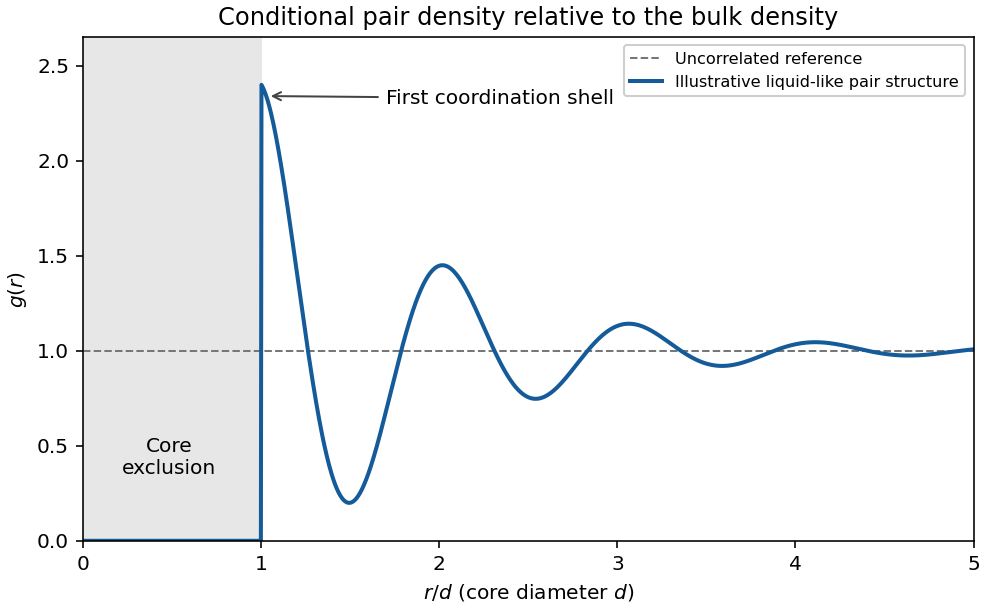
Original schematic radial distribution function showing a core exclusion region and damped liquid-like coordination shells; the curve is illustrative rather than measured data
. Details. 
The same pair structure enters the static structure factor measured through scattering. In the bulk isotropic convention,Thus real-space coordination and reciprocal-space scattering peaks describe the same correlations.
Energy from the structure. If interactions are sums of a central pair potential , the equipartition theorem gives the classical kinetic energy . Count the interaction of a tagged particle with its neighbours and divide by two to avoid counting each pair twice. The pair-correlation expression for internal energy isThis makes structure thermodynamically useful: short-distance repulsion and the attractive region contribute with different weights. Additional internal molecular modes or many-body interactions require extra terms. The formula is a classical bulk pair-potential result, not a universal energy formula for every liquid.
Pressure and the dilute expansion. The mechanical virial theorem relates the pair forces to pressure. The virial pressure from pair correlations isAt low density, , giving the virial expansionThe second virial coefficient has units of volume per particle; higher coefficients encode additional cluster correlations. A hard-sphere exclusion diameter gives . Attractions contribute negative terms and can make negative. Although the pair-correlation formulas can describe a dense liquid when its actual is known, truncating the virial series after a few terms is normally a dilute-fluid approximation. It should not be silently extrapolated through condensation or into a dense liquid.
In the grand canonical ensemble, the system exchanges both energy and particles with a reservoir at fixed temperature and chemical potential . The probability of a particular many-body microstate , with energy and particle number , is its Boltzmann weight divided by the grand canonical partition function , where . The denominator normalizes ; a degeneracy is accounted for by counting distinct microstates, rather than changing an individual state's probability.
For noninteracting particles, specify a microstate by the occupation numbers of one-particle levels of energy . Then , so the Gibbs probability factorizes between levels. Put .
For fermions, the Pauli exclusion principle permits in each complete one-particle state, giving . Its mean occupancy isthe Fermi-Dirac distribution.
For bosons, , so the geometric sum is when . Differentiating that sum givesthe Bose-Einstein distribution. Finite-system convergence requires ; condensation is the limiting approach to the lowest energy with macroscopic ground-state occupation. Both quantum distributions reduce to when occupation is small. The quantities derived here are mean occupancies of states, rather than normalized probabilities over the set of one-particle energies.
Repeated letters. There are six positions, with two copies of each of two letters. Counting labeled arrangements and dividing by the permutations of each repeated pair gives
Single-occupancy cells. For indistinguishable particles, specifying which of the distinct cells are occupied completely specifies a configuration. ThusFor distinguishable particles, each chosen occupied set admits assignments of particle labels:Equivalently, successively place labeled particles in available cells. The single-occupancy constraint is essential: this is not unrestricted stars and bars. Both counts give one empty configuration at ; at they give one unlabeled occupation pattern and labeled assignments.
There are unlisted articles, also show them or only show them.