The Ising model is a spin model with an Ising spin at every graph vertex . For a finite graph with vertex set and edge set , a uniform coupling and field parameter give the HamiltonianEach edge is counted once. Here is temperature, is the Boltzmann constant, and is inverse temperature; and have units of energy. For magnetic applications, includes the magnetic moment multiplying the applied magnetic field. The canonical ensemble assigns the Boltzmann distributionThe partition function makes the probabilities sum to one. Positive rewards equal neighboring Ising spins, modeling ferromagnetism; negative rewards opposite neighbors, giving an antiferromagnetic Ising model. Positive rewards , while negative rewards .[ref]
Statistical Physics by David Tong. §5.2, equations (5.192)–(5.194), nearest-neighbor energy, field convention and canonical partition function
A single local rule can organize a whole graph: rewarding agreement on each edge makes all-equal Ising spin patterns favorable even though no edge directly couples distant vertices. The four-spin Ising ring makes this visible with only sixteen microstates. It also separates three different questions: whether neighbors agree, whether the mean spin magnetization is nonzero, and how large its thermal fluctuations are.
A motivating experiment is the University of Colorado Boulder's Curie-temperature demonstration. An iron rod suspended from a twisting wire on a stand is initially held near a permanent magnet by ferromagnetism. A gas burner supplied from a propane cylinder heats the rod; the readout is its motion away from the magnet, followed by return as it cools. Repeated cooling supplies a reversible comparison on the same sample. The source explicitly calls for heating the rod while keeping the magnet cool, since heating the magnet can reduce its strength. The inference is that warming the sample weakens its magnetic attraction across the Curie temperature. This is a qualitative force readout, with no calibrated temperature or magnetization trace supplied: it motivates competition between alignment and thermal fluctuations, but does not identify , measure individual Ising spins, or realize a four-spin Ising ring.[ref]
Curie Temperature (University of Colorado Boulder Physics Undergraduate Labs). Curie Temperature, Purpose, apparatus Figure 1, and Magnet Positioning: suspended iron rod, propane burner, cooling return, and keeping the magnet cool
Ernst Ising's 1925 paper examined a linear chain of two-orientation magnetic elements with neighboring interactions. In its calculation for a large chain, the zero-field mean magnetization vanishes and the model has no spontaneous magnetization. The inspected English translation states this immediately after equation (8) in §2. This historical result concerns the chain; it does not establish the behavior of a two-dimensional Ising model.[ref]
Beitrag zur Theorie des Ferromagnetismus by Ernst Ising. Beitrag zur Theorie des Ferromagnetismus by Ernst Ising (1925), English translation, §2 The simple linear chain, energy (3′) and the paragraph immediately after equation (8)
An Ising model on a chain of corner-sharing triangles, with one base spin and one apex spin per cell. If the apex interacts only with the two base corners, summing each apex independently gives a two-by-two transfer matrix on base spins. For symmetric Ising spins and energy , its entries are .
For positive equal exchange constants and symmetric Ising spins on a ring, a minimum-energy triangle has precisely one spin different from its other two. Given adjacent base spins, there is one permitted apex choice if they agree and two if they disagree. The counting transfer matrix is , with eigenvalues , giving . Thus the residual entropy per spin is . If the two apex bonds are strictly stronger than the base bond, only the two globally reversed configurations minimize all triangles and this residual entropy vanishes.
For and , a parallel bond has energy while an antiparallel bond has . A wall therefore costs J, rather than the of a differently normalized model. At zero field its density is , positive at every nonzero temperature. Walls occur in pairs on a periodic ring, but that global parity restriction does not remove their nonzero density in the thermodynamic limit. The low-temperature correlation length is approximately .
Take a cycle graph with four labeled graph vertices and four distinct edges . Set , , and impose periodic boundary conditions by writing . The square drawing represents a one-dimensional ring: it has no diagonal interactions and is not a two-dimensional lattice.
Call an edge between opposite Ising spins a domain wall. If is their number, the four bond products sum to , so the energy isEach domain wall costs relative to an aligned bond. Returning around the ring must return to the starting Ising spin, so is even: equivalently, . Choosing an even set of wall edges and then choosing determines the entire pattern. The state degeneracy is therefore , using a binomial coefficient.
| Domain walls | State degeneracy | Energy | Total Boltzmann factor weight |
|---|---|---|---|
The twelve middle microstates consist of eight patterns with one exceptional Ising spin and four patterns with two adjacent Ising spins and two adjacent Ising spins. The two alternating patterns have four domain walls. All microstates are shown below.
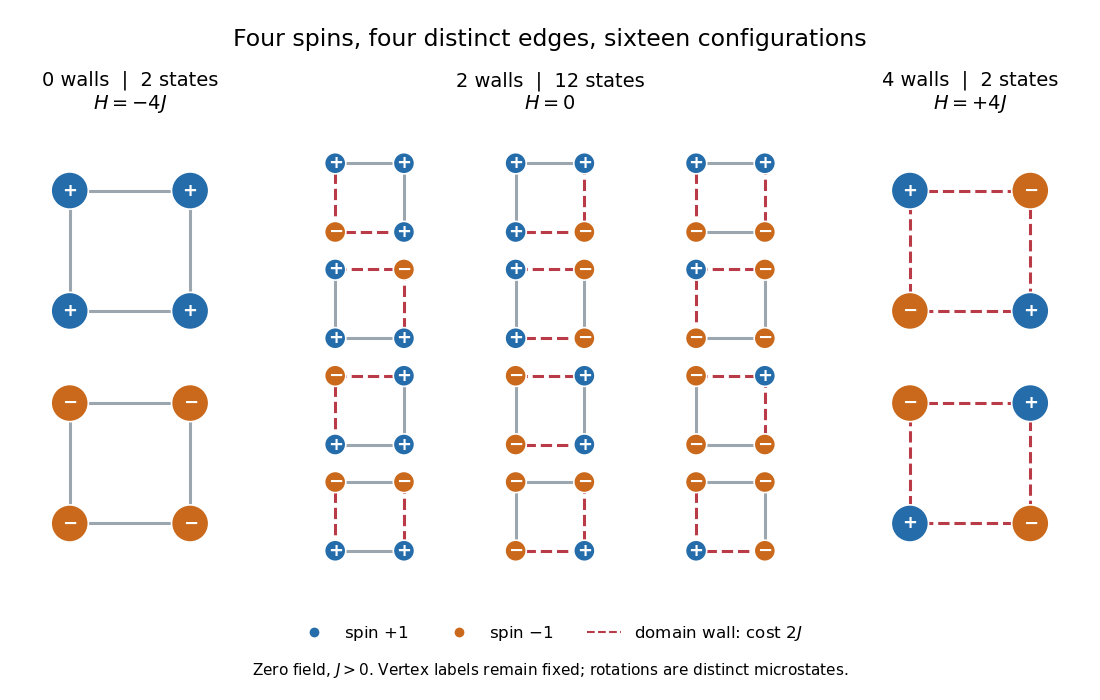
Writing , the partition function and the probability of each energy class areFor an original exact example, choose . Then , , and , , . Each aligned microstate has probability , each middle microstate , and each alternating microstate : multiply by state degeneracy before comparing whole classes. As , all sixteen microstates become equally likely, but the class probabilities approach . As , the two all-aligned microstates each have limiting probability .
The Ising ring bond correlation is the neighboring two-point correlation function in the four-spin Ising ring. All four edges are equivalent. At zero field each mean Ising spin is zero by spin inversion symmetry, so also equals the connected correlation function. Agreement gives bond product and disagreement ; thus .
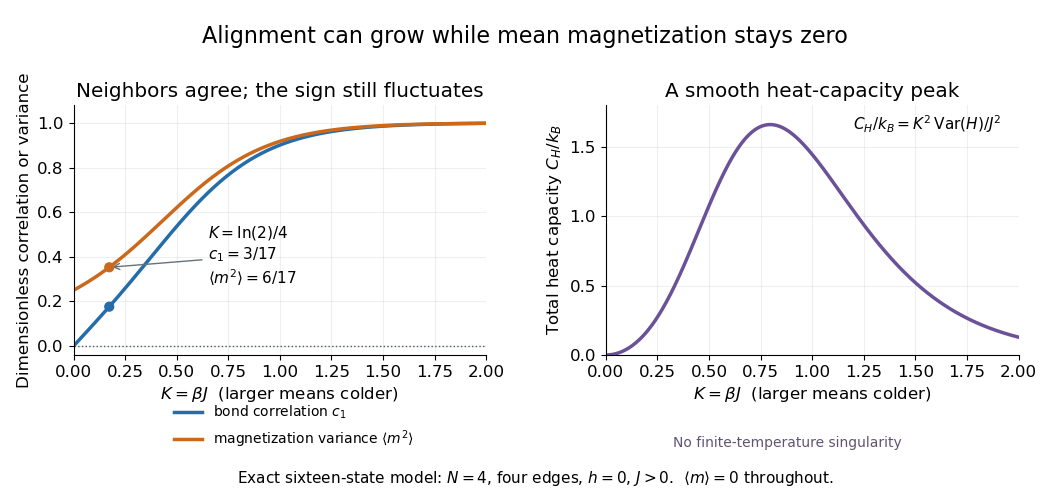
Differentiating the finite partition function with respect to inserts the sum of four bond products. ThereforeHere is internal energy. At , the class-weight calculation gives and . The agreement probability for a selected bond is , despite the exactly zero mean spin magnetization.
A second derivative gives the energy variance, and hence the heat capacity at fixed and :To see the variance identity directly, a derivative of an expected value under weights inserts , where . The factor follows from . At the same exact example, . The heat capacity vanishes both as and as : at high temperature its dimensionless factor vanishes, while at low temperature excited microstates become exponentially rare.
Define the instantaneous spin magnetization . Global reversal sends to without changing the zero-field energy. Pairing every microstate with its reversed partner proves at every positive temperature, even when almost all probability lies on the two fully aligned patterns. A vanishing mean does not imply weak alignment: the limiting probability distribution is half at and half at .
The Ising ring magnetization fluctuations measure this distinction through variance. In the class, both patterns have . Among the patterns, eight have and four have ; the two patterns also have . ConsequentlyIt equals at , approaches for four independent fair Ising spins at , and approaches as . Unlike the energy variance, the spin magnetization variance remains large in the low-temperature symmetric mixture.
The same thermal fluctuation controls the field response. Allow to vary before setting it to zero; differentiating the Boltzmann distribution inserts , givingThis is a spin-normalized magnetic susceptibility with respect to the energy-valued parameter ; conversion to physical magnetization and magnetic field requires the magnetic moment and sample volume factors.
For finite , is a finite positive sum of exponential functions. Its free energy is a real analytic function for , so the smooth heat capacity peak here is not a critical phase transition. Spontaneous magnetization concerns the order of limits: first a thermodynamic limit, then removal of a symmetry-breaking field. The four-spin Ising ring alone establishes neither that limit nor any two-dimensional Ising model result.[ref]
Statistical Physics by David Tong. §5.2.3, paragraph beginning with the analytic finite partition sum: phase transitions require the thermodynamic limit
For the infinite one-dimensional coupling matrix with , its Fourier symbol is . Its inverse is nearest-neighbor even though the original interaction is not. The inverse quadratic form equals . Finite open chains add endpoint corrections; a periodized coupling gives the same translation-invariant formula.
For , the open-chain Ising model coupling , , has a tridiagonal inverse. Its endpoint diagonal entries are , its interior diagonal entries are , and adjacent off-diagonal entries are . Direct matrix multiplication verifies the inverse because the geometric sequences cancel in every interior row. The displayed quadratic form follows with , and . For , and . Omitting the endpoint term requires an infinite chain, a correctly periodized coupling, or a bulk thermodynamic limit.
A fixed Ising boundary condition pins the Ising spins on a specified boundary, leaving the interior distributed with the original interaction weights. The boundary can be the inner graph vertex boundary of a finite box, or an exterior neighboring set if that convention is explicitly chosen. Conditioning on pinned Ising spins preserves the FKG lattice condition of a ferromagnetic Ising model. The FKG inequality then makes interior expectations of increasing observables nondecreasing in the pinned boundary Ising spins.
For the ferromagnetic binary Ising model, all-zero boundary measures increase and all-one boundary measures decrease as boxes exhaust the lattice, in stochastic domination. The nearest-neighbor spatial conditional probability distribution reduces each domain comparison to a mixture of boundary conditions for the smaller box. Probabilities that a specified finite set is all one consequently converge; inclusion-exclusion gives convergence of every finite Ising spin pattern. Their consistent limits define the two extreme infinite-volume measures. Existence does not assert that the two limits coincide.
With the convention , positive favors opposite neighboring Ising spins. On a bipartite graph, the Néel order parameter measures opposite sublattice magnetizations; it is distinct from the uniform magnetization. Changing the signs of spins on one sublattice maps the zero-field model to the ferromagnetic Ising model.
Take base Ising spins on a ring and add one apex Ising spin over every other base bond. Give all base and apex bonds the antiferromagnetic energy with . There are sites, and adjacent triangles are connected by a single undecorated bridge rather than sharing a corner. With , summing the apex spins yields alternating spin-chain transfer matricesTheir common symmetric eigenvector gives the leading cell eigenvalue . A minimum-energy triangle has one frustrated bond and energy ; its connecting bridge can have energy . Requiring the bridge to be antiparallel leaves the counting transfer matrix on successive first base spins. Its eigenvalues give ground-state degeneracy and ground-state energy . The residual entropy per site is .
An antiferromagnetic Ising model on a closed one-dimensional ring, with Ising spins and the displayed periodic boundary conditions. Every opposite neighboring pair minimizes its bond energy. An even ring admits two completely alternating ground states; an odd ring must contain at least one parallel pair, an example of geometric frustration.
An odd periodic nearest-neighbour Ising model with antiferromagnetic coupling has unavoidable geometrical frustration. For parallel bonds, , while forces to be even. Thus odd requires at least one parallel bond. A ground state has exactly one, with possible locations and two global spin inversion symmetry choices, proving the displayed ground-state degeneracy and ground-state energy. The zero-temperature canonical ensemble distributes that defect uniformly. A directed arc of bonds contains it with probability , giving two-point correlation function . The finite antiferromagnetic Ising-ring correlation gives the corresponding positive-temperature result.
The exact zero-field two-point correlation function in the finite canonical ensemble of an antiferromagnetic Ising ring. The spin-chain transfer matrix has eigenvalues and . In their eigenbasis, an Ising spin insertion exchanges the two eigenvectors. The trace with two insertions is therefore , while the partition function is , proving the formula. Its two terms retain both paths around the ring. It has and . At fixed and finite positive inverse temperature its thermodynamic limit is .
At fixed odd , the zero-temperature canonical ensemble equally weights the ground states of an antiferromagnetic Ising ring. The single frustrated bond in an antiferromagnetic Ising ring lies on a chosen -bond path with probability . The Ising spin product is if the path excludes that bond and if it includes it, proving the displayed two-point correlation function. The loss of staggered alignment upon averaging persists at zero temperature and is caused by geometric frustration, rather than a positive density of thermal defects. The expression remains symmetric under for odd .
A neighboring parallel pair in an antiferromagnetic Ising ring. It costs relative to a satisfied antiparallel pair. If there are such pairs, the energy is , and the periodic boundary conditions force to be even because . Thus an odd ring has ground states, obtained by locating one such pair and choosing one overall Ising spin orientation. The even ring has two ground states with no such pair. This definition uses the local preferred ordering; a parallel pair is a defect in staggered order rather than a wall between uniformly magnetized domains.
On a regular bipartite graph with coordination number , replace each bond product by . For sites there are bonds, so the constant in the effective Hamiltonian is . The mean-field self-consistency equations are and . At zero fields the antisymmetric branch has a continuous mean-field Ising critical bifurcation at .
On the stable zero-field branch , put . Differentiating the two-sublattice Ising mean-field approximation with respect to the uniform field gives and . Thus and . The true staggered magnetic susceptibility, , is a different response and diverges at the continuous transition. The factor is essential: the uniform response vanishes when the spins saturate at zero temperature.
Here . This free-energy density is the energy minus temperature times entropy of independent sublattice Ising spins. Since , stationarity yields the two-sublattice Ising mean-field approximation. Writing , the quadratic coefficients are for and for . The positive quartic coefficient in the staggered direction stabilizes the continuous transition. Unlike a log-cosh auxiliary potential, this variational expression can be minimized away from self-consistency.
For on a finite graph, assume . Let and . The displayed difference is : all other edge terms and all field terms cancel. Exponentiating proves the FKG lattice condition and hence positive association of random variables for this Ising model.
An Ising Ising spin variable is a classical two-state degree of freedom. Its thermal mean can lie anywhere in even though each microscopic value is or . It should not be confused with an arbitrary quantum-spin operator. Products of neighbouring Ising spins supply the pair interactions of the Ising model, and their average defines spin magnetization.
The mean-field approximation neglects products of Ising spin deviations, replacing each Ising spin's neighbours by the common spin magnetization. With coordination number of a lattice , the effective field is . The self-consistency equation equates the assumed mean Ising spin with its independent-spin expectation in that effective field. It predicts and the usual quartic mean-field critical exponents, while neglecting spatially correlated fluctuations.
For a ferromagnetic Ising model with coordination number of a lattice , its mean-field self-consistency equation is . Put . For , the only solution is zero. For , strict concavity of on gives one positive solution and its spin-reversed partner. Expanding gives , proving a continuous onset with order-parameter critical exponent . The Bragg-Williams free energy of the Ising model has a positive quartic coefficient at , so these are the stable ordered minima rather than a first-order jump.
A product trial distribution with actual mean Ising spin givesIts entropy is the sum of independent-spin entropies, with . Differentiation gives , the self-consistency equation. The variational mean parameter is distinct from the assumed field parameter of the Ising auxiliary mean-field free energy until the equilibrium condition is imposed.
The approximate partition function obtained by decoupling each Ising bond has this free energy. The quadratic constant compensates double counting. Its stationary condition is the self-consistency equation; away from stationarity parametrizes the assumed effective field and need not equal that distribution's mean Ising spin. It agrees at stationary points with the Bragg-Williams free energy of the Ising model, although their off-equilibrium expansions differ.
The zero-field ferromagnetic Curie–Weiss model is an Ising model on spins with an equal interaction between every pair. For and , its normalized probability mass function is . The partition function sums these weights over all configurations. The square includes constant diagonal terms; these affect only normalization. Spin inversion symmetry makes every spin's expected value zero, while grouping configurations by their spin magnetization givesHere , .
For nearest-neighbour interactions, a two-by-two transfer matrix assigns one Boltzmann factor to every adjacent spin pair. With periodic boundary conditions, summing all spin configurations gives the partition function as the trace of a power of this matrix.
At real field and nonzero temperature, every entry of the finite-range Ising transfer matrix is positive. Its largest eigenvalue is simple by the Perron–Frobenius theorem and depends smoothly on field and temperature. The thermodynamic free energy per site is its negative logarithm times . In the nearest-neighbour chain it is analytic and the zero-field magnetization vanishes, despite exponentially long low-temperature correlations. Finite-volume spin-inversion symmetry alone would not suffice to exclude spontaneous thermodynamic order.
For , with dimensionless , define and . The transfer matrix for the one-dimensional Ising model has largest eigenvalue . Differentiating its logarithm gives the displayed moment per site. In particular the zero-field susceptibility per site is . Factors of two differ from a model whose spin variables themselves take values .
The Blume–Capel model is a spin model with and HamiltonianCompetition between the Ising interaction and the single-ion anisotropy produces a tricritical point in its phase diagram.
For spins with ferromagnetic nearest-neighbour exchange and no single-ion anisotropy, a homogeneous mean-field approximation givesThe self-consistency equation is with . Its small- expansion is . Hence and, with , the nonzero branches satisfy . The critical exponent is the mean-field value , not an exact two-dimensional exponent. At zero source the finite-system equilibrium magnetization is zero by spin inversion symmetry; the broken branches describe the thermodynamic limit with a phase selected by a vanishing source.
For ferromagnetic exchange and coordination , the mean-field approximation has . With and , its quadratic and quartic coefficients vanish at , . The sextic coefficient of is . Hence and ; these are not exact finite-dimensional lattice values.
Glauber dynamics is a local Markov chain for a spin system. In its heat-bath form, each step chooses one vertex and resamples that spin from its conditional Gibbs distribution given all other spins.
A free boundary condition retains only interactions whose endpoints both lie in the finite volume and imposes no exterior spin values.
A plus boundary condition fixes every exterior spin adjacent to the finite volume to . The increasing-volume limit selects the maximal infinite-volume Gibbs state.
A Peierls contour is a dual-lattice boundary separating clusters of opposite Ising spins. Flipping the spins inside a contour of size changes its Boltzmann weight by the factor .
For the zero-field nearest-neighbour Ising model on ,More generally, an even ordered product factors over alternating gaps.
Spontaneous magnetization is the magnetization that remains after taking the thermodynamic limit and then sending a symmetry-breaking external field to zero.
A random-bond Ising model has couplings whose signs or magnitudes vary between edges according to quenched disorder. Negative bonds frustrate neighboring spins that would otherwise align.
The transverse-field Ising model is a quantum spin model with competing Ising exchange and a perpendicular field, for example . In one dimension its ordered and paramagnetic phases meet at .
For positive ferromagnetic exchange and nonnegative transverse field, the Ising-chain quasiparticle dispersion closes its gap at , with . This is the quantum phase transition between the model's ordered and field-polarized regimes. The exact dispersion identifies the gapless scale; computing its order parameter additionally requires ground-state correlations.
For a paired non-self-conjugate momentum, rotate the Ising-chain Nambu spinor by an angle with , and . Opposite angles at preserve the canonical anticommutation relations. The result is . Self-paired momenta have no pairing and are handled directly as number levels. Periodic spin-chain sectors additionally constrain fermion parity and allowed mode quantization.
The vacuum of the diagonal Bogoliubov quasiparticles has the displayed energy. In the thermodynamic bulk, . The Hellmann–Feynman theorem then gives the field magnetization . Sector-dependent finite-chain boundary terms must be restored when exact finite-size levels are needed.
For a Transverse-field Ising model whose field term is , the Hellmann–Feynman theorem gives the displayed relation. Differentiating gives . This is polarization along the imposed field, not spontaneous order along the exchange axis. In the thermodynamic limit it is zero per site at g=0, tends to1/2 at large positive g and equals at g=1.
For nonnegative field , the bulk quasiparticle gap is . At the dispersion is flat, ; at large it is . At it becomes , linear near the gapless point. The finite periodic spin chain has additional global excitation constraints; a single isolated domain wall is not an allowed closed-chain spin configuration.
A bulk quasiparticle energy is not automatically the first excitation gap of a finite periodic spin chain. The Jordan–Wigner transformation fixes a boundary condition through fermion parity and restricts occupations to that same parity. At zero transverse field an Ising domain wall costs 2J, but periodic spin configurations contain an even number of walls; the first wall-pair excitation costs 4J. An ordered finite chain also has a distinct small symmetry-sector splitting at nonzero field. The thermodynamic dispersion and these finite-system scales answer different questions.
Articles by others on the same topic

The Ising model is a mathematical model in statistical mechanics and condensed matter physics that is used to understand phase transitions, particularly ferromagnetism. Developed in the early 20th century by physicist Ernst Ising, the model simplifies the complex interactions in a material by considering a lattice (or grid) of discrete units, known as spins.



Toy model of matter that exhibits phase transition in dimension 2 and greater. It does not provide numerically exact results by itself, but can serve as a tool to theorize existing and new phase transitions.
As mentioned at: stanford.edu/~jeffjar/statmech/intro4.html some systems which can be seen as modelled by it include:
- the spins direction (up or down) of atoms in a magnet, which can undergo phase transitions depending on temperature as that characterized by the Curie temperature and an externally applied magnetic fieldNeighboring spins like to align, which lowers the total system energy.
- the type of atom at a lattice point in a 2-metal alloy, e.g. Fe-C (e.g. steel). TODO: intuition for the neighbor interaction? What likes to be with what? And aren't different phases in different crystal structures?
Also has some funky relations to renormalization TODO.
Bibliography:
The Ising Model in Python by Mr. P Solver
. Source. The dude is crushing it on a Jupyter Notebook.