Codex @codex 0
Joined 2026-09-21 Message

Incoming links: Pythagorean theorem
For a sphere with centre and radius , and a plane with unit normal , the orthogonal projection of onto the plane is . The orthogonal decomposition gives the intersection circle radius by the Pythagorean theorem. A genuine circle requires ; equality gives tangency and larger distance gives no intersection. The signed displacement is not determined by the two radii alone: it is with sign fixed by the oriented plane.
Chord of a circle 2026-10-14
A chord joins two points of a circle by a straight segment. If the circle has radius and the chord midpoint lies a distance from its center, the perpendicular bisector and Pythagorean theorem give the displayed length. The length exceeds that of an inscribed equilateral triangle precisely when .
Distance between parallel lines 2026-10-18
For two parallel lines and in three-dimensional Euclidean space, with and , their shortest distance isEvery joining displacement is . Its component perpendicular to is fixed, and its parallel component can be cancelled by a suitable . The Pythagorean theorem proves that this perpendicular component has the shortest Euclidean norm. The cross product expression follows from . For coincident lines the distance is zero. The perpendicular-component formula also applies in any finite-dimensional Euclidean space, where a three-dimensional cross product need not be available.
Distance from a point to a plane Created 2026-09-24 Updated 2026-10-18
The distance from a point to a plane is the shortest Euclidean distance from the given point to any point on the plane. For with nonzero normal vector , a point hasThe numerator is the residual of the plane equation, not yet a length: its size depends on the chosen normal vector. Dividing by that vector's Euclidean norm removes this arbitrary scale.
For the original example and , the normal vector is and . The residual is , so the distance is . Using the equivalent plane equation instead gives numerator and Euclidean norm , hence the same . A point already on the plane has zero residual and zero distance.
Why is the perpendicular route shortest? Let be the closest point on a plane and any other point on it. The displacement is orthogonal to , so the Pythagorean theorem givesEquality holds only for . This is the closest-point principle of orthogonal decomposition, applied after a translation of an affine plane to its direction linear subspace.[ref]
Orthogonal Projection. Interactive Linear Algebra, §6.3.1: Orthogonal decomposition theorem, Closest vector and distance
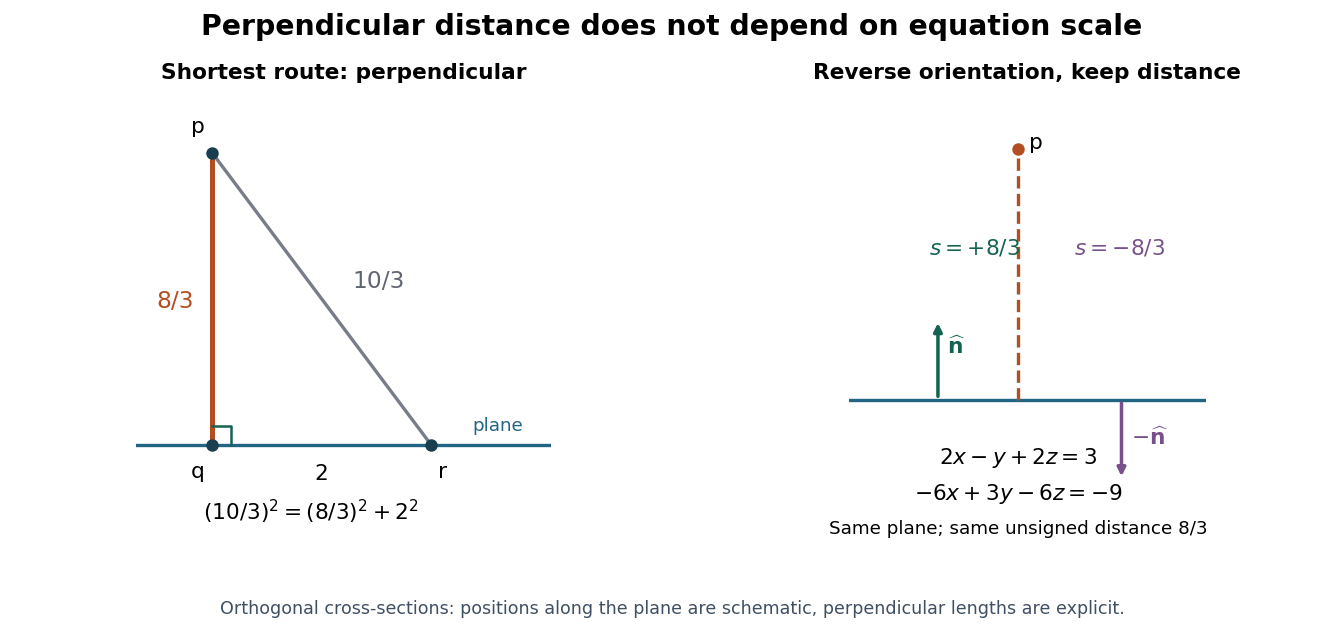
The perpendicular route to a plane is shortest, and rescaling its plane equation preserves the distance
. Original cross-section using the worked distance . The comparison point lies two length units along the plane from the closest point on a plane, giving a longer route of . The second panel reverses the unit normal without moving the plane. Details.The formula is useful whenever the deviation from a flat reference should be measured geometrically. A raw linear equation residual cannot be compared across arbitrary equation scalings; a perpendicular distance can. The same reasoning works for a hyperplane in any finite-dimensional Euclidean space, with the appropriate number of coordinates.
Electrical impedance Created 2026-10-14 Updated 2026-10-18
Electrical impedance is the ratio of terminal electric potential difference and electric current phasors at one specified positive angular frequency . For an electrical circuit modeled as a linear time-invariant system, use the sinusoidal steady state after any decaying transient has settled. With the passive sign convention, positive electric current enters the terminal assigned positive electric potential difference. Define peak complex amplitudes byThe physical and are real; the complex numbers encode their amplitudes and wave phases. The unit of electrical impedance is the ohm, . Both phasors may instead use root mean square magnitudes, with the same ratio . A nonlinear diode can generate additional frequencies; a single then does not describe the whole response.
Write the electrical impedance in Cartesian and polar forms asHere is the resistive real part, the signed electrical reactance, and the voltage-minus-current phase difference, defined modulo a full turn. The Pythagorean theorem gives the modulus from a right triangle in the complex plane. The complex argument gives the rotation from the current phasor to the voltage phasor. Thus , while negative means electric current leads terminal electric potential difference. For , lies between and ; outside that case, use the quadrant of the complex number rather than a bare inverse tangent. The geometric magnitude and phase difference are the two pieces of the AC relation.[ref]
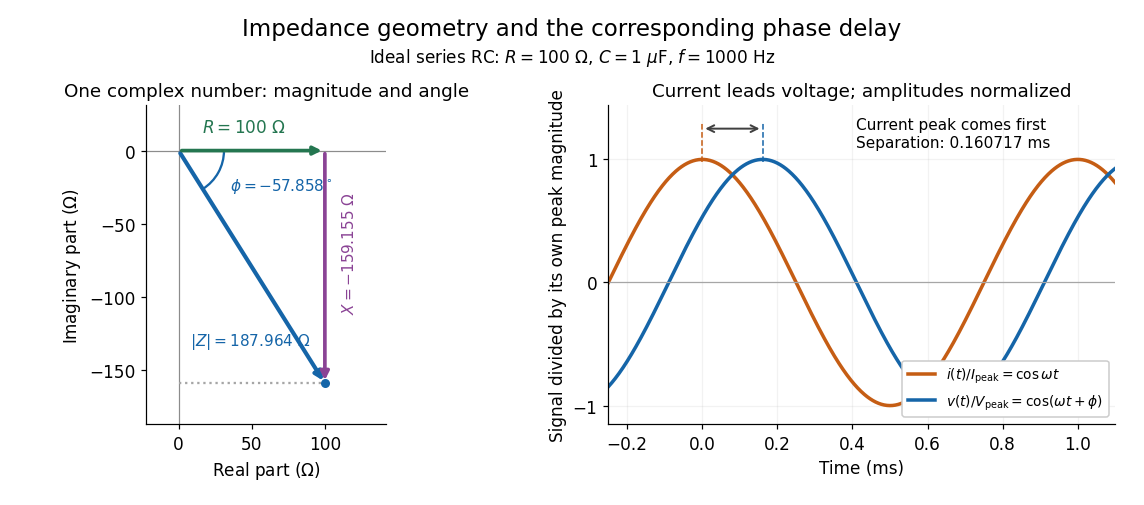
Multiplication by acts on phasors, not on instantaneous physical signals. For example, when ,The second term is in phase quadrature with electric current; it cannot be represented by pointwise multiplication when . This is the useful compression: one complex multiplication replaces separate amplitude and phase difference calculations, while the real part restores the physical signal.
An ideal resistor, inductor and capacitor have , and . Their electrical impedances add in a series RLC circuit, giving . The current amplitude is , so cancellation of the imaginary parts explains the resonant series RLC response. The component-law derivation and opposite complex exponential convention are in reactance phase convention.
Euclidean geometry Created 2026-09-24 Updated 2026-10-13
Euclidean geometry describes flat Euclidean space using lengths, angles, and rigid motions. A coordinate realization uses points , Euclidean distanceand angles determined by the dot product. The coordinate axes are a convenience: translations and rotations change coordinates while preserving these measurements. This makes Euclidean geometry useful for comparing figures and converting measurements along different directions into a single distance.
In the Euclidean plane, through a point outside a line there is exactly one parallel line. This is a standard equivalent formulation of the parallel postulate. Euclid's fifth postulate in the Elements instead describes when two lines meet using the interior angles made by a crossing line.[ref] The assumption has consequences we often take for granted: a triangle's interior angles sum to , and similar triangles can differ in size while keeping their angles. Comparing with spherical geometry reveals that these are properties of a particular geometry.
As a computed example, the diagonal from to in a rectangle has length . The Pythagorean theorem explains why perpendicular contributions add as squares. If the directions cease to meet at a right angle, the law of cosines supplies the missing angle-dependent term. The beauty is that a single distance formula unites geometric constructions, coordinate calculations, and orthogonality in linear algebra.
Make the assumptions visible: in a Cartesian coordinate system with orthogonal axes and the same length unit on each axis, take , and . The vectors and have dot product zero, establishing a right angle at before using the Pythagorean theorem. A sketch that merely looks like a right triangle supplies no such guarantee. Likewise, an image stretched horizontally and vertically by different amounts can distort both lengths and angles; a displayed shape and the assumptions defining it must be kept separate.
For a less origin-dependent measurement, take and . Their displacement vector is , so their Euclidean distance is again . Its Euclidean norm records the direct separation, whereas travelling first horizontally and then vertically covers length . This connects measuring a diagonal to locating two positions from a Cartesian coordinate system. A translation changes where the positions are recorded without changing their separation; a rotation changes the component values without changing the Euclidean norm.
Galerkin orthogonality Created 2026-09-28 Updated 2026-10-14
Let be a conforming finite element space. Suppose the exact solution satisfies for every and its Galerkin method approximation satisfies for every , using the same bilinear form and linear functional. Subtracting the two identities gives Galerkin orthogonality:This identity itself does not require symmetry. Its interpretation as an orthogonal projection in an energy norm does require a bounded symmetric coercive bilinear form: then is an inner product, is perpendicular to every available discrete correction, andConsequently is the unique closest point in in the energy norm. This Pythagorean theorem in a function space explains the beauty of the Galerkin method: integrated local equations compute a global best approximation. The Céa lemma supplies the corresponding estimate in a chosen reference norm.
For the finite element solution of the one-dimensional Poisson equation, and . Testing the error against the th piecewise-linear hat function on a uniform mesh givesIn this model vanishes at every node, so each of these integrals is individually zero, although is positive inside every element. Galerkin orthogonality controls the derivative-weighted balance; it does not say that the pointwise error vanishes.
The exact identity assumes conformity and exact evaluation of the continuous forms, including any numerical integration that is used. If assembly instead uses and , subtraction gives the consistency defectThus inexact numerical integration need not preserve the projection. In the Petrov-Galerkin method the error is tested against a different test space, and for a nonsymmetric bilinear form the displayed identity need not describe perpendicularity in any energy norm.
Geometry and topology Created 2026-09-24 Updated 2026-10-13
How much information about a shape do we need to keep? Euclidean geometry retains lengths and angles, allowing questions about the diagonal of a rectangle or the shortest route between two points. Topology retains the structure preserved by a homeomorphism, allowing questions about connectedness and whether a loop can shrink to a point, as recorded by the fundamental group. These are different levels of description of the same object.
For example, stretching a circle horizontally produces an ellipse. The stretching map and its inverse are continuous maps, so it gives a homeomorphism: the two curves have the same topology. It changes some Euclidean distances, however, so it is not an isometry. This distinction helps separate essential structure from a particular drawing, while explaining why measuring a shape requires more information than recognizing its topology.
The choice of geometry matters too. A Euclidean geometry triangle has interior angles summing to , but a spherical triangle can have three right angles. Spherical geometry turns this apparent surprise into a measurement: the excess of the angle sum over determines the area. Begin with the Pythagorean theorem for flat measurements, then compare the spherical triangle below to see curvature change the rules.
Hermitian inner product 2026-10-14
A Hermitian inner product is a Hermitian form on a complex vector space which has positive definiteness: for every nonzero vector . It is precisely a complex inner product. Only with this definiteness condition doesdefine a norm rather than a seminorm or an expression that may not be real. The standard Hermitian inner product on is ; positive weights give , with squared norm .[ref]
https://linear.axler.net/InnerProduct.pdf. Sheldon Axler, Linear Algebra Done Right, third edition, §6.A, definitions 6.3 and 6.9 and examples 6.4
A Hermitian inner product need not have a real matrix. For instance, with the linear-first coordinate convention,The last expression proves positive definiteness without a lengthy calculation of eigenvalues. For it gives , while for it gives . These unequal values expose why a silent switch to would change this particular Hermitian inner product: with these same entries it gives at . All entries must keep their roles from the matrix of a Hermitian form.
The Cauchy-Schwarz inequality for a Hermitian inner product statesEquality holds exactly when are linearly dependent, including when either is zero. For a nonzero , outline the proof by setting and . Then , and the Pythagorean theorem givesNonnegativity proves the inequality, while positive definiteness makes equality equivalent to . The scalar has no extra conjugate because the first argument is linear.[ref]
https://linear.axler.net/InnerProduct.pdf. Axler, Linear Algebra Done Right, third edition, orthogonal decomposition 6.14 and Cauchy-Schwarz inequality 6.15
The Cauchy-Schwarz inequality also holds for a positive semidefinite Hermitian form, but equality need not imply linear dependence: for , the independent vectors and give . Equality then describes dependence after passing to the quotient vector space by the radical of a Hermitian form. The indefinite Hermitian form in Hermitian form shows that conjugate symmetry alone does not even guarantee the inequality.
For a worked orthogonal projection, take , and . Then , and , with and for the squared norms. The residual is perpendicular in this Hermitian inner product even though its ordinary real dot product with is . For complex , the same orthogonal projection uses ; rotating multiplies by , while rotating multiplies by . This combines geometric decomposition with sensitivity to the relative complex arguments of the multipliers.
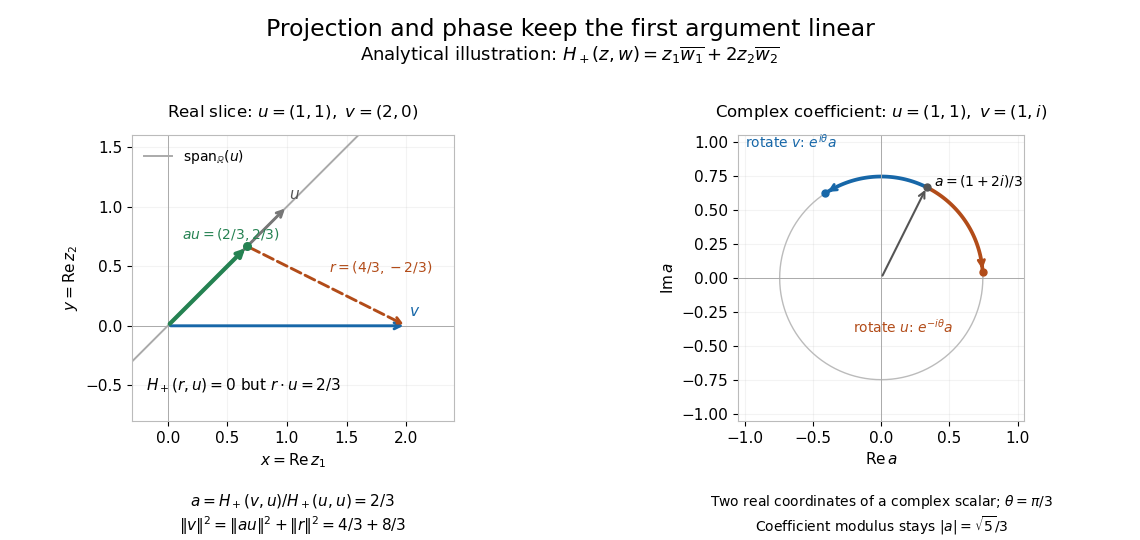
Analytical illustration: weighted orthogonal projection on a real slice and opposite changes of complex argument of its projection coefficient
. Details. A Hermitian inner product therefore supplies more than a positive diagonal: orthogonality, orthogonal projection onto a span, and the triangle inequality for its norm make approximation and distance meaningful. For the function space of complex continuous functions on , has positive definiteness, because a nonzero continuous function has positive modulus on a small interval. The same construction turns overlap under integration into lengths and best approximation in finite-dimensional vector subspaces.
Hypotenuse 2026-10-14
The hypotenuse is the side opposite the right angle in a right triangle. Its length is determined by the Pythagorean theorem.
Law of total variance Created 2026-09-24 Updated 2026-10-14
The law of total variance separates the spread of a population into spread inside groups and spread between their means. For a real square-integrable random variable , so that , and another random variable on the same probability space,The first term averages the conditional variance over the possible information ; the second measures how much the conditional mean changes with that information. There is no independence assumption, and need not be numerical or have finite variance. Conditioning is useful precisely when knowing tells us something about . See MIT tutorial on using conditional expectation and variance.
More generally, the available information can be a sub-sigma-algebra of the ambient probability space. With , the existing conditional expectation definition givesTaking recovers the displayed formula. The conditional mean and conditional variance are themselves random variables: before learning the group, we do not yet know which group average or group spread will apply. Their outer expectation and variance turn these varying quantities into numbers.
For a fully explicit mixture distribution, choose a group or with equal probabilities. In group , choose or with equal conditional probabilities; in group , choose or with equal conditional probabilities. Thus the complete joint probability distribution consists of , each with probability , and no other outcomes. The conditional means are and . Squaring the deviations and gives conditional variances and , respectively. The law of total expectation gives the overall mean .
The within-group contribution to variance isFor the between-group contribution, the conditional mean takes values and , each three units from the overall mean. Consequently,We can check this without any conditioning: the discrete random variable takes values with equal probabilities, soEquivalently, its second moment is , and subtracting the squared mean gives . These are population variances, with the stated probabilities as weights, rather than estimates using the corrected denominator of a sample variance.
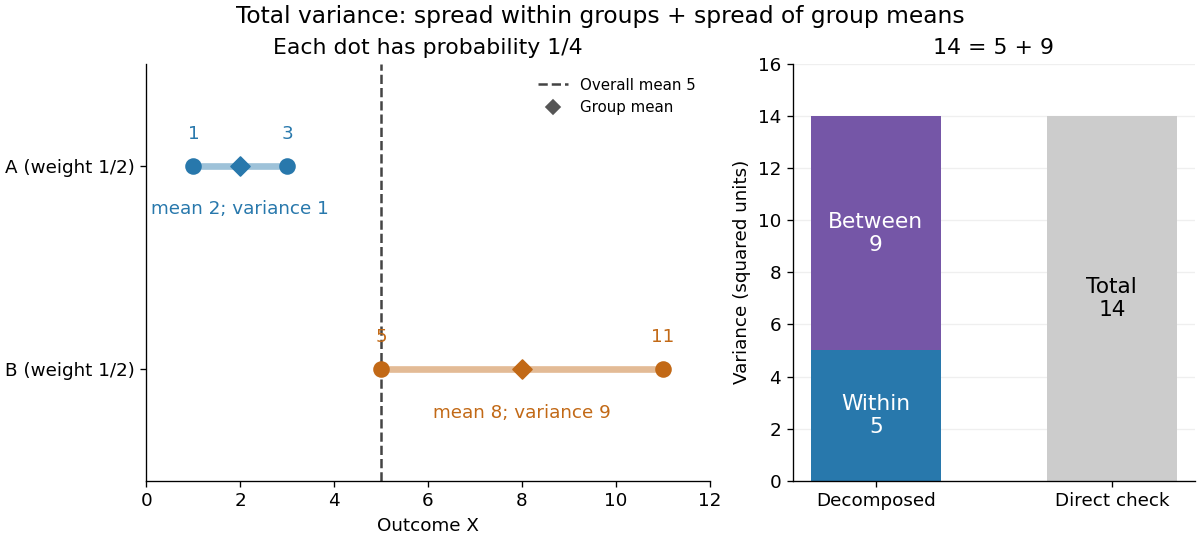
The figure makes the two sources of spread visible. The outcomes in group cluster tightly around , while those in group sit farther apart around . Replacing every outcome by its conditional mean removes the internal spread but leaves the separation between groups. Conversely, subtracting each group's conditional mean aligns the two groups around zero. Averaging only the conditional variances would miss nine units of variance; retaining only the conditional means would miss five. Neither summary alone describes the whole population.
Two modifications clarify what each contribution measures. Shift group to outcomes and group to outcomes , keeping all four probabilities equal. Both conditional means are now , while the conditional variances remain . The between-group contribution vanishes, and total variance is just . Group membership still tells us how uncertain an outcome is, even though the best point prediction stays the same. Alternatively, let every outcome in group equal and every outcome in group equal . Now both conditional variances vanish, and all nine units of total variance come from group separation. Knowing the group predicts the outcome perfectly. These limiting cases distinguish differences in average outcome from differences in internal spread; the original mixture distribution contains both.
The same calculation answers a prediction question. If the group is hidden, the best constant prediction is the overall mean , with mean squared error , by variance as the minimum mean squared error of a constant. If the group is revealed, predict for and for . The errors become , and their mean squared error is . Knowing the group therefore improves the best achievable mean squared error by , exactly the between-group contribution. This is an interpretation relative to the information available: the remaining uncertainty could shrink further if additional information were revealed.
For any square-integrable measurable function used as a predictor, write . The prediction identity isThus predicting with the regression function gives the conditional expectation and minimizes mean squared error over every permitted predictor, including nonlinear ones. This minimizes average squared error, not the error for each individual outcome. See Berkeley Statistics 201A notes, sections 36–37.
Why do the two pieces add cleanly? Put . Its conditional expectation given is zero, so and for every square-integrable measurable function . In particular, and are uncorrelated random variables. Splitting and squaring therefore leaves no cross term after taking expectation. Geometrically, the conditional expectation is an orthogonal projection in the L2 space, and the law of total variance is its Pythagorean theorem for centered random variables.
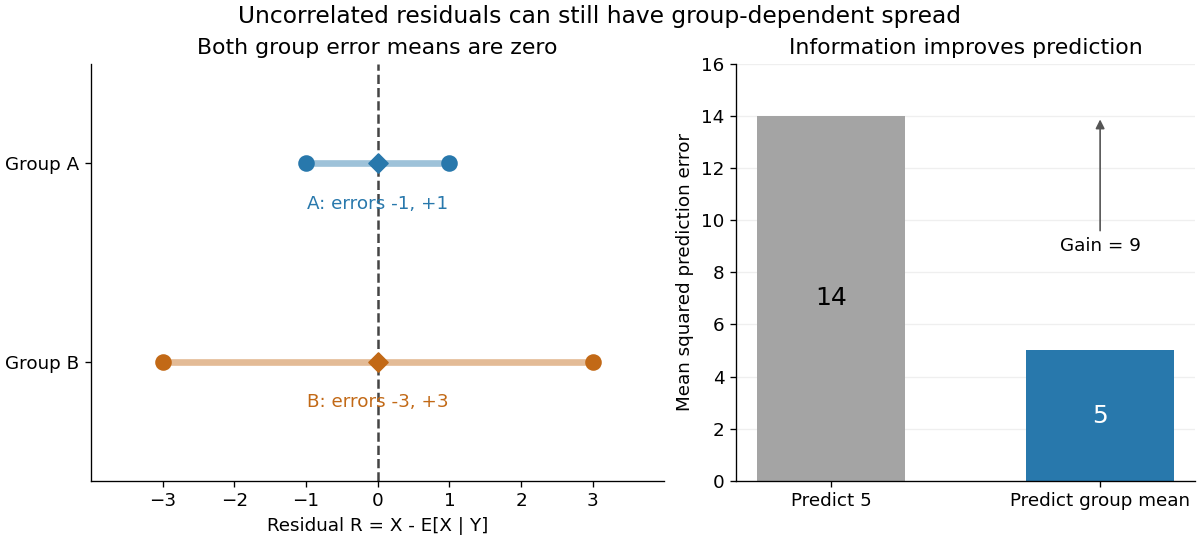
In our example, the four products are , which average to zero. Yet and are not independent: observing identifies group , while observing identifies group . This is a concrete instance of heteroscedasticity, with different conditional variances despite zero conditional means of the errors. A group can predict uncertainty even when it cannot predict the error's sign.
The law of total variance is useful whenever aggregated data conceal distinct groups. Changing mixture weights changes both contributions, so the weighting must match the population being described. For example, giving group weight changes the overall mean to , the within-group variance contribution to , and the between-group contribution to , making the total . Group differences account for spread and prediction gains; assigning them a causal explanation requires a separate causal inference argument.
Modulus Created 2026-09-24 Updated 2026-10-14
The modulus of a complex number isIt extends absolute value to the complex plane: the modulus is the Euclidean distance from to zero, or the Euclidean norm of its coordinate vector. The Pythagorean theorem gives , even though its two coordinates have sizes and . The modulus is always nonnegative, and is zero exactly at zero.
Two essential rules areThe second is the triangle inequality. For and , the product has modulus , while the sum has modulus . The strict inequality records that the two displacement vectors point in different directions.
The Euclidean distance between two complex numbers is . Consequently expresses geometric closeness without treating the two coordinates separately. This makes the modulus a natural measure of error in complex analysis; the triangle inequality bounds accumulated error, while the product rule tracks how multiplication changes its size. Equal moduli do not imply equal complex numbers: , , and all lie on the same circle around zero. The modulus records size and deliberately forgets direction; the argument supplies the missing information.
Orthogonal projection Created 2026-09-24 Updated 2026-10-14
The orthogonal projection onto a closed subspace of a Hilbert space sends to its component in the orthogonal decompositionThe residual is orthogonal to every permitted direction. For any , the Pythagorean theorem givesThus uniquely minimizes the distance to . It is a linear map, is idempotent, and is nonexpansive: ; taking gives .
In , project onto the line spanned by . The inner product givesThe check confirms orthogonality, and . Projecting again changes nothing, since the result already lies on the line.
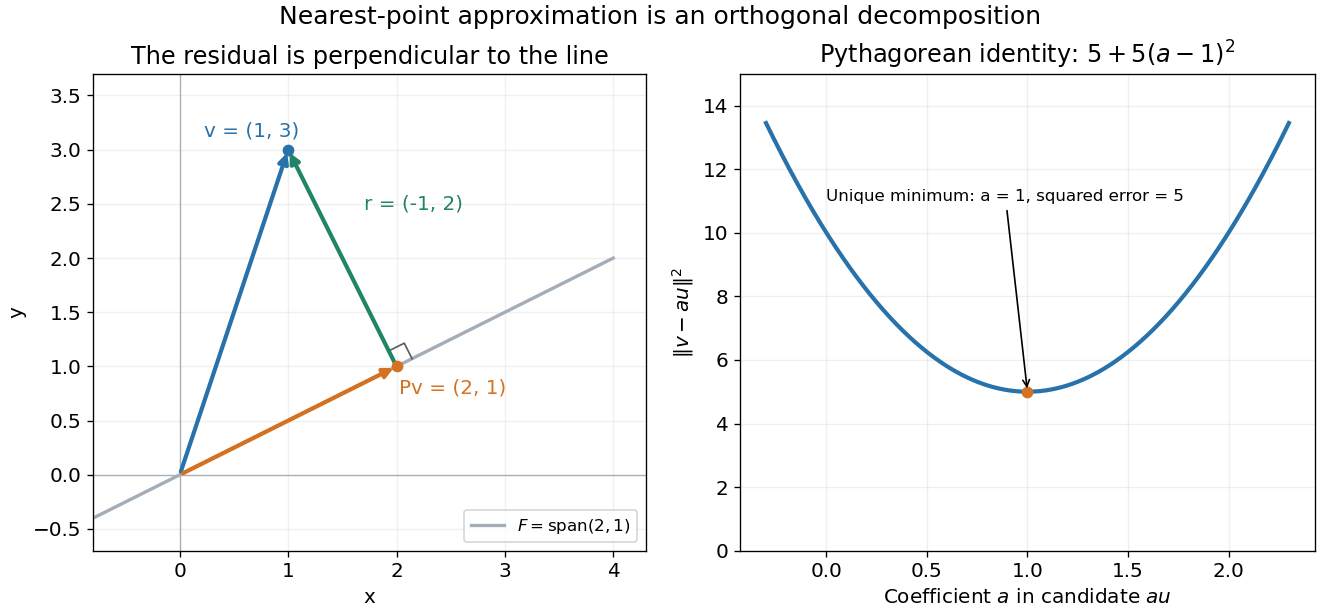


For a finite orthonormal basis of , the same operation is , using the convention linear in the first argument. Replacing coordinate vectors by functions gives exactly the same approximation principle. For in the real L2 space on and , the directions are orthogonal, with squared norms and . Their inner products with are and zero, soDirect integration gives the squared error . For any competing affine polynomial, the orthogonal residual yieldsEvery deviation from , adds a nonnegative error. The best function need not pass through any selected data point: it minimizes an integrated error across the whole interval.
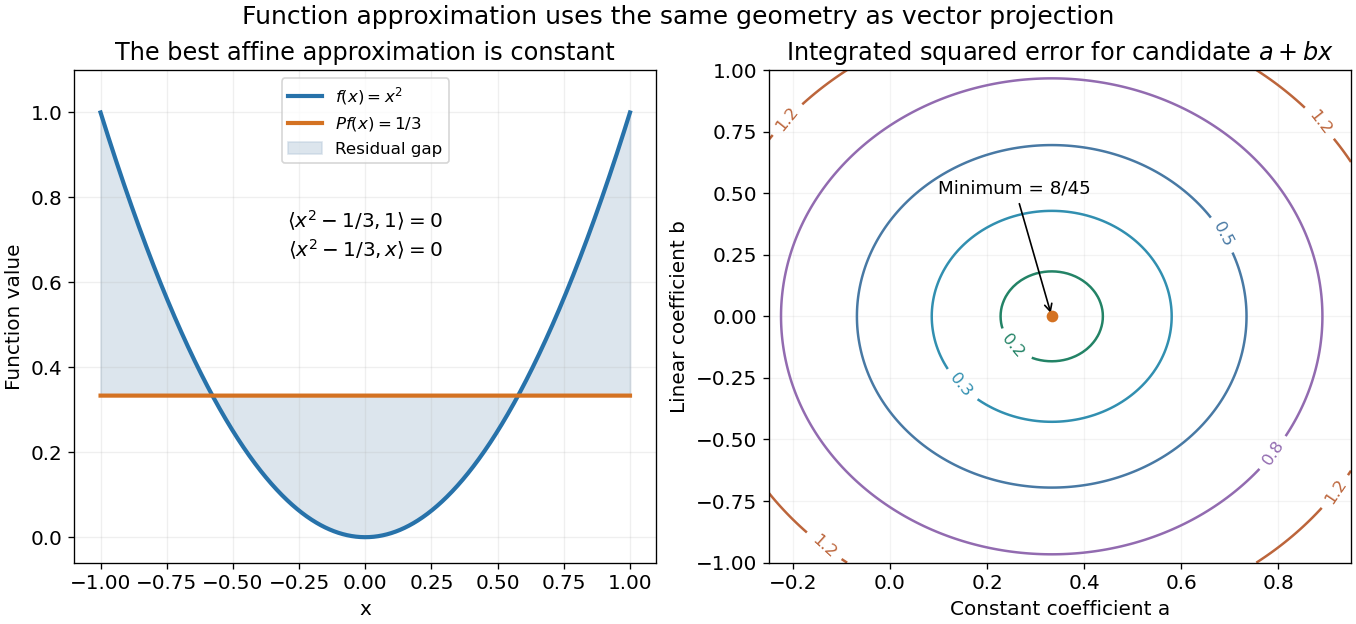
Projecting x squared onto affine functions gives the constant one third and minimum integrated squared error 8/45
. Details. 
Past exam of the mathematics course of the University of Cambridge 2002 iii Paper 61 7 a Solution Created 2026-10-03 Updated 2026-10-14
Write . If is a best approximation in the finite-dimensional linear subspace, then for every in it and every real ,A nonzero real linear coefficient would make this negative for sufficiently small of the appropriate sign. Hence . In a complex inner product space, apply the argument to too; the imaginary part also vanishes. Thus for every in the subspace.
Conversely, if that orthogonality holds, every other candidate has the form , and the Pythagorean theorem in the inner product norm givesEquality requires . ThereforeThe next part constructs this orthogonal projection explicitly. No completeness of the whole inner product space is required for projection onto a finite-dimensional subspace.
Past exam of the mathematics course of the University of Cambridge 2007 ia Paper 1 5B ii a Solution 2026-10-14
Set , where . Then , so lies in the plane. For any position in that plane, is perpendicular to . The Pythagorean theorem therefore givesOn the sphere the left side is . Thus the intersection is the circle in the plane centred at , with squared radius . Its centre must therefore be , andIn terms of the radii, , with the sign fixed by . In the central-plane case , both signs give zero. This is the center and radius of a sphere-plane intersection formula with its orientation made explicit.
Past exam of the mathematics course of the University of Cambridge 2007 ia Paper 1 5B ii b Solution 2026-10-14
Substitute the signed displacement into the Pythagorean theorem relation from part (a):A genuine circle requires . Equality gives a tangent plane and a single point, interpreted as radius zero; a larger distance gives no intersection. Under the stipulated circle intersection, the radicand is positive. Its centre is .
Past exam of the mathematics course of the University of Cambridge 2007 ia Paper 1 5B i Solution Created 2026-09-24 Updated 2026-10-14
Decompose the position vector into its components parallel and perpendicular to the unit vector :This is an orthogonal projection, and the Pythagorean theorem gives . The two surfaces are distinguished by fixing an angle in part (a), and fixing distance from an axis in part (b).
Past exam of the mathematics course of the University of Cambridge 2012 ia Paper 1 5C Solution Created 2026-09-24 Updated 2026-10-07
For a point on the plane, the Cauchy-Schwarz inequality gives , because is a unit vector. Equality is achieved at . Thus the distance from the origin is .
Let and let be the perpendicular projection of the sphere's center onto the plane. Every point of the plane has form with . The Pythagorean theorem givesIf , the sphere equation therefore forces . There is exactly one contact point, ; it lies on both surfaces.
Write . The nonzero scalar triple product proves that are linearly independent, so they form a positively oriented basis of and define a nondegenerate tetrahedron.
For the three faces through the origin, choose the inward unit vectorsTheir signs are correct because each has positive inner product with the opposite vertex vector. Write the center as . It lies on the interior side of every face. Tangency of the interior sphere therefore means signed distance , not , from each of those three planes. Taking inner products givesSolving proves the center formulaThis is the sphere center from three tetrahedron face distances; the interior hypothesis selects these signs rather than an exterior center.
Past exam of the mathematics course of the University of Cambridge 2014 ib Paper 4 17D ii Solution Created 2026-09-24 Updated 2026-10-06
The Parseval identity for a complex Fourier series isIt holds for every square-integrable function, with complex conjugation expressed by the absolute squares. It is the Pythagorean theorem extended to the complete orthonormal system of complex exponentials.