Topics (384k) Articles (398k) Users (410) Discussions (242) Comments (383) Files (13k) New article

A physical quantity is a property of a phenomenon, body or substance whose magnitude can be expressed by a number and a reference, usually a unit of measurement. For example, the length and the same length have different numerical values but represent the same physical quantity. The numerical value alone is therefore incomplete.
A physical quantity must also be specified physically. A gas's pressure at a stated position and temperature, the mass of a specimen, and a detector's electric current are different measurands even if an instrument happens to display the same number for them. Dimensional analysis constrains which quantities can be added or compared, while a system of units supplies a consistent convention for expressing them.[ref]
A system of units chooses reference units of measurement for a set of base physical quantities and specifies how other units of measurement are derived. In the International System of Units, length, mass and time are expressed using the metre, kilogram and second; a velocity has derived unit .
A consistent system allows an equation to connect numerical values without hidden unit-conversion factors. It does not change the underlying physical relation: the same speed may be written as or . The familiar formulas for electromagnetism can nevertheless contain different constants in SI and Gaussian conventions, because the definitions of the electrical quantities differ as well as their numerical scales.[ref]
A plasma is a gas of mobile charged particles whose collective electromagnetic response is important to its dynamics. It commonly contains ions and electrons, and may also contain a neutral component: complete ionization is not required. A multi-species fluid description has current density . The relative motion of the species can matter even when a single-fluid magnetohydrodynamics approximation describes the large-scale dynamics.
A physicist investigates physical phenomena through experiments, observations, mathematical models and computation. Quantitative predictions connect a physical theory's assumptions with measurements, while discrepancies can expose missing effects or a failed mathematical model.
Experimental and theoretical work often interact: a new measurement can motivate a new description, and a physical theory can suggest which quantities to measure or which background effects must be excluded. The specialized lists organize individual contributions by their main subject.
Gravity governs falling bodies and orbits. Newtonian gravity describes it through a gravitational field acting on masses; general relativity instead relates matter and radiation to the geometry of spacetime through the Einstein field equations.
A physical law expresses a reproducible relation used to describe or predict physical phenomena within its domain of applicability. Applying it requires a model specifying the system and conditions: Newton's second law, together with a force model, predicts a body's acceleration; conservation of energy constrains exchanges within a specified system. Its predictions must be compared with physical observations.
A laboratory vacuum is a region with substantially reduced gas pressure, rather than an experimentally perfect absence of matter. Lowering the number density increases the mean free path, allowing a molecular beam to travel with fewer collisions. In molecular flow, the mean free path exceeds the apparatus dimensions, so wall encounters dominate.
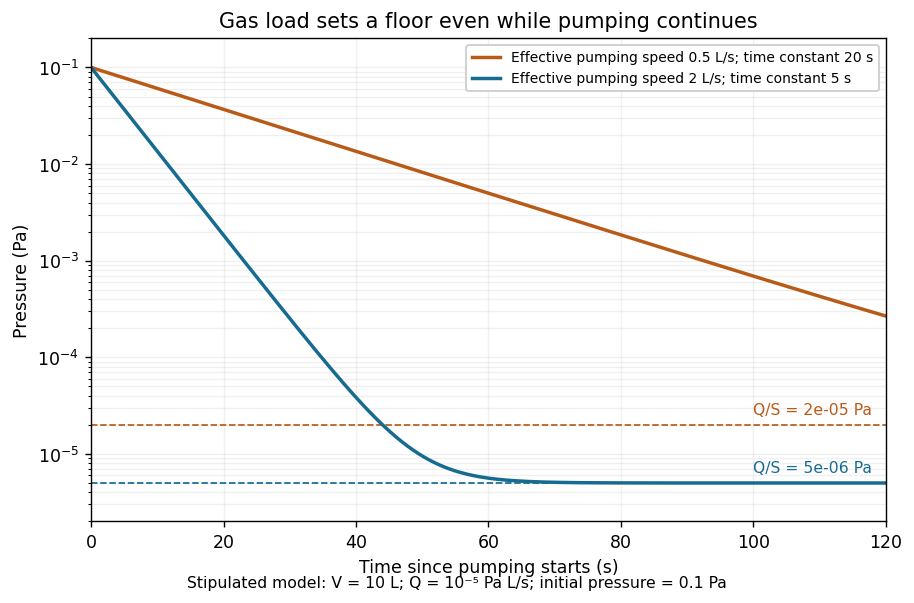
A vacuum pump competes with leaks and outgassing. For an isothermal vessel of volume , constant gas load in pressure-volume per unit time, and effective pumping speed , gas balance givesThis ideal model predicts a pump-down time constant and a limiting pressure . A restricted connecting pipe reduces the effective pumping speed; a larger pump alone need not fix it. Measuring the pressure transient tests the model, while deviations can reveal changing outgassing or pumping speed.[ref]
A mathematician develops and studies mathematical structures, formulates conjectures, constructs mathematical proofs and designs methods for solving problems. Work can emphasize foundational theory, computational methods or applications to scientific models; these activities often interact.
For example, a question about stable numerical methods may require a theorem in functional analysis, while a geometric example can reveal the right algebraic definition. The list of mathematicians connects individual contributions with the reusable mathematical ideas they helped establish.
An invariant is a property or quantity unchanged by a specified class of transformations. The transformations are part of the definition: an invariant of a group action and an invariant set of a measure-preserving transformation concern different transformation classes.
Mathematical economics uses mathematical optimization, game theory and analysis to study allocation, choice and market coordination.
Signal processing transforms or analyzes signals to extract information, change a representation, or improve a measurement. Examples include smoothing a sensor record, selecting a band of frequencies, and decomposing a recording through Fourier analysis. A signal is a mathematical representation of a physical record; deciding which variation is meaningful and which is noise is part of the problem.
A linear filter offers a simple entry point. Its output is assembled from weighted copies of its input. A moving average can reduce rapid variation, but it also changes timing and can erase useful detail. The worked example below makes that tradeoff explicit rather than treating a smoother plot as automatic improvement.
Two complementary views make the subject appealing. An impulse response describes the effect of a localized input; a frequency response describes the effect of a sustained oscillation. For a linear time-invariant system, both describe the same operation, connected by convolution and Fourier analysis. [ref]
https://ocw.mit.edu/courses/res-6-007-signals-and-systems-spring-2011/0400ba59406d52d94c079d99928156ee_MITRES_6_007S11_lec04.pdf. Alan Oppenheim, MIT Signals and Systems, lecture 4: impulses, complex exponentials and convolution
.Thévenin's theorem replaces the terminal behavior of a linear resistive circuit by an ideal voltage source in series with a Thévenin resistance, whenever its terminal electric potential difference is a well-defined affine function of the delivered electric current. Fix terminals , write , and take positive out of the network at into the electrical load, returning through . ThenThe open-circuit voltage is the intercept at ; is the slope. Thus two parameters predict what happens when many different electrical loads are connected. The Wheatstone bridge detector loading calculation uses precisely this replacement to find the detector reading even when the bridge's two voltage dividers interact through its detector.
For example, a ideal voltage source with above and below a voltage divider junction supplies and at that junction relative to the lower terminal. Attaching a electrical load reduces its voltage to and draws . The equivalent explains why an unloaded divider ratio alone cannot predict a loaded output.
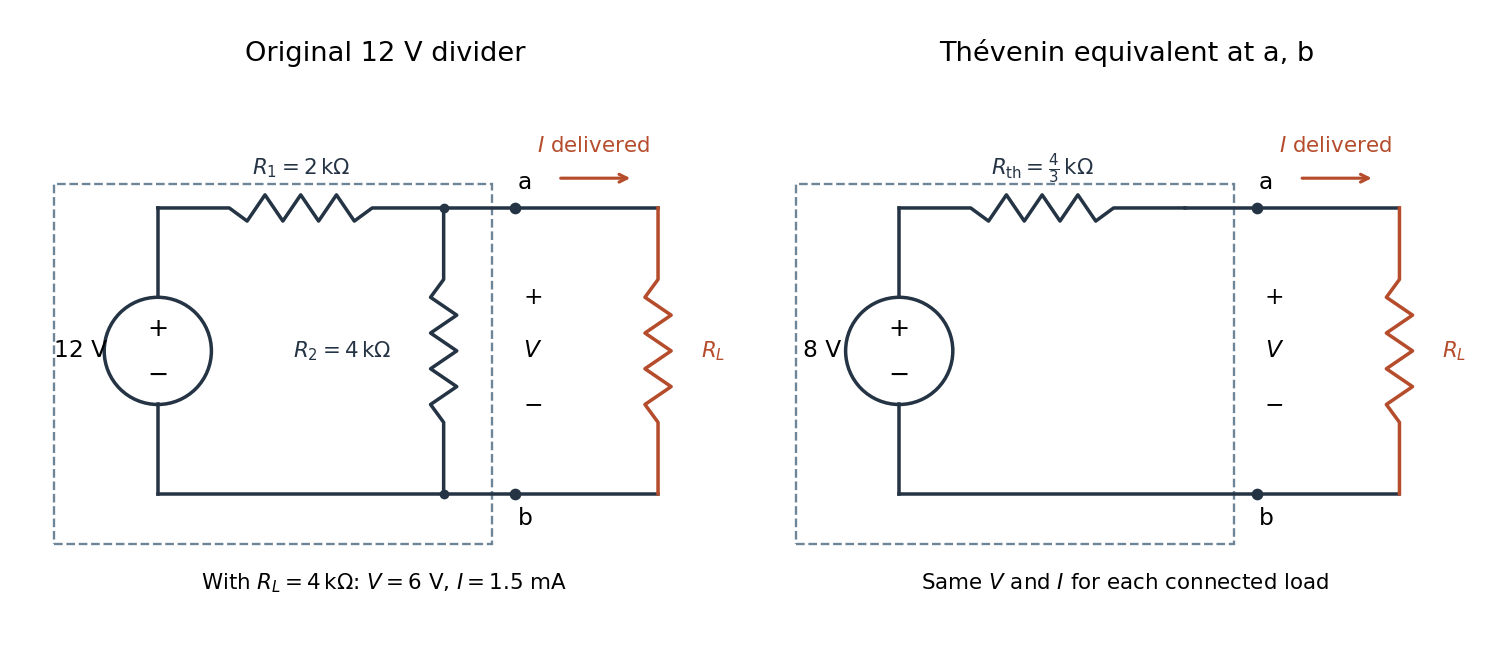
The equivalence concerns the chosen terminals, including the power delivered there. It does not identify internal branch electric currents or internal Joule heating. At open circuit the original divider still draws from its supply, while the equivalent's series branch carries no electric current. [ref]
Thevenin and Norton Equivalents, University of Houston teaching notes. Thevenin and Norton Equivalents, pp. 1–2, “The Idea” and “Important Notes”: equivalence at the specified terminals
A voltage divider uses two resistors connected in series to obtain a fraction of an applied electric potential difference. Let the upper electrical resistance be , the lower one , and the input be relative to a common electrical reference potential. The output is the junction's electric potential difference relative to that same reference, across . The familiar ratio assumes zero output electric current: no external electrical load draws from the junction. In a steady direct current model with fixed resistors obeying Ohm's law and an ideal voltage source,Here is the open-circuit voltage; correspond to in the header formula. With no junction branch, Kirchhoff's current law makes the same electric current pass through both resistors, and Ohm's law gives the two voltage drops. For , division gives ; if , the predicted output is zero but this ratio is undefined.
An original stipulated example has and . With zero output electric current, and . An attached electrical load instead gives ; a load gives . These are exact model predictions, not measured readings or specifications of a particular multimeter or oscilloscope.
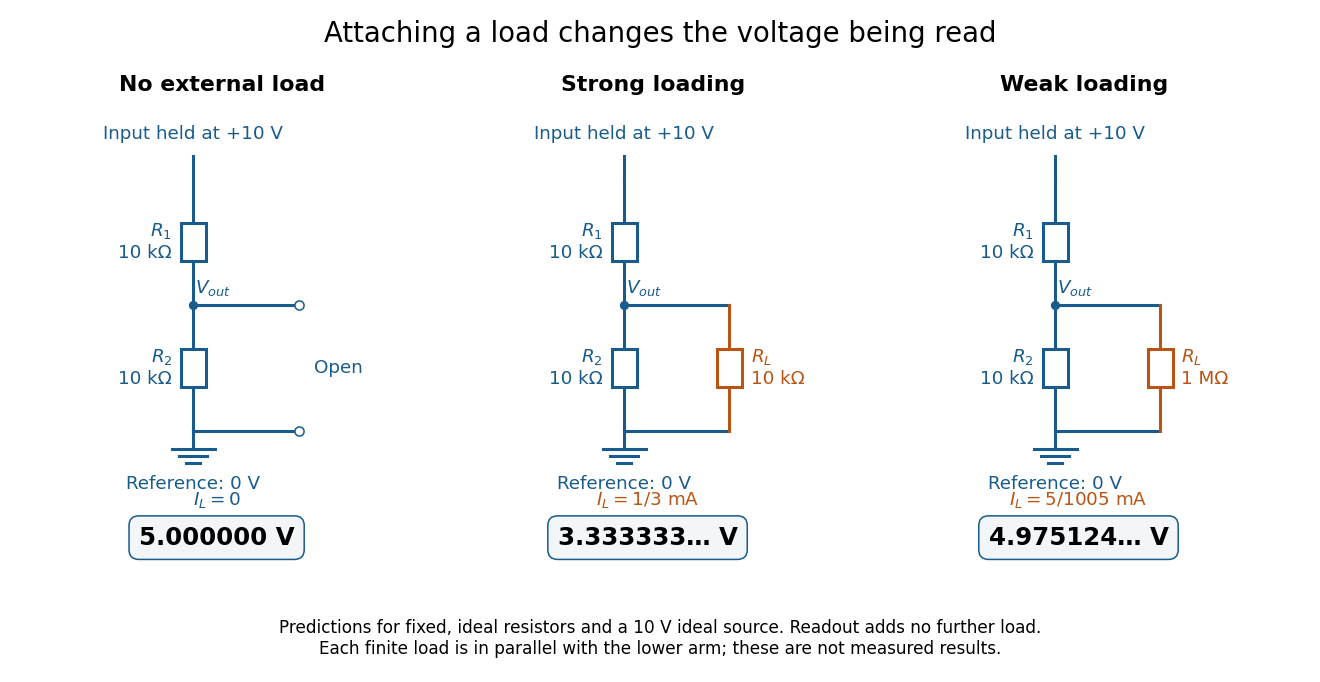
The same voltage divider has three different predicted outputs as the attached load changes
. Original circuit and readout comparison for ideal input and two resistors. Each finite connects across ; the displayed numbers are model predictions with ideal readout, not experimental data. Source. Details.The divider is useful for scaling a voltage or converting a change in a sensor's electrical resistance into an electric potential difference. Its beauty is also its trap: multiplying both electrical resistances by the same positive factor preserves the unloaded ratio, but changes the effect of any fixed electrical load. A divider therefore supplies a predictable ratio under specified loading conditions; it is not a source that maintains that voltage for arbitrary output electric currents. A Wheatstone bridge compares two divider junctions, while Thévenin's theorem describes the divider's response to many different loads.
An electrical measurement estimates a quantity such as voltage, current, resistance or impedance using a calibrated electrical instrument and a measurement model. Connecting an instrument can alter the circuit: a voltmeter's finite input impedance draws current, while an ammeter's shunt produces a voltage drop. Calibration, uncertainty, noise and bandwidth determine how to interpret a displayed value. A slowly changing DC voltage and a short pulse can require different instruments even when their peak voltages match. A numerical reading becomes useful evidence only through its stated units and measurement conditions.
x86 is a family of instruction set architectures whose members include the 32-bit IA-32 architecture and its 64-bit extensions. An instruction set architecture specifies operations, visible processor registers and programmer-visible behaviour; different CPUs can implement it with different internal organizations. The distinction matters when a computer program is correct at the architectural level but has performance that depends on a particular CPU. The Intel manuals separately describe instruction semantics, application programming and system facilities such as virtual memory and processor privilege levels.[ref]
Computer memory stores information that a computer can retrieve while executing computer programs. A memory location holds a value, and a memory address selects a location under the machine's addressing rules. In a byte-addressed example, consecutive bytes have consecutive memory addresses; a four-byte value can occupy four locations. The interpretation of those stored bits as a number, an instruction or another representation belongs to the computer program and architecture.
Computer memory has different physical and logical roles. Non-volatile memory retains stored information without power, while other technologies require power to retain it. A memory cache holds selected information for faster reuse; virtual memory presents an operating-system process with its own address space. These describe different properties, so a cached value and its virtual address should not be confused with the physical storage holding it.
In the paging examples, resident memory pages occupy main computer memory, and address translation maps a virtual address to a physical address. The operating system can change a mapping while keeping an operating-system process's numerical virtual address unchanged. This separation makes controlled sharing and isolation possible.[ref]
Operating Systems: Three Easy Pieces by Remzi H. Arpaci-Dusseau and others. chapter 2, memory virtualization overview
Pinned article: Introduction to the OurBigBook Project
Welcome to the OurBigBook Project! Our goal is to create the perfect publishing platform for STEM subjects, and get university-level students to write the best free STEM tutorials ever.
Everyone is welcome to create an account and play with the site: ourbigbook.com/go/register. We belive that students themselves can write amazing tutorials, but teachers are welcome too. You can write about anything you want, it doesn't have to be STEM or even educational. Silly test content is very welcome and you won't be penalized in any way. Just keep it legal!
Intro to OurBigBook
. Source. We have two killer features:
- topics: topics group articles by different users with the same title, e.g. here is the topic for the "Fundamental Theorem of Calculus" ourbigbook.com/go/topic/fundamental-theorem-of-calculusArticles of different users are sorted by upvote within each article page. This feature is a bit like:
- a Wikipedia where each user can have their own version of each article
- a Q&A website like Stack Overflow, where multiple people can give their views on a given topic, and the best ones are sorted by upvote. Except you don't need to wait for someone to ask first, and any topic goes, no matter how narrow or broad
This feature makes it possible for readers to find better explanations of any topic created by other writers. And it allows writers to create an explanation in a place that readers might actually find it.
Figure 1. Screenshot of the "Derivative" topic page. View it live at: ourbigbook.com/go/topic/derivativeVideo 2. OurBigBook Web topics demo. Source. - local editing: you can store all your personal knowledge base content locally in a plaintext markup format that can be edited locally and published either:This way you can be sure that even if OurBigBook.com were to go down one day (which we have no plans to do as it is quite cheap to host!), your content will still be perfectly readable as a static site.
- to OurBigBook.com to get awesome multi-user features like topics and likes
- as HTML files to a static website, which you can host yourself for free on many external providers like GitHub Pages, and remain in full control

Figure 2. You can publish local OurBigBook lightweight markup files to either OurBigBook.com or as a static website.
Figure 3. Visual Studio Code extension installation.
Figure 5. . You can also edit articles on the Web editor without installing anything locally. Video 3. Edit locally and publish demo. Source. This shows editing OurBigBook Markup and publishing it using the Visual Studio Code extension. 
- Infinitely deep tables of contents:




All our software is open source and hosted at: github.com/ourbigbook/ourbigbook
Further documentation can be found at: docs.ourbigbook.com
Feel free to reach our to us for any help or suggestions: docs.ourbigbook.com/#contact