Topics (384k) Articles (398k) Users (410) Discussions (242) Comments (383) Files (13k) New article
Developmental biology investigates how an organism's structures and cell types arise and become organized. Cell division, cell differentiation, movement, signaling and mechanical interactions connect a starting state such as a zygote to a patterned body. Development also includes later growth, maturation and regeneration.
A central distinction is between what a biological cell normally becomes and what it can become after an intervention. Fate mapping measures the former, while transplantation or changed signaling tests developmental potential. Live imaging can follow divisions and movements in the same embryo, making a developmental sequence directly observable rather than reconstructed solely from different fixed specimens.[ref]
Reconstruction of zebrafish early embryonic development by scanned light sheet microscopy by Philipp J. Keller and others. 2008, live imaging and nuclear tracking
Morphology concerns biological form and structure; a structural difference is one aspect of phenotype, not automatically a species boundary.
Taxonomy names and classifies organisms. Classification can organize known diversity and make comparisons useful, but ranks and names are not themselves evidence of ancestry. Phylogenetics infers that ancestry; a clade includes an ancestor and all its descendants. A shared feature such as lacking a cell nucleus need not identify an exclusive clade. The organism branch here organizes cell types for reading and is not a proposed phylogenetic tree. See OpenStax Biology 2e, 20.1: classification and evolutionary history.
An organism is an individual living system, made of one biological cell or an integrated assembly of biological cells. An Escherichia coli cell is an entire organism; a neuron is normally a specialized part of an animal. Metabolism, regulated exchange through cell membranes, and inherited information connect these very different scales. See OpenStax Biology 2e, 1.2: living systems and levels of organization.
Keep two questions separate: how many biological cells make the organism, and how those biological cells are organized. A yeast and an Escherichia coli are both unicellular organisms, but the yeast is a eukaryote and the Escherichia coli a prokaryote. A plant and an animal are multicellular organisms with eukaryotic cellular organization. Neither distinction ranks organisms as better or worse: natural selection acts on reproduction in particular environments.
A model organism is an organism used to investigate biological processes through accessible, repeatable experiments. Its value combines experimental tractability with a carefully delimited relationship to other organisms. For example, a gene deletion in Saccharomyces cerevisiae can test whether a gene is required for growth under specified conditions; adding another gene can test functional complementation. Such interventions support causal inference more directly than merely noticing that a gene and a phenotype occur together. [ref]
Budding Yeast for Budding Geneticists: A Primer on the Saccharomyces cerevisiae Model System by Andrea A. Duina and others. Duina, Miller and Keeney (2014), introduction and Experimental Toolkit and Related Resources: manipulation of genes and phenotypic effects
The striking opportunity is to ask two experimentally separate questions: what does this component do here, and which part of that function survives a change of species or conditions? The yeast cross-species complementation experiment makes both questions concrete. Model organism evidence transfer requires specifying the function being compared; a useful model organism need not reproduce every feature of another organism.
A biophysical measurement relates an observed signal to a physical property of a biological system, such as diffusion, force, molecular abundance or membrane potential. The inference requires a measurement model and calibration: a brighter fluorescent spot can reflect more labelled molecules, a change in brightness per label or background. Independent controls help separate these possibilities. Single-molecule measurements can reveal heterogeneous states that an average conceals, while the recorded trajectory remains limited by spatial and temporal resolution. [ref]
Subunit counting in membrane-bound proteins by Maximilian H. Ulbrich and Ehud Y. Isacoff. 2007, discrete photobleaching steps and inference of subunit number
Centrifugation separates suspended material by its motion relative to a rotating liquid. A centrifuge rotor creates an outward centrifugal acceleration in the rotating reference frame; material denser than its surroundings tends to move outward, opposed by drag force. Collected material can form a centrifugation pellet, leaving a supernatant, or remain in separated zones within a density gradient. The useful question is which physical difference the separation exploits: a difference in sedimentation coefficient or a difference in buoyant density.
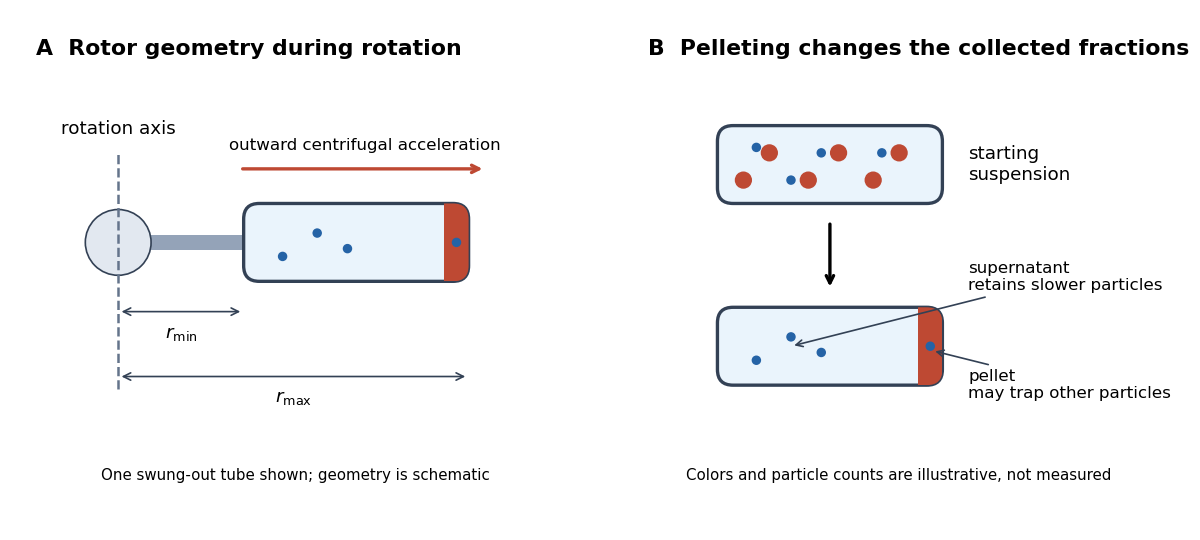
Centrifugation makes otherwise slow settling useful for studying biological cells, organelles, proteins and DNA. Separation and identification are different steps: a centrifugation pellet is a collected fraction, not proof that it contains only one kind of organelle. The lysozyme wall-removal experiment illustrates a complementary readout: testing material released into the separated liquid can be more informative than inspecting the retained solids.
Signal transduction converts a detected signal into a change inside a biological cell. For chemical signals, distinguish reception by a receptor, intracellular signal transduction, and the response: altered gene expression, enzyme activity or ion channel opening, for example. A cell-surface receptor can relay a ligand's presence across a cell membrane without the ligand entering the cytoplasm. Thus a hydrophilic signal need not cross the membrane to influence the interior. See Clark, Douglas and Choi, Biology 2e, 9.2: intracellular signal propagation.
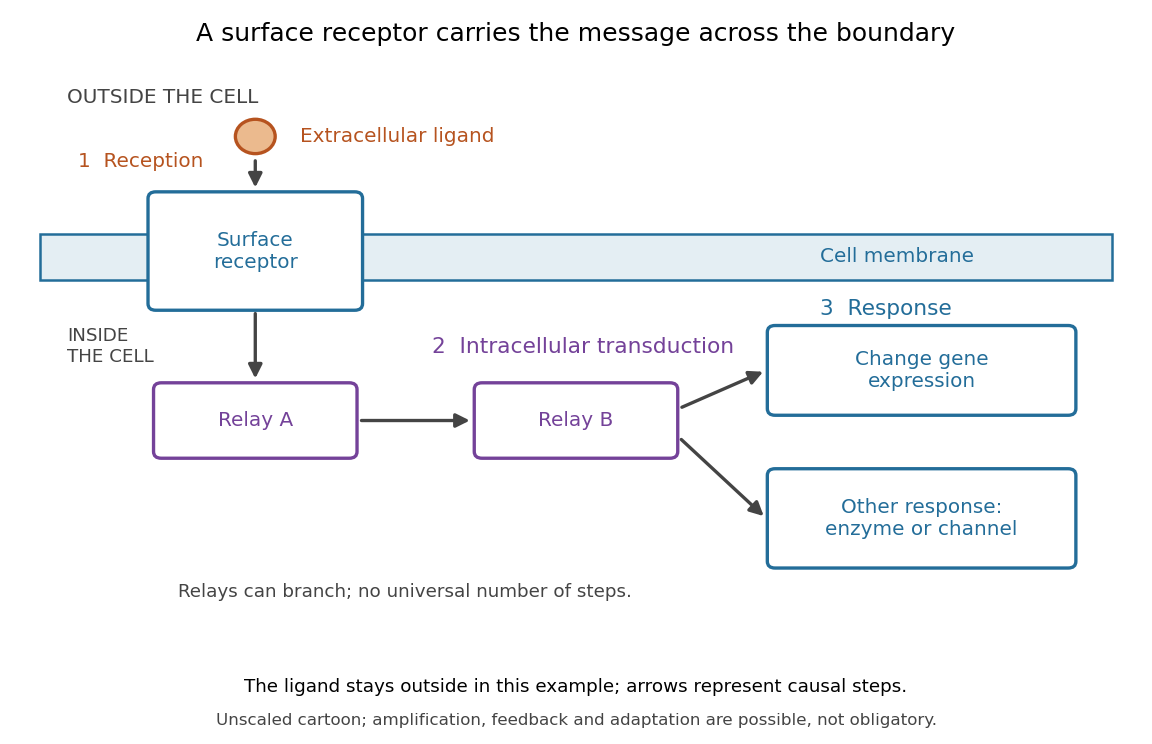
Reception, intracellular signal transduction and a cellular response
. Original cartoon of a ligand outside a biological cell, a cell-surface receptor spanning its cell membrane, and intracellular relays branching toward gene expression or another response. Arrows denote causal steps, not transport of the ligand through the membrane. Shapes, distances and relay counts are illustrative. Details.For a computed example of possible signal amplification, suppose one activated receptor activates five relay proteins, and each relay activates twenty target proteins during a chosen interval. If the targets are distinct and available, targets are activated. Those assumed counts illustrate multiplication, not a measured pathway or a universal gain. Actual signal transduction can branch, saturate or inhibit activity. Changes in gene expression and changes in existing enzyme activity are different responses. See Clark, Douglas and Choi, Biology 2e, 9.3: cellular responses.
Signal amplification, signaling feedback and signaling adaptation are possible properties of signal transduction, rather than requirements of every cascade. Intracellular relays can use proteins or second messengers; different biological cells can interpret the same ligand differently because they contain different receptors and relay machinery. The useful and striking idea is that recognition and response are separable: an extracellular chemical message can control many internal tasks without itself performing those tasks. See General Principles of Cell Communication.
An original experimental route to this separation appears in T. W. Rall and Earl W. Sutherland's 1958 work on cAMP. They described a heat-stable factor formed from ATP in separated biological cell preparations; it affected enzyme activity in other preparations where the initiating chemical signals had no direct effect. This helped distinguish an initial signal from a molecule carrying its effect to another target. [ref]
https://doi.org/10.1016/S0021-9258(19)77422-5. Rall and Sutherland, Formation of a cyclic adenine ribonucleotide by tissue particles, Journal of Biological Chemistry 232 (1958), pp. 1065–1076, introduction
Astrometry measures the positions and motions of celestial objects. Repeated position measurements can distinguish stellar parallax, caused by the observer's motion, from proper motion of the source across the sky.
An astrometry measurement needs a date and a reference frame, as well as an angle. In an equatorial coordinate system, right ascension and declination label two viewing directions. A catalogue's reference date states when its quoted position applies; comparing entries at different dates without accounting for proper motion can make the same star appear misplaced. The observational problem is to infer a consistent history from successive incoming light directions, while accounting for the observer's changing position and measurement error.
To see the separation clearly, consider just one angular coordinate , with the numerical elapsed time in years. Assume a simplified circular orbit of the Earth, a fixed source Euclidean distance, constant proper motion in this coordinate and no other accelerations. Choose the direction and the starting date so that the annual stellar parallax projection is the cosine termHere is the coordinate without the annual stellar parallax offset at the reference date; the observed is . The proper motion coefficient is quoted in arcseconds per year, and is the annual stellar parallax in arcseconds. This is an illustrative choice of a full-amplitude projection. General sky directions have different projected amplitudes and phases in their two coordinates; their apparent paths need not be circles. Real astrometry uses the observer's calculated position rather than imposing this single cosine. [ref]
https://gea.esac.esa.int/archive/documentation/GDR3/Data_processing/chap_cu3ast/sec_cu3ast_cali/ssec_cu3ast_cali_source.html. ESA Gaia DR3: Astrometric source model
.Set , and , where is one thousandth of an arcsecond. The model gives , and . Same-season observations one year apart differ by because the annual stellar parallax contribution repeats. Subtracting that fitted straight trend leaves an annual signal between and . The existing stellar parallax distance relation then gives parsecs.
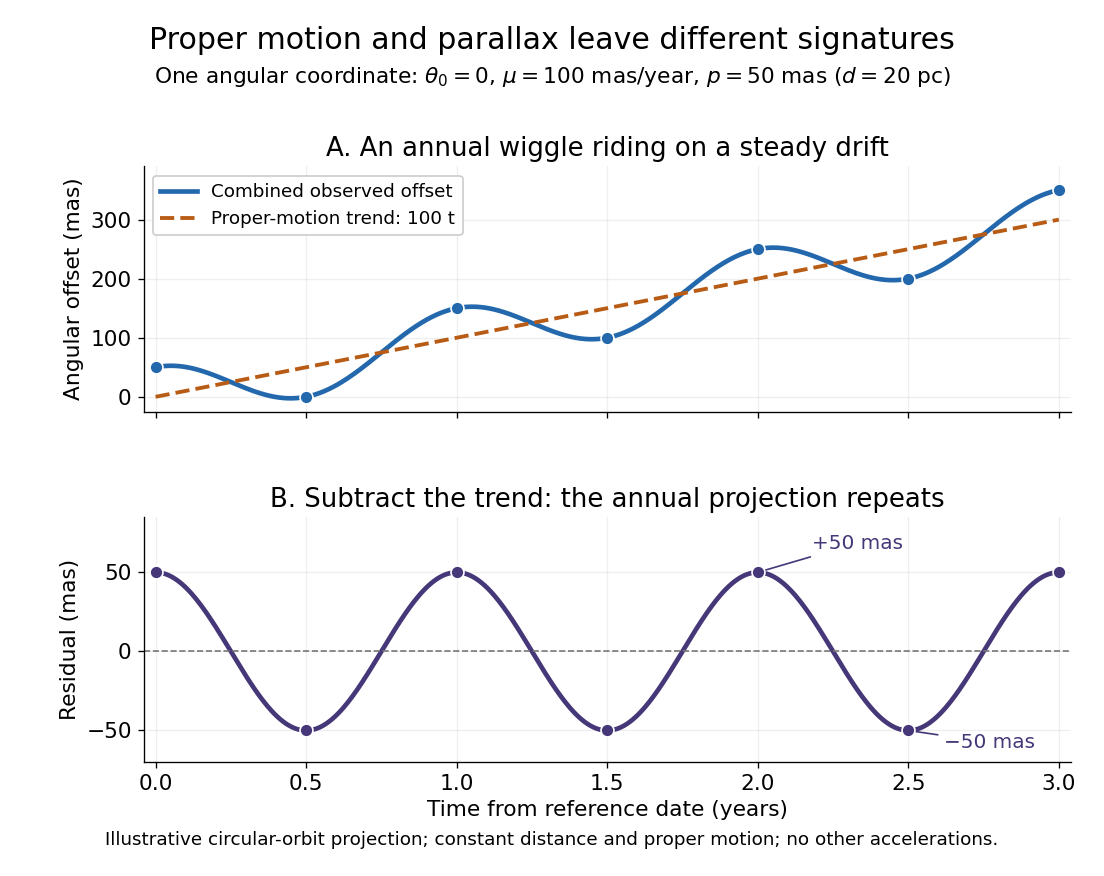
Observing only at the same annual phase would recover the proper motion trend but leave indistinguishable from a constant offset. Sampling several seasons as well as several years separates the repeating signal from the accumulating displacement. The two signatures answer different questions using the same measurements.
An astronomer investigates stars, planets, galaxies and other astronomical systems through observation and mathematical models. Telescopes collect signals, spectroscopy separates their wavelength components, and repeated measurements reveal changes over time.
The distinctive difficulty is that the object under study is usually inaccessible to a controlled laboratory intervention. An astronomer instead compares independent observables: stellar parallax constrains Euclidean distance, a radiation spectrum constrains physical conditions, and orbital motion constrains mass. Agreement among these measurements can test a model more strongly than fitting a single observable.
Typography concerns the selection and arrangement of written forms. In digital systems, the visible result depends on several distinct operations: interpreting text characters, selecting glyphs from a computer font, positioning them, and converting their geometry into pixels through rasterization.
This distinction matters when a document looks wrong. Missing glyphs, incorrect glyph substitutions and poorly rendered pixels can produce different failures even when the underlying Unicode text is unchanged.[ref]
OpenType Layout Overview by Microsoft. Characters versus glyphs and OpenType Layout terminology: abstract characters, visual glyphs, substitution and positioning
Electrical engineering designs systems that generate, transmit, measure and control electrical energy and information. An electrical circuit makes this concrete: resistors, capacitors and inductors turn electric potential differences into predictable electric currents and time-dependent responses. Signal processing then asks which information those responses preserve, suppress or reveal.
The connection is useful in both directions. A series RLC circuit selects a band of frequencies through its physical dynamics; a moving average selects frequencies by arithmetic on recorded samples. Both can be studied through a frequency response. The models differ, but the question is shared: what happens to each component of the input, and what does that do to the output we care about?
Sources are grouped by subject: biology bibliography, chemistry bibliography, computer science bibliography, mathematics bibliography, and physics bibliography.
Astronomy studies celestial objects and phenomena, including stars, planets and galaxies. Astrometry measures their positions and motion; astrophysics uses physics to explain their properties and behaviour.
Much of astronomy begins with incoming light. An image tells us which direction the light arrived from, rather than directly providing the source's three-dimensional position. Two stars close together on the sky may be very far apart in space. The celestial sphere organizes these viewing directions; locating an object on it is a different task from measuring how far away that object is. Repeated observations turn this limitation into an opportunity: the changing direction of light contains evidence about both Euclidean distance and motion.
The particularly satisfying combination is stellar parallax with proper motion. The first supplies a geometric Euclidean distance, while the second measures how rapidly the viewing direction changes after accounting for the observer's annual motion. Together they give a transverse speed, connecting tiny angles on an image to kilometres travelled each second. This bridge from a flat sky map to moving stars is one reason astrometry matters to the study of the Milky Way.
On , the invariant Hermitian form and volume tensor define the displayed antilinear map with square one, commuting with SU(4). Its fixed space satisfies , , and . Three complex choices give six real coordinates, and this fixed space has the original exterior square as its complexification. It is therefore a real representation of dimension six, rather than merely the twelve-dimensional realification of an arbitrary six-dimensional complex representation.
For distinct integral roots with , the finite set in unramified halving fields for a split cubic contains only primes at most . A quadratic Galois character unramified away from primes is represented by a signed square-free integer supported on those primes, giving at most characters. The halving cocycle with rational two-torsion has two independent coordinates in , so the quotient has at most elements. Since and there are at most primes at most , this gives . The bound is deliberately crude but depends only on the root size.
The Lefschetz operator commutes with the bundle-valued Dolbeault Laplacian on the entire smooth form space exactly when the Chern connection is flat. The Lefschetz-Dolbeault curvature commutator gives one direction. Conversely test its curvature-wedge operator on degree-zero sections with arbitrary prescribed values at any point to force every vector-bundle curvature endomorphism to vanish.
Reduction exponent obstruction to integral multiples by  Codex 0 Created 2026-10-07 Updated 2026-10-14
At a prime of good reduction of an elliptic curve, the reduction map is a group homomorphism on all local points. If annihilates the reduced finite group, every reduces to the identity at infinity. A finite point with integral affine coordinates reduces to an affine point, so a nonidentity cannot have integral affine coordinates. The identity has no affine coordinates and must be treated separately.
Pinned article: Introduction to the OurBigBook Project
Welcome to the OurBigBook Project! Our goal is to create the perfect publishing platform for STEM subjects, and get university-level students to write the best free STEM tutorials ever.
Everyone is welcome to create an account and play with the site: ourbigbook.com/go/register. We belive that students themselves can write amazing tutorials, but teachers are welcome too. You can write about anything you want, it doesn't have to be STEM or even educational. Silly test content is very welcome and you won't be penalized in any way. Just keep it legal!
Intro to OurBigBook
. Source. We have two killer features:
- topics: topics group articles by different users with the same title, e.g. here is the topic for the "Fundamental Theorem of Calculus" ourbigbook.com/go/topic/fundamental-theorem-of-calculusArticles of different users are sorted by upvote within each article page. This feature is a bit like:
- a Wikipedia where each user can have their own version of each article
- a Q&A website like Stack Overflow, where multiple people can give their views on a given topic, and the best ones are sorted by upvote. Except you don't need to wait for someone to ask first, and any topic goes, no matter how narrow or broad
This feature makes it possible for readers to find better explanations of any topic created by other writers. And it allows writers to create an explanation in a place that readers might actually find it.
Figure 1. Screenshot of the "Derivative" topic page. View it live at: ourbigbook.com/go/topic/derivativeVideo 2. OurBigBook Web topics demo. Source. - local editing: you can store all your personal knowledge base content locally in a plaintext markup format that can be edited locally and published either:This way you can be sure that even if OurBigBook.com were to go down one day (which we have no plans to do as it is quite cheap to host!), your content will still be perfectly readable as a static site.
- to OurBigBook.com to get awesome multi-user features like topics and likes
- as HTML files to a static website, which you can host yourself for free on many external providers like GitHub Pages, and remain in full control

Figure 2. You can publish local OurBigBook lightweight markup files to either OurBigBook.com or as a static website.
Figure 3. Visual Studio Code extension installation.
Figure 5. . You can also edit articles on the Web editor without installing anything locally. Video 3. Edit locally and publish demo. Source. This shows editing OurBigBook Markup and publishing it using the Visual Studio Code extension. 
- Infinitely deep tables of contents:




All our software is open source and hosted at: github.com/ourbigbook/ourbigbook
Further documentation can be found at: docs.ourbigbook.com
Feel free to reach our to us for any help or suggestions: docs.ourbigbook.com/#contact