Topics (384k) Articles (398k) Users (410) Discussions (242) Comments (383) Files (13k) New article

A chemist investigates the composition, structure, properties, and transformations of matter. Experimental and theoretical methods connect molecular descriptions with reproducible measurements.
For example, proposing a reaction mechanism can require product analysis, kinetics, spectroscopy, and control experiments rather than one successful synthesis. Chemistry also distinguishes a pure compound's identity from the composition and behavior of a practical material or mixture.
Mass spectrometry separates and detects ions according to mass-to-charge ratio. It can distinguish isotopes which belong to the same chemical element but have different atomic masses. The instrument measures ions: interpreting the result as a neutral atomic mass requires accounting for electron removal and its ionization energy. For a singly positive ion in its ground state, , where is the electron rest mass, is the ionization energy, and is the speed of light.
For a simple illustrative analyzer, positive ions of mass and electric charge gain kinetic energy across an electric potential difference before entering a transverse uniform magnetic field . The Lorentz force supplies centripetal acceleration, soAt fixed and , the measured bending radius separates mass-to-charge ratios, not masses independently of electric charge. This ideal model assumes negligible initial kinetic energy and speeds small compared with the speed of light; the historical focusing mass spectrograph used the geometry described below.
The experimental achievement is to turn invisible differences between individual ions into separated, calibrated positions. Aston velocity focusing explains how an early mass spectrograph sharpened its images; the velocity-selected magnetic mass analyzer provides an independent model whose equations can be checked directly. The magnesium isotope mass spectrum shows why position, width, and intensity carry different information.
Thermochemistry studies the heat associated with chemical and physical transformations. At constant pressure, the measured heat equals the enthalpy change when the process performs only pressure-volume work and the usual thermodynamic conditions are satisfied.
Because enthalpy is a state function, a reaction enthalpy can be calculated from a sum of steps with the same overall starting and final states. This is the basis of Hess's law. A calorimetric comparison must specify temperature, phase, and composition; different physical states do not define the same thermochemical transformation.
Physical chemistry explains chemical behavior using quantitative relations between molecular structure, energy, motion, and matter. Chemical thermodynamics describes equilibrium and energy constraints, chemical kinetics describes reaction rates, and quantum and statistical descriptions connect those observations to microscopic states.
For example, thermodynamics can predict an equilibrium product ratio without predicting how quickly it is reached. A catalyst can accelerate the approach while leaving that equilibrium unchanged. Spectroscopy then supplies a separate test of molecular energy levels and structure. Combining these measurements helps distinguish a plausible mechanism from one that fits only a single observation.
A steady state has time-independent concentrations because formation and removal rates balance for the species considered. Nonzero reaction fluxes can continue, so a steady state need not be chemical equilibrium. A quasi-steady-state approximation imposes this balance approximately for a fast intermediate while slower species evolve.
A functional group is an identifiable group of chemical atoms associated with characteristic chemical reactions. In step-growth polymerization, and name compatible reactive groups, not necessarily entire monomers or particular chemical elements.
Stereochemistry studies the spatial arrangement of chemical atoms in molecules. A Fischer projection records this information at successive stereocenters, whereas a molecular formula only counts chemical atoms. See McMurry: representing carbohydrate stereochemistry.
Infrared spectroscopy measures a sample's response to infrared electromagnetic radiation. Absorption associated with stretching or bending motions of chemical bonds helps identify groups and their environments. Peak positions are commonly reported as reciprocal wavelength, in ; a lower value means lower frequency. [ref]
https://openstax.org/books/organic-chemistry/pages/12-6-infrared-spectroscopy. McMurry: infrared spectroscopy and its wavelength convention
Size-exclusion chromatography separates dissolved molecules by their hydrodynamic size in the chosen solvent. A larger species that cannot enter the packing's pores travels with the liquid between particles and elutes earlier. Smaller species explore more internal liquid and elute later. The column is not a sieve that permanently traps the large species: exclusion makes them leave first. “Gel filtration” is common for aqueous separations; “gel permeation chromatography” is common for organic-solvent analysis of polymers. SEC molar mass calibration translates size-dependent elution into a standard-relative estimate of molar mass, rather than a universal absolute measurement.
This makes SEC useful for separating proteins from small dissolved species, comparing protein aggregation, and characterizing dissolved polymer chains. The residual-group monitoring of polyurethane formation experiment already illustrates polymer calibration: its reported molar masses are relative to polystyrene standards. Size-exclusion characterization of chain polymers explains why an elution trace alone cannot count chains or establish their growth mechanism.
Nuclear magnetic resonance detects the response of atomic nuclei with a magnetic moment to a radio frequency magnetic field in a steady magnetic field. Its striking possibility is to measure a nuclear property through an ordinary electrical signal from a bulk sample: an enormous number of tiny magnetic moments can produce a measurable change in a receiving circuit.
For a nucleus with spin angular momentum , define its gyromagnetic ratio by . Throughout this article is angular, measured in radians per second per tesla; is the corresponding value in cycles per second per tesla. With , the Hamiltonian is . Adjacent energy levels differ byThus a measured resonance frequency and a calibrated magnetic field determine . Converting that into a nuclear magnetic moment also requires the spin quantum number: the maximum projection has magnitude . This simple experiment does not by itself determine the sign of .
The Rabi molecular beam magnetic resonance experiment detects transitions through changes in a selected molecular beam. The bulk experiments below instead detect electrical consequences of nuclear magnetization in matter at ordinary density. A small Boltzmann distribution population imbalance is multiplied by a very large number of nuclei. For noninteracting spin one-half nuclei of number density and positive , their equilibrium magnetization isThis follows by weighting the two projections with their Boltzmann distribution probabilities. It explains both the smallness of the bulk polarization at ordinary temperature and the value of many nuclei contributing to one receiving circuit.
NMR spectroscopy measures resonant responses of atomic nuclei to applied electromagnetic radiation in a magnetic field. In residual-group monitoring of polyurethane formation, distinguishable signal integrals supply a relative residual-group readout; overlap or very weak signals can limit that inference.
A mixture contains two or more chemical substances combined in proportions that need not be fixed. A chemical compound instead has a definite composition: water has two hydrogen chemical atoms per oxygen chemical atom, whereas a sucrose and water mixture can contain different sugar proportions. A homogeneous mixture has uniform composition on the scale of representative samples; a heterogeneous mixture has distinguishable regions of different composition. A chemical solution is homogeneous, whereas sand dispersed in water is a particle suspension.[ref]
1.2 Phases and Classification of Matter. Chemistry 2e, §1.2, Classification of Matter: mixtures, variable composition, homogeneous and heterogeneous examples
The distinction concerns the sample, not merely its ingredient list. A vessel with dissolved sodium chloride and excess undissolved sodium chloride contains a chemical solution and an ionic crystal thermodynamic phase. The liquid portion can be homogeneous while the whole vessel is heterogeneous. Similarly, molecular oxygen dissolved in water is part of a chemical solution; visible gas bubbles introduce a separate gas thermodynamic phase.
Acid-base chemistry studies how chemical acids and chemical bases exchange protons or electron pairs. Here the focus is transfer of protons in water: a chemical acid donates a proton, and a chemical base accepts it. The resulting chemical equilibrium determines pH, while a buffer solution can resist changes in pH. This connects microscopic chemical reactions with a compact, measurable description of a chemical solution.
The important distinction is between how much chemical acid is present and how readily it transfers a proton. A weak acid and a strong acid at the same total concentration need not have the same pH. Conversely, two buffer solutions can have the same pH while containing very different total quantities of their chemical acids and chemical bases.
A polymer is a large molecular chain or network built from many chemically linked repeating units. Statistical chain models idealize its microscopic structure by segment vectors and describe its conformation through distributions, correlations and scattering. A freely jointed chain fixes each segment length while allowing independent orientations; a Gaussian chain replaces the segment or coarse-grained displacement distribution by a Gaussian distribution. These ideal models neglect excluded-volume and other segment interactions.
Molar mass turns a weighed sample into a count of specified particles. For a pure chemical substance with specified chemical formula and isotopic abundances, its molar mass iswhere is the sample mass and its amount of substance. The SI unit is ; the common laboratory unit is , with . Equal values of amount of substance correspond to equal counts of specified entities, but heavier entities give greater masses.
Combining this definition with molecular count and amount of substance givesThe Avogadro constant is exact under the modern definition of the mole. The mass is the mean mass per specified entity; if isotopes differ within the sample, individual molecules need not all have that mean mass.[ref]
Specify what counts: water molecules, hydrogen chemical atoms, and oxygen chemical atoms give different values of amount of substance for the same sample. For a mixture, dividing total mass by total amount of substance of its chosen entities gives a composition-dependent mean. A polymer sample can contain many chain molar masses; its number-average molar mass and weight-average molar mass answer different averaging questions. Relating either to degree of polymerization also requires a unit-mass convention and end-group accounting.
A chemical bond associates chemical atoms or groups of chemical atoms into a sufficiently stable structure to treat it as a distinct entity. The concept covers connections within molecules and in extended solids; see the IUPAC Gold Book, chemical bond. It is useful because composition alone does not specify how the chemical atoms are connected, and those connections help determine a chemical substance's properties and possible chemical reactions.
In a covalent bond, electrons are shared between chemical atoms. Two hydrogen chemical atoms can form a molecular hydrogen molecule, with its electrons interacting with both atomic nuclei. In the usual description of this diatomic molecule, the potential energy as a function of nuclear separation has a minimum: moving the nuclei too close or too far raises the energy. See 7.2 Covalent Bonding.
Separating bonded chemical atoms requires energy; forming the corresponding chemical bonds releases energy. Whether an overall chemical reaction releases energy depends on both the chemical bonds broken and those formed. The lines in the stoichiometry diagram indicate connections schematically, rather than literal rods or a sequence of microscopic events.
Quantum chemistry applies quantum mechanics to chemical bonding, molecular structure, spectra, and reactions. An electronic Hamiltonian describes interactions among electrons and nuclei; approximations make its many-particle solutions tractable.
For example, the Born-Oppenheimer approximation first treats nuclei as fixed while solving an electronic problem, giving a potential-energy surface for nuclear motion. Molecular orbitals, electron correlation, and spectroscopy then connect the calculated states with observable bond energies and transition frequencies. A useful calculation states its approximations rather than treating every numerical energy as exact.
A molecule, using the International Union of Pure and Applied Chemistry (IUPAC) convention, is an electrically neutral entity containing two or more chemical atoms. Its constituents form a bound unit through chemical bonds; merely drawing a boundary around neighboring particles does not make a molecule. The neutrality requirement concerns total electric charge, not the absence of internal charge separation: water is a polar molecule with zero total electric charge.[ref]
One water molecule, , contains two hydrogen and one oxygen chemical atom. One molecular oxygen molecule, , contains two oxygen chemical atoms; a molecule need not contain different chemical elements. One carbon dioxide molecule, , contains one carbon and two oxygen chemical atoms. The molecular formula records these inventories, while molecular geometry describes their arrangement. Water and carbon dioxide are chemical compounds; molecular oxygen is a form of one chemical element.
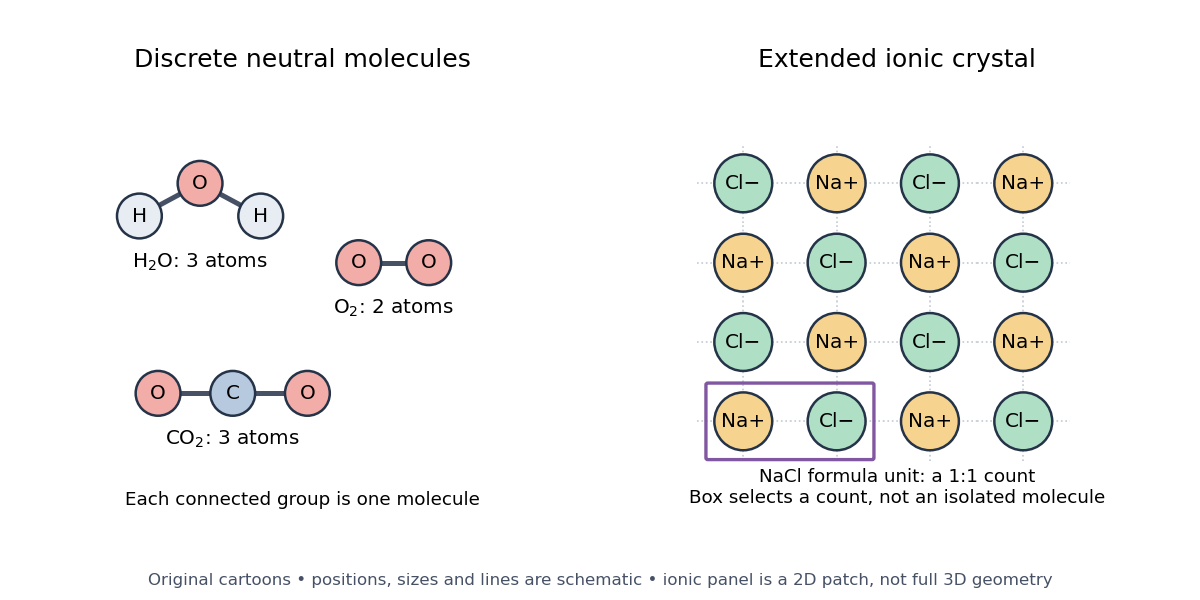
Ordinary crystalline sodium chloride, , contains an extended arrangement of sodium cations and chlorine anions . Its formula unit specifies one of each for compositional accounting, without selecting a unique isolated pair. Bulk neutrality therefore does not imply a material consists of neutral molecules. This statement concerns the ionic crystal; the physical state and conditions matter when deciding what particles a chemical formula represents.[ref]
2.6 Ionic and Molecular Compounds. Ionic Compounds: NaCl composition and the absence of discrete molecules in the ordinary crystal
A polyatomic ion is a charged bound group of chemical atoms, such as hydronium, . A molecular ion formed by removing an electron from intact water, , retains the same atom inventory but has net electric charge . Neither satisfies the neutral-molecule definition. Distinguishing these entities makes molecular count and amount of substance and mass spectrometry interpretable: say whether the count is of chemical atoms, neutral molecules, ions, or formula units.
The useful surprise is that a molecule can be treated as one particle for motion and counting while retaining internal structure. Its molar mass connects a particle inventory to bulk mass; molecular rotation and molecular vibration reveal internal organization. The continuum approximation uses bulk fields in place of individual molecular positions and motions.
A radical has one or more unpaired electrons. In a simple atomic orbital or molecular orbital occupancy picture, an unpaired electron occupies a spatial orbital without an opposite-spin partner in that orbital. A dot such as marks this electronic property; it does not mean a missing electron or positive electric charge. Free radicals can be neutral or charged. Terminology also has a boundary: metal ions exhibiting paramagnetism are not normally called free radicals just because they have unpaired electrons.[ref]
Glossary of Terms Used in Physical Organic Chemistry (IUPAC Recommendations 1994): R entries by International Union of Pure and Applied Chemistry. Glossary of Terms Used in Physical Organic Chemistry, IUPAC Recommendations 1994: radical (or free radical), opening definition and metal-ion qualification
Compare three species containing the same single proton. The hydrogen atom has one electron in its atomic orbital, and is a neutral radical. The hydrogen cation has no electrons, so no unpaired electron. The hydrogen anion has two electrons paired in its atomic orbital. It is charged but is not a radical in its ground state. With protons, electrons, and positive elementary charge , the independent electric charge count isThe electron pair and electric charge questions require different information. An odd ensures that not all electrons can be paired; an even alone does not ensure pairing, as the molecular orbital description of molecular oxygen illustrates.
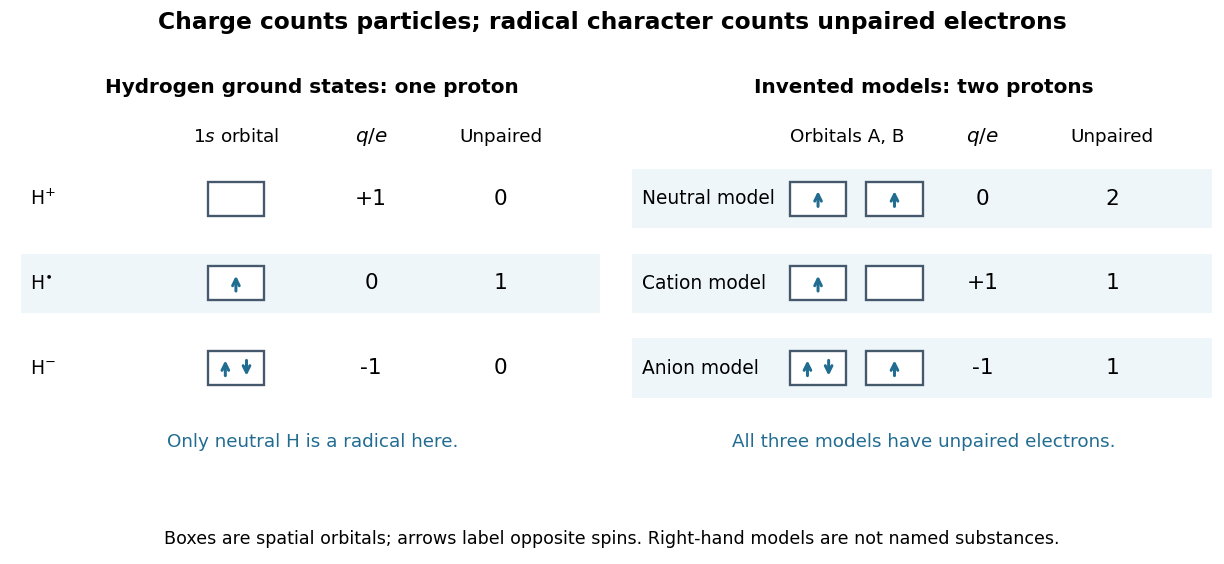
Electric charge and unpaired electrons are different properties
. Left: actual ground state occupancies of , , and . Right: stipulated two-orbital models with fixed illustrate neutral, positive, and negative free radicals; those boxes are not assignments for particular chemical substances. Arrows label spin occupancy, not particle trajectories. Details.The distinction matters whenever a chemical reaction mechanism uses dots and charge signs together. Homolysis gives one bonding electron to each fragment, while heterolysis assigns both to one fragment. A radical chain reaction can pass an unpaired electron from one species to another without generating net electric charge. Detection then exploits the unpaired electron's spin and magnetic moment, rather than merely measuring whether the sample carries an electric charge.
Pinned article: Introduction to the OurBigBook Project
Welcome to the OurBigBook Project! Our goal is to create the perfect publishing platform for STEM subjects, and get university-level students to write the best free STEM tutorials ever.
Everyone is welcome to create an account and play with the site: ourbigbook.com/go/register. We belive that students themselves can write amazing tutorials, but teachers are welcome too. You can write about anything you want, it doesn't have to be STEM or even educational. Silly test content is very welcome and you won't be penalized in any way. Just keep it legal!
Intro to OurBigBook
. Source. We have two killer features:
- topics: topics group articles by different users with the same title, e.g. here is the topic for the "Fundamental Theorem of Calculus" ourbigbook.com/go/topic/fundamental-theorem-of-calculusArticles of different users are sorted by upvote within each article page. This feature is a bit like:
- a Wikipedia where each user can have their own version of each article
- a Q&A website like Stack Overflow, where multiple people can give their views on a given topic, and the best ones are sorted by upvote. Except you don't need to wait for someone to ask first, and any topic goes, no matter how narrow or broad
This feature makes it possible for readers to find better explanations of any topic created by other writers. And it allows writers to create an explanation in a place that readers might actually find it.
Figure 1. Screenshot of the "Derivative" topic page. View it live at: ourbigbook.com/go/topic/derivativeVideo 2. OurBigBook Web topics demo. Source. - local editing: you can store all your personal knowledge base content locally in a plaintext markup format that can be edited locally and published either:This way you can be sure that even if OurBigBook.com were to go down one day (which we have no plans to do as it is quite cheap to host!), your content will still be perfectly readable as a static site.
- to OurBigBook.com to get awesome multi-user features like topics and likes
- as HTML files to a static website, which you can host yourself for free on many external providers like GitHub Pages, and remain in full control

Figure 2. You can publish local OurBigBook lightweight markup files to either OurBigBook.com or as a static website.
Figure 3. Visual Studio Code extension installation.
Figure 5. . You can also edit articles on the Web editor without installing anything locally. Video 3. Edit locally and publish demo. Source. This shows editing OurBigBook Markup and publishing it using the Visual Studio Code extension. 
- Infinitely deep tables of contents:




All our software is open source and hosted at: github.com/ourbigbook/ourbigbook
Further documentation can be found at: docs.ourbigbook.com
Feel free to reach our to us for any help or suggestions: docs.ourbigbook.com/#contact