Topics (384k) Articles (398k) Users (410) Discussions (242) Comments (383) Files (13k) New article

A conical flask has a narrow neck and a wider body that permits swirling a chemical solution, as in a redox titration.
Physiology studies how organisms and their parts function. It connects molecular processes, cellular activity and interactions among organs to observable outcomes such as blood flow, movement and thermoregulation.
A physiological explanation distinguishes the measured variable from its mechanism. For example, a changing heart rate can alter cardiac output, but output also depends on the volume pumped per beat. Experiments that measure both quantities can test a proposed control mechanism more directly than a pulse count alone.
Separation of charged molecules through a gel in an electric field. Denaturing conditions suppress folded structures, helping compare RNA lengths; matching migration alone does not establish an identical nucleotide sequence or identical covalent bonds. In the ribozyme experiments, labelled RNA was detected after separation by exposing photographic film.
In DNA agarose gel electrophoresis, the backbone phosphate groups carry negative electric charge under the usual mildly alkaline buffer solution conditions. DNA therefore moves toward the positive anode, away from the negative cathode.[ref]
The electric field points the other way: the electric force reverses direction when . The apparatus is driven by an external source of electric potential difference; the positive anode convention here belongs to that operating mode. Direction follows electric charge, so it is not a rule that all molecules move toward the same electrode.
The useful result is a spatial comparison: a mixture becomes separated gel bands, which can be compared with a DNA ladder or recovered for subsequent analysis. Agarose gel electrophoresis of linear double-stranded DNA, gel electrophoresis of denatured RNA, and SDS-PAGE of proteins use different conditions to make migration informative about chain size. An electric field supplies motion; the gel supplies a porous obstacle course.
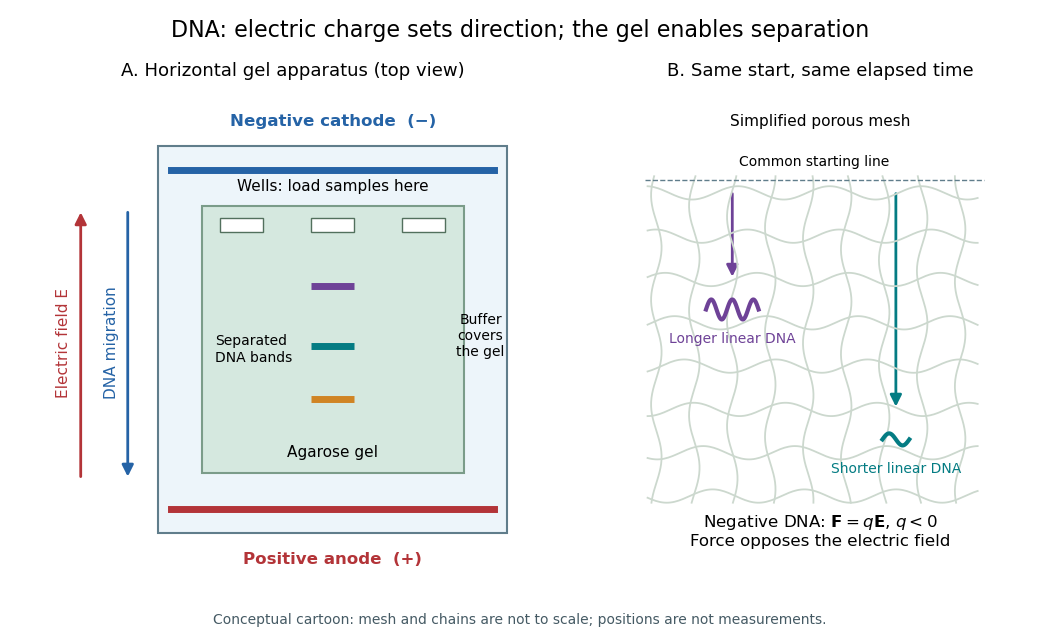
DNA migrates toward the positive anode, opposite to the electric field; the agarose mesh separates linear DNA fragments. Conceptual apparatus and mesh, not measured trajectories or a drawing to scale
. Details. A nucleoside comprising guanine attached to ribose. Its free hydroxyl group initiates group I intron RNA splicing; guanosine is incorporated into the excised intron, rather than acting as a regenerated catalyst.
Processing of a precursor RNA that removes an intron and joins the flanking exons. The ribozyme experiments show one self-splicing mechanism; RNA splicing need not always be autonomous.
Reproduction is the production of new organisms, maintaining lineages across generations. In asexual reproduction, a parent produces offspring without fusion of gametes; sexual reproduction includes fertilization and, in the usual eukaryotic life cycle, meiosis. A growing organism can add biological cells without producing a new individual, so mitosis alone does not establish organism-level reproduction.
A fern illustrates why reproduction cannot always be represented as an adult giving birth to a similar adult: its sporophyte produces spores, which develop into gametophytes that make gametes. Following both alternation of generations and the number of chromosome sets makes the connection between reproduction and heredity explicit.
Flow cytometry records signals from suspended particles passing an illuminated interrogation region. For a flow cytometric DNA-content assay, a laser excites a DNA-binding dye and a detector records its fluorescence. An event is a recorded passage, not a guarantee that exactly one intact biological cell was measured.
An enzyme is a biological catalyst: it accelerates a chemical reaction and is regenerated after a successful catalytic cycle. Most enzymes are proteins, but catalytic RNA molecules, called ribozymes, also exist. Many reactions needed by a biological cell would proceed too slowly under its ordinary conditions without enzymes. See Cooper, The Cell: the central role of enzymes as biological catalysts.
The biological beauty is selective speed. A biological cell contains many possible reactants; its enzymes help determine which transformations happen on a useful timescale. In metabolism, one step's reaction product can become another step's substrate, so selective catalysts support an organized flow of material.
The ribosome is a striking biological example: the machinery that builds proteins has RNA at its catalytic centre. The complete ribosome contains both RNA and proteins, but its bond-forming active site is built from RNA. Structural evidence established this distinction in Nissen et al., The structural basis of ribosome activity in peptide bond synthesis, Science 289, 920–930 (2000).
Selection occurs at an active site, the region where substrate binding and catalytic chemistry take place. Shape and chemical interactions favour some substrates over others; binding can also reshape the enzyme, an induced fit. Recognition alone is insufficient: holding a substrate extremely tightly need not make it react quickly. Catalysis requires a favourable route through the transition state, the high-barrier configuration between reactants and reaction products. Positioning reactive groups and stabilizing this configuration relative to the bound substrate can lower that barrier. Specificity is often strong, but need not mean exactly one acceptable substrate. See Cooper, The Cell: mechanisms of enzymatic catalysis.
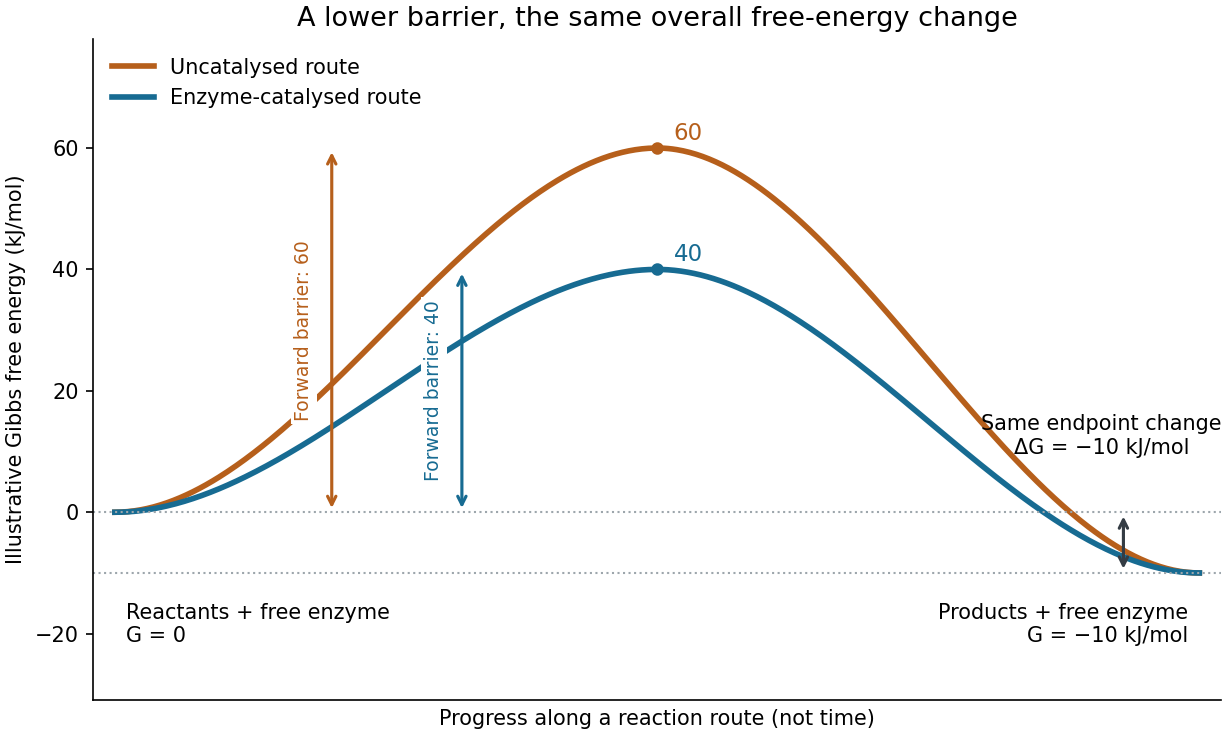
Read the diagram numerically. Its chosen Gibbs free energies are for the reactants and for the reaction products. The uncatalysed peak is , whereas the catalysed peak is . The forward free-energy barriers are therefore and ; viewed from the reaction products, the reverse barriers are and . Both decrease by , while the endpoint difference stays . These are constructed values, not measurements of a particular enzyme.
This separates chemical kinetics from chemical equilibrium. An enzyme changes how rapidly the system approaches chemical equilibrium; it does not change the equilibrium constant for the same overall chemical reaction under the same conditions. Faster catalysis therefore supplies no extra driving energy. In a biological cell, continuing supply of reactants and removal of reaction products can nevertheless sustain a net flow: the surroundings keep that system away from chemical equilibrium. See IUBMB, Symbolism and terminology in enzyme kinetics: basic definitions.
Some enzymes require a cofactor, an additional nonprotein component such as a metal ion or a small organic molecule. Organic helpers are often called coenzymes; they can assist transfers that the protein alone cannot readily perform. The cofactor may remain bound or exchange with the surroundings, depending on the system. A coenzyme can be chemically changed in one reaction and regenerated by another: regeneration of the enzyme does not mean every helper is unchanged in that individual reaction. Some enzymes need no additional cofactor. See Alberts et al., Molecular Biology of the Cell: small molecules associated with proteins and Alberts et al., activated carriers and their regeneration.
How much faster does adding substrate make a reaction? Enzyme kinetics gives a quantitative answer when a model's assumptions fit. For an illustrative reaction obeying Michaelis-Menten kinetics, use the Michaelis-Menten equation with substrate concentration , limiting reaction rate and Michaelis constant . At , substitution gives . At , it gives ; at , it gives . Thus a hundredfold increase in substrate between the first and last examples yields only a tenfold increase in reaction rate.
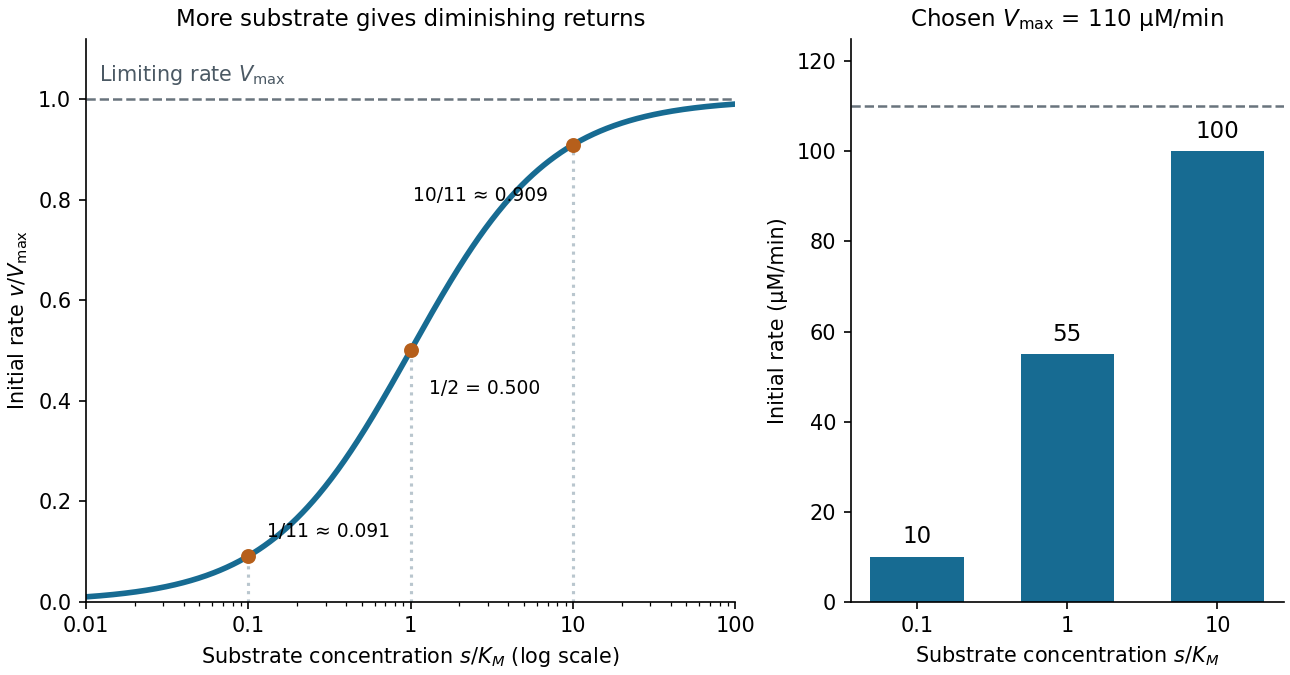
For a chosen , those fractions mean reaction rates of , and . Doubling substrate from to raises the normalized rate only from to , a relative increase of about . In this simplest model, the catalytic machinery is already nearly fully occupied. Doubling the amount of active enzyme instead doubles and the predicted reaction rates at fixed free substrate concentration, provided the other conditions are unchanged. This distinction helps decide whether additional substrate or additional catalytic capacity could improve throughput.
The interpretation has limits. The simplest Michaelis-Menten kinetics assumes a single substrate, fixed active enzyme amount, a suitable quasi-steady-state approximation, and initial measurements with negligible reverse reaction from accumulated reaction product. Substantial depletion, interacting binding sites, or inhibition by excess substrate can invalidate this model. Within it, is the substrate concentration giving half the limiting reaction rate; it is not generally the binding dissociation constant . See IUBMB, enzyme kinetics: steady-state approximation and substrate dissociation and IUBMB, Michaelis-Menten and non-Michaelis-Menten kinetics. Measuring activity also requires specified temperature, pH and necessary cofactor availability: a weak signal can reflect unsuitable conditions rather than little enzyme. See Brooks et al., Assay Guidance Manual: basics of enzymatic assays for HTS.
The study of nervous systems, from the properties of individual neurons to circuits, development, behavior and information processing.
Mortality describes deaths in a defined population during a specified observation window. A cumulative death probability is distinct from a death rate per person-time. Comparing treatments requires the same endpoint definition, time origin and ascertainment in both arms.
A biosignature is observable chemical, morphological or other evidence attributable to biological activity after assessing plausible abiotic explanations. It can concern present or past life on Earth or elsewhere. An exoplanet biosignature is the remote planetary specialization, requiring atmospheric and environmental context.
Twins are two offspring from the same gestation. Monozygotic twins arise from one fertilized egg, while dizygotic twins arise from two. The distinction supplies the biological premise for twin studies.
A morphogen is a signal whose spatial concentration helps specify different biological cell fates or behaviors during biological development. A morphogen gradient provides a positional cue: biological cells at different distances from a source experience different local concentrations and can follow different developmental pathways. A spatial concentration variation alone does not establish that a substance is a morphogen; its graded developmental effects matter. See Alberts et al., Molecular Biology of the Cell, 4th edition (2002): morphogens as graded developmental signals.
The beautiful idea is that one distributed signal can help organize several regions of a developing body. A continuous morphogen gradient can supply the input for distinct domains of gene expression, rather than requiring a separate signal for every position. A morphogen response threshold is a useful idealization of that interpretation: high, intermediate and low concentrations are assigned different outcomes. The morphogen reaction-diffusion equation describes one way to generate a morphogen gradient; the equation is a model of transport and reaction, while the morphogen is the signal being transported.
Detection and interpretation also depend on the receiving biological cell. For an extracellular morphogen, receptors and signal transduction connect the local concentration to a response; receptor binding occupancy is only one step in that connection. The same morphogen gradient can be interpreted differently in different tissues because their developmental context differs. Thus a morphogen response threshold summarizes a particular response in a particular context, rather than being a universal property of the signal. See Scott F. Gilbert, Developmental Biology, 6th edition (2000): positional information and context-dependent interpretation.
An important experimental example came in 1988. Wolfgang Driever and Christiane Nüsslein-Volhard used antibodies to examine the bicoid protein in early fruit-fly embryos. They reported a concentration profile approximately described by an exponential function, highest at the front, with the protein concentrated in cell nuclei. Their abstract proposed diffusion from localized messenger RNA and dispersed degradation as a likely origin of the morphogen gradient, rather than proving a unique transport mechanism. [ref]
In a companion study, Driever and Nüsslein-Volhard genetically changed the amount and distribution of bicoid messenger RNA, measured the resulting protein morphogen gradient, and compared developmental maps. Increased local bicoid protein levels shifted prospective anterior structures toward the rear; decreased levels shifted them toward the front. This linked a measured concentration profile to positional effects in biological development. The toy calculations below illustrate that logic with arbitrary numbers, not measured bicoid parameters. [ref]
https://pubmed.ncbi.nlm.nih.gov/3383245/. Driever and Nüsslein-Volhard, The bicoid protein determines position in the Drosophila embryo in a concentration-dependent manner, Cell 54 (1988), 95–104: primary abstract
A protein is a biological molecule made of one or more polypeptide chains: ordered amino acid residues joined by peptide bonds. Biological translation assembles a chain in the order specified by messenger RNA codons. Protein folding then brings parts of that chain into spatial relationships that support its function. See Cooper, The Cell: protein composition and structure. These processes can overlap in a biological cell; the sequence-to-shape explanation does not require waiting until biological translation finishes before any folding begins. See Cooper, The Cell: protein folding and processing.
The useful connection is from information to physical work. A protein's protein primary structure records an order; its protein tertiary structure can bring distant amino acid residues together at an active site. An enzyme uses such an arrangement to recognize a substrate and accelerate a chemical reaction. Other proteins serve as receptors, membrane transport proteins or structural material. For example, actin assembles into filaments whose mechanical properties can be described by biopolymer mechanics. See Alberts et al., Molecular Biology of the Cell: protein function and binding.
Order matters beyond composition. Let A stand for alanine and M for methionine, and read from the N-terminus to the C-terminus. The illustrative strings AMAMAMAMAMAM and AAAAAAMMMMMM each contain exactly six A and six M amino acid residues. Each has peptide bonds when made into one unbranched polypeptide chain. In the first string all eleven neighboring pairs have different letters; in the second only the pair at positions 6 and 7 does. A composition histogram therefore loses information about which amino acid residues are neighbors. Their arrangements can affect protein folding and function; these short invented strings neither specify a known functional protein nor establish what shape either would adopt.
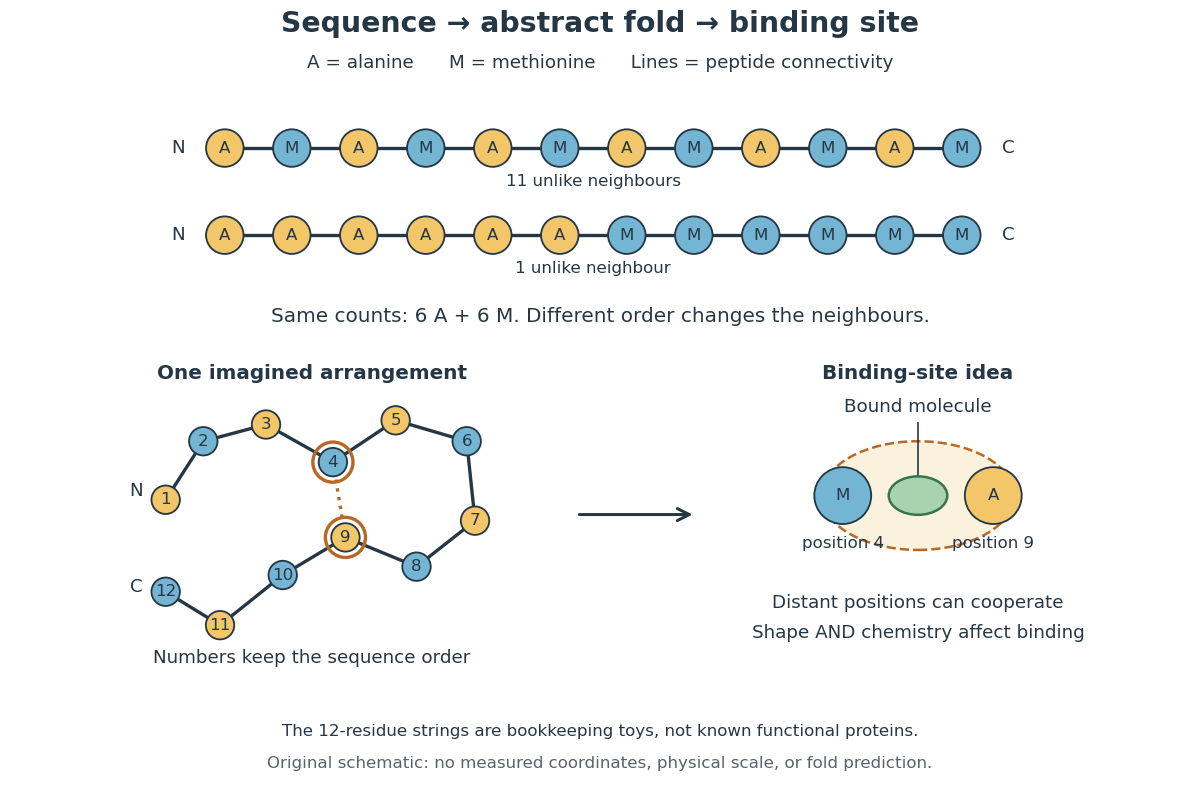
From amino acid order to an imagined fold and binding site
. Original schematic using two twelve-residue strings with equal composition. The imagined fold uses the first string: colors and numbers preserve its protein primary structure, while positions 4 and 9 approach one another. The binding-site cartoon explains spatial cooperation, not an actual enzyme or a measured protein structure. No actual coordinates, physical scale or exact protein folding predictor are implied. Details.Protein structure is a moving arrangement, not a permanently rigid outline. Substrate binding can change an enzyme's shape through induced fit, and a functional protein can include flexible regions. Sequence, surroundings and interacting molecules must therefore be considered together. See Alberts et al.: binding, conformational changes and protein function.
The goal of ecology is to explain where organisms live, how many there are, and how their interactions with one another and their surroundings change those patterns. Living partners include prey, predators and parasites; nonliving conditions include light, temperature and water. An ecosystem brings these interacting parts into one study system. See Clark, Douglas and Choi, Biology 2e, 44.1: the scope of ecology.
Start with an invented aquatic food web: photosynthetic algae feed zooplankton, which feed small fish, which feed large fish. That food chain has four feeding positions and three feeding arrows. Dead material also reaches decomposers through detritus, so the food web branches rather than forming a single ladder.
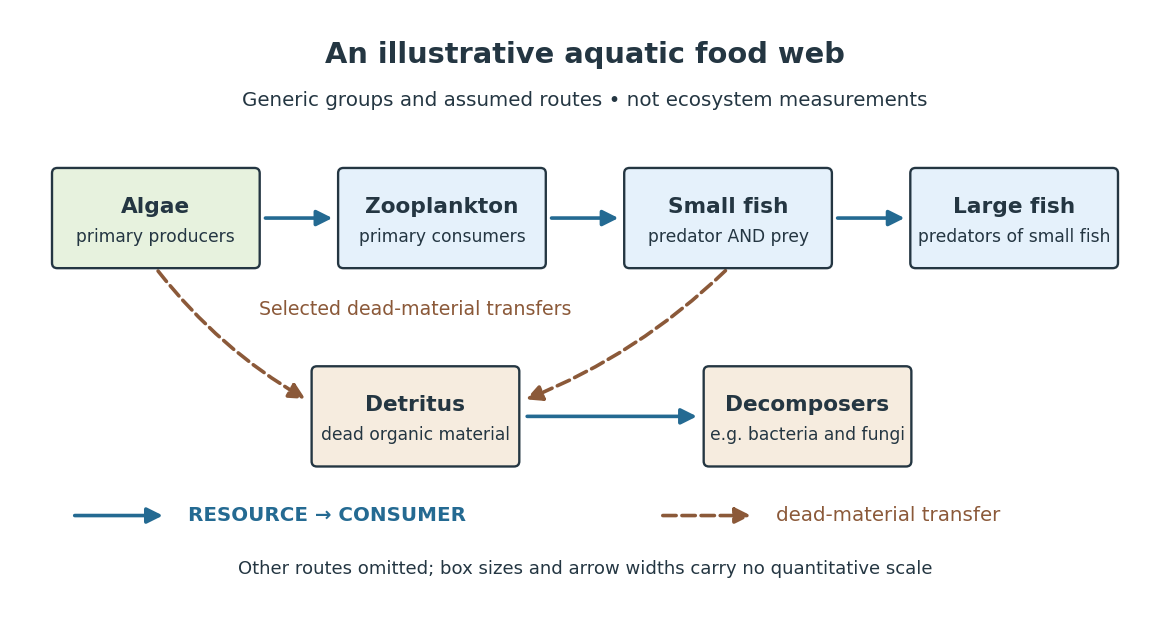
The appeal of ecology is that an organism's surroundings include other organisms that change those surroundings. Photosynthesis links light to living material; predation transfers that material between organisms; decomposers return its constituent chemical elements to forms that can be used again. These connections help explain why changing one part of an ecosystem can affect distant parts of its food web, although an arrow alone does not predict the size or even the direction of an indirect change. Population dynamics supplies quantitative tools when the question concerns changing counts.
In 1866, Ernst Haeckel's Generelle Morphologie der Organismen included a section titled Oecologie und Chorologie in volume 2, beginning on page 286. This places the terminology of ecology in an early systematic treatment of organisms and their relationships. See Haeckel, Generelle Morphologie der Organismen, volume 2 (1866), contents and p. 286. A later quantitative landmark is Raymond L. Lindeman's 1942 treatment of ecosystems through feeding relationships and energy flow. See Lindeman, The Trophic-Dynamic Aspect of Ecology, Ecology 23 (1942), 399–417.
Paleontology investigates past life through fossils and their geological context. It combines anatomy, ecology, evolution and evidence about burial and preservation to infer what extinct organisms were like and how life changed.
The connection between evidence and history is the central challenge. A fossil may preserve a tooth but lose its surrounding soft tissues; absence of a visible character need not mean the living organism lacked it. Taphonomy therefore informs both reconstruction of individual organisms and interpretation of the fossil record.
Experiments following carcass decay test that inference directly: anatomically selective loss can remove derived characters and produce stemward slippage in a phylogenetics analysis.[ref]
Pinned article: Introduction to the OurBigBook Project
Welcome to the OurBigBook Project! Our goal is to create the perfect publishing platform for STEM subjects, and get university-level students to write the best free STEM tutorials ever.
Everyone is welcome to create an account and play with the site: ourbigbook.com/go/register. We belive that students themselves can write amazing tutorials, but teachers are welcome too. You can write about anything you want, it doesn't have to be STEM or even educational. Silly test content is very welcome and you won't be penalized in any way. Just keep it legal!
Intro to OurBigBook
. Source. We have two killer features:
- topics: topics group articles by different users with the same title, e.g. here is the topic for the "Fundamental Theorem of Calculus" ourbigbook.com/go/topic/fundamental-theorem-of-calculusArticles of different users are sorted by upvote within each article page. This feature is a bit like:
- a Wikipedia where each user can have their own version of each article
- a Q&A website like Stack Overflow, where multiple people can give their views on a given topic, and the best ones are sorted by upvote. Except you don't need to wait for someone to ask first, and any topic goes, no matter how narrow or broad
This feature makes it possible for readers to find better explanations of any topic created by other writers. And it allows writers to create an explanation in a place that readers might actually find it.
Figure 1. Screenshot of the "Derivative" topic page. View it live at: ourbigbook.com/go/topic/derivativeVideo 2. OurBigBook Web topics demo. Source. - local editing: you can store all your personal knowledge base content locally in a plaintext markup format that can be edited locally and published either:This way you can be sure that even if OurBigBook.com were to go down one day (which we have no plans to do as it is quite cheap to host!), your content will still be perfectly readable as a static site.
- to OurBigBook.com to get awesome multi-user features like topics and likes
- as HTML files to a static website, which you can host yourself for free on many external providers like GitHub Pages, and remain in full control

Figure 2. You can publish local OurBigBook lightweight markup files to either OurBigBook.com or as a static website.
Figure 3. Visual Studio Code extension installation.
Figure 5. . You can also edit articles on the Web editor without installing anything locally. Video 3. Edit locally and publish demo. Source. This shows editing OurBigBook Markup and publishing it using the Visual Studio Code extension. 
- Infinitely deep tables of contents:




All our software is open source and hosted at: github.com/ourbigbook/ourbigbook
Further documentation can be found at: docs.ourbigbook.com
Feel free to reach our to us for any help or suggestions: docs.ourbigbook.com/#contact