An extensive quantity measures how much of a thermodynamic system there is; an intensive quantity describes its state independently of that amount. The clean comparison is replication: take independent identical systems at the same thermodynamic equilibrium, with the same substance, composition and thermodynamic phase. Combining their accounting boundaries multiplies internal energy , entropy , volume , mass and amount of substance , while leaving temperature , pressure and chemical potential unchanged.[ref]
Statistical Physics by David Tong. Statistical Physics, chapter 1 The Fundamentals of Statistical Mechanics, §1.4.3 Extensive and Intensive Quantities
For copies the ledger isAn integer counts actual copies; a positive real describes the corresponding bulk scaling law. Copies can remain separated: replication need not involve removing a partition, changing a container or performing any work. Distinguish , the amount of substance measured in moles, from , the dimensionless count of specified entities, where is the Avogadro constant in . For example, contains specified entities; tripling it gives and entities. This uses the exact Avogadro constant , which does not triple. In the differential , is a molar chemical potential in ; the coefficient of instead has units of energy per entity.
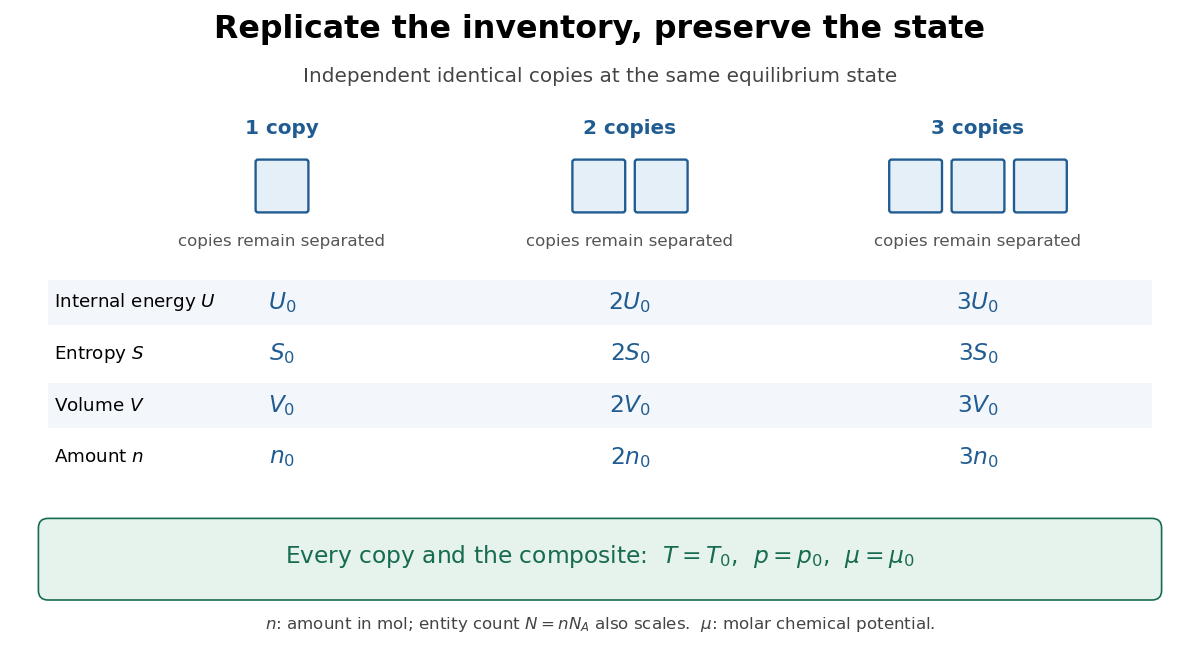
Replication multiplies the extensive ledger while preserving the equilibrium state
. Details. As a direct check, the ideal gas law givesFor a monatomic ideal gas with only translational degrees of freedom active, internal energy of an ideal gas gives , so at unchanged temperature. Here is the molar gas constant. The scaling distinction lets a small sample supply an equation of state for a much larger amount: material state and inventory become separate questions.
Replication does not mean multiplying every linear dimension by : a geometrically similar container then has times the volume. Nor does it mean combining samples at different states. Equal temperature establishes thermal equilibrium but does not imply equal pressure, composition or mass density. Density of a composite system makes this distinction concrete.
The Dieterici equation of statemodels excluded volume through and attraction through . Its critical point has and .
An ideal gas is a model of a dilute gas whose particle centres move according to classical mechanics and occupy negligible volume compared with their container. Treating the particles as point masses removes the molecular-size correction; neglecting interactions between separated particles removes the intermolecular contribution to potential energy. The usual kinetic theory model retains brief elastic collisions with the walls and, optionally, with other particles: these transfer momentum while conserving the total kinetic energy of the colliding bodies. There is no appreciable interaction energy stored between collisions. These assumptions lead to the ideal gas law, . [ref]
2.1 Molecular Model of an Ideal Gas. OpenStax University Physics Volume 2, section 2.1: molecular model and ideal gas law
[ref]https://openstax.org/books/university-physics-volume-2/pages/2-2-pressure-temperature-and-rms-speed. OpenStax University Physics Volume 2, section 2.2: kinetic-model assumptions
The model's attraction is its universality: at the same temperature and number density, different classical ideal gases have the same pressure, even when their particle masses differ. In ideal gas pressure from wall collisions, heavier particles move more slowly at a given temperature, and the two effects cancel. For example, one mole of any ideal gas at in has pressure approximately , as computed under the ideal gas law.
The ideal gas law describes the translational contribution to pressure; it does not specify all of the internal energy or the heat capacity. A monatomic gas has three classical translational degrees of freedom, whereas a gas of molecules can also store rotational kinetic energy and energy in vibrational normal modes. An equation of state alone therefore does not determine how much heat a chosen temperature increase requires. It also does not select a process: isothermal expansion and adiabatic expansion need different additional constraints. [ref]
A real gas departs from this approximation when particle size or interactions become important, especially at high number density or low temperature near a phase transition. The Van der Waals equation adds such corrections. Independently, at sufficiently low temperature or high number density, quantum statistics can become essential: even particles with negligible interactions need not obey the classical ideal gas law. The classical statistical assumption is the nondegenerate gas regime, which is distinct from neglecting interactions. [ref]
2.1 Molecular Model of an Ideal Gas. OpenStax University Physics Volume 2, section 2.1: departures from ideal-gas behavior
[ref]The chemical potential measures how a thermodynamic potential changes when matter is added under specified constraints. It plays for matter exchange the role that temperature plays for heat exchange: a difference supplies a direction, and equality characterizes thermodynamic equilibrium when the corresponding exchange is allowed. This connects diffusion, phase coexistence and chemical equilibrium through one quantity.
For a single component, the particle convention iswhere is internal energy, counts particles, is entropy and is volume. This partial derivative holds entropy and volume fixed; it measures an incremental change rather than the average energy per particle. See David Tong, Statistical Physics, section 1.4.
In chemistry the molar convention instead uses amount of substance , measured in moles:Here is Gibbs free energy, is temperature, is pressure and is the Avogadro constant. The units are per particle versus . For several chemical species, define each chemical potential by varying only its own particle count or amount of substance, with all other components' counts or amounts fixed. Many texts use for either convention, so the units and the variable being differentiated must identify it.
For a simple compressible system with variable component inventories, the fundamental differentials areThey describe changes between states in thermodynamic equilibrium with only pressure-volume work. If every component inventory is fixed, the sums vanish. The Gibbs free energy form follows by differentiating and using ; this is why the two definitions describe the same chemical potential in different units.
A chemical potential can be negative. Holding entropy fixed while adding matter need not increase internal energy; Tong explains this explicitly for a classical ideal gas in Statistical Physics, section 2.2.4. Its absolute sign also depends on the reference energy: replacing by shifts by . A common reference shift cancels from differences for the same chemical species, which are what determine exchange. Thus “energy cost” means a signed increment, not an always positive amount that must be supplied.
Internal energy is the energy stored in the microscopic degrees of freedom of a thermodynamic system: random molecular kinetic energy, internal molecular excitations, and interaction potential energy. Its value requires a specified system and an energy reference. In thermodynamic equilibrium, internal energy is a state function; it records the present state, without remembering whether a previous change came from stirring, compression or heat transfer. This makes internal energy the common accounting quantity connecting mechanical experiments to thermal ones.[ref]
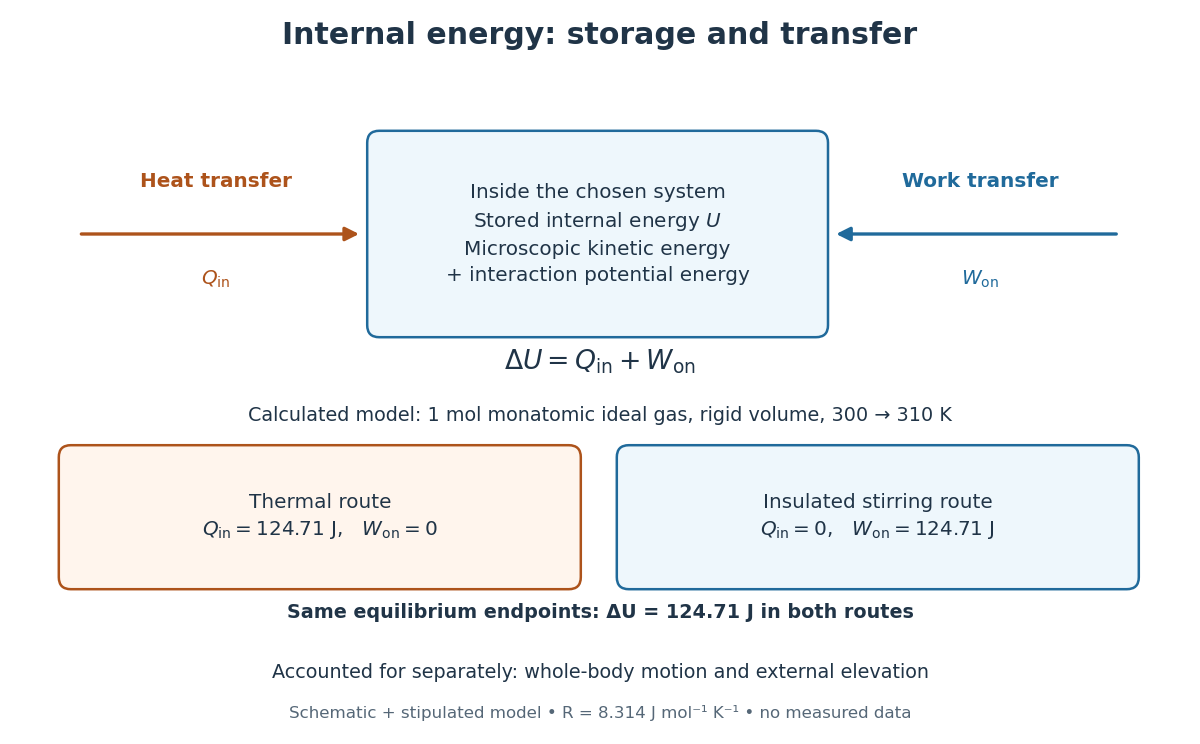
Heat and work describe energy crossing the system boundary during a process. They are not separately stored contents of the system. For a closed system whose bulk kinetic energy and external potential energy have unchanged endpoint values, the first law of thermodynamics givesHere is positive for incoming heat, and is positive for net work done on the system. Two routes between the same equilibrium states have the same , although their heat and work can differ. The infinitesimal notation distinguishes a state function change from path-dependent transfers.[ref]
For a calculated example, take one mole of a classical monatomic gas in the ideal gas regime, at fixed volume, from to . With stipulated molar gas constant , its internal energy change is . A purely thermal route supplies with . An ideal insulated stirring route supplies with , measured between equilibrium endpoints after the motion dies away. The same stored increment has two different transfer histories; neither history defines a separate kind of stored energy.
The familiar internal energy of an ideal gas is a useful special case. Neglect intermolecular interactions, hold the amount of substance and composition fixed, and suppose that independent quadratic terms per particle obey the classical equipartition theorem. Choosing the constant reference contribution as zero givesHere is absolute temperature, is the molar gas constant, and is the whole sample's heat capacity at constant volume. A monatomic gas has translational terms. A rigid diatomic molecule has when its two rotational terms are active and vibration is frozen; activating one harmonic oscillator vibration adds two terms, one kinetic energy and one potential energy, giving . The counting is of quadratic contributions, so a vibrational coordinate is not just one contribution.[ref]
This constant- formula applies only over a regime with those same active terms, classical translational statistics, nonrelativistic motion and unchanged composition. Quantum freezing, quantum degeneracy, chemical reactions or appreciable intermolecular interactions invalidate that simple counting. More generally, at fixed amount and composition an ideal gas can still have with varying heat capacity at constant volume, so use . A nonzero constant reference adds to without altering .
Volume measures the size of a three-dimensional region. In Euclidean space it is the Lebesgue measure ; a layer of thickness over a planar region has .
Pressure measures the compressive normal force per unit surface area. For a uniformly loaded surface of surface area , the magnitude of the perpendicular force is ; locally, . Its SI unit is the pascal, . A force parallel to the surface contributes shear stress, rather than pressure. In a gas, the steady macroscopic force comes from many microscopic transfers of momentum; ideal gas pressure from wall collisions makes this connection explicit. [ref]
https://openstax.org/books/university-physics-volume-2/pages/2-2-pressure-temperature-and-rms-speed. OpenStax University Physics Volume 2, section 2.2: microscopic origin of pressure
For a computed example, a uniform pressure of on a piston of surface area produces a perpendicular force of . If the opposite face is exposed to , the net force due to the two pressures is , directed toward the lower-pressure side. The pressure on either face and their difference answer different questions; gauge pressure records a difference from a specified reference, often atmospheric pressure.
A scalar pressure describes a gas in local thermodynamic equilibrium with isotropic random particle velocities: every wall orientation has the same normal force per unit surface area. Without this isotropy, normal stresses can depend on direction and a pressure tensor is needed. Thus random motion alone is insufficient; a preferred direction matters.
In thermodynamics, pressure and volume are thermodynamic conjugate variables. For a simple compressible system, reversible expansion delivers work , and at fixed entropy and particle number ,where is internal energy. A large pressure therefore means both a large wall force per unit surface area and a large amount of expansion work per small increase in volume.
The third law implies that the entropy of a system with a nondegenerate ground state approaches zero as its temperature approaches absolute zero. In particular, ordinary equilibrium heat capacities approach zero.
Heat is energy transferred across a thermodynamic system's boundary because of a temperature difference. It is measured in joules, like work and internal energy. A hot cup transfers heat to cooler surroundings; its temperature describes its state, while the transferred heat describes a process. The cup stores internal energy, rather than a substance called heat. [ref]
https://openstax.org/books/university-physics-volume-2/pages/1-4-heat-transfer-specific-heat-and-calorimetry. Ling, Moebs and Sanny, OpenStax, University Physics Volume 2, section 1.4: heat and internal energy
For a closed system with unchanged bulk kinetic energy and potential energy, choose for heat entering and for work done by the system. The first law of thermodynamics givesHere is the stored internal energy. For example, a sealed piston cylinder receiving of heat and delivering of work gains of internal energy. A closed system retains its matter while exchanging energy; it need not be an isolated system. [ref]
https://openstax.org/books/university-physics-volume-2/pages/3-3-first-law-of-thermodynamics. Ling, Moebs and Sanny, OpenStax, First law of thermodynamics and sign conventions
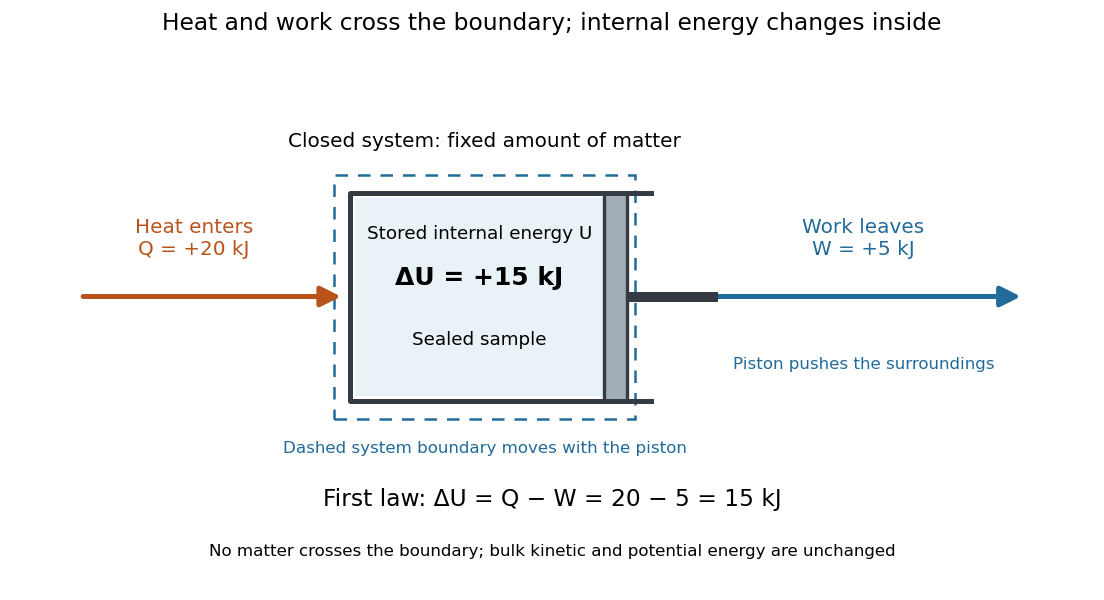
Unlike internal energy, heat is not a state function: different paths between the same equilibrium states can transfer different , with compensating differences in work. The symbol records this dependence on the path; there is no stored quantity whose difference is always . The two paths in first law of thermodynamics illustrate this directly. Supplied heat can raise temperature as sensible heat, change a phase fraction through latent heat, or help supply expansion work. Measuring temperature alone therefore does not determine transferred heat.
For a reversible thermodynamic process, , where is absolute temperature and is entropy. This identification requires reversibility: an irreversible adiabatic process has and can nevertheless increase entropy. Likewise , with enthalpy , requires the particular fixed-pressure conditions in enthalpy. These distinctions make heat useful as a precise boundary-transfer quantity in heat engines, refrigerators and heating calculations.
Historically, James Prescott Joule's paddle experiments showed that stirring water with input work could raise its temperature, helping establish conservation of energy. The lesson is still useful: a temperature rise can result from work even without incoming heat. [ref]
https://openstax.org/books/university-physics-volume-2/pages/1-4-heat-transfer-specific-heat-and-calorimetry. Ling, Moebs and Sanny, OpenStax, section 1.4: Joule's paddle experiment
For an isolated system, the second law requires . More generally, include all affected surroundings to obtainEquality describes the reversible limit; irreversible macroscopic processes produce entropy. A closed system can lose entropy by exporting heat, so nondecrease does not apply to that system alone. The Clausius statement of the second law forbids a cyclic device whose sole effect is transferring heat from cold to hot. The Kelvin-Planck statement of the second law forbids a cyclic device whose sole effect is converting heat from one thermal reservoir completely into work. "Sole effect" matters: a refrigerator moves heat from cold to hot by consuming work. [ref]
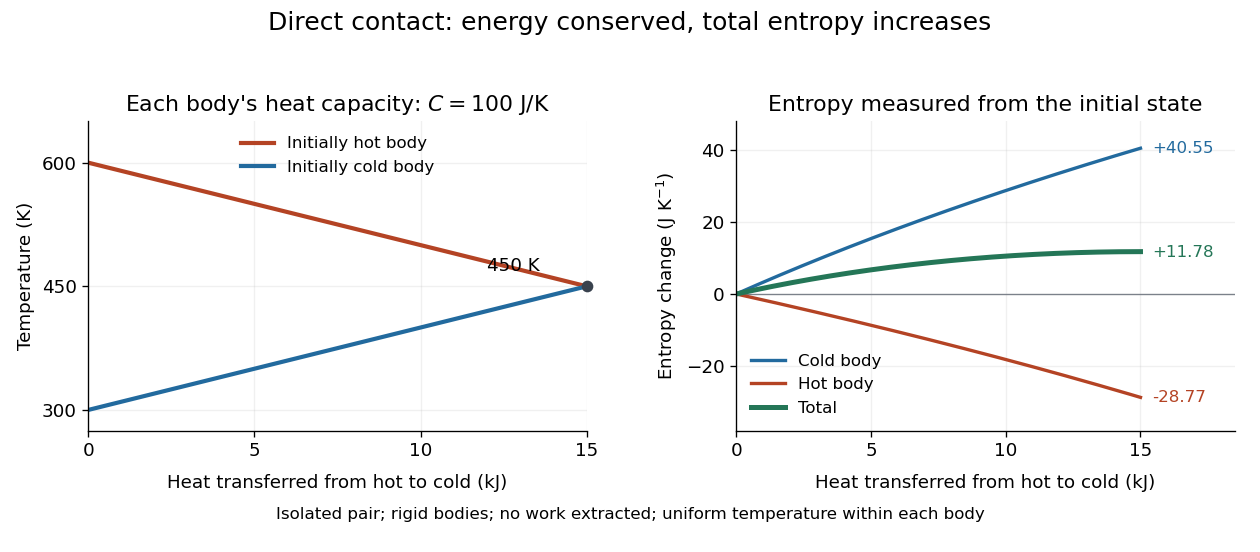
For direct transfer of from a thermal reservoir at to one at , with no work extracted,The reverse transfer alone would have negative total entropy change. Both directions conserve energy, but only the hot-to-cold direction is spontaneous. The finite-body example under entropy replaces these constant temperatures by changing ones.
Friction, free expansion and heat transfer across a finite temperature difference all introduce irreversibility. Moving arbitrarily slowly is insufficient if friction remains. A reversible thermodynamic process must permit restoration of both the system and surroundings. This gives engineers a useful ideal benchmark: irreversibility spends an opportunity to obtain work, even though energy itself is conserved. [ref]
https://www.ocw.mit.edu/ans7870/16/16.unified/thermoF03/chapter_7.htm. MIT, Irreversibility and lost opportunities for work
Entropy is an extensive quantity and a state function of an equilibrium system, measured in . Differences between equilibrium states are calculated along a reversible thermodynamic process:Here heat entering the system is positive and is its absolute thermodynamic temperature. The reversible path used for calculation need not be the path actually taken. Dividing the actual heat by a single temperature generally fails for an irreversible process.
For example, put two rigid bodies, each with constant heat capacity , at and in an otherwise isolated system. Assume each body has a uniform internal temperature, no phase transition occurs, and no work is extracted. Their final thermal equilibrium is at , because the internal energy lost by one equals that gained by the other. Using entropy from heat capacity,so . One body's entropy decreases while the total increases. [ref]
https://web.mit.edu/16.unified/www/FALL/thermodynamics/notes/node41.html. MIT, Entropy changes and the hot-brick problem


In statistical mechanics, Boltzmann's entropy formula counts equally likely microstates compatible with a macrostate; Gibbs entropy handles a specified probability distribution over microstates. If the number of equally likely microstates doubles, entropy increases by . The logarithm makes multiplicative counts additive for independent systems. These are precise statements about states and probabilities, not a universal measure of visible messiness. Calling entropy merely "disorder" obscures the thermal calculation above and hides which microstates are being counted. [ref]
https://web.mit.edu/16.unified/www/FALL/thermodynamics/notes/node57.html. MIT, Statistical entropy and randomness
The usefulness of entropy is that measurable heat capacities determine its changes, and the Second law of thermodynamics turns those changes into constraints on processes. It also connects macroscopic measurements to microscopic descriptions without requiring us to track every particle.
Two internally equilibrated systems are in thermal equilibrium if bringing them into contact that permits only heat exchange causes no net heat transfer. In ordinary nonrelativistic thermodynamics without appreciable gravitational temperature shifts, their thermodynamic temperatures are equal. Merely preventing heat transfer with insulation does not establish thermal equilibrium: two insulated bodies can have different temperatures. [ref]
1.1 Temperature and Thermal Equilibrium. Samuel J. Ling, William Moebs and Jeff Sanny, OpenStax University Physics Volume 2, section 1.1
A thermometer illustrates the definition. Its own temperature settles to the object's temperature after thermal contact, provided its effect on the object is negligible. The existing zeroth law of thermodynamics makes this comparison transitive: two objects separately in thermal equilibrium with the same thermometer are in thermal equilibrium with each other. This lets one calibrated scale compare different materials.
Equal temperatures do not imply equal internal energies or equal heat capacities. Nor does thermal equilibrium by itself imply mechanical equilibrium or chemical equilibrium; these require additional allowed exchanges. There is also a distinction between no net exchange in thermal equilibrium and a constant temperature maintained by equal incoming and outgoing heat. The latter can be a steady state with ongoing entropy production. Microscopic exchanges can continue at thermal equilibrium, but their opposing contributions balance on average.
Temperature labels thermal equilibrium: two internally equilibrated bodies have the same temperature when contact permitting only heat exchange produces no net heat transfer. The zeroth law of thermodynamics makes the comparison transitive. If bodies A and B separately reach thermal equilibrium with the same thermometer without appreciably disturbing either body, they agree with each other. This is what lets a gas thermometer compare a metal block with water, despite their different internal energies and heat capacities. Insulation alone makes no such comparison: it can prevent heat transfer between bodies at different temperatures. [ref]
1.1 Temperature and Thermal Equilibrium. Ling, Moebs and Sanny, University Physics Volume 2, section 1.1: temperature and the zeroth law
The zeroth law of thermodynamics establishes equality comparisons, but does not choose a numerical scale. Thermodynamic temperature supplies an absolute scale consistent with Carnot's theorem and entropy. For a simple compressible system at thermodynamic equilibrium with fixed particle number and composition,Here is internal energy, is entropy, and is volume; the second equality assumes the derivative can be inverted. Temperature is a thermodynamic conjugate variable to entropy and belongs to the intensive and extensive thermodynamic quantities as an intensive quantity. Its partial derivative tells us how much internal energy must change per unit change of entropy under the stated constraints. More general systems require their other mechanical and material variables to be held fixed too. [ref]
For an infinitesimal quantity of heat transferred from A to B, with no work or matter exchange, the equilibrium entropy changes giveFor ordinary positive temperatures, spontaneous heat transfer from increases total entropy; thermal equilibrium has . This comparison uses changes in entropy, rather than the total internal energy contained in either body. A small hot object can have less internal energy than a large cool one. See entropy maximization under thermal contact for the equilibrium criterion and negative temperature for the special case of bounded energy spectra.
Express absolute thermodynamic temperature in kelvin, and a Celsius reading in degree Celsius:The offset is exact: corresponds to , and to . Their absolute temperature ratio is ; dividing their Celsius readings gives a different number. Thus gas thermometer pressure ratios and Carnot's theorem require thermodynamic temperature. The modern SI definition of the kelvin fixes the Boltzmann constant ; a reference bath realizes or transfers the scale rather than defining that constant.[ref]
The International System of Units (SI), ninth edition, SI Brochure. section 2.3.1: kelvin and Celsius temperature
Temperature is not universally the mean kinetic energy of a particle. In a classical, nonrelativistic ideal gas at thermal equilibrium, the equipartition theorem gives the mean translational kinetic energy relative to the gas's bulk motion:Here is particle mass, its velocity, and the mean flow velocity. In this regime, different particle masses at the same temperature have equal mean translational kinetic energies but different characteristic speeds. A moving gas can also carry bulk kinetic energy without being hotter in its rest frame. Internal molecular modes and quantum statistics require further care; the equipartition theorem has classical assumptions, whereas the equilibrium entropy definition applies more widely. [ref]
https://davidtong.org/teaching/statistical-physics/statmechhtml/S2#S2.SS2.SSS1. Tong, Statistical Physics, section 2.2.1: classical equipartition and its limits
Commuting Hamiltonian terms on separate factors are simultaneously diagonalized by tensor products of their eigenvectors and have additive eigenvalues.
Kronecker product representation of local operators by  Codex 0 Created 2026-09-24 Updated 2026-09-24
Codex 0 Created 2026-09-24 Updated 2026-09-24For distinguishable particles with one-particle Hilbert spaces , the multiparticle state space is . A product state is a tensor product of one-particle states, while a general state is a linear combination of product states.
A projected entangled pair operator is a higher-dimensional tensor-network operator with physical input and output legs.
There are unlisted articles, also show them or only show them.