Maxwell's displacement current is the electric-field contribution needed to make Ampère's law consistent with charge conservation. In macroscopic form,The displacement current density has units . Since , it contains the vacuum field term and, in matter, the polarization-current contribution. It need not represent free charge moving through a material.
Taking the divergence gives . Gauss's law, , then yields the continuity equation . Without the displacement term, Ampère's original law would incorrectly require every current distribution to be divergence-free even while charge accumulates.
A charging parallel-plate capacitor makes this concrete. Ignoring fringing, , so the displacement current across its dielectric gap is , equal to the conduction electric current in its wire. The integral lawtherefore gives the same answer whether the spanning surface cuts the wire or passes through the gap. Together with Faraday's law, this field term also permits self-consistent electromagnetic waves in vacuum, with speed .
For a cold, unmagnetized, collisionless plasma, take an equilibrium Electron density , Electrons of mass and charge , and approximately stationary ions. Use fields proportional to . The Electron displacement satisfiesIts electric polarization is , hence the cold collisionless plasma dielectric responseThe negative susceptibility arises from the inertial Electron response, rather than a restoring force binding an Electron to a particular atom.
A transverse electromagnetic wave then obeysFor , the plasma supports propagation, with refractive index . The phase velocity is greater than , while the group velocity is ; their product is , and no superluminal signal is implied. Below the plasma frequency, the bulk wavenumber is imaginary and the field is evanescent. A sufficiently thick plasma largely reflects such radiation in the lossless model.
Including an Electron momentum-relaxation rate replaces the denominator by :Its imaginary part describes absorption with the stated time convention. Finite Electron temperature also produces plasma screening of slowly varying electrostatic fields, with . That spatial, longitudinal screening problem is distinct from simply taking in the cold transverse-wave formula. Magnetic bias, ion motion and kinetic resonances require more general dielectric responses.
For weak fields in a linear isotropic material, magnetization is , with magnetic susceptibility . Paramagnetism has , while diamagnetism has . In either case, . These weak responses generally disappear when the applied field is removed, unlike hysteretic ferromagnetism.
A paramagnet can contain permanent magnetic moments from unpaired Electrons or atomic angular momentum. Alignment lowers the energy , while thermal disorder opposes it. For independent classical moments of magnitude , their weak-field average projection is , soThis is Curie's law; it assumes weak magnetization and no important interactions between moments. With quantum angular momentum , replace by . Strong-field magnetization saturates instead of growing linearly without limit. Conduction Electrons also exhibit Pauli paramagnetism: only occupations near the Fermi surface readily redistribute between spin states, giving a nearly temperature-independent susceptibility when .
Diamagnetism is an induced orbital response opposing the applied magnetic field. For bound Electrons, a weak field changes orbital motion and induces an opposing magnetic moment. For an isotropic collection of atoms, the elementary orbital estimate iswhere the sum runs over the Electrons of one atom. It is usually small and weakly temperature dependent. Delocalized Electrons also have orbital Landau diamagnetism; for an ideal three-dimensional free Electron gas with a quadratic isotropic dispersion and electron spin with , . Both spin and orbital contributions must be included to determine the total response. Diamagnetism is not a consequence of permanent dipoles choosing to align against the field; that orientation would increase their energy.
The Poynting vector is the electromagnetic energy flux density,In vacuum it equals . For a linear nondispersive medium with time-independent constitutive coefficients, Maxwell's equations and the identity give Poynting's theorem,The source term is work done by the fields on free charges; for an Ohmic conductor it is the positive local Joule heating rate . Integrating over a volume states that loss of stored field energy plus outward energy flow equals energy transferred to matter. In dispersive media, such as a plasma, material motion contributes to stored energy and the simple nondispersive expression cannot be used indiscriminately.
For a vacuum plane wave, and , and the propagation direction form a right-handed triad. With real peak field , the time-averaged wave intensity isMore generally, complex peak amplitudes give . Along a transmission line, the cross-section integral of the longitudinal Poynting vector is the transmitted electrical power . Energy flows through the electromagnetic fields in the surrounding dielectric, even though the conductors guide the currents.
Distributed circuit model. A transmission line must be treated as a distributed system when its propagation time is appreciable compared with the signal timescale. Divide a uniform two-conductor line into elements of length . Each has series resistance and inductance , and shunt electrical conductance and capacitance . The primes denote quantities per unit length, with units , , and , respectively.
Kirchhoff's voltage and current laws give the Telegrapher's equations:For a lossless line, , differentiation gives and the same wave equation for . The propagation speed and characteristic impedance areA general lossless signal has and . Thus characteristic impedance is the voltage/current ratio of one travelling wave, not simply the resistance of the wires. It can be real even when the line dissipates no energy, because energy is carried away by propagation.
For sinusoidal quantities with convention , the general lossy-line formulas areChoose the square-root branches for forward attenuation and positive forward power. The real part of is attenuation per unit length; its imaginary part is the phase wavenumber. For small losses, attenuation is approximately , using the lossless real in this estimate.
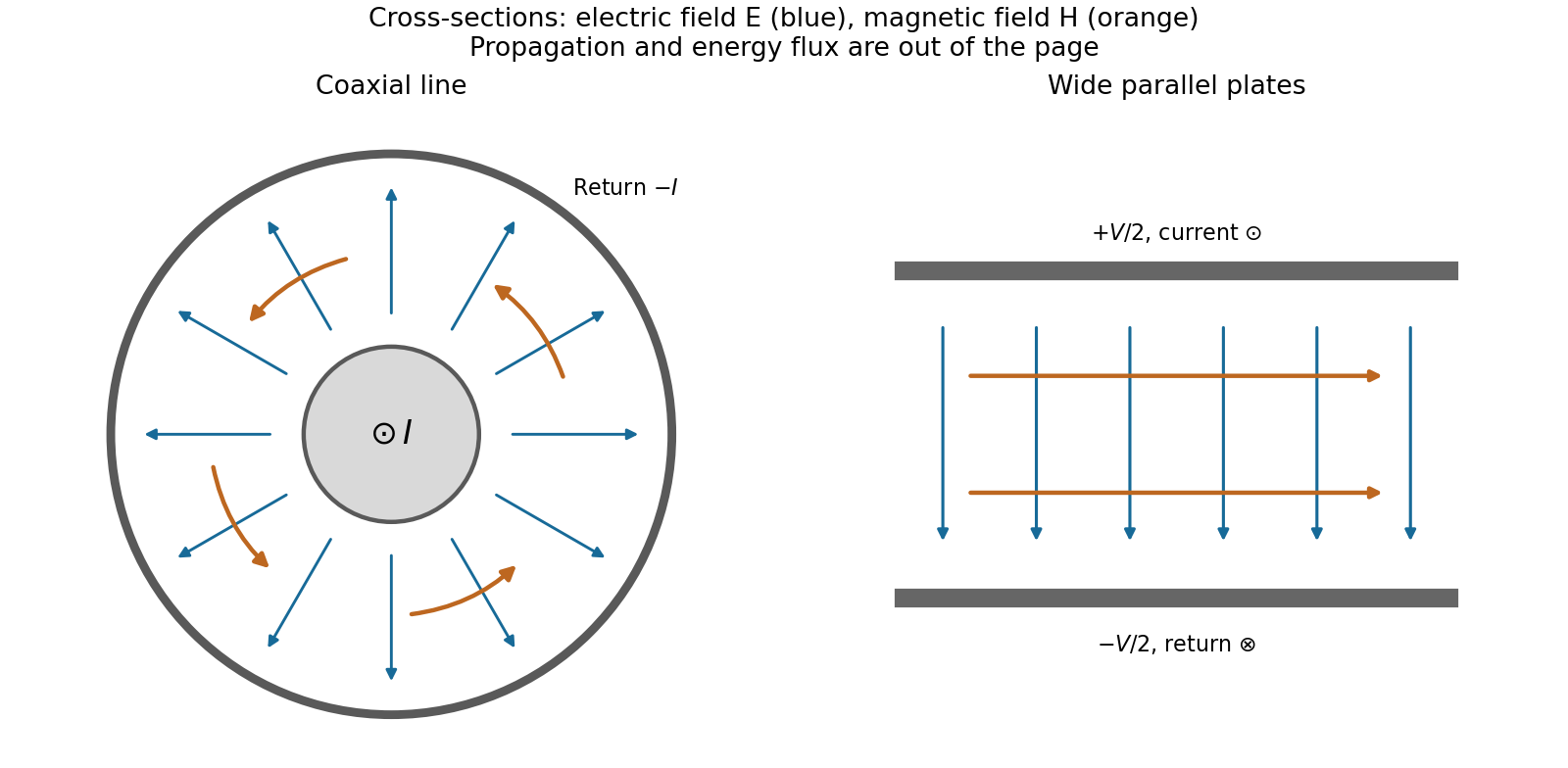
Fields and geometry. Two separated conductors support a transverse electromagnetic mode, with electric and magnetic fields transverse to the propagation axis. For a homogeneous dielectric and negligible conductor penetration, both examples below have and hence . The distributed circuit model follows from the field energy and charges in each slice.
For a coaxial cable with inner radius and inner surface of the outer conductor at , Gauss's law and Ampère's law giveThe electric field is radial and the magnetic field circles the axis. Integration of voltage and field energy givesThe equal and opposite return current on the outer conductor confines the ideal external field to the annulus.
For wide parallel plates of width separated by , neglect fringing. The electric field crosses the gap, , while the magnetic field lies in the gap parallel to the plates and perpendicular to propagation, . ThereforeFor a forward wave, points along the line. Integrating this Poynting vector over either cross-section gives instantaneous power . For complex peak amplitudes, average power is , or for a single forward wave on a lossless line. The conductors guide an energy flux predominantly in the dielectric between them.

Terminations and reflection. At a load , require . If and are the incident and reflected voltage amplitudes there, the total current is . ThusA matched load, , absorbs the incident power with no reflection. An open circuit has , a current node and a doubled voltage at the end. A short circuit has , a voltage node and a doubled current there. A purely reactive load on a lossless line has and accepts no average power. For real , the reflected power fraction is and the accepted fraction is .
Incident and reflected waves produce a standing-wave pattern with voltage standing wave ratio . The input impedance of a lossless length isThis gives for a short and for an open. A quarter-wave section gives , enabling impedance transformation. After a source launches a pulse, a distant termination affects it only after the reflected pulse returns; the return time is . Real conductor resistance, dielectric loss and departures from a TEM field profile limit the ideal model at high frequency.
An Euler strut is a slender elastic column under axial compression. Let its bending stiffness about the weaker section axis be and its length be . With small lateral deflection and a dead compressive load , the quadratic total potential energy isThe first term is bending energy; the negative term is work released by the load as bending shortens the end-to-end distance. Stationarity gives . For pinned ends, at , and requires . The first instability is Euler's critical load,Below this load, the straight state has positive quadratic energy against these perturbations. At the threshold, the lowest bending mode has zero quadratic restoring energy; above it the straight state is unstable. For a rectangular section, about the appropriate bending axis, so the smaller second moment of area controls the first buckling direction.
Endpoint constraints matter. Write : for pinned-pinned, for fixed-free and for fixed-fixed conditions. This elastic instability differs from compressive material failure. Imperfections cause bending before the ideal threshold, and a short column may yield before Euler buckling occurs.
A gravitational assist changes a spacecraft's velocity relative to the Sun by scattering it in the gravitational field of a moving planet. In the planet's rest frame, ignore other forces during the encounter and take the spacecraft mass negligible. The incoming and outgoing asymptotic velocities have equal magnitude,because the encounter is conservative, but their directions differ along a hyperbolic orbit. If the planet has approximately constant heliocentric velocity , the heliocentric spacecraft velocities are . Its specific energy change isThus a flyby can increase or decrease heliocentric energy depending on its geometry. The planet exchanges momentum and orbital energy with the spacecraft; its speed change is extremely small because its mass is much greater. There is no energy creation and no increase of asymptotic speed in the planet's own frame.
For a point-mass planet, conservation of energy and angular momentum gives the hyperbolic eccentricity and deflection anglewhere is periapsis distance and the impact parameter. The velocity-vector change has magnitude , so the maximum energy-change magnitude for this fixed deflection is . A small periapsis increases the turning angle, but collision, atmosphere and tidal forces limit how close a real spacecraft may pass. Multiple encounters allow large changes without expending the propellant that equivalent direct velocity changes would require.
Take axes fixed in a rigid body, chosen along its principal axes, with moments of inertia . The angular momentum components are . Newton's rotational equation is , while the rotating-frame transport rule givesThus Euler's equations areThe nonlinear cross terms arise because the principal axes rotate. Even with no external torque, the body-frame components of angular momentum can vary while the angular momentum vector stays fixed in inertial space.
With zero torque, the equations conserveUniform rotation about any principal axis is a torque-free solution. If , linearization about the intermediate-axis solution givesThe positive coefficient gives exponential growth: intermediate-axis rotation is unstable, whereas rotation about the largest or smallest moment is linearly stable. For a symmetric body, Euler's equations also describe the precession of the transverse angular velocity around its symmetry axis. Torques from gravity or an applied couple enter through the right-hand sides rather than being absorbed into the inertial cross terms.
Archimedes' principle states that the resultant hydrostatic pressure force on a body equals the weight of the fluid displaced, directed opposite to gravity. Let be the displaced fluid region, with outward normal from the body into the fluid. Since the fluid pressure force is inward,Hydrostatic balance is , with downward gravitational acceleration . Thereforefor uniform fluid density and gravity. Uniform atmospheric pressure gives no net force on a closed surface. For a floating body, the same displaced-volume construction includes the free surface; any significant air buoyancy can be included as a second displaced fluid.
A freely floating body of mass satisfies , so its displaced volume is . A homogeneous body of density floats with submerged fraction ; if , hydrostatic buoyancy alone cannot support it. The buoyant force acts through the centre of buoyancy, the centroid of the displaced volume for constant density, while weight acts through the centre of mass. Their relative positions determine rotational equilibrium and stability. For a fully submerged body, a centre of mass below the centre of buoyancy gives a restoring torque; a floating body's changing displaced shape additionally requires the metacentric height criterion. Surface tension, externally driven flow and contact forces can alter the simple force balance.
Following the moving fluid. The Eulerian velocity field assigns a velocity to each position. A fluid particle satisfies , so the chain rule gives the material derivative, also called the convective derivative,Even in steady flow a particle can accelerate because it moves between regions with different velocity. For example, flow around a curved obstacle changes direction despite . Mass conservation isFor a constant-density incompressible fluid, .
Euler equations for an inviscid fluid and Bernoulli's equation. Neglect viscosity and take the body force per unit mass to be . Newton's second law for a fluid element givesFor steady flow, dot with displacement along a streamline. The tangential component of is the derivative of along that line. For constant density, integration givesIn uniform gravity, . Thus pressure, kinetic energy per unit mass and gravitational potential energy per unit mass exchange along a streamline. For a barotropic compressible fluid, replace by . Different streamlines need not have the same Bernoulli constant.
Vorticity and potential flow. Vorticity is . A small fluid element rotates locally with angular velocity after its deformational part is separated. The vector identitygives for steady constant-density inviscid flow. Thus an irrotational region has one common Bernoulli constant on each connected region. In a simply connected irrotational domain, introduce a velocity potential . Incompressibility then gives Laplace's equation, . For unsteady irrotational flow,An impermeable stationary wall fixes , but ideal potential flow does not enforce no slip. In a multiply connected domain, irrotational flow may still have nonzero circulation around an excluded vortex core, so a globally single-valued potential requires care.
For example, uniform two-dimensional flow past a circular cylinder has outside . Its normal velocity vanishes at the cylinder, and its surface tangential velocity is . Bernoulli's equation predicts a symmetric pressure distribution and zero drag. This is D'Alembert's paradox: the assumptions omit the viscous boundary layers, separation and wake responsible for real drag.
For an incompressible fluid of constant kinematic viscosity , the curl of the motion equation givesThe first term stretches and tilts vortex lines; the second diffuses vorticity. In two-dimensional incompressible inviscid flow the stretching term is absent and vorticity is carried with the fluid. In a three-dimensional inviscid flow it can be amplified by stretching. Density gradients not parallel to pressure gradients provide an additional source in a general compressible fluid.
Viscous flow. A Newtonian fluid's shear stress is proportional to rate of strain. For constant viscosity and incompressibility the Navier-Stokes equation iswith dynamic viscosity and kinematic viscosity . At an ordinary solid wall, the no-slip boundary condition sets fluid velocity equal to the wall velocity. Viscosity transfers momentum between neighbouring layers and converts mechanical energy into heat; unlike the pressure force, its shear contribution depends on velocity gradients.
For plane Couette flow between plates , with the upper plate moving at , the steady solution is , with shear stress . For pressure-driven flow through a pipe of radius , a constant pressure gradient gives the parabolic Poiseuille profileThe Reynolds number compares convective inertia with viscous force. Small Reynolds number often permits the Stokes-flow approximation; large Reynolds number can produce thin boundary layers and, under suitable conditions, turbulence. It does not justify neglecting the wall conditions. Bernoulli's inviscid constant is generally not conserved along a viscous streamline, and pipe flow instead shows a pressure loss corresponding to dissipation.
Articles by others on the same topic
There are currently no matching articles.