Topics (384k) Articles (398k) Users (410) Discussions (242) Comments (383) Files (13k) New article

A linear molecule has collinear atomic nuclei in its idealized molecular geometry. Both a diatomic molecule and carbon dioxide can supply linear rigid rotor examples, although their electric-dipole selection rules need not give an observable permanent-electric dipole spectrum.
Molecular rotation changes a molecule's orientation. Its rotational kinetic energy depends on the arrangement and masses of its chemical atoms. A rigid rotor freezes internal distances to isolate this motion; rotational spectroscopy tests the resulting energy eigenvalues through transitions between quantum states. The molecular beam electric resonance experiment provides a complementary probe of the coupling to an electric field.
Evidence transfers at a stated level. Sequence alignment can suggest a candidate relationship between genes; functional complementation tests whether a candidate can supply a particular function in a chosen recipient. Neither alone establishes identical native gene expression, identical signal transduction, or identical consequences in every species. The yeast cross-species complementation experiment is especially useful because it tests a conserved function by intervention rather than assuming it from resemblance. [ref]
Pathways over Time: Functional Genomics Research in an Introductory Laboratory Course by Todd D. Reeves and others. Reeves et al. (2018), project design, pp. 3–4, and Course Activities, pp. 5–6
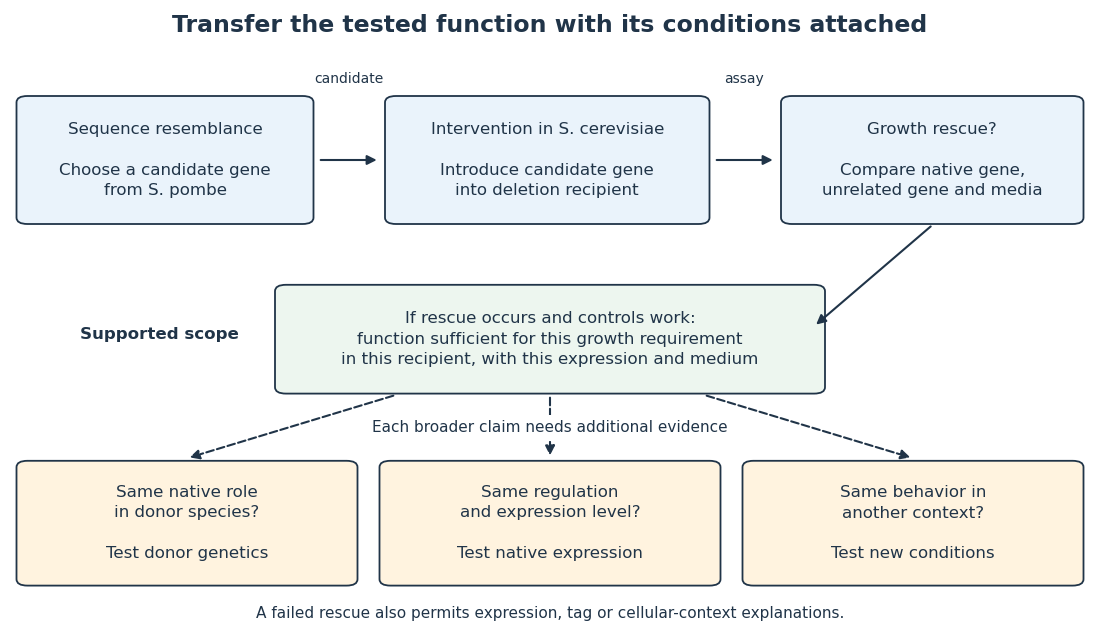
Even successful functional complementation occurs within a specific genetic background, nutrient supply and imposed gene expression. The enzyme may work with the recipient’s available substrates and partner proteins at an experimentally imposed abundance. Establishing the same role in the donor species calls for experiments there; establishing behavior under another condition calls for experiments under that condition. A conserved component can therefore coexist with context-dependent behavior of an entire pathway. This separation makes model organisms powerful: an accessible experiment supplies a precise mechanistic foothold and a better question for the next system.
Can a gene from Schizosaccharomyces pombe replace a missing function in Saccharomyces cerevisiae? A modern laboratory project tested functional complementation of methionine synthesis. For each tested gene deletion, the investigators compared plasmids carrying the corresponding Saccharomyces cerevisiae gene, a candidate Schizosaccharomyces pombe gene, and an unrelated gene. The first was a positive scientific control; the last was a negative scientific control. The paper describes this design rather than publishing a complete set of individual growth measurements. [ref]
Pathways over Time: Functional Genomics Research in an Introductory Laboratory Course by Todd D. Reeves and others. Reeves, Warner, Ludlow and O’Connor (2018), Course Activities, pp. 5–6 and Table 1: three plasmids, replica plating and protein-expression checks
The recipient biological strains also lacked the ability to make uracil. The pYES2.1/V5-His plasmids carried URA3, a gene restoring that ability, and used the GAL1 gene promoter to control the inserted gene. Initial plates lacked uracil but supplied methionine: this selected biological colonies containing plasmids without requiring successful methionine synthesis. Subsequent plates lacking methionine tested the missing function, comparing galactose induction with glucose conditions. Thus selecting for a plasmid and testing its functional contribution were separate operations. [ref]
Pathways Over Time Plasmids Engage Students in Functional Genomics Research by Clare O’Connor. O’Connor (2018), Plasmid features enable multiple student experiments and Complementation reveals conservation of function
The apparatus can be simple and informative. In the associated protocol, replica plating uses a block covered with velveteen to transfer small samples of biological colonies from a master plate onto plates with different nutrient conditions. Orientation marks preserve correspondence between locations; gentle contact limits the transferred material. The specified replicas omit uracil and methionine with either inducing sugar or glucose, and include a fresh glucose plate supplying methionine. The readout is growth at corresponding locations, not a direct measurement of enzyme activity. [ref]
12.6: Exercise 2 - Replica plating and complementation. O’Connor, Investigations in Molecular Cell Biology, §12.6, introductory paragraphs and steps 1–3: velveteen block, orientation marks and three replica media
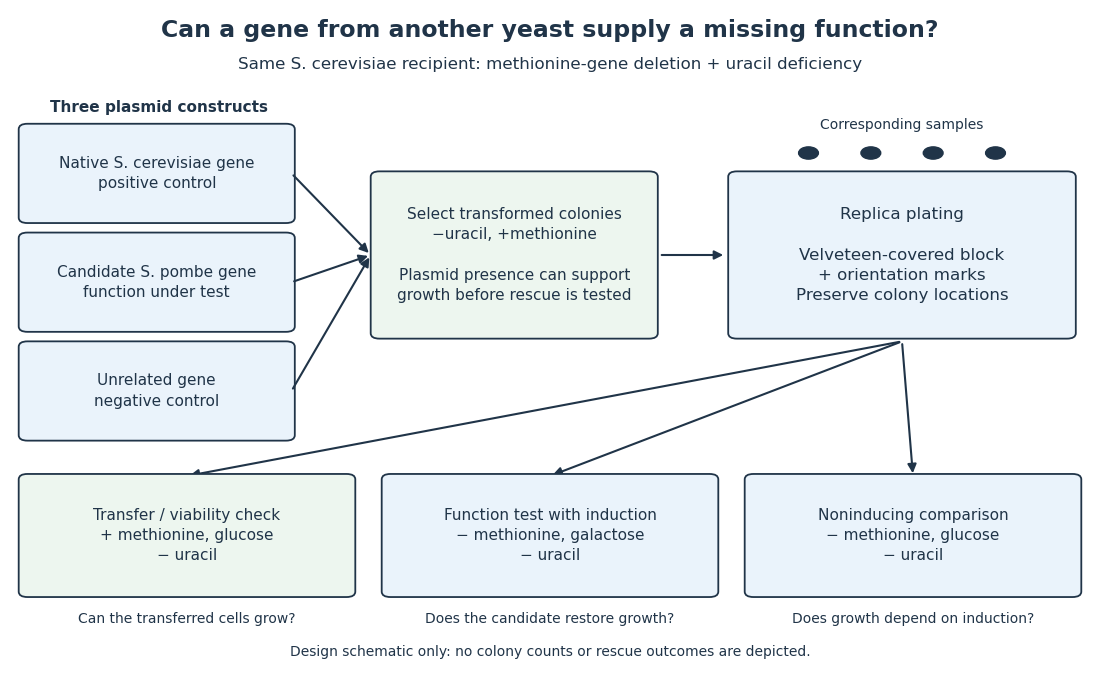
The scientific controls answer different objections. Growth on the methionine-supplied replica checks survival and transfer. Rescue by the native gene checks that this biological strain and assay can reveal functional complementation. The unrelated gene tests whether carrying a plasmid alone is sufficient. Comparing induction conditions checks dependence on gene expression, although changing the sugar also changes metabolism: it is not an isolated change of gene expression in every other respect.
If the candidate gene restores growth while those comparisons behave as intended, it supplies a function sufficient for the tested growth requirement in this recipient. Failure to rescue is less decisive: the candidate protein might not be produced, might be altered by its attached tag, or might not work in this cellular context. The investigators therefore also used Western blots to examine protein production. A detected protein still does not establish correct protein folding or catalytic activity. [ref]
Pathways over Time: Functional Genomics Research in an Introductory Laboratory Course by Todd D. Reeves and others. Reeves et al. (2018), Course Activities, pp. 5–6: functional conservation, tag interference and Western-blot follow-up
Experimental tractability is the practical ability to cultivate a system, manipulate the variables of interest, and obtain an interpretable readout with appropriate scientific controls. In Saccharomyces cerevisiae, inexpensive cultivation, accessible haploid and diploid states, and tools for introducing DNA make controlled changes of genotype feasible. A haploid biological strain exposes a changed allele without a second copy at that genetic locus, while crosses and meiosis permit tests of inheritance. [ref]
Budding Yeast for Budding Geneticists: A Primer on the Saccharomyces cerevisiae Model System by Andrea A. Duina and others. Duina, Miller and Keeney (2014), introduction, Figure 2 and Experimental Toolkit and Related Resources
An accessible readout is not necessarily a direct measurement of the mechanism. Growth of a biological colony integrates many cellular functions. Failure to grow could reflect the intended gene deletion, unsuitable conditions, failed genetic transformation, or another mutation. Matching the genetic background and using scientific controls narrows these alternatives. Ease of doing an experiment and strength of its inference are distinct advantages.
A chemical solution is a homogeneous mixture in which designated solutes are distributed in a solvent. Representative equal-volume samples have the same composition after mixing. Individual molecules and ions remain distinguishable. The solute/solvent labels describe their roles in this mixture.[ref]
A dissolved solute is dispersed as molecules, chemical atoms, or ions, rather than as the larger solid particles of a particle suspension. For example, sucrose retains its molecular formula during dissolution in water; a chemical reaction is not required. Dissolved sodium chloride supplies sodium cations and chloride anions, surrounded by water molecules through solvation. Dissolved does not mean chemically destroyed or converted into water.[ref]
11.1 The Dissolution Process. Chemistry 2e, §11.1, opening molecular and ionic examples and defining traits of solutions
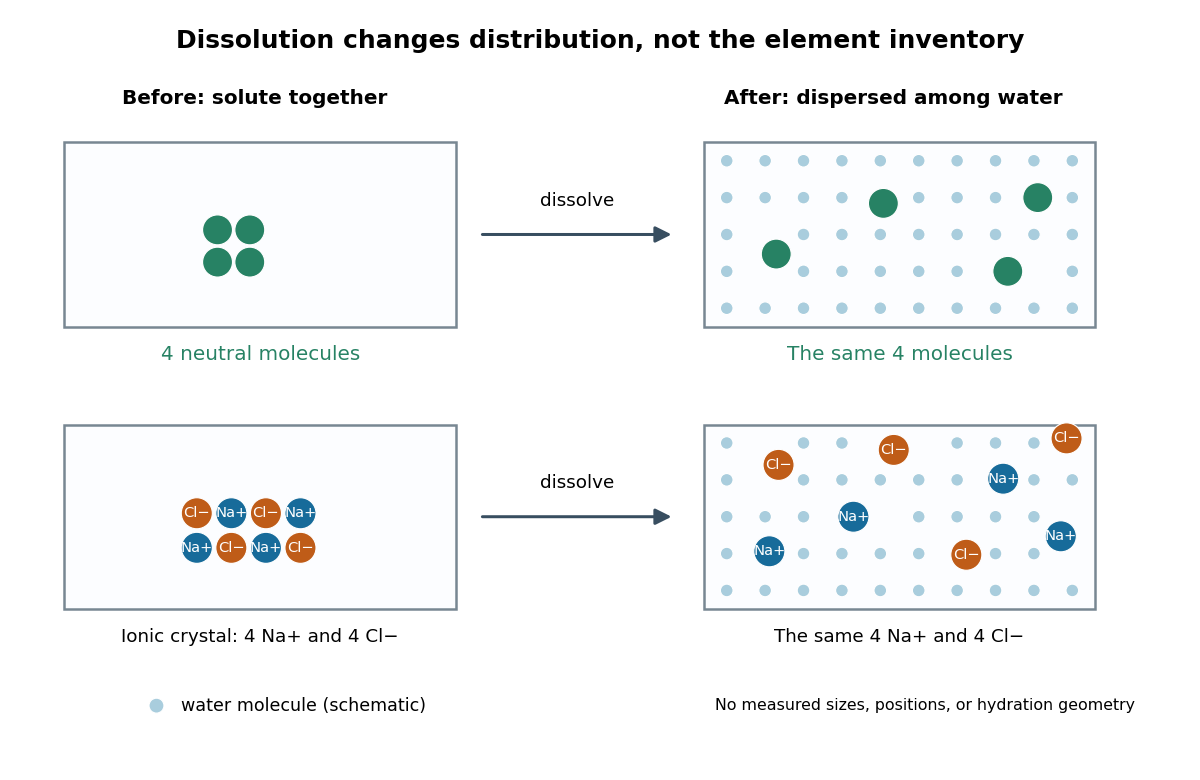
Dissolution disperses particles while preserving their chemical elements
. Original schematic with invented particle positions, not a microscopy image. Top: four generic neutral molecules retain their identity. Bottom: four sodium cations and four chloride anions separate from an ionic crystal. Pale dots represent water molecules; sizes, spacing, and counts are explanatory, not measured. Solvation surrounds each dissolved species; the diagram does not specify a hydration shell geometry. Details.This makes a useful connection between microscopic identity and laboratory sampling. If a chemical solution is well mixed, the amount of substance in a measured portion follows from its concentration and volume. A scoop from a poorly mixed particle suspension need not represent the whole vessel. Visual clarity alone cannot establish composition or exclude a fine dispersion; the quantitative claim needs representative sampling.
For a current dipole in a homogeneous insulating sphere of radius , let and let be its primary electric potential. The displayed representation solves the interior Neumann boundary condition up to an additive constant. It rewrites the spherical Kelvin transform correction and a distributed dipole correction using the dipole line-integral identity. The image parameters depend on the observation radius; this is an exact parametrized representation rather than a fixed collection of image source positions.
Cellular respiration transfers energy from chemical fuels into usable forms including ATP. Oxidation of the fuel is coupled to reduction of an electron acceptor; the energy transfer can support ATP synthesis. Plants carry out cellular respiration as well as photosynthesis. Their biological cells need usable energy in darkness too, and a seed can draw on stored fuel during germination.[ref]
Biology 2e by Mary Ann Clark and others. Biology 2e, §7.1, Electrons and Energy and ATP in Living Systems: redox and energy carriers
[ref]Follow three different accounts: carbon moving from fuel to products, electrons moving to an electron acceptor, and energy becoming available for cellular work. They are connected, but an oxygen uptake measurement alone does not identify the fuel or count the ATP made. The pea seed respirometry experiment makes this distinction visible with simple apparatus.
Carbon fixation incorporates carbon from carbon dioxide into organic chemical compounds. It identifies a material transformation, rather than a particular source of energy: carbon fixation can be supported by photosynthesis or by other metabolism. The Calvin cycle is one pathway, not the definition of all carbon fixation.
Lipolysis hydrolyses stored triacylglycerols to release fatty acids and glycerol through successive cleavage steps. It mobilizes stored carbon but is distinct from fatty-acid oxidation, which subsequently extracts energy. Released fatty acids can be transported, oxidized or re-esterified depending on tissue state. Thus an increased rate of lipolysis need not equal the rate of net loss of body lipid stores. [ref]
Gluconeogenesis synthesizes glucose from non-carbohydrate precursors. It is distinct from glycogenolysis, which mobilizes an existing glycogen store.
Glycogenolysis breaks down glycogen to mobilize stored glucose units. Glycogen phosphorylase removes many residues as glucose 1-phosphate, while additional activity resolves branch points. In muscle, the products support local energy demand; release of free glucose into circulation additionally requires the appropriate enzymatic machinery. This distinction explains why a glycogen store in one tissue is not equivalent to an immediately interchangeable blood-glucose reserve. [ref]
Glycogenesis builds glycogen; glycogenolysis breaks it down. Their opposing directions matter in the insulin and glucagon circuit.
Glycogen is a highly branched polysaccharide of glucose units, serving as a storage form of glucose in animals. Liver and muscle provide familiar examples. The classical second messenger experiments measured regulation of an enzyme involved in glycogen breakdown, glycogen phosphorylase. [ref]
https://openstax.org/books/biology-2e/pages/3-2-carbohydrates. Clark, Douglas and Choi, Biology 2e, 3.2: glycogen
In its biochemical sense, fermentation is metabolism that obtains ATP from breakdown of organic substrates without a respiratory electron transport chain. The alcoholic route is one example; not every fermentation produces ethanol. See Clark, Douglas and Choi, Biology 2e, 7.5: fermentation versus anaerobic respiration.
Ethanol is the chemical compound produced by the alcoholic fermentation described under Saccharomyces cerevisiae. Its two carbon chemical atoms explain the product bookkeeping there. See NIST Chemistry WebBook: ethanol formula and identity; the Biology 2e section cited under Saccharomyces cerevisiae identifies ethanol as the alcohol product.
A psychoactive drug is a substance that changes mental activity, mood or perception. In population causal inference, its per-user adverse-event risk and its total population harm are distinct: the latter also depends on how many people use it, for how long, and on substitution between substances.
Isolation separates recognized infected or ill individuals from susceptible contacts to limit transmission. Quarantine instead concerns exposed individuals who may or may not be infected.
Pinned article: Introduction to the OurBigBook Project
Welcome to the OurBigBook Project! Our goal is to create the perfect publishing platform for STEM subjects, and get university-level students to write the best free STEM tutorials ever.
Everyone is welcome to create an account and play with the site: ourbigbook.com/go/register. We belive that students themselves can write amazing tutorials, but teachers are welcome too. You can write about anything you want, it doesn't have to be STEM or even educational. Silly test content is very welcome and you won't be penalized in any way. Just keep it legal!
Intro to OurBigBook
. Source. We have two killer features:
- topics: topics group articles by different users with the same title, e.g. here is the topic for the "Fundamental Theorem of Calculus" ourbigbook.com/go/topic/fundamental-theorem-of-calculusArticles of different users are sorted by upvote within each article page. This feature is a bit like:
- a Wikipedia where each user can have their own version of each article
- a Q&A website like Stack Overflow, where multiple people can give their views on a given topic, and the best ones are sorted by upvote. Except you don't need to wait for someone to ask first, and any topic goes, no matter how narrow or broad
This feature makes it possible for readers to find better explanations of any topic created by other writers. And it allows writers to create an explanation in a place that readers might actually find it.
Figure 1. Screenshot of the "Derivative" topic page. View it live at: ourbigbook.com/go/topic/derivativeVideo 2. OurBigBook Web topics demo. Source. - local editing: you can store all your personal knowledge base content locally in a plaintext markup format that can be edited locally and published either:This way you can be sure that even if OurBigBook.com were to go down one day (which we have no plans to do as it is quite cheap to host!), your content will still be perfectly readable as a static site.
- to OurBigBook.com to get awesome multi-user features like topics and likes
- as HTML files to a static website, which you can host yourself for free on many external providers like GitHub Pages, and remain in full control

Figure 2. You can publish local OurBigBook lightweight markup files to either OurBigBook.com or as a static website.
Figure 3. Visual Studio Code extension installation.
Figure 5. . You can also edit articles on the Web editor without installing anything locally. Video 3. Edit locally and publish demo. Source. This shows editing OurBigBook Markup and publishing it using the Visual Studio Code extension. 
- Infinitely deep tables of contents:




All our software is open source and hosted at: github.com/ourbigbook/ourbigbook
Further documentation can be found at: docs.ourbigbook.com
Feel free to reach our to us for any help or suggestions: docs.ourbigbook.com/#contact