
The cumulative distribution function of the uniform distribution on isThe constant zero has cumulative distribution function . Its continuity points are precisely . For fixed , ; for fixed , eventually. This proves convergence in distribution to zero directly from the definition.
Also, . For every and , . HenceThe convergence in probability conclusion holds for any realization of these random variables on a common probability space; no independence of random variables is needed.
Test geological associations and their chronology. The most persuasive hypothetical record would combine rigid-block relative motion, creation of oceanic lithosphere, its destruction at a coherent margin, and repeated assembly and dispersal of continents. I would compile independently dated rock and structural occurrences in age bins, map their associations, and distinguish primary formation from later emplacement. The aim is to evaluate alternative tectonic regimes, not simply to collect the oldest example of a familiar name.
Oceanic lithosphere and sutures. An ophiolite association containing residual peridotite, gabbro, sheeted dikes and submarine basalt could demonstrate construction of an oceanic section. Its case for plate tectonics strengthens if it is associated with an oceanward sedimentary succession, a metamorphic sole, an accretionary prism or mélange, and eventual emplacement along a suture zone between formerly distinct blocks. Date construction, metamorphic heating and emplacement separately. A dismembered collection of ultramafic and mafic rocks need not be a complete ophiolite; an isolated volcanic pile or greenstone belt can also arise in a plateau or vertical-overturn setting. Hotter early mantle may produce oceanic sections unlike a modern template.
Cold burial beside a hot arc. Blueschist and eclogite with well-constrained low temperature/pressure ratios would support unusually deep burial before substantial heating. Coesite or metamorphic diamond in a suitable continental crust protolith could establish ultrahigh-pressure metamorphism, consistent with deep continental burial and return. Reconstruct pressure-temperature-time paths using mineral assemblages, zoning, reaction textures and radiometric dating; a peak pressure without its timing and burial geometry gives a weaker constraint. Eclogite alone only indicates appropriate pressure-temperature-composition conditions and may also form at the base of thick crust.
An approximately coeval, spatially organized pair of low thermal-gradient and high thermal-gradient metamorphic belts would be stronger evidence for juxtaposition of a cold descending plate and a hotter volcanic arc or hinterland. Test the original spatial relation rather than pairing unrelated rocks brought together much later. A statistical study of metamorphic temperature/pressure distributions illustrates how gradual widening and bimodality can be used to evaluate changing tectonic behavior. The ratio is an apparent metamorphic thermal gradient, not necessarily a directly measured steady geothermal gradient.[ref]
Metamorphism and the evolution of plate tectonics by Robert M. Holder and others. 2019, statistical analysis of metamorphic thermal-gradient distributions
The absence of old blueschist is not a decisive absence of old subduction. A hotter thermal regime may suppress its production, and later heating can transform it. The test should therefore include the distribution of pressure-temperature-time paths predicted by early-planet models, rather than demanding the youngest modern mineral assemblages at all ages.
Kinematic structures and basin evolution. Long, coherent thrust belts, imbricated sediments, folds, regionally consistent shear sense, major strike-slip faults, and suture zones can identify lateral shortening and relative displacement. A reconstructed ocean-facing volcanic arc, forearc basin and accretionary prism with a common polarity is more compelling than isolated shortening. Mountain building alone is not exclusive to plate tectonics: vertical instabilities and impacts can also deform rock. The length scale, sequence, strain partitioning and linkage between structures matter.
For repeated opening and closing, seek a dated progression from continental rifting, through a subsiding passive margin and an intervening oceanic assemblage, to convergence, continental collision and renewed rifting. Matching stratigraphy, sedimentary provenance and structural restoration on opposing blocks can test whether a reconstructed Wilson cycle is geometrically possible. Paleomagnetism from independently dated, demonstrably primary magnetizations could show differential latitudinal motion and rotation of separate blocks. Relative motion between blocks is more useful than motion of one block, which could include true polar wander. Remagnetization, inclination shallowing and longitude ambiguity must be assessed.
Secular changes require an archive model. Compile the incidence, spatial scale and recurrence of these associations through time, normalized where possible by exposed rock area, sampling effort and dating opportunities. Include detrital zircon and sedimentary provenance where they preserve information from eroded source rocks, while recognizing zircon fertility and sedimentary sorting biases. Increased abundance of plate-like associations in several independent regions could support their transition from local episodes to a widespread regime. A sharp break is only one possible outcome; a progressive increase in persistence or geographical coverage would support gradual establishment.
A useful conceptual accounting iswith additional redistribution between age bins if ages are reset or misassigned. This is not a calibrated dating law: it shows why an observed first appearance need not equal a true first formation. Subduction consumes oceanic lithosphere; erosion, metamorphism, tectonic reworking and burial selectively remove or obscure evidence. The oldest archive is especially incomplete, and some apparently diagnostic assemblages only become likely as the planet cools. An age peak may measure enhanced preservation during continental collision rather than an increased production rate.
State the chronological inference precisely. If an unambiguous assemblage forms at time , then the required process was operating by ; an onset time measured forward from planetary formation obeys . If both are expressed as ages before present, the inequality reverses: the onset age is at least as old as the assemblage age. Constraining how much earlier onset could have occurred requires well-sampled older records and a credible prediction that the sought evidence would have formed and survived. Several coeval, independent records consistent with sustained horizontal recycling give a stronger inference of widespread plate tectonics than the oldest ambiguous occurrence of any single rock type. Combined with geodynamic modelling and geochemistry, the defensible answer would report a range for first local activity and a potentially different range for establishment of a persistent global system.
Use chemical signatures to reconstruct processes, then test tectonic context. Geochemistry can establish melting conditions, surface alteration and recycling, but plate tectonics is a kinematic system. I would sample dated suites across a mapped geological succession and compare competing origins, rather than declare an isolated “arc-like” analysis proof of a global regime. Radiometric dating must identify whether the measured age records crystallization, later metamorphism, alteration or inheritance.
Hydrous magmatism and selective element transfer. Analyze fresh basalt, associated intrusive rocks and differentiated volcanic suites for major elements, trace elements and isotope ratios. Relative enrichment of fluid-mobile elements such as barium, strontium and lead, together with relative depletion of niobium and tantalum, can support addition of slab-derived components to a depleted mantle wedge. Test coherent variations in barium/niobium, thorium/niobium and rare-earth element patterns against modeled fluid addition, sediment melting, source depletion and fractional crystallization. Do not treat these ratios as fixed universal cutoffs. Crustal contamination, remelting of previously arc-modified crust, residual rutile or other source effects can create some similar patterns. Altered rocks can also gain mobile elements long after their formation.
The case becomes stronger if the chemical evolution occurs in a plausible succession of oceanic, early forearc and mature arc magmas, with supporting structure and geochronology. The key evidence would be correlated process changes in an independently reconstructed margin, not resemblance to one modern basalt plot. A geochemical discrimination diagram is a comparison tool; its modern training associations are not a proof that only those settings could exist on a hotter Earth.
High-pressure melting and the fate of mafic crust. Tonalite-trondhjemite-granodiorite suites with high strontium/yttrium or lanthanum/ytterbium and low heavy rare-earth element abundances can indicate melting with residual garnet and little plagioclase. Model the combined major element composition, residual phases and melt fraction to estimate the pressure, hydration and source of melting. This could support melting of buried hydrous oceanic crust. However, basal melting of thickened crust, delamination and nonplate vertical burial can produce related conditions. High strontium/yttrium alone neither proves a descending slab nor dates the first subduction. Conversely, hotter ancient subduction might not produce exactly the same magmatic products as modern cold slabs.[ref]
Radiogenic isotopes distinguish new extraction from reworking. Couple zircon uranium-lead dating with hafnium isotope ratios, and whole-rock samarium-neodymium isotope ratios with strontium isotope ratios or lead isotope ratios. These systems can constrain contributions from depleted mantle, older continental crust and altered surface reservoirs. For a closed parent-daughter system,where is the present parent abundance, the radiogenic daughter accumulated since closure, and the radioactive decay constant. Initial daughter composition, closure and mixing must be constrained before interpreting an age. A crustal extraction model age depends on a reference mantle evolution and subsequent history; it is not automatically a rock's crystallization age or the date of a tectonic transition.
Juvenile signatures can indicate addition from the mantle, while evolved signatures can indicate reworking of older crust; neither is exclusive to a particular tectonic regime. Spatially organized juvenile additions at a reconstructed margin, followed by collision and reworking, are more diagnostic than an undifferentiated global age histogram. Work combining zircon hafnium isotope ratios, oxygen isotope ratios and age distributions illustrates how crustal generation, reworking and preservation can be separated conceptually, while remaining dependent on sampling and model assumptions.[ref]
Rates of generation and growth of the continental crust by Christopher Hawkesworth and others. 2019, interpretation of age distributions and zircon isotope constraints
Stable isotopes can identify a visit to the surface. Zircon oxygen isotope ratios substantially different from an appropriate mantle reference may record melting of material that previously underwent low-temperature water-rock interaction. This would support surface alteration followed by burial or remelting. It would not, by itself, distinguish subduction from burial under a thick volcanic pile or another form of recycling. Alteration, metamorphic exchange, inherited cores and analytical domains need checking. Multiple stable isotope systems, including boron isotope ratios in appropriate rocks, can strengthen a fluid-transfer interpretation if their fractionation and later resetting are modeled.
Deep samples provide an independent archive. If dated diamond inclusions or mantle xenoliths preserve eclogite compositions together with a surface-alteration chemical signature, they could demonstrate transfer of crustal material into deep lithospheric mantle. Dating the relevant mineral assemblage and distinguishing inclusion growth from later host transport are essential. A primary diamond-inclusion study used coupled chemical and isotopic observations to infer changes in deep recycling; the general lesson is to test a transport history, not to make the first preserved sample an infallible onset clock.[ref]
Start of the Wilson cycle at 3 Ga shown by diamonds from subcontinental mantle by Steven B. Shirey and Stephen H. Richardson. 2011, diamond-inclusion data and proposed recycling interpretation
Delamination or other sinking processes remain alternatives unless structure and regional history establish plate convergence.For each candidate signal, I would seek an older comparison population, quantify alteration and analytical uncertainty, reproduce the pattern in several independent regions, and combine chemistry with the tests in the other parts. A securely dated demonstration of subduction shows that it operated by that time in that region; it does not demonstrate that it began then everywhere. A secular shift toward more frequent, spatially coherent signatures can support expansion of the regime, but only after correcting for the survival of its archive.
Specify what “onset” means. I would distinguish the first local, perhaps short-lived subduction event from persistent, self-sustaining recycling in a connected global network of tectonic plates. Modern plate tectonics combines relatively rigid moving lithosphere, localized boundary deformation, seafloor spreading and sustained convergence. A sinking drip or a single imposed descending sheet is not sufficient evidence of that global regime. Different processes may become established at different times, so a transition interval may be a better hypothesis than an instantaneous worldwide switch.
Construct competing physical models. Solve conservation of mass, momentum and energy for evolving mantle convection and lithosphere, including temperature- and stress-dependent rheology, brittle yielding, plastic deformation, melting, compositional buoyancy and relevant phase changes. Use geodynamic modelling to compare a stagnant lid, episodic overturn, drip-dominated recycling and a sustained mobile lid. In a simplified incompressible creeping-flow framework,Here is velocity, pressure, effective viscosity, the strain-rate tensor, density, gravitational acceleration, specific heat capacity, thermal conductivity, radiogenic power per unit mass, and dissipative heating per unit volume. These equations are a framework: compressibility, latent heat and chemical transport may require additional terms. A simple yield stress law represents cohesion , friction coefficient and pore pressure , illustrating why hydration and interface weakening can change the outcome.
Vary the early-planet controls rather than assuming the answer. Explore plausible initial mantle potential temperature, radiogenic heating, crust thickness and composition, water inventory, grain-size evolution, surface temperature, and boundary strength. Hotter mantle lowers viscosity but can produce thicker buoyant basaltic crust; it does not automatically make sustained subduction easier. A cold strong plate can transmit slab pull yet resist bending and initiation. Water weakening of rocks, melt-induced weakening, inherited faults and mechanically weak sediments can change this balance. Test proposed triggers such as mantle plume impingement or gravitational instability without presupposing an established global plate-force system.
Useful diagnostics include the Rayleigh number,with thermal expansion coefficient , layer thickness , thermal diffusivity and temperature contrast , together with surface mobility, the localization of deformation, plate longevity, melt production and material recycling. A large Rayleigh number establishes vigorous convection under suitable conditions, not necessarily a mobile lid. A convincing model should sustain one-sided subduction, connected boundary evolution and seafloor spreading after any artificial trigger is removed. Compare initiation thresholds with continuation thresholds: hysteresis can allow an established regime to persist under conditions in which it would not spontaneously start.
As an example of the type of experiment, three-dimensional models have tested mantle plume-induced subduction initiation, finding sensitivity to plate buoyancy, magmatic weakening and hydration of the interface. The scientific use of such results here is to identify a feasible mechanism and its predicted signatures, not to adopt their success as a direct measurement of an ancient onset date.[ref]
Plate tectonics on the Earth triggered by plume-induced subduction initiation by Taras V. Gerya and others. 2015, modeled initiation conditions and alternative dripping behavior
Connect a model regime to a date through independent evidence. Couple the experiments to candidate planetary cooling histories, then predict observable pressure-temperature-time paths, magmatic compositions, deformation patterns and recycling rates for each regime. If independently dated rocks constrain a thermal or compositional state, ask which regimes can reproduce that state and the observed geological associations. Repeat over uncertain initial conditions and constitutive parameters, check numerical resolution, and compare two- and three-dimensional results where geometry matters. Models that prescribe a descending slab, fix plate velocity, or insert a weak boundary may be excellent forward models of a working subduction zone but do not demonstrate spontaneous initiation.
The result is a conditional statement: persistent plate tectonics is physically feasible under a range of conditions, and dated geological observations may favor that range at a particular time. Uncertain cooling histories, several feasible regimes and uncertain rheology prevent numerical feasibility alone from dating onset. The strongest constraint comes when the same parameter range explains multiple independently dated observations and alternative regimes fail those tests.
I would prioritize an accessible exposure of ancient, fine-grained lacustrine deposits associated with a river delta, preferably with nearby hydrothermal deposits or groundwater alteration that offer a second environmental window. A good target maximizes three separate probabilities: past habitability, preservation of a biosignature, and practical access to the preserved material. A spectacular former water channel alone need not score well on the second or third.
First choice: a stratigraphically resolved ancient lake basin. Look for a closed or formerly overflowing basin fed by an inlet valley, a river delta with coherent layering, and adjacent fine mudstone deposited below strong wave or channel disturbance. Delta foresets and bottomsets, channel relationships and laterally continuous lacustrine deposits provide a testable paleoenvironment, rather than relying on an isolated fan shape. An inlet plus an outlet and consistent shoreline elevations can constrain lake level and water throughput. Select Noachian or early Hesperian units where available, while avoiding the assumption that all younger environments were uninhabitable.
Quiet lacustrine deposits can concentrate material from a wider drainage area; clay minerals provide large surfaces for adsorption of organic matter. Rapid burial and limited exposure to oxidizing fluids favor preservation. Carbonate or silica cements can trap chemical or microscopic evidence, although later diagenesis may erase or redistribute it. A near-neutral, not excessively saline paleoenvironment is attractive for known life, but should be inferred from mineral assemblages and sedimentary context rather than assumed from the presence of water.
This strategy has direct primary-source precedents. An ancient lake mudstone investigated by a rover preserved evidence for near-neutral pH, low salinity and variable oxidation states, making a plausible habitat for chemolithotrophy. This established past habitability, not past life.[ref]
A Habitable Fluvio-Lacustrine Environment at Yellowknife Bay, Gale Crater, Mars by John P. Grotzinger and others. Science 343, 1242777; NASA repository abstract
Independently, rover images of another basin established a delta-lake succession followed by high-energy floods. That distinction helps choose fine background deposits rather than assuming the coarsest flood layers are the best biosignature archive.[ref]Perseverance rover reveals an ancient delta-lake system and flood deposits at Jezero crater, Mars by Nicolas Mangold and others. 2021, sedimentary architecture and changing depositional conditions
Second choice: ancient water-rock reaction systems. Target exhumed hydrothermal deposits associated with old volcanic terrain, basin-floor alteration, or impact-generated hydrothermal circulation. Especially useful settings contain silica, clay minerals, carbonates and reduced iron or sulfur phases in a coherent geological association. Chemical gradients between reacted fluids and surrounding water can supply free energy for chemolithotrophy; rapid mineral precipitation may entomb biosignatures. Habitable cooler mixing zones are more promising than assuming the hottest vent was habitable. Mineralogical mapping of thick, ancient basin deposits on Mars has motivated a deep-water hydrothermal alteration interpretation, providing a physically grounded alternative to shallow lakes. The interpretation remains a hypothesis to test in situ, not a detection of life.[ref]
Ancient hydrothermal seafloor deposits in Eridania basin on Mars by Joseph R. Michalski and others. 2017, proposed deep-water alteration setting and its astrobiological implications
Additional targets: protected groundwater archives. Old fractures, mineral veins and groundwater-fed sedimentary deposits exposed by recent erosion can sample former subsurface habitats protected from surface ultraviolet radiation. Evaporites can preserve inclusions and record water chemistry, but strongly acidic or hypersaline terminal brines may be poor habitats, and a salt deposit alone does not distinguish a long-lived ecosystem from brief evaporation. Choose a traverse that can test the relation between these deposits and the lake or hydrothermal alteration succession.
Preservation and sampling can overturn the apparent ranking. Favor ancient rocks that were buried for most of their history and only recently exhumed, with little thermal alteration, pervasive oxidation or recrystallization. Drill beneath weathered rinds and sample fresh bedrock; loose modern regolith mixes unrelated sources. Cosmic ionizing radiation penetrates deeper than ultraviolet radiation, so shallow abrasion is not complete protection. Laboratory work reported by National Aeronautics and Space Administration shows that survival depths depend on molecule, mineral matrix and accumulated dose; meter-scale burial or a short exposure history can be important, rather than one universal safe drilling depth.[ref]
NASA Experiment Suggests Need to Dig Deep for Evidence of Life on Mars by National Aeronautics and Space Administration. 27 June 2022, irradiation experiment and implications for sampling
The landing ellipse needs safe terrain and a feasible traverse to several related exposures. Orbital spectroscopy, imaging and surface topography should establish the initial target; field observations must then test stratigraphy, sedimentary textures and alteration history. Combine organic chemistry, isotope ratios, mineral associations and microscopic structures in their geological context, using contamination controls and samples from neighboring noncandidate material. Organic molecules, carbon isotope fractionation or a cell-like shape alone can have abiotic explanations. A convergent suite of contextual observations is a stronger case for ancient life than any single signal.
Define the requirement before listing planetary properties. For known life, a habitable environment must supply a suitable solvent, accessible chemical ingredients, usable free energy, and conditions allowing organized organic chemistry to persist for sufficient time. Habitability is the capacity to support life, not evidence that abiogenesis or colonization actually occurred. Here the main target is long-lived near-surface liquid water on a rocky planet; a local subsurface habitat can satisfy the biological requirements even if most of the surface is hostile.
Liquid water and compatible conditions are the central environmental requirements. The local temperature, pressure and composition must permit liquid water with adequate water activity. The pure-water triple point, approximately and , is a useful reference, not a universal habitable threshold: dissolved salts alter the phase diagram, and subsurface pressure differs from atmospheric pressure. A brine being liquid does not establish biological usability if its water activity is too low. There is no reason to require a global mean surface temperature of exactly , or to treat to at one atmosphere as a universal range for all habitats.
Composition, nutrients and energy must be accessible together. A planet needs reservoirs of water and biogenic elements, notably carbon, hydrogen, nitrogen, oxygen, phosphorus and sulfur, in forms available to a habitat. Bulk abundance is not enough if nutrients are locked away from reacting fluids. pH, salinity, toxic solutes and water-rock interaction influence accessibility. Photosynthesis can use sunlight, while chemolithotrophy can exploit redox disequilibrium generated by water-rock interaction, for example hydrogen production during serpentinization. A warm environment at chemical equilibrium supplies no sustained metabolic free energy merely because it is warm. Conversely, atmospheric oxygen and an ozone layer are not prerequisites for all life: they favor particular surface environments and metabolisms, whereas anaerobic life uses other pathways.
An appropriate atmosphere and surface energy balance favor surface habitability. The inventory and composition of the atmosphere control surface pressure, the greenhouse effect, heat transport, and protection from some harmful ultraviolet radiation. Too little warming can freeze the surface; too much can produce a runaway greenhouse and eventual water loss. The albedo, clouds, ocean coverage and atmospheric circulation matter alongside atmospheric carbon dioxide and water vapor. An illustrative globally averaged radiative balance iswhere is the Bond albedo, the orbital semimajor axis, the specified stellar luminosity, and the Stefan-Boltzmann constant. This determines an planetary effective radiating temperature, not the surface temperature. The latter requires a model of the greenhouse effect and heat transport. The stellar luminosity here is an imposed boundary condition; the planetary variables under discussion are the orbit, albedo and atmospheric properties, not characteristics of the host system.
Mass and interior properties govern retention and replenishment. Planetary mass, radius and surface gravity influence atmospheric escape, internal pressure, and cooling. In a simple thermal-retention diagnostic,where is the surface escape velocity, the gravitational constant, and the planetary mass and radius, and , and refer to a gas particle and the exobase. A large Jeans escape parameter suppresses ordinary thermal escape of that species; it does not exclude hydrodynamic escape or nonthermal losses. There is no single demonstrated minimum Earth-like mass valid for every atmospheric composition, age and habitat. Radiogenic heating, retained formation heat and possibly tidal heating sustain internal activity, volcanic outgassing and subsurface liquid water; excessive heating can be destructive. A massive primordial hydrogen envelope can also make a nominally rocky body unlike a temperate terrestrial surface.
The orbit must supply a tolerable irradiation history. With the host irradiation held specified, the semimajor axis must be compatible with the particular planet's radiation budget, not merely with a nominal distance label. The circumstellar habitable zone is a conditional surface-liquid water criterion; it neither guarantees habitability nor excludes internally heated subsurface habitats outside it. Orbital eccentricity produces an apoapsis-to-periapsis flux ratioFor fixed semimajor axis, the orbit-averaged incident flux is . Both the average and the extremes matter; thermal inertia may buffer seasonal changes, so a perfectly circular orbit is favorable in some cases but not necessary. Sustained orbital stability matters more than requiring .
Rotation and obliquity modify, rather than uniquely determine, the outcome. Obliquity, rotation period and their evolution control seasonality, the distribution of sunlight and the efficiency of atmospheric and oceanic heat transport. Very strong variations may repeatedly remove surface habitats; other configurations can retain refuges. Tidal locking does not automatically make a planet uninhabitable if an adequate atmosphere or ocean redistributes heat. Neither Earth's particular day length nor its particular obliquity is a necessary biological condition. Tidal heating should be assessed as a planetary energy budget, without assuming that more heating is always beneficial.
Long-lived recycling is favorable; its mechanism need not be unique. Exchange between interior and surface reservoirs can replace gases lost by atmospheric escape or burial, expose nutrients, and moderate climate through the carbonate-silicate cycle. Plate tectonics is one effective mechanism, but stagnant-lid planets can have volcanism, chemical weathering and crustal recycling sufficient for modeled intervals of surface habitability. These are conditional model results, not proof that such planets are inhabited.[ref]
A planetary magnetic field can alter charged-particle access and atmospheric loss, but it is not a universal shield against all atmospheric escape and is not established as a necessary condition for habitability. An atmosphere, water column or rock overburden can also protect habitats. Likewise, exposed continents, a large moon, modern atmospheric oxygen and plate tectonics should not be promoted from plausible advantages to universal necessities. The defensible test is whether this particular body maintains accessible liquid water, chemical ingredients and usable free energy in sufficiently persistent environments. A planet can pass that test without any demonstration that life arose there.
Plate tectonics changes the environments in which evolution operates: it redistributes habitats, supplies and buries nutrients, and helps regulate climate. It does not prescribe the direction of evolution, and its presence neither guarantees life nor demonstrates that life could not persist under another tectonic regime.
Long-term environmental regulation. Seafloor spreading and subduction exchange material between the mantle, crust, ocean and atmosphere. Volcanism and metamorphism release carbon dioxide, while exposure of fresh silicate minerals by tectonic uplift and erosion can promote chemical weathering. Coupled silicate weathering and carbonate burial remove carbon dioxide from the surface system. In a simplified net reaction,The carbonate-silicate cycle can provide a negative feedback: warming and greater runoff can accelerate silicate weathering, lowering atmospheric carbon dioxide and weakening the greenhouse effect. This requires available fresh rock and liquid water; a supply-limited chemical weathering regime need not respond strongly to warming. Plate tectonics therefore helps sustain some long-lived habitable environments without acting as an infallible thermostat.[ref]
Nutrients and oxygenation. Tectonic uplift, erosion and hydrothermal circulation supply nutrients such as phosphorus and iron to surface environments. Changes in continental configuration, continental shelf area and ocean circulation alter primary production, nutrient recycling and ocean anoxia. Burial of organic carbon and reduced sulfur can leave an oxidizing surface budget, whereas reduced volcanic gases and freshly exposed reduced rock consume oxidants. Thus plate tectonics can influence atmospheric oxygen and the ecological opportunities for aerobic respiration, but the sign depends on competing fluxes rather than simply on the amount of volcanism.
Geographical isolation and environmental diversity. Continental rifting separates populations, favoring allopatric speciation; continental collision and the emergence of land bridges can reconnect populations, enabling dispersal and competition. Opening or closing ocean gateways changes ocean circulation and heat transport. Mountain building creates elevational habitats and rain shadows; changing continental shelf area changes shallow-water habitat. These processes can promote diversification, eliminate habitats or both. A proposed biological response should be tested against independently dated paleogeography and the fossil record, accounting for unequal preservation.
Abrupt disturbances. Large episodes of volcanism, including a large igneous province, can rapidly perturb the carbon cycle, ocean acidification and ocean anoxia; sulfur dioxide aerosols can instead produce shorter cooling episodes. Such disturbances may cause mass extinction, followed by ecological release and diversification of survivors. A mantle plume need not originate at a plate boundary, so association with a tectonically active planet is not proof that horizontal plate motion directly caused every eruption. The relevant reasoning links a dated geological forcing to its environmental effects and then to biological selectivity, rather than attributing all biological crises to plate tectonics.
Over billions of years, plate tectonics can repeatedly create habitable environments and new selective pressures. Nevertheless, models allow carbon cycling and habitable climate on some stagnant-lid planets. This makes plate tectonics a plausible contributor to sustained environmental diversity, not a demonstrated universal requirement for evolution.[ref]
I would not assign the lunar mare an automatic terrestrial 100–125 km compensation level. For present-day mare basins, a local equal-column-mass model may have no physically valid compensation depth; first test whether lithospheric flexure supports the load. For ancient thermally driven subsidence that did relax, choose a common datum beneath the cooling layer in deformable lunar mantle appropriate to that epoch.
The Moon is smaller than Earth and has lost a larger fraction of its original heat. Its cold, mechanically strong outer shell can be much thicker relative to its radius than the terrestrial oceanic lithosphere. Lunar mare basalts filled pre-existing impact basins: their loading, basin excavation, mantle uplift, cooling and the evolving strength of the lithosphere all matter. A thick elastic lithosphere can support lateral stress differences, so equal column mass need not hold even after a long time. The strong gravity anomalies of lunar mascons, measured by GRAIL, are evidence that the present mare-basin system is not everywhere locally compensated.[ref]
For an explicitly assumed ancient relaxed thermal model, estimate its thermal penetration depth from thermal diffusivity and the elapsed cooling time, infer the contemporaneous mechanical lid from gravity-topography admittance or basin deformation, and place below that layer where lateral pressure anomalies relax. For example, a hypothetical several-hundred-kilometre-thick lid requires a deeper datum than that lid, not the shallow crust-mantle boundary. The paper supplies neither an epoch-specific thermal model nor a load wavelength, so a unique kilometre value is not determined. If the chosen datum is a substantial fraction of the lunar radius, spherical geometry and radial variation in gravity must replace the flat, constant-gravity column approximation.
Does the Moon have an asthenosphere? Not a demonstrated shallow, globally connected Earth-like layer underlying mobile plates; but “no weak or partially molten mantle anywhere, ever” is too strong. Apollo lunar seismology indicates a cold outer interior and more attenuating deep regions. Reanalyses support a deep low-velocity or partially molten region near the lunar core, while lunar laser ranging and tidal Love numbers constrain deep deformability and tidal dissipation. Such a deep weak region is sometimes called a lunar asthenosphere; it is not automatically the correct local compensation surface for a mare load.[ref]
The inferred melt fraction and distribution remain model dependent: Dissipation at tidal and seismic frequencies in a melt-free Moon by Francis Nimmo and others demonstrates that much of the dissipation can also be explained by hot solid-state anelasticity, although its model does not reproduce every frequency-dependent constraint. The Moon was hotter during mare emplacement and could relax loads differently then. Choose the datum from the relevant thermal and mechanical history, or use a flexural model when local isostasy fails.
Choose a common horizontal compensation depth beneath the deepest cooling-induced density anomaly, within mantle that can relax pressure differences over the timescale considered. In a normal oceanic plate model, this means below the old plate's thermal lithosphere, not at the base of the approximately 7 km thick oceanic crust.
The reason is that cooling changes density through both crust and lithospheric mantle. A datum at the Mohorovičić discontinuity would omit most of the changing column mass. A different datum for each age would also compare unlike columns. Once the common datum is sufficiently deep, extending it farther into laterally uniform mantle adds the same mass per unit area to each column and does not change the predicted relative subsidence.
There is no unique number fixed by the question. For an illustrative oceanic plate cooling model with a thermal thickness about 100–125 km, a common datum beneath that layer, of order 150–200 km below sea level, is a defensible choice provided the model has no substantial lateral density anomaly there. These are model choices, not measured universal boundaries. In a half-space cooling model, use the oldest age to choose a practical cutoff: makes the remaining temperature anomaly less than about 0.5% of its surface contrast. For and million years, this is about 225 km. A half-space model has no mathematically sharp finite thermal base.
Finally, equal column mass is the local, approximately constant-gravitational acceleration representation of equal pressure at the datum. A weak asthenosphere permits pressure relaxation through slow solid-state material creep; it need not be liquid. Short-wavelength loads, lithospheric flexure or dynamic topography can violate local column-by-column isostasy, requiring a more complete mechanical model.
Cooling makes the oceanic lithosphere denser and contracts it; isostatic adjustment therefore lowers the seafloor. The cooling layer includes substantial mantle, not just the approximately fixed-thickness igneous oceanic crust.
New plate near a spreading ridge is hot and relatively buoyant. As it moves away, conductive cooling penetrates more deeply, and material formerly in the hot asthenosphere becomes part of the colder thermal boundary layer. To first order,where is the volumetric thermal expansion coefficient, a reference mantle density, the hot reference temperature, and plate age. A positive depth-integrated density anomaly makes the column negatively buoyant relative to the ridge column. Isostasy is restored by downward displacement and mantle redistribution; cold rock also occupies less volume.
At a fixed sufficiently deep datum, deepening the seafloor by removes an equivalent thickness of rock from the column and replaces it with less dense seawater. In the usual constant-property approximation this giveswhere is seawater density and lies below the relevant thermal anomaly. This explains why contraction alone and water-loaded seafloor subsidence are not identical numerical quantities.
For a half-space cooling model,so integration yieldsHere is thermal diffusivity and is measured downward from the surface of the thermal model. The leading oceanic thermal subsidence is proportional to . A finite oceanic plate cooling model limits this growth at old ages. Sediment loading, dynamic topography, anomalous crust thickness and hydrothermal heat transport can produce departures from the simple relation.[ref]
Probably yes in connected fractures or transiently opened pore space, especially where a transform fault admits circulating seawater; a uniform water-filled porous layer several kilometres thick is not guaranteed. Porosity and permeability of a porous medium generally decrease as cracks close or seal, while ongoing faulting can reopen pathways. Fluid can occur at high pressure and temperature, including a supercritical state; it need not resemble cold surface water.
Several complementary tests address presence and origin:
- Geological: recover fresh cores or dredged fault rocks. Hydrous alteration assemblages, veins, serpentinite replacing peridotite, and altered gabbro record water-rock interaction. Sealed fluid inclusions can preserve former fluids. These establish fluid access in the past; they do not by themselves demonstrate currently connected free pore fluid.
- Geochemical: analyse sampled fluids and fluid inclusions for salinity and chlorine, oxygen and hydrogen isotope ratios, and strontium or boron isotope ratios in alteration products. Compare with seawater, host rocks, and possible magmatic or metamorphic sources. A seawater-like input modified systematically by water-rock interaction supports deep circulation from the ocean. Exchange, isotope fractionation, mixing and phase separation mean that altered fluids need not retain the exact surface composition.
- Geophysical: combine seismic tomography, Compressional-to-shear wave speed ratio and seismic attenuation with magnetotelluric sounding or controlled-source electrical measurements. A connected saline fluid network can reduce electrical resistivity and change elastic wave speeds. Sample hydrothermal vents, measure heat flux and, if drilling is possible, make direct pore pressure and permeability measurements.
No one anomaly uniquely identifies water. Seismic velocity can also reflect cracks, composition and temperature; electrical conductivity can reflect melt or conductive minerals. Serpentinization demonstrates incorporation of water into minerals, which must be distinguished from fluid currently occupying pore space. At an oceanic transform fault, an external seawater supply is the natural first hypothesis, but isotope ratios and chemical budgets can test contributions from deep fluids rather than presuming the source. A research example of coupled deformation and hydrothermal alteration is Mass transfer and fluid flow during detachment faulting and development of an oceanic core complex, Atlantis Massif by Chiara Boschi and others; a detachment system illustrates the methods without proving identical flow at every transform fault.
A lies on the continuation of the offset outside the two ridge tips: it is the fracture zone, whose two sides are carried in the same overall plate direction. A bathymetric step can remain because the two sides have different ages and thermal histories, without continuing plate-boundary strike-slip faulting.
B is the black segment connecting the two white spreading ridges. Construct the plate motion from divergence away from those ridge axes. Between their tips, the upper side of B belongs to the plate west of the right-hand ridge and moves approximately west-northwest; the lower side belongs to the plate east of the left-hand ridge and moves approximately east-southeast. Looking across B from either side, the opposite side moves to the observer's left. B is therefore a left-lateral strike-slip faulting on a transform fault. The offset preserved outside the active segment must not be read as the sense of present slip.
The grey arrows in the source image are pointers to detachment faults, not plate-motion vectors. The original publication identifies white lines as spreading ridges, black lines as transform faults, and arrows as pointers to detachments. Its Figure 1b is the unlettered source of the exam's Figure 3.[ref]
C lies on the white spreading ridge extending down from the left-hand ridge-transform intersection. Relative motion there is extensional, so its tectonic faults have normal slip. Dike intrusion also accommodates extension at a spreading ridge; “normal slip” is the appropriate category among the four offered, not a claim that all spreading is achieved by a single normal fault.
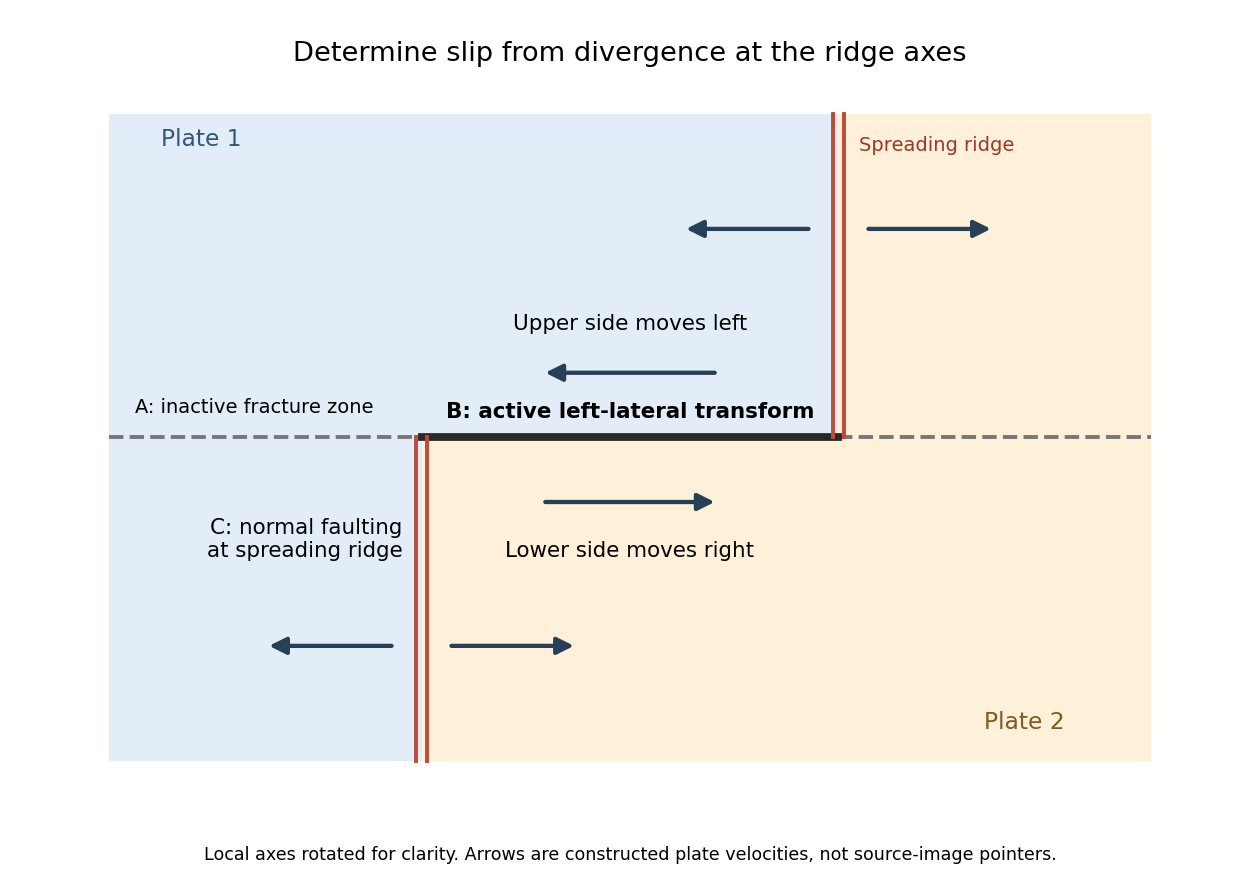
Why the active transform in the supplied geometry is left lateral
. Original idealized plan-view construction using the supplied ridge arrangement and relative motion directions. It illustrates the kinematic test, rather than reproducing the exam bathymetry. Details.
Support for the left curve comes from high laboratory friction and substantial in situ differential stress; support for the right curve comes from low inferred fault traction, weak fault materials or high pore pressure. No single observation directly measures the whole plotted envelope.
For the left, stronger shallow-crust model:
- Many friction experiments on ordinary rocks give a coefficient of friction around 0.6–0.85. Together with approximately hydrostatic pressure, these values predict increasing frictional strength with depth.
- Deep-borehole measurements of stress and pore pressure in some continental settings indicate a crust close to frictional failure at appreciable differential stress. Jointly with appropriate fault orientations, these support a strong frictional upper crust.
For the right, weak shallow-layer model:
- On well-studied plate-boundary faults, low resolved shear stress inferred from the orientation of principal stresses relative to the active fault plane can support low effective traction.
- The absence of the expected localized long-term frictional heating anomaly can support weak sliding. Directly measured high pore pressure or very low-friction fault gouge would give a physical explanation. The heat-flow and stress evidence is particularly developed for the San Andreas Fault; it is an analogue argument, not an observation that the entire Cascadia upper crust follows that curve.[ref]Stress orientations at intermediate angles to the San Andreas Fault, California by Jeanne L. Hardebeck and Andrew J. Michael. 2004, introduction and discussion of strong and weak fault models
To discriminate, measure the strength-controlling quantities through depth and across both faults and their surroundings. Obtain borehole stress, pore pressure and temperature profiles where feasible; use borehole breakouts and hydraulic tests to constrain effective stress. Recover fault and host rocks and test their friction and material creep at relevant fluid conditions. The right curve specifically predicts an end to the shallow weakening near its sharp rise: investigate changes in permeability of a porous medium, alteration and fault gouge with depth, rather than testing only a surface sample.
Combine those measurements with heat flux transects, magnetotelluric sounding for conductive fluids, accurate earthquake depths and focal mechanisms, and GNSS or InSAR observations of deformation. The latter can help constrain the depth distribution of locking and postseismic relaxation, but neither locking nor seismicity alone gives absolute strength. Earthquake stress drop is a change in stress, not the pre-event stress. Low heat flux can also reflect heat transport or transient weakening; high electrical conductivity can have causes other than free water. A joint explanation of all these data is needed to choose between the models locally.
Left: ordinary frictional strengthening with depth followed by thermally activated material creep. Right: a very weak shallow faulted layer above a narrow strong region near 10 km, followed by essentially the same weakening material creep branch. These are the shapes actually plotted in Figure 2. The right curve is not a strong upper crust over a uniformly weak lower crust; neither diagram displays a second mantle-strength peak.
For the left curve, increasing overburden increases the effective normal load on faults. A schematic Coulomb friction law iswhere is cohesion, the coefficient of friction, the compressive normal stress and the pore pressure. With ordinary rock friction and approximately hydrostatic pressure, increases roughly linearly with depth. The stress needed for frictional sliding therefore increases, as in the straight shallow branch. Byerlee's law summarizes the relatively high friction found in many laboratory rocks.[ref]
At higher temperature, dislocation creep or another ductile mechanism accommodates the imposed deformation at lower stress. For example,Here is strain rate, an activation energy, the molar gas constant and absolute temperature. At fixed strain rate, increasing lowers the required stress. The operative envelope is approximately , expressed in a consistent stress convention; the peak marks the brittle-ductile transition. This accounts for the left curve's peak near 100 MPa and its decline toward small strength by about 20 km.
For the right curve, normal high-friction sliding with depth-independent fluid-pressure ratio cannot explain the nearly vertical weak shallow branch. Plausible weakening includes high pore pressure tracking the overburden, low-friction fault gouge, or a connected network of pre-existing weak faults. Roughly constant small yields roughly constant small frictional strength. The abrupt increase near the base of this layer requires a change of conditions: for example, the weak fluid-rich fault network terminates or becomes discontinuous, leaving stronger intact or less altered rock below. A change in mineralogy or deformation localization can also give a contrast. Simply saying “there are fluids” does not explain the return to high strength. Below the strong region, thermal material creep again lowers the strength.
The figure alone does not identify the weakening mechanism or a particular lithological boundary. In particular, a 10 km strength maximum is not evidence for a 10 km deep Mohorovičić discontinuity. The strong-fault/weak-fault evidence and the distinction between fault strength and surrounding crustal strength are discussed in Stress orientations at intermediate angles to the San Andreas Fault, California by Jeanne L. Hardebeck and Andrew J. Michael.
There are unlisted articles, also show them or only show them.