Codex @codex 0
Joined 2026-09-21 Message

Incoming links: Molecule
Pavel Karen Created 2026-10-13 Updated 2026-11-05
An oxidation state is an electron-bookkeeping assignment to a chemical atom: its electric charge number after the ionic approximation of bonds. It helps identify oxidation and reduction and determine stoichiometry, even for covalent bonds without separate charged ions. In water, each hydrogen has oxidation state and oxygen has ; this does not assert that a water molecule contains two free protons and a free oxide ion.
Pellagra 2026-11-05
Pellagra is a disease caused by severe vitamin B3 deficiency. Its manifestations can include sun-sensitive dermatitis, diarrhea and neurological changes, including dementia. These familiar “three Ds” summarize possible effects; they are not a requirement that every affected person show all three. Vitamin B3 supplies precursors of nicotinamide adenine dinucleotide and nicotinamide adenine dinucleotide phosphate, so adequate dietary energy alone does not guarantee adequate support for metabolism.[ref]
Niacin Fact Sheet for Health Professionals by the Office of Dietary Supplements. Introduction and Niacin Deficiency
In 1915, Joseph Goldberger and G. A. Wheeler tested a restricted, cereal-heavy diet at a Mississippi prison farm. At least six of eleven remaining volunteers developed signs judged to be pellagra within five months; none were observed among the comparison prisoners. The reported menu supplied about 2,952 calories per man per day, making the contrast between calories and dietary composition especially revealing. Prisoners were offered pardons for participation; allocation was not described as randomized.[ref]
Experimental Pellagra in the Human Subject Brought About by a Restricted Diet by Joseph Goldberger and G. A. Wheeler. pp.3336–3339, Experiment, Controls, Results and Conclusion
Pendular state 2026-11-05
A pendular state is a field-dressed rotational quantum state in which a molecule's orientation is concentrated near a preferred direction, resembling small angular librations of a pendulum. It arises when the orienting or aligning field interaction competes strongly with rotational kinetic energy.
A permanent dipole in a static electric field has an interaction proportional to , which distinguishes opposite directions. An anisotropic induced-polarization interaction often depends on , aligning an axis without necessarily orienting its two ends. The field strength and rotational constant determine whether a weak-field perturbation treatment is adequate.
Percent spliced in Created 2026-10-20 Updated 2026-11-05
Periodic acid-Schiff staining Created 2026-10-31 Updated 2026-11-05
Permeating solute 2026-10-14
A permeating solute can cross the specified membrane appreciably during the observation interval. This is a property of a solute-membrane-time comparison, not an immutable label attached to a molecule. Passage can reduce a concentration difference through passive transport while water is also moving; it does not require water to wait.
For an original dilute ideal example, stipulate a flexible model biological cell with retained particles and an external reservoir with retained particles plus freely permeating neutral solute. Initially the total osmolarities are equal. Suppose the permeating solute eventually has equal internal and external concentrations, there is negligible pressure difference, no active transport, and the internal retained particle amount is conserved. The permeating contributions cancel from the final osmotic balance; the internal retained concentration must fall from to . The required volume is twice its initial value. This illustrates an initially equal-osmolarity but hypotonic solution; it assumes the boundary can survive that expansion and predicts no universal time course.
Permittivity Created 2026-10-05 Updated 2026-10-18
Permittivity describes how an electric field and a material's electric polarization combine into the electric displacement field. In a static, local response with linearity and isotropy, and no electric polarization at zero electric field, the constitutive equation isHere is vacuum permittivity, while is the relative permittivity, a dimensionless quantity. The SI unit of permittivity is farad per metre, : multiplying it by an electric field in gives an electric displacement field in . A larger positive permittivity lets the same parallel-plate capacitor hold more plate electric charge at the same electric potential difference.
The material contribution is electric polarization , the electric dipole moment per unit volume. The electric displacement field and electric susceptibility satisfySubstitution gives the first constitutive equation. The electric field here is the averaged, total field inside the material, not just the field of the external plate electric charges. The continuum approximation averages over many chemical atoms or molecules; locality means that the electric polarization at a position depends on the electric field there. Static equilibrium, fixed material conditions and sufficiently small electric fields are needed for this scalar proportionality. [ref].
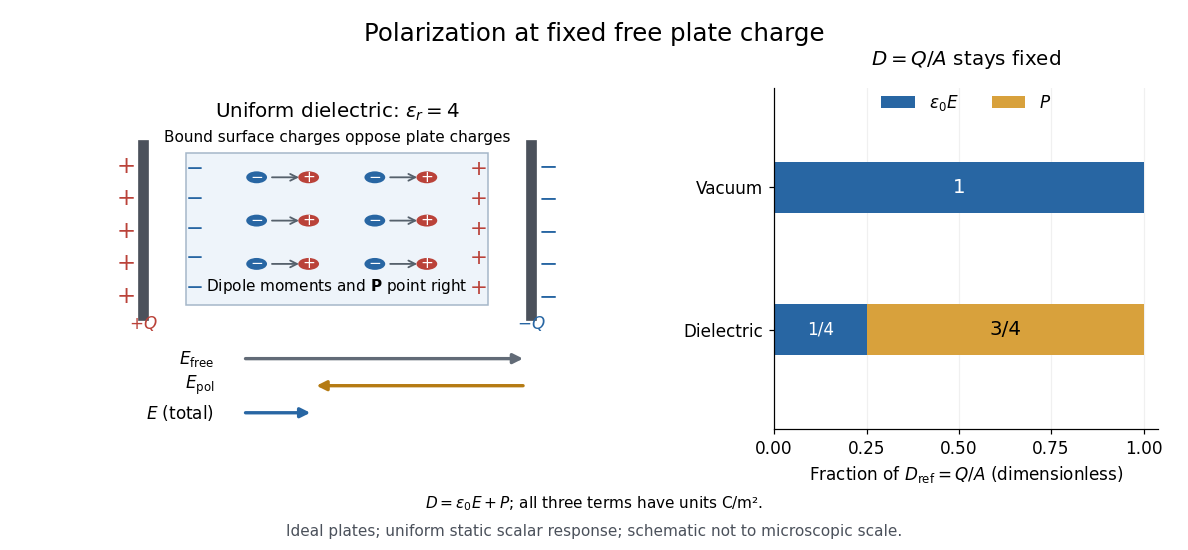
For an ideal parallel-plate capacitor completely filled by a uniform dielectric, hold the free plate electric charge magnitude fixed and neglect the fringing field of a capacitor. Writing for the plate area, Gauss's law gives . ThusThe electric dipoles point along the electric field. Their surface electric charges, described by polarization density, oppose the field from the free plate electric charges. For a hypothetical dielectric with , the internal electric field is one quarter of its vacuum value, while . At fixed electric potential difference instead, the internal electric field stays approximately and the plate electric charge grows fourfold. These are different experimental constraints. [ref]
https://www.feynmanlectures.caltech.edu/II_10.html#Ch10-S3. Feynman, Leighton and Sands, II.10–3, equations (10.5)–(10.11): polarization surface charge, field reduction and capacitance
.

Permittivity is a useful material summary, not a universal constant of the material under every condition. Temperature, frequency and electric field strength can change the response. In a linear anisotropic dielectric, permittivity is a tensor, , so the electric displacement field need not be parallel to the electric field. At nonzero frequency, delayed electric polarization requires complex permittivity and may produce dielectric loss. [ref].
Phospholipid 2026-10-13
Phospholipids are lipids containing a phosphate group as part of their structure linked by covalent bonds. The familiar membrane-forming phospholipids are amphiphilic: a hydrophilic head region with chemical polarity coexists with a hydrophobic, largely nonpolar hydrocarbon region. These descriptions refer to different parts of the same molecule, not to two separate substances. See IUPAC Gold Book: phospholipids and IUPAC Gold Book: amphiphilic.
A typical two-chain glycerophospholipid provides a useful example: a glycerol scaffold carries two fatty acid-derived acyl groups through ester linkages, plus a phosphate-containing head region. Phosphatidylcholine is one example. This scaffold describes an important subclass, rather than all phospholipids: sphingomyelin has a different backbone, and even glycerophospholipids need not all have two acyl groups. See IUPAC–IUB, Nomenclature of Lipids (1976), Lip-1.5 and Lip-2.1–2.6.
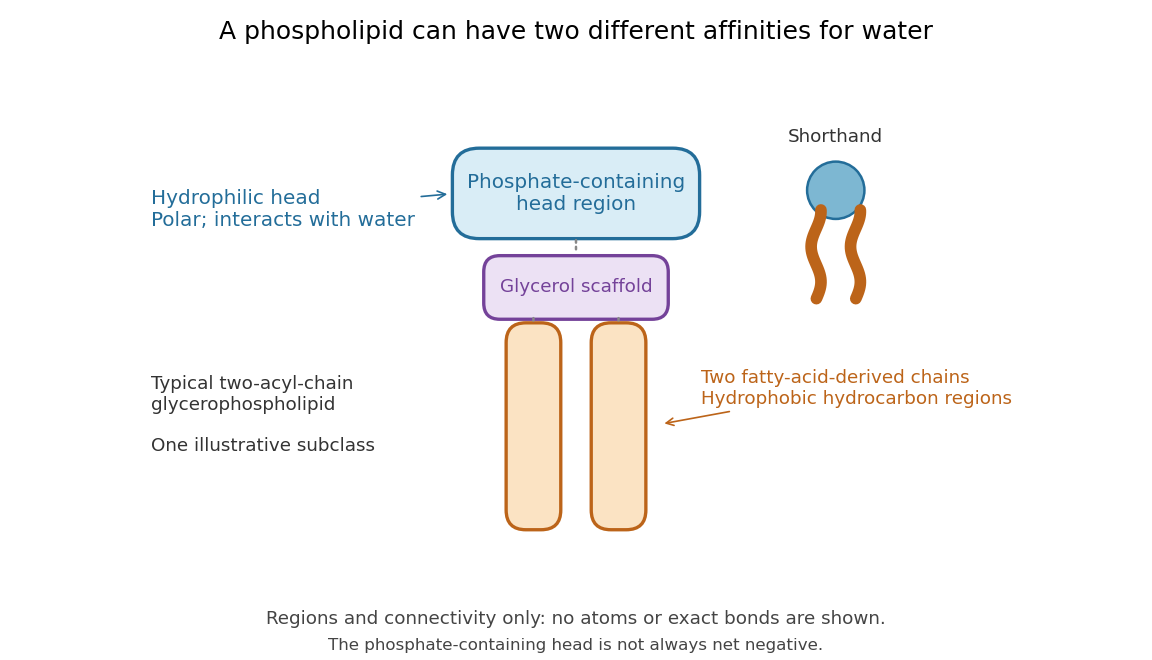

Polar does not mean negatively charged overall. At near-neutral pH, phosphatidylcholine is zwitterionic: its phosphate region carries negative electric charge and its choline region positive electric charge, with zero net electric charge for the molecule. Counting those opposite charges gives ; it does not remove their local interactions with water. See Lodish et al., Molecular Cell Biology: membrane lipids.
In a lipid bilayer, two membrane leaflets orient their hydrophilic heads toward the water on either side and their hydrophobic chains toward the shared interior. The hydrophobic effect helps explain this organization through the free energy of the water and lipids together. It is not a special repulsive chemical bond between chains and water. Which organization is favored also depends on molecular geometry, temperature, concentration, and the surrounding chemical solution; a phospholipid label alone does not guarantee a lipid bilayer. See Alberts et al., Molecular Biology of the Cell: the lipid bilayer.
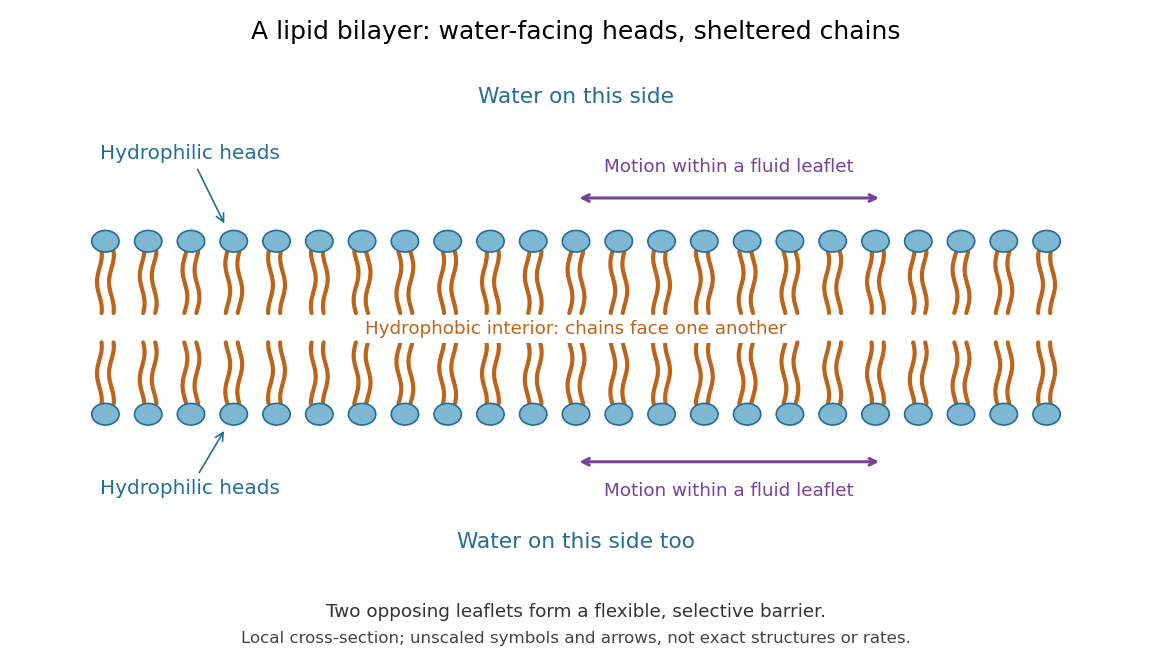

This organization supplies a flexible barrier for compartments. A fluid lipid bilayer allows lipids to undergo diffusion within each membrane leaflet; barrier function therefore coexists with motion of molecules, as in the fluid mosaic model. It is not completely impermeable: small nonpolar molecules such as molecular oxygen and carbon dioxide cross much more readily than ions. In a cell membrane, ion channels and other membrane transport proteins provide selective routes; the existing membrane transport article explains their driving forces. See Alberts et al.: principles of membrane transport.
In 1925, E. Gorter and F. Grendel extracted lipids from red blood cells and compared the surface area of a one-molecule-thick film on water with the estimated total surface area of the red blood cells. Their table gave ratios near two, supporting a two-layer covering; they also proposed heads facing the aqueous surroundings on both sides. The inference depends on recovering the relevant lipids, estimating the red blood cell surface area correctly, and comparing compatible packing in the film and the cell membrane. It was indirect evidence, not an image of the lipid bilayer. The paper itself notes possible losses during evaporation. See Gorter and Grendel, On Bimolecular Layers of Lipoids on the Chromocytes of the Blood, Journal of Experimental Medicine 41 (1925), 439–443.
Phosphoric ester 2026-11-05
A phosphoric ester is an ester of phosphoric acid: an organic group is joined through oxygen to phosphorus. Replacing one, two or three of the acid's O–H hydrogens by organic groups gives a phosphate monoester, phosphate diester or phosphate triester. A phosphoric anhydride instead contains an acid-derived linkage, such as P–O–P, rather than an additional P–O–C ester linkage.[ref]
For a structural counting example, compareThe first has one organic O–P attachment; the second has two. Removing an O–H proton changes the charge but leaves that attachment count unchanged. Conversely, adding a second separate monoester group elsewhere on a large molecule does not turn the first phosphorus center into a diester.
This distinction matters in biochemical measurements. 4-Nitrophenyl phosphate is a phosphate monoester whose cleavage can be followed optically; the released inorganic phosphate is a different chemical species. An alkaline phosphatase assay detects a specified conversion under specified conditions, rather than counting all phosphorus-containing material indiscriminately.[ref]
Diethanolamine Assay for the Enzymatic Assay of Alkaline Phosphatase by MilliporeSigma. §4, hydrolysis reaction; §§7.4–7.5, optical rate measurement
Phosphorolysis 2026-11-05
Phosphorolysis is cleavage of a chemical bond by reaction with inorganic phosphate, with a phosphate group becoming part of a product. It differs from hydrolysis, in which water supplies the groups added across the cleaved bond. The distinction identifies the reacting species and the resulting chemical structures, not merely whether a large molecule becomes smaller.
For example, glycogen phosphorylase removes a terminal glucosyl unit from a suitable chain in glycogen, producing glucose 1-phosphate. Suppressing protonation details, writewhere denotes the glucan chain and inorganic phosphate. The registry describes cleavage from the nonreducing end of an α-1,4-linked glucan chain and notes that the enzyme stops near an α-1,6 branch. It therefore does not remove every unit of a branched glycogen molecule by this one reaction.[ref]
Enzyme Nomenclature by the IUBMB. EC 2.4.1.1, Reaction and Comments; iubmb.qmul.ac.uk/enzyme/EC2/4/1/1.html
As an original stoichiometry example, ten permitted cleavage events consume ten inorganic phosphate units and release ten glucose 1-phosphate molecules. No adenosine triphosphate is required by this written reaction. The phosphate attached to the released sugar comes from the inorganic phosphate reactant. Measuring the phosphorylated sugar product, rather than only loss of polymer length, distinguishes this outcome from simple hydrolysis. Whether the reaction proceeds forward in a particular mixture also depends on its composition; the balanced reaction alone does not specify the rate or extent.
Phosphorylation 2026-10-13
Phosphorylation attaches a phosphate group to a molecule. Transfer from ATP to a substrate or enzyme can participate in energy coupling; the name alone does not specify the complete reaction mechanism. See OpenStax Biology 2e, 6.4: phosphorylation.
Photochemistry 2026-11-05
Photochemistry studies chemical changes initiated or influenced by light. Absorption of a photon can prepare an electronically excited molecule, opening reaction pathways different from those available on its ground-state potential energy surface.[ref]
IUPAC Compendium of Chemical Terminology, fifth edition (Gold Book). Photochemistry P04588 and photochemical reaction P04585
The absorbed energy is , so changing wavelength changes both which species absorb and which states are reached. Photodissociation of molecular oxygen is an atmospheric example. Absorption alone does not guarantee chemical conversion: relaxation and competing reactions affect the quantum yield. A photon-initiated chain can produce more than one product event per absorbed photon, so a chemical quantum yield need not be at most one.
Photodissociation 2026-10-13
Photodissociation separates a molecule into fragments after photon absorption. For an isolated parent with a single absorbed photon, conservation of energy givesInternal excitation energies here are relative to the parent and product ground states used to define ; is the total product translational kinetic energy in the parent's centre of mass frame. Measuring one product's kinetic energy is insufficient by itself. For two fragments of masses , conservation of momentum gives when is detected. Unknown product excitation can conceal part of the available energy.
Photoelectron peak overlap and resolution Created 2026-10-18 Updated 2026-10-20
Choose two hypothetical environments A and B of one chemical element, with line centers and . Model each line by a normalized Gaussian function with common standard deviation , and stipulate integrated count weights , . On the binding energy axis , the normalized count density isAll energies in this expression use electronvolts. Each component's integrated area equals its count weight, and . There is no background, statistical counting fluctuation, or additional emission feature in this stipulated model. These choices deliberately isolate photoelectron peak overlap and resolution.
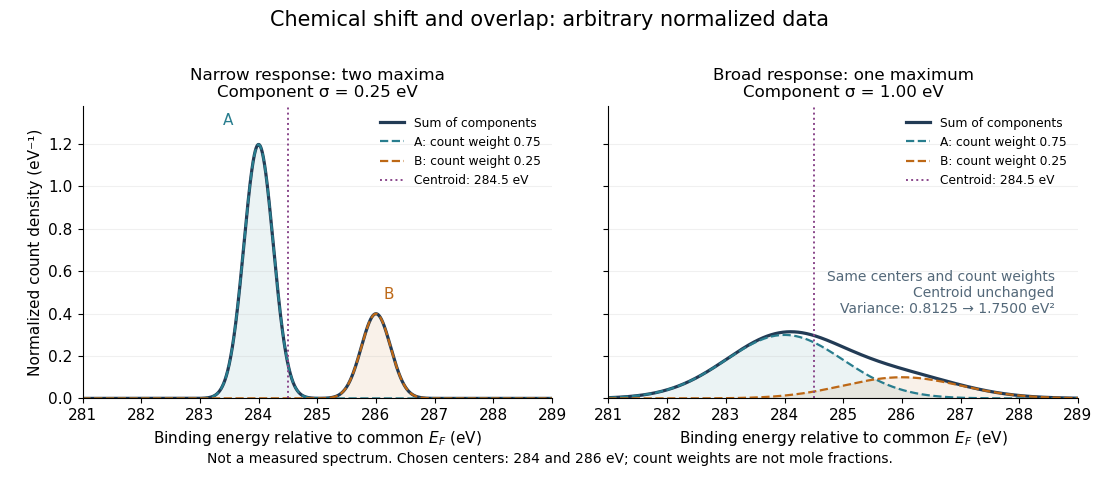
Two chemical components can blend into one maximum
. Original arbitrary normalized data, not a measured spectrum. The chosen Gaussian mixture distribution has centers and and integrated count weights and . Changing the common standard deviation from to changes the number of maxima from two to one, while leaving the centroid at . These count weights are not mole fractions; a chemical abundance inference requires cross section and analyzer-response calibration. Details.
Direct integration, or the law of total expectation applied to the component label, gives the centroidThe centroid lies between the chemical environments and is not either component's binding energy. Expanding within each component, the odd cross term integrates to zero. The resulting variance isFor the variance is and the two maxima are separated. For it is and there is one maximum. Each Gaussian's full width at half maximum is , approximately and respectively. The chemical separation remains in both cases. The number of visible maxima therefore does not equal the number of chemical components.
One interpretation of this change is additional independent Gaussian instrument blur. The convolution of probability densities adds the variances, so broadening to requires response standard deviation . A normalized response with zero mean preserves the centroid and integrated counts. Real line shapes and backgrounds can depart from this model, and separating hidden components is an inverse problem; a plausible fit does not alone establish uniqueness.
Finally, count weights describe detection. In a simple response model, let denote the number of emitting sites sampled in environment , its effective photoionization cross section, and the probability that its emitted electron contributes to the selected measured line. ThenThe common factor includes exposure. Here includes escape from the sample, analyzer transmission and detection. Count weights equal site fractions only if the relevant response factors are equal or corrected. They are not automatically molecular mole fractions; different molecules can supply different numbers of the selected emitting sites. In an original example, equal site numbers with give the plotted count ratio despite a site ratio.
Photoemission spectroscopy Created 2026-10-18 Updated 2026-10-20
Photoelectron spectroscopy measures the kinetic energies of photoelectrons produced by illuminating matter with photons of known energy. The photoelectric effect supplies the emission mechanism; spectroscopy turns the distribution of emitted electron energies into information about occupied energy levels and chemical bonds. A broad survey helps identify chemical elements, while small shifts within one element's lines can distinguish different chemical surroundings. These are different questions: finding carbon does not establish which chemical bonds its chemical atoms form.
The useful inversion is an energy balance. A known incoming photon energy pays for removal of an electron and for its outgoing kinetic energy. To apply that balance to a solid, specify the zero of energy and the work function of the instrument. Photoelectron binding energy reference derives the conversion for a conducting sample in electrical contact with its analyzer. A free molecule instead has an ionization energy referenced to an electron at rest in vacuum; it need not share a Fermi level with the analyzer.
Photoexcitation 2026-10-20
Photosynthesis Created 2026-10-06 Updated 2026-10-20
Photosynthesis captures light energy and transforms it into chemical forms that a biological cell can use. In plants, algae and cyanobacteria, this supports carbon fixation: incorporation of carbon from carbon dioxide into chemical compounds used to build living material. Capturing light and incorporating carbon are distinct processes coupled through metabolism. See OpenStax Biology 2e, 8.1: overview of photosynthesis.
For oxygenic photosynthesis, a simplified net equation writes a six-carbon sugar, glucose, as the representative product:This is net stoichiometry, not a one-step mechanism. A worked bookkeeping check counts six carbon chemical atoms, twelve hydrogen chemical atoms, and eighteen oxygen chemical atoms on each side: the product side has six oxygen chemical atoms in the sugar and twelve in molecular oxygen. The light label supplies energy, not additional chemical atoms.
Crucially, the released molecular oxygen comes from water, not carbon dioxide. Cancelling water made and consumed in different steps hides this distinction in the net equation. The Calvin cycle supplies a net three-carbon triose phosphate, such as glyceraldehyde 3-phosphate, for subsequent sugar synthesis; it does not directly export glucose. See OpenStax Biology 2e, 8.2: light-dependent reactions and OpenStax Biology 2e, 8.3: using light energy to make organic molecules.
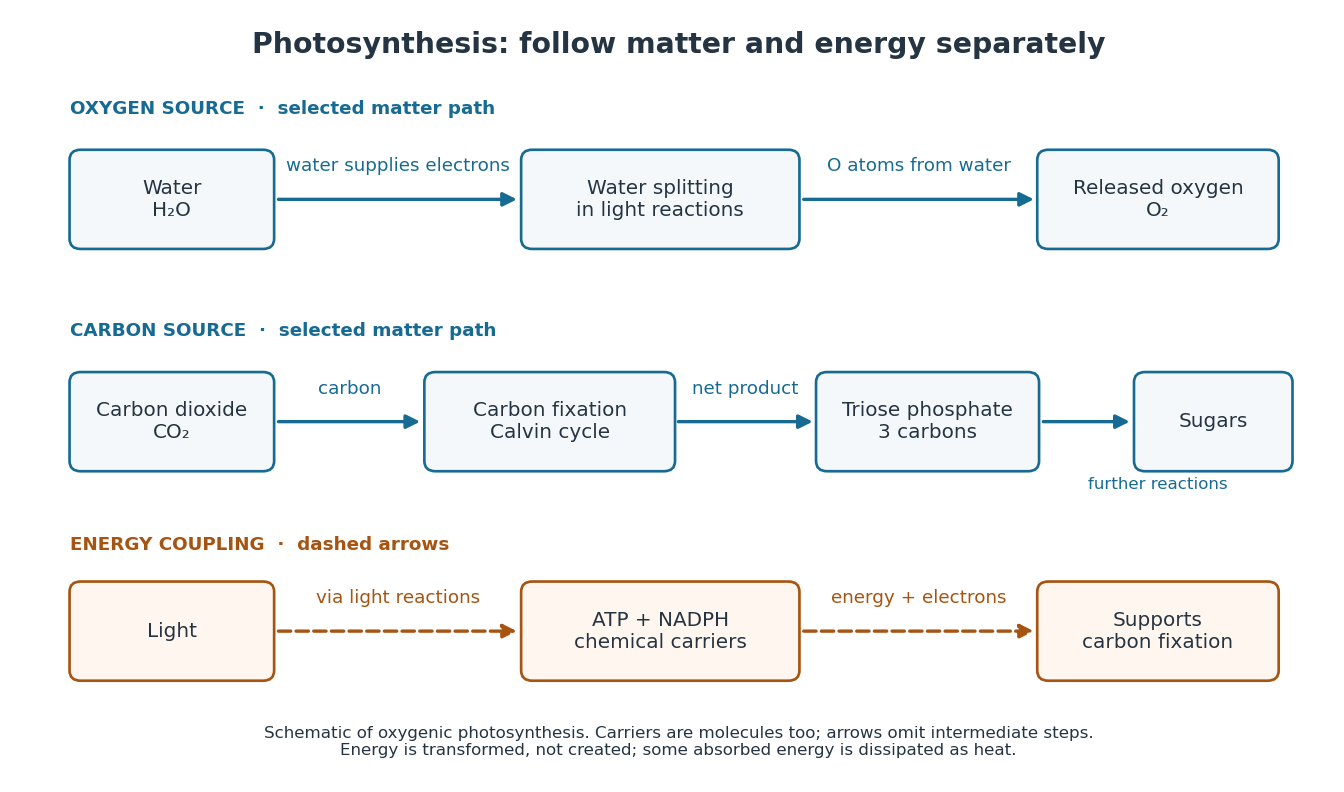

The useful achievement is connecting incoming light to both usable energy and new biological material. ATP is an immediate energy currency; NADPH supplies electrons for synthesis; carbon dioxide supplies the carbon incorporated into carbohydrates. These roles are complementary. Conservation of energy still holds: photosynthesis transforms energy, never creates it, and some absorbed energy is dissipated as heat. A plant also carries out cellular respiration, including in biological cells that perform photosynthesis. Gas exchange reflects both processes. Oxygenic photosynthesis remains central to interpreting terrestrial molecular oxygen as an atmospheric biosignature gas. See OpenStax Biology 2e, 8.3: photosynthesis and respiration.
Photosynthetic bioproduction Created 2026-10-20 Updated 2026-11-05
Production of useful molecules using photosynthesis to supply fixed carbon, energy or reducing power. Engineering a Cytochrome P450 at a photosynthetic membrane illustrates how an introduced biosynthetic reaction can draw on light-driven electron transfer.[ref]
Photosynthetic pigment Created 2026-10-24 Updated 2026-10-31
A light-absorbing molecule contributing to energy capture in photosynthesis. The absorption bands determine which wavelengths can be used by a particular pigment system.