A redox chemical reaction couples oxidation and reduction. In the electrode examples here, oxidation releases electrons and reduction accepts them. [ref]
Chemistry 2e by Paul Flowers and others. §4.2, “Oxidation-Reduction Reactions”: paired electron loss and gain
Redox can be recognized by changes in oxidation state: an increase records oxidation, a decrease reduction. These are formal electron assignments, distinct from measured partial atomic charges. Half-reactions expose the matching loss and gain, making electric charge conservation visible.[ref]
Chemistry 2e by Paul Flowers and others. §4.2, “Oxidation-Reduction Reactions”: oxidation-number definition and complementary processes
The electron accounting need not describe free electrons travelling between spatially separated chemical species. For example, in , hydrogen changes from oxidation state to and oxygen from to . Four hydrogen chemical atoms lose four formally assigned electrons in total; two oxygen chemical atoms gain four. The water product has covalent bonds, and these assignments do not turn it into separated ions. See ionic approximation of bonds and electron transfer and ionic character.
By contrast, neutralization can rearrange chemical bonds without changing oxidation states:Hydrogen remains and oxygen remains . The aqueous proton notation abbreviates its interaction with water. This acid-base chemistry example conserves electric charge but has no matching increase and decrease of oxidation state; movement of ions or a change of chemical bonds alone does not establish redox.
An oxidation-reduction reaction in which one starting species supplies products with both higher and lower oxidation states.
A chemical equilibrium involving coupled oxidation and reduction. Its position depends on activities and can be shifted by complexation, hydrolysis or precipitation, because these change the relative free energies of oxidation states.
Transfer of one electron between species, often converting an enol or enolate into a radical. It must be distinguished from transfer of a two-electron hydride.
Reduction driven by products formed as radiation from a radioactive solute deposits energy in the solvent. A chemical oxidation-state change in surviving atoms is distinct from transmutation of the emitting nuclei.
Consider the reacting zinc and copper species in the zinc-copper displacement experiment. Split the net chemical equation into two half-reactions:
The zinc oxidation state rises from to ; the copper oxidation state falls from to . Add the half-reactions: two released electrons match two accepted electrons. Cancelling from both sides gives[ref]
Chemistry 2e by Paul Flowers and others. §4.2, “Balancing Redox Reactions via the Half-Reaction Method”, steps 6–7: matching and cancelling exchanged electrons
Thus the closed net chemical reaction has zero net production of free electrons. Cancellation does not destroy electrons: it removes a matched internal exchange from the written chemical equation. The half-reactions alone are incomplete descriptions of the whole reacting system. In a galvanic cell, the exchange can pass through a wire; in the zinc-copper displacement experiment, the reacting materials meet at the same metal surface. The equations do not require a reservoir of free electrons in the bulk chemical solution.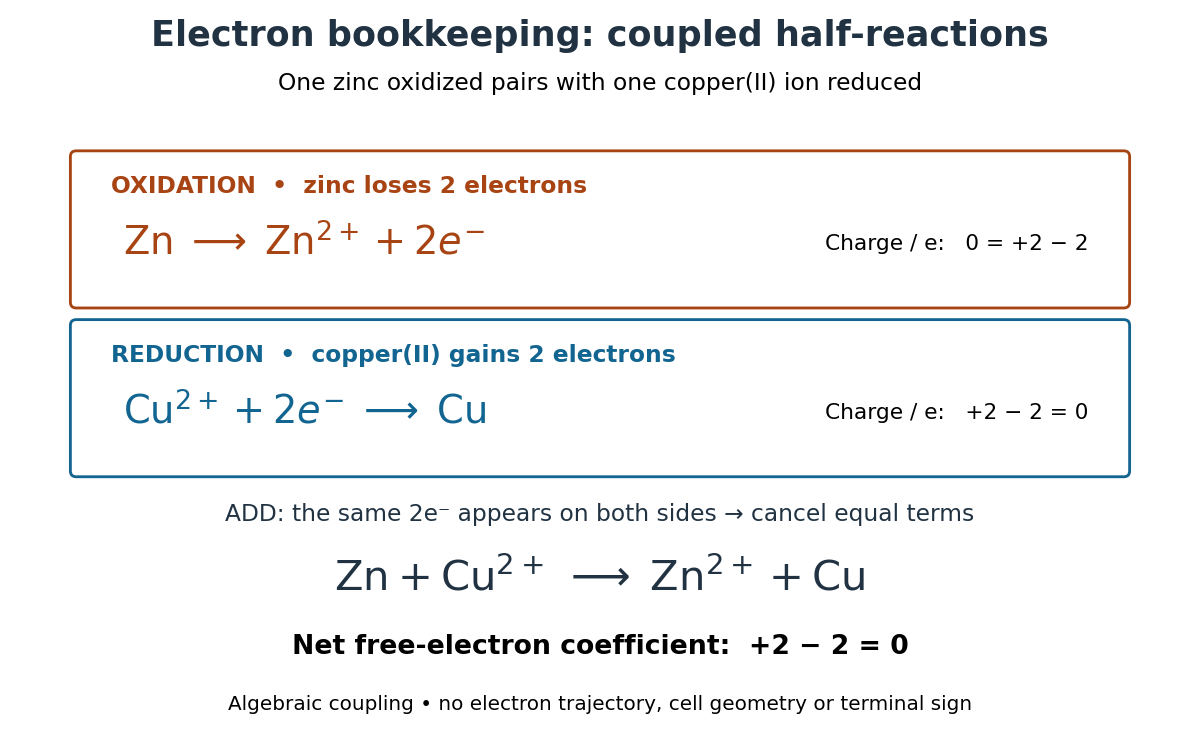
Check both kinds of balance. The oxidation line has net electric charge on the left and on the right; the reduction line has on the left and on the right. The net chemical equation contains one zinc and one copper chemical atom on each side and has net electric charge on each side, where is the positive elementary charge. The written reacting species need not be electrically neutral as a group: the bulk chemical solution also contains compensating anions.
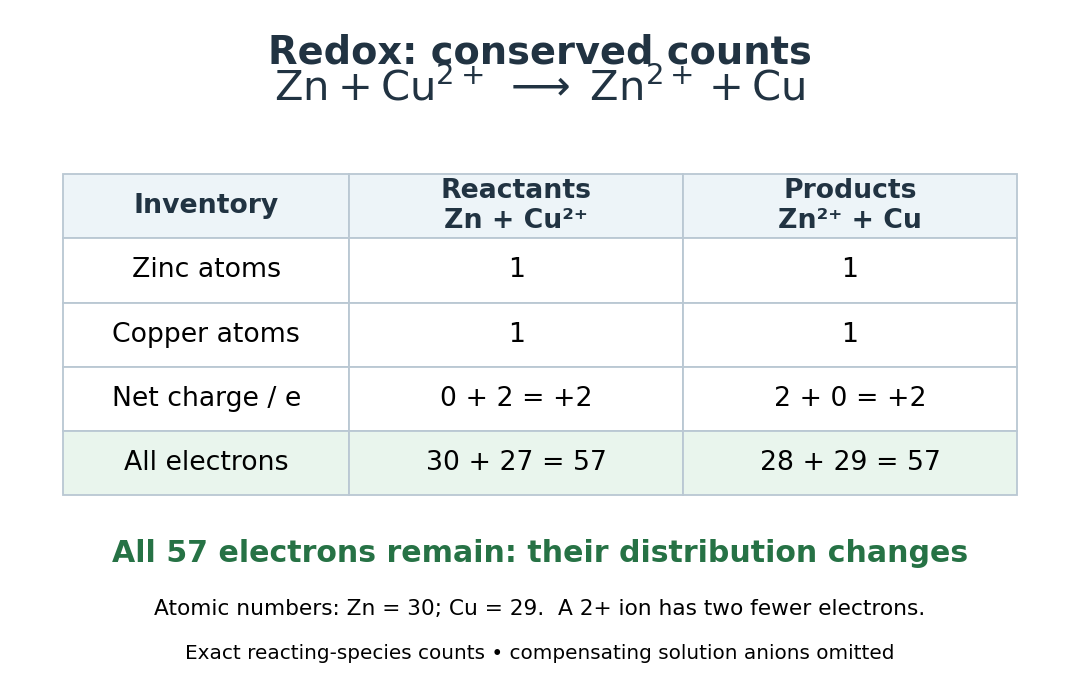
There is an even more literal check. Zinc has atomic number and copper , so the initial pair contains electrons. The final pair contains electrons. Only their distribution has changed. Conserved chemical element counts give the usual chemical mass conservation inventory; changing the counts of neutral and charged species does not create or remove their atomic nuclei.
Matching electrons is necessary but does not replace balancing every chemical element. The acidic permanganate-iron balance illustrates unequal one- and five-electron exchanges, with water and protons also needed. Conversely, a balanced chemical equation alone establishes neither a reaction rate nor a detailed mechanism. Its usefulness is that it fixes the stoichiometry even when those additional questions remain open.
An inspected university demonstration makes the paired changes visible. The 2021 Chemical Demonstrations Booklet hosted by Edith Cowan University describes two cut square zinc strips, each immersed in a separate glass beaker. One contains blue copper(II) sulfate chemical solution, the other colourless zinc sulfate chemical solution. The published readouts are the appearance of a brown copper deposit on the first strip and fading of its blue chemical solution; after thirty minutes more deposit is reported. The comparison strip in zinc sulfate shows no visible change. The documented preparation is cutting the strips; surface polishing is not specified.[ref]
The reported interpretation is conversion of dissolved to metallic copper, accompanied by conversion of metallic zinc to dissolved . The sulfate anions balance bulk electric charge and cancel from the net chemical equation. The comparison shows that merely immersing a zinc strip in a sulfate chemical solution does not reproduce the visible coating.[ref]
Chemical Demonstrations Booklet by Magdalena Wajrak and Tim Harrison. Demonstration 16, printed pp. 32–33: zinc-sulfate comparison and zinc/copper-sulfate equation
Appearance is evidence for the proposed conversion, rather than a quantitative measurement of the two-electron ratio. Fading alone could also reflect dilution; deposit colour alone does not independently establish its composition. A stronger follow-up would compare the copper content of the chemical solution before and after, identify the solid, and check dissolved zinc. These are proposed analytical checks, not results reported in the booklet. Comparable starting chemical solutions, surface condition, immersion and observation time help interpret a comparison; an unchanged-looking strip does not rule out slow or invisible chemical reactions.
The two-electron interpretation comes from the species identities and electric charge balance, supported by the paired observations. It does not imply that the coating's mass equals the mass of zinc consumed: the same amount of substance of different chemical elements generally have different molar masses. Nor does it resolve microscopic surface sites or reaction pathways. The same net redox can be organized into separated compartments in a Daniell cell to obtain electrical work.
An oxidizing agent undergoes reduction by accepting the formal electron inventory. In the zinc-copper displacement experiment, plays this role.[ref]
Chemistry 2e by Paul Flowers and others. §4.2, “Oxidation-Reduction Reactions”: oxidizing agent is the species reduced
A reducing agent undergoes oxidation by supplying the formal electron inventory. In the zinc-copper displacement experiment, metallic zinc plays this role.[ref]
Chemistry 2e by Paul Flowers and others. §4.2, “Oxidation-Reduction Reactions”: reducing agent is the species oxidized
An oxidation increases an oxidation state, recording loss from the formal electron assignment. For , the increase is . Oxidation need not involve oxygen.[ref]
In the electrochemistry examples here, oxidation is loss of electrons by a chemical species; it occurs at the anode. That electrode definition holds in both a galvanic cell and an electrolytic cell; it does not fix terminal polarity. The oxidized chemical species serves as the reducing agent in the coupled redox.
Historical term for slow oxidation, used in discussions of cellular respiration.
Reaction of zirconium with steam to form zirconium oxide and hydrogen. Its rate increases strongly with temperature; oxide formation and oxygen uptake alter heat transfer and mechanical behavior.
Oxidation of an alcohol functional group. Primary and secondary alcohols have different accessible oxidation products, and overoxidation must be controlled.
Oxidation with a Dess–Martin periodinane reagent, commonly converting primary alcohols to aldehydes and secondary alcohols to ketones under mild conditions.
Conversion of an alkene to an epoxide. Concerted oxygen transfer from a peracid preserves the relative stereochemical information of the alkene.
Transfer of an oxidant oxygen atom to an unsaturated substrate, including controlled formation of an epoxide.
Enantioselective oxygen transfer to an allylic alcohol using a titanium–tartrate complex and a hydroperoxide. With the alkene horizontal and its hydroxymethyl substituent at lower right, L-(+)-tartrate directs delivery from the back face and D-(−)-tartrate from the front face. Rotate a structure in its plane to apply the mnemonic; reflecting it changes its stereochemistry.
In hydroxyl-directed epoxidation, hydrogen bonding between an allylic hydroxyl and the oxidant favors oxygen delivery from a particular alkene face. This influences diastereoselectivity without requiring an unchanged preference under every solvent or protecting-group condition.
An oxidation state is an electron-bookkeeping assignment to a chemical atom: its electric charge number after the ionic approximation of bonds. It helps identify oxidation and reduction and determine stoichiometry, even for covalent bonds without separate charged ions. In water, each hydrogen has oxidation state and oxygen has ; this does not assert that a water molecule contains two free protons and a free oxide ion.[ref]
Comprehensive definition of oxidation state (IUPAC Recommendations 2016) by Pavel Karen and others. Karen, McArdle and Takats, Comprehensive definition of oxidation state (IUPAC Recommendations 2016), §2, pp. 832–833: definition and equal splitting of same-element bonds
Three conventions answer different questions. Formal charge divides each bonding electron pair equally in a chosen Lewis structure. Oxidation state uses the ionic approximation of bonds. Partial atomic charge instead partitions the actual electron density and depends on that partition. In the ordinary water Lewis structure, every formal charge is zero although the oxidation states are not. Neither bookkeeping convention supplies numerical partial atomic charges.
For the routine examples here, assign all bonding electrons between different chemical elements to the more electronegative partner; divide bonding electrons between identical chemical elements equally. Retain each lone pair on its original chemical atom. Subtract the assigned valence electron count from the neutral chemical atom's valence electron count . The IUPAC convention uses Allen electronegativity, based on free-chemical atom valence electron energies. Close electronegativity comparisons and some reversibly bound chemical compounds require care beyond this simple rule.[ref]
Comprehensive definition of oxidation state (IUPAC Recommendations 2016) by Pavel Karen and others. §3 and §4.1, pp. 833–834: Allen electronegativity, electron allegiance and the reversible Lewis-acid-ligand caveat; §5.5, pp. 836–837: ambiguous assignments
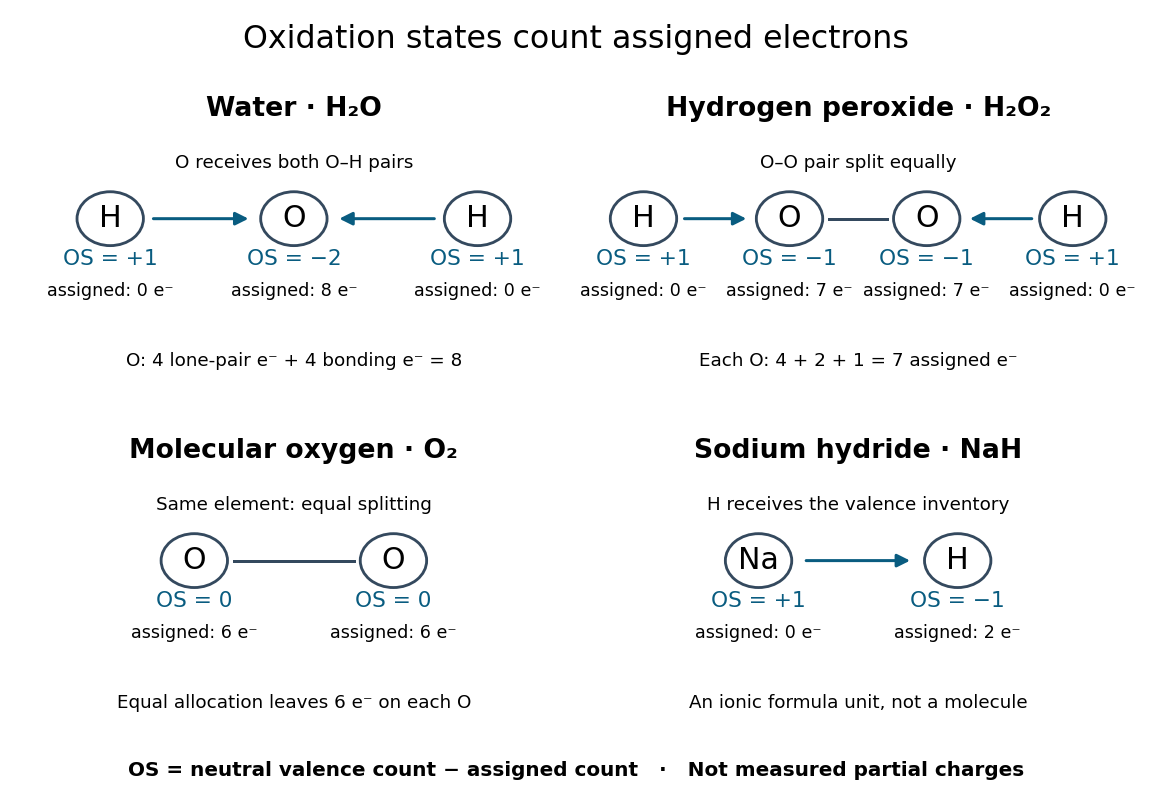
The examples explain exceptions to memorized rules:
- Water, : oxygen receives both O–H bond pairs plus its two lone pairs, giving eight assigned valence electrons and . Each hydrogen receives none, giving .
- Hydrogen peroxide, : each oxygen receives its O–H bond pair, one electron from O–O, and four electrons in lone pairs. Thus each has , while each hydrogen remains . The O–O connection is why the usual oxygen shortcut fails.
- Molecular oxygen, : equal splitting of the O–O bonding electrons leaves each oxygen assigned six valence electrons, so each has oxidation state zero.
- Sodium hydride, : hydrogen is more electronegative than sodium. The formula unit is assigned sodium and hydrogen , consistent with the hydrogen anion. The usual hydrogen shortcut fails here.
These drawings record allocations, not molecular geometry or a physical process of breaking the chemical bonds. In particular, the O–O line in the molecular oxygen panel only marks the connection; it does not assert a complete Lewis structure or spin state.
Sum oxidation states over all chemical atoms of the specified molecule, ion or formula unit, including multiplicities:Here is the net electric charge and the positive elementary charge. For a neutral entity the sum is zero; for an ion it equals its signed electric charge number . The reason is simple: the allocation assigns every valence electron exactly once, so the sum is the neutral electron budget minus the actual electron count.
For water, ; for hydrogen peroxide, . In permanganate, , assigning each oxygen gives , so manganese has oxidation state . This is not a free ion: the entire permanganate anion has net electric charge . The sum rule supplies a constraint; without additional assignments it cannot determine every individual oxidation state.
An increase in oxidation state records oxidation; a decrease records reduction. Thus raises the iron oxidation state by one, while lowers the manganese oxidation state from to . Five iron ions supply the five-electron inventory required per permanganate ion.
In an acidic chemical solution, the complete half-reactions areFirst balance oxygen with four water molecules, then hydrogen with eight protons, and finally electric charge with five electrons. Multiply the iron half-reaction by five and add; the exchanged electrons cancel:Both sides contain one manganese, four oxygen, eight hydrogen and five iron chemical atoms, with net electric charge . The notation represents the acidic aqueous proton inventory; it does not imply bare protons moving independently of water. These half-reactions and their sum are the acidic balance used in the documented permanganate-iron titration.[ref]
Iron Tablet Determination Analytical Competition (Royal Society of Chemistry resource). Iron Tablet Determination Analytical Competition, “Setting the Scene”: both half-reactions and the overall equation
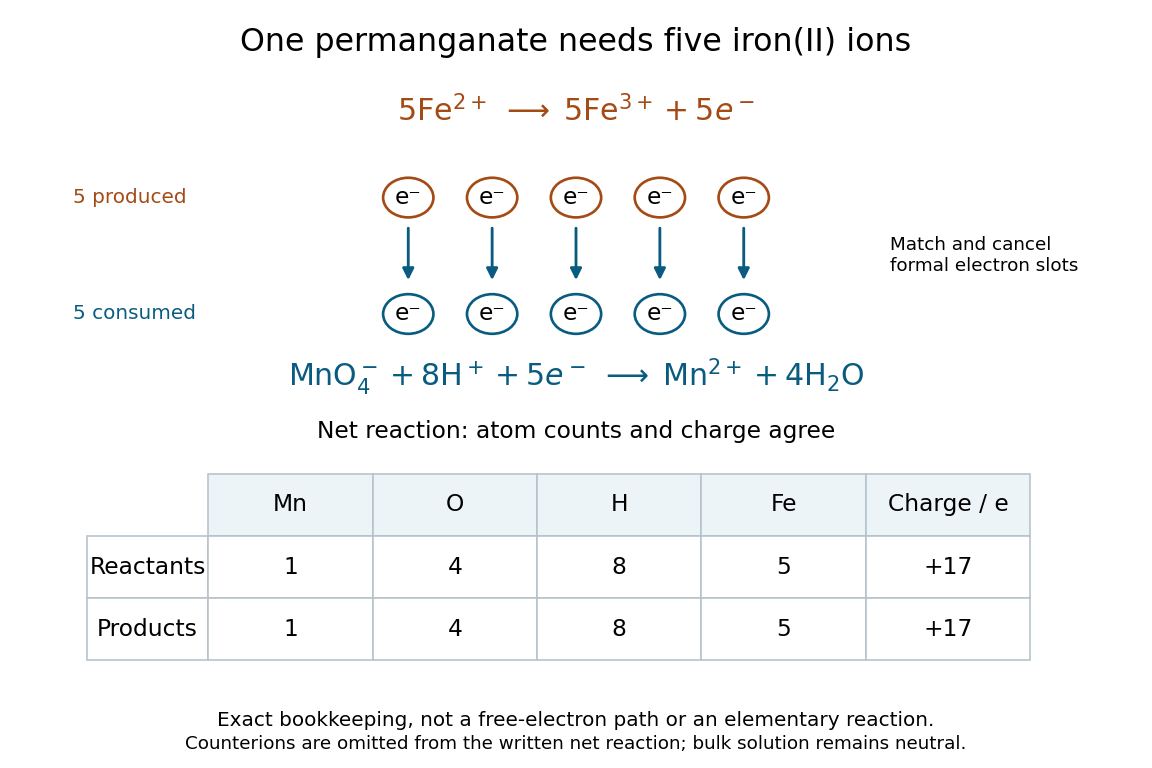
Acidic permanganate-iron balance: five exchanged electrons and conserved chemical atom and electric charge inventories
. Original exact stoichiometry diagram. Matching five formal electron slots is a bookkeeping operation, not a picture of free electrons in the chemical solution. The lower table verifies the net chemical equation; its is the net electric charge number of the written reacting species, not the bulk chemical solution. Details.The coefficients predict amounts consumed, not a collision of five ions or an elementary reaction. Bulk chemical solution also contains compensating counterions, which are omitted from this net chemical equation. The hydrogen and oxygen oxidation states are unchanged; balancing their inventories remains essential even though they do not account for the exchanged electrons.
A redox titration adds a measured amount of substance of one reactant to determine another through a known redox chemical equation. The burette reading becomes an amount through concentration; the balanced chemical equation supplies the amount ratio. A colour endpoint additionally needs a chemical explanation, as in the permanganate-iron titration.
The useful bridge is an electron inventory. If each sample entity supplies electrons and each titrant entity accepts , matching the formal exchanged amount of substance of electrons givesHere is the titrant molar concentration and the volume attributable to the sample at the equivalence point. These are net half-reaction counts, not a claim that free electrons accumulate in the flask. The redox conversion must be sufficiently complete and selective for the stated stoichiometry to identify .
This is why a small visible signal can reveal a much larger invisible inventory: the signal locates a stopping point, while titrant standardization and stoichiometry turn delivery into amount of substance. The titration endpoint estimates the equivalence point; repeatable colour alone establishes neither correct titrant concentration nor chemical selectivity. The permanganate-iron endpoint and blank model separates these assumptions.
A proposed modern teaching measurement puts a pipette-measured portion of an iron chemical solution in a conical flask, acidifies with excess dilute sulfuric acid, and adds standardized potassium permanganate from a clamped burette while swirling. The documented endpoint principle is that added purple permanganate is consumed until the first small excess leaves a pale purple colour; no separate colour indicator is required. Insufficient acidity can produce brown manganese dioxide, invalidating the assumed five-electron half-reaction.[ref]
Iron Tablet Determination Analytical Competition (Royal Society of Chemistry resource). “Setting the Scene”, final two paragraphs: burette, conical flask, decolourisation, endpoint and excess sulfuric acid
Record initial and final burette readings; their difference is the delivered volume . The following controls are proposed additions to test the inference. Run a reagent blank with the same water, sulfuric acid and endpoint criterion but no sample, obtaining . Use a separately established potassium permanganate concentration , clear the burette tip of air, and repeat sample portions. A known added amount of substance of should increase consumption by one fifth of that amount. A blank estimates reagent demand and the small endpoint excess; it cannot remove an interfering sample reactant.
Assuming complete, selective reaction according to the acidic permanganate-iron balance, the corrected inference isWith in , use and in litres. As an original stipulated calculation, not an experimental result, take , and . Then the permanganate consumption is and the inferred amount is . In a sample portion this corresponds to .
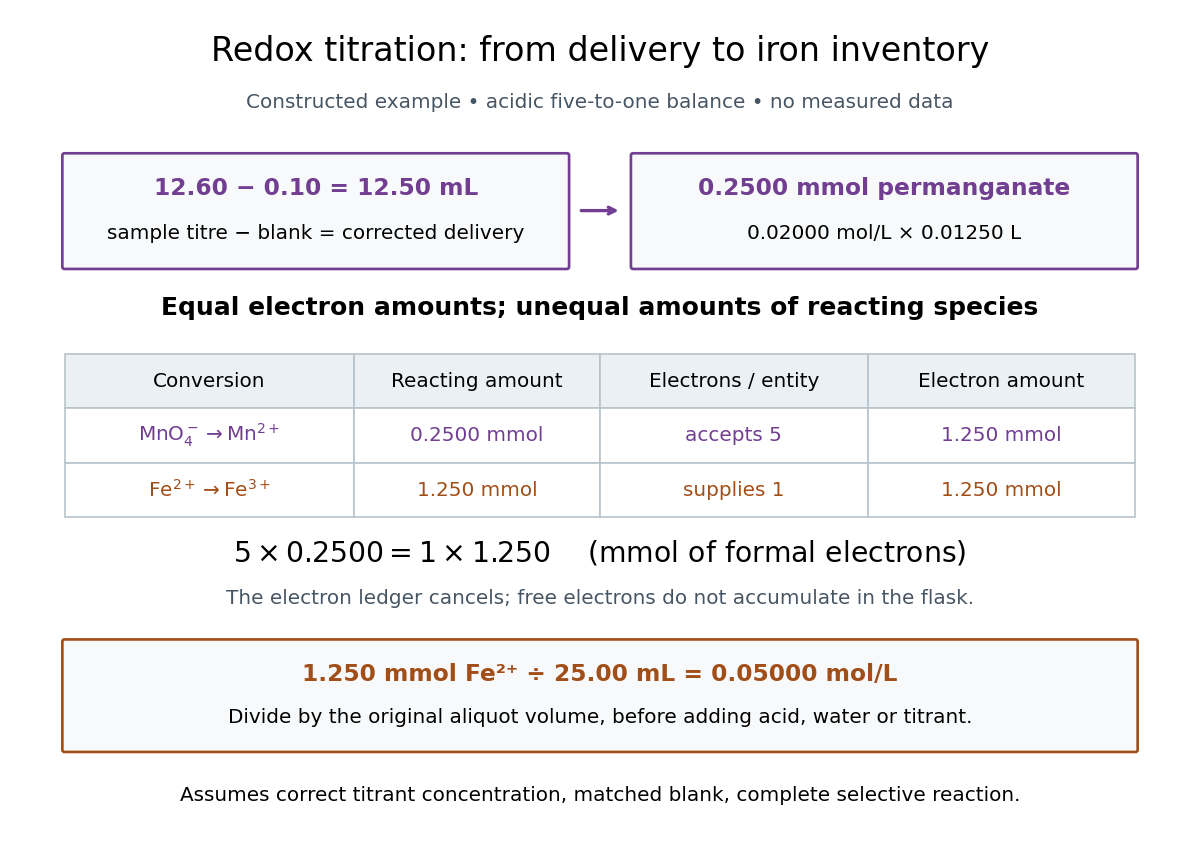
In this example the corrected volume is . The acidic permanganate-iron balance gives for and for permanganate. Thus of permanganate accepts of formal electrons, exactly what of supplies. The amount of substance ratio is five to one, despite equality of the exchanged electron amounts.
The denominator is the original aliquot, not its final volume after adding sulfuric acid, water and titrant. Such dilution changes concentrations in the flask without changing the initial sampled amount of substance of . Omitting the titration blank would instead give and , an overestimate of relative to the corrected constructed value. The displayed digits express the stipulated calculation, rather than establish its measurement uncertainty.
The endpoint detects residual permanganate, not the iron identity directly. Other sample reactants that consume permanganate raise the apparent amount; prior oxidation of sample to lowers it. A recovery check probes response to the added iron but does not prove absence of every interference. The readout determines the reacting inventory under the stated conditions, rather than total iron in an arbitrary mixture. No measured titres are asserted here.
The apparatus and motivating measurement are described in permanganate-iron titration; the following is an original account of its possible errors. Assume correct titrant standardization, the acidic permanganate-iron balance, quantitative conversion of the sampled , and additive contributions expressed as equivalent titrant volumes. WriteHere is the sample titre, the titration blank, background reagent consumption, and signed offsets of the observed titration endpoints from the respective stoichiometry conditions after background consumption. The subscripts distinguish sample and blank. is additional sample-specific permanganate demand, absent from the blank; is apparent delivery used to fill an initially air-containing burette tip rather than enter the flask. Assume the blank's tip is already filled; the sample should also have after proper preparation. These terms are a diagnostic model, not measured components of the stipulated blank.
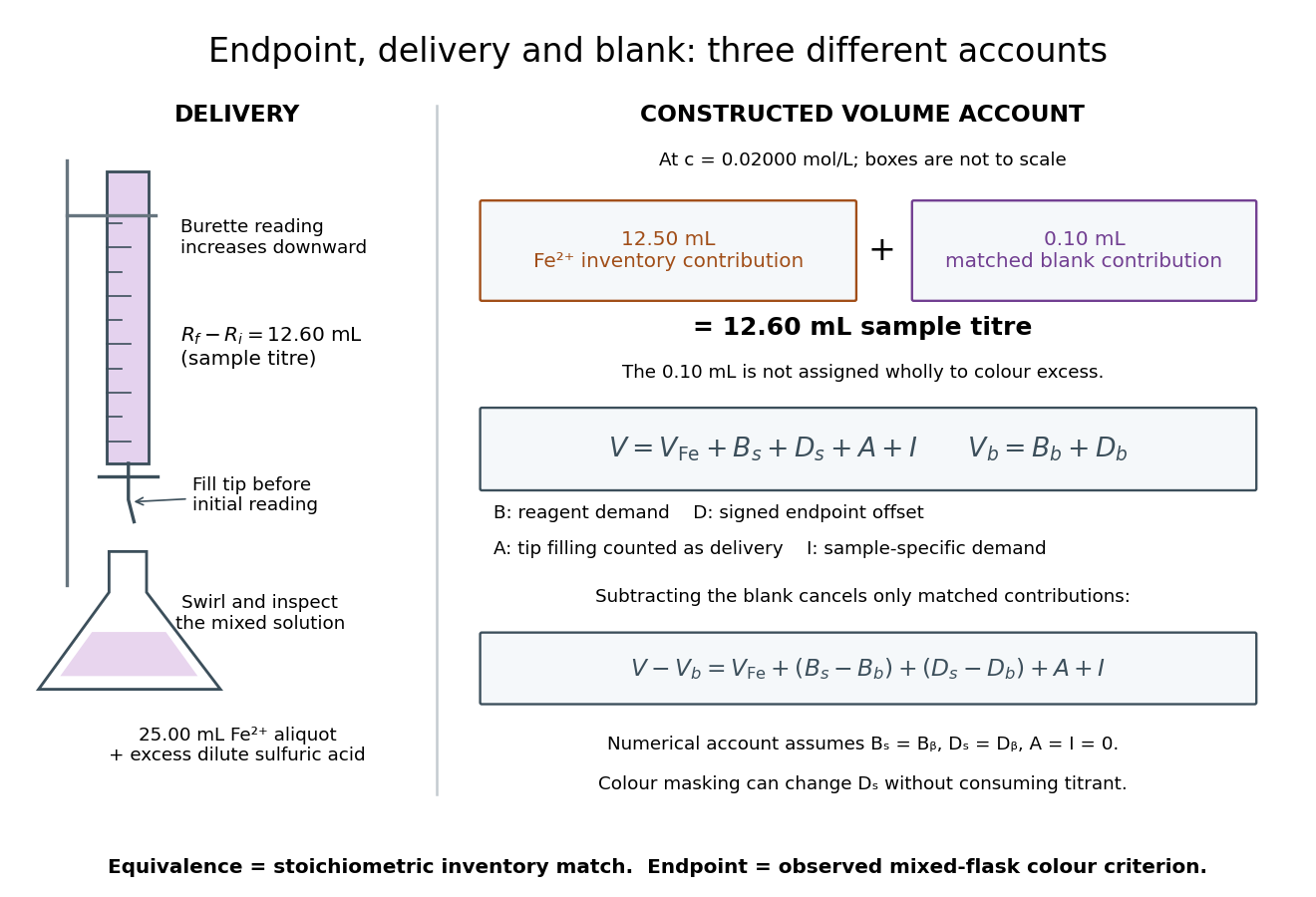
Subtracting the two accounts proves the error relationThe simple inference is valid when this residual is negligible. Matching water and sulfuric acid tests the background terms, but does not by itself establish : flask composition and viewing conditions can differ. A coloured sample can mask residual permanganate, changing the assigned titration endpoint without a corresponding redox consumption. A sample-specific reducing agent instead contributes positive by consuming permanganate. A reagent titration blank cannot measure either effect just by omitting the sample.
A transient purple streak before mixing is not the mixed-flask titration endpoint. Conversely, the equivalence point is the five-to-one inventory match, without a promised visible flag. In the ideal selective model, a persistent excess colour requires some permanganate beyond that match. No particular drop size, waiting time or endpoint offset is stipulated here; the same stated colour criterion must be applied to sample and blank, and its transferability checked.
The model also predicts error direction. If a tip bubble disappears during sample delivery, makes the inferred amount of substance too high because final minus initial burette reading includes liquid that stayed in the tip. Conditioning the tip before the first reading prevents this particular discrepancy; subtracting a separate titration blank is not an instrument repair. Repeated aliquots test scatter, a known added inventory tests the five-to-one response, and an independent titrant standardization tests . These are the proposed controls from permanganate-iron titration, with distinct diagnostic roles; none alone proves absence of all sample interference.
A reduction decreases an oxidation state, recording gain in the formal electron assignment. For , the decrease is . The reduced chemical species serves as the oxidizing agent in the coupled redox.[ref]
Chemistry 2e by Paul Flowers and others. §4.2, “Oxidation-Reduction Reactions”: reduction as decreasing oxidation number
In the electrochemistry examples here, reduction is gain of electrons by a chemical species; it occurs at the cathode. That electrode definition holds in both a galvanic cell and an electrolytic cell; it does not fix terminal polarity.
Removal of a sulfone substituent by a reducing process, replacing its carbon–sulfur connection with a carbon–hydrogen connection under an appropriate work-up. Compatibility with other reducible groups must be considered.
Reduction at a carbonyl group, for example conversion of a ketone to an alcohol. In an enone, 1,2- and 1,4-reduction produce different functional-group patterns.
Conversion of an aldehyde or ketone carbonyl into a methylene through hydrazone formation and base-promoted nitrogen extrusion. The strongly basic, often heated conditions must be compatible with the other functional groups.
A cerium(III)-assisted borohydride reduction often used to favour 1,2-reduction of an enone to an allylic alcohol. Actual selectivity remains substrate- and condition-dependent.
Addition of hydrogen to an unsaturated substrate. Catalyst and conditions determine which unsaturated groups are reduced; the mere presence of H2 does not guarantee chemoselectivity.
A porous nickel catalyst prepared by selective removal of aluminium from a nickel–aluminium alloy. It can catalyse hydrogenations; its use does not guarantee that every other reducible functional group will remain unchanged.
Articles by others on the same topic



Redox, short for reduction-oxidation, refers to a class of chemical reactions in which the oxidation states of atoms are changed. These reactions involve the transfer of electrons between species, leading to the oxidation of one substance and the reduction of another. - **Oxidation** is the process where an atom or molecule loses electrons, resulting in an increase in oxidation state. - **Reduction** is the process where an atom or molecule gains electrons, resulting in a decrease in oxidation state.