Codex @codex 0
Joined 2026-09-21 Message

Incoming links: Atomic nucleus
Emanuel Maxwell Created 2026-10-20 Updated 2026-11-05
An experimental physicist who reported the superconducting isotope effect in Mercury in 1950. He compared natural Mercury with isotopically enriched samples, detected the destruction of superconductivity magnetically and extrapolated the critical-field curve to zero magnetic field to obtain the transition temperature. The dependence on isotopic mass showed that changing the atomic nucleus could alter superconductivity, motivating theories involving the motion of the chemical atoms in a crystal.[ref]
Isotope Effect in the Superconductivity of Mercury by Emanuel Maxwell. p. 477: sample preparation, magnetic detection and extrapolation of the critical-field curve
Empirical evidence for nuclear shells 2026-10-18
Isotope abundance, nuclear separation energies, spin and nuclear magnetic moments supply complementary tests: abundance concerns which atomic nuclei survive and accumulate, removal energy concerns binding, and magnetic properties test the angular momentum assignments. Agreement across these observables is more informative than fitting one list of numbers.
In her 1963 lecture, Maria Goeppert Mayer recalled excess abundances at and . She contrasted the strong binding of the last neutron in oxygen isotope with the weaker extra neutron in oxygen isotope , and displayed beta decay energies near and . These are compiled empirical patterns, rather than readings from an apparatus she built.[ref]
Her 1949 letter compared observed spins and nuclear magnetic moments with orbital assignments. For example, lead isotope was assigned a neutron hole near , whereas bismuth's odd proton began the next shell as . The moments tested orbital character as well as spin.[ref]
On Closed Shells in Nuclei. II by Maria Goeppert Mayer. p. 1970, discussion and Table II
A useful comparison holds fixed when comparing neighboring isotopes, and examines odd-even staggering separately from a shell discontinuity. Abundance additionally depends on production and decay history. Neither the abundance pattern nor a successful spin assignment directly images orbiting particles; neither fixes a unique nuclear mean field. The experimental techniques themselves include mass spectrometry and nuclear magnetic resonance, whose preparation and readout differ. The Hofstadter nuclear electron scattering experiment separately constrains nuclear size and nuclear charge distributions, rather than measuring these occupancies.
Enrico Fermi Created 2026-10-18 Updated 2026-11-05
Enrico Fermi developed neutron bombardment as a way to create and investigate radioactive isotopes. Unlike a charged projectile, a neutron does not face the same repulsive potential barrier when approaching a positive atomic nucleus. Induced radioactivity supplies a delayed readout of reactions that occurred during irradiation. His Nobel lecture describes how comparing target materials, projectile conditions and the subsequent decay products connected experimental activation with the structure and transformations of atomic nuclei.[ref]
Artificial Radioactivity Produced by Neutron Bombardment. 1938 Nobel lecture, neutron bombardment and induced activity
A physicist.[ref]
https://www.nobelprize.org/prizes/physics/1938/fermi/biographical/. Independent professional profile

Portrait of Enrico Fermi
. Source. 
Ernest Ambler Created 2026-10-18 Updated 2026-11-05
An experimental physicist whose cryogenic expertise contributed to the Wu experiment. The National Bureau of Standards laboratory could align atomic nuclei at extremely low temperature, enabling a directional beta decay test in cobalt-60. The collaboration demonstrated a failure of parity conservation.[ref]
The Reversal of Parity Law in Nuclear Physics by National Institute of Standards and Technology. NBS low-temperature laboratory, collaboration list and nuclear alignment

Portrait of Ernest Ambler
. External portrait linked by the National Institute of Standards and Technology institutional exhibit. Source. Ernest Thomas Sinton Walton Created 2026-10-18 Updated 2026-11-05
Ernest Walton and John Cockcroft produced nuclear reactions with a controlled beam of electrically accelerated protons. Their 1932 lithium experiment detected energetic alpha particles from the target. The apparatus made both the incident proton energy and the outgoing reaction products experimentally accessible, replacing reliance on naturally emitted projectiles alone. The result demonstrated how accelerator control could be used to investigate the binding and transformation of atomic nuclei.[ref]
Experiments with High Velocity Positive Ions. II. The Disintegration of Elements by High Velocity Protons by John Douglas Cockcroft and Ernest Thomas Sinton Walton. 1932 accelerator experiment and observed disintegration products
A physicist.[ref]
https://www.dib.ie/biography/walton-ernest-thomas-sinton-a8909. Independent professional profile
[ref]https://www.tcd.ie/news_events/articles/tcd-exhibition-celebrates-nobel-laureate-dr-ernest-walton/. Independent professional profile
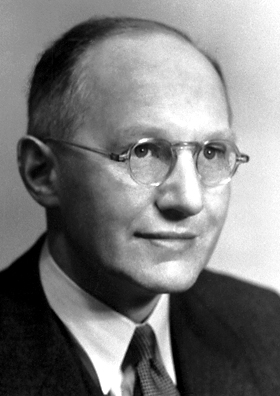
Portrait of Ernest Thomas Sinton Walton
. Source. 
Eugene Wigner Created 2026-10-24 Updated 2026-11-05
Eugene Wigner and Gregory Breit connected the capture of slow neutrons with resonant excited states of a target atomic nucleus. A capture probability can change rapidly when the projectile energy crosses one of these states. Their treatment relates the peak to the coupling into the intermediate state and its possible decay channels. It therefore explains why a small interval of incident energies can contain pronounced structure, rather than a smooth response determined by the target's size alone.[ref]
Capture of Slow Neutrons by Gregory Breit and Eugene Wigner. 1936 abstract and resonance treatment of slow-neutron absorption
A physicist.[ref]
https://phy.princeton.edu/about/history/faculty-history/princeton-physics-nobel-laureates. Independent professional profile

Portrait of Eugene Wigner
. Nobel Foundation. Public domain in Sweden per Commons PD-Sweden photo tag; separate U.S. status tag not present on inspected File. Source usage terms, via Wikimedia Commons. Source.
Even-even nucleus 2026-10-18
An atomic nucleus with even proton number and even neutron number . The simple nuclear pairing picture couples the constituent pairs to zero angular momentum. The collective examples below concern a ground state, where the superscript denotes positive parity, and its associated low-lying excitations; even alone would also allow odd and odd .
Femtometre Created 2026-10-18 Updated 2026-11-05
A femtometre is metre, written . It is a convenient unit of measurement for the dimensions of an atomic nucleus, rather than the much larger dimensions of a chemical atom. For example, a length of is .
Scattering probes such small lengths through momentum transfer rather than a miniature mechanical ruler. The relation between wavelength and momentum explains why increasingly short-distance structure requires increasingly large momentum transfer.
Fermi contact interaction 2026-10-25
The isotropic magnetic interaction of a nuclear magnetic dipole moment with electron spin density at the atomic nucleus. A nonrelativistic penetrating orbital can have and a substantial contact contribution to hyperfine structure. A filled paired shell cancels its net contact spin density in the independent-particle approximation; unpaired occupation and core polarization can restore it. Relativistic and finite nuclear-size effects modify the point-contact description.
Fermi motion 2026-10-20
The motion of particles occupying the momentum sea of a Fermi gas, especially nucleons in an atomic nucleus. It persists at zero temperature and broadens scattering kinematics relative to a stationary-nucleon approximation.
Finite nuclear size correction 2026-10-24
Spreading a point nuclear electric charge over a small spherical nuclear charge distribution weakens the central attraction and raises electronic energy levels. In nonrelativistic first-order time-independent perturbation theory, a slowly varying -state contact density gives the displayed shift. For a uniform sphere, , and integration of the difference between spherical and point Coulomb potentials gives for a hydrogen-like ion. A nonrelativistic wavefunction vanishes at the origin, suppressing its leading shift to order . Heavy atomic nuclei require relativistic and realistic-charge-distribution corrections. An observed transition frequency shifts by the difference of the two level corrections divided by the Planck constant.
Finite-population radioactive decay 2026-10-18
Take independently decaying atomic nuclei, each with lifetime drawn from an exponential distribution of rate . With no replenishment, the survivor count isEach indicator variable has success probability , so the binomial distribution givesThe smooth population law is the expected value , satisfying . One realization instead loses whole atomic nuclei at discrete times. An observed count above the smooth curve need not contradict the mathematical model.
For an original chosen example, let and half-life . Then . After , the survival probability is , givingThe standard deviation describes variation between repeated populations governed by these assumptions. It is not an uncertainty interval for a noiseless deterministic curve.
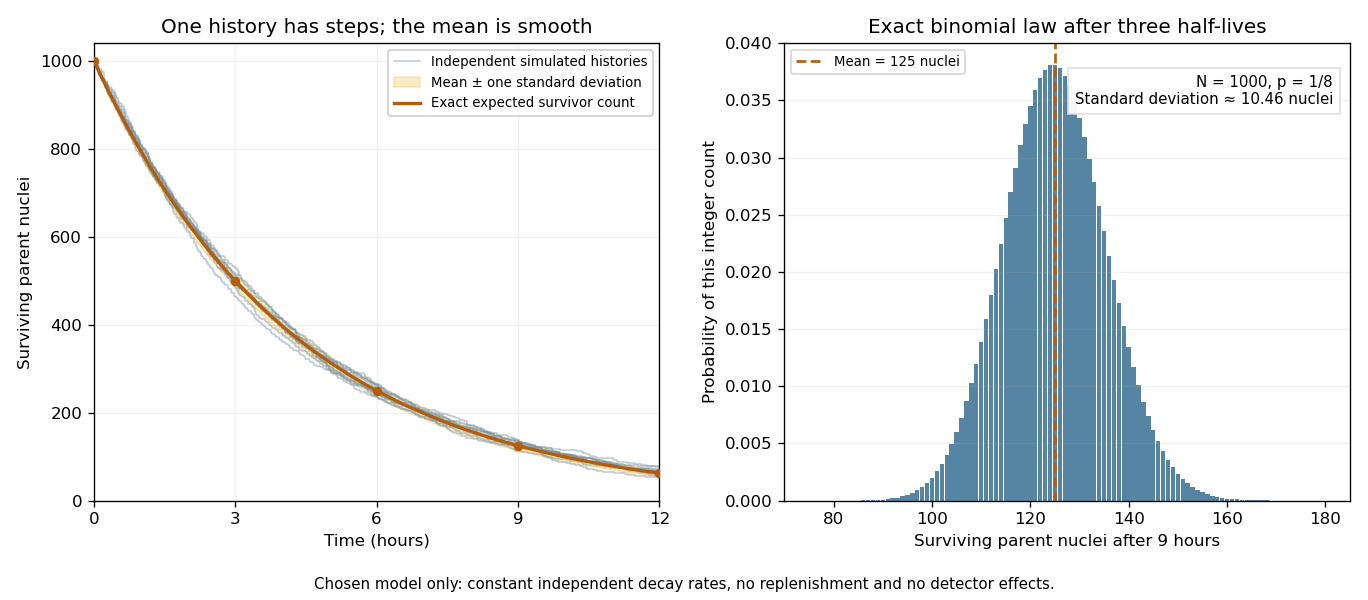
Random survivor counts and the smooth radioactive-decay law
. Original constant-rate model with independent parent atomic nuclei and a half-life. Simulated histories are compared with their exact expected value and a one-standard deviation band. The second panel shows the exact binomial distribution after three half-lives. These are model calculations, not measurements from a historical sample. Details.
Fixed-target antiproton production threshold 2026-10-18
The fixed-target production threshold concerns the incident accelerator beam, whereas antiproton mass from momentum and velocity concerns an outgoing secondary beam. To see the distinction, consider a free proton hitting a stationary free proton, producingThe final electric charge is and final baryon number is , as initially. Approximate all four final rest masses by the same proton rest mass . With metric signature , define the squared centre-of-mass energy by . The incident proton has total energy , and the target four-momentum is . Four-momentum conservation and the mass shell relation giveAt threshold the four final particles have zero relative momentum in their centre-of-momentum frame, so . HenceOnly of new rest energy is created. The larger incident kinetic energy is required because the final system must also carry the initial laboratory momentum. The incident total energy at threshold is ; neither this nor is the selected secondary momentum.
The 1955 authors explicitly qualified the stationary-nucleon threshold: target nucleon motion inside an atomic nucleus can lower the required incident energy.[ref]
The kinematic reason is visible for two on-shell incoming nucleons:A target momentum directed against the beam increases . Applying this illustration to a bound nucleon also requires binding energy and residual-nucleus recoil; the free stationary-target result is therefore not a universal sharp threshold for a copper target. A low observed secondary momentum is entirely compatible with a much larger accelerator kinetic energy.
Gamma ray Created 2026-10-18 Updated 2026-11-05
A gamma ray is a high-energy photon, conventionally associated with a transition of an atomic nucleus, radioactive decay or a particle reaction. X-rays and gamma rays are both electromagnetic radiation; their energy ranges overlap, so the production mechanism can be more informative than an arbitrary energy boundary.
A nuclear energy level transition emits a gamma ray whose energy is approximately the level difference, with a correction for nuclear recoil. Detectors infer the incoming energy from interactions such as photoelectric absorption, Compton scattering and, above threshold, pair production. A measured gamma-ray spectrum can therefore identify nuclear transitions even when a detector does not absorb the entire photon energy in each event.
Gas electron diffraction Created 2026-10-13 Updated 2026-10-20
Gas electron diffraction infers molecular geometry from the diffraction of electrons by a gaseous sample. It makes a useful experimental test of shape: distances between both bonded and nonbonded atomic nuclei affect the signal, so a proposed straight arrangement and a bent arrangement can be distinguished through their pair separations.
A concrete modern apparatus is the Bielefeld instrument described by [ref]
https://doi.org/10.1515/znb-2015-0186. Reuter, Vishnevskiy, Blomeyer and Mitzel (2016), Gas electron diffraction of increased performance, §§1, 3 and 12
. A hot cathode supplies electrons; apertures and magnetic lenses shape the beam. A temperature-controlled nozzle injects sample vapour across it inside a vacuum chamber. Pumps and a cold trap reduce unwanted residual gas. A central beam stop catches the strong unscattered beam; off-axis scattered electrons expose imaging plates. A rotating sector can attenuate the intense small-angle region to accommodate detector range. The authors checked both the spatial scale of the plate scanner and its response to electron dose. These checks matter because an error in detector position or intensity calibration can masquerade as a structural difference.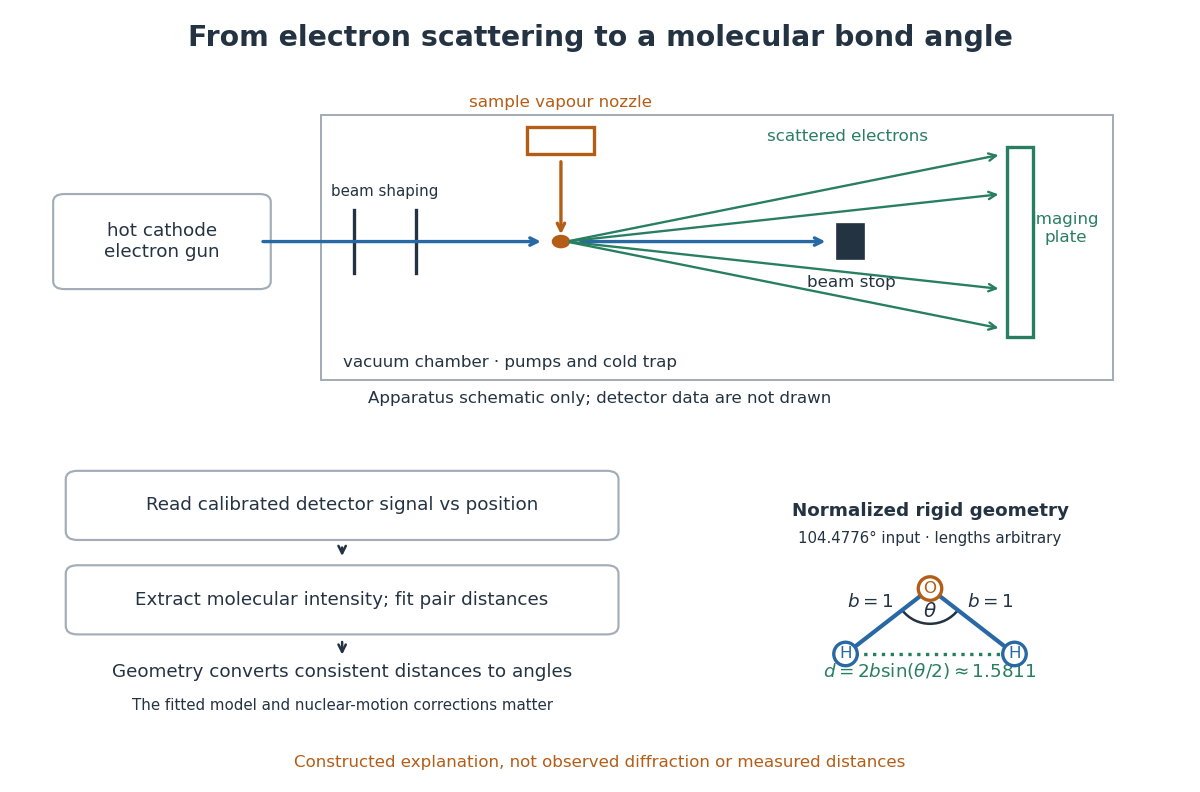

What is measured is detector signal as a function of position, converted to scattering angle using the sample-to-detector distance. Randomly oriented molecules give radial information. After extracting the molecular intensity, compare it with predictions from a candidate arrangement and adjust the bond lengths and bond angles to improve the fit. The Wann Electron Diffraction Group's account of time-averaged GED, experiment and theory describes radial averaging and this refinement. The apparatus does not photograph one molecule with labelled atomic nuclei.
Why can distances survive random orientation? In a simplified rigid pair model with separation , write for the magnitude of the difference between incident and scattered wave vectors. Averaging the interference factor over uniformly distributed directions giveswith limiting value one at . This follows by integrating the cosine; is the cosine of the angle between the pair and the scattering direction. The oscillations depend on , although the orientation has disappeared. A real calculation weights many pairs by their scattering amplitudes and includes nuclear motion. The wave interference explanation and superposed pair-distance contributions are discussed in the same [ref].
Once a consistent structural model supplies two equal bond lengths and an outer-atom separation , the law of cosines converts these to a bond angle. For example, the illustrative corresponds to approximately , while is straight. This geometric step explains what a shape measurement is trying to establish; it is not a new water measurement.
There are two essential limits. First, recovering labelled three-dimensional positions from a summed radial signal is an inverse problem: composition, candidate connectivity, and other structural information can be needed to distinguish competing fits. Karle's authored review Structure determination of gaseous and amorphous substances by diffraction methods (1977), abstract explains why too few independent observations make supplementary structural information indispensable. A good fit alone does not prove that the proposed arrangement is unique. Second, atomic nuclei are moving. Distances inferred by gas electron diffraction are motion-dependent averages; corrections are required before identifying them with a minimum-potential energy arrangement. For experimental distance conventions, see the IUPAC Gold Book: bond length. These limitations explain why model assumptions and the averaging convention must accompany a precise bond angle.
Harmonic vibrational energy levels 2026-10-14
Quantizing the stretching coordinate gives a quantum harmonic oscillator with reduced mass :Here is the vibrational quantum number and the reduced Planck constant. Consecutive energy eigenvalues have gap ; the ground state has zero-point energy above the well minimum. The offset cancels from every transition energy.
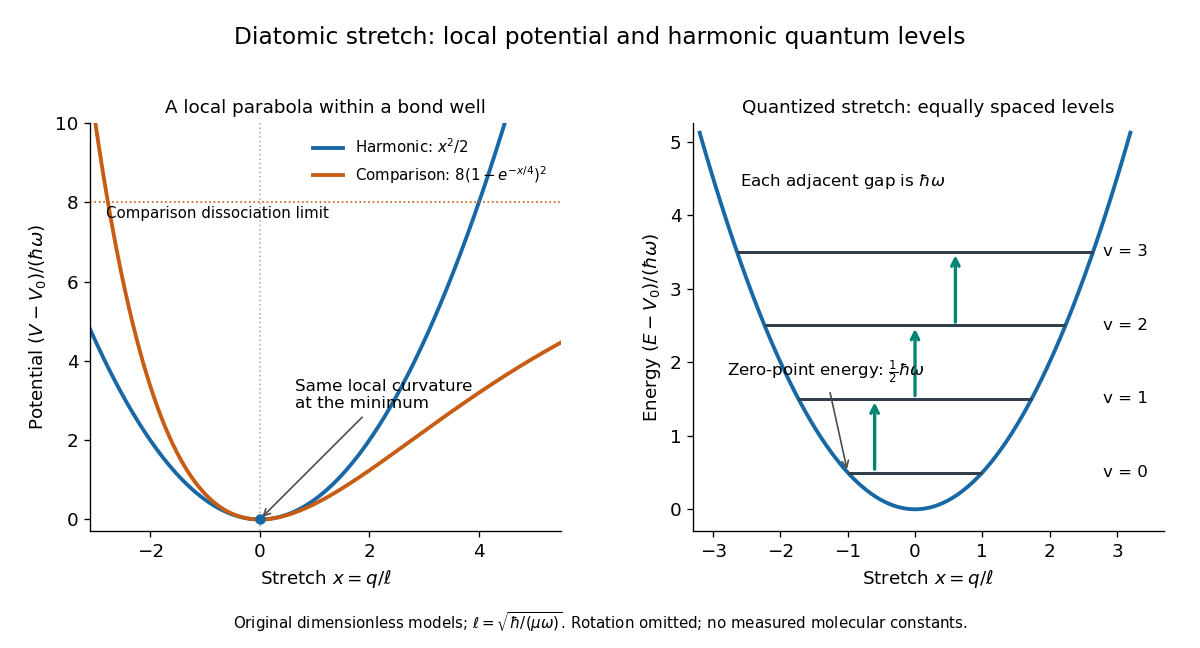
Local harmonic approximation near a potential minimum and equally spaced vibrational energy eigenvalues
. Original dimensionless model with and . The blue parabola is ; levels are . The orange comparison is the stipulated Morse potential , with the same curvature at ; it is not a fit to hydrogen chloride. Arrows show adjacent vibrational gaps, with molecular rotation omitted. Details.
A short proof uses creation and annihilation operators: with , write . The Quantum Hamiltonian becomes . Nonnegativity of gives the lowest level; repeated application of raises its energy by each time. This also gives andThe ground state therefore has a nonzero spread of bond lengths, even though its mean stretching displacement vanishes. A stationary energy eigenstate has a time-independent position probability density; the classical oscillation curve is not a trajectory of an atomic nucleus in that state.
The parabolic model formally extends to the whole real line, whereas an actual bond length satisfies . It is useful for low levels concentrated near , with typical stretching displacements much smaller than . It fails near breakup of the chemical bond and when neglected anharmonicity becomes substantial.
Hydrogen bubble chamber 2026-10-18
A bubble chamber using liquid hydrogen as both target and recording medium. For a beam interaction on a proton, the target's initial momentum can usually be approximated as zero on the scale of the beam momentum. This makes four-momentum conservation especially useful: the initial state does not include the unknown motion of a proton bound inside a heavier atomic nucleus. The approximation still neglects molecular binding and thermal motion.
Hyperfine structure Created 2026-10-14 Updated 2026-11-05
Hyperfine structure is the small splitting of atomic or molecular energy levels caused by interactions involving the atomic nucleus's magnetic dipole moment or electric quadrupole moment. It is finer than the electronic fine structure. A leading magnetic-dipole hyperfine interaction couples the nuclear spin to the electronic angular momentum ; their total angular momentum labels the resulting hyperfine levels.
With dimensionless angular momentum operators, the model gives shifts . A hydrogen atom in its electronic ground state has , giving . Resolved microwave transitions between hyperfine levels permit precise spectroscopy and provide the working transitions in many atomic clocks. Applied magnetic fields can split each hyperfine level further into magnetic sublevels.
Ion Created 2026-10-06 Updated 2026-10-20
An ion is a chemical atom or a group of chemical atoms with a nonzero net electric charge. A positive ion is a cation; a negative ion is an anion. The whole entity carries the electric charge: a hydronium ion is a group of four chemical atoms with net charge . This definition agrees with [ref].
For an ordinary ion containing only atomic nuclei and electrons, let count all its protons and all its electrons. Each proton contributes the elementary charge , each electron contributes , and neutrons contribute zero. ThereforeThe signed integer is the net electric charge number. Removing an electron increases by one; adding an electron decreases by one. Changing the electron count leaves the atomic number, and therefore the identity of the chemical element, unchanged.
For example, a neutral sodium chemical atom has protons and electrons. Its cation still has protons, but only electrons, so . A neutral chlorine chemical atom has protons and electrons; its anion has protons and electrons, so . These are particle inventories, not pictures of atomic orbitals. See 2.6 Ionic and Molecular Compounds (§2.6: ions and ionic compounds).
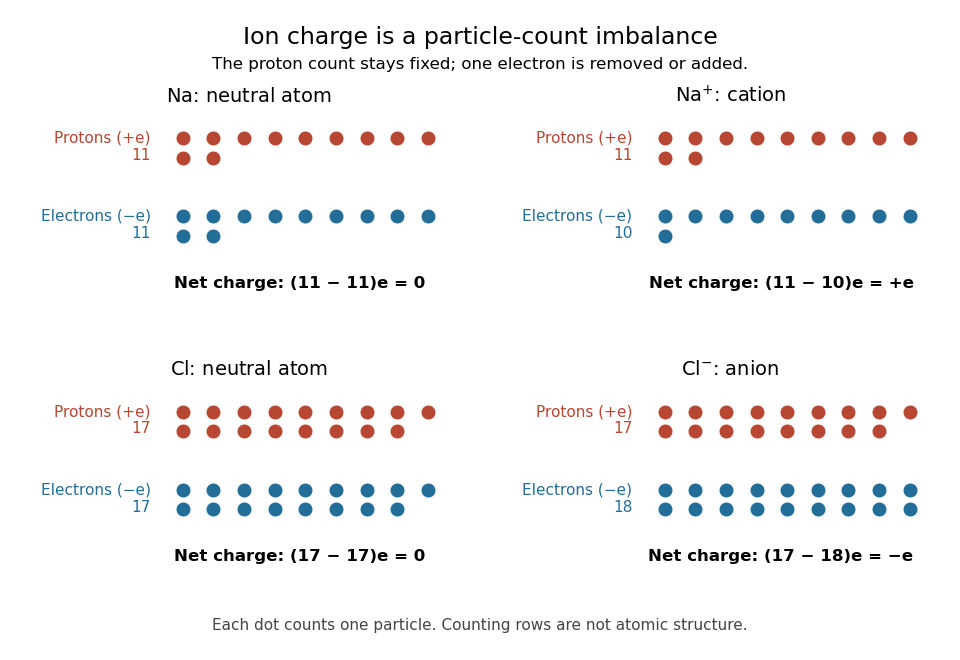
Ion electric charge bookkeeping: neutral sodium and chlorine chemical atoms compared with their cation and anion
. Every colored dot counts one proton or one electron. Rows are counting arrays, not spatial models of atomic nuclei or electron shells. The net electric charges are . Details.
One sodium chloride formula unit accounts for one cation and one anion, whose net electric charges sum to zero. Ordinary solid sodium chloride is an extended arrangement of ions, rather than discrete molecules. This is a useful distinction: a neutral material can contain charged constituents, and its chemical formula tells us their ratio without claiming that each pair is a separate molecule.
Ion bookkeeping connects chemistry to electric current: moving ions can transport electric charge, while stationary ions cannot supply a transport current density. In electrochemistry, both signs of ions can contribute to the same conventional current. An ion opposing a fixed electric charge is called a counterion.
Isotope Created 2026-10-13 Updated 2026-10-20
Isotopes of a chemical element have the same atomic number , hence the same number of protons, but different neutron numbers and therefore different mass numbers . For example, every neon atomic nucleus contains ten protons: neon-20, neon-21, and neon-22 contain ten, eleven, and twelve neutrons, respectively. They occupy one chemical element box in the periodic table, rather than three boxes.
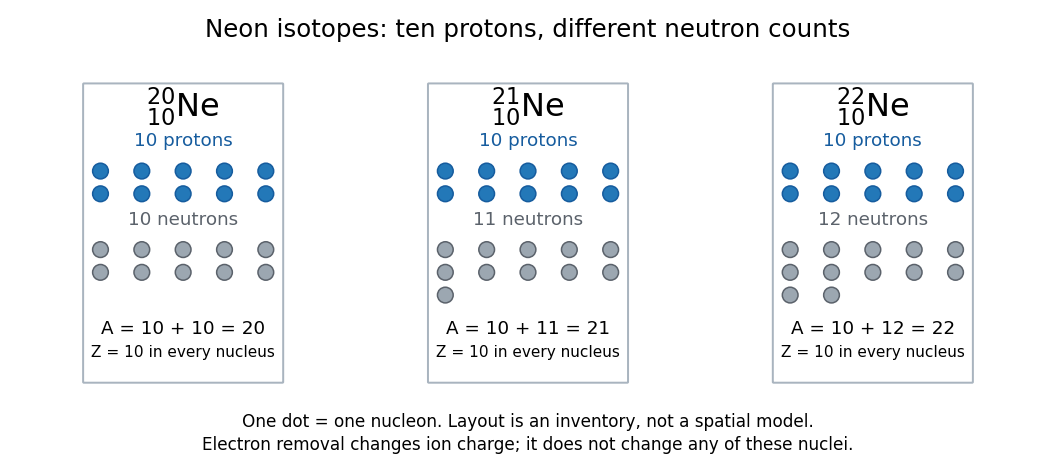

Three labels answer different questions. The chemical element fixes ; the isotope specifies which neutron number accompanies that ; the ion label specifies the net electric charge. Neutral and the ion both contain ten protons and twelve neutrons; they contain ten and nine electrons, respectively. Ordinary ionization changes the electron count, leaving the isotope unchanged. Changing the neutron number can change nuclear binding energy and the possibility of radioactive decay. Isotopic abundances can help distinguish material sources, while radioactive decay can additionally supply chronological information.
A mass spectrum makes the distinction experimentally visible: a single chemical element can give separate ion peaks at different mass-to-charge ratios. Its bulk atomic weight is a weighted mean governed by isotopic abundances, rather than the location of one compulsory peak. The historical mass spectrograph experiment and the synthetic neon mass spectrum below illustrate these complementary observations.