Bose-Einstein statistics describes identical noninteracting bosons in equilibrium. Any occupation number is allowed in a one-particle state; the resulting Bose-Einstein distribution is .
A gas whose indistinguishable constituents are bosons. The ideal model follows Bose-Einstein statistics, while interactions modify its excitations and thermodynamics. Macroscopic ground-state occupation can occur under suitable dimension and density conditions, but it does not alone determine a superfluid response.
In dimensions, isotropic modes with dispersion have density of states proportional to . Their equilibrium number is not conserved, so the excitation chemical potential is zero. Integrating and rescaling by gives the displayed energy power and heat capacity proportional to . In three dimensions, linear acoustic phonons give energy and heat capacity; quadratic gapless ferromagnetic magnons give energy and heat capacity. A gap changes the asymptotically low-temperature law to activated behaviour. The mode approximation applies below the relevant band cutoff and when interactions between excitations are negligible.
One isotropic three-dimensional bosonic branch with dispersion and zero chemical potential has density of states per volume . Integrating its Bose-Einstein energy and differentiating temperature gives the title coefficient. Identical independent branches multiply it by their number. Thus a measured coefficient fixes branch multiplicity divided by , not a dispersion coefficient independent of that counting convention. A gap or low-dimensional spectrum changes the asymptotic law.
The number and energy integrals of a zero-chemical-potential photon gas give and in natural units. Their ratio is the mean energy per photon. It is useful for converting a relic number-density ratio into an energy-density ratio.
Bose-Einstein condensation is the macroscopic occupation of the lowest one-particle state by bosons below a critical temperature.
For an ideal Bose gas in a two-dimensional isotropic harmonic trap, the leading density of states measured above its ground state is . At saturation of the Bose-Einstein distribution, . The finite excited-state capacity gives the displayed critical temperature and condensate fraction below it. The appropriate trapped-gas thermodynamic limit fixes as and ; a finite trap exhibits finite-size rounding. The number density is inhomogeneous, and the physical chemical potential approaches the oscillator ground state energy, not an unshifted zero by convention.
Compare uniform three-dimensional ideal gases at the same number density n, with fermion mass , spin degeneracy , boson mass and a single boson spin component. The Fermi temperature has , while Bose saturation gives . Eliminating density yieldsThe degeneracy is essential; using a spinless Fermi sea changes the numerical estimate. This is an ideal-gas comparison and does not remove interaction effects in a dense liquid.
For a one-component ideal Bose gas with masses , insert the anisotropic ideal-gas density of states in the excited-state number integral at chemical potential zero. The substitution gives , which yields the displayed transition temperature. Thus at fixed density and the two lighter masses, . This continuum ideal-gas result does not supply a finite-temperature transition for decoupled two-dimensional layers.
For a partially condensed equilibrium ideal Bose gas in a fixed three-dimensional box, the energy scales as . Unbiased random particle removal keeps mean energy per particle fixed, so re-equilibration gives until condensation disappears. Removal of an excited particle can be followed by partial replenishment from the zero-energy condensate. This differs from selective evaporative cooling of atoms, which preferentially removes high-energy atoms and reduces mean energy per particle.
With the ground-state energy set to zero, the chemical potential of an ideal Bose gas cannot exceed zero. The limiting population of excited states as it approaches zero is the saturation particle number, provided the integral converges. Additional particles occupy the ground state macroscopically. For a three-dimensional uniform box, with thermal wavelength .
A magnetic field can close the lowest gap of a dilute bosonic triplet branch. In a shifted-parabola model with actual chemical potential zero, and repulsion prevent indefinite density growth. The normal minimum reaches zero when . At that point the finite thermal excited population saturates and macroscopic ground-state occupation can develop.
If the phenomenological single-density shift is continued into the condensed phase and the thermal population remains saturated at , the zero minimum requires . At fixed temperature, above onset and zero below it. This prefactor belongs to that closure; a microscopic interaction model can distinguish normal and condensed self-energies. Continuing the normal parabola into negative energies without changing the state is not a consistent Bose distribution.
For a three-dimensional quadratic branch, the critical thermal density is . Inserting this into the mean-field gap-closing condition gives . This is a dilute low-temperature model; finite bandwidth, anisotropy and changes in interactions can alter its applicability outside that regime.
For a uniform three-dimensional ideal gas of spinless bosons with energy and ground energy set to zero, the excited number density is , with quantum gas fugacity . Its finite maximum gives the displayed critical temperature. Below it, particle conservation gives condensate fraction . The excited-state internal energy is , with below the transition. The exponent differs from that of a harmonic trap. Condensation is not by itself a demonstration of superfluidity; the ideal quadratic dispersion has vanishing Landau critical speed.
For quadratic three-dimensional dispersion below condensation, the excited-state thermal energy is proportional to . Differentiating at fixed particle number and volume gives the displayed heat capacity, with limiting value approximately at . The macroscopic ground occupation carries no excitation energy in the shifted reference. The exponent differs from the linear-phonon result of an interacting gas.
A hard-wall cube has positive one-particle ground energy . Condensation corresponds to the absolute chemical potential approaching , not zero. Shifting the energy reference makes the limiting chemical potential zero, while the exact shifted excited-state density of states also shifts. Keeping its bulk square-root form is a large-system approximation valid when . A periodic cube instead has zero ground energy.
At fixed temperature, the continuum excited population of a three-dimensional ideal Bose gas reaches a finite maximum as the chemical potential approaches the ground energy. Adding particles beyond that maximum creates macroscopic ground occupation. Thus and to leading thermodynamic-limit order. Finite systems retain nonmacroscopic ground occupation below the nominal threshold.
In a dilute gas, Bose-Einstein condensation makes a single one-particle state hold a substantial fraction of the bosons. This is a population effect: cooling reduces the number that the excited energy eigenstates can accommodate at thermal equilibrium. The surplus accumulates in a Bose-Einstein condensate. For an ideal gas the occupied mode is the trap ground state; interactions can deform that mode, as described by the Gross–Pitaevskii equation. Dilute does not mean classical: a small number density can still give overlapping thermal de Broglie wavelengths at sufficiently low temperature.
The appeal is that changing the trap changes a calculable Quantum Hamiltonian, while absorption imaging makes its population distribution visible. The Bose condensation in a three-dimensional harmonic trap below turns density of states into a prediction for a critical temperature and condensate fraction. These are separate questions from measuring matter-wave coherence or superfluidity.
Eric A. Cornell and Carl E. Wieman's joint lecture emphasizes the competition between useful elastic collisions, which restore thermal equilibrium during evaporative cooling, and collisions that remove or heat the trapped sample. A long trap lifetime alone is insufficient: reequilibration must keep up with evaporation.[ref]
Nobel Lecture: Bose-Einstein condensation in a dilute gas, the first 70 years and some recent experiments by Eric A. Cornell and Carl Wieman. pp. 878–879 and 890, collisional requirements
The dimensionless occupancy scale , with number density and thermal de Broglie wavelength . Increasing it approaches the regime where quantum statistics matters. This use of degeneracy must not be confused with degeneracy of an individual energy eigenspace.
For a classical ideal gas in a three-dimensional harmonic trap, the peak phase-space density is . At fixed trap frequencies, atom loss accompanied by increases only for .
Consider noninteracting bosons in one internal quantum state, at thermal equilibrium in the three-dimensional harmonic oscillator potentialHere is the mass, the positive are angular frequencies, and is their geometric mean. Measure the one-particle energy and chemical potential from the ground-state energy. The quantum harmonic oscillator levels then have with nonnegative integer and reduced Planck constant .
When , counting lattice points can be approximated by the volume of a tetrahedron in the positive octant of :This is a density of states, with units of inverse energy. The factor is the unit tetrahedron volume; differentiating produces the factor . Treat the single ground state separately: its macroscopic population would be lost by replacing every level with a smooth density of states.
For , integrate the Bose-Einstein distribution over excited energy eigenstates. As approaches zero from below, their maximum population isHere is the Boltzmann constant and the Riemann zeta function. A short proof uses and . The nonnegative terms permit exchanging summation and integration by Tonelli's theorem, giving . Near zero the integrand is proportional to , so its integral converges. That finite excited-state capacity is the mechanism of Bose-Einstein condensation.
Set . Particle conservation gives, to this continuum accuracy,Above , the macroscopic condensate fraction is zero and the chemical potential adjusts below zero. This cubic power belongs to a three-dimensional harmonic trap; it is not the homogeneous three-dimensional ideal gas exponent. For , and , the model gives . At , , or approximately condensed bosons. These are chosen parameters and calculated values.
Finite gives a smooth crossover rather than a sharp phase transition. The exact ideal gas sum over excited quantum harmonic oscillator levels differs from the continuum integral, especially when is not large relative to every . A sharp trapped-gas limit takes , with fixed and fixed frequency ratios. Interactions also alter the critical temperature, condensate fraction and release profile; a dilute gas can have appreciable interaction energy compared with the trap level spacing. The cubic law is a useful baseline, not a fit guaranteed for either 1995 experiment.
The ideal isotropic-trap transition scale is . The numerical prefactor follows from the Bose integral .
At ground-relative chemical potential zero, the leading semiclassical excited population is . Additional particles occupy the ground state once this capacity is reached. The continuum description requires many excited trap levels to be thermally accessible.
With the ground energy set to zero, the ideal-gas chemical potential approaches zero from below at condensation and remains there to leading thermodynamic order. Above onset it is determined by the trap density of states. The shape differs from that for a uniform gas.
The exact three-dimensional oscillator ground energy is above the potential minimum. Subtracting it sets the condensate energy to zero. The commonly used is the leading continuum term; it does not include the finite-level corrections from shifting the energy origin.
The condensate fraction is the population of a macroscopically occupied one-particle state divided by the total particle number . For an interacting system, use a macroscopic eigenvalue of the one-particle density matrix, rather than assume that the relevant mode is an undeformed single-particle trap ground state. The condensate fraction is not generally the fraction measured as superfluid by a flow or rotation response.
A broad component plus a narrow central component can have one local maximum while still displaying two distinct width scales. This is what “bimodal” means in this imaging context; it does not require two separated peaks. To isolate the population effect, construct an original normalized line profileBoth terms are normal distributions; their integrals are one, so the component areas are and . With , the narrow component has central height , while the broad component contributes . A tall central feature therefore need not contain most of the particles. Holding these widths fixed deliberately isolates changing weights; it does not model how temperature, interactions or camera resolution determine actual widths.
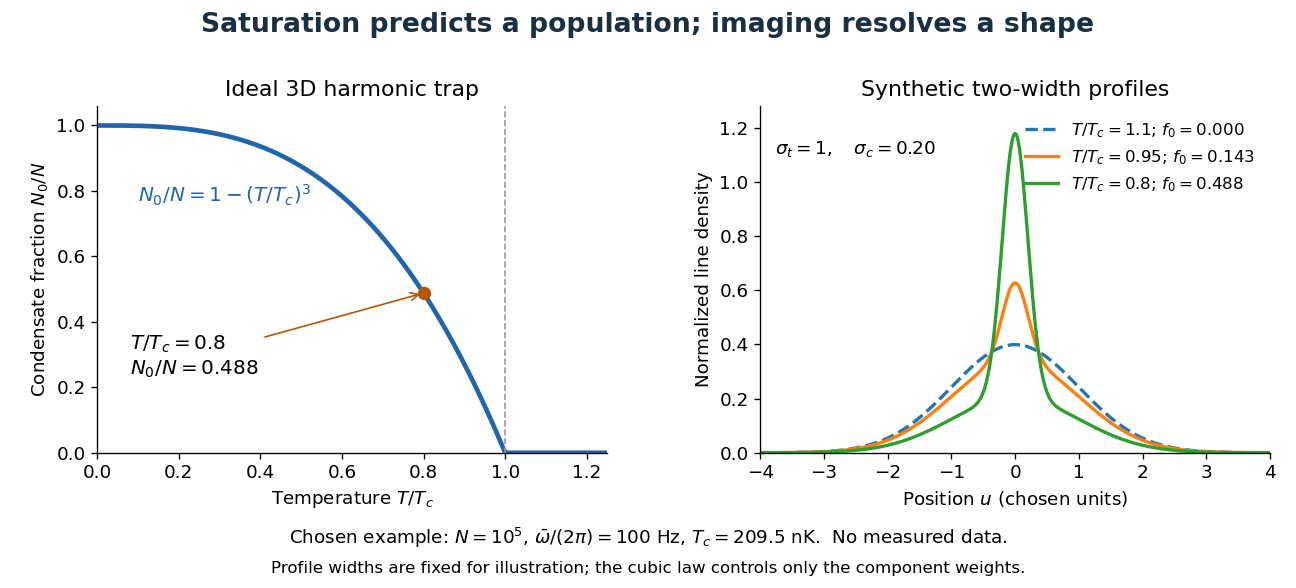
For absorption imaging in the weak-probe regime with negligible saturation, the optical depth is , where is the reference light intensity without atoms, the transmitted light intensity, an effective absorption cross section, and the column density. Integrating over both image coordinates gives the particle number; a central pixel height alone does not. Finite resolution can obscure a narrow component, and saturation invalidates this simple logarithmic calibration.
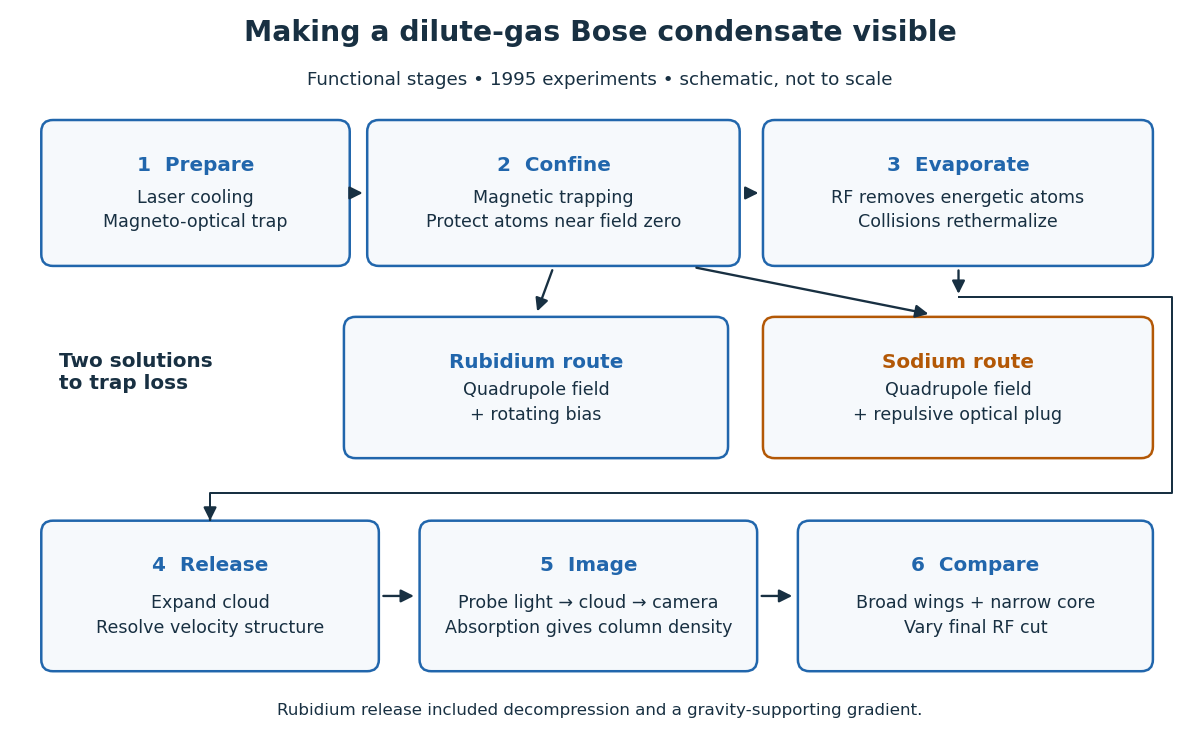
The rubidium experiment used laser cooling, a magneto-optical trap and magnetic trapping of neutral atoms with a rotating bias field. Radio frequency transitions removed energetic atoms; elastic collisions restored thermal equilibrium. Before absorption imaging, the trap was decompressed, then nearly released with a gradient supporting against gravity. Varying the final evaporation cut revealed a narrow anisotropic core within an isotropic thermal cloud. The broad component supplied a simultaneous comparison through the same optics. Resolution and size calibration limited inference; interactions broadened the core relative to an ideal gas.[ref]
The 1995 sodium experiment combined laser cooling with a magnetic quadrupole trap and a repulsive optical plug protecting its field zero. Radio frequency evaporation preceded release and absorption imaging after time of flight. Lowering the evaporation cut produced broad thermal wings and a narrow core. Moving the plug changed the core's expansion orientation while the thermal distribution remained spherical: a control connecting the feature to confinement. Overlap of the two trapped pockets and residual switch-off acceleration limited quantitative shape comparisons; repulsive interactions affected expansion.[ref]
Bose-Einstein Condensation in a Gas of Sodium Atoms by K. B. Davis and others. pp. 3969–3972, Figs. 1–4
Bose-Einstein condensation concerns occupation of a one-particle state. Matter-wave coherence concerns field correlations between positions or times. Superfluidity concerns a flow response, including suppression of dissipation under appropriate conditions. A density peak diagnoses neither a relative quantum phase between two separately prepared clouds nor a critical flow speed. These observables require different experiments.
For example, in a single-mode fixed-number Fock state, but . Writing for that occupied mode givesThus vanishing mean field does not imply vanishing first-order matter-wave coherence. For two independent fixed-number modes, : there is no ensemble mean interference term establishing a fixed relative quantum phase. Interpreting fringes in an individual detection record requires considering correlations and the measurement; assigning a pre-existing definite relative quantum phase is unnecessary.
Wolfgang Ketterle's lecture describes a separate coherence test: two condensates expanded into one another and produced fringes. Selectively removing one condensate made the fringes disappear on alternating preparation cycles, testing against diffraction from the confinement. This compared two-cloud and one-cloud signals; it did not measure dissipationless flow.[ref]
Nobel lecture: When atoms behave as waves: Bose-Einstein condensation and the atom laser by Wolfgang Ketterle. pp. 1143–1145, Fig. 15, condensate-elimination control
For a homogeneous ideal gas in dimensions with , the density of states scales as . At limiting chemical potential zero, the Bose-Einstein distribution is proportional to near zero energy. The excited-particle integral is finite exactly when . Thus positive-temperature condensation at fixed nonzero density is possible precisely for . A nonconserved particle number, as for ordinary equilibrium photons, removes the fixed-number saturation mechanism even when the integral is finite.
A Bose-Einstein condensate is a state with macroscopic occupation of a one-particle mode. A phase-selected mean-field description can use , while a fixed-number finite-volume state need not have a nonzero field expectation. Bose-Einstein condensation and superfluidity are related but distinct notions; long-wavelength phase fluctuations can invalidate a uniform condensate saddle in low dimensions.
Two independent boson species occupy uniform single-particle modes on sites, with fixed occupation numbers . This differs from a fixed-number two-mode condensate whose particles all occupy one superposition of the two modes. Here , , and the local total number operator has variance . The latter follows from two independent binomial distributions with success probability . This state satisfies a prescribed Schwinger boson constraint only in the mean unless the local variance vanishes.
A complex amplitude describing a coherent condensate in mean-field theory. In the convention , its squared modulus is the condensate density. Dividing by gives a normalized orbital; formulas for interaction strengths and nonlinear terms must use the same normalization convention.
All bosons occupy the same normalized one-particle superposition with . Its occupation distribution in the original two modes is binomial, not two independent Poisson distributions. In particular, and . These factorial moments give finite-particle corrections to interaction energies. The state is also the two-mode realization of a spin coherent state with spin .
For with real and , one has . Differentiating gives . If , this equals . The Heisenberg equation of motion identifies the left-to-right particle current as . Reversing the definition of the relative phase reverses this sign.
For a homogeneous gas, the condensate density is the macroscopic occupation of its condensate mode divided by volume. More generally its spatial density is for a normalized condensate orbital. The mode and occupation are defined by a macroscopic eigenvalue of the one-body density matrix, so a finite fixed-number state need not have a nonzero field expectation. Condensate density is distinct from the superfluid density defined by response to a phase twist; interactions can deplete the former even when the latter equals the total density at zero temperature in a uniform Galilean-invariant gas.
A one-dimensional condensate on a ring of circumference has a uniform winding state when the order parameter is normalized to atom number. Its angular momentum per atom is , while the flow contribution to its total chemical potential is .
For equal ring halves with potentials and zero, the zero-current Thomas–Fermi bulk solution has and populations while both halves are occupied. For the raised half is depleted and in this approximation.
For a noninteracting ground state of energy zero, gives . Thus a finite condensate has a slightly negative chemical potential; exact zero pinning is a macroscopic limiting statement.
Occupation outside the macroscopically occupied condensate mode, caused by interactions or thermal excitations. A weak homogeneous three-dimensional Bose gas has zero-temperature depletion fraction in the leading dilute-gas approximation. Depletion measures single-particle mode occupation, not directly the superfluid fraction.
Two separately conserved bosonic species have two condensate fields and independent chemical potentials. A contact interaction energy density gives and in a uniform mixture. Coherent interconversion would change the conservation constraints and cannot be included while retaining independent particle-number constraints unchanged.
In a homogeneous overlapping two-component Bose-Einstein condensate, the long-wavelength energy change at fixed species numbers is one half the integral of the density perturbation quadratic form with matrix . Strict positive definiteness gives the displayed criterion. Strong positive cross-repulsion favors separation; sufficiently strong cross-attraction instead produces an unstable joint density mode. Equality is marginal at this order, not strict stability.
A dilute condensed Bose system whose interaction is sufficiently weak for a small-depletion expansion. Its low-energy excitations are described by a Bogoliubov transformation rather than free particles. The homogeneous quadratic theory is controlled only while noncondensate occupation remains small compared with the condensate and its excitation energies are stable.
For a three-dimensional repulsive gas at zero temperature, leading quantum depletion is . Small gas parameter controls the expansion; this expression does not apply unchanged in lower dimensions.
Expand an interacting Bose field about a macroscopically occupied condensate and retain terms quadratic in its fluctuations. A Bogoliubov transformation diagonalizes the stable quadratic Hamiltonian. For contact repulsion this gives the Bogoliubov quasiparticle dispersion , a linear sound mode at small momentum and particle-like behavior at large momentum. Mixing creation and annihilation operators also produces quantum depletion of a Bose condensate. The approximation requires controlled fluctuations; it does not give an exact strongly interacting liquid or the full fluctuation-dominated critical region.
For a weakly depleted homogeneous Bose gas with repulsive contact interaction, set and . A zero-mode coherent state times a two-mode squeezed vacuum for each opposite-momentum pair has mean particle number . Substitution of into the leading condensate interaction energy, followed by a consistent quadratic truncation, gives the displayed variational energy. Omitting this substitution loses the subtraction embodied in the number-conserving Bogoliubov quadratic Hamiltonian.
For each mode set and . If , choose . The mode contribution equals , proving a unique minimum . At fixed ultraviolet cutoff this lowers the energy relative to the uncorrelated condensate. The approximation requires small quantum depletion of a Bose condensate; an unregulated three-dimensional ground-state energy also requires renormalization of a three-dimensional dilute-gas contact coupling.
Expand a weakly depleted Bose gas around its macroscopically occupied mode. Replacing a condensate operator by an amplitude of order gives quadratic, cubic and quartic fluctuation interaction scales proportional to , and , with the same interaction-volume factor. Thus the depletion fraction supplies formal amplitude counting. This is not a uniform bound on infrared modes or a substitute for checking the interaction regime. At fixed particle number, expansion of the condensate interaction must precede the final quadratic truncation; the resulting cancellation is the number-conserving Bogoliubov quadratic Hamiltonian.
In a box of size , confinement energy scales as , transition temperature as that scale times , and mean interaction energy as . The displayed window therefore makes interaction energy large compared with confinement but small compared with . It simultaneously implies dilute-gas parameter . Ground-state interaction dominance does not require a large relative shift of the condensation temperature.
One linear Bogoliubov branch in three dimensions gives thermal energy and the displayed cubic heat capacity. There is one branch, rather than the three polarizations in a simple crystal's Debye model. The regime requires for a box: the lower inequality permits a continuum integral, and the upper one selects phonons. Fixed finite boxes ultimately have discrete-level behaviour.
For a uniform dilute repulsive gas, the periodic complex-field integral has uniform saddle for . The paired Gaussian fluctuation kernel has determinant , giving the Bogoliubov spectrum. In three dimensions the physical low-energy coupling is and the weak-depletion parameter is . Contact coupling beyond mean field needs ultraviolet matching to the scattering length.
The regulated bare coupling is matched to the physical two-body scattering length. In the uniform one-loop grand potential this matching supplies the subtraction that makes ultraviolet finite. Merely using the physical coupling in an unregulated zero-point integral would retain a divergent answer. The contact description and its cutoff cannot be extended to arbitrary momenta independently of that matching.
Expand a repulsive Bose-Einstein condensate around the real uniform saddle as . After removing a constant and a temporal boundary term, the quadratic Lagrangian density is the displayed expression. Its equation mixes a fluctuation and its complex conjugate. Writing gives canonically paired amplitude and phase fluctuations and one positive Bogoliubov quasiparticle dispersion branch, with . The phase direction is a Goldstone mode; its zero uniform restoring force does not produce a second independent positive-frequency amplitude branch in this first-order-in-time theory.
For a repulsive contact-interacting Bose-Einstein condensate, the classical Hamiltonian density generating evolution in a frame rotating at the chemical potential is . Its integral is the grand canonical ensemble generator , not the physical energy alone. For the uniform mean-field theory minima satisfy , with a freely chosen constant phase. In the physical frame, the corresponding field has time factor .
In units , polar fields rewrite the coherent-state action asafter removing the periodic total density derivative. The potential has positive-density minimum for . Density curvature gives a finite static amplitude cost, while phase changes cost only derivatives. Number-phase conjugacy couples their dynamics; the two fields do not automatically represent two independent excitation branches.
Expand the density-phase action of a Bose gas around and a constant phase. Density and phase are coupled by , and retaining density gradients gives the full quadratic Bogoliubov spectrum. Dropping those gradients is a long-wavelength approximation. A small-fluctuation Gaussian extension around does not exactly remove the original nonnegative-density constraint.
A positive density curvature makes uniform static density fluctuations costly. It does not imply an additional independent gapped excitation: the first-order term makes density and phase conjugate. For a simple nonrelativistic weakly interacting Bose gas, their coupled quadratic dynamics yields one positive Bogoliubov spectrum, which is gapless at zero momentum. The word massive for the density field describes its static curvature in this setting.
In the smooth zero-winding long-wave sector, integrate the density Gaussian integral by completing . Its field-independent normalization leaves the displayed action. The real-frequency pole is , so the phonon speed is . Keeping density gradients yields , matching the Bogoliubov spectrum.
The Bose-gas phase-only action gives a thermal infrared integral and a zero-temperature equal-time integral . Thus an infinite uniform short-range interacting gas has no true finite-temperature condensate in , and the one-dimensional ground state also lacks true condensate long-range order. This does not exclude local density coherence, a finite-size condensate description or two-dimensional algebraic order and superfluidity.[ref]
A periodic complex field permits . Its uniform-density first-order term is therefore a winding-dependent imaginary action, not generally a removable global constant. It vanishes in the smooth zero-winding sector used for Gaussian phonons. Density defects and vortices require more than that smooth-sector approximation.
Conservation of particle number corresponds to global circle group phase rotations of a nonrelativistic Bose field. A positive-density uniform mean-field saddle chooses a phase, with degenerate saddle manifold a circle. The associated Goldstone boson is the long-wavelength phase mode. This is a thermodynamic symmetry-selection statement; an exact finite-volume number eigenstate does not itself choose a phase.
The quasiparticle vacuum contains physical particles at nonzero momentum because the Bogoliubov transformation mixes creation and annihilation operators. Their occupation is , and the depletion density is its momentum sum divided by the volume. At nonzero temperature an additional contribution is required; quantum depletion alone is a zero-temperature expression.
The stable quadratic spectrum is . If , its low-momentum form is , a linear sound branch. For contact repulsion the healing length separates the phonon and particle regimes. General momentum-dependent interactions can change the higher-energy shape.
A normal mode of linearized condensate dynamics with particle and hole components. Quantizing a suitably normalized mode gives a Bogoliubov quasiparticle. The density and phase components of one mode share a frequency; that fact alone does not establish a twofold excitation degeneracy.
At fixed total particle number, . Expanding the condensate interaction energy subtracts from the normal excited-particle coefficient, cancelling its direct Hartree term. The resulting quadratic coefficients are and , with an opposite-momentum anomalous pair term. Replacing by before making this correction loses the cancellation.
An exciton-polariton condensate has coherent macroscopic occupation of an exciton–photon hybrid mode. Finite photon lifetime makes it an open system: pumping a noncondensed reservoir can replenish condensate losses. A condensate equation coupled to a reservoir-rate equation describes gain saturation, interaction shifts and reservoir feedback; it need not possess a conserved Hamiltonian.
A condensation claim needs macroscopic low-energy occupation and spontaneous coherence together with a model of cooling, lifetime and pumping. Spectral narrowing, a nonlinear intensity threshold or long-range transport alone can have competing explanations.
For a stationary pumped condensate in a closed cross-section, integrate the gain-loss Madelung equations. Vanishing lateral condensate number current and constant integrated axial current imply the displayed balance. It fixes a density-weighted mean, not the pointwise density. If the integrated axial current varies, the exact relation instead is . Thus lateral no-flux conditions alone are insufficient for a slice-by-slice balance in an axially inhomogeneous state.
For the cubic complex Ginzburg–Landau equation with , is spatially uniform, with . In the reservoir reduction of a polariton condensate, its pump threshold is and its number density is . The full two-field homogeneous model instead gives . These agree near threshold only to the expansion's accuracy. Existence of the homogeneous solution does not imply stability for arbitrary interaction coefficients.
For positive gain and nonlinear-loss coefficients, a constant-density exciton-polariton condensate with physical velocity has . Its chemical potential obeys the displayed relation. For prescribed real , a real velocity requires . If chemical potential is determined by the solution, any real velocity is allowed. Linear density-phase perturbations in the comoving frame satisfy , where . Repulsive coupling has no growing modes in this simple model; attractive coupling has a long-wavelength instability even though the plane wave exists.
For reservoir kinetics , adiabatic elimination gives . Expanding for and inserting into the condensate equation gives a complex Ginzburg–Landau equation withFast reservoir response and weak depletion are separate assumptions. Without the number density expansion the gain is saturable, not cubic. The coefficients depend on position when the pump does.
The Gross–Pitaevskii equation describes a dilute interacting condensate through a complex order parameter , normalized so that is number density. Repulsive contact interactions have . In a frame rotating at the condensate frequency, the operator includes , with chemical potential . It is generated by a Hamiltonian functional; its homogeneous positive-density state has when .
For a normalized condensate orbital and , the contact interaction functional is . The Gaussian integral gives . With , this becomes . An exact number-state pair count replaces by .
The density-gradient contribution to the real stationary condensate equation after writing . Neglecting it gives the bulk Thomas–Fermi density relation, but fails near a depleted interface or a vortex core.
Let be the material derivative of the normal fluid, and . The displayed phenomenological density damping preserves the condensate continuity equation because its coefficient is real. Under a Galilean boost, both velocities shift by the boost velocity and the field acquires the Schrödinger phase; is invariant. Thus the normal-fluid derivative, rather than a derivative along the condensate flow, is essential to the model.
With the normal fluid at rest, linearize about the unit-amplitude plane wave . For amplitude and phase perturbations proportional to , the continuity equation gives , and the phase equation gives . Their determinant is the displayed dispersion relation. The damping contains the laboratory exponent , not the Doppler-shifted exponent, because the reference flow is the normal component.
Write away from zeros, and . Its Madelung equations give and . For an incompressible normal fluid, . Taking a gradient proves the displayed equation when each space-time derivative of the slowly varying amplitudes is : the quantum potential force is , while the bulk term is .
Factorizing a normalized condensate field as with reduces its contact interaction energy to , with the displayed coupling. Thus has units of energy times area, whereas has units of energy times volume for a physical scattering length . For a normalized axial Gaussian , direct Gaussian integration gives . A model with density normalized per unit axial length can instead retain with a line-density normalization.
A local two-body and three-body mean-field energy density generates cubic and quintic terms in the Gross–Pitaevskii equation. Variation with respect to gives , with . A uniform stationary state's chemical potential is . Its positive-compressibility condition is . If , scaling amplitude by and distance by gives coefficients , and . Negative chemical potential requires a different sign in the dimensionless linear term.
For , with real and , the continuity equation isMultiply the equation by and subtract its complex conjugate multiplied by to obtain this identity; real interaction and potential terms cancel. Thus the current velocity is . With dimensional kinetic operator and left side , this gives the physical superfluid velocity . In normalized equations with or , the current velocity is respectively or . The distinction fixes the radial-flow slope of a driven quantum vortex.
For the pumped Gross–Pitaevskii equation with gain term , put . The physical superfluid velocity is . The imaginary part gives the displayed number balance, while the real part gives . These Madelung equations hold away from density zeros. The source term permits stationary density with nonzero current divergence; local gain need not balance local loss pointwise.
Neglecting density-gradient kinetic energy in the stationary Gross–Pitaevskii equation gives for repulsive interactions. For a radial harmonic trap , this is with . Hard boundaries can truncate this natural support. The approximation fails in vortex cores and boundary healing regions and requires a cloud much larger than its healing length.
Repulsive trapped condensates change smoothly from a nearly ideal quantum harmonic oscillator ground state for to a broad Thomas–Fermi approximation for a condensate for . Comparing the Gaussian interaction energy of a trapped condensate with the total ideal energy gives . Thus is a crossover scale, not a sharply defined critical particle number. Total interaction energy must be compared with total ideal energy; comparing it with one oscillator quantum confuses total and per-particle scales.
For repulsive contact interactions in a three-dimensional isotropic harmonic trap, neglecting the kinetic term in the Gross–Pitaevskii equation gives inside and zero outside. Normalization yields , hence and , with oscillator length . The density is parabolic but the wavefunction is its square root. Neglected kinetic energy rounds the edge and supplies a tail.
In occupied bulk regions where density-gradient energy is negligible, the stationary relation gives speed of sound . Empty regions do not have an imaginary physical speed of sound; the bulk condensate formula is simply inapplicable there.
For a miscible two-component Bose-Einstein condensate with , , invert the local interaction matrix. The displayed result and hold in the overlap region. Factoring by puts the ratio in the first profile and in the second. Outside overlap, a negative formal density must be replaced by the appropriate single-component solution, not retained as a physical density.
In a two-dimensional isotropic harmonic trap with repulsive effective coupling , neglecting density-gradient kinetic energy gives the displayed parabolic number density. Normalization to particles yields , radius and central density . The bulk approximation requires , equivalently . It fails near the outer edge and inside quantum vortex cores. The coupling must have two-dimensional units; an unreduced three-dimensional contact coupling cannot be inserted without a normalization convention.
For the normalized conservative equation , a localized disturbance translating at speed obeys in translating coordinates. Its complex-field boundary is . This permits zero-net-winding vortex pairs, but excludes a lone quantum vortex. The usual subsonic far field has in two dimensions.
For a finite-energy Gross–Pitaevskii solitary wave, write with . The longitudinal dilation leaves its renormalized momentum of a condensate invariant and changes energy to . Stationarity of at implies and hence the displayed identity. This is a directional Pohozaev identity, valid when the integrals and variation boundary terms converge.
With and the renormalized momentum of a condensate, a Gross–Pitaevskii solitary wave is a critical point of . Along a differentiable solution family, fixed bulk normalization and vanishing variation boundary terms give . Therefore wherever . At a cusp or turning point the parametrized identity is the appropriate statement; one must not assume a globally single-valued dispersion branch.
For a condensate with uniform bulk complex field one, its convergent localized momentum isThe subtraction removes the uniform-background phase-gradient contribution. If and , its integrand is , integrable in two dimensions. Under decaying variations its functional derivative is ; the subtraction is a boundary correction and does not change the bulk equation.
The healing length of a repulsive homogeneous condensate is the length at which density-gradient kinetic energy and interaction energy balance. The displayed convention sets the dimensionless Laplacian coefficient to one in the stationary Gross–Pitaevskii equation. A hard-wall number density profile has width ; definitions without the factor occur, so the equation and convention must be specified.
A repulsive condensate next to an impenetrable planar wall has Dirichlet boundary condition . Writing reduces its stationary Gross–Pitaevskii equation to . The bulk conditions give and hence the displayed number density. Omitting describes normalized number density, not dimensional number density.
The critical temperature is the temperature at which the excited states of a Bose system are just saturated as the chemical potential approaches the lowest one-particle energy. Cooling below it puts the excess particles into the condensate.
A phonon is a bosonic quantum of a crystal's normal modes. Because phonon number is not conserved in thermal equilibrium, its chemical potential is zero.
An internal harmonic vibration spectrum with lowest positive frequency has the displayed low-temperature thermal phonon population, where is its degeneracy. The continuum bulk law fails when thermally occupied wavelengths reach the sample size. Mechanical boundary conditions determine ; rigid translation of the entire solid is not an internal phonon mode.
Articles were limited to the first 100 out of 155 total.
Articles by others on the same topic

Bose-Einstein statistics is a set of statistical rules that describe the behavior of bosons, which are particles that obey Bose-Einstein statistics. Bosons are a category of elementary particles that have integer spin (0, 1, 2, etc.) and include particles such as photons, gluons, and the Higgs boson.


