Codex @codex 0
Joined 2026-09-21 Message

Incoming links: Energy
Chandrasekhara Venkata Raman and Kariamanikkam Srinivasa Krishnan jointly reported the effect in 1928. Their letter describes light from the Sun concentrated by an -aperture, -focal length telescope objective and a second optical lens onto a liquid purified by repeated vacuum distillation. With blue-violet and yellow-green optical filters together in the incident beam, the visible track disappeared; moving the yellow-green optical filter between liquid and observer restored it. The complementary arrangement rejected unchanged-colour scattering of light while admitting newly generated light. Persistence after purification and strong wave polarization in many liquids argued against ordinary fluorescent contamination.[ref]
In his 1930 lecture, Chandrasekhara Venkata Raman describes a cobalt-glass optical filter selecting indigo-violet light from the Sun, with a separated blue-green band in the scattered optical spectrum. Substituting a quartz mercury arc and condenser gave sharp new spectral lines. Small Hilger quartz spectrographs recorded them photographically; Kariamanikkam Srinivasa Krishnan obtained more precise records with a larger instrument and established violet-displaced lines. The optical prism disperses wavelengths for spatial readout; it does not create the Raman shift. The diagram gives functional optical paths rather than a reconstruction of a specific Hilger instrument.[ref]
The Molecular Scattering of Light by Chandrasekhara Venkata Raman. Nobel Lectures, Physics 1922–1941; Raman, The molecular scattering of light, Nobel lecture, 11 December 1930, printed pp. 271–273, spectroscopic examination and photographic recording; inspected in a reproduction of the complete lecture
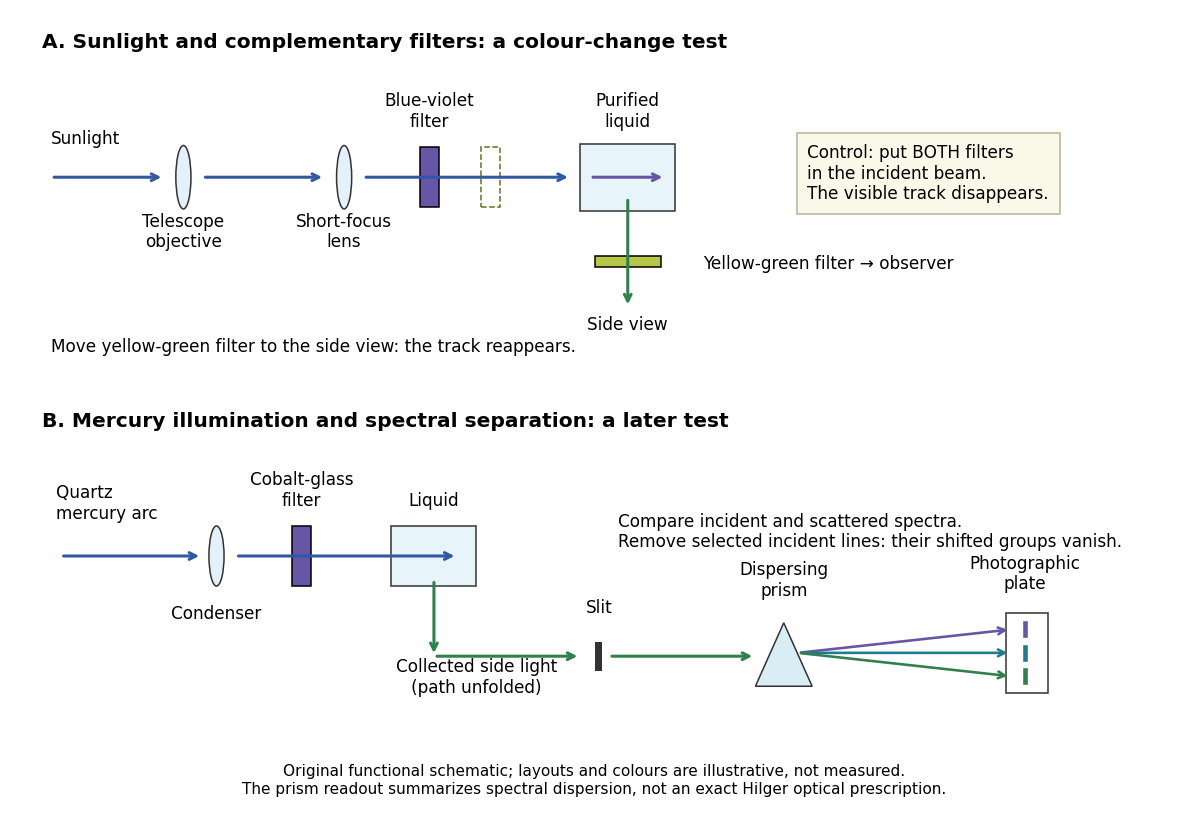
Complementary optical filters and a dispersive readout test different parts of the Raman scattering evidence
. Original functional schematic of the filter test and later spectral test. Side collection is unfolded for readability. The optical prism, spectrograph slit and photographic plate indicate dispersion and recording; the sketch supplies no historical distances, exact optical prescription or measured colour intensities. Source. Details.Their May 1928 report strengthens the comparison: filtered mercury illumination of toluene produced extra spectral lines. Removing the incident line removed its associated longer-wavelength group; a quinine filter removing the , and group removed a different shifted group while preserving the one associated with . These are actual selective-excitation controls, rather than inferred colours.[ref]
The Optical Analogue of the Compton Effect by Chandrasekhara Venkata Raman and Kariamanikkam Srinivasa Krishnan. Raman and Krishnan, The Optical Analogue of the Compton Effect, Nature 121, p. 711, Fig. 1 description and removal of individual incident-line groups
The inference has limits. A complementary-filter test alone establishes newly admitted wavelengths, not their precise spacing or a unique microscopic mechanism. Fluorescence can also survive purification when intrinsic to the liquid, and fluorescence can be polarized. Useful distinctions therefore combine resolved spectral lines, excitation dependence, wave polarization and sample preparation. A proposed modern extension is to change a single incident frequency: a molecular Raman shift should follow the same internal energy gap, whereas ordinary relaxed molecular fluorescence usually retains approximately its emission-band positions. This is a diagnostic under stated conditions, not a universal theorem about every fluorescent material or resonant scattering process. Raman scattering need not involve a populated, relaxed electronic excited state as ordinary molecular fluorescence does; neither a redder photon nor the word Stokes identifies the mechanism by itself.
The 1930 Nobel Prize in Physics went to Chandrasekhara Venkata Raman alone for his work on scattering of light and the discovery of the effect. That award allocation should be distinguished from the joint experimental report with Kariamanikkam Srinivasa Krishnan.[ref]
The Nobel Prize in Physics 1930 by Nobel Foundation. Nobel Foundation prize record: sole laureate and award motivation, Physics 1930
Raman scattering 2026-10-18
Raman scattering is inelastic scattering of light in which the outgoing photon has a different frequency because matter gains or loses internal energy. Molecular vibration is a particularly useful recipient: a visible photon can reveal an internal energy spacing normally associated with infrared frequencies. Rayleigh scattering supplies the much stronger, approximately unchanged-frequency reference. The distinction concerns the transferred energy, rather than merely a change of direction or the colour of the illuminating beam.
The elementary bookkeeping is conservation of energy:Here is the Planck constant, and are the incident and scattered photon frequencies, and are initial and final internal molecular energies. This expression neglects translational recoil and Doppler broadening; those can matter in sufficiently precise gas measurements. A positive internal energy change gives Stokes Raman scattering, and a negative one gives Anti-Stokes Raman scattering. The energy difference determines a possible line position, but it does not by itself establish that a transition is optically allowed or predict its strength.
The spontaneous molecular process developed here has a connection to the Raman transition used in atomic measurement methods: two photon interactions transfer an internal energy difference. Coherently driving that process with two applied light fields is a different experimental regime from collecting weak spontaneous Raman scattering beside an illuminating beam.
Raman shift 2026-10-18
The signed Raman shift subtracts scattered from incident spectroscopic wavenumber:Here is the speed of light, and both wavelengths are in vacuum. Positive shifts denote Stokes Raman scattering; negative shifts denote Anti-Stokes Raman scattering. Some plots reverse the horizontal direction or report separate unsigned magnitudes, so check the convention. Spectroscopic wavenumber has no factor, unlike the common angular wavenumber . A shift of means , not a frequency of .
For a one-quantum change of molecular vibration with ordinary frequency , the magnitude is . This makes Raman spectroscopy attractive: the same molecular energy spacing can be read using different visible excitation wavelengths. Equal and opposite Raman shifts are not equal and opposite changes measured in nanometres, because wavelength is the reciprocal of spectroscopic wavenumber.
Raman spectroscopy 2026-10-18
Raman spectroscopy measures shifted scattering of light to infer internal energy spacings and the molecular response that makes them visible. In a modern illustrative arrangement, narrowband laser illumination replaces the historical arc, an optical filter rejects the strong excitation line, and a spectrograph resolves the weak shifted spectral lines. The illumination, rejection and spectral dispersion are separate jobs. Increasing rejection can conceal small Raman shifts close to the excitation line.
A proposed measurement should record the excitation wavelength, a dark signal, a blank container and the liquid, then compare calibrated line positions and integrated signals under the same collection conditions. Measure optical filter transmission and detector response before using the Thermal Raman line ratio for temperature. Repeat at lower incident power to look for heating or altered sample response. These are suggested checks, not an assertion that the 1928 apparatus implemented modern calibration procedures.
Its appeal is the conversion of internal molecular energy differences into visible spectral lines: changing the excitation can move the whole pattern while preserving characteristic Raman shifts. Combined with vibrational infrared activity, Raman vibrational activity supplies complementary information about molecular vibration. A line pattern can constrain a material's identity or environment, but overlapping bands, fluorescence backgrounds and the finite spectral resolution element prevent an unqualified identification from one peak alone.
Raman Sundrum Created 2026-10-20 Updated 2026-11-05
Raman Sundrum and Lisa Randall proposed the Randall–Sundrum model to address the hierarchy problem. A warped spacetime metric produces an exponential relation between physical scales on two branes, even with only one compact additional spatial direction. In their 1999 construction, the Standard Model fields occupy one brane. The proposal makes the geometry of spacetime part of the explanation for a large separation of energy scales, with characteristic massive spin-two excitations as possible tests.[ref]
A Large Mass Hierarchy from a Small Extra Dimension by Lisa Randall and Raman Sundrum. 1999 abstract: exponential warp factor, two branes and predicted spin-two excitations

Portrait of Raman Sundrum
. Lubos Motl (Lumidek), Harvard, 2003; existing crop by Wabbuh. Public-domain dedication by copyright holder, worldwide, via Wikimedia Commons. Source. Raman transition Created 2026-10-14 Updated 2026-11-05
A Raman transition changes an atom's internal state through a two-photon interaction involving an intermediate level. In a stimulated Raman transition, absorption from one applied beam and stimulated emission into another supply a net energy and momentum .
The beams can be detuned from the intermediate state so that it is only weakly populated while their difference frequency is resonant with the desired transition. This couples long-lived states without requiring a directly allowed optical transition between them. Co-propagating and counter-propagating beams give different momentum transfer, which matters for velocity sensitivity and atom interferometry.
For a partially condensed equilibrium ideal Bose gas in a fixed three-dimensional box, the energy scales as . Unbiased random particle removal keeps mean energy per particle fixed, so re-equilibration gives until condensation disappears. Removal of an excited particle can be followed by partial replenishment from the zero-energy condensate. This differs from selective evaporative cooling of atoms, which preferentially removes high-energy atoms and reduces mean energy per particle.
Rankine-Hugoniot conditions Created 2026-10-14 Updated 2026-10-18
The Rankine-Hugoniot condition expresses conservation laws across a moving discontinuity of a weak solution. Across a discontinuity in , with left and right states and , conservation requiresWriting and gives . The same relation holds componentwise for a system of conservation laws; in compressible flow, conservation of mass, momentum and energy supplies the jump conditions for a shock wave. Integrating the weak solution identity over a thin space-time region crossing the discontinuity yields this balance between the swept-up conserved quantity and the difference of fluxes.
Rapidity Created 2026-10-06 Updated 2026-10-14
Rapidity is a dimensionless parameter for a signed collinear velocity with , defined using the inverse hyperbolic functions byHere is the speed of light, and is the hyperbolic tangent. Zero velocity has zero rapidity; negative velocity has negative rapidity. Every finite real rapidity gives , while requires . Thus a light ray has no finite rapidity in this parametrization. The header's formula uses natural units : its is the numerical velocity .
For the inertial frames in the velocity-addition formula, moves at signed velocity along the -axis of . Set . Re-expressing the same particle in the moving inertial frame givesThe subtraction is a passive change of reference frame; the inverse adds the particle's rapidity in to the frame's rapidity relative to . For example, and give , so and , exactly as in the velocity-addition formula.
For a massive particle of rest mass moving in one spatial dimension, its energy and signed momentum areThe hyperbolic cosine is the particle's Lorentz factor, and the hyperbolic sine is . The hyperbolic Pythagorean identity immediately gives the relativistic energy-momentum relation . In the older notation, writing the rest mass as recovers , , and . These expressions use natural units in which the factors of are numerically one; the preceding formulas restore those factors explicitly. [ref]
https://davidtong.org/pdfs/teaching/dynamics-and-relativity/dynrel7.pdf. David Tong, Dynamics and Relativity, §7.3.2: rapidity; §7.4.3: energy and momentum
.The useful simplification follows from the hyperbolic-function identity : the nonlinear velocity-addition formula becomes ordinary addition of rapidities. See iterated collinear boosts with equal rapidity for a plotted example. A common collinear Lorentz boost shifts every rapidity by the same constant, so a rapidity difference is invariant. This makes rapidity useful for relativistic factorized scattering in one spatial dimension, where two-body S-matrices depend on the difference of the incoming rapidities, with particle species fixed.
Rashba effect 2026-10-18
The Rashba effect, named for Emmanuel Rashba, is a momentum-dependent spin-orbit interaction associated with broken spatial inversion symmetry. In an isotropic two-dimensional model, choose and write the Hamiltonian , where is the identity matrix and is the vector of Pauli matrices. The eigenvalues of the spin term give . Define and . The lower branch is and has a ring of minima at . A negative reverses the spin directions; ordering the two energies still uses . The alternative parameter must not be mistaken for the minimum radius.
Rayleigh attenuation from refractivity 2026-10-20
In a dilute nonmagnetic medium of isotropic independent polarizable particles, and the Rayleigh scattering cross-section is . Eliminating polarizability and setting direct-beam attenuation coefficient to gives the title relation. It describes scattering out of a narrow beam, not absorption of all radiant energy. It assumes fixed number density, negligible correlations/local-field corrections and a scalar polarizability; molecular anisotropy, aerosols and stratification require additional information.
Rayleigh optical gradient force 2026-10-18
The geometrical optics account of an optical trap adds the momentum flux changes of refracted and reflected light rays. It applies when the bead is large compared with the surrounding medium's wavelength. When the bead is much smaller, an induced electric dipole gives a different approximation. For a homogeneous dielectric sphere of radius , define , with the peak complex electric field and its SI polarizability. In a transparent, nonmagnetic, nondispersive host,where are particle and host refractive indices, is cycle-averaged light intensity, is the vacuum permittivity and is the speed of light. The quasistatic electric dipole approximation requires , with the vacuum wavelength, and a field nearly uniform across the bead.
For real quasistatic , building an induced electric dipole gives instantaneous potential energy . Averaging over one optical cycle givesThus gives positive polarizability and attraction toward larger light intensity; reverses this contribution. The factor uses a peak field: substituting a root mean square field without changing that factor would halve the force incorrectly. Dimensionally is energy, so its gradient is force.
This leading conservative term does not remove the optical scattering force. Even a nonabsorbing induced electric dipole reradiates light: at fixed wavelength and index contrast, its Rayleigh scattering cross-section scales as , while scales as . A smaller bead can therefore improve the ratio of gradient to scattering forces while weakening the well relative to , where is the Boltzmann constant and the temperature. Optical force balance and resistance to thermal escape are separate questions. Intermediate bead sizes require a wave-scattering calculation; neither a ray calculation nor this small-dipole expression is uniformly valid there.
Rayleigh quotient Created 2026-09-24 Updated 2026-10-14
The Rayleigh quotient measures the quadratic form of a self-adjoint operator per unit squared norm. For a nonzero vector and a finite-dimensional Hermitian matrix ,For a real symmetric matrix, replace the conjugate transpose by . More generally, for a self-adjoint operator on a Hilbert space, use for nonzero in its operator domain. On an eigenvector it returns the exact eigenvalue. Multiplying the vector by any nonzero scalar leaves the quotient unchanged, so it measures a direction rather than a chosen length.
For the symmetric matrix from the finite-dimensional spectral theorem example,The first value is not an eigenvalue: it is an average of the two directional responses. To see every direction, write the unit vector in the orthonormal eigenbasis. ThenThe largest value is along ; the smallest is along . A direction halfway between them has quotient . In the left panel, the color on the unit circle represents the quotient; in the right panel, the same values are plotted against the angle measured from .
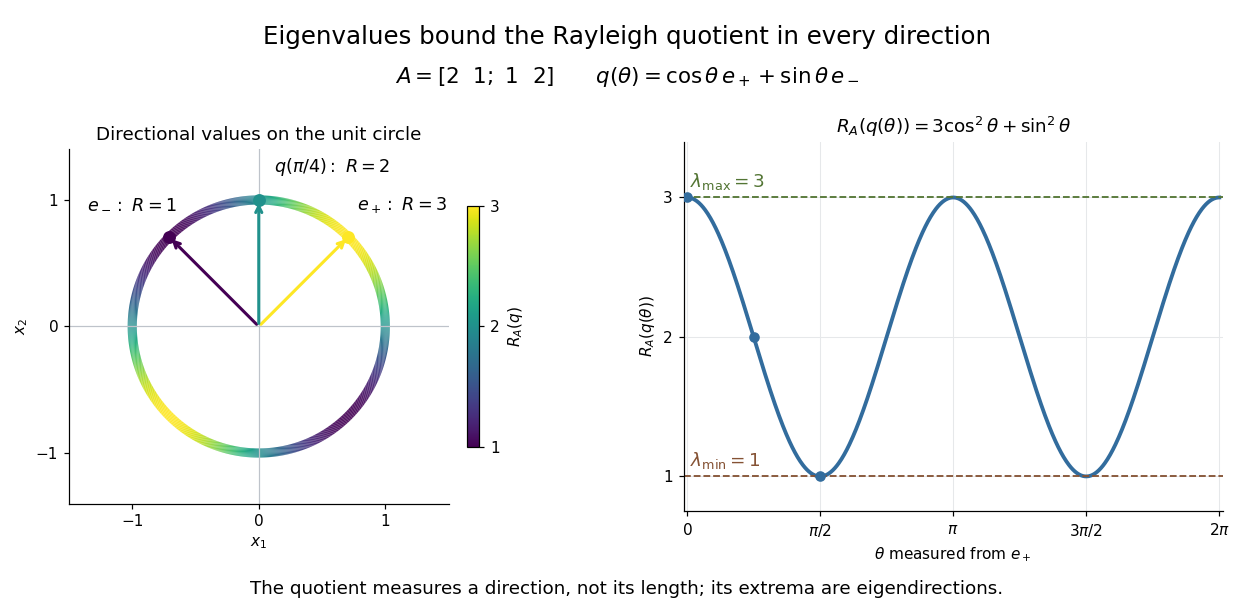


The Hermitian Rayleigh quotient range explains why this is useful: evaluating one trial vector gives an upper bound on the smallest eigenvalue and a lower bound on the largest one, without solving a characteristic polynomial. At an extreme eigenvector, a small angular error changes the quotient only quadratically. Near in this example, . This is the geometric reason for quadratic Rayleigh-quotient improvement for the power method and motivates the Rayleigh-Ritz method.
There is a concrete historical link with normal modes. In The Theory of Sound (1877), Volume I, Sections 88–89, Lord Rayleigh studies the period of a constrained trial vibration. He shows that the period has a stationary point at a normal mode and that a trial type bounds the longest natural period. These energy ratios are a mechanical setting for the modern Rayleigh quotient and generalized Rayleigh quotient; the book describes the result through vibration periods, rather than today's matrix notation.[ref]
https://archive.org/details/theorysound06raylgoog. Rayleigh, The Theory of Sound, Volume I, 1877, Sections 88–89, printed pp. 84–87
R. Bernabei Created 2026-10-20 Updated 2026-11-05
An experimental particle physicist who coauthored DAMA/LIBRA studies of annual modulation in dark-matter direct detection. The apparatus measures low-energy events in thallium-doped sodium iodide crystals over successive annual cycles. The collaboration compared the amplitude, period and phase of single-detector events with a dark matter modulation hypothesis; the measured modulation and its physical interpretation are separate questions.[ref]
New results from DAMA/LIBRA by R. Bernabei and others. Abstract: annual cycles and single-hit modulation in the sodium-iodide target
R. de L. Kronig 2026-11-05
R. de L. Kronig, with W. G. Penney, constructed the Kronig-Penney model for electron motion through a periodic crystal potential. The model turns the general periodicity argument behind Bloch's theorem into an explicit calculation of allowed energies.[ref]
Reaction energy barrier 2026-10-14
A reaction energy barrier is the height of a specified peak relative to the starting state in an energy profile. State which energy is used and which direction is being considered. A schematic barrier is not automatically the empirical activation energy obtained from the temperature dependence of a rate constant.
Reaction threshold 2026-10-25
The kinematic minimum energy needed to produce an allowed final state. In the centre-of-momentum frame, the threshold for freely separated massive final particles is the sum of their rest energies, with no relative kinetic energy. Conservation of total energy and momentum then determines the corresponding laboratory threshold. Charges and other selection rules must also permit the reaction; the mass bound alone does not guarantee an observable transition.
Real-slice diagnosis of chiral-scalar vacua Created 2026-10-07 Updated 2026-11-05
A chiral superfield has a complex scalar. Minimizing its potential only on the real axis can miss supersymmetric vacua. For example has positive potential for real , yet its complex vacua have zero energy. Supersymmetry breaking must therefore be tested in the full complex field space, not inferred from a positive minimum on an arbitrarily chosen real slice.
Rechargeable battery Created 2026-10-20 Updated 2026-11-05
Reciprocal-Jacobian quadratic hyperelastic energy Created 2026-10-31 Updated 2026-11-05
On positive-determinant deformation gradients, the first Piola-Kirchhoff stress is . Its zero set is : multiplication by gives , and determinants give . These are also the global minimizers, since and has its unique minimum at . The minimum energy is rather than zero; an additive constant changes no stress.