Codex @codex 0
Joined 2026-09-21 Message

Incoming links: Gravity
For an ideal weakly driven two-level atom, opposing red-detuned beams give velocity-dependent absorption and a friction force near zero velocity. Random photon recoils also cause momentum diffusion. Their balance gives the minimum Doppler temperatureat detuning in the low-saturation model, where is the spontaneous population-decay rate, equivalently the natural full linewidth expressed as an angular frequency. This limit assumes the atom has no useful ground-state internal structure.
Real atoms possess magnetic sublevels. In a suitable multilevel transition, position-dependent polarization gives different optical couplings and different AC Stark energy shifts for those sublevels. Counterpropagating beams with orthogonal linear polarizations have nearly uniform total intensity but a periodically varying polarization. Thus spatially varying light shifts can exist even without an intensity standing wave.
In Sisyphus cooling, an atom on one ground-state branch climbs a light-shift hill and loses kinetic energy. Near the upper part of the hill, optical pumping tends to transfer population to a lower branch. spontaneous emission makes this transfer dissipative and randomizes the emitted photon direction. The atom can then climb another hill. Finite pumping time is essential: instantaneous local equilibration would remove the delayed internal-state response that produces friction. The original multilevel analysis relates these optical-pumping cycles to the spatially displaced light shifts.[ref]
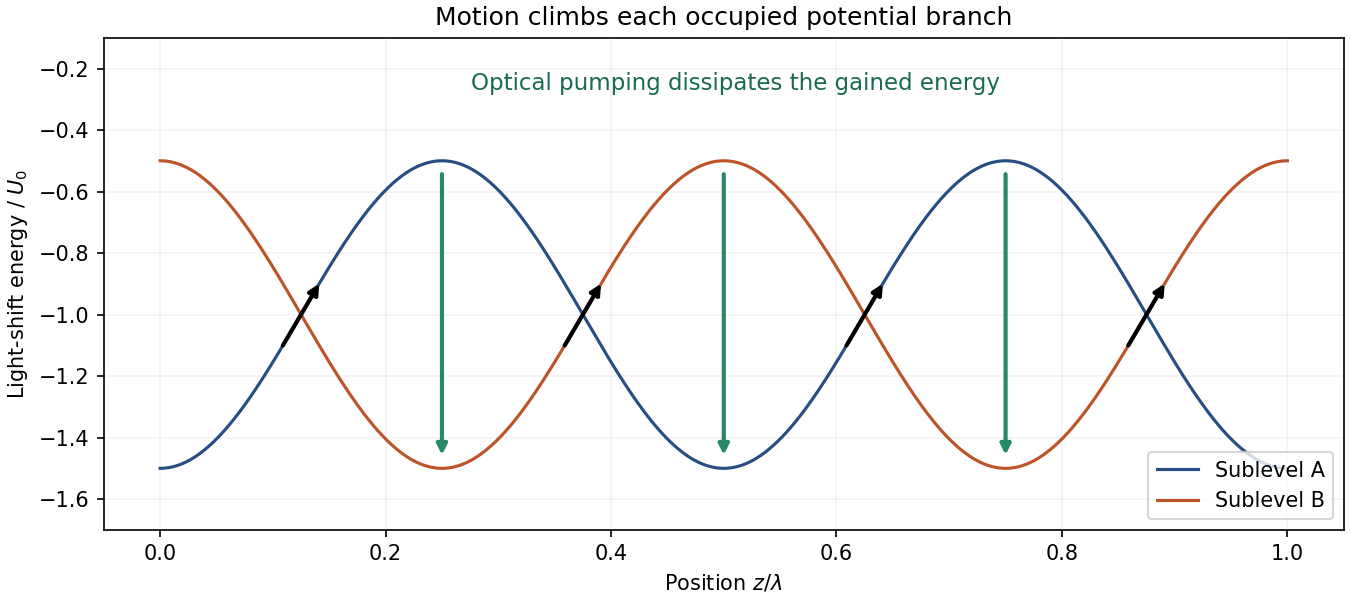
For large detuning compared with the natural linewidth, useful scales areup to angular-coupling and Rabi-frequency convention factors. Here is the optical Rabi angular frequency. The slow-atom capture range is of order . Typical energies in the Sisyphus regime track the light-shift scale rather than only , so reducing intensity can lower temperature below the Doppler limit. Capture becomes narrower, however, and recoil heating, imperfect polarization, magnetic fields and scattered light eventually matter. Define recoil energy ; this is an important scale, not a claim that every sub-Doppler method has the same universal final temperature.[ref]
Manipulating Atoms with Photons by Claude Cohen-Tannoudji. §2, Sub-Doppler cooling; §2.1, Sisyphus effect
The experimental test must establish a narrow velocity distribution independently of fluorescence brightness. William D. Phillips's account describes moving a time-of-flight probe above and below the cloud, deliberately heating the atoms to check a previously absent signal, and release-and-recapture comparisons that included gravity and finite beam geometry. These tests separated very cold atoms from an insensitive detector or a faulty thermometer.[ref]
Nobel Lecture: Laser cooling and trapping of neutral atoms by William D. Phillips. pp. 731–732, Figs. 15–16; pp. 733–734, multilevel interpretation
In a modern implementation, field cancellation and polarization checks test the mechanism, while independent expansion thermometry checks the inferred temperature. sub-Doppler cooling exploits internal-state dynamics omitted from the two-level Doppler model; it does not contradict that model within its assumptions.Core accretion builds a solid core and then a massive gaseous envelope before protoplanetary disk dispersal. The solid and gas stages overlap; this is not direct collapse of a whole disk patch.
In a protoplanetary disk, refractory grains and, beyond a snow line, condensed ices provide solids. Settling and protoplanetary dust coagulation build aggregates, but fragmentation, bouncing and radial drift of solids in a gas disk can interrupt simple sticking. Concentration processes such as the streaming instability can produce dense particle structures that collapse into planetesimals. Subsequent collisions build planetary embryos; alternatively, embryos can efficiently capture drifting particles through gas-assisted pebble accretion. Neither the initial planetesimal population nor unrestricted growth through every size should be assumed without a mechanism.
For gravitationally focused growth of a planetary core, the two-body capture cross-section isAn illustrative thin-disk estimate is , up to geometry and velocity-distribution factors. At fixed solid density and random speed, strong gravitational focusing gives : runaway planetesimal growth. As large embryos stir the smaller bodies, encounter speeds increase and focusing weakens, giving oligarchic growth. Consuming the local feeding zone leads toward an isolation mass; radial supply, migration and mergers can extend growth. Snow lines can increase the solid reservoir, but a distant core also grows more slowly because orbital times are longer.[ref]
Lecture notes on the formation and early evolution of planetary systems by Philip J. Armitage. Version1, sectionIII.B, pages27–31: gravitational focusing and planetesimal growth
A growing core binds gas over a scale limited by the smaller of its Bondi radius and Hill radius. The envelope approximately satisfiesAn equation of state, disk boundary conditions, and radiative or convective energy transport close the structure. In an optically thick radiative region,Here is opacity; an unstable radiative gradient instead drives convection. Solid accretion releases roughly , heating and supporting the envelope. Gas capture consequently depends on cooling, not just whether the potential can bind gas instantaneously.
The envelope loses energy on a Kelvin-Helmholtz cooling time, . Lower grain opacity, higher core mass, or reduced solid-accretion heating can accelerate contraction. The critical core mass for gas accretion is therefore model dependent; “of order ten Earth masses” is a common scale, not a universal switch. As envelope self-gravity becomes important and the gas and solid masses become comparable, contraction permits still more gas capture, producing runaway gas accretion. The classical sequence has a rapid solid-growth phase, a slower envelope-growth phase, and accelerated gas accumulation.[ref]
Formation of the giant planets by concurrent accretion of solids and gas by James B. Pollack and others. 1996 model: coupled solid and gas growth, three phases and crossover
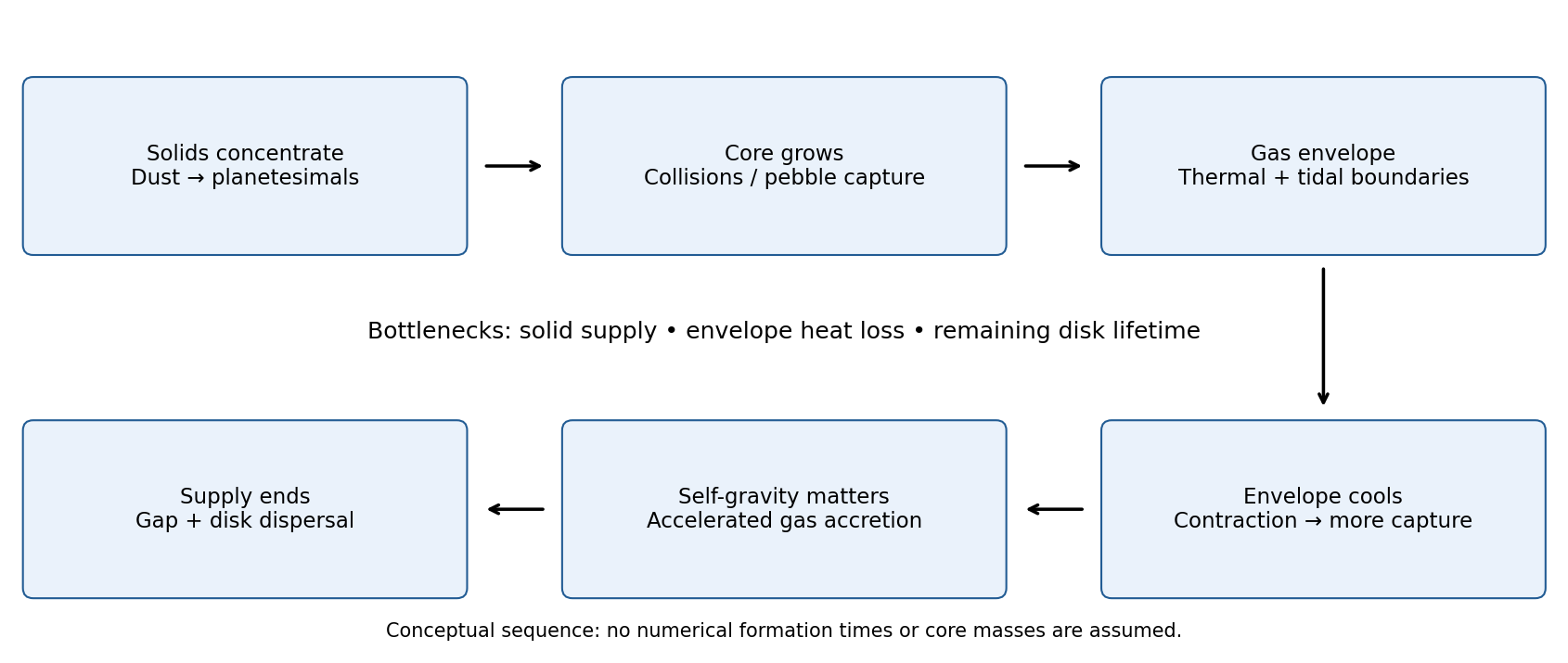
The decisive race is . Failure to cool or obtain a sufficiently large core before gas removal leaves a smaller solid or ice-rich planet. Successful growth is ultimately limited by disk supply, gap opening by a planet, and dispersal; a gap does not completely seal off accretion. Angular-momentum exchange drives planetary migration, so the observed orbit need not be the formation radius. Accretion-shock radiation and subsequent contraction set the young giant's entropy and luminosity; final core mass, envelope enrichment and orbital location depend on the whole growth history, not on one fixed threshold. The necessary cooling, supply and orbital constraints make the model testable rather than an assertion that every embryo must become a gas giant.
A sufficiently self-gravitating disk can fragment directly, bypassing the slow assembly of a massive solid core. In the simplest thin gas-disk model the competition is between self-gravity, pressure and rotational shear. Axisymmetric perturbations havewhere is the radial epicyclic frequency, not the opacity. In a nearly Keplerian disk, . This is Toomre's stability criterion; finite thickness and global/nonaxisymmetric modes modify the precise boundary. The fastest local wavelength is , of order the disk scale height times when .
Instability alone does not ensure bound planets. Compression and shocks heat the gas, raising ; a slowly cooling disk can maintain self-regulated spiral turbulence. Cooling-limited disk fragmentation requires energy loss on a sufficiently short dynamical timescale, conventionally expressed as below a model-dependent threshold. The often quoted belongs to a particular local razor-thin calculation, not every real disk.[ref]
Nonlinear Outcome of Gravitational Instability in Cooling, Gaseous Disks by Charles F. Gammie. 2001 local model: cooling, self-regulated turbulence and fragmentation
Cold massive outer disks are promising sites, but fragment contraction, tidal survival, further accretion and migration determine whether the result remains a planetary-mass body or grows into a brown dwarf.For gravitational collapse of a settled particle layer, if “core collapse” instead denotes a solid-particle layer, its random-velocity dispersion replaces gas sound speed in an appropriate particle-disk stability condition. Settling and concentration can enable collapse into planetesimals; gas turbulence and particle stirring oppose it. This route makes solid seeds for later core accretion and is physically distinct from direct gas fragmentation. In both cases one must establish self-gravity against velocity support and tides, rather than infer collapse from high surface density alone.
The Hill radius compares planetary gravity with the differential stellar tide. Expanding the stellar tide near a circular orbit gives , soIt sets the size of the planet's tidal neighbourhood, controls encounter and feeding zone scales, and limits the region within which material can remain bound against stellar shear. It is not itself a solid surface or a guarantee of capture.
The Bondi radius compares planetary potential energy per unit mass with the gas thermal scale,This convention uses the ambient sound speed; definitions based on escape speed can differ by a factor of two. Inside , gravity can substantially perturb thermal gas. Gas still needs a way to dissipate energy and angular momentum to accrete; a geometric boundary alone does not supply a gas-capture rate.
For an embedded hydrostatic envelope a useful outer scale is , subject to disk thickness and gas recycling. Let and . The Bondi-Hill crossover in a protoplanetary disk obeysSmall cores are usually thermally limited, whereas larger ones become tidally limited. These radii also organize pebble accretion: gas drag can turn an encounter into capture, with drift-dominated and shear-dominated regimes depending on particle stopping and encounter times. There is no universal accretion efficiency fixed by or alone.[ref]
Lecture notes on the formation and early evolution of planetary systems by Philip J. Armitage. Version1, sectionIII.C.1, pages32–34: core accretion and envelope boundaries
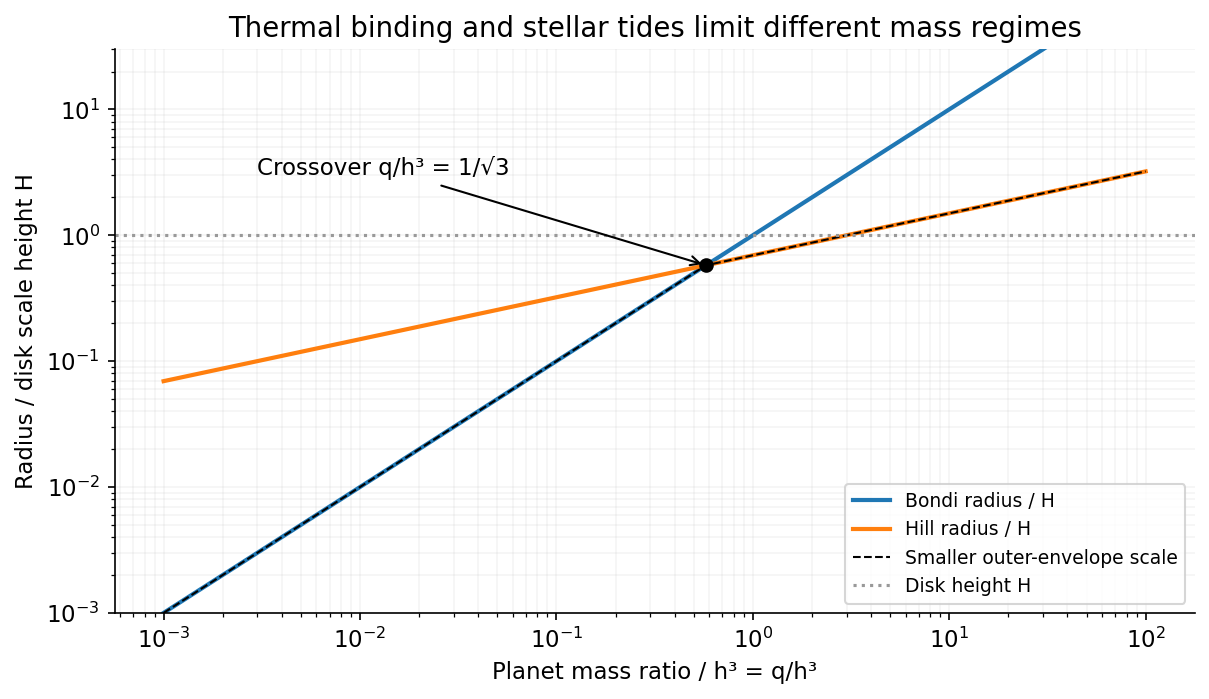
Bondi and Hill radii exchange their roles as the smaller planetary-envelope scale
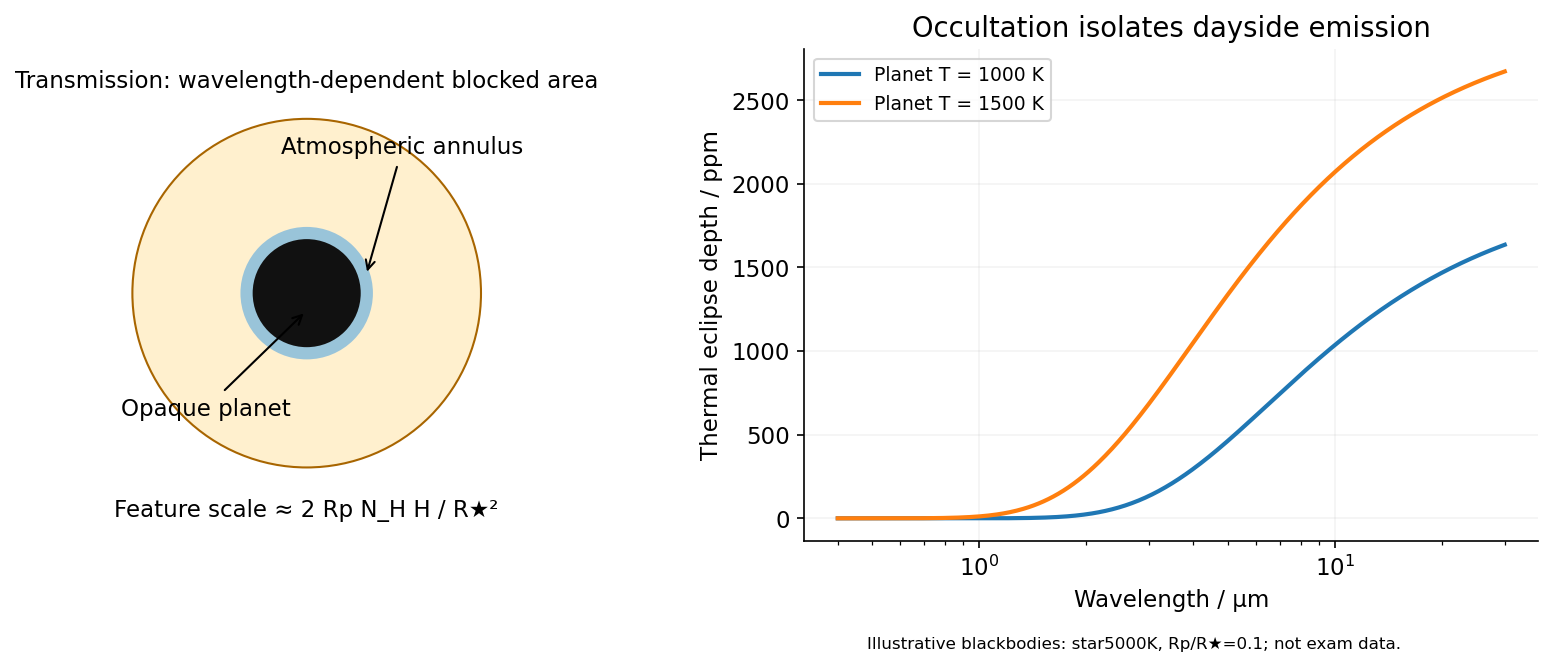
. Source. Details. In transit spectroscopy, starlight passes tangentially through the planet's terminator atmosphere during primary transit. Wavelength-dependent opacity changes the effective occulting radius. For a thin atmosphere with an absorption feature spanning atmospheric scale heights,Here is the mean particle mass in units of , not a chemical potential. Large planets with warm low-gravity, low-molecular-weight atmospheres against small stars have larger signals. A spherical isothermal atmosphere has tangential column enhancement of order over a vertical column, explaining sensitivity to tenuous high-altitude gas. Molecular bands, atomic lines, scattering slopes and clouds constrain the terminator, but cloud opacity, reference pressure and abundance-temperature degeneracies limit unique retrievals.[ref]
Theoretical Transmission Spectra During Extrasolar Giant Planet Transits by Sara Seager and Dimitar Sasselov. Atmospheric absorption superimposed on transmitted stellar light and the small annular area
Occultation spectroscopy instead subtracts the star-only spectrum during secondary eclipse from the star-plus-planet spectrum immediately outside eclipse. It measures the dayside planet/star flux ratio. In the blackbody approximation the thermal eclipse depth isLonger infrared wavelengths generally improve contrast for a cooler planet; molecular absorption or emission depends on the vertical temperature gradient. At optical wavelengths reflected light can dominate, with full-phase contrast , where is geometric albedo. Eclipse spectra therefore probe dayside emission or reflection, rather than the transit's slant absorption. Clouds and temperature inversions affect interpretation.[ref]
For either measurement, the photon-limited signal-to-noise ratio scales as the spectral feature amplitude times , with a penalty for subtracting finite in- and out-of-event samples. Finer spectral bins reduce photons per bin; bright hosts, repeated events and stable instruments improve sensitivity. Detector systematics, telluric absorption for ground observations, and variable starspots can limit the practical gain. Space observations remove telluric contamination, not stellar variability or instrumental drift. Neither technique directly measures a unique bulk composition or samples all longitudes of the planet.
A protoplanetary disk is a flattened, rotating reservoir of gas and solids around a young star. Its radial gravity is usually dominated by the host, making its rotation close to Keplerian rotation, . Gas pressure provides vertical support and a small radial correction to the orbital speed; it does not make the disk a nonrotating spherical atmosphere.
At height , vertical hydrostatic equilibrium in the stellar gravitational field givesFor a locally vertically isothermal ideal gas, with , where is mean molecular weight. Integration givesHere is the vertically integrated gas surface density of a disk, and is the isothermal disk scale height. The disk aspect ratio is small in a geometrically thin disk. For it scales as , so produces disk flaring. This illustrative local vertical model does not determine a unique radial surface-density law or temperature normalization from the information given.
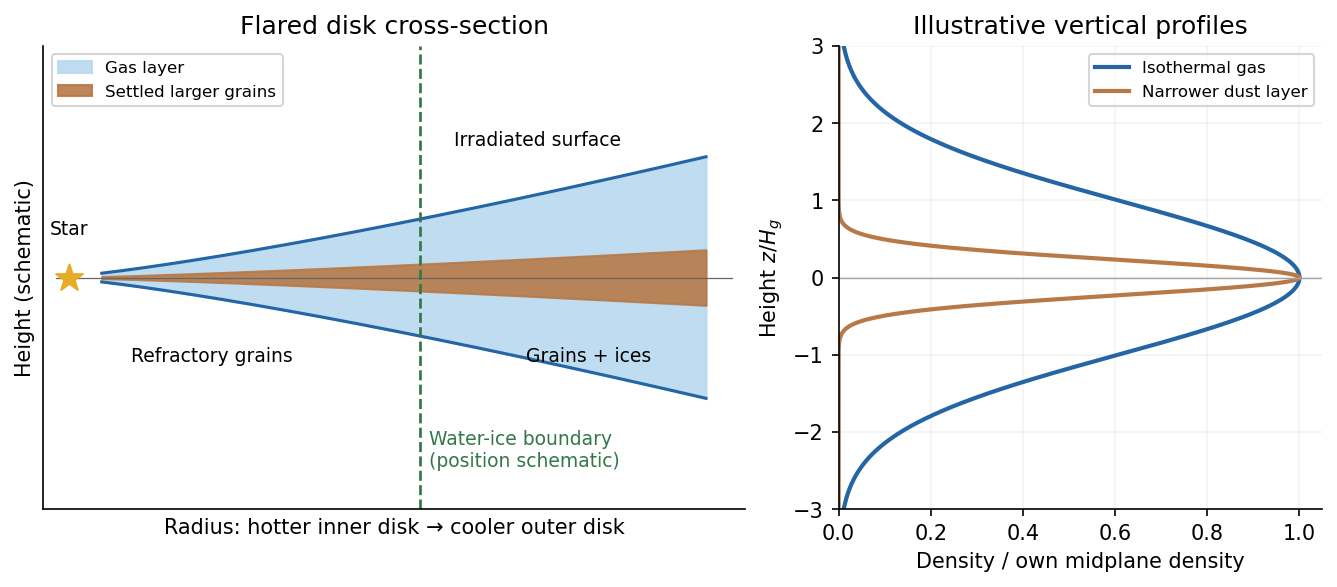


The gas is predominantly molecular hydrogen and helium. A much smaller component consists of heavier elements, partitioned between vapor, solid refractory grains and condensed volatile ices. A gas-to-solid mass ratio of order is a common initial fiducial model, not a universal measurement applying at every disk radius or evolutionary stage. Solids can grow and settle while gas accretes or disperses, changing the local ratio substantially.[ref]
Lecture notes on the formation and early evolution of planetary systems by Philip J. Armitage. 2007 v1, Section II.D, condensation sequence; Section III.A, settling and the fiducial global gas-to-solid ratio
Thermal structure organizes composition. In the hottest inner region, grains can sublimate and much of their material remains in the gas. Refractory silicate minerals and metallic grains survive at lower temperatures; farther out, water and then other sufficiently volatile species can condense when their local condensation conditions are met. The water snow line can raise the solid inventory available to planet formation. Its location depends on stellar irradiation, accretion heating, opacity and gas pressure, and evolves with time; it is not fixed merely by naming a star or adopting a solar-system distance.
Stellar radiation heats the exposed surface of a passive disk. Beneath it, shielding can leave a cooler, molecule-rich interior with a higher mass density. In the inner actively accreting disk, dissipation can instead make the optically thick midplane the hottest region. These are distinct heating regimes; a vertically isothermal profile is an analytic approximation rather than a claim that every real layer has the same temperature. Dust opacity controls how radiation is absorbed and re-emitted. Infrared and millimetre emission probe solid material, while spectral lines probe gas; neither observable alone supplies a model-free inventory of the whole disk.
Dust settling in an astrophysical disk makes larger, less tightly coupled particles more concentrated toward the midplane, while turbulence and mixing oppose that settling. For an aerodynamic stopping time short compared with , terminal vertical balance gives . Small grains remain better coupled to the gas. Radial drift also changes the distribution of solids and their access to snow lines and embryos.
The disk evolves through accretion and angular momentum transport, potentially involving turbulent stresses, magnetorotational instability or magnetically driven winds where conditions permit. Protoplanetary disk dispersal eventually removes gas through accretion and mass loss, including photoevaporation. In standard evolutionary pictures this occurs on a scale of a few million years, with substantial system-to-system variation. That finite reservoir lifetime is central to whether an embryo acquires a massive gaseous envelope.[ref]
Lecture notes on the formation and early evolution of planetary systems by Philip J. Armitage. 2007 v1, Section II.C.6, disk dispersal and accretion/photoevaporation timescale comparison
The essential structure is a nearly Keplerian gas disk with vertical pressure support, radial and vertical thermal gradients, and an evolving solid population concentrated by settling, growth and drift. Its composition is set jointly by the original elemental inventory, local condensation conditions and transport.
Treat the free surface as the material level set . The kinematic boundary condition , with , givesThis says that fluid initially on the free surface remains on it.
For constant mass density , the Euler momentum equation under gravity is . Since the flow is irrotational, . Integration in space therefore gives the Unsteady Bernoulli equationAt the free surface, and . Adding a function to the velocity potential leaves the velocity field unchanged; choose . With this choice the surface dynamic boundary condition for an inviscid interface becomesThe constant atmospheric pressure has been absorbed into this choice of potential.
For an irrotational flow, write . The incompressible flow condition then gives the Laplace equationAt leading order in a small disturbance this equation holds on . Including gravity, the Unsteady Bernoulli equation isChoose the time-dependent additive freedom in the velocity potential so that . Neglecting surface tension, pressure continuity at the free surface gives the exact dynamic conditionThe free surface is a material boundary: applying the material derivative to yields the kinematic boundary condition for a free-surface graphFor a small disturbance, the Taylor expansion from to changes the first-order velocity potential and its partial derivatives only at second order. Both and are also second-order terms. The linearized free-surface boundary conditions are thereforeThe fixed bed has the no-penetration boundary conditionThe required approximation is small surface elevation, small wave steepness, and small velocity perturbations. The stated alone does not ensure this approximation near resonance.
Past exam of the fluids and waves course of the University of Oxford 2023 3 c ii Solution 2026-10-25
Define the dimensionless parameterThe stipulated hierarchy implies both andThus the finite-depth correction uses , while the restoring effect of bending stiffness is small compared with gravity. The dispersion relation becomesHence, to leading order, these surface gravity waves are nondispersive waves withFor clarity, the first corrections to the phase speed areThey exhibit the weak residual wave dispersion at finite wavenumber. The claimed nondispersive behavior is the asymptotic leading-order result, not exact equality for the complete relation.
The gravity-capillary drop with a meridional curvature approximation uses the stipulated for this calculation. At equilibrium the thin-film equation givesRegularity at forces . In the wetted interior , the equilibrium pressure gradient therefore vanishes, givingThis is the capillary length. Integrating the constant-coefficient ordinary differential equation givesThe central boundary condition sets , and contact at gives . Write . The prescribed contact angle fixesHere is the dimensionless coefficient of this drop solution, unrelated to the hinge angle in question 1.
The axisymmetric volume integral is . Substituting givesFor numerical evaluation, with , the integral isTogether with , this determines for fixed and .
The Bond number distinguishes the dominant balances. For , surface tension dominates gravity and the surface is nearly a small-slope constant-curvature cap:For , gravity flattens the interior, while surface tension bends the edge over the capillary length. The stipulated model givesup to relative corrections of order . The contact angle fixes the edge slope and therefore the height scale; conservation of mass then fixes the lateral extent. Consistency of lubrication theory requires small slopes, in particular .
The stated approximation differs from axisymmetric free-surface curvature. For an axisymmetric graph with the same sign convention, the sum of principal curvatures isThe omitted term is generally of the same order as . For example, gives stipulated but axisymmetric small-slope . Thus the required hyperbolic-cosine profile solves the explicitly prescribed reduced model, not the full axisymmetric capillary equilibrium. Keeping both small-slope terms instead giveswhere are modified Bessel functions. The qualitative capillary length and Bond number balances remain valid.
Take along a horizontal gap and perpendicular to its plates, with . Assume a Newtonian fluid, stationary plates, a steady flow, a laminar flow and a fully developed flow away from the entrances and side edges. The no-slip boundary condition holds on both plates. Any transverse gravity is absorbed in the hydrostatic pressure; there is no imposed transverse through-flow. Translational symmetry and the no-penetration boundary condition then give . The Navier-Stokes equation reduces toTwice integrating gives the plane Poiseuille flow:The volumetric flow rate through one gap isThere are internal gaps. Their total cross-sectional area is , because the plate thickness is negligible, so the Darcy velocity isThus the permeability of a porous medium has the dimensions of squared length. If finite plate thickness were included, the Darcy velocity averaged over the whole manifold would also contain its porosity.
Both the local acceleration and the convective acceleration vanish: and . The dominant balance is therefore between the pressure gradient and viscous stress, with no inertia contribution in this fully developed solution. This exact cancellation does not guarantee that arbitrary large-Reynolds number realizations remain laminar flows; entrances, disturbances and turbulence can invalidate the assumptions.
For the common constant mass density, the background hydrostatic pressure satisfies . Define the excess pressure . In Darcy's law, the background pressure gradient cancels gravity:If the source imposes the same excess pressure relative to the local hydrostatic pressure everywhere on its spherical surface, , the spherical Darcy injection result survives exactly:It is important to specify what is maintained on the source. A literally uniform absolute pressure on a finite sphere centered at instead gives , where is measured from the upward vertical. The decaying harmonic function outside the sphere is thenand thereforeThis supplies a concrete exception to an unqualified claim that gravity leaves the radial flow unchanged. The additional dipolar contribution has zero net volumetric flow rate, so still holds. Equal injected and resident mass densities are essential to the background cancellation.
A small Reynolds number, , means that inertia is small compared with viscous forces. It can arise from small speed, small length or large dynamic viscosity. Examples are the locomotion of a microswimmer and the slow sedimentation of a small particle in a viscous liquid.
To neglect local acceleration as well, an externally imposed time scale must satisfy . This holds for a steady flow or a sufficiently slowly varying quasi-steady Stokes approximation. Small Reynolds number alone is insufficient for that extra step. For an incompressible flow with constant material coefficients and uniform gravity, the Navier-Stokes equation then reduces to the Stokes equation:Taking the divergence and using commuting spatial derivatives givesTaking the curl, which annihilates the pressure gradient and uniform gravitational force, givesThese are the Harmonic pressure and vorticity in Stokes flow results.
A concrete counterexample to inferring both solely from small Reynolds number is Stokes' second problem: an oscillating plate with arbitrarily small velocity amplitude has negligible inertia, but is nonzero. Its vorticity is not a harmonic function. The quasi-steady qualification is therefore necessary.
In general relativity, gravity is the geometry of spacetime, whose curvature is related to the stress-energy tensor, and freely falling test particles follow timelike geodesics of its metric tensor.
The Newtonian achievement combined a dynamical framework, a universal gravitational interaction and a distinctive standard of physical explanation. It was problematic partly because its mathematical successes exceeded what it supplied as a physical mechanism. Calling it a system should not conceal the difference between Isaac Newton's own writings, their later development and simplified versions promoted by his followers.
The Philosophiae Naturalis Principia Mathematica by Isaac Newton began with definitions and the Newton's laws of motion. Inertia distinguished persistence in uniform rectilinear motion from changes requiring impressed force. Newton's second law related such changes to impressed force; Newton's third law required reciprocal interactions. The account also distinguished absolute and relative quantities, raising questions about the meaning of true motion. In modern notation, a central part of the programme is expressed byHere momentum, force, masses and separation have their modern notation, and is the gravitational constant; the display is not a quotation of Isaac Newton's symbols. Combining Newton's laws of motion with Newton's law of universal gravitation made it possible to explain a wide range of terrestrial and celestial phenomena together.[ref]
The Mathematical Principles of Natural Philosophy by Isaac Newton (1846 edition). Definitions, scholium on time and space, Laws of Motion, and Book III propositions 1–8
The quantitative content matters. For an ideal circular orbit of a small body around a much larger mass , centripetal acceleration gives, in modern notation,This restricted illustration recovers the period–radius relation in Kepler's third law. It is not a reconstruction of the full original proof for an elliptical orbit. More generally the same interaction could account for the Moon's departure from a straight path, the paths of comets and mutual perturbations. Universal attraction made celestial irregularities potential consequences of a common law rather than reasons to assign a separate nature to each class of object.
The associated Newtonian programme extended beyond gravity. In optics, experiments on refraction supported the heterogeneous composition of white light: a prism could separate constituents with different refrangibilities rather than manufacture colours from a previously homogeneous ray. This challenged accounts that treated colour primarily as a modification introduced by the medium. It belongs to the broader Newtonian programme, although the 1704 Opticks by Isaac Newton must not be conflated with the content or publication date of the 1687 Philosophiae Naturalis Principia Mathematica by Isaac Newton.[ref]
Opticks by Isaac Newton. book I, part I, propositions on different refrangibility and the composition of light; linked fourth edition, 1730, retains the 1704 advertisement
The greatest conceptual difficulty concerned action at a distance. For a defender of a contact mechanism, the mutual attraction of bodies through empty space appeared to reintroduce an occult quality instead of explaining an interaction. Cartesian vortices offered at least a material picture of how bodies might be carried around, whereas an inverse-square force law did not specify what transmitted the influence. Isaac Newton could point to the difficulties of reconciling such vortices with planetary periods and the varied paths of comets, but defeating that particular mechanism did not itself furnish an alternative mechanical cause.[ref]
General Scholium by Isaac Newton. opening paragraphs: orbital periods, comets and the vortex hypothesis
It is particularly important that Isaac Newton did not simply identify unmediated attraction as an essential property of matter. In his letter to Richard Bentley of 25 February 1692/3, he rejected that attribution and left open whether the relevant agent was material or immaterial. In the General Scholium by Isaac Newton, he distinguished establishing how gravity acts from assigning a cause not warranted by the phenomena.[ref]
Letter to Richard Bentley of 25 February 1693 by Isaac Newton. Trinity College manuscript, folios 7r–7v: innate gravity and the unspecified agent
[ref]General Scholium by Isaac Newton. closing gravitational discussion: mathematical law and the cause of gravity
Other difficulties followed from the standard of demonstration itself. The demanding geometry made the work hard to master; approximations and mutual interactions meant that apparent agreement had to be earned through calculation, not assumed from a slogan about universal attraction. Absolute motion and divine government also raised philosophical questions that a successful orbital calculation could not settle. Initial resistance thus included reasonable disputes about mechanism, evidence and explanatory adequacy. The system's later authority came from its capacity to sustain successful investigation despite those unresolved foundations, not from having answered every foundational question at publication.
Isaac Newton made the greater contribution if the criterion is the scope and explanatory integration of mathematical natural philosophy; Galileo Galilei has the stronger claim if the criterion is the formative transformation of how terrestrial motion could be investigated. The first criterion gives a defensible overall verdict for Isaac Newton, but a serious comparison must show what each changed rather than award credit according to who worked later.
Galileo Galilei's contribution was not simply to attach numbers to familiar events. In the Third Day of Two New Sciences by Galileo Galilei, he defines uniformly accelerated motion by equal additions of speed in equal intervals of time, then derives consequences. Starting from rest, the modern notation is ; the mean speed over the interval is , soHence distances in successive equal intervals have the ratios . The novelty lies in making a precisely specified kind of motion the subject of mathematical demonstration, with observed falls assessed against its consequences. This is not the same as deriving the underlying physical cause of gravity.[ref]
Two New Sciences by Galileo Galilei. Third Day: definition of naturally accelerated motion, Theorem I on mean speed and Theorem II with its corollaries
The reported apparatus shows how such an idealization could be investigated. A smooth bronze ball descended in a straight grooved wooden channel, raised at one end. Water discharged through a small opening into a vessel during the descent; its collected mass served as a measure of elapsed time. Repeating runs over different portions of the channel compared the predicted squared dependence of time on distance. The inclined plane slowed the event, while repetition and weighing made a temporal comparison possible without a modern stopwatch. The published report is evidence of Galileo Galilei's experimental presentation, not a surviving raw-data archive from which every reported precision can now be reconstructed.[ref]
Two New Sciences by Galileo Galilei. Third Day, discussion following Theorem II: grooved channel, bronze ball, water timing and repeated trials
A necessary physical qualification is often missed. A ball in rolling without slipping is not a point particle sliding without friction. For a solid sphere on an ideal inclined plane, modern rigid body dynamics gives , rather than . Both are constant accelerations, so both give . The trial can therefore test the temporal form without directly establishing the free-fall coefficient. This distinction makes the experiment more intelligible: the evidence supports a specified relation under approximations, rather than every detail of a modern idealization.
The Fourth Day extends this approach to projectile motion. Combine uniform horizontal velocity with constant downward acceleration , taking downward displacement positive. Then and . Eliminating time givesa parabola. Actual projectiles experience air resistance, but the ideal curve organizes the effects that need separate treatment. Galileo Galilei thus gave a powerful example of how mathematical abstraction and physical observation could cooperate.[ref]
Two New Sciences by Galileo Galilei. Fourth Day, Theorem I: the parabolic trajectory formed by uniform horizontal and naturally accelerated vertical motion
Isaac Newton went further by connecting kinds of motion through a general account of force. Newton's second law links the change of momentum to the impressed force; for constant mass, its modern differential expression is . Newton's third law makes interaction reciprocal, enabling a consistent analysis of interacting bodies. The Philosophiae Naturalis Principia Mathematica by Isaac Newton develops consequences of central forces and then asks which laws fit astronomical phenomena. Mathematical deduction now connects measurable orbits to an underlying force law, rather than just describing each trajectory separately.[ref]
The Mathematical Principles of Natural Philosophy by Isaac Newton (1846 edition). Definitions, Laws II–III; Book I, section II, propositions I–III; section III, propositions XI–XIII
A simple modern reconstruction shows the increase in explanatory reach. For a circular orbit of radius and orbital period about a much more massive central body, centripetal acceleration is . Kepler's third law, , therefore implies an acceleration proportional to . This circular argument is illustrative; Isaac Newton's treatment of elliptical orbits is more general. With Newton's law of universal gravitation,the two-body orbital period is tied to the semimajor axis and both masses. The same theory connects the Moon's orbital acceleration with terrestrial gravity, and supports further investigations of tides, comets and departures from a simple two-body orbit.[ref]
The Mathematical Principles of Natural Philosophy by Isaac Newton (1846 edition). Book I, proposition XV and section XI; Book III, proposition IV and the subsequent treatment of universal gravitation
This achievement depended on more than two individuals. Johannes Kepler's relations supplied crucial astronomical constraints, and both authors inherited geometry, observational records and technical practices. Nor should the Philosophiae Naturalis Principia Mathematica by Isaac Newton be described simply as the first application of symbolic calculus: its published arguments are largely geometrical. What distinguishes Isaac Newton is the demonstrative network uniting terrestrial and celestial problems, together with explicit idealizations whose failures generated further calculable questions.
On breadth, quantitative unification and the inference from motion to force, Isaac Newton's contribution was greater. Galileo Galilei's work supplied an exemplary way to mathematize terrestrial motion and test its idealized relations. Giving the former the overall verdict should therefore acknowledge the latter's distinct foundational achievement, not portray the Philosophiae Naturalis Principia Mathematica by Isaac Newton as a creation without predecessors.
Past exam of the mathematical methods I course of the University of Oxford 2022 4 Solution 2026-10-25
Set . The second-order position equation becomes the first-order linear ordinary differential equation . For , multiply by the integrating factor and impose :The limiting terminal velocity is , consistent with upward-positive position and downward gravity. The continuous zero-drag limit is ; one must take that limit of the whole expression rather than set in its two singular-looking terms separately.
Here is water depth, the depth-averaged downstream speed, bed elevation relative to the reference slope, and free-surface elevation relative to that reference. The constants are water and grain densities, is the reference bed slope, bed shear stress, bed porosity, suspended sediment mass concentration, bedload solid volume flux per unit width, and erosion and deposition velocities. The settling speed is denoted by in the constitutive laws.
Depth integration of incompressible water conservation gives the depth-storage plus discharge-divergence balance. Depth-averaged momentum has local and advective acceleration on the left, and gravity driven by the actual surface gradient together with bed drag on the right. Hydrostatic pressure and a shallow-water approximation underlie this Saint-Venant description.
Suspended sediment conservation first has the conservative form ; the water balance reduces it to the material-derivative form printed in the source. Solid bed volume per unit horizontal area is . Its storage plus bedload divergence equals deposition minus erosion, giving the Exner bed balance. Adding the suspended and bed balances after converting bed volume to grain mass cancels exchange terms: erosion and deposition transfer sediment between the two reservoirs rather than create it.
Resolve gravity into components down the bed and normal to it. For slow incompressible flow, inertia is negligible and Cauchy momentum equation reduces to the divergence of the stress tensor plus the gravitational force density being zero. Write the dominant shear component as and the leading normal stresses as .
The shallow-ice approximation assumes a small thickness-to-length ratio. Vertical variation of the shear is retained in the along-bed equation, while longitudinal deviatoric-stress gradients and the shear contribution to the normal equation are higher order. The leading balances are consequentlyThe second is a hydrostatic pressure balance; the first balances gravitational driving and the surface-induced pressure gradient against vertical shear. This approximation requires shallow geometry and sufficiently slow flow, not a Newtonian constitutive equation for ice.
Take the pivot as origin, with horizontal and vertically upward. For the simple pendulum, putThe velocity and acceleration areThe forces are the tension and gravity . Taking the dot product of Newton's second law with eliminates the tension and givesNear the downward stable equilibrium , the small-angle approximation gives to first order. Since , its linearization isThis is simple harmonic motion with angular frequency ; the restoring sign confirms the stable equilibrium.