Codex @codex 0
Joined 2026-09-21 Message

Incoming links: Oxygen
Precipitation (chemistry) Created 2026-10-13 Updated 2026-10-31
Precipitation is formation of a solid from a chemical solution; the formed solid is a precipitate. Dissolved chemical species enter a separate thermodynamic phase. A newly formed solid can create a surface for heterogeneous catalysis; observing it does not establish the composition or catalytic role of that surface.
For example, mixing suitable chemical solutions of calcium chloride and sodium carbonate can form calcium carbonate:Here means dissolved in water, and marks the solid. Both sides contain one calcium chemical atom, one carbon chemical atom, and three oxygen chemical atoms; net electric charge is on the left and zero on the right. The arrow describes the net change when precipitation occurs, rather than promising complete removal of either ion. The calcium carbonate precipitation experiment makes this phase separation visible.[ref]
Carbon Captured Chalk by Tony Butterfield. Carbon Captured Chalk, Summary and Background for Teachers: sodium carbonate and calcium chloride form calcium carbonate
The attraction is that an invisible dissolved inventory becomes a recoverable solid. Net ionic equations track that transfer; the saturation criterion for precipitation determines whether it is favored under specified conditions. This combination supports separations and chemical analysis.[ref]
Chemistry 2e by Paul Flowers and others. Chemistry 2e, §4.2, Precipitation Reactions and Solubility Rules: separations and analytical uses
Pulmonary artery Created 2026-10-31 Updated 2026-11-05
A pulmonary artery carries blood from the right ventricle toward the lungs. Its relatively low oxygen content illustrates why artery and vein are directional terms. Branching distributes flow to exchanging regions where oxygenation occurs.
Pulmonary circulation Created 2026-10-31 Updated 2026-11-05
The pulmonary circulation carries blood from the right heart through the lungs and back to the left heart. It supports exchange of oxygen and carbon dioxide. Its pressure load differs from the systemic circulation even though long-term net flow through both circuits must balance.
Pulmonary trunk 2026-11-05
The pulmonary trunk is the common artery leaving the right ventricle through the pulmonary valve before dividing into the vessels supplying the two lungs. It is the initial shared segment of the pulmonary artery route in the pulmonary circulation. The name artery describes flow away from the heart; the blood in the pulmonary trunk has not yet acquired oxygen in the lungs.[ref]
At a junction with negligible storage, conservation of mass givesA constructed total blood flow of L/min could therefore divide into and L/min. Measuring the total does not establish equal flow to the two lungs. In a simple steady model with a common upstream and downstream pressure, branch blood flow rates depend on their respective vascular resistance values; the shared inlet does not force the resistances to be equal.
The pulmonary trunk also supplies an important distinction between two measurements. Right ventricular ejection fraction describes change in a chamber volume, whereas forward blood flow in the pulmonary trunk describes transport through a vessel. They agree through stroke volume and heart rate only under the relevant balance assumptions, including negligible backward flow. An anatomical connection is therefore the starting point for a flow model, rather than a substitute for its assumptions.
Pulmonary vein 2026-11-05
A pulmonary vein returns blood from a lung to the left atrium. The pulmonary veins complete the return side of the pulmonary circulation, after blood has received oxygen in the lungs. They are veins because they carry blood toward the heart, even though their oxygen content is higher than that of the blood arriving through the pulmonary artery.[ref]
Following a parcel of blood makes the sequence clear: right ventricle, pulmonary trunk, vessels of the lungs, pulmonary vein, left atrium, then left ventricle. The pulmonary vein connects the lung circuit to the receiving chamber of the left heart; it does not drain directly into the right atrium.
A simple oxygen balance illustrates why both content and flow matter. Suppose two returning streams have blood flow rates and oxygen contents . If they mix without further oxygen exchange, the left atrium's inflow content isFor constructed values L/min, L/min, and mL/mL, this gives mL/mL. An unweighted average would give mL/mL. A specimen's vessel connections establish where the streams meet; conservation of mass establishes how their transported oxygen combines.
Pyridoxine 2026-11-05
Pyridoxine is the alcohol form of Vitamin B6, with molecular formula . Its pyridine ring has a methyl group at position 2, a hydroxyl group at position 3 and hydroxymethyl groups at positions 4 and 5.[ref]
At position 4, pyridoxine differs from the aldehyde pyridoxal and the amine pyridoxamine. Replacing by changes the formula by two hydrogen atoms; replacing it by changes both the oxygen and nitrogen counts. This provides a concrete structural meaning for the three names, beyond their membership of the same vitamin family.
The distinction also matters for biochemistry. Pyridoxal phosphate and pyridoxamine phosphate are active coenzyme forms; free pyridoxine is not simply another name for either phosphorylated molecule.[ref]
Vitamin B6 Fact Sheet for Health Professionals by the Office of Dietary Supplements. Introduction, chemical forms and active coenzymes
For example, an experiment comparing equal molar amounts of two B6 forms holds the number of molecules constant, while their functional groups and ability to enter a particular reaction can still differ. Equal mass would additionally fail to hold molecular amount constant because the forms have different molar mass values. Pyridoxine phosphate 2026-11-05
Pyridoxine phosphate is the 5′-phosphate derivative of pyridoxine, one of the forms of Vitamin B6. Attaching a phosphate group and changing an alcohol group into an aldehyde are different chemical modifications. Pyridoxine phosphate still differs from pyridoxal phosphate, the form used as a coenzyme in many reactions.[ref]
Vitamin B6 Fact Sheet for Health Professionals by the Office of Dietary Supplements. Introduction: six vitamin B6 forms and their phosphorylated derivatives
An important connection is the oxidation of pyridoxine phosphate by pyridoxal 5'-phosphate synthase. The official reaction isHere oxygen accepts the reducing equivalents, producing hydrogen peroxide; the phosphate group is retained. The enzyme contains flavin mononucleotide.[ref]
For a constructed material-balance example, complete conversion of 4 micromoles of pyridoxine phosphate through this reaction consumes 4 micromoles of oxygen and forms 4 micromoles each of pyridoxal phosphate and hydrogen peroxide. There is no net release of free phosphate in that reaction. Measuring only total phosphorus would therefore miss the conversion: the substrate and product each retain one phosphorus atom. A measurement that distinguishes their functional groups can answer a question that elemental accounting cannot.
Pyrolysis 2026-10-31
Chemical breakdown caused by heating, usually with little or no external oxygen supplied.
Pyrone 2026-10-20
Pyrophosphate 2026-11-05
Pyrophosphate is the two-phosphorus member of the condensed phosphate family, with a phosphorus–oxygen–phosphorus bridge joining its two phosphate units. The fully deprotonated anion is ; its acid is . The name also occurs in salts and partially protonated forms, so an actual chemical solution must be described with its pH and protonation state.
Cleaving the bridge by hydrolysis produces two separate phosphate units. One balanced representation isBoth the atoms and the total charge balance: the two products together carry charge . The equation distinguishes chemical cleavage from merely releasing an intact pyrophosphate ion from a larger molecule.
A classic experiment isolated crystalline inorganic pyrophosphatase from yeast and tested its activity on pyrophosphate. The enzyme accelerated hydrolysis and required activating metal ions, including magnesium. Its failure to hydrolyze the tested organic compounds containing related phosphate linkages demonstrated reaction substrate specificity: recognizing free pyrophosphate is not equivalent to attacking every phosphorus–oxygen–phosphorus linkage.[ref]
Crystalline inorganic pyrophosphatase isolated from baker's yeast by M. Kunitz. abstract, catalytic specificity and activating ions
Pyrylium ion 2026-10-20
Rainer Ludwig Claisen Created 2026-10-24 Updated 2026-11-05
Rainer Ludwig Claisen investigated rearrangements that make new carbon–carbon chemical bonds. His 1912 paper describes conversion of phenol allyl ethers into carbon-allylated phenols, a transformation now associated with the Claisen rearrangement. The product moves the allyl attachment from oxygen to the aromatic carbon skeleton.[ref]
Über Umlagerung von Phenol-allyläthern in C-Allyl-phenole by Rainer Ludwig Claisen. Über Umlagerung von Phenol-allyläthern in C-Allyl-phenole, 1912, pp.3157–3166

Portrait of Rainer Ludwig Claisen
. Unknown author; University of Kiel. Public domain. Source usage terms, via Wikimedia Commons. Source.
Rayleigh-Ramsay argon density experiment 2026-10-18
In his 1895 lecture, Lord Rayleigh compared gas masses in a globe under matched pressure and temperature. Removing oxygen from air left gas about half a percent heavier than nitrogen prepared entirely from chemical sources. Several preparation routes reproduced the difference; hydrogen contamination was a concern. An eight-month storage test re-established the filling conditions: simply reweighing a sealed globe could not test a change in molar mass. William Ramsay concentrated the residual gas by circulating the mixture over hot magnesium, which consumed nitrogen. A spectral test checked remaining nitrogen. Agreement of spectra from this route and the alternative spark-and-alkali separation supported a common residual gas.[ref]
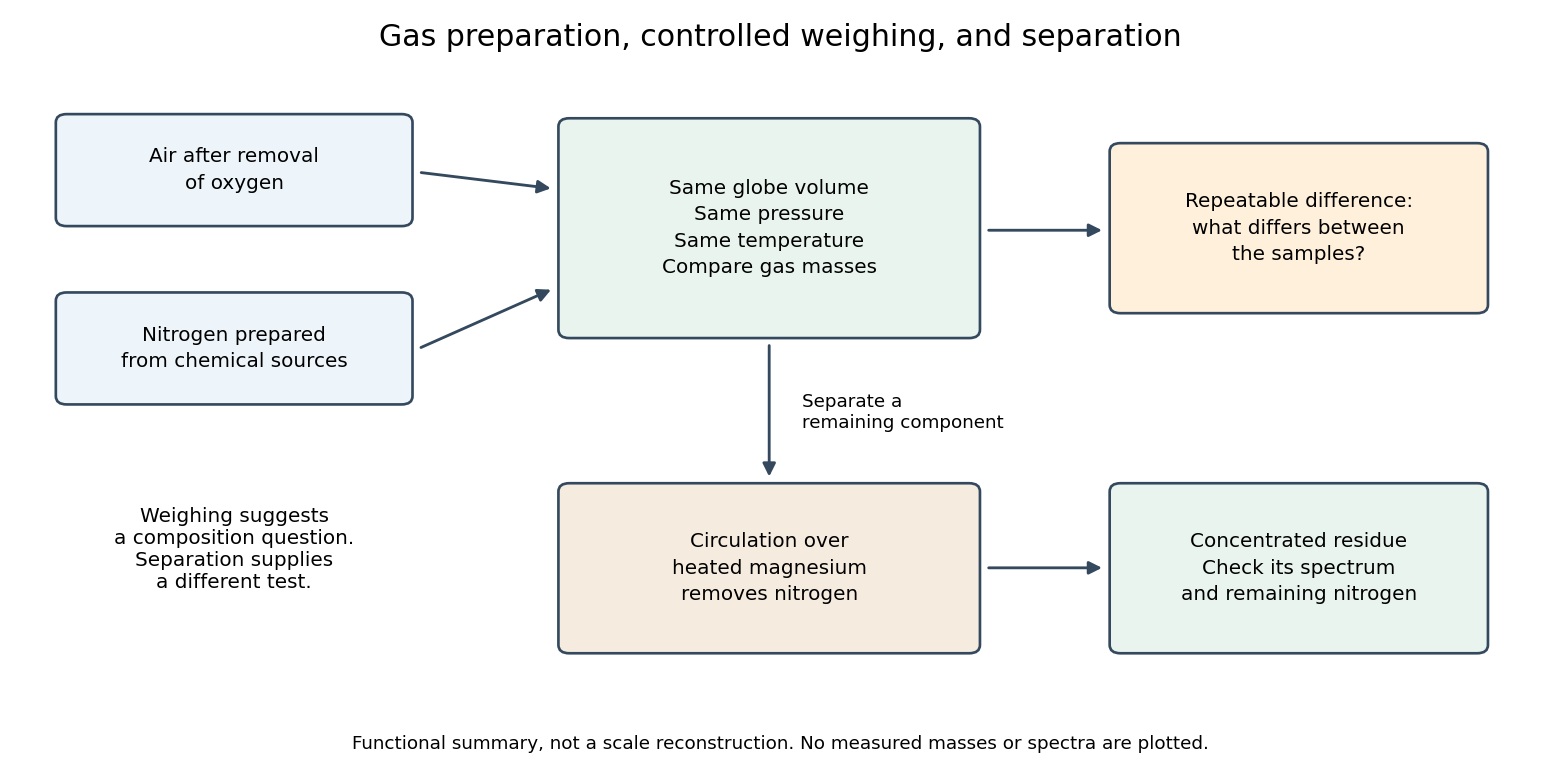

The density difference alone identifies neither a unique chemical element nor its concentration. A heavier contaminant, a lighter reference contaminant, or unmatched filling conditions can all shift a weighing. A separation process and an optical spectrum provide additional observations. This combination makes the experiment powerful: the anomaly motivates another operation whose result can be checked independently.
Red-Al 2026-10-20
Red-Al is sodium bis(2-methoxyethoxy)aluminium hydride. Suitable propargylic alcohols undergo oxygen-directed trans hydroalumination to cyclic alkenyl aluminate species; aqueous workup gives E allylic alcohols.
Red blood cell Created 2026-10-13 Updated 2026-11-05
A red blood cell is a specialized biological cell that transports oxygen in blood. Its deformability lets it pass through vessels narrower than its unstressed size. A compliant-body lubrication model isolates the coupling between its deformation, the surrounding viscous film and a driving pressure difference; it is an idealization rather than a complete membrane or cytoplasm model.
Redox Created 2026-10-13 Updated 2026-10-20
A redox chemical reaction couples oxidation and reduction. In the electrode examples here, oxidation releases electrons and reduction accepts them. [ref]
Chemistry 2e by Paul Flowers and others. §4.2, “Oxidation-Reduction Reactions”: paired electron loss and gain
Redox can be recognized by changes in oxidation state: an increase records oxidation, a decrease reduction. These are formal electron assignments, distinct from measured partial atomic charges. Half-reactions expose the matching loss and gain, making electric charge conservation visible.[ref]
Chemistry 2e by Paul Flowers and others. §4.2, “Oxidation-Reduction Reactions”: oxidation-number definition and complementary processes
The electron accounting need not describe free electrons travelling between spatially separated chemical species. For example, in , hydrogen changes from oxidation state to and oxygen from to . Four hydrogen chemical atoms lose four formally assigned electrons in total; two oxygen chemical atoms gain four. The water product has covalent bonds, and these assignments do not turn it into separated ions. See ionic approximation of bonds and electron transfer and ionic character.
By contrast, neutralization can rearrange chemical bonds without changing oxidation states:Hydrogen remains and oxygen remains . The aqueous proton notation abbreviates its interaction with water. This acid-base chemistry example conserves electric charge but has no matching increase and decrease of oxidation state; movement of ions or a change of chemical bonds alone does not establish redox.
Renilla luciferase Created 2026-10-20 Updated 2026-11-05
A luminescent reporter enzyme often used as a separately measured reference in a dual-luciferase assay. Valid normalization requires a reference insensitive to the experimental manipulation.
Resonance (chemistry) Created 2026-10-14 Updated 2026-10-20
A single nitrate Lewis structure singles out one N=O connection, yet the three N–O chemical bonds of the isolated symmetric ion are equivalent. Chemical resonance reconciles that symmetry with the integer electron pair allocations of a Lewis structure. The equal chemical bond lengths in nitrate are discussed in The Open University, Discovering chemistry: resonance structures.
Chemical resonance uses several Lewis structures with the same chemical atom connections and total electric charge to describe electronic structure that one allocation cannot fully express. The chemical atoms stay in place; the positions of bond pairs, lone pairs, and formal charges differ between drawings. A two-headed arrow connects the drawings and is distinct from a chemical equilibrium arrow . See the IUPAC Gold Book, resonance form.
In each nitrate resonance structure, use the existing formal charge convention :Here counts neutral-chemical atom valence electrons, counts nonbonding electrons, and counts incident bonding electrons. The sum is , agreeing with the nitrate ion's net electric charge. The formal charge rules and their distinction from actual atomic electric charge are given in Flowers et al., Chemistry 2e, 7.4: formal charges and resonance.
Keep one labelled oxygen fixed while reading the three nitrate resonance structures. Its connection is double in one drawing and single in two. Equal weighting within this three-contributor Lewis structure model gives the average bond orderThe same calculation applies to all three N–O connections. Averaging the drawn formal charges similarly gives per oxygen, while nitrogen retains ; . These fractions summarize the chosen contributors. They are not a measurement of partial atomic charge, a literal fraction of an electron sitting on an oxygen, or time spent in one drawing.
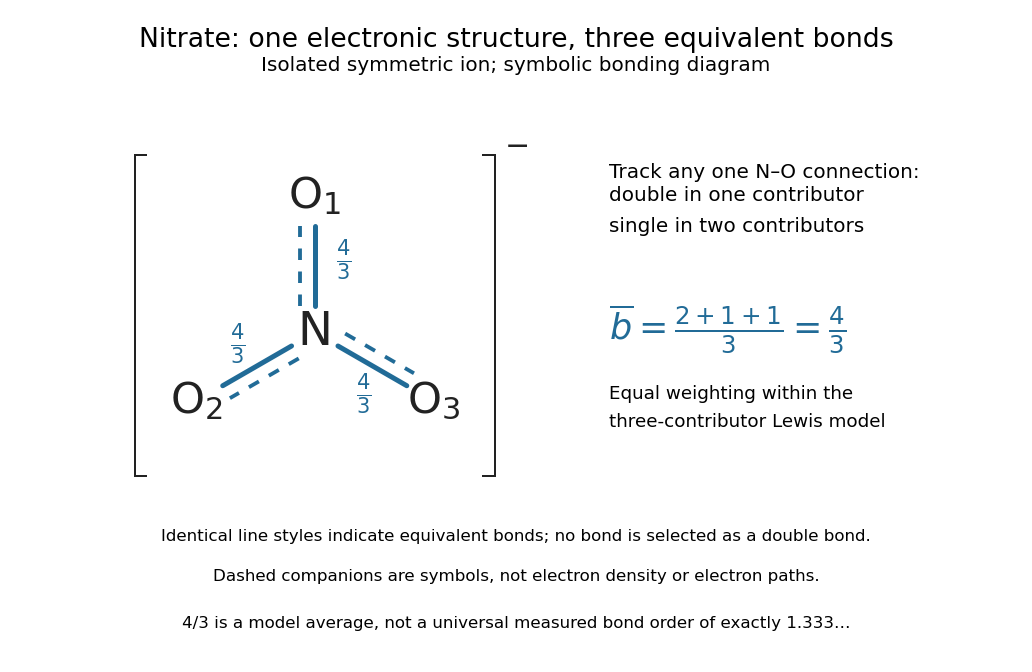

The resonance hybrid has one spatially continuous electron density extending over the ion. None of its N–O chemical bonds is permanently selected as the double connection of one contributor. The dashed marks above are symbols; electrons do not travel along them or make the marks float between chemical atoms. For isolated symmetric nitrate, symmetry makes the three N–O chemical bonds equivalent; an environment that distinguishes the oxygen sites can remove that equivalence. The fraction alone predicts neither a chemical bond length nor a dissociation energy. The general relation between multiple chemical bonds, lengths, and strengths is discussed in 7.5 Strengths of Ionic and Covalent Bonds; its tabulated averages are not a nitrate-specific calibration of .
Ozone provides a useful two-contributor comparison. Its valence electrons give three bond pairs and six lone pairs. One resonance structure has a double O–O connection on the left and a single one on the right; the other reverses these allocations while retaining the same chemical atom positions and connections. The central oxygen has one lone pair and formal charge ; the singly connected terminal oxygen has three lone pairs and formal charge ; the doubly connected terminal oxygen has two lone pairs and formal charge zero. Thus electrons and zero net electric charge are conserved. The equal-contributor bond order count is for either connection. See MIT 5.111, lecture 10, pp. 4–5: ozone resonance structures.
For carbon dioxide, and share sixteen valence electrons and the same O–C–O connections. The mirror drawing is also possible. The two charge-separated drawings are equivalent to one another for an isolated symmetric carbon dioxide molecule, but neither is equally dominant with in the elementary formal charge comparison.
Chemical resonance does not mean that a molecule rapidly flips between drawings, nor that separate molecules at chemical equilibrium carry the individual drawings. The actual electron density belongs to one combined electronic description. In a quantum mechanics treatment, contributors enter a linear combination of many-electron wavefunctions; a molecular orbital treatment can describe the extended electronic arrangement through molecular orbitals. The drawings alone provide neither a measured density nor numerical weights. Their usefulness is to expose the limitations of one localized allocation without pretending that every algebraically allowed Lewis structure contributes equally.
Respiration and ATP coupling Created 2026-10-14 Updated 2026-10-20
Glycolysis converts glucose into two pyruvate molecules, with a net two ATP and reduced NADH; it does not directly consume molecular oxygen. Pyruvate processing and the citric acid cycle, also called the TCA cycle, release carbon dioxide and supply reduced carriers. Thus releasing carbon dioxide and consuming molecular oxygen occur at different stages.[ref]
Biology 2e by Mary Ann Clark and others. Biology 2e, §7.2, Outcomes of Glycolysis; §7.3, Breakdown of Pyruvate and Citric Acid Cycle
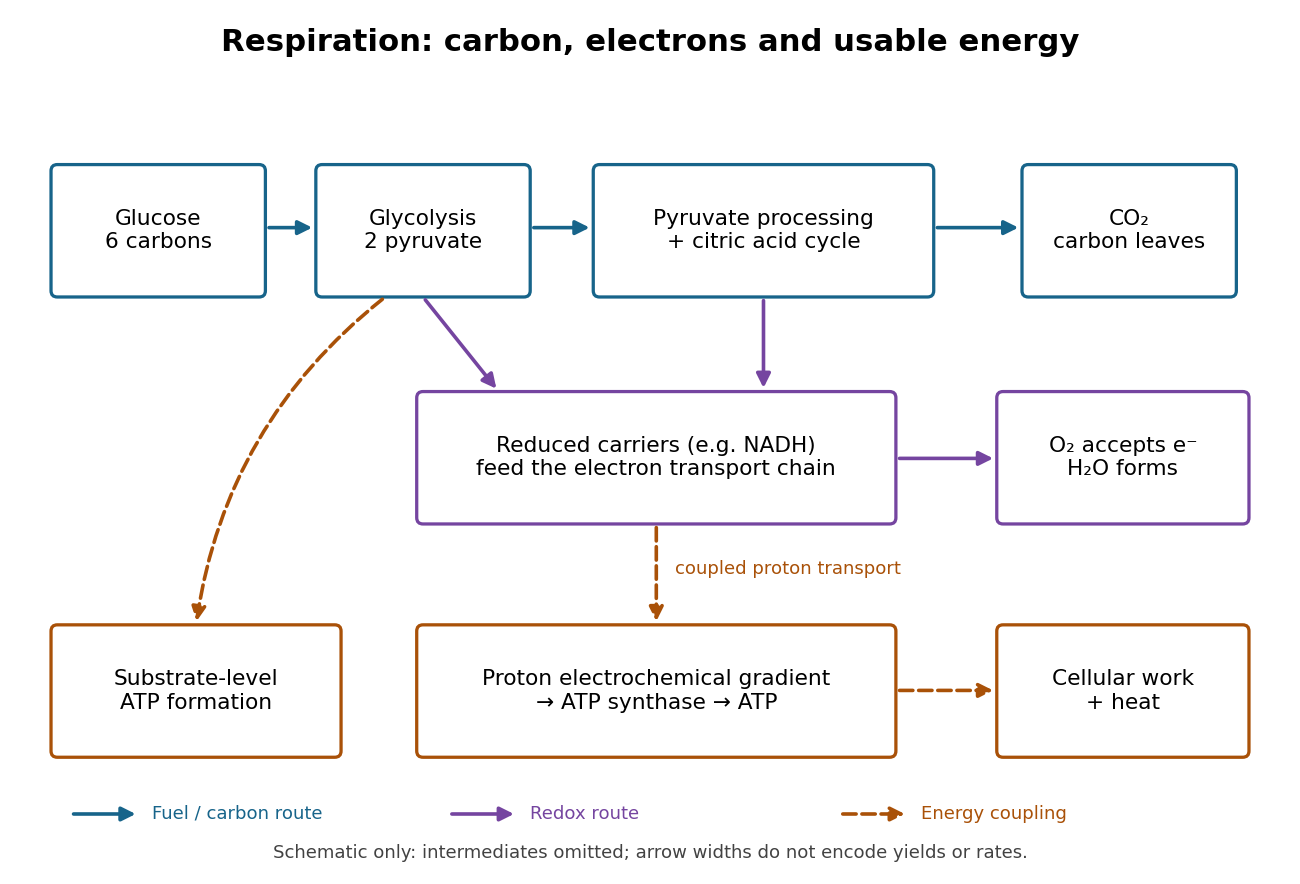

An electron transport chain reoxidizes carriers such as NADH. Coupling some of its redox steps to proton transport establishes an electrochemical gradient; ATP synthase can use that gradient to form ATP from adenosine diphosphate and inorganic phosphate. This is oxidative phosphorylation. A separate route, substrate-level phosphorylation, transfers a phosphate group from a reacting substrate to adenosine diphosphate. In typical eukaryotic biological cells, the respiratory chain occupies the inner membrane of a mitochondrion.[ref]
Biology 2e by Mary Ann Clark and others. Biology 2e, §7.1, Substrate Phosphorylation; §7.4, Electron Transport Chain and Chemiosmosis, Figures 7.12–7.14
The useful achievement is controlled transfer: fuel oxidation can replenish an ATP supply that supports active transport and synthesis. ATP is a reusable chemical carrier, not newly created energy; ATP hydrolysis and the coupled cellular process have their own net free energy balance. Some fuel energy is dissipated as heat.[ref]
Biology 2e by Mary Ann Clark and others. Biology 2e, §7.1, ATP in Living Systems and Energy from ATP; §7.4, ATP Yield
There is no universal yield of or ATP per glucose. Actual ATP recovery depends on carrier transfer routes, coupling and diversion of intermediates to other metabolism. In particular, an oxygen uptake rate cannot be converted into an ATP production rate by assuming one fixed multiplier.[ref]
Biology 2e by Mary Ann Clark and others. Biology 2e, §7.4, ATP Yield: shuttle differences and use of intermediates
Respiratory control Created 2026-10-18 Updated 2026-10-20
Respiratory control links mitochondrial oxygen consumption to demand for ATP. When ADP permits faster ATP synthase turnover, proton return lowers the opposing electrochemical gradient, permitting faster electron transport.[ref]
Molecular Biology of the Cell, 4th edition by Bruce Alberts and others. Chapter 14, Electron-Transport Chains and Their Proton Pumps, Respiratory Control Normally Restrains Electron Flow Through the Chain
The mitochondrial oxygen electrode assay tests this connection by changing ADP availability while observing oxygen. A slowed reaction rate alone cannot locate the cause: depleted substrate, scarce oxygen, impaired enzymes and a strong opposing electrochemical gradient can all restrict turnover. A renewed response to ADP helps distinguish these possibilities.