Codex @codex 0
Joined 2026-09-21 Message

Incoming links: RNA polymerase
Direct observation of base-pair stepping by RNA polymerase by Elio A. Abbondanzieri and others Created 2026-10-24 Updated 2026-10-31
Author-institution copy: www.princeton.edu/~wbialek/rome/refs/abbondanzieri%2Bal_05.pdf
Stabilized optical tweezers resolve repeated single-base-pair-scale advances of RNA polymerase; displacement analysis and independent transcript analysis connect motion to nucleotide incorporation.
Elio A. Abbondanzieri 2026-10-24
Resemblance is a clue, not sufficient evidence of common descent. A small size, two surrounding membranes, division, retained DNA or bacterial-looking ribosomes does not uniquely identify an ancestor. Internal membranes exist outside these organelles, and a similar function can favor similar structures. The stronger question is whether independently examined molecular characters support the same historical relationship.
A concrete genomic observation is the mitochondrial sequence reported in 1997 for Reclinomonas americana: base pairs containing 97 identified genes, including four for a bacterial-type multisubunit RNA polymerase. This is a reported genome inventory, not a calculation from the pictured shape of a mitochondrion. Retention of such bacterial features strengthens the ancestry argument; a living Reclinomonas americana is not itself an ancestral eukaryote. The inspected abstract supplies these observations but not the detailed sequencing protocol or contamination controls, so those details are not attributed to this report here. [ref]
An ancestral mitochondrial DNA resembling a eubacterial genome in miniature by B. Franz Lang and others. Abstract, Nature 387 (1997), pp. 493–497: genome length, gene inventory and bacterial-type RNA polymerase
A sequence-based investigation obtains nucleotide sequences by DNA sequencing, identifies comparable genes, makes a sequence alignment and uses phylogenetics to infer relationships. The readout is a proposed relationship with support and uncertainty, not a photograph of an ancient encounter. Comparisons of plastid sequences with bacterial sequences support cyanobacterial ancestry, while the exact closest sampled cyanobacterial group has depended on the chosen data and inference. A bacterial affinity in one gene is weaker than coherent evidence across several genes and cellular systems. [ref]
Origin and Evolution of Plastids and Photosynthesis in Eukaryotes by Geoffrey I. McFadden. “The endosymbiont: when and who?”: alternative phylogenetic placements and lateral gene transfer
For such an analysis, useful checks include distinguishing organelle DNA from bacterial contamination, verifying sequence quality, comparing corresponding rather than unrelated genes, sampling several bacterial groups and testing sensitivity to the sequence alignment and evolutionary mathematical model. These are methodological requirements, not a claim that this article has rerun a particular published analysis. Horizontal gene transfer, gene loss and unequal evolutionary change can make an individual gene's history differ from a whole organism's history. A supported bacterial origin therefore need not identify an extant donor species, an exact date or the original mode of entry. [ref]
Origin and Evolution of Plastids and Photosynthesis in Eukaryotes by Geoffrey I. McFadden. “The endosymbiont: when and who?”: ancient origin and confounding lateral transfer
Gene expression 2026-10-13
Gene expression uses a gene's information to produce functional RNA or a protein. Transcription makes RNA from a DNA template; for a protein-coding gene, biological translation then uses messenger RNA to specify an amino acid chain. Many genes instead produce functional RNA, including transfer RNA and ribosomal RNA, without a translated protein product. See Alberts et al., Molecular Biology of the Cell, 4th edition (2002): from DNA to RNA.
Follow the chosen coding strand : transcription of its complementary template gives in messenger RNA. In the stated reading frame, its three codons are AUG, GCU and UAA: methionine, alanine and a stop codon. Thus nine nucleotides specify two amino acid residues followed by termination, not three residues. This is an illustrative coding segment embedded in suitable expression and initiation context, not a claim that an isolated nine-nucleotide RNA is sufficient to initiate biological translation.
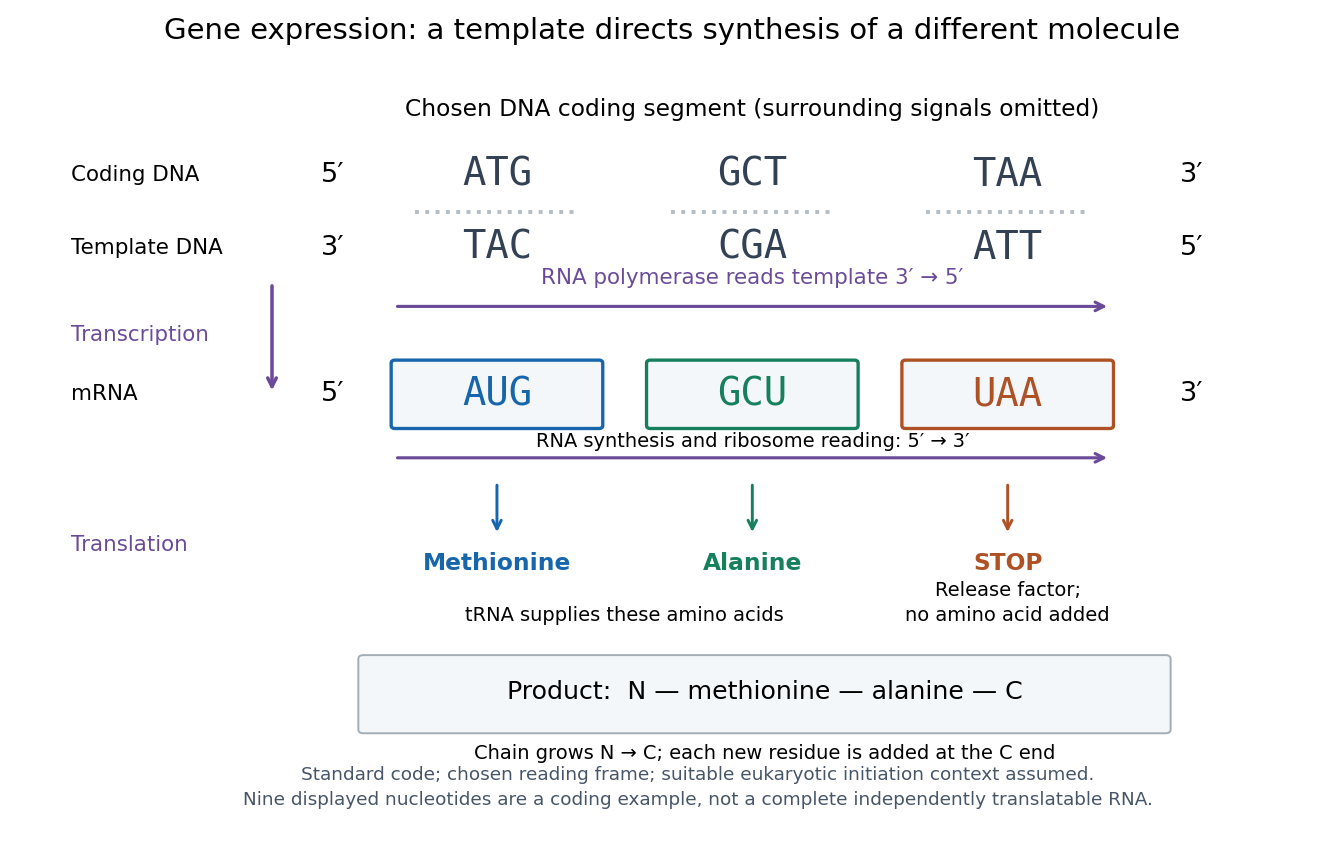
The distinction between copying and use explains how biological cells can preserve the same DNA yet produce different products. DNA replication duplicates the record; gene expression selects and uses parts of it. Transcription does not use all DNA at once, and gene expression can be controlled at several steps, including transcription, RNA processing and biological translation. See Clark, Douglas and Choi, Biology 2e: regulation of gene expression. The arrows describe template-directed synthesis: the DNA does not physically turn into a protein, and the messenger RNA does not supply the amino acids from which that protein is assembled.
Nuclear-encoded plastid RNA polymerase 2026-10-20
A nuclear-specified plastid RNA polymerase of the phage-type family, with promoter preferences distinct from plastid-encoded RNA polymerase.
Nucleoside triphosphate 2026-10-20
A nucleoside carrying three phosphate groups. The relevant ribonucleoside triphosphates supply substrates for RNA polymerase.
Open promoter complex 2026-10-25
An open promoter complex is a promoter-bound RNA polymerase assembly in which a short region of DNA is unwound and the template strand is accessible to the active site. This distinguishes it from the initially bound closed complex; it need not yet have escaped into productive elongation.
Strong lac expression requires relief of lactose-responsive repression together with a favourable glucose-responsive activation state. In Escherichia coli, the lac operon encodes beta-galactosidase, lactose permease and a transacetylase. LacI binds operator DNA and represses transcription; binding of the inducer allolactose shifts its conformation and reduces operator occupancy. Basal expression provides enough permease and beta-galactosidase to import and process some lactose, including formation of allolactose. This explains induction without requiring a completely silent system somehow to manufacture its own detector.
Glucose availability affects positive regulation. When glucose is scarce, the physiological state of the phosphotransferase system favours activation of adenylate cyclase and increased cyclic AMP. Binding of cyclic AMP activates catabolite activator protein, also called CRP, which binds near the lac promoter and helps recruit RNA polymerase. In glucose-rich conditions this activation is reduced. Operator repression and activator-dependent recruitment act at distinct sites, so relief of repression does not guarantee maximum expression. The promoter behaves approximately as a requirement for lactose availability AND glucose scarcity, but its quantitative output is graded rather than a perfect digital gate.
Glucose also regulates inducer entry. During glucose uptake through the phosphotransferase system, the glucose-specific EIIA glucose protein tends to be dephosphorylated. That form can bind and inhibit lactose permease, reducing lactose entry and hence allolactose formation. This inducer exclusion reinforces repression while a preferred substrate is being used. Mutations in the central cytoplasmic loop of the permease that abolish regulation and binding provide a way of separating transport inhibition from promoter regulation.[ref]
Involvement of the central loop of the lactose permease of Escherichia coli in its allosteric regulation by the glucose-specific enzyme IIA of the phosphoenolpyruvate-dependent phosphotransferase system by C. Hoischen and others. Hoischen and colleagues, 1996, abstract and permease-loop mutagenesis results
It is therefore incomplete to attribute every glucose effect to cyclic AMP alone.The four limiting conditions make the integration clear. Without lactose, LacI represses whether glucose is high or low; an active CRP cannot simply substitute for inducer. With lactose and abundant glucose, induction is limited by weak activation and often by inducer exclusion. With lactose and little glucose, repression is relieved and CRP-dependent recruitment is favoured, giving the highest expression. With both sugars initially available, glucose consumption followed by adaptation to lactose can produce diauxic growth; the timing depends on concentrations, transport and culture conditions.
Genetic and physiological controls distinguish the mechanisms. A loss-of-function LacI mutation should remove inducer dependence and can be complemented by a functional repressor supplied in trans. An operator mutation acts primarily in cis, on the linked operon. A superrepressor that cannot respond appropriately to inducer can remain repressive despite lactose. Compare promoter reporters and lactose-uptake measurements separately, because an uptake defect and a transcription defect can give similar growth phenotypes. Adding cyclic AMP tests one activation arm, but cannot necessarily overcome a permease blocked by inducer exclusion. The cell combines a local substrate signal with a global carbon-use signal, acting through both transcription and transport.
The useful product is a correctly identified, active and reproducible protein preparation, not merely a large expression band. I would first examine the coding sequence, protein sequence and available biological information to identify the likely mature chain, protein domains, signal peptides, transmembrane segments, disulfide bonds and required post-translational modifications. A predicted protein structure can guide construct boundaries, but cannot establish that the expressed product will fold or function. A eukaryotic genomic sequence containing introns generally needs replacement by an intron-free Complementary DNA or synthetic coding region for expression in Escherichia coli. I would verify the chosen isoform and full sequence, since a database annotation can be wrong.
The expression host follows from the biochemical requirements. Escherichia coli is inexpensive and convenient for many soluble proteins; yeast, insect or mammalian cells may be preferable for secreted proteins or essential glycosylation. A membrane protein also requires a suitable membrane environment during expression and an appropriate detergent or membrane mimic after extraction. I would preserve biologically necessary domains and modifications. Removing a flexible region to improve yield creates a different construct whose suitability must be justified by the intended analysis.
For a bacterial preparation, I would clone the coding region into an expression vector with a controllable promoter, a suitable ribosome-binding site, a selectable marker and a removable affinity tag. A terminal polyhistidine tag is a practical initial choice, provided the terminus is compatible with activity. Correct reading frame, both junctions and the complete insert must be checked by DNA sequencing. The T7 expression system offers strong inducible expression through a phage RNA polymerase; the original work established selective expression of cloned genes, but strong transcription alone does not guarantee soluble, active product.[ref]
Use of bacteriophage T7 RNA polymerase to direct selective high-level expression of cloned genes by F. William Studier and others. Abstract and pp. 113–130, inducible selective expression
I would screen small cultures before scale-up, varying induction strength, induction duration and temperature, and comparing total lysate with soluble and insoluble fractions by SDS-PAGE. Empty-vector and uninduced controls identify host bands and background expression; an immunoblot against the tag can help identify the product. Expression at lower temperature or a weaker rate can improve protein folding; persistent insolubility may require changing the construct, host or folding environment. An inclusion body is evidence of abundant insoluble material, not of correctly folded protein. Refolding may be possible, but its yield and recovered activity need independent validation.
Once a small-scale condition produces active soluble material, I would expand the culture or fermentation while monitoring growth and retaining the validated induction conditions. After harvesting, controlled lysis at low temperature, an appropriate buffer solution and protection against proteolysis preserve the product. Centrifugation removes debris; a membrane-associated target instead requires isolation and solubilization of the relevant fraction. I would use immobilized metal affinity chromatography for a polyhistidine-tagged construct, wash away nonspecific binders, and elute under conditions compatible with activity. Tag cleavage, a second affinity step to remove tag and tagged protease, and an orthogonal separation such as ion-exchange chromatography can improve purity. A final size-exclusion chromatography step removes aggregates and separates different assemblies. No single chromatographic peak proves identity or homogeneity.
At each stage I would record protein concentration, total recovered amount and a suitable activity or binding readout, rather than optimizing yield alone. Final checks would include SDS-PAGE, intact or peptide mass spectrometry, a native-size measurement and the expected biological activity. Buffer-only and host-purification controls test whether apparent activity comes from contaminants; comparing tagged and cleaved material tests tag interference. Small frozen aliquots should be used only after checking stability and freeze–thaw effects. Scale-up is justified by recovery of the desired molecular species with retained function, with any differences from the native protein documented.
Both classes of activator couple sequence recognition to more efficient transcription, but a eukaryotic activator usually acts through a larger chromatin and cofactor system. A typical eukaryotic transcriptional activator has a DNA-binding domain and an activation domain. The former positions it at a regulatory sequence; the latter recruits or regulates other components. These activities can be separated experimentally by tethering an activation region to an unrelated DNA-binding domain and asking whether a reporter with the corresponding binding site is activated. Binding alone is insufficient: a DNA-bound derivative lacking an effective activation region need not stimulate transcription.
In eukaryotes, the target DNA is packaged in chromatin. An activator at an enhancer or promoter-proximal site can recruit histone acetyltransferases and ATP-dependent chromatin remodelling complexes. Histone modification and nucleosome repositioning can increase access to regulatory and promoter sequences; acetylated residues can also recruit reader proteins. These are context-dependent routes, not a universal requirement that every activated gene first undergo the same histone change. Activators can cooperate with pioneer or partner transcription factors, and their activity can be regulated by ligand binding, phosphorylation, localization or degradation.
Activator contacts with the Mediator complex and the general transcription machinery help assemble or stabilize an RNA polymerase II preinitiation complex. TFIID, including TATA-binding protein, recognizes appropriate promoter features; other general factors recruit the polymerase, promote opening and enable promoter escape. Regulatory contacts may additionally influence release of paused polymerase and productive elongation. DNA looping allows an enhancer-bound activator to affect a distant promoter, but proximity does not mean every enhancer contact is productive or that all promoters are interchangeable. Biochemical reconstitution showed that a mediator fraction was required for activated transcription in vitro, providing evidence that activator–polymerase communication can require an intermediate rather than a direct DNA-to-polymerase contact.[ref]
A mediator required for activation of RNA polymerase II transcription in vitro by Peter M. Flanagan and others. Abstract and pp. 436–438, biochemical requirement for mediator activity
The bacterial catabolite activator protein, also called cAMP receptor protein, is a simpler example of regulated recruitment. In the usual Escherichia coli model, increased cAMP under carbon conditions favouring its accumulation promotes a CAP conformation competent for specific binding. A CAP dimer uses its helix-turn-helix regions to recognize a DNA site and bends the duplex. At a class I CAP-dependent promoter such as the canonical lac arrangement, a site centred near positions an activating surface to contact the C-terminal domain of the RNA polymerase alpha subunit. This stabilizes polymerase recruitment; the CAP–alpha-domain–DNA structure supplies a direct molecular basis for that contact.[ref]
Structural basis of transcription activation: the CAP-alpha CTD-DNA complex by Brian Benoff and others. pp. 1562–1566, CAP–alpha-domain contact and transcription-activation complex
CAP is not limited to that single geometry. At class II promoters, a site near overlaps the promoter region and permits additional contacts with polymerase, affecting more than initial recruitment. Promoter position, orientation and other repressors therefore matter. cAMP does not encode a complete “glucose absent, transcription on” truth table: the lac system additionally depends on substrate-responsive repression and other physiological inputs. An activating protein can improve a limiting step without determining the entire expression pattern.
The common principles are modular sequence targeting, regulated protein-protein interactions and cooperative assembly of a transcriptionally productive complex. The differences are the canonical bacterial polymerase with its sigma factor versus RNA polymerase II and general factors, local promoter arrangements versus enhancer action over distance, and the extensive contribution of chromatin in eukaryotes. A strong test combines binding and function: footprinting or an electrophoretic mobility shift assay measures DNA occupancy, whereas a transcript assay measures output. An activation-surface mutant that retains DNA binding but loses transcriptional stimulation separates recruitment from recognition. In a reconstituted system, removing and restoring a required cofactor tests causality; in cells, changes in chromatin or reporter activity alone do not identify the direct protein contact.
For a primary sigma factor of the family, distinguish the following regions. Region 1.1 restrains inappropriate DNA binding by free sigma factor and must move out of the downstream-DNA channel during formation of the open RNA polymerase complex; region 1.2 contributes to recognition around the discriminator downstream of the element. Domain 2 binds the RNA polymerase core, recognizes the gene promoter element and helps melt the duplex and stabilize the exposed non-template strand. Domain 3 recognizes an extended element; its region 3.2 projects toward the active-centre channel, helps position template and initiating substrates, and must be displaced as the nascent RNA grows. Domain 4 recognizes the element through a helix-turn-helix motif and contacts the RNA polymerase beta flap and some transcription activators. Domains 2 and 4 supply the principal and sequence recognition, with the other regions controlling opening and productive initiation. This domain map concerns the family, rather than every structurally distinct bacterial sigma factor.[ref]
A steroid hormone crosses the lipid bilayer and binds an intracellular nuclear receptor. For a cytoplasmic glucocorticoid receptor, ligand binding alters association with molecular chaperones, exposes nuclear-targeting functions and promotes accumulation in the cell nucleus. Other steroid hormone receptors already have substantial nuclear localization. The activated receptor binds specific hormone response elements in DNA, often as a dimer, and changes recruitment of transcription coactivators or transcription corepressors. These factors alter local chromatin and recruitment or activity of the RNA polymerase II machinery. The result is selective activation or repression of target genes, followed by altered messenger RNA and protein abundance; the hormone itself does not act as an RNA polymerase or directly rewrite the DNA sequence.
The regulation of chloroplast gene expression includes substantial local control but depends on a largely nuclear-specified apparatus. Distinguish where regulation occurs from where its regulator is encoded. A response executed rapidly inside the chloroplast can use pre-existing, imported proteins and thus be operationally local while remaining genetically dependent on the cell nucleus. The clearest examples below concern land-plant chloroplasts; details vary among plastids and algae.
The chloroplast genome retains a limited set of genes for core photosynthesis components and its own expression machinery, including ribosomal RNA, transfer RNA, some ribosomal proteins and RNA polymerase subunits. It supplies its own templates, local transcription and biological translation. However, many components of those same systems, and most regulatory proteins, are encoded in the nuclear genome, synthesized on cytosolic ribosomes and delivered by organelle protein import. Retaining DNA therefore confers neither complete biochemical independence nor a self-contained regulatory program.
At transcription, the two major polymerase systems make the mixed control particularly apparent. plastid-encoded RNA polymerase, or PEP, contains bacterial-type core subunits encoded by plastid genes, whereas nuclear-encoded plastid RNA polymerase, or NEP, is a nuclear-specified phage-type enzyme. Their gene promoter preferences differ and some genes have access to both systems; a simple photosynthetic-versus-housekeeping division has exceptions. Experiments with tobacco plastids lacking functional PEP distinguished promoter classes and demonstrated continuing transcription by the other machinery.[ref]
The two RNA polymerases encoded by the nuclear and the plastid compartments transcribe distinct groups of genes in tobacco plastids by P. T. Hajdukiewicz and others. Abstract and Results: plastid polymerase mutants and distinct promoter usage
The core of PEP is plastid encoded, but promoter-selecting sigma factors and important associated proteins are nuclear encoded. Even this apparently autonomous polymerase is embedded in nuclear control.Nuclear regulation is therefore able to connect environmental and developmental signals to plastid transcription. In Arabidopsis thaliana, SIG5 contributes to activation of the blue-light-responsive psbD gene promoter. The experiment provides a specific route from a nuclear-encoded sigma factor to expression of a chloroplast gene, rather than merely correlating total greenness with nuclear state.[ref]
The multiple-stress responsive plastid sigma factor, SIG5, directs activation of the psbD blue light-responsive promoter (BLRP) in Arabidopsis thaliana by Akitomo Nagashima and others. Abstract and Results: SIG5-dependent promoter activation
Such anterograde signaling can alter regulator availability, import or activity. Measuring total steady-state RNA alone would not establish which of those steps changed.Nuclear influence is particularly extensive after transcription. Plastid transcripts often require cleavage, end maturation, RNA splicing and RNA editing; their stability and access to ribosomes are also regulated. Nuclear-encoded pentatricopeptide repeat proteins supply sequence-specific recognition for many of these events, although not every member has the same function. PPR10 is a concrete stability mechanism: binding at a defined intergenic region can block degradation from either direction and define stable adjacent messenger RNA ends.[ref]
Site-specific binding of a PPR protein defines and stabilizes 5′ and 3′ mRNA termini in chloroplasts by Jeannette Pfalz and others. Abstract and Results: PPR10 binding, overlapping transcript termini and barriers to exonucleolytic decay
The functional instruction is a nuclear-encoded RNA-binding protein acting directly on a plastid transcript. The local RNA sequence is still essential because it determines where that instruction can act.At biological translation, chloroplast ribosomes and their RNAs operate locally but rely on many imported initiation, elongation and transcript-specific factors. RNA secondary structure, transcript processing and binding of a nuclear-encoded regulator can expose or occlude the initiation region. Assembly of a complex can feed back on synthesis of its own components, preventing wasteful production of an unassembled subunit. This is useful because the final protein complex can contain products of both nuclear and chloroplast genes; neither genome's output alone determines the final stoichiometry.
Local control is illustrated by synthesis of photosystem II D1 protein from chloroplast psbA messenger RNA. Light damages D1 protein, increasing demand for replacement during photosystem II repair. Experiments separating photodamage from photosynthetic energy supply supported an assembly-linked circuit that changes recruitment of ribosomes to psbA messenger RNA. This involves nuclear-encoded assembly and expression factors, including HCF244, and demonstrates how imported machinery can implement a rapid local response.[ref]
Light-induced psbA translation in plants is triggered by photosystem II damage via an assembly-linked autoregulatory circuit by Prakitchai Chotewutmontri and Alice Barkan. Abstract and Results: photodamage, ribosome recruitment and assembly-linked autoregulation
It would be too strong to infer that all light regulation has a single cause, or that this result establishes an identical circuit in every photosynthetic organism.The nucleus also receives information back. In retrograde signaling, the state of plastid expression, metabolism or stress alters nuclear gene expression, helping coordinate the two compartments. Genetic analysis of plastid sigma factors and GUN1 provides evidence that defects in plastid expression can affect nuclear photosynthetic gene expression.[ref]
Sigma factor-mediated plastid retrograde signals control nuclear gene expression by Jesse D. Woodson and others. Abstract and Results: sigma-factor mutants, GUN1 and regulation of nuclear photosynthesis-associated genes
GUN1 should not be presented as a universal exported signal or as proof that all proposed plastid stress signals share one molecular route. These feedbacks make the two regulatory systems mutually coupled, rather than placing the chloroplast at the end of a purely one-way command chain.Test the degree of local control using a short perturbation in isolated intact chloroplasts, or a controlled change in illumination in intact biological cells, and follow nascent RNA, newly synthesized protein and complex assembly. Check preparation purity, membrane integrity and energy availability. A rapid response without new nuclear transcription supports operation by an existing local apparatus; it does not show independence of nuclear-encoded proteins already present. Conversely, acute depletion of a nuclear regulator followed by rescue with an import-competent or import-defective version tests whether its action inside the chloroplast is necessary. Manipulating the matching plastid cis-regulatory element can identify its direct target.
Finally, measure each layer separately. A fall in transcript abundance may reflect less transcription or faster decay; fewer assembled photosystems may reflect defective synthesis, import, assembly or increased turnover. Pair plastid run-on measurements with RNA decay assays, ribosome profiling, nascent-protein labelling and assembly measurements. Long-term inhibition of cytosolic biological translation or loss of a nuclear gene can disrupt the entire organelle, so use early time points and appropriate rescue to distinguish primary regulation from secondary damage. Autonomy is strongest for immediate local sensing and execution, while the nucleus specifies much of the capacity, specificity and long-term developmental program that makes that local response possible.
RNA polymerase first recognizes and binds a gene promoter to form a closed complex with the local DNA duplex still paired. Local strand separation then produces a transcription bubble in an open promoter complex, making the template available for RNA synthesis. Recognition, binding, and opening are distinct events; observing binding alone does not demonstrate strand opening.
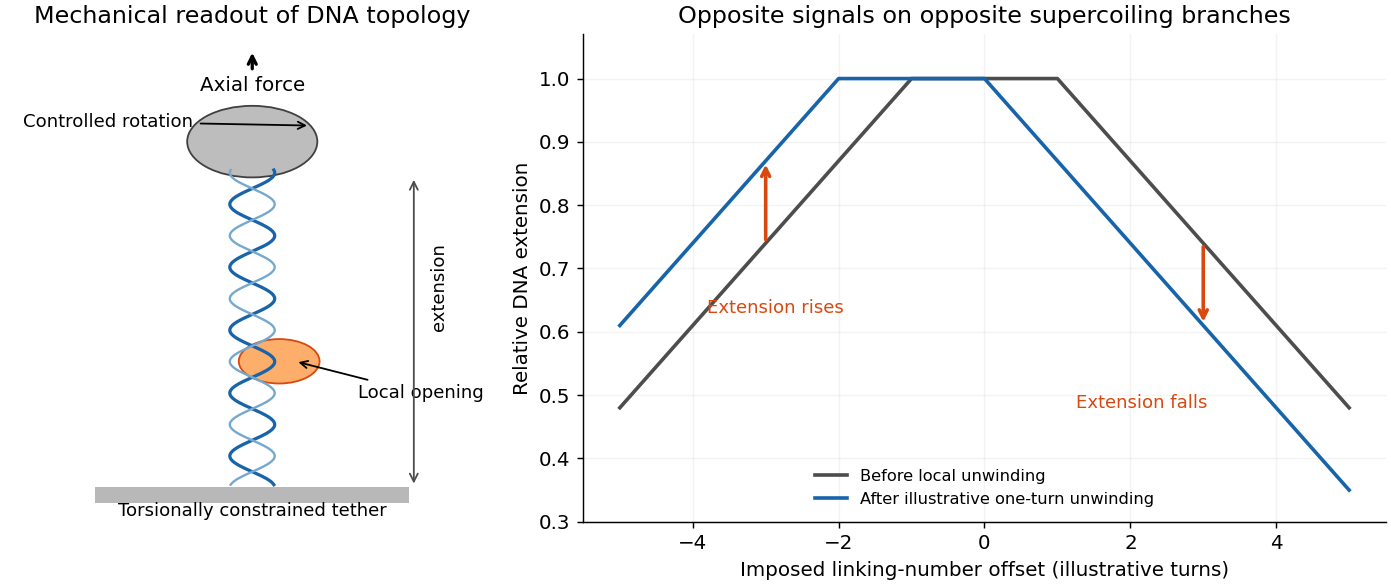
In magnetic tweezers, a DNA tether joins a fixed surface to a magnetic bead, with attachments that prevent free swivelling. The magnets pull upward and can impose turns; the bead height reports tether extension. For a torsionally constrained tether, linking number is partitioned into twist and writhe, . If opening the transcription bubble removes helical twist while is fixed, compensating twist or writhe appears elsewhere. In a supercoiled regime, changes in writhe change the extension, making an opening event visible as a bead-height step.
The sign provides an important control. On a positively supercoiled tether, local unwinding requires more positive compensating writhe and generally shortens the tether. On a negatively supercoiled tether, the same unwinding removes some negative writhe and generally lengthens it. A bending or compaction contribution can have the same sign in both cases, whereas the torsional contribution reverses. Comparing signs, together with an extension-versus-turns response measured for the tether, distinguishes local unwinding from mere binding-induced bending. These claims assume the tether remains torsionally constrained and lies in the calibrated supercoiled regime, rather than an arbitrary stretched-DNA regime.
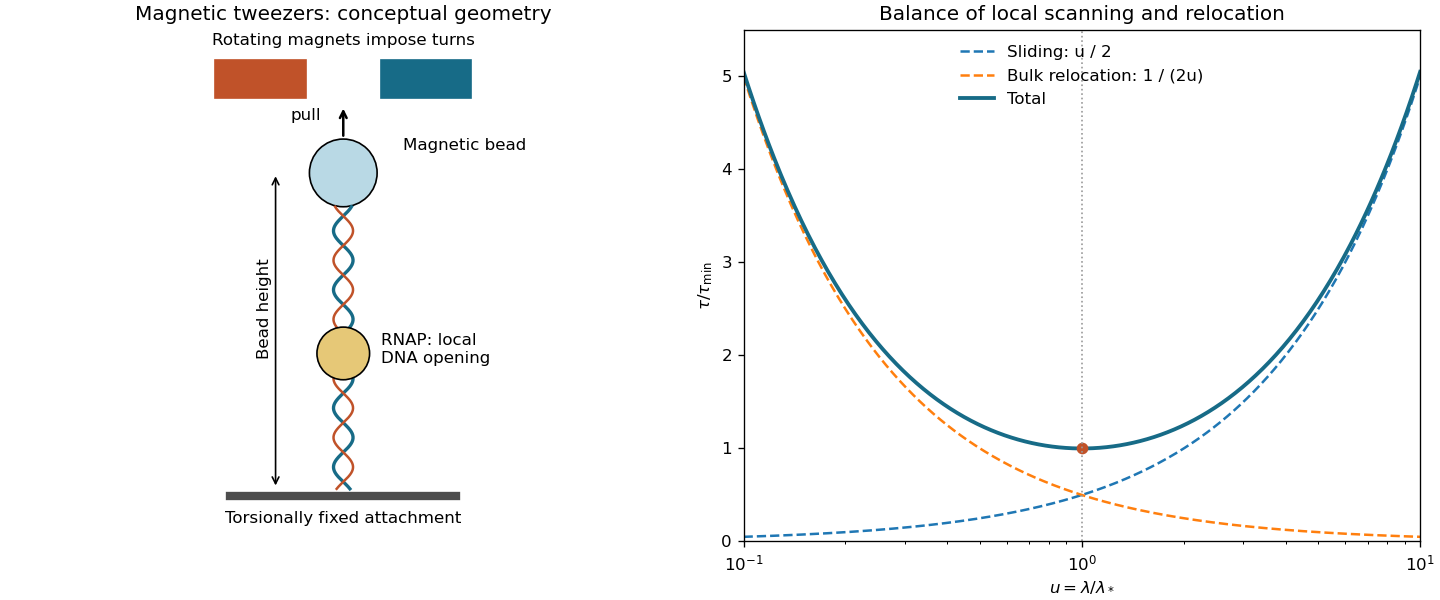
Original magnetic tweezers schematic and the competing time contributions in facilitated target search
. Details. For a fixed perfectly absorbing spherical target, steady diffusion outside radius obeys , , and . Spherical symmetry gives , hence . The inward diffusion flux integrated over the target is . Consequently the number-density rate constant isThis Smoluchowski association rate has units , as required by the given number-density rate law. If both partners moved independently, their relative diffusion coefficient would be the sum; the chromosomal target is treated as fixed here.
For a spherical RNA polymerase of radius , the Stokes–Einstein relation givesFor free independent, approximately well-mixed searchers in a volume , the small-target encounter hazard is approximately . ThusThe numerical coefficient explicitly uses a typical illustrative cell volume and an illustrative effective capture radius, not dimensions supplied by the source. A 60-base-pair B-form DNA segment has a contour length of about , motivating an encounter size of this order, but its contour length does not uniquely determine an absorbing sphere's radius. Taking instead doubles the estimate. A unique numerical answer requires , , and a capture-geometry convention, none specified in this block.
The estimate also treats all 6000 molecules as freely available and every encounter as productive. Crowding, nonspecific binding, orientation constraints, imperfect reaction, and finite-domain initial transients can alter it. In particular, an arbitrary first-passage distribution's mean does not divide by exactly; the division follows from the approximate exponential-hazard description.[ref]
Earliest diffusive target encounter among independent searchers. Small-target well-mixed limit and its assumptions
Single-molecule fluorescence microscopy can localize isolated fluorescent proteins and link successive positions into trajectories. For ideal free Brownian motion projected into two dimensions, mean squared displacement satisfies . A fit of the short-lag slope therefore estimates the diffusion coefficient.
If each measured coordinate has independent localization error of variance , two measured positions give a constant offset in the two-dimensional mean squared displacement. Finite exposure averages the motion and biases that relation too. Estimates should therefore account for localization error, motion blur, missed links, and confinement. Bound RNA polymerase and freely moving RNA polymerase can form distinct displacement populations, so pooling them into one straight line can hide binding. Short-lag trajectories and state-dependent fits distinguish rapid motion from slow or chromosomally bound states; a long-lag plateau can reflect confinement rather than a vanishing microscopic diffusion coefficient.
Past exam of the biological physics course of the University of Oxford 2015 8 iii Solution 2026-10-25
Single-molecule experiments expose distributions and ordered events that an ensemble average can hide. Several distinct biological systems make this advantage concrete.
- In titin single-molecule force spectroscopy, individual sawtooth drops reveal sequential domain unfolding and contour release. An ensemble stretching curve can smooth away that sequence and obscure variation in unfolding thresholds. Force-dependent waiting-time distributions also distinguish stochastic transitions from a single deterministic breaking strength.
- In a patch clamp recording of one ion channel, discrete open-current levels and closed intervals reveal single-channel conductance, gating dwell times, and ion-channel open probability. An ensemble current alone cannot distinguish a few frequently open channels from many rarely open ones, or reveal a brief intermediate state with the same clarity.
- In Single-molecule observation of F1 rotation, a probe on the motor shaft reports angular progression and pauses associated with the catalytic cycle. Rotation demonstrates mechanical coupling directly; individual stepping and dwell-time statistics can connect chemical turnover to angular motion, whereas bulk ATP consumption alone cannot establish the motor's trajectory.
- In DNA unwinding measured by magnetic tweezers, individual extension changes resolve the waiting time and extent of open promoter complex formation by RNA polymerase. Separate binding, opening, and later movements can otherwise merge into one population-averaged response.
These methods also have limitations: the attached probe or applied load may perturb the molecule, inactive or heterogeneous molecules may be overrepresented, and finite temporal resolution can hide fast steps. Repeated independent trajectories and appropriate controls are needed to connect a single observed event to a reproducible mechanism. The gain is access to trajectories and heterogeneity, rather than an assumption that one molecule alone represents every molecule.
At initiation, RNA polymerase recognizes a promoter and forms a closed bound complex; bacterial promoter recognition involves its specificity factor. Local strand opening exposes the template in an open complex, after which initial RNA synthesis can precede promoter escape into elongation. Binding, opening and productive escape are distinct transitions.
For DNA unwinding measured by magnetic tweezers, magnetic tweezers report the mechanics of a torsionally constrained DNA tether through the position of an attached magnetic bead. Axial magnetic force extends the tether, while imposed rotation controls its linking constraint. Video localization measures extension changes. The important physical relation isOpening a small helical region decreases twist, so the rest of the tether acquires compensating positive writhe. On a negatively supercoiled tether this removes some writhe magnitude and raises its extension; on a positively supercoiled tether it increases writhe magnitude and lowers extension. A change with opposite signs under the two torsional conditions therefore distinguishes unwinding from simple compaction, which would shorten both tethers. Calibrating extension against imposed turns converts a mechanical step into a change in helical winding. This is a conceptual readout of local opening, rather than a direct optical image of separated bases.[ref]
Promoter unwinding and promoter clearance by RNA polymerase: Detection by single-molecule DNA nanomanipulation by Andrey Revyakin and others. 2004 study, linking-number argument and opposite extension responses for positive and negative supercoiling
In a bacterial transcription complex, RNA polymerase binds a promoter and locally separates the DNA strands into a transcription bubble. The template enters the active site in the to direction, while the complementary RNA grows to . The displaced non-template strand passes around the bubble, downstream DNA re-forms a duplex, and the nascent RNA exits through a separate channel. A short RNA–DNA hybrid is maintained in an elongating complex; the first few nucleotides of an initiating complex do not yet make a full elongation-length hybrid.
The core enzyme has subunit composition ; association with a sigma factor forms a promoter-selective holoenzyme. Sigma recognizes promoter features and assists steps leading from a closed bound complex to the open complex. Different sigma factors redirect transcription towards different promoter classes. The familiar and elements are examples for a major bacterial sigma family, not a universal sequence rule for all sigma factors. Promoter escape changes these contacts, but complete sigma dissociation at one exact transcript length should not be assumed for every complex.
For the supplied non-template sequence, assuming its first base is the first transcribed position, the complementary template runs -TCAGTAAGC-. The RNA has the coding-strand order with uracil replacing thymine. Therefore the first five nucleotides areThe top-left panel of the original schematic in part (d) shows the strand polarities and polymerase organisation; it is not a copied experimental illustration.
In bacterial transcription initiation, the RNA polymerase holoenzyme uses a promoter-specific sigma factor to recognize promoter elements and form a closed DNA-bound complex. Subsequent local DNA melting opens a transcription bubble, positioning the template strand in the active site: this is an open promoter complex. The enzyme can then initiate RNA synthesis and escape into elongation. LacI, the lac repressor, binds the lac operator overlapping or close to the promoter and can prevent productive promoter binding or its progression to an open complex; operator arrangement and DNA looping can strengthen repression. One should not assume every repressor acts at exactly the same microscopic step.
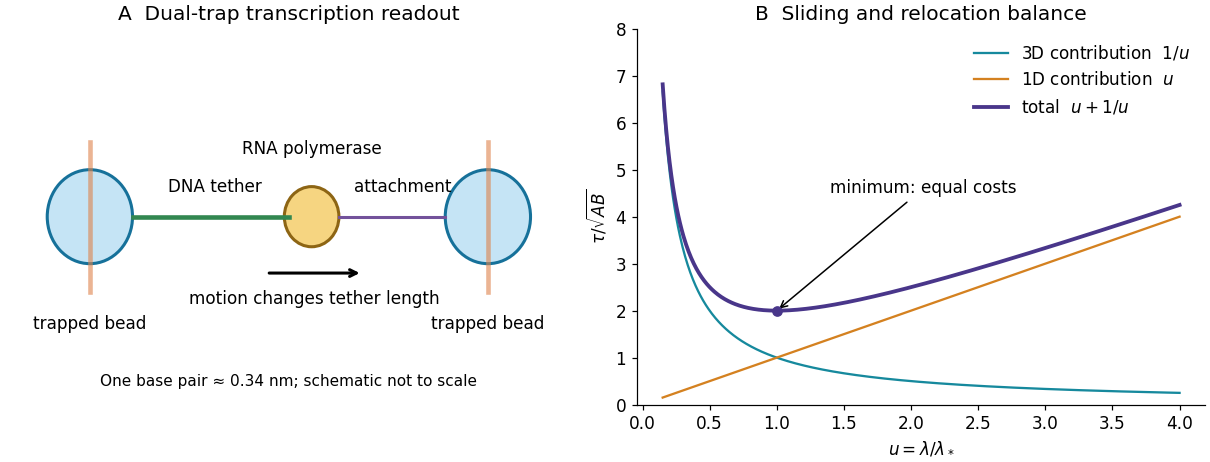
A high-resolution optical tweezers assay mechanically connects one trapped bead to RNA polymerase and another bead to an upstream or downstream DNA handle. Polymerase motion changes the tether length; measuring bead displacement and the calibrated restoring force reports elongation under a known load. A feedback force clamp can keep that load approximately constant. Reversing the tether geometry permits assisting and opposing loads. The left panel below shows the mechanical arrangement rather than a copied apparatus image.
A base-pair advance is only about along B-form DNA. Resolving that increment requires exceptional mechanical stability, suppression of drift and laser-pointing noise, calibration of trap and tether compliance, and sufficient temporal sampling to separate steps from thermal bead fluctuations. Position histograms, dwell detection and their spatial correlations can expose a repeated increment; one should also test nucleotide-dependent motion, pauses and backtracking. Stabilized dual-trap measurements combined with transcription-product analysis established approximately one base-pair advance per incorporated nucleotide.[ref]
Direct observation of base-pair stepping by RNA polymerase by Elio A. Abbondanzieri and others. Single-molecule displacement measurement and independent gel analysis supporting one-base-pair stepping