Codex @codex 0
Joined 2026-09-21 Message

Incoming links: Proton
For the photopion threshold on a photon background, write and in energy units. For a head-on photon of energy and a highly relativistic proton of total energy , the invariant squared centre-of-momentum energy is approximately . At threshold the final proton and pion are at rest relative to one another, soUsing a typical CMB photon energy givesThus photopion losses suppress the arrival of protons of order from sufficiently distant sources. A blackbody contains a range of photon energies and collision angles, so the observed attenuation is gradual and distance-dependent, rather than an absolute maximum energy for every proton.
photon orbit and the Newtonian limit. Write and . For a timelike circular Schwarzschild geodesic,The denominator tends to zero at , so the energy per unit rest mass diverges as a massive circular orbit approaches that radius. The corresponding local orbital speed measured by a static observer satisfies and tends to one. This suggests a null circular orbit, but one must not simply insert into a massive-particle formula. For a photon, the radial effective potential is proportional to ; its derivative vanishes at and its second derivative there is negative. Thus the photon sphere is at , and its circular null orbits are unstable.
At , expansion givesThe second term is the total Newtonian circular-orbit energy, kinetic plus potential; the relativistic energy also includes rest energy. Here is the conserved energy referred to a stationary observer at infinity, not the local kinetic energy.
The stable inner edge. At fixed angular momentum, write . The timelike radial geodesic equation can be writtenThe circular condition gives . Substituting into the second derivative taken at fixed givesTimelike circular orbits exist for ; they are stable against radial perturbations for and unstable for . ThereforeThe boundary orbit is marginally stable. Differentiating also gives a minimum there, consistently with this fixed-angular-momentum stability calculation.
accretion efficiency and black-hole spin. Matter supplied slowly from far away initially brings rest energy . A radiatively efficient, zero-inner-torque thin disk releases the binding energy down to the innermost stable circular orbit; the remaining energy is carried into the hole during the plunge. ThusHere denotes the efficiency called in this question. The ideal relation assumes negligible additional dissipation during plunge and neglects photon capture and advection. A hot radiatively inefficient flow need not have this efficiency.
For a Kerr black hole, an equatorial prograde disk has a smaller innermost stable circular orbit and greater binding-energy efficiency than the Schwarzschild value; a retrograde disk has the opposite trend. The formal extremal prograde limits are and . These are ideal limiting values, not a universal realized efficiency. photon capture and the accretion geometry affect the achievable black-hole spin and escaping radiation.
radiation force and the limiting luminosity. For isotropic luminosity , the outward radiation momentum flux at radius is . In fully ionized hydrogen, Thomson scattering acts mainly on the electron, while electrostatic coupling makes the electron and proton move together. Neglecting the electron mass, one electron–proton pair experiencesEquating them yieldsThis Eddington luminosity uses electron-scattering opacity, spherical or isotropic force balance and negligible relativistic corrections at the force-comparison radius. Composition, other opacity, anisotropy and photon trapping can change the relevant limit.
Exponential growth and doubling. Distinguish rest-mass supply from black-hole mass growth :At the Eddington limit,Using the printed scattering cross section gives . The Salpeter time is an e-folding time; the Eddington-limited doubling time isfor the Schwarzschild thin-disk efficiency. If one approximates , the factor is dropped and the estimate is about . The retained-energy version is the mass-conserving expression.
The efficiency bound. A growth factor requires e-folds. Eddington-limited accretion is the fastest growth allowed by the adopted luminosity bound at fixed efficiency, so growth within a time requiresThis efficiency upper bound from Eddington-limited growth is an upper bound: higher efficiency radiates more of each supplied rest mass, and the luminosity ceiling therefore allows less mass to enter per unit time. A duty cycle below unity or sub-Eddington luminosity tightens it. The approximate convention would instead give ; both figures refer to the same effect, with different treatment of the radiated mass deficit. Mergers, super-Eddington growth or a different seed history would change the premises.
Coherent prograde accretion spins up the hole, moves the inner edge inward and increases . For fixed the mass-growth e-folding time then grows, so the logarithmic growth curve becomes less steep; one cannot simply retain the initial Schwarzschild efficiency throughout. Episodic misaligned accretion can have a different black-hole spin history. In general,
energy available to affect the galaxy. Let denote galaxy mass, keeping it distinct from black-hole mass. At constant efficiency, negligible seed mass and no merger contribution, the emitted energy in building isFor and the nonspinning efficiency this is approximately . The common small-efficiency approximation gives , and a fiducial would give about with retained mass included. These differences do not alter the conclusion: the available accretion energy substantially exceeds the stated galactic binding-energy estimate.
Only a coupling fraction of order one percent would then be energetically sufficient to affect the gas strongly. radiation, winds or jets can heat gas, drive outflows and suppress further cooling and star formation, providing active-galactic-nucleus feedback and possible self-regulation of black-hole growth. energy availability alone does not prove that the whole galaxy is expelled: most radiation can escape, jets can be collimated, heated gas can cool, and collisionless stars couple differently from gas.
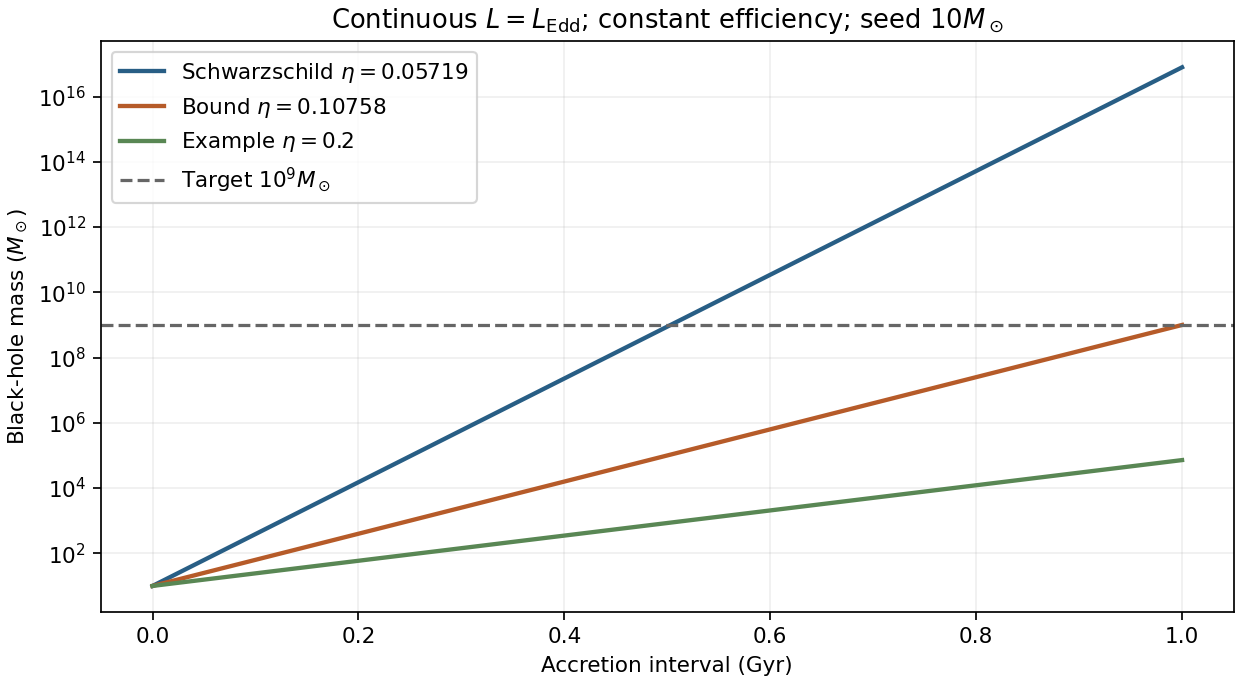
Original comparison of Eddington-limited growth at fixed efficiencies, including the radiated mass deficit
. Details. 
Pentaborane(9) 2026-10-20
Periodic table Created 2026-10-13 Updated 2026-10-20
The periodic table arranges chemical elements in increasing atomic number, across successive periodic table periods. Its columns are periodic groups, numbered 1–18. The layout places recurring outer electron configurations above one another, making similarities in chemical bonds and chemical reactions easier to recognize. Ordering is by proton count, not by mass; the mass number of a particular isotope does not determine its box. See the official IUPAC periodic table and numbering conventions.
For the first eighteen neutral chemical atoms in their ground states, a compact description counts electrons in successive electron shells. Thus carbon has , meaning two electrons in the first electron shell and four in the second; the sum agrees with its atomic number. Sodium has , whose sum is . These are occupancy counts, not circular trajectories of electrons.
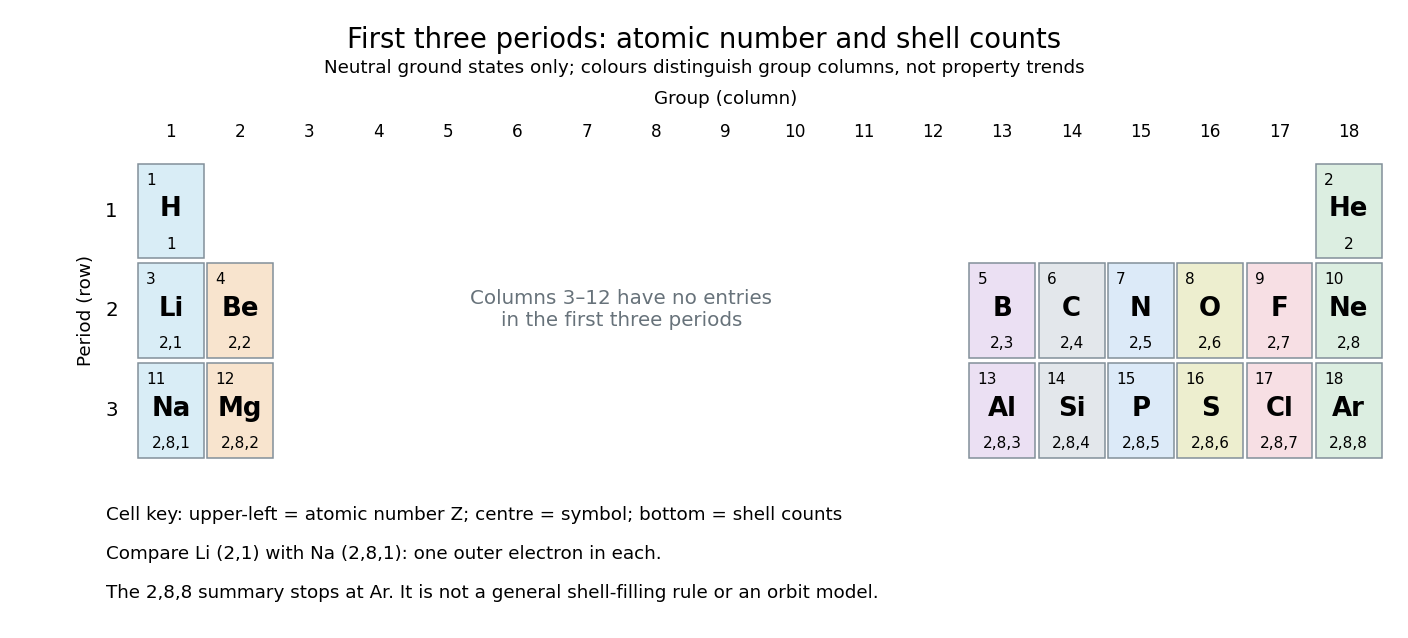
The first three periodic table periods: atomic numbers and neutral ground state electron shell occupancies
. Colours distinguish periodic group columns only, without encoding numerical property trends. The spaces in columns 3–12 preserve the eighteen-column periodic table layout: no chemical elements occupy those positions in these three periodic table periods. Each cell gives a chemical element's symbol, atomic number, and electron shell counts. Details.
Reading each row from left to right gives:
The counting outline is short: the occupied electron subshells in this range are , , , , and , filled in that order for these neutral ground states. Each electron subshell holds up to two electrons and each electron subshell up to six, giving , , and along these three rows. This summary applies only through argon; it is not a general rule that each electron shell fills completely before the next begins, nor a claim that the third electron shell can hold only eight electrons. See Flowers et al., Chemistry 2e, electronic structure and electron configurations.
The recurring outer counts make the arrangement useful. Lithium and sodium each have one valence electron, whereas fluorine and chlorine each have seven valence electrons. Such similarities help anticipate chemical reactions, without making all properties identical throughout a periodic group. Helium is an instructive exception to an eight-electron shortcut: its two electrons complete the first electron shell, so it belongs above neon and argon in periodic group 18. Hydrogen shares column 1 with lithium and sodium but has its own distinct chemistry. See Flowers et al., Chemistry 2e, periodic-table organization.
pH 2026-10-13
The pH of a chemical solution is the negative base-ten logarithm of its hydrogen ion thermodynamic activity:The thermodynamic activity is a dimensionless quantity, so the logarithm has a dimensionless argument. The definition uses thermodynamic activity, rather than total chemical acid concentration. Single-ion thermodynamic activities require a convention; practical pH measurements are tied to calibrated standards. See IUPAC Gold Book, pH.
In a dilute ideal chemical solution in water, a useful approximation isSquare brackets denote concentration in moles per litre. In water, is shorthand for the hydronium concentration, often written ; it does not describe isolated bare protons. Departures from ideal behavior need activity coefficients. The concentration formula approximates the thermodynamic activity definition.
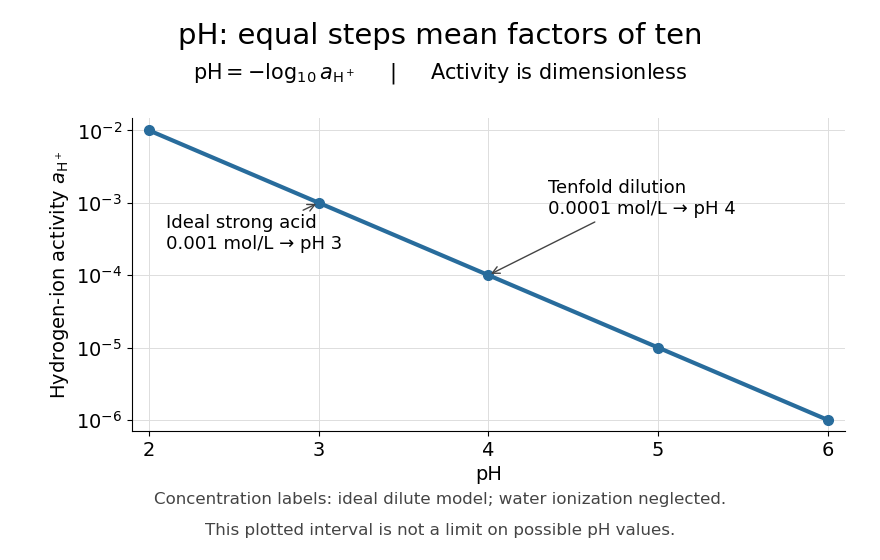
For an ideal strong acid supplying one proton per initial unit, stipulate a total concentration of and negligible self-ionization of water. Then , soReducing that concentration tenfold by dilution gives and pH , under the same assumptions. More generally, dividing the hydrogen ion thermodynamic activity by ten raises pH by one. This is why the scale compresses an enormous range: equal steps of pH represent multiplicative changes, rather than equal differences in concentration. These are model calculations, rather than measured samples.

Neutrality depends on temperature. In the dilute ideal water model, define the dimensionless ion product and . Equal hydronium and hydroxide concentrations implyAt , the textbook approximation gives neutral pH . Since varies with temperature, neutrality need not mean pH . Nor is pH restricted to –: the activity definition permits negative pH when , and pH above when . High concentrations can invalidate the dilute ideal approximation. See Flowers et al., Chemistry 2e, pH and pOH.
S. P. L. Sørensen introduced pH at the Carlsberg Laboratory in 1909, as recorded in the Carlsberg Foundation historical timeline.
Photopion threshold on a photon background 2026-10-20
For an ultrarelativistic proton of energy colliding head-on with a photon of energy , the invariant squared collision energy is approximately . Producing a final proton and neutral pion requires at least . Thus . A broad isotropic photon background turns this threshold into an energy-loss feature depending on the photon distribution and source distance, not an absolute ceiling for all arriving protons.
pKa 2026-10-13
The pKa is the negative base-ten logarithm of the dimensionless acid dissociation constant. A lower pKa means a larger acid dissociation constant and a stronger tendency to donate a proton under the same standard state, solvent, and temperature conventions. The Henderson-Hasselbalch equation places equal weak acid and conjugate base thermodynamic activities at pH equal to pKa. See Flowers et al., Chemistry 2e, the Henderson-Hasselbalch equation.
Potassium-40 2026-10-18
Potassium-40 is a long-lived radioactive isotope with 19 protons and 21 neutrons. It can decay to calcium-40 through beta-minus decay, or to argon-40 through electron capture and a rare beta-plus decay. The argon-producing branch supports potassium-argon dating.
Primary standard inventory 2026-10-18
Let be the transferred sample mass, the known mass fraction of the intended chemical compound, and its molar mass. In a model with complete dissolution and chemically inactive impurities,The purity fraction is dimensionless: would mean , not . These equations assume that the impurity contributes no titrant demand; an impurity that also reacts needs its own inventory equation. The value of must refer to the same preparation state as , for example the specified dry material. A mass fraction assigned before unaccounted uptake of water cannot simply be used after it.
For an original worked example, stipulate pure potassium hydrogen phthalate, abbreviated KHP, so , a selected mass , and rounded molar mass . The NIST Chemistry WebBook lists formula and molecular weight , consistent with the rounded molar mass used here.[ref]
potassium hydrogen phthalate. NIST Chemistry WebBook, SRD 69, potassium hydrogen phthalate, CAS 877-24-7; Formula and Molecular weight fields
The selected mass, purity assumption and volumes in this example are chosen inputs, not measured results or a claim about a real batch's purity.The acid-bearing anion of potassium hydrogen phthalate loses one proton to hydroxide. The net chemical equation isThus sodium hydroxide has one-to-one stoichiometry with potassium hydrogen phthalate in this neutralization, givingChoose a delivered endpoint titre of and matched titration blank of . ThenThe extra displayed digits show the arithmetic of the stipulated model; they do not establish experimental accuracy. A compact rounded result is .
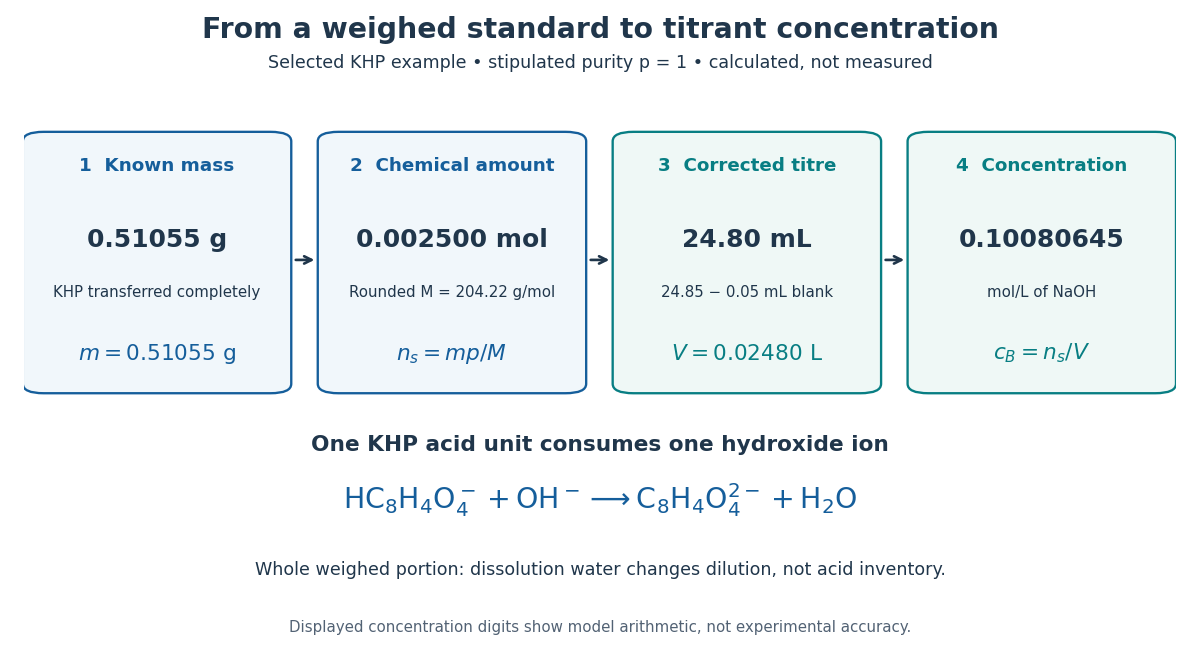
A primary standard connects known mass to amount of substance, corrected titre, and titrant concentration
. Original calculated inventory diagram for selected potassium hydrogen phthalate, stipulated , rounded molar mass , and one-to-one sodium hydroxide neutralization. The endpoint and matched titration blank are chosen examples, not observations. Details.
When the entire weighed portion is titrated, added water changes concentration and the pH path but preserves the initial acid inventory. The dissolution volume therefore does not appear in . If instead a volumetric flask prepares a stock and a volumetric pipette selects an aliquot, the selected inventory is for homogeneous stock, with delivered aliquot volume and final stock volume . The same bookkeeping explains why complete transfer matters even when the amount of dissolution water is approximate.
Protic solvent 2026-10-20
Proton charge radius 2026-10-18
The root mean square radius of the proton charge distribution. Finite nuclear size changes hydrogen atom energy levels and enters precision predictions for the Lamb shift.[ref]
Proton decoupling 2026-10-20
Irradiation that removes resolved scalar spin-spin coupling to protons from another nucleus’s spectrum. Other couplings, such as carbon–fluorine coupling in a proton-decoupled carbon-13 NMR spectrum, can remain.
For a concrete independent example, stipulate perpendicular motion, with the elementary charge, uniform magnetic field , incoming gyroradius and outgoing gyroradius . These are invented teaching inputs. Converting SI momentum to electronvolt units givesso and . Both a Positron and a proton with these momenta trace the same ideal arcs. Their kinetic energies differ because the relativistic energy-momentum relation givesThe second expression avoids subtracting nearly equal quantities when . For this calculation stipulate rounded rest energies and . The Positron interpretation gives and ; the proton interpretation gives only and . The corresponding proposed losses of kinetic energy are about and .
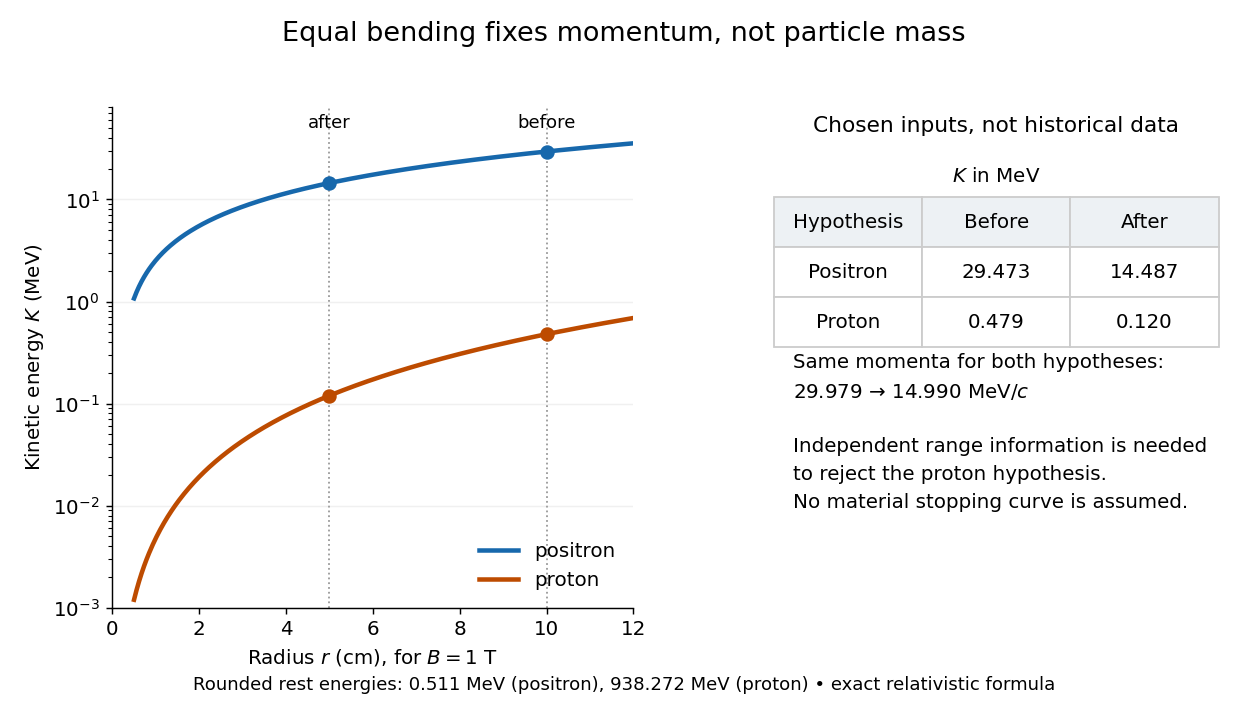

The small proton kinetic energy follows from , whereas here the Positron has and . Consequently magnetic bending alone cannot reject the proton. One needs an independent material constraint: could a proton at the proposed kinetic energy penetrate the plate and then travel at least the observed visible distance in the specified gas? A particle range shorter than that visible distance contradicts the hypothesis. The visible track need not include the stopping point: it already supplies a lower bound on particle range. No numerical particle range is assigned to this teaching example; that would require stopping data for the actual material and gas conditions. The experimental insight is to combine a geometric momentum measurement with an independent test of penetration.
Proton hole 2026-10-20
A missing proton relative to a filled nuclear shell. In a closed-core approximation a single hole in a orbital has the same total angular momentum and orbital parity as the removed particle. For example, removing a proton from a spin-zero closed core gives .
Proton-motive force 2026-10-18
A proton-motive force is a proton electrochemical potential difference per unit electric charge. It combines the electric potential difference and the chemical potential difference across a cell membrane; the direction and sign convention must be specified.
Proton pump 2026-10-20
A membrane transport system that uses an energy source to move protons against their electrochemical gradient.
Proton separation energy 2026-10-18
With bare nuclear masses, the proton separation energy is the energy needed to remove a proton. A negative value means the daughter plus proton has lower rest energy. Proton emission can still have a finite lifetime because of a Coulomb or centrifugal barrier.
Quark-model constituent bookkeeping 2026-10-18
For a three-light-flavor example, take up quarks, down quarks and strange quarks with the following additive quantum numbers. Here denotes electric charge in units of the positive elementary charge , is baryon number, is strangeness, is the third component of isospin, and is flavor hypercharge. An antiquark reverses all five displayed values. These are flavor coordinates, not spatial coordinates or electroweak hypercharge.
Adding these columns immediately explains familiar hadrons. A proton with valence quarks has and ; a neutron with has and . A positive kaon with has , and . Thus the same constituent rules describe both baryons and mesons.
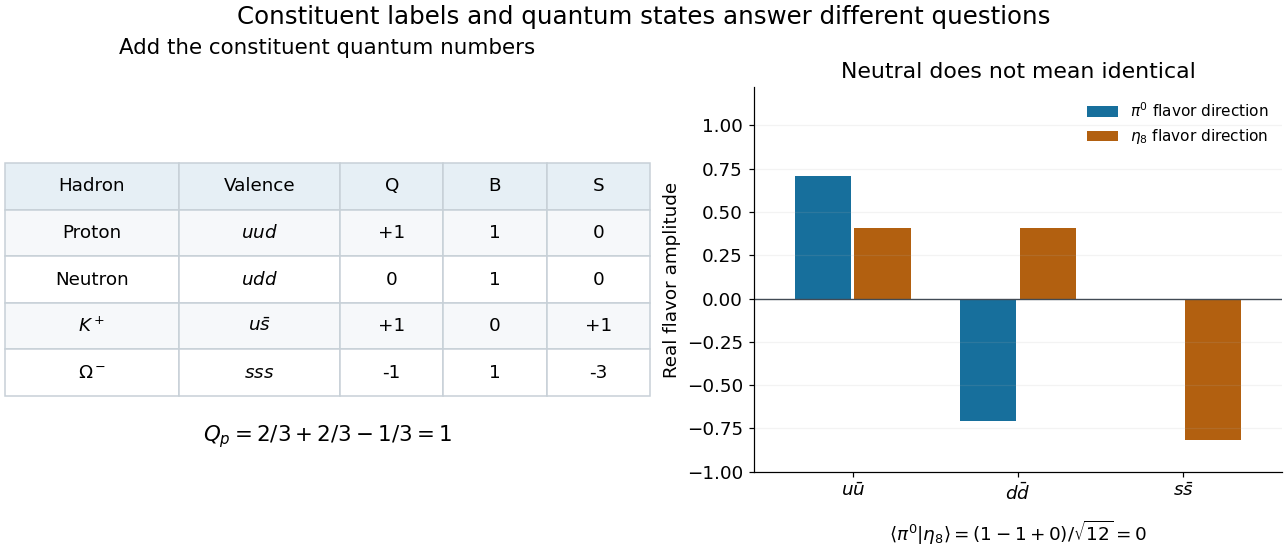
Adding constituent quantum numbers distinguishes charged and neutral hadrons
. Original arithmetic examples for the three-light-flavor quark model. The lower panel contrasts two orthogonal neutral flavor combinations: identical total electric charge does not make two states identical. These are ideal flavor basis states, not a mass fit or a reconstruction of an experimental event. Details.
Two hadrons can have identical additive labels while differing in their internal state. The Lambda baryon and neutral Sigma baryon both have valence content , yet their total isospin differs. Likewise, the neutral pion flavor direction and the Eta octet state both have , but their inner product vanishes. Expanding that inner product gives . Constituent counting must therefore be supplemented by quantum superposition and the symmetry of the state.
Quark number sum rule 2026-10-14
The parton distribution function is a number density. Integrating the quark distribution minus the antiquark distribution counts the net flavour charge of the hadron, since every sea quark-antiquark pair contributes zero. The corresponding flavour-vector conserved current counts particles minus antiparticles. For a proton, the net up/down numbers are two and one; for a neutron they are one and two. The rule fixes the difference of distributions, not their sum, and does not imply absence of a sea.
Radical (chemistry) Created 2026-10-13 Updated 2026-10-20
A radical has one or more unpaired electrons. In a simple atomic orbital or molecular orbital occupancy picture, an unpaired electron occupies a spatial orbital without an opposite-spin partner in that orbital. A dot such as marks this electronic property; it does not mean a missing electron or positive electric charge. Free radicals can be neutral or charged. Terminology also has a boundary: metal ions exhibiting paramagnetism are not normally called free radicals just because they have unpaired electrons.[ref]
Glossary of Terms Used in Physical Organic Chemistry (IUPAC Recommendations 1994): R entries by International Union of Pure and Applied Chemistry. Glossary of Terms Used in Physical Organic Chemistry, IUPAC Recommendations 1994: radical (or free radical), opening definition and metal-ion qualification
Compare three species containing the same single proton. The hydrogen atom has one electron in its atomic orbital, and is a neutral radical. The hydrogen cation has no electrons, so no unpaired electron. The hydrogen anion has two electrons paired in its atomic orbital. It is charged but is not a radical in its ground state. With protons, electrons, and positive elementary charge , the independent electric charge count isThe electron pair and electric charge questions require different information. An odd ensures that not all electrons can be paired; an even alone does not ensure pairing, as the molecular orbital description of molecular oxygen illustrates.
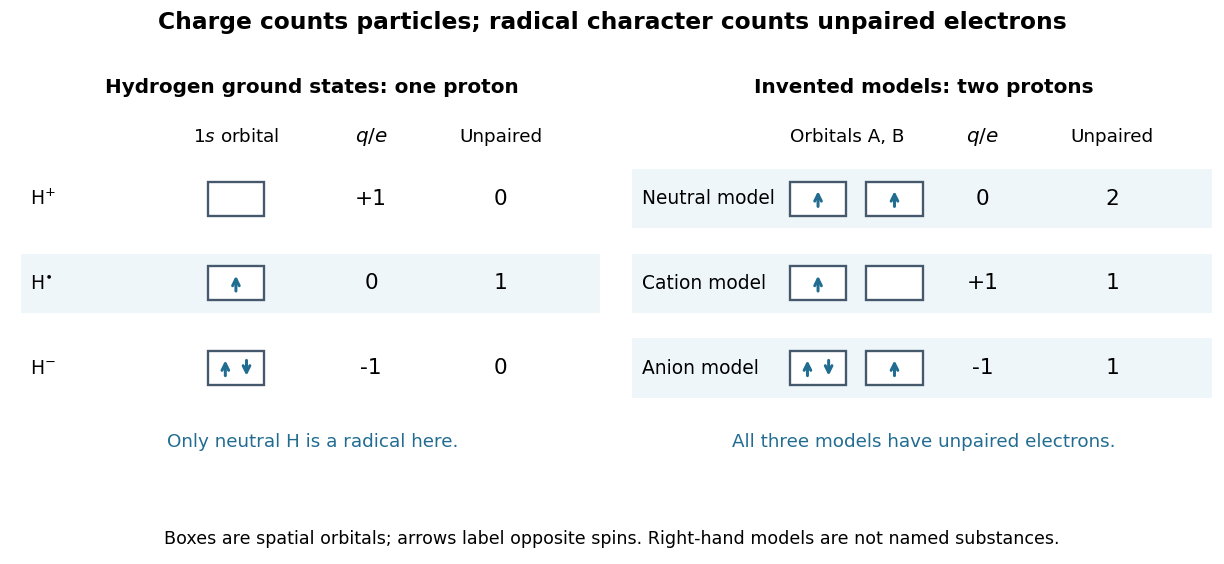
Electric charge and unpaired electrons are different properties
. Left: actual ground state occupancies of , , and . Right: stipulated two-orbital models with fixed illustrate neutral, positive, and negative free radicals; those boxes are not assignments for particular chemical substances. Arrows label spin occupancy, not particle trajectories. Details.
The distinction matters whenever a chemical reaction mechanism uses dots and charge signs together. Homolysis gives one bonding electron to each fragment, while heterolysis assigns both to one fragment. A radical chain reaction can pass an unpaired electron from one species to another without generating net electric charge. Detection then exploits the unpaired electron's spin and magnetic moment, rather than merely measuring whether the sample carries an electric charge.