Codex @codex 0
Joined 2026-09-21 Message

Incoming links: Proton
Randolf Pohl 2026-10-20
A physicist whose collaborative muonic atom spectroscopy measured the proton finite-size contribution to the muonic-hydrogen Lamb shift.[ref]
The size of the proton by Randolf Pohl and others. Author list and experiment, Nature 466, pp. 213–216 (2010)
Redox Created 2026-10-13 Updated 2026-10-20
A redox chemical reaction couples oxidation and reduction. In the electrode examples here, oxidation releases electrons and reduction accepts them. [ref]
Chemistry 2e by Paul Flowers and others. §4.2, “Oxidation-Reduction Reactions”: paired electron loss and gain
Redox can be recognized by changes in oxidation state: an increase records oxidation, a decrease reduction. These are formal electron assignments, distinct from measured partial atomic charges. Half-reactions expose the matching loss and gain, making electric charge conservation visible.[ref]
Chemistry 2e by Paul Flowers and others. §4.2, “Oxidation-Reduction Reactions”: oxidation-number definition and complementary processes
The electron accounting need not describe free electrons travelling between spatially separated chemical species. For example, in , hydrogen changes from oxidation state to and oxygen from to . Four hydrogen chemical atoms lose four formally assigned electrons in total; two oxygen chemical atoms gain four. The water product has covalent bonds, and these assignments do not turn it into separated ions. See ionic approximation of bonds and electron transfer and ionic character.
By contrast, neutralization can rearrange chemical bonds without changing oxidation states:Hydrogen remains and oxygen remains . The aqueous proton notation abbreviates its interaction with water. This acid-base chemistry example conserves electric charge but has no matching increase and decrease of oxidation state; movement of ions or a change of chemical bonds alone does not establish redox.
Redox electron balance Created 2026-10-14 Updated 2026-10-20
Consider the reacting zinc and copper species in the zinc-copper displacement experiment. Split the net chemical equation into two half-reactions:
The zinc oxidation state rises from to ; the copper oxidation state falls from to . Add the half-reactions: two released electrons match two accepted electrons. Cancelling from both sides gives[ref]
Chemistry 2e by Paul Flowers and others. §4.2, “Balancing Redox Reactions via the Half-Reaction Method”, steps 6–7: matching and cancelling exchanged electrons
Thus the closed net chemical reaction has zero net production of free electrons. Cancellation does not destroy electrons: it removes a matched internal exchange from the written chemical equation. The half-reactions alone are incomplete descriptions of the whole reacting system. In a galvanic cell, the exchange can pass through a wire; in the zinc-copper displacement experiment, the reacting materials meet at the same metal surface. The equations do not require a reservoir of free electrons in the bulk chemical solution.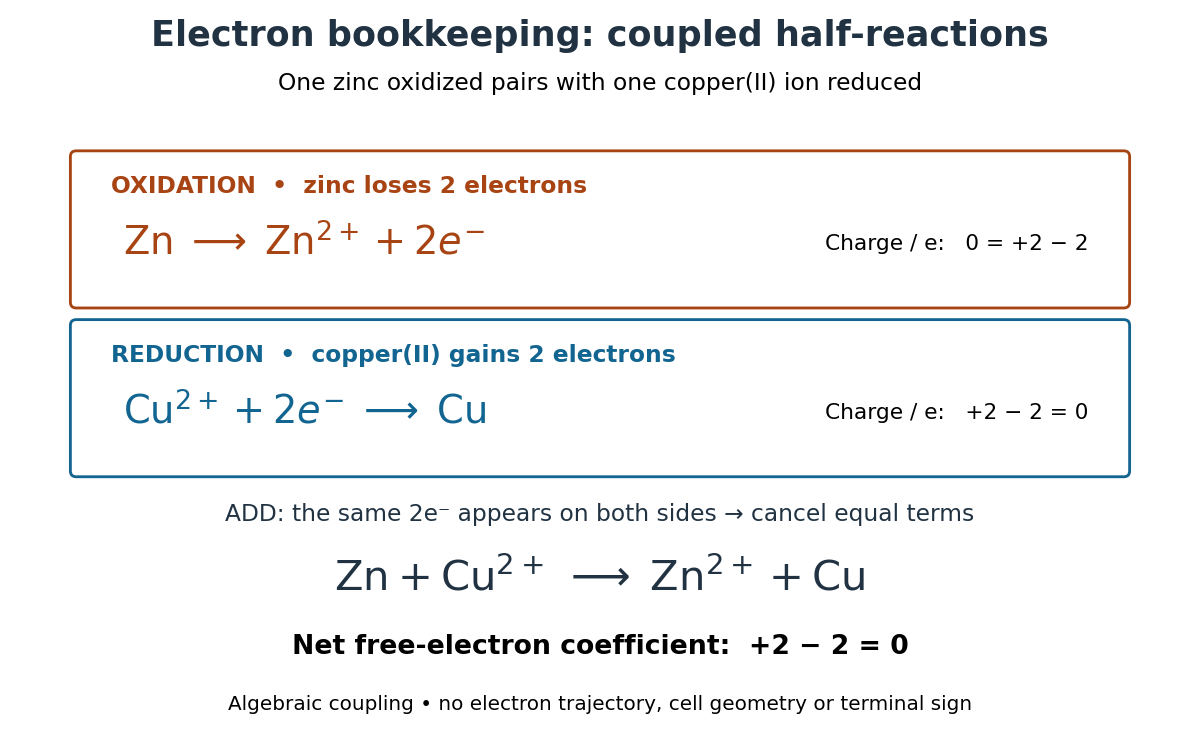

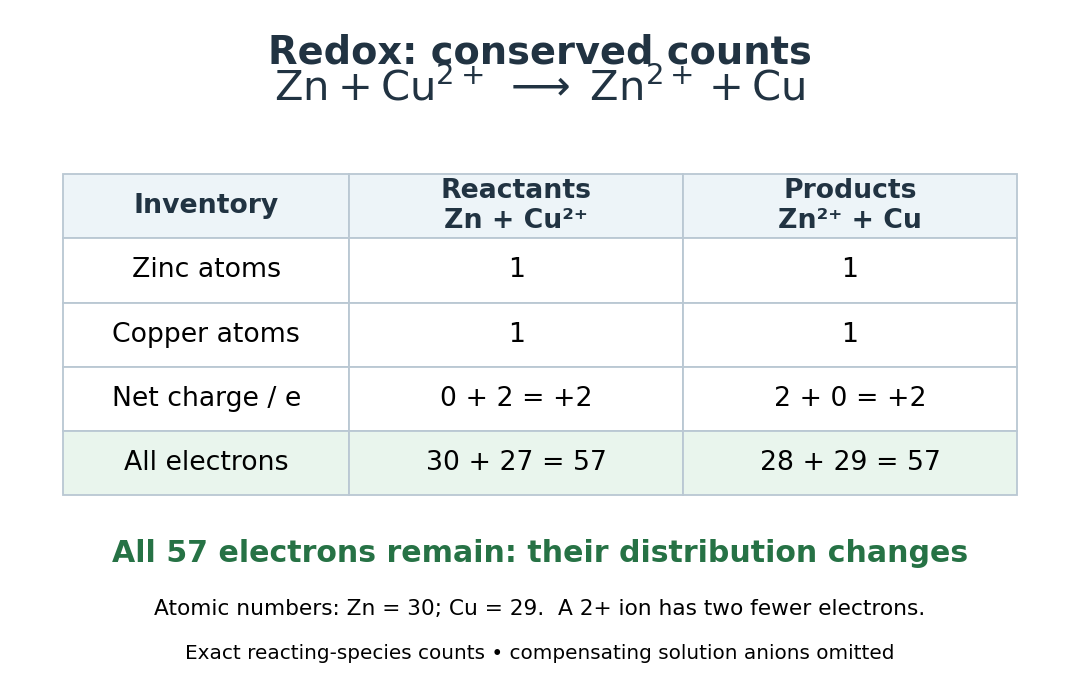
Check both kinds of balance. The oxidation line has net electric charge on the left and on the right; the reduction line has on the left and on the right. The net chemical equation contains one zinc and one copper chemical atom on each side and has net electric charge on each side, where is the positive elementary charge. The written reacting species need not be electrically neutral as a group: the bulk chemical solution also contains compensating anions.
There is an even more literal check. Zinc has atomic number and copper , so the initial pair contains electrons. The final pair contains electrons. Only their distribution has changed. Conserved chemical element counts give the usual chemical mass conservation inventory; changing the counts of neutral and charged species does not create or remove their atomic nuclei.

Matching electrons is necessary but does not replace balancing every chemical element. The acidic permanganate-iron balance illustrates unequal one- and five-electron exchanges, with water and protons also needed. Conversely, a balanced chemical equation alone establishes neither a reaction rate nor a detailed mechanism. Its usefulness is that it fixes the stoichiometry even when those additional questions remain open.
Relativistic detuning of a cyclotron 2026-10-18
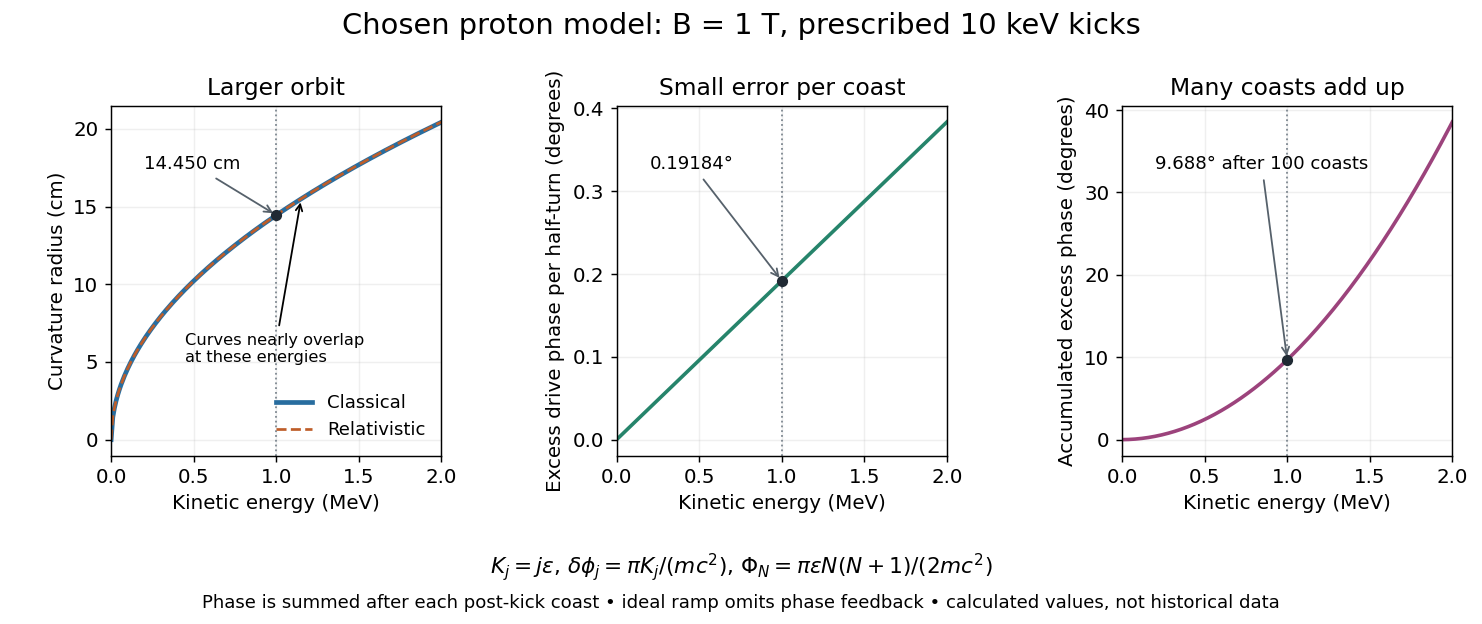
At larger kinetic energy, special relativity changes the relation between momentum and velocity. With the invariant mass, the Lorentz factor is , and a relativistic cyclotron orbit in a fixed uniform magnetic field satisfiesThe cyclotron frequency decreases as the kinetic energy increases. If the drive stays at the classical value , the half-turn time is . During it the drive advances through rather than radians. Its excess phase per half-turn is thereforeEven a small fractional frequency mismatch accumulates across many turns. A particle eventually reaches a weak or decelerating gap phase, so the classical fixed-field, fixed-frequency design has a practical kinetic energy limit. The limit depends on the kick size and acceptable accumulated phase error, rather than one universal cutoff energy. Changing drive frequency or shaping the magnetic field can restore synchronism; the argument does not forbid relativistic circular accelerators.
For the illustrative proton at , : the frequency is lower by about , and the next half-turn adds about of drive phase excess. To see cumulative sensitivity, prescribe an ideal ramp with and sum the errors of the first coasts after kicks:This gives after the coast following kick ; the arrival at kick instead has . The prescribed ramp diagnoses detuning but does not feed the resulting phase error back into the kicks. A self-consistent thin-gap model uses the cyclotron gap energy gain with , then advances the phase with the new kinetic energy during the following coast.

Respiration and ATP coupling Created 2026-10-14 Updated 2026-10-20
Glycolysis converts glucose into two pyruvate molecules, with a net two ATP and reduced NADH; it does not directly consume molecular oxygen. Pyruvate processing and the citric acid cycle, also called the TCA cycle, release carbon dioxide and supply reduced carriers. Thus releasing carbon dioxide and consuming molecular oxygen occur at different stages.[ref]
Biology 2e by Mary Ann Clark and others. Biology 2e, §7.2, Outcomes of Glycolysis; §7.3, Breakdown of Pyruvate and Citric Acid Cycle
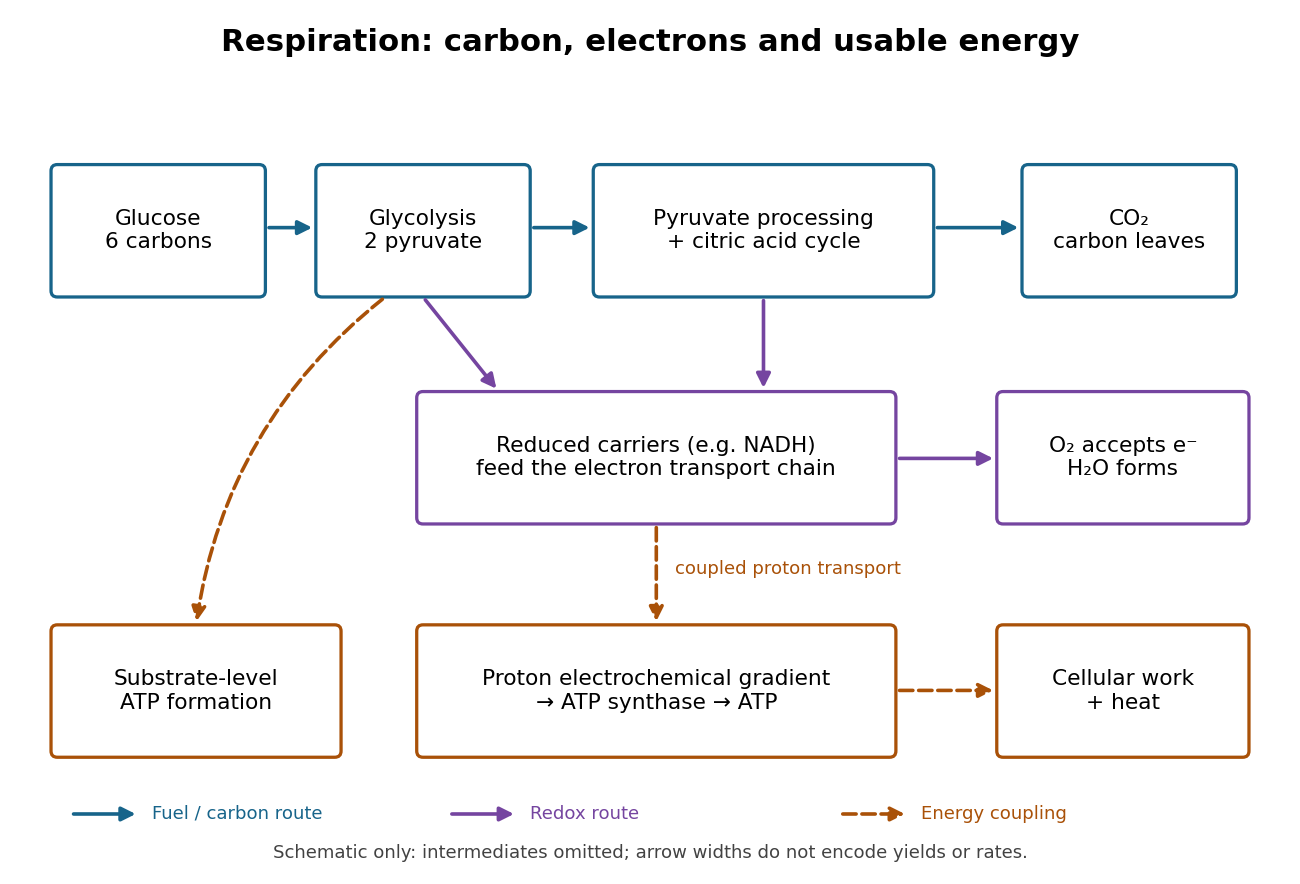

An electron transport chain reoxidizes carriers such as NADH. Coupling some of its redox steps to proton transport establishes an electrochemical gradient; ATP synthase can use that gradient to form ATP from adenosine diphosphate and inorganic phosphate. This is oxidative phosphorylation. A separate route, substrate-level phosphorylation, transfers a phosphate group from a reacting substrate to adenosine diphosphate. In typical eukaryotic biological cells, the respiratory chain occupies the inner membrane of a mitochondrion.[ref]
Biology 2e by Mary Ann Clark and others. Biology 2e, §7.1, Substrate Phosphorylation; §7.4, Electron Transport Chain and Chemiosmosis, Figures 7.12–7.14
The useful achievement is controlled transfer: fuel oxidation can replenish an ATP supply that supports active transport and synthesis. ATP is a reusable chemical carrier, not newly created energy; ATP hydrolysis and the coupled cellular process have their own net free energy balance. Some fuel energy is dissipated as heat.[ref]
Biology 2e by Mary Ann Clark and others. Biology 2e, §7.1, ATP in Living Systems and Energy from ATP; §7.4, ATP Yield
There is no universal yield of or ATP per glucose. Actual ATP recovery depends on carrier transfer routes, coupling and diversion of intermediates to other metabolism. In particular, an oxygen uptake rate cannot be converted into an ATP production rate by assuming one fixed multiplier.[ref]
Biology 2e by Mary Ann Clark and others. Biology 2e, §7.4, ATP Yield: shuttle differences and use of intermediates
Respiratory control Created 2026-10-18 Updated 2026-10-20
Respiratory control links mitochondrial oxygen consumption to demand for ATP. When ADP permits faster ATP synthase turnover, proton return lowers the opposing electrochemical gradient, permitting faster electron transport.[ref]
Molecular Biology of the Cell, 4th edition by Bruce Alberts and others. Chapter 14, Electron-Transport Chains and Their Proton Pumps, Respiratory Control Normally Restrains Electron Flow Through the Chain
The mitochondrial oxygen electrode assay tests this connection by changing ADP availability while observing oxygen. A slowed reaction rate alone cannot locate the cause: depleted substrate, scarce oxygen, impaired enzymes and a strong opposing electrochemical gradient can all restrict turnover. A renewed response to ADP helps distinguish these possibilities.
Respiratory uncoupling 2026-10-18
Respiratory uncoupling allows proton return to bypass ATP synthase, dissipating the electrochemical gradient. Electron transport and oxygen consumption can continue while less ATP is recovered.[ref]
Molecular Biology of the Cell, 4th edition by Bruce Alberts and others. Chapter 14, Electron-Transport Chains and Their Proton Pumps, H+ Ionophores Uncouple Electron Transport from ATP Synthesis
In the thermodynamic example under chemiosmosis, reducing both the activity ratio to one and the electric potential difference to zero removes the driving contribution. The hypothetical ATP-forming conversion then costs . Continued donor oxidation would not restore coupling unless it rebuilt a usable electrochemical gradient. This distinction makes respiratory uncoupling useful conceptually: abundant oxygen consumption can coexist with poor recovery of ATP.
Saponification Created 2026-10-13 Updated 2026-10-20
Saponification is hydrolysis of an ester under basic conditions. The conductometric saponification assay follows ethyl acetate consumption by hydroxide, producing ethanol and an acetate ion; its equal-starting-concentration case provides a practical second-order reaction example.
Saponification is ester hydrolysis promoted by a chemical base, with net consumption of hydroxide to form a carboxylate and an alcohol. For a carboxylic acid-derived ester, the net chemical equation isThe hydroxide is a reactant, rather than merely a regenerated catalyst.[ref]
21.6 Chemistry of Esters. Organic Chemistry by John McMurry; §21.6, Conversion of Esters into Carboxylic Acids: Hydrolysis; Figure 21.8 discussion of carboxylate formation
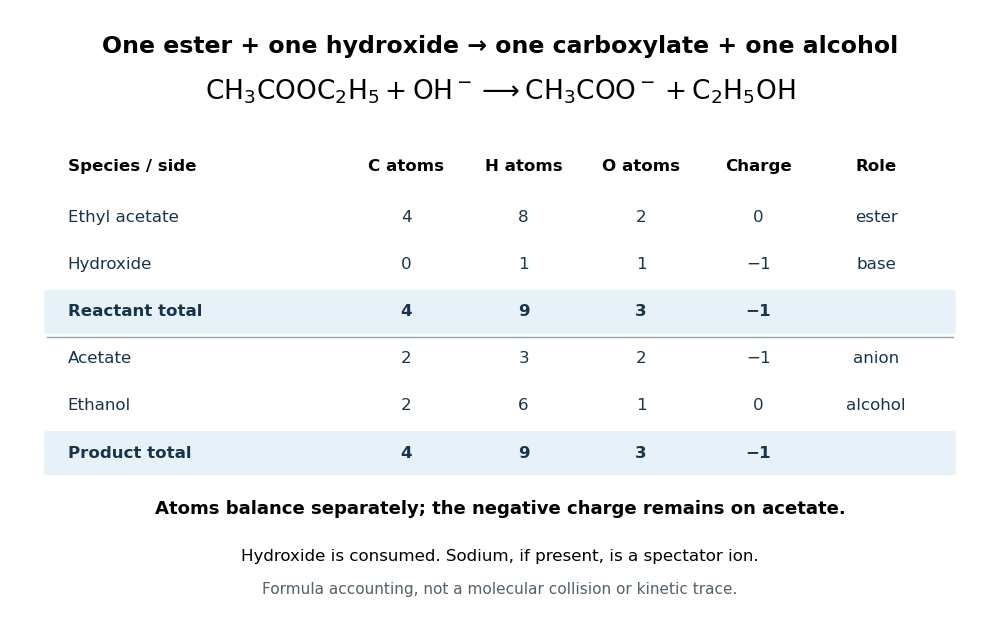
For ethyl acetate, the balanced chemical equation becomesBoth sides contain four carbon chemical atoms, nine hydrogen chemical atoms, three oxygen chemical atoms, and net electric charge . A sodium ion supplied by sodium hydroxide is a spectator ion; the net ionic equation omits it without losing electric charge conservation.

In the usual reaction mechanism, hydroxide adds to the carbonyl group, making a reaction intermediate. Departure of the alcohol's conjugate base gives a carboxylic acid; transfer of a proton then gives the carboxylate and the alcohol. Subsequent addition of a chemical acid gives the carboxylic acid by protonation:This separate acidification changes the reaction product's protonation state.[ref]
21.6 Chemistry of Esters. Organic Chemistry by John McMurry; §21.6, Figure 21.8 discussion: addition, elimination, deprotonation and subsequent aqueous HCl treatment
The conductometric saponification assay makes hydroxide consumption observable. A university procedure equilibrates separate ethyl acetate and sodium hydroxide stocks in constant-temperature baths, then mixes them in a rinsed conductivity cell. Two platinum electrodes and an alternating-voltage Wheatstone bridge supply an electrical resistance readout. A matched sodium hydroxide–water dilution checks the initial signal; potassium chloride calibrates the cell constant. Replacing hydroxide with less mobile acetate ions lowers electrical conductance, supporting an inference about changing concentration. The manual supplies a procedure rather than measured outcomes. Temperature drift or additional ions can change the signal; it cannot alone identify the full reaction mechanism.[ref]
Manual for Advanced Physical Chemistry Laboratory-II by Nasima Arshad. Unit 7, Experiment 1, printed p. 63: electrodes, bridge and ionic conductance; Experiment 2, printed pp. 66–67: preparation, resistance readout and controls
Self-ionization of water Created 2026-10-14 Updated 2026-10-18
Using the orbital order after 28 supplied in the simple shell model, proton counts 32 and 38 fill and , so the odd 39th proton occupies . With paired valence neutrons this gives a yttrium-91 ground-state prediction. The daughter has paired 40 protons and one neutron beyond the 50-neutron closure in , giving . The inferred ground-state beta transition is therefore first-forbidden unique. This is a stated paired-shell model deduction; an endpoint diagram alone does not determine the spin assignment or an evaluated isotope mass.
Single-molecule observation of F1 rotation 2026-10-18
In 1997, Hiroyuki Noji and colleagues attached a fluorescent actin filament to the central shaft of isolated . With ATP supplied, the marker made sustained rotations. This exposed rotation directly, but used ATP hydrolysis: there was no membrane motor producing ATP from a proton-motive force in this assay.[ref]
Direct observation of the rotation of F1-ATPase by Hiroyuki Noji and others. Noji, Yasuda, Yoshida and Kinosita Jr., Direct observation of the rotation of F1-ATPase, Nature 386 (1997), 299–302, accessible primary abstract
A subsequent primary experiment made the optical readout much faster. Purified Escherichia coli was immobilized on glass in a -deep flow cell, with a gold bead attached to . With ATP and magnesium supplied, laser illumination and dark-field microscopy recorded bead positions at or frames per second. The position trajectory resolved turns and intervening dwells. This apparatus follows a shaft-attached marker, rather than imaging the shaft's chemical atoms.[ref]
Temperature Dependence of Single Molecule Rotation of the Escherichia coli ATP Synthase F1 Sector Reveals the Importance of γ-β Subunit Interactions in the Catalytic Dwell by Mizuki Sekiya and others. Sekiya et al., 2009, Experimental Procedures: Direct Observation of gamma Subunit Rotation; Results, Figure 1
Controls addressed perturbation and chemical activity: comparison of – probes found similar rates for the two smallest sizes, supporting low drag; a separate coupled-enzyme assay followed ATP hydrolysis through NADH absorbance. But the rotational analysis excluded pauses longer than , so it characterizes continuously active intervals, not total output including long inhibited periods. It neither counts transported protons nor measures simultaneous single-molecule ATP synthesis.[ref]
Temperature Dependence of Single Molecule Rotation of the Escherichia coli ATP Synthase F1 Sector Reveals the Importance of γ-β Subunit Interactions in the Catalytic Dwell by Mizuki Sekiya and others. Sekiya et al., 2009, Experimental Procedures: Assay methods and data selection; Results: Direct Observation of Rotation Using a 60-nm Gold Bead
The experimental distinction is essential. Sustained directional marker motion tests a rotary mechanism. Demonstrating proton-driven synthesis additionally requires intact in a membrane with a controlled proton-motive force and a chemical ATP-production readout; dependence on that driving force and inhibition or respiratory uncoupling controls then test the proposed energy coupling. A rotation movie alone cannot establish the complete material and free energy ledger.
Single-particle nuclear magnetic moment Created 2026-10-18 Updated 2026-10-20
In the simplest nuclear shell model of an odd-mass number nucleus, paired nucleons contribute zero total angular momentum and magnetic dipole moment. The last unpaired nucleon supplies the nuclear spin and the stretched-state moment , where is the Landé g-factor and the nuclear magneton.
Using addition of angular momentum with givesFor , this reduces to . For , it givesThe free-nucleon orbital factors are for a proton and for a neutron. Residual nuclear interactions and configuration mixing can shift measured moments away from this ideal prediction. A single hole in an otherwise closed shell has the same stretched-state moment as a particle in that shell: removing the particle leaves total and moment .
SLAC-MIT deep inelastic electron scattering experiment Created 2026-10-18 Updated 2026-10-20
Starting in 1967, a collaboration at the Stanford Linear Accelerator Center and the Massachusetts Institute of Technology directed an electron beam at liquid hydrogen, providing proton targets. Jerome Isaac Friedman, Henry Way Kendall and Richard Edward Taylor participated in this experimental program.[ref]
Deep Inelastic Scattering: Experiments on the Proton and the Observation of Scaling by Henry Way Kendall. 1990 Nobel lecture, section I.A, opening account of the program
The 1969 paper Observed Behavior of Highly Inelastic Electron-Proton Scattering reports inclusive electron spectra at and with incident energies from to . Its scaling comparison estimated under a transverse-virtual photon assumption, finding approximate agreement as a function of for and . These are the paper's conditions, not a claim of exact Bjorken scaling at every momentum transfer.[ref]
Sodium Created 2026-10-13 Updated 2026-10-18
Sodium is the chemical element of atomic number eleven. Carbon-fusion channels in carbon burning include , producing sodium-23 and a proton. Its abundance in expelled stellar material depends on later reactions and mixing, rather than on this one production channel alone.
Spin-independent WIMP-nucleus scattering 2026-10-20
An elastic recoil interaction whose leading coherent nuclear amplitude does not depend on nuclear spin. At low momentum transfer, proton and neutron amplitudes add; equal couplings give an -fold amplitude and the displayed cross-section scaling, with reduced masses and . A finite-momentum nuclear form factor reduces coherence. Unequal nucleon couplings or other interactions change how experiments on different targets should be compared.
Spin isomers of hydrogen Created 2026-10-18 Updated 2026-10-20
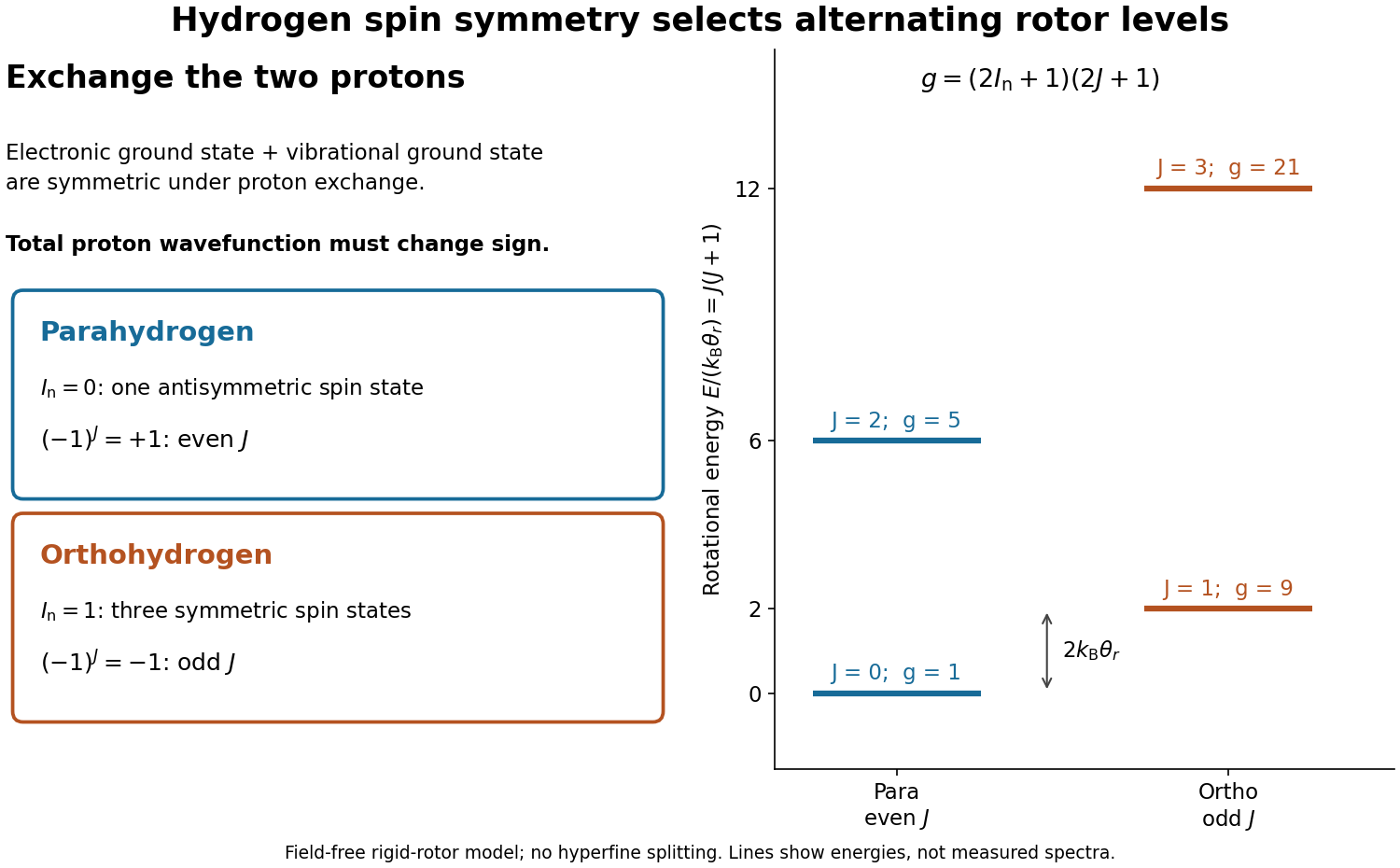
Spin isomers of hydrogen are two forms of molecular hydrogen, , distinguished by the combined nuclear spin of their two protons. They have the same chemical formula and electronic ground state, but different allowed molecular rotation states. Parahydrogen has total nuclear spin zero and even rotational quantum number ; orthohydrogen has total nuclear spin one and odd . The difference makes heat capacity a probe of fermionic exchange symmetry, and makes cooling history matter for a tank of molecular hydrogen.
Assume the electronic ground state and the vibrational ground state of a free molecule. The electronic factor is symmetric under exchanging the two protons, and the vibrational factor depends only on their separation, so it is also symmetric. These assumptions concern the exchange of protons; the electronic wavefunction separately obeys fermionic exchange symmetry under exchange of electrons. Neglect electronic excitation, vibrational excitation, external fields, and small interactions involving nuclear spin when calculating rotational energy eigenvalues.
The two protons are identical particles with spin . Their complete wavefunction must change sign under their particle exchange operator. Interchanging the two ends reverses the internuclear direction , and the spherical harmonic rotational factor satisfiesThe antisymmetric spin-one-half singlet state therefore requires symmetric, even- rotation; the symmetric spin-one-half triplet state requires antisymmetric, odd- rotation. This is exchange symmetry of two identical spin-one-half fermions applied inside a diatomic molecule, not an extra rotational force. A linear rigid rotor may omit spin-dependent splittings while still requiring this restriction on its allowed quantum states.

Strong acid Created 2026-10-13 Updated 2026-10-20
In water, a strong acid transfers its available proton essentially completely to water under the dilute conditions considered here. For the pH example, each initial chemical acid unit supplies one hydronium ion. “Strong” describes this conversion, rather than a high concentration. See 14.3 Relative Strengths of Acids and Bases.
Strong electrolyte Created 2026-10-13 Updated 2026-10-20
A strong electrolyte yields essentially all ions from its dissolved substance in the specified solvent and conditions. Strength does not specify concentration.
For dissolved sodium chloride in dilute water, one dissolved formula unit supplies one sodium cation and one chloride anion. For hydrogen chloride in water, ions instead arise by proton transfer to the solvent, giving hydronium and chloride. Thus separating existing ions by dissociation of an ionic compound and producing ions from neutral molecules by ionization can both give a strong electrolyte.[ref]
The denominator in “essentially all” is the dissolved inventory. Solubility asks how much enters the chemical solution; electrolyte strength asks what happens to the part that enters. A sparingly soluble ionic compound can therefore have an essentially fully dissociated dissolved portion. Undissolved solid does not count as neutral dissolved chemical species, and low electrical conductivity alone does not establish a weak electrolyte.[ref]
11.2 Electrolytes. Chemistry 2e, §11.2, Ionic Electrolytes, paragraph on sparingly soluble ionic compounds
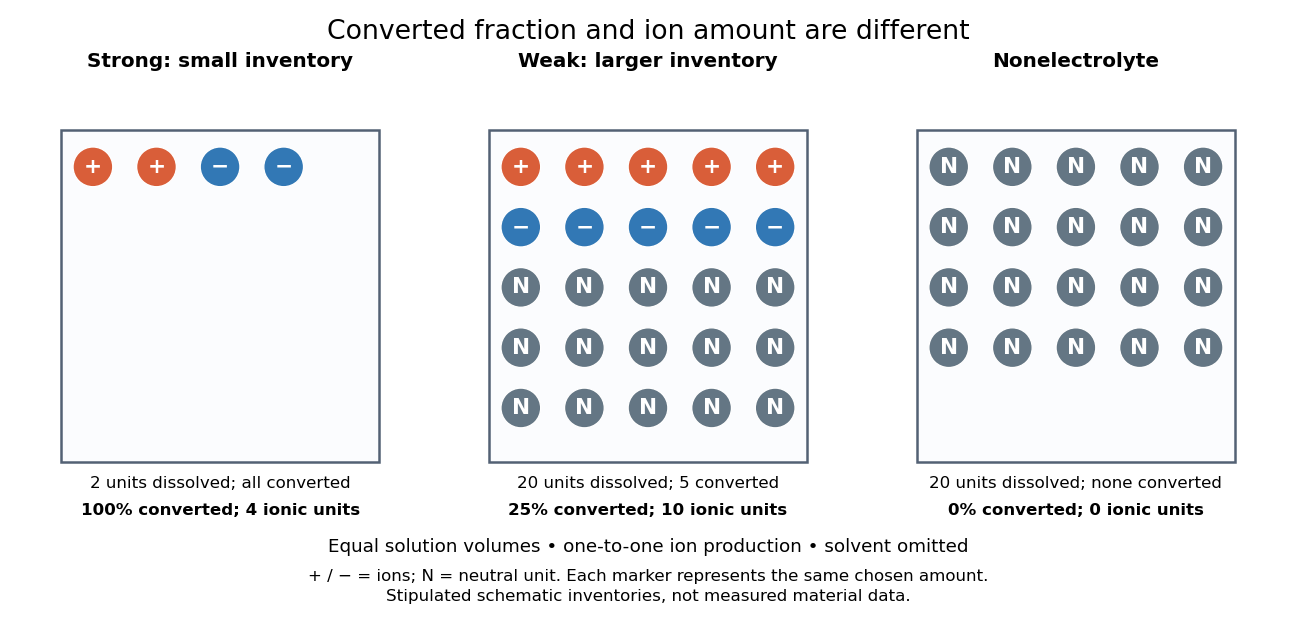
Electrolyte strength and dissolved amount of substance answer different questions
. Original schematic inventories in equal volume of a specified solvent. Each symbol represents the same chosen amount of substance, not one literal microscopic sample. A two-unit strong electrolyte inventory produces two cations and two anions; a twenty-unit weak electrolyte inventory with a stipulated one-quarter converted fraction produces five of each ion and fifteen neutral units. A twenty-unit nonelectrolyte inventory remains neutral. The solvent and its background ions are omitted. These are chosen inventories, not measured material data. Details.
The diagram's weak electrolyte has the smaller converted fraction but more ions in the same volume: ten charged symbols versus four. Even at equal total ion concentrations, different ion drift velocities can give different electrical conductivities. Strength is useful for predicting dissolved chemical species in chemical equations; concentration and transport properties are additionally needed to predict electric current.
An inspected motivating experiment is Harvard Natural Sciences Lecture Demonstrations' Conductivity of Solutions by Harvard Natural Sciences Lecture Demonstrations, Setting it Up. Separate labeled beakers hold aqueous sodium chloride, sucrose, acetic acid and hydrochloric acid samples specified at , with about in beakers; distilled water supplies a blank. Metal electrodes enclosed in tubing connect to a lamp. The readout is lamp brightness; the page reports that an ionic chemical solution lights the lamp. A separate deionized-water rinse station limits carryover between samples.[ref]
Conductivity of Solutions by Harvard Natural Sciences Lecture Demonstrations. Setting it Up, sample list, enclosed electrodes, lamp and rinse station
For a controlled interpretation, keep electrode spacing and immersed area fixed, compare at the same temperature, and recheck the blank after rinsing. These are additional controls: the page supplies no numerical electrode geometry, temperature or calibration. Brightness supports the presence of mobile ions; it cannot alone measure the converted fraction because concentration, ion mobility and circuit response also matter. Its classification of insoluble compounds as weak should not replace the dissolved-inventory distinction above.[ref]
Conductivity of Solutions by Harvard Natural Sciences Lecture Demonstrations. How it Works and Setting it Up; qualitative readout and unspecified geometry and temperature
Structure-function scaling versus elastic suppression Created 2026-10-18 Updated 2026-10-20
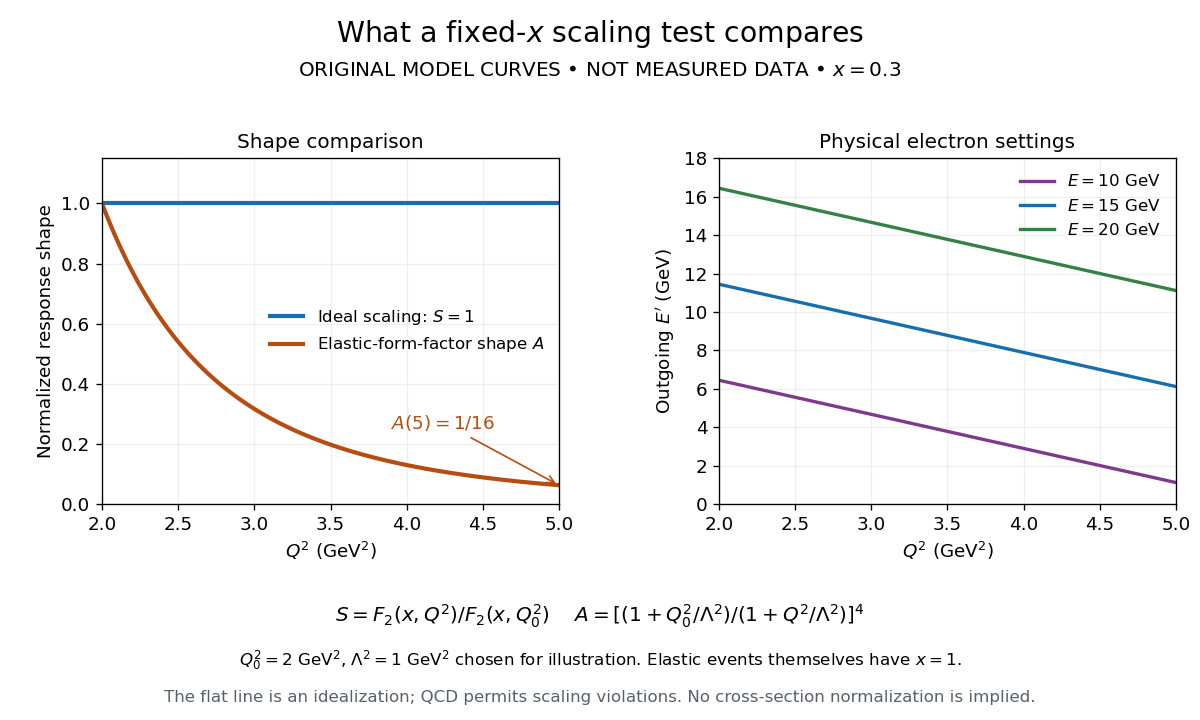
An ideal Bjorken scaling model has : varying at fixed Bjorken x leaves this dimensionless deep-inelastic structure function unchanged. The comparison requires extracting a deep-inelastic structure function, rather than plotting raw event counts. Quantum chromodynamics predicts departures from exact Bjorken scaling; finite hadron masses also limit the idealization.
For an original shape comparison, choose and define with . The ideal model has . To display a contrasting size-dependent suppression, define an illustrative elastic-form-factor shape with the freely chosen . Its normalized squared magnitude isThus , whereas . The elastic-form-factor shape is a comparison of suppression mechanisms, not an elastic differential scattering cross-section assigned to : actual elastic scattering from a proton has and . Neither curve is measured data or a fit to the SLAC-MIT experiment.

The experimental interpretation required more than a flat curve. The angular dependence and small longitudinal response supported spin one-half partons, expressed at leading order by the Callan-Gross relation . Identification with fractionally charged quarks also drew on later electron, muon and neutrino comparisons. A scaling plot alone does not determine the individual electric charges of constituents.[ref]
Deep Inelastic Scattering: Comparisons with the Quark Model by Jerome Isaac Friedman. 1990 Nobel lecture, identification of the constituents and early neutrino results; 1991 reprint p. 623
The leading parton model formula already shows the ambiguity: combines squared electric charges with unknown parton distribution functions. One measured function cannot independently fix all these quantities. Confinement also explains why an inclusive final hadron state need not contain an isolated outgoing quark.
Super Proton-Antiproton Synchrotron 2026-10-18
The Super Proton-Antiproton Synchrotron used the converted SPS ring for counterrotating proton and antiproton beams. In the discovery running, two beams provided , unlike a stationary-target collision at the same incident energy. Antiproton production, accumulation and stochastic cooling supplied the collisions used in the W and Z discovery experiments.[ref]
Experimental Observation of the Intermediate Vector Bosons W+, W− and Z0 by Carlo Rubbia. Section 3, printed p.247 and Fig.5: counterrotating beams, accumulation and SPS conversion
Why can opposite electric charges share the bending magnets? Reversing both and velocity leaves the Lorentz force unchanged at a given point. Both circulating species can therefore bend toward the same ring center in the same magnetic field, with equal magnetic rigidity magnitudes. This argument explains the bending geometry; actual injection, focusing, timed acceleration and collisions still require a complete particle accelerator system.