Joule heating is the dissipative conversion of electrical work into internal energy in an electrical conductor. In a metal, the electric field supplies energy to charge carriers, which transfer it to the material. This makes an immersed resistor a useful calibrated heater and makes electrical resistance a source of losses in wiring. Wind-driven electric currents are a proposed source of heating of an inflated giant planet.
For a stationary, purely resistive Ohmic conductor, use the passive sign convention: is the terminal electric potential difference from the entry to the exit of positive electric current . The absorbed electrical power and Ohm's law giveThe last two expressions assume at the relevant material temperature. For constant electrical resistance and electric current over a duration , the dissipated energy is ; otherwise use . In SI, .[ref]
Absorbed electrical power is more general than Joule heating: a capacitor can store energy, a battery can change its chemical energy, and an electrical circuit can deliver mechanical work or emit light. Even a heated resistor need not show an indefinitely rising temperature: in a thermal steady state, its dissipated power leaves by heat transfer. With the heater inside a calorimeter boundary, electrical input crosses as work; the subsequent heat transfer to the room is a different term in the first law of thermodynamics.
A resistor at fixed temperature and unchanged thermodynamic state has no net entropy accumulation. Electrical work becomes heat at rate , which is exported to the thermostat. In the ideal work-source model the surroundings gain entropy at rate , equal to the total entropy production. Additional losses inside a real power source add to this idealized budget.
Whether increasing electrical resistance increases Joule heating depends on what the supply holds fixed. Consider separate ideal resistor experiments with and , each maintained at its specified temperature. At fixed electric current , doubling changes the required electric potential difference from to and doubles power from to . At fixed electric potential difference , doubling halves electric current from to and halves power from to . These are stipulated model values, not measured data.
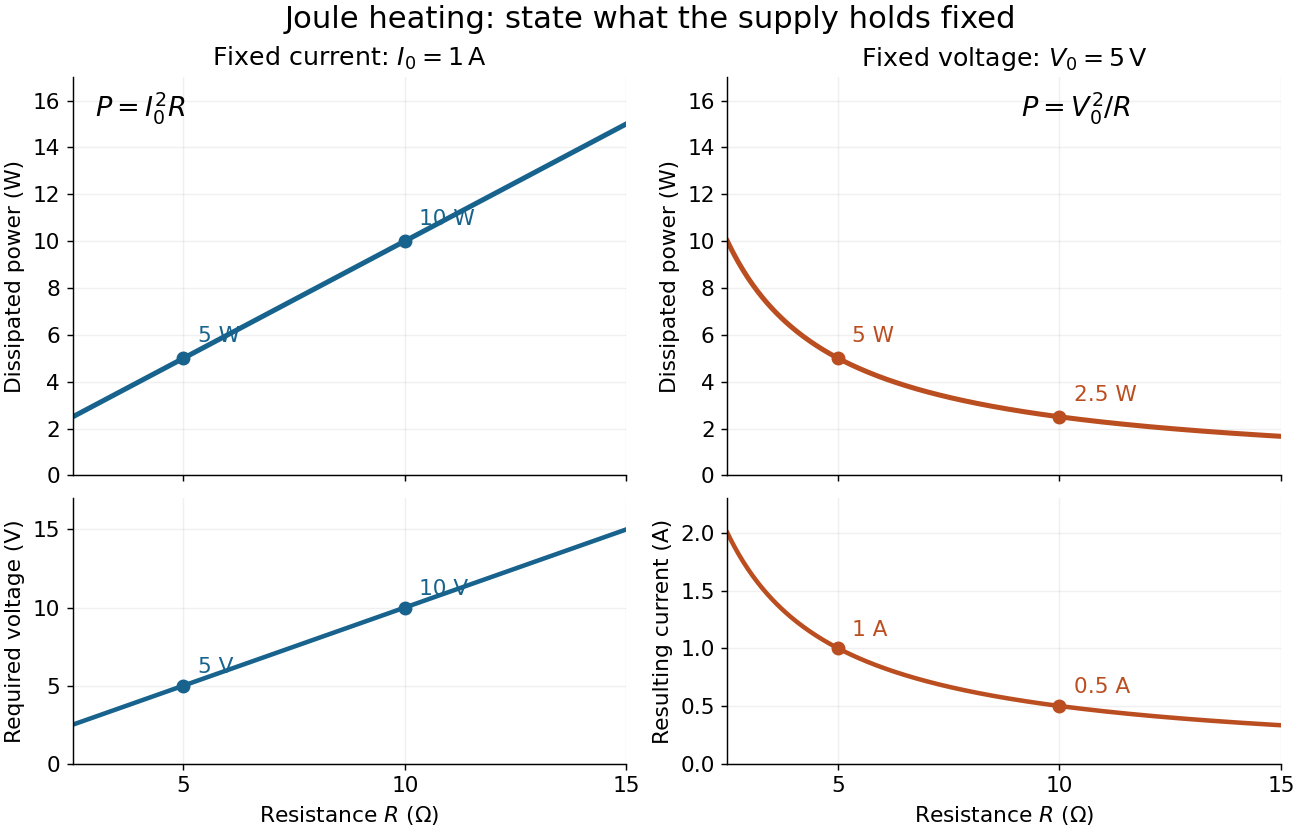
Increasing electrical resistance has opposite effects on Joule heating under fixed electric current and fixed electric potential difference
. Original calculated comparisons, with on the left and on the right. The marked and cases are separate ideal experiments. Each lower panel shows the companion quantity that changes when the supply holds the other quantity fixed. Details.The comparison also predicts feedback when a particular resistor's electrical resistance rises with temperature: a supply maintaining electric current increases its heating power, whereas one maintaining terminal electric potential difference reduces it. Predicting the actual temperature still needs the material response and its heat transfer to the surroundings; a nominal supply setting does not establish which drive is actually constant at the resistor.
The electric field does work on matter at local power per volumeHere is current density and the dot product includes the relative direction. Positive means energy passes from the field to matter; negative means matter supplies energy to the field. In general this is a work rate, not automatically an irreversible heating rate.[ref]
For a stationary isotropic Ohmic conductor with real scalar electrical conductivity , local Ohm's law gives . Thus the local Joule heating rate isThe electrical resistivity has units , and electrical conductivity has units . These formulas use the material's rest frame and dissipative conduction current density. Moving media, complex conductivity, and additional storage or transport processes require their appropriate energy balance rather than this scalar substitution.
For uniform current in a straight homogeneous wire of length , wire cross-sectional area and constant electrical conductivity, , and . The volume integral recovers terminal power:As a numerical check, the wire already used in electrical resistance has , , and . It gives , and , agreeing with and . Concentrating the same electric current in a smaller wire cross-sectional area therefore raises the local heating rate if electrical resistivity stays fixed.
A long wire with uniform current density generates uniform heat per volume . Radial steady conduction obeys . Regularity at the centre removes a logarithmic solution, leaving the displayed parabolic temperature excess relative to the surface. Conductivity, electrical conductivity and current density are assumed constant.
The surface flux of a uniformly heated cylinder is . Equating it to the Newton-cooling flux gives the displayed surface temperature. The full temperature profile adds the internal parabolic excess to this surface value. Electrical power per length equals the surface heat loss per length in steady state.
An electrical calorimetry experiment asks whether a measured electrical work input accounts for a measured warming. The University of Iowa's demonstration uses an insulated flask containing water, an immersed heater, a thermometer, electrical meters and a timer. Its procedure compares the duration, electrical readings and temperature rise. The following low-power measurement design and synthetic readout develop that idea; they are not measurements reported by the demonstration. [ref]
5F15.10 - Electrical Equivalent of Heat by University of Iowa Department of Physics and Astronomy. Equipment and Procedure: insulated flask, immersed heater, thermometry, electrical meters and timed warming
Use a covered calorimeter with weighed water, an immersed resistor, a calibrated thermometer and gentle stirring. Put an ammeter in series with the heater branch and a high-input-electrical resistance voltmeter across the immersed resistor's terminals. Record , , temperature and room temperature before, during and after switching the heater on. Measure the electric potential difference at the heater, rather than at the supply: lead and contact electrical resistance outside the receiving boundary can consume power that never reaches the water. Account for voltmeter loading if the ammeter also includes the sensing branch's electric current.[ref]
The electrical readout gives operating electrical resistance when , and power . To test Ohm's law, obtain several pairs at the same temperature; one ratio alone cannot establish a linear response. For small electrical resistance, use four-terminal sensing to exclude lead drops and reverse electric current to test stable offsets from the thermoelectric effect. Use brief low-power resistance measurements if the intended result is the unheated value: the test itself causes Joule heating.
For a covered assembly at approximately constant pressure, with negligible evaporation, negligible endpoint mechanical energy changes and no phase transition, takeHere is the water's specific heat capacity at constant pressure, is the participating vessel, heater and sensor heat capacity, is signed outward heat leakage, and is stirring work entering the assembly. The storage term approximates its enthalpy change; for a rigid fixed-volume receiver use the corresponding heat capacity at constant volume. Calibrate independently if the purpose is to test electrical input against thermal storage. Using the same heating run to define and then claiming it verifies the equality would be circular.
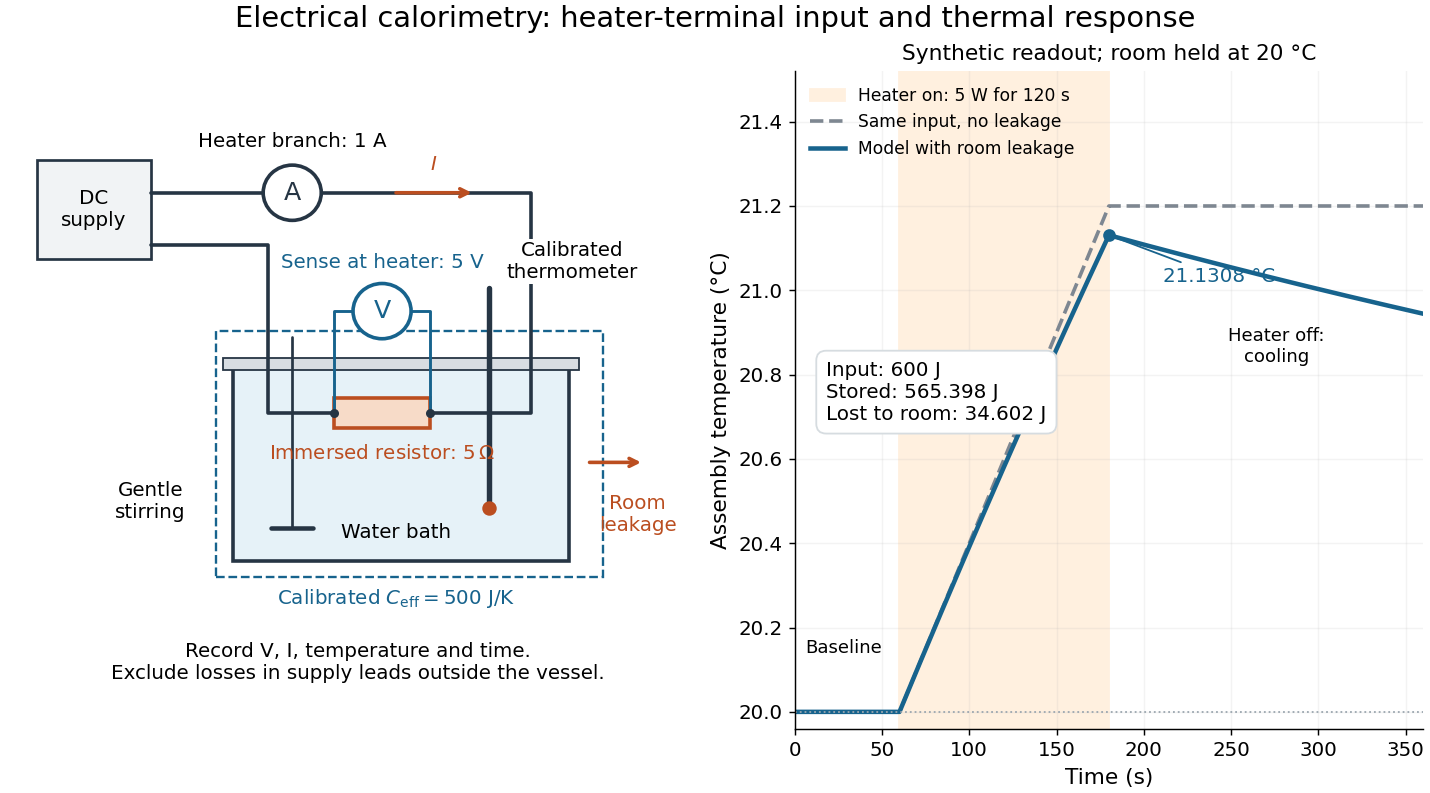
For the synthetic trace, stipulate , , , , room temperature , and loss coefficient , with negligible stirring input. The heater runs for , beginning at room temperature. The calorimeter heat-loss correction model isIt predicts , , storage and outward loss . Neglecting leakage undercounts deposited energy by about ; assuming no loss predicts . After switching off, the excess temperature undergoes exponential decay with time constant . A cooling slope can estimate only with known and a credible single-temperature model.
Controls separate causes of a temperature rise. Check the electrical meters' zeros and thermometer calibration; keep water mass, immersion, lid and stirring fixed between runs. Record a heater-off stirred baseline to estimate sensor drift and stirring input. Repeat cooling runs over the same temperature range to estimate environmental heat transfer; a baseline taken only at room temperature cannot measure warming-dependent leakage. Vary electric current while keeping and initial thermal conditions comparable: corrected deposited energy should scale as for equal durations. An independent calorimeter calibration or known reference heat capacity makes this a quantitative test rather than a qualitative observation.
Finite sensor response, incomplete thermal equilibrium, changing or heat capacity, evaporation, and imperfect loss corrections limit the inference. A final temperature alone cannot distinguish smaller electrical input from larger heat leakage or a larger participating heat capacity. Agreement tests the stated assembly and its energy accounting; it does not show that all electrical work in arbitrary devices becomes heat.
Historically, the Royal Society's archive description of James Prescott Joule's manuscript dated 13 October 1840 records a coil of wire in a jar of water, a thermometer and a galvanometer, and summarizes his inference that warming depends on electrical resistance and the square of electric current intensity. This electrical experiment precedes Joule's paddle-wheel experiment; the input here is electrical work, whereas the paddle supplies mechanical work. The catalogue, rather than the inaccessible manuscript images, supports this account. [ref]
Archive catalogue record AP-23-34: On the production of heat by voltaic electricity by The Royal Society Archives. Royal Society Archives, AP/23/34, Description and Date: apparatus, resistance dependence and duplicate-ratio conclusion; manuscript dated 13 October 1840
Articles by others on the same topic



Joule heating, also known as resistive heating or ohmic heating, is a process in which the energy of an electric current is converted into heat as it flows through a conductor. This phenomenon occurs due to the resistance of the material to the flow of electric charge.