Topics (384k) Articles (398k) Users (410) Discussions (242) Comments (383) Files (13k) New article
In an integer-filling charging model, occupied spin-resolved branches can drive approximately charge rearrangements per added flux. Two coupled spin branches can therefore yield near- oscillations. This does not change the elementary single-electron flux quantum and is not guaranteed by counting two independent noninteracting spin spectra alone.
A closed antidot edge orbit can tunnel-couple extended channels on opposite edges. When its electrochemical energy aligns with the reservoirs, resonant backscattering reduces conductance from an otherwise transmitting integer plateau. Different connectivity can instead add a transmission path and produce peaks. Gate voltage changes both the orbit and tunnel couplings; charging and spin alter the simplest fixed-area Aharonov-Bohm resonance sequence.
A quantum dot is an electron-confining potential well, whereas an antidot is a depleted potential hill. At the same magnetic field, their closed guiding-centre drift has opposite circulation. A series dot needs transmission through two barriers; a side-coupled antidot can connect already propagating quantum Hall edge states and induce backscattering. Both can have discrete energies and charging effects, but a electrical conductance peak or dip depends on lead connectivity rather than solely on the existence of a closed orbit.
Past exam of the zoology course of the University of Cambridge 2025 Paper zm6 6 b Solution by  Codex 0 2026-10-20
Ubiquitin is a central regulator of selective protein turnover, but “the most important” has no universal meaning without specifying substrate, cell state and the quantity being measured. Selective destruction of a short-lived regulator, bulk recycling during starvation, and removal of a damaged mitochondrion are different problems. The ubiquitin system is extensive, yet it neither encompasses every degradation pathway nor makes all ubiquitination a destruction signal.
In the canonical pathway, an E1 enzyme uses ATP to activate ubiquitin, an E2 enzyme carries it, and an E3 ligase supplies much of the substrate specificity. Repeated conjugation can build chains on a substrate, while deubiquitinating enzymes edit or remove those modifications. Linkage and chain architecture influence recognition; a K48-linked chain is a common proteasomal signal, but “polyubiquitinated” does not specify a single outcome. Some ubiquitinations regulate location or signalling instead of degradation.
The proteasome recognizes suitable substrates, removes or recycles ubiquitin, unfolds accessible protein regions using ATP-dependent machinery, and threads the polypeptide into a proteolytic core. Substrate tagging is therefore one control point among several: accessibility, engagement and unfolding matter as well. This permits rapid removal of regulatory proteins and disposal of misfolded soluble proteins without digesting an entire organelle.
A particularly clear exception is ornithine decarboxylase. In a cell-free system, proteasome depletion blocked its ATP- and antizyme-dependent degradation; purified 26S proteasomes supported degradation without ubiquitin. This provides direct biochemical evidence that proteasomal destruction need not always require substrate ubiquitination.[ref]
Ornithine decarboxylase is degraded by the 26S proteasome without ubiquitination by Yasuko Murakami and others. Immunodepletion and purified-proteasome assays, Nature 360, pp. 597–599
It is a specific exception rather than evidence that ubiquitin is generally dispensable.Lysosomes provide another major route. Autophagy can sequester cytoplasm, aggregates and organelles in membrane carriers for lysosomal degradation. Some selective autophagy receptors recognize ubiquitinated cargo, so this route is partly coordinated with ubiquitin; bulk starvation-induced autophagy and other cargo-recruitment mechanisms show why it is not equivalent to proteasomal tagging. A yeast genetic screen used failure to accumulate autophagic bodies and failure of starvation-induced vacuolar protein turnover to identify autophagy-defective mutants. The experiment established a genetically separable membrane-delivery programme essential to this recycling response.[ref]
Isolation and characterization of autophagy-defective mutants of Saccharomyces cerevisiae by Miki Tsukada and Yoshinori Ohsumi. Mutant isolation, complementation groups, and nitrogen-starvation-induced vacuolar protein degradation
Membrane proteins can also be delivered through endocytosis and endosomal sorting, including ESCRT-dependent entry into internal vesicles before lysosomal destruction. Here ubiquitin often helps specify sorting, while receptor internalization, membrane traffic and lysosomal activity supply additional control points. Dedicated organellar proteases add further pathways.
Experimentally, compare proteasome inhibition, lysosomal inhibition and perturbation of a defined E3 ligase or autophagy factor while following a labelled substrate over time. A steady-state increase is insufficient: it can result from increased synthesis rather than reduced degradation. Measure turnover and pathway flux, check inhibitor toxicity and use genetic rescue. The defensible conclusion is that ubiquitin is a major, versatile selectivity signal whose importance is context-dependent; complete protein clearance depends on several regulated degradation systems.
Past exam of the zoology course of the University of Cambridge 2025 Paper zm6 6 a Solution by Codex 0 2026-10-20
Codex 0 2026-10-20Coat-associated adaptors couple three tasks: recognizing the correct membrane, selecting cargo, and assembling a carrier. Each interaction can be modest on its own; coincidence detection creates a selective assembly site. A sorting motif on a cargo's cytoplasmic tail can contact an adaptor directly, whereas soluble luminal cargo requires a transmembrane receptor to expose an adaptor-binding signal to the cytoplasm. Thus cargo recognition respects membrane orientation.
In clathrin-mediated endocytosis, the AP2 adaptor complex recognizes plasma-membrane determinants and cargo motifs while recruiting the clathrin scaffold. Other clathrin adaptors operate at internal membranes, so clathrin alone does not specify an itinerary. AP1 adaptor complex-associated carriers, for example, rely on a different local molecular context. Cargo, lipid and small-GTPase interactions collectively distinguish productive assembly from accidental coat binding.
COPII illustrates the same logic at endoplasmic reticulum exit sites. Membrane-associated Sar1 GTPase recruits the inner Sec23-Sec24 complex layer, in which Sec24 recognizes cargo and cargo receptors; Sec13-Sec31 complex builds an outer scaffold. COPI uses a different coat assembly, recruited by ARF-family GTPases, and participates in retrieval toward the endoplasmic reticulum and traffic within the Golgi apparatus. These systems need not have identical subunits to share the architecture of membrane recruitment, cargo selection and scaffold assembly.
An especially useful mechanistic test is biochemical reconstitution. Purified COPII coat components and defined liposomes were sufficient to produce coated vesicles, demonstrating that assembly itself can deform membranes rather than merely decorate carriers made by a wholly independent mechanism.[ref]
COPII-coated vesicle formation reconstituted with purified coat proteins and chemically defined liposomes by Ken Matsuoka and others. Reconstitution with Sar1, Sec23/Sec24 and Sec13/Sec31 on defined liposomes
Sufficiency in this minimal system does not imply that every regulator and cargo in a living cell is dispensable.Coat polymerization, membrane-inserting regions and accessory factors contribute to curvature, while fission machinery and details of neck geometry differ among pathways. The nucleotide cycles of Sar1 GTPase and ARF-family GTPases regulate coat recruitment and turnover; they should not be portrayed as identical engines executing every membrane-cutting step. After budding, substantial uncoating permits subsequent targeting and fusion. Destination specificity then depends on additional factors, including tethering machinery, Rab-family GTPases and SNAREs; a coat is not a complete postal address by itself.
To test the common design, mutate a cargo motif, its adaptor-binding site and the membrane-recruitment determinant separately. Measure recruitment, cargo concentration and productive transport as separate outputs, and rescue with the corresponding wild-type component. A cargo-selective defect without complete loss of carrier formation is particularly informative because it separates selection from the physical formation of a carrier.
Past exam of the zoology course of the University of Cambridge 2025 Paper zl6 6 b Solution by Codex 0 2026-10-20
Codex 0 2026-10-20Mechanics shapes tissues by generating active forces, directing rearrangements and converting constrained growth into deformation. Three experimentally distinct examples are folding of the fly ventral epithelium, elongation of the fly germband and formation of chick intestinal villi. They respectively emphasize changes in cell shape, changes in cell neighbours and a growth-driven instability. In each case, a satisfactory explanation needs both a force-generating process and the material or boundary conditions that convert it into a particular shape.
First, apical constriction drives Drosophila ventral furrow formation. Ventral cells accumulate a contractile actomyosin network near their apical surfaces. Reducing apical area while retaining tissue continuity changes cell geometry and contributes to inward bending of the epithelial sheet. This is not adequately described as uniform contraction of a permanent circumferential belt. Time-resolved imaging showed pulses of medioapical myosin II accumulation associated with discrete contractions, and stabilization between pulses permits net constriction. Regulation by Snail and Twist helps coordinate contraction and the retention of the resulting shape.[ref]
Pulsed contractions of an actin-myosin network drive apical constriction by Adam C. Martin and others. Live imaging, pulsatile apical contraction and transcription-factor perturbations
The force must be transmitted to neighbouring cells through adherens junctions; a detached contracting cortex can deform internally without folding a coherent sheet. Geometry is therefore a collective property. A useful causal test compares acute inhibition of myosin activation with perturbation of junctional coupling, scoring apical area, contraction pulses, cell length and tissue curvature separately. laser ablation can reveal the direction of tissue load, and localized activation of contractility can test whether the site of force generation predicts bending. Recoil velocity alone is not tension: in an overdamped approximation , where is released tension and an effective resistance. Comparing recoil between conditions requires considering possible changes in resistance as well as load. External pressure, basal constraints and neighbouring tissue movement also influence invagination, so apical contraction need not be sufficient under every boundary condition.
Second, Drosophila germband extension changes tissue aspect ratio through oriented cell intercalation. Selected cell junctions shrink, cells briefly share a vertex or multicellular rosette, and new junctions appear in the complementary orientation. Repeated local neighbour exchanges extend the tissue along one axis while narrowing it along the other. myosin II is enriched at the shrinking interfaces, and interfering with its activity disrupts polarized junction remodelling. This supplies a mechanism for convergent extension without requiring that every cell grow longer or that an increased number of divisions provide the extension.[ref]
Myosin-dependent junction remodelling controls planar cell intercalation and axis elongation by Claire Bertet and others. Time-lapse junction analysis and perturbation of polarized myosin activity
Here the crucial distinction is between active rearrangement and passive stretching. Track all vertices and neighbours in a patch and decompose tissue deformation into cell-shape change, neighbour exchange and cell-number change. A tissue can lengthen while individual cells remain similar in shape if topology changes; alternatively, pulling from a neighbouring tissue can elongate cells without local intercalation supplying the force. Test whether local myosin inhibition suppresses the junction transitions before global tissue movement is lost, and compare spatial patterns of load by laser ablation. Rescue must restore directional transitions as well as the final length. planar cell polarity provides the orientation, and junctional adhesion permits force transmission while contacts are remodelled. Thus mechanics can translate a molecular anisotropy into coordinated movement of an epithelial sheet.
Third, chick intestinal villi illustrate differential growth constrained by surrounding layers. The growing inner tissues are enclosed by sequentially differentiating smooth muscle layers. Mechanical constraints drive a progression from longitudinal ridges through zigzags toward a villous surface. The important process is not simply muscle contraction pushing each villus into place: the muscle acts as a restricting layer against which continued tissue growth builds compressive stress. In the primary experiments, blocking muscle differentiation prevented the expected folding, while an artificial constraining silk tube could restore folding in the inhibited tissue. This rescue is particularly informative because it replaces a living layer's mechanical contribution without restoring all its possible signals.[ref]
Villification: how the gut gets its villi by Amy E. Shyer and others. Muscle perturbation, artificial confinement and mechanical modelling
The physical principle is a buckling instability: a sufficiently compressed growing layer can lower its mechanical cost by bending. The wavelength and mode depend on geometry, thickness and stiffness, so equal amounts of growth need not yield equal shapes in different environments. An ideal thin-plate model has bending rigidity , with Young's modulus , thickness and Poisson's ratio . It predicts strong thickness sensitivity of resistance to bending, but this formula alone does not compute the wavelength of a living multilayer gut. That requires measured geometry, growth and an appropriate constitutive model. Compare proliferation, muscle differentiation, material properties and folding after each perturbation to distinguish mechanical confinement from secondary effects on growth.
The chick example should not be imposed unmodified on mouse villus development, where mesenchymal cluster patterning precedes the corresponding epithelial deformation. Nor is any of the three mechanisms independent of chemical signalling: signals position contractility, specify muscle and regulate adhesion, while mechanical deformation changes the subsequent signalling environment. Their distinct causal signatures are nonetheless clear. A contractile apical network folds a coupled sheet; anisotropic junctional tension changes neighbours and tissue aspect ratio; constrained growth generates an instability whose form depends on material properties. Testing these signatures through timed perturbation and mechanical rescue explains organ shape more precisely than simply observing that a cytoskeletal protein is required.
Past exam of the zoology course of the University of Cambridge 2025 Paper zl6 6 a Solution by Codex 0 2026-10-20
Codex 0 2026-10-20Polarity proteins generate tissue form by controlling where cells build surfaces, place junctions and divide. Their morphogenetic roles can be separated experimentally from a wholesale loss of epithelial identity. Three examples illustrate different outputs: positioning a single lumen, orienting neighbour exchange, and limiting tube dimensions.
The first example is Cdc42-dependent lumen formation in three-dimensional Caco-2 epithelial cysts. Cells in a normal cyst coordinate their apical-basal polarity so that apical surfaces face one central lumen. During growth, a correctly oriented spindle apparatus places daughter cells into the epithelial wall rather than establishing inappropriate internal cell arrangements. Cdc42 depletion disrupts spindle orientation and produces abnormal, often multiple, luminal spaces. Importantly, the cells can still establish apical membrane identity: in this model the crucial defect is the coordination and positioning of apical surfaces during division, rather than an absolute inability to make any apical surface. This distinguishes tissue-level organization from polarity within an isolated cell.[ref]
Cdc42 controls spindle orientation to position the apical surface during epithelial morphogenesis by Aron B. Jaffe and others. Caco-2 three-dimensional cysts, Cdc42 depletion and spindle-orientation analysis
Mechanistically, Cdc42 connects cortical organization to the PAR polarity complex, polarized trafficking and spindle-positioning machinery. However, the relative contributions depend on the model: a Cdc42 trafficking phenotype in another epithelial line cannot simply be substituted for the Caco-2 spindle result. A convincing test combines live-cell imaging of division and the first ectopic lumen with apical and basal markers, verifies target depletion and rescues with functional Cdc42. Compare the total number and viability of cells, because a dying cell population can also produce abnormal cavities. A perturbation that restores spindle positioning while leaving other outputs of Cdc42 impaired would help isolate the causal route. These controls make the single-lumen phenotype an interpretable morphogenetic output.
The second example is Bazooka, the fly PAR-3 protein, during Drosophila germband extension. This uses planar cell polarity within the epithelial sheet as well as apical-basal organization. Bazooka and junctional components become enriched at a complementary set of cell interfaces to myosin II. Spatially patterned gene activity organizes this planar asymmetry, and loss of Bazooka disrupts normal polarized cell behaviour and extension. Thus a protein associated with epithelial junction assembly is redeployed to make different junctions behave differently in the same sheet.[ref]
Patterned gene expression directs bipolar planar polarity in Drosophila by Jennifer A. Zallen and Eric Wieschaus. Planar distributions of Bazooka and myosin and dependence on patterned gene expression
Oriented junction shrinkage and new-junction formation permit cell intercalation while maintaining epithelial continuity. The important geometry is that junctions separating anterior and posterior neighbours shrink and resolve into interfaces with the complementary orientation, producing extension along the body axis. Junction names can be confusing because they may describe either the neighbours or the line itself; tracking vertices and neighbour exchange avoids this ambiguity. Bazooka is a spatial organizer, not itself the force-generating motor. To test its contribution, quantify its localization, myosin localization, junction lifetimes, cell rearrangements and tissue strain after an acute or mosaic perturbation that leaves enough epithelial structure for movement to occur. A general epithelial collapse would establish an essential structural role but would not isolate its role in planar coordination.
The third example is control of fly tracheal tube size by the apical determinant Crumbs and basolateral regulators including Yurt and Coracle. Crumbs promotes the apical domain, so restricting its activity helps constrain the amount of luminal cell surface and hence tube dimensions. Mutations in yurt produce overlong tracheal tubes, and reducing Crumbs dosage suppresses important length defects; Crumbs overexpression has the opposite tendency. This genetic interaction connects the balance of apical and basolateral regulators to organ geometry rather than simply to the presence of an epithelial sheet.[ref]
Epithelial polarity proteins regulate Drosophila tracheal tube size in parallel to the luminal matrix pathway by Patrick Laprise and others. Tube measurements, Crumbs dosage suppression and Vermiform secretion controls
The luminal extracellular matrix is a crucial control in this example. Septate-junction-associated proteins can also affect delivery of the matrix-modifying protein Vermiform, potentially changing tube shape indirectly. Yet yurt mutants retain Vermiform secretion, and reducing Crumbs can suppress coracle length defects without restoring the secretion defect. Scribble mutants also show long tubes but are not equivalently rescued by the tested Crumbs reduction. The result supports parallel and partly distinct routes, rather than a universal linear pathway in which every basolateral protein merely inhibits Crumbs. Compare cell number, apical area, tube length and diameter independently: a longer tube need not result from extra divisions. Quantitative dosage interactions and rescue are particularly informative because they can reveal a size-control function while preserving much of epithelial organization.
Together, these examples link polarity to three separable operations. Cdc42 coordinates the location of new apical surfaces during division; Bazooka contributes to directional junction remodelling within a sheet; and the Crumbs-regulator balance sets the extent of a luminal surface. Conversely, changing forces and geometry can alter junctional organization, so the relationship is reciprocal. The common principle is that epithelial polarity supplies spatial constraints on growth and rearrangement. It is a dynamic component of morphogenesis, not merely a static property to be established before morphogenesis starts.
Past exam of the zoology course of the University of Cambridge 2025 Paper zl6 3 b Solution by Codex 0 2026-10-20
Codex 0 2026-10-20reactive oxygen species can alter competitive fitness, but neither high ROS nor an antioxidant response universally identifies a loser. cell competition is relative: cells that survive in one neighbourhood are preferentially lost in another, with fitter neighbours occupying their place. An experiment showing oxidant-induced death in a homogeneous tissue establishes toxicity, not necessarily cell competition. In epithelia, loss can occur through apoptosis, extrusion or differentiation followed by departure from a proliferative layer.
reactive oxygen species include superoxide and hydrogen peroxide, which differ in reactivity, localization and transport. They can arise from mitochondrial metabolism or regulated oxidase activity. At controlled levels they participate in redox signalling; excess or poorly buffered production damages DNA, proteins and membranes. Competitive fitness can therefore change through altered damage, stress responses, growth or differentiation. NRF2 and its fly counterpart CncC regulate antioxidant and detoxification programmes. Their activation is an integrated response to cellular conditions, not a direct quantitative measurement of one ROS species.
An instructive fly study compared prospective losers carrying a ribosomal-protein defect or loss of Mahjong protein. Both activated antioxidant-response genes before elimination. In ribosomal-protein-deficient cells, two ROS dyes did not reveal a uniform increase, whereas reduced-thiol staining was lower. Mild CncC activation was tolerated across an entire disc but caused boundary-enriched death in clones surrounded by normal cells; those clones survived better among less-fit neighbours. Conversely, reducing CncC impaired stressed-cell survival. Thus a protective response can also confer relative loser status. The study separated this module from JNK signalling effects on growth and from JAK-STAT signalling effects on tissue expansion; it did not establish a compulsory linear chain from ROS through JNK to elimination.[ref]
Chronic activation of JNK JAK/STAT and oxidative stress signalling causes the loser cell status by Iwo Kucinski and others. Figures 5–7, redox measurements and neighbourhood-dependent CncC experiments
This distinction prevents two errors. First, a high antioxidant-response reporter can coexist with successful buffering and relatively low measured oxidant levels. Second, knocking down a protective factor may kill cells autonomously, making their apparent competitive loss worse even if that factor also participates in neighbour-dependent recognition. To identify a competitive mechanism, compare the same genotype in a homogeneous tissue, in a mosaic with normal neighbours and in a mosaic with an alternative neighbour genotype. Quantify clone growth, death at boundaries and in centres, and replacement by neighbours, normalized to the corresponding cell numbers or areas. A clone that is small because its cells divide slowly has not necessarily been actively eliminated.
The adult mammalian oesophagus supplies a striking environmental example. In transgenic mouse epithelium, low-dose ionizing radiation induced an oxidative response that shifted normal basal cells toward differentiation. Cells carrying mutant p53 were relatively insensitive and expanded at their neighbours' expense. Combining antioxidant treatment with irradiation reversed the population outcome, promoting normal-cell proliferation and mutant-cell differentiation. The selective advantage was consequently conditional on the redox environment, not a fixed property of the mutation. This also shows that competitive replacement need not be executed primarily by apoptosis.[ref]
A separate mouse experiment generated a mosaic of NRF2-deficient and NRF2-intact oesophageal cells. Deficient cells persisted under unstressed conditions but accumulated damage and were preferentially lost during exposure to the carcinogen 4-nitroquinoline 1-oxide. Tumours predominantly arose from the surviving NRF2-intact population. This supports a context-dependent role for stress protection in population selection, while not proving that every disappearing cell was directly recognized and killed by a neighbour. Carcinogen detoxification and DNA damage are additional variables, so the experiment is not a chemically pure ROS titration.[ref]
Cellular Nrf2 Levels Determine Cell Fate during Chemical Carcinogenesis in Esophageal Epithelium by Makoto Horiuchi and others. Mosaic deletion, unstressed controls and 4NQO exposure experiments
To test a proposed ROS mechanism in an epithelial mosaic, image a calibrated, compartment-targeted redox biosensor before clone loss, along with cell boundaries, a proliferation readout and a death or differentiation reporter. Include sensor controls for pH, expression level and dynamic range; general oxidant dyes have loading, localization and chemical-specificity limitations. Perturb the source and scavenging machinery independently and restrict the perturbation to prospective losers or winners. For example, a validated catalase manipulation tests peroxide buffering, while a source-specific perturbation tests whether that peroxide is required. A matched rescue should restore both the measured redox change and the competitive outcome. Monitor cellular energy and survival in homogeneous controls because a mitochondrial perturbation can affect fitness independently of ROS. Perturb downstream stress signalling separately to distinguish oxidant production, stress detection and execution of cell loss.
The tissue consequences can be beneficial or harmful. Elimination of damaged cells can preserve a barrier, but a stress-resistant mutant can also exploit environmental oxidants to displace normal cells. Persistent stress signals from damaged or dying cells may alter neighbour proliferation and inflammation, producing further changes in fitness. The experimentally supported conclusion is that redox state reshapes the conditions under which cells persist, differentiate or are eliminated. A universal prescription to raise ROS or administer antioxidants does not follow: the relevant species, tissue compartment, neighbour genotype and exposure history determine the direction of selection.
Past exam of the zoology course of the University of Cambridge 2025 Paper zl6 3 a Solution by Codex 0 2026-10-20
Codex 0 2026-10-20Epithelial cell fate plasticity is a context-dependent change in developmental potential or differentiated identity. It includes dedifferentiation toward a progenitor cell state, transdifferentiation between differentiated identities, and reversible intermediate states. It is distinct from selecting a pre-existing rare stem cell, and from ordinary progression down a lineage. epithelial-mesenchymal plasticity is one important form, but changing epithelial subtype without losing epithelial organization is also cell fate plasticity.
The strongest physiological rationale is that a tissue needs both stable specialization and reserve routes for replacement. During ordinary adult tissue homeostasis, a stem-cell hierarchy can efficiently supply predictable cell types. After injury removes a component of that hierarchy, local signals and newly available stem-cell niche space may permit a committed descendant to reacquire self-renewal. In mouse intestine, Alpi marked enterocyte-lineage progenitor cells normally generate short-lived absorptive descendants. After targeted ablation of Lgr5 positive intestinal stem cells, labelled progenitor cells can generate long-lived crypt-villus lineages with renewed stem-cell output. Comparing the same labelled population before and after ablation distinguishes injury-dependent cell fate plasticity from its normal fate. The experiment concerns progenitor cells in the enterocyte lineage; it should not be generalized to every terminally mature villus enterocyte.[ref]
A complementary model is the mouse airway. Genetic depletion of basal stem cells, combined with prior lineage tracing of luminal secretory cells, revealed secretory-cell descendants that acquired basal-cell properties and sustained subsequent epithelial production. Experiments with isolated cells and cocultures further showed that contact with basal cells inhibits this conversion. cell fate plasticity is therefore regulated by the tissue environment, not simply an intrinsic capacity unmasked whenever a marker changes. Its interpretation requires controls for residual basal cells and for whether the secretory-lineage driver labelled basal cells before injury.[ref]
Dedifferentiation of committed epithelial cells into stem cells in vivo by Purushothama Rao Tata and others. Basal-cell ablation, secretory-cell lineage tracing and contact-dependent suppression
Development provides additional contexts. Embryonic epithelia can undergo epithelial-to-mesenchymal transition during processes such as gastrulation, and mesenchymal-to-epithelial transition can subsequently assemble epithelial structures. These are regulated changes in adhesion, cell polarity, motility and gene expression, rather than a simple binary switch read from E-cadherin alone. In wound repair, transient relaxation of epithelial organization can facilitate migration while retaining intercellular contacts. A partially migratory repair state need not entail a complete mesenchymal conversion or a permanent change of lineage. Following wound closure, restoration of barrier function and polarized architecture is as important as the initial ability to move.
The most convincing experimental design labels a defined starting population irreversibly before the inducing event, allows the inducer to clear, then follows labelled descendants through the transition. Check immediate labelling specificity, include no-inducer and uninjured controls, quantify labelling efficiency and rule out ectopic driver activation after injury. Demonstrate the new state with multiple markers, morphology and function, and persistence after the inducing signal is removed. Serial epithelial production or a second injury challenge tests stable self-renewal; a transient appearance of a basal marker does not. Sparse labelling and continuous live-cell imaging help distinguish conversion from contamination, cell fusion or selective expansion of a rare initially unrecognized progenitor cell.
single-cell RNA sequencing can identify intermediate cell states and candidate regulators, but inferred trajectories are not lineage histories. Combine it with genetic barcodes, spatial localization and timed perturbation of candidate transcription factors or niche signals. Organoids offer defined media, prospective cell isolation and manipulation of matrix stiffness. A sorted population's ability to make a structure in culture establishes potential under those conditions; dissociation and a permissive medium may induce a capacity rarely used in vivo. Compare culture results with intact-tissue fate mapping before claiming a normal physiological contribution.
The evolutionary argument is a trade-off, rather than a claim that every plastic response is an adaptation. Conditional access to alternative cell fates could buffer environmental injury and permit repair without maintaining a separate reserve stem-cell pool for every possible lesion. Conserved signalling modules can also be redeployed in new developmental contexts. These advantages must be weighed against loss of specialized function, energetic costs and the danger of inappropriate persistent growth. Comparative experiments should ask whether homologous lineages undergo similar transitions under comparable injuries; shared expression of a few regulators is insufficient to prove that an ancestral cell fate plasticity programme has been conserved. At the tissue level, cell fate plasticity supplies alternative states on which selection can act, but it does not itself establish heritable evolutionary change.
Clinically, controlled cell fate plasticity may improve epithelial repair, provide transplantable cells and make patient-derived disease models. The same capacity can undermine treatment: a tumour may switch to a less drug-sensitive lineage or regenerate a stem-like population after therapy. In carcinoma, epithelial-mesenchymal plasticity can contribute to invasion and treatment resistance, but neither a single EMT marker nor its absence establishes the mechanism of metastasis. In a lineage-traced mouse lung-cancer model, the tested EMT programme was dispensable for lung metastasis while contributing to chemoresistance; the conclusion is specific to that model and reporter coverage.[ref]
Epithelial-to-mesenchymal transition is not required for lung metastasis but contributes to chemoresistance by Kari R. Fischer and others. Lineage-tracing and chemotherapy experiments in mouse tumours
The useful clinical aim is therefore a defined, reversible transition that restores function, with evidence that it does not leave a persistently proliferative or malignant population. Past exam of the thermal and statistical physics course of the University of Cambridge 2016 Paper 1 4 Solution by Codex 0 2026-10-20
Codex 0 2026-10-20For the ideal dilute Maxwell-Boltzmann gas implicit in a single-particle partition function, indistinguishability gives . With Stirling's approximation,Differentiate at fixed :This is a thermodynamic-limit ideal-gas result; arbitrary interacting classical gases do not have .
Equilibrium constraints and the Gibbs minimum. The open-system equilibrium contacts allow exchange of heat, volume and matter. For unconstrained contacts without external-field or interface corrections, equilibrium requires equal temperatures, pressures and each exchangeable species' chemical potentials across the contacts. These conditions follow by maximizing total entropy under conserved total energy, volume and species amounts.
The next minimization statement fixes the system's particle number. For a system in a reservoir at , with fixed and only pressure-volume work, the reservoir entropy change givesFor candidate states at the imposed , , the expression in parentheses is . Thus the Fixed-particle-number Gibbs minimum selects stable equilibrium at fixed , with stationary first variation and nonnegative allowed second variation. If particle exchange remains unconstrained, is not fixed and this minimization statement must be replaced by one incorporating the particle reservoir; it is not a justification for minimizing over arbitrary .
The simple-compressible-system first law givesFor a homogeneous extensive single-component phase, the Single-component Gibbs Euler relation follows from , yielding . For a mixture, the corresponding identities are and . Surface effects or other nonextensive contributions require additional terms.[ref]
Classical Thermodynamics by David Tong. Free energies, chemical potential and equilibrium with imposed reservoir variables
Reaction equilibrium. Let be an allowed reaction extent for the forward process, so and . At fixed ,For an interior equilibrium allowing both reaction directions, the coefficient vanishes:At fixed , minimizing gives the same condition. The reaction formula-unit conservation gives , not the total number of gas particles. This conservation law replaces fixed total particle number for the reacting mixture.
Using the stipulated single-particle functions,The number-based dissociation equilibrium ratio is thereforeThis number-based quantity has a factor of volume; the corresponding concentration ratio depends on temperature alone in the stated ideal model. A standard activity-based equilibrium constant would additionally specify reference states. No bond-energy factor is added to the functions given in the paper.
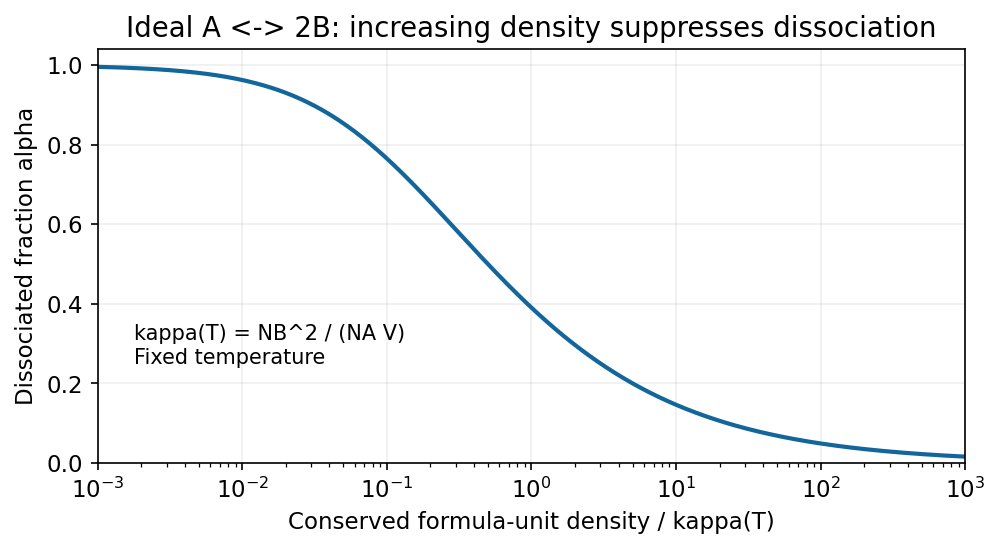
Define the dissociated fraction of original A formula units by . Then and , soThe dissociation fraction versus conserved density follows because the left side increases monotonically from zero to infinity on . At fixed , increasing decreases , hence decreases dissociation. Equivalently, at fixed compression raises and favours A. Association produces fewer independent translating particles; at high density the translational-entropy advantage of the two-particle side is smaller, so equilibrium shifts toward the one-particle side.
Past exam of the thermal and statistical physics course of the University of Cambridge 2016 Paper 1 3 Solution by Codex 0 2026-10-20
Codex 0 2026-10-20Measure energies from the single-particle ground state, and assume the three-dimensional ideal Bose gas in the large-particle-number limit. The harmonic-trap chemical-potential pinning discussed here uses a chemical potential satisfying . On cooling, it approaches zero; below the condensation temperature it remains at zero to leading thermodynamic order. Above that temperature it is negative. The detailed negative-chemical-potential branch shape is determined by the density of states; the figure uses the harmonic trap analysed below. The finite-size condensate chemical potential stays slightly below zero rather than being exactly pinned there.
A Bose-Einstein condensate has macroscopic occupation of a single quantum state. A dilute atomic gas needs low temperature and high phase-space density while remaining metastable against ordinary liquid or solid formation. Laser cooling followed by evaporative cooling of atoms in a weak trap can achieve the required regime. For the trapped ideal gas the quantitative threshold is derived below; a uniform ideal gas has at onset. An experimental signature is a narrow low-momentum component appearing within the broader thermal distribution after time-of-flight expansion, as observed in magnetically trapped rubidium-87.[ref]
Observation of Bose-Einstein Condensation in a Dilute Atomic Vapor by M. H. Anderson and others. 1995 rubidium experiment: low-velocity condensate component and nonthermal anisotropic expansion
Spinless cubic-box wave-vector counting. Impose periodic boundary conditions on a cube of side . The allowed vectors are with integer components. Each state occupies in wave-vector space. For a spinless particle, counting the spherical shell givesThere is no spin multiplicity. This is continuum shell counting; a finite box has discrete levels. Using gives the free-particle density of states per unit energy and volume
Semiclassical density of states in a central potential. At position , the available kinetic energy is . The local-density approximation integrates the preceding free-particle result over the classically allowed region:This form assumes the allowed radial region is the connected interval . A nonmonotonic potential would require integrating all allowed shells.
For the isotropic harmonic trap, . Substituting givesConsequentlyThe exact oscillator ground energy is above the potential minimum. The harmonic-trap energy-zero convention subtracts that constant, while the displayed density of states is the leading semiclassical continuum expression, neglecting the finite-level corrections produced by that shift. The discrete ground state must be counted separately.
Condensate population. Below the transition, use for the excited states. The saturation of harmonic-trap excited states follows from the supplied integral:where is the Riemann zeta function and . Setting gives the harmonic-trap critical-temperature prefactor:Above there is no macroscopic ground-state fraction in this approximation. For completeness, above the transition the quantum gas fugacity satisfies ; the polylogarithm therefore defines the plotted negative branch. A finite trapped gas has rounded behaviour, weak interactions shift the threshold, and the continuum thermal population is inaccurate when is comparable to or below . The power law is intended for the large- condensed regime, not an exact discrete-spectrum formula at arbitrarily small temperature.[ref]
Quantum Gases by David Tong. Section 3.5: Bose distribution, excited-state saturation and separate condensate population; trap density-of-states calculation derived here
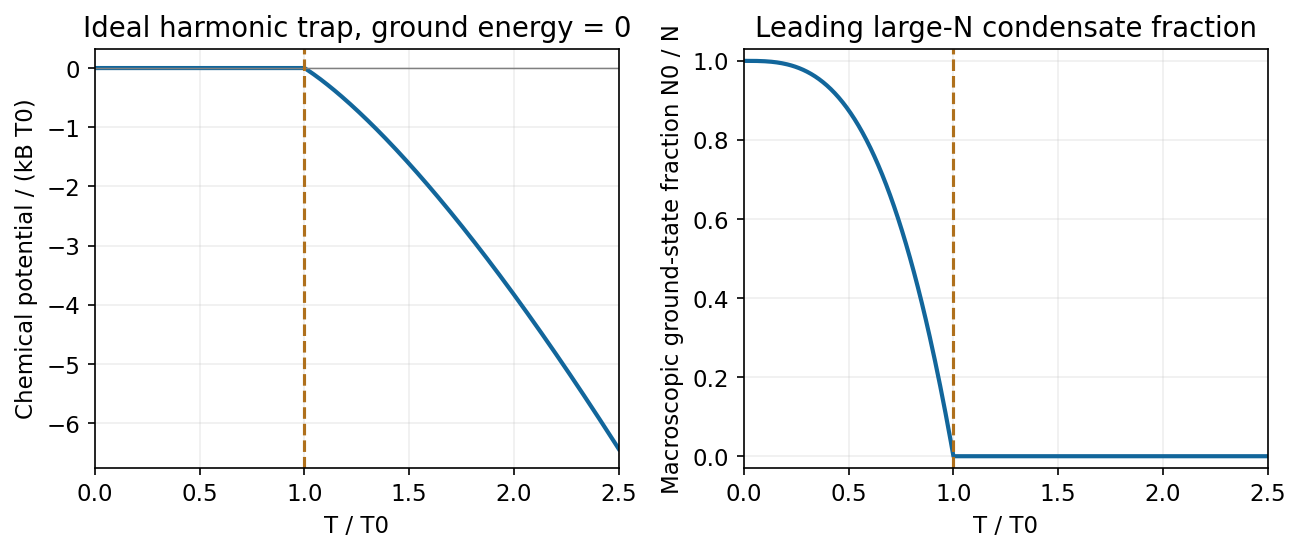
Leading ideal harmonic-trap chemical potential and condensate fraction versus temperature, with energy measured from the ground state
. Source. Details. Past exam of the thermal and statistical physics course of the University of Cambridge 2015 Paper 1 4 Solution by Codex 0 Created 2026-10-20 Updated 2026-10-20
Codex 0 Created 2026-10-20 Updated 2026-10-20Landau description. Introduce a macroscopic order parameter and expand an appropriate free energy analytically in that parameter, retaining terms permitted by the physical symmetries. Stable equilibrium minimizes this free energy globally; a local minimum with larger free energy is metastable. Coefficient changes with temperature can exchange the preferred minima. A continuous emergence from zero can produce a continuous transition, while competing separated minima can produce a first-order transition. Stability requires a positive highest retained even-power term. This local mean-field description neglects spatial fluctuations and nucleation dynamics unless gradient and dynamical terms are added; near a critical point those omissions can matter.
Local behavior at the origin. To determine constrained order-parameter boundary stability, note that and , the origin is a local minimum for and a local maximum for . At , the quadratic term vanishes, but for small positive . ThereforeThe equality case uses the stipulated domain . On an unrestricted real line, the nonzero cubic term would instead make it a stationary inflection point.
Global stability in both inline cases. For , complete the square in :The quartic coefficient guarantees a bounded global minimum. A negative value exists precisely when the minimum of this quadratic factor is negative. Hence case a, , has a nonzero globally stable phase with for every physical temperature. Case b, , has such a phase exactly forAt , the square's centre is at the boundary, but its negative constant still gives for small positive , so this endpoint is included.
At ,The two global minima have equal free energy, and . The coexistence barrier of a cubic-quartic Landau transition has its maximum at , with barrier height .
For locating the extrema away from coexistence,Retain only real positive roots; when both are positive, is a local maximum and a local minimum. For , only is positive. If , the pair first appears on cooling at ; if , a higher-free-energy nonzero minimum already exists at arbitrarily high temperature. These local-stability limits must not be mistaken for the global coexistence condition. The boundary also favors a nonzero minimum at every finite temperature, but has no finite .
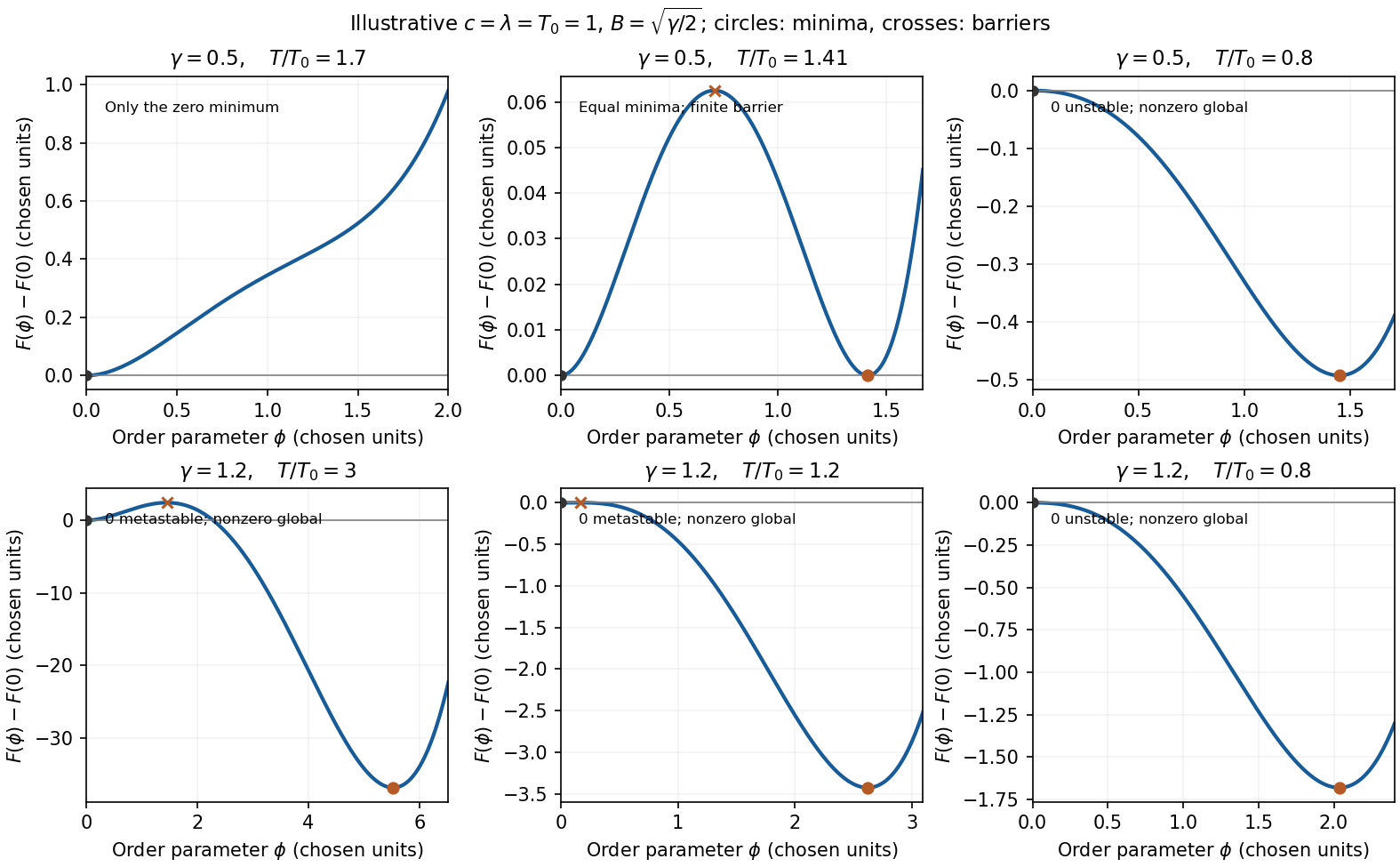
Cooling and transition temperature. For , equilibrium starts at the zero minimum at high temperature and switches to the nonzero minimum at . The jump is finite, , and there is a barrier between the coexisting states. This is a first-order transition. The latent heat of a temperature-dependent cubic-quartic Landau transition follows from differentiating the minimized free energy: the heat released on cooling isIf is an energy density rather than total energy, is likewise a density. An actual system can supercool below before nucleation, so is the equilibrium transition temperature.
For thermal symmetry nonrestoration in a cubic-quartic model, with , the equilibrium global minimum is nonzero already at arbitrarily high temperature. Following it does not force a transition. A system initially prepared in the metastable zero minimum can still leave it by nucleation while ; that minimum loses local stability at . This is the sense in which a change is possible rather than inevitable. There is no equilibrium coexistence temperature for in this model. A kinetic transition can depend on preparation and nucleation dynamics; is the limiting loss of local stability of the zero state, not a second coexistence temperature. Continuing to an imaginary value does not define a physical transition temperature.
Mass window in the specified electroweak phase transition model. For the mass window in a cubic electroweak transition model, put . The supplied ratios implyThe two strict conditions therefore requireSince is increasing for , the finite window isUsing the specified and givesAt u, , but . Thus 134 u lies outside the required window, failing the order-parameter-strength condition. This does not remove the polynomial model's finite first-order jump; it fails the additional requirement . The result is a bound within the specified simplified model, not a model-independent Higgs-mass bound.
Past exam of the thermal and statistical physics course of the University of Cambridge 2015 Paper 1 3 Solution by Codex 0 2026-10-20
Codex 0 2026-10-20Ensemble and applications. A grand canonical ensemble describes a system exchanging both energy and particles with a large reservoir. Its fixed control parameters are , while microstates with different have probabilitiesWeak coupling allows the system's energy levels to remain meaningful; equilibrium fixes the reservoir temperature and chemical potential. The grand potential is , with now the mean population. It generates entropy, pressure and mean particle number by differentiation. This ensemble is convenient for gases in contact with particle reservoirs, independently occupied quantum levels and surface adsorption; its particle-number fluctuations are part of the description, not an error in counting.
Classical single-level limit. For the single-level grand partition function in the dilute limit, put . Empty and singly occupied levels contribute and . In the dilute classical limit , higher occupancies contribute only at order or beyond:This truncation does not impose the Pauli principle on a classical gas. A fermion state has exactly , a boson state has , and Maxwell-Boltzmann occupancy weights give ; they all agree to this order. In particular, , with the classical Maxwell-Boltzmann result exactly .
grand potential and chemical potential. With , summing the single-level logarithms and using the stated density of states givesSubstitute , for whichCombining this with the density-of-states prefactor gives . ThusDifferentiating at fixed ,Similarly , so . This is the grand-canonical chemical potential of a classical ideal gas. The condition states the classical regime. The supplied density of states counts one internal state; extra internal degeneracies would have to be included consistently rather than inserted at only one stage.
One adsorption site. Take the free-vapour energy reference as zero and the binding energy as . A site is either empty or singly occupied; the latter has vibrational partition function . Its adsorption-site grand partition function and mean occupation areThe chemical potential of an adsorbed species on equivalent sites follows by inverting the occupation ratioThe factor is the vacant-site probability. The binding reference and the energies included in must be chosen consistently, so that vibrational zero-point energy is not counted twice.
Isotherm. The vibrational factor in a Langmuir equilibrium constant is fixed by adsorption equilibrium, . Neglecting vapour internal degrees of freedom and writing its number density as gives . ThereforeThis is the Langmuir isotherm: initially linear, increasing monotonically and concave down, approaching unit coverage. Half coverage occurs at . The coefficient has inverse-pressure units. It assumes equivalent independent sites, at most one molecule per site and no lateral interaction or multilayer adsorption. The molecular mass appropriate to the vapour determines .
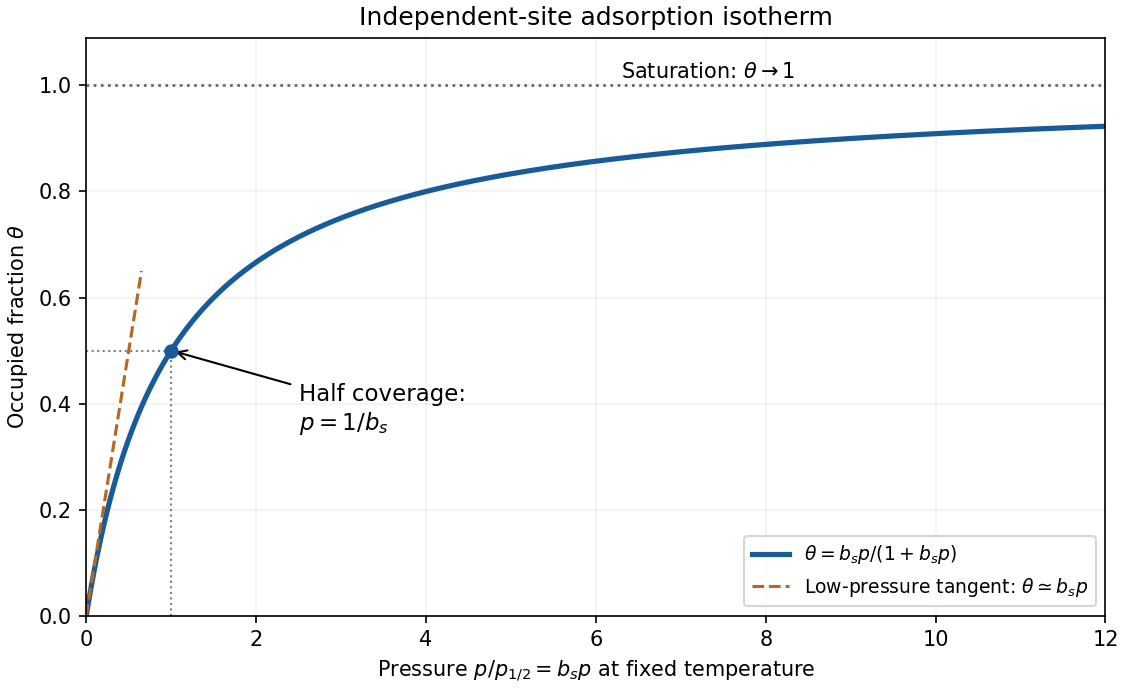
Original dimensionless Langmuir coverage curve with half-coverage and limiting behavior
. Details. A real uptake measurement must separate adsorbed molecules from free gas in the apparatus. Langmuir's original mica experiment compared a mica-containing bulb with a similar blank and inferred uptake from calibrated gas volumes and pressures. His stated blank contribution and bath-temperature drift limited the inferred adsorption; a saturating curve alone does not establish ideal equivalent sites.[ref]
The Adsorption of Gases on Plane Surfaces of Glass, Mica and Platinum by Irving Langmuir. pp. 1376–1378: mica apparatus and blank; p. 1385: limitations
Pinned article: Introduction to the OurBigBook Project
Welcome to the OurBigBook Project! Our goal is to create the perfect publishing platform for STEM subjects, and get university-level students to write the best free STEM tutorials ever.
Everyone is welcome to create an account and play with the site: ourbigbook.com/go/register. We belive that students themselves can write amazing tutorials, but teachers are welcome too. You can write about anything you want, it doesn't have to be STEM or even educational. Silly test content is very welcome and you won't be penalized in any way. Just keep it legal!
Intro to OurBigBook
. Source. We have two killer features:
- topics: topics group articles by different users with the same title, e.g. here is the topic for the "Fundamental Theorem of Calculus" ourbigbook.com/go/topic/fundamental-theorem-of-calculusArticles of different users are sorted by upvote within each article page. This feature is a bit like:
- a Wikipedia where each user can have their own version of each article
- a Q&A website like Stack Overflow, where multiple people can give their views on a given topic, and the best ones are sorted by upvote. Except you don't need to wait for someone to ask first, and any topic goes, no matter how narrow or broad
This feature makes it possible for readers to find better explanations of any topic created by other writers. And it allows writers to create an explanation in a place that readers might actually find it.
Figure 1. Screenshot of the "Derivative" topic page. View it live at: ourbigbook.com/go/topic/derivativeVideo 2. OurBigBook Web topics demo. Source. - local editing: you can store all your personal knowledge base content locally in a plaintext markup format that can be edited locally and published either:This way you can be sure that even if OurBigBook.com were to go down one day (which we have no plans to do as it is quite cheap to host!), your content will still be perfectly readable as a static site.
- to OurBigBook.com to get awesome multi-user features like topics and likes
- as HTML files to a static website, which you can host yourself for free on many external providers like GitHub Pages, and remain in full control

Figure 2. You can publish local OurBigBook lightweight markup files to either OurBigBook.com or as a static website.
Figure 3. Visual Studio Code extension installation.
Figure 5. . You can also edit articles on the Web editor without installing anything locally. Video 3. Edit locally and publish demo. Source. This shows editing OurBigBook Markup and publishing it using the Visual Studio Code extension. 
- Infinitely deep tables of contents:




All our software is open source and hosted at: github.com/ourbigbook/ourbigbook
Further documentation can be found at: docs.ourbigbook.com
Feel free to reach our to us for any help or suggestions: docs.ourbigbook.com/#contact