Past exam of the genetics course of the University of Cambridge 2025 Paper 4 3 Solution by  Codex 0 2026-10-20
pleiotropy means that a single gene or genetic variant influences more than one distinguishable phenotypic trait. Its evolutionary consequence depends on the directions and magnitudes of those effects and on how they affect genotype fitness. It must be distinguished from genetic linkage, in which different causal genetic loci travel together, and from epistasis, in which the effect of one allele depends on another. pleiotropy can constrain adaptation, facilitate coordinated change, and maintain trade-offs; its sign is not intrinsically negative.
For a small change in a phenotypic trait vector , write its effect as and define the phenotypic selection gradient . A first-order Taylor polynomial givesA mutation that improves one component can therefore be harmful overall if its other effects oppose sufficiently strong natural selection. For an illustrative two-trait case, and give . With , the same approximation gives . What matters is the full effect vector, not whether the mutation has been called “large” or “pleiotropic”. Near an optimum the first-order term can vanish, making curvature important.
This geometric constraint is explicit in Fisher's geometric model. Put the optimum at the origin and let denote the current displacement. A step improves an isotropic quadratic measure of genotype fitness exactly whenA step toward improvement in one component may damage many other components. In models where a step has random direction across many independent selected dimensions, the set of favorable directions can become restricted: this motivates a cost of complexity. But the prediction depends on how total step size, per-trait effect size and the number of affected phenotypic traits scale. Organismal complexity is not automatically equal to the number of dimensions affected by every mutation.
At the population level, the multivariate breeder's equation iswhere is the additive genetic covariance matrix. This is a local approximation under the relevant inheritance and weak-selection assumptions.[ref]
Quantitative genetic analysis of multivariate evolution, applied to brain:body size allometry by Russell Lande. Evolution 33, pp. 402–416; multivariate response to selection
The off-diagonal entries cause correlated responses. For example,There is abundant genetic variance for each phenotypic trait separately, yet their negative genetic covariance slows simultaneous increase. For , the response instead becomes : the same covariance facilitates this direction. A singular can make an instantaneous response unavailable, but present covariance does not establish an eternal constraint. Moreover, genetic linkage can also produce genetic covariance; estimating alone does not demonstrate pleiotropy.antagonistic pleiotropy arises when effects favor different outcomes in different components of genotype fitness, environments, sexes or life stages. An allele that increases early reproduction but reduces late survival can be favored if its early benefit receives greater reproductive weighting. This provides a possible route to senescence, without implying that deterioration is itself selected for. Sex-specific benefits and costs can produce sexual antagonism. Such conflicts may maintain variation under some combinations of dominance, demography and environmental variation, but opposite effects alone do not guarantee a protected polymorphism. The invasion success of each alternative when rare must be checked.
pleiotropy can also promote adaptation by coordinating changes that work well together. A developmental regulator can change a group of interacting structures; a single physiological change can improve several measures of performance. natural selection may favor developmental modularity, tissue-specific regulation or gene duplication when they reduce costly coupling. The pelvic enhancer example in question 2 illustrates how cis-regulatory evolution can localize an effect; it does not establish a universal privilege of regulatory over coding mutations.
Empirical measurement requires care. Screens of yeast, nematode and mouse mutants found strongly modular relationships between genes and measured phenotypic traits, challenging assumptions of universal equal-effect pleiotropy.[ref]
Genomic patterns of pleiotropy and the evolution of complexity by Zhi Wang and others. Results on the degree of pleiotropy and modularity; Figures 1–3
A deletion can nevertheless have more severe and widespread effects than a naturally segregating regulatory allele; unmeasured environments and phenotypic traits hide effects, whereas multiple correlated measurements can inflate apparent dimensionality. To test causal pleiotropy, introduce the same precise genetic variant into matched genetic backgrounds, measure multiple prespecified phenotypic traits across environments and life stages, and use recombinant or edited lines to exclude a neighboring causal genetic locus. Assay genotype fitness as well as convenient laboratory phenotypic traits. The evolutionary constraint is the alignment between available heritable effects and current selection, not the mere count of affected phenotypic traits. Past exam of the genetics course of the University of Cambridge 2025 Paper 4 2 Solution by Codex 0 2026-10-20
Codex 0 2026-10-20evolutionary developmental biology explains many novelties as new uses, arrangements or regulation of inherited components. A new organ need not require an entirely new set of genes: changes to a gene regulatory network can deploy existing activities at a new place, time or strength during biological development. Novelty in the resulting phenotype is therefore compatible with continuity of the underlying materials.
One route is gene co-option. A regulator already controlling a useful cellular program can acquire a new domain of gene expression, bringing downstream activities into a different structure. The important unit may be an entire interacting module, rather than a single gene. In the classic ectopic-eye experiment, targeted gene expression of eyeless in developing fruit-fly tissues induced eye structures in abnormal locations. This shows that competent tissues can deploy an existing developmental program when a regulatory input changes; it does not show that a regulator alone constructs an eye independently of its cellular context.[ref]
Induction of ectopic eyes by targeted expression of the eyeless gene in Drosophila by Georg Halder and others. Science 267, pp. 1788–1792; targeted expression and differentiated ectopic eye structures
Shared regulators can constitute deep homology even where the final structures have different architectures. Sharing one regulator, however, is not sufficient to establish that two complete organs are homologous.cis-regulatory evolution supplies a way to change one deployment while preserving others. A transcription factor may function in several tissues, giving coding changes extensive pleiotropy. A tissue-specific enhancer can instead change the spatial pattern of gene expression. In sticklebacks, recurrent deletion of a pelvic enhancer of Pitx1 contributes to pelvic reduction while leaving other deployments of the gene available. Mapping, enhancer assays and transgenic restoration connected the regulatory region to the skeletal outcome.[ref]
Adaptive evolution of pelvic reduction in sticklebacks by recurrent deletion of a Pitx1 enhancer by Yingguang Frank Chan and others. Science 327, pp. 302–305; pelvic enhancer deletions, reporter activity and transgenic rescue
This is primarily a reduction of a structure, but it demonstrates the regulatory modularity that can also enable gains or transformations. Not every enhancer is tissue-specific, and regulatory changes can themselves have extensive pleiotropy.Developmental transformations can also involve heterochrony, a change in timing or duration, and heterotopy, a change in location. Extending a growth phase can alter a structure's proportions; moving a signaling source can alter a pattern. Changes in Hox genes or their regulation can alter regional identities along the body axis, while changes in downstream targets can modify one segment without changing every segment. serial homology supplies repeated structures that can subsequently specialize. These routes modify inherited developmental processes, but the resulting functional organization can still be new. The size of an adult change is not a reliable measure of the number of underlying mutations.
gene duplication makes another form of reuse possible. Initially the copies may share a function. subfunctionalization can partition ancestral deployments between them; neofunctionalization can give one copy a new function while the other preserves an old one. Changes in regulatory connections and protein sequence can then accumulate with fewer immediate costs. Duplication is not guaranteed to generate novelty: most extra copies may be lost or change gene dosage, and retaining a copy requires an account of its inheritance and effects on genotype fitness. Similarly, exaptation describes recruitment of an existing character to a new use; it is a functional historical claim, whereas gene co-option names a developmental mechanism that may underlie that history.
Reuse can also generate a new biochemical function. Comparative sequence analysis traced Antarctic fish antifreeze glycoproteins to an ancestral trypsinogen gene: retained ancestral segments and amplification of a short sequence helped construct a new repetitive coding region.[ref]
Evolution of antifreeze glycoprotein gene from a trypsinogen gene in Antarctic notothenioid fish by Liangbiao Chen and others. PNAS 94, pp. 3811–3816; comparison of gene structures and reconstruction of the amplification process
An inherited coding framework supplied material for an ice-binding protective product with a different function. This is a molecular novelty rather than a new organ, but it illustrates how reuse can build a new activity rather than merely preserve or remove an old one.Development also changes which variants are accessible. A gene regulatory network can buffer many perturbations but respond sharply to a particular change, so mutation does not sample all imaginable forms equally. developmental bias can make similar outcomes recur in independent lineages. natural selection then filters the variants that actually arise; developmental accessibility and selective advantage are distinct explanations that can operate together. Repeated involvement of the same gene might reflect its useful regulatory position, an unusually high local mutation rate, or inheritance of the same ancestral allele. Distinguishing these requires comparative and functional evidence.
The quotation should not be interpreted as denying new sequence or new function. de novo gene birth can produce a newly translated product from previously non-coding DNA; mutations can create a new regulatory binding site; and a genuinely new interaction can arise between old components. Such cases challenge the narrower assertion that every new gene is a modified pre-existing coding gene. They still involve changes to existing DNA, cellular machinery and developmental context, rather than construction without material antecedents. Failure to detect a distant sequence relative is also insufficient evidence for de novo gene birth, because rapid divergence and incomplete sampling can hide ancestry.
A convincing evolutionary developmental account therefore combines a phylogenetic tree establishing ancestral states, comparative measurements at matched developmental stages, and perturbations that connect the proposed change to the new outcome. For a candidate enhancer, compare ancestral and derived sequences in the same integration context, include an inactive construct and the normal sequence as controls, and test replacement or rescue at the endogenous genetic locus. A reporter alone tests regulatory potential, not the necessity of the sequence in its native context. Novelties commonly arise by modifying inherited developmental systems, but their new organization and function are real, and the origin of new genes cannot be reduced to duplication alone.
Past exam of the genetics course of the University of Cambridge 2025 Paper 4 1 Solution by Codex 0 2026-10-20
Codex 0 2026-10-20Visible divergence and reproductive incompatibility measure different outcomes of evolution. A few changes in a gene regulatory network can transform a conspicuous phenotype, whereas differences in the machinery of meiosis or biological development can prevent reproduction without greatly changing adult appearance. Neither membership of the same genus nor morphological similarity specifies divergence time or the extent of reproductive isolation.
First separate barriers. premating isolation can arise through differences in courtship, habitat or breeding season even when a forced cross produces fertile offspring. postzygotic isolation concerns the survival or fertility of the offspring themselves. Thus fertile captive hybrids do not refute substantial reproductive isolation in nature: they may never encounter suitable mates, may have intermediate ecological requirements, or may be unattractive to both parental biological populations. Under the biological species concept, the relevant issue is effective gene flow among natural biological populations, not the success of one laboratory mating. Conversely, a laboratory failure can reflect husbandry rather than an intrinsic incompatibility.
Rapid visible divergence is especially plausible when sexual selection changes plumage or other signals, or natural selection changes a feeding structure. Such changes can involve a small part of the genome, leaving most interactions required for fertility compatible. In Darwin's finches, genome comparisons associated an ALX1 region with beak shape and also revealed interspecific gene flow. This is an example of conspicuous adaptive differentiation coexisting with exchange of alleles, rather than evidence that all avian hybrids are fertile.[ref]
Evolution of Darwin's finches and their beaks revealed by genome sequencing by Sangeet Lamichhaney and others. Results on interspecific gene flow and the ALX1 haplotype association with beak shape
Continued gene flow can itself help maintain compatibility through much of the genome while divergent natural selection preserves differences at selected genetic loci.For cryptic incompatibility, consider a Dobzhansky-Muller incompatibility. Two lineages start with compatible alleles . One evolves in the presence of , while the other evolves in the presence of . Each change is tolerable in its own genetic background, but the combination disrupts function in hybrids. This requires neither lineage to pass through a low-fertility intermediate. Such epistasis can affect spermatogenesis, chromosome pairing, or interactions between nuclear and mitochondrial genomes, while leaving the adult body plan nearly unchanged. The relevant changes can arise through natural selection, genetic drift, or conflict over inheritance; adaptive divergence in external form is not required.
A particularly informative mammalian experiment concerns PRDM9, which helps specify recombination hotspots. In a particular house-mouse cross, changing its DNA-binding region to the corresponding human sequence restored chromosome pairing and male fertility. The experiment implicates compatibility between a genetic recombination regulator and its binding sites, rather than visible morphological divergence. Crucially, this was a rescue in a specified cross and genetic background, not a demonstration that PRDM9 explains all mammalian speciation.[ref]
Re-engineering the zinc fingers of PRDM9 reverses hybrid sterility in mice by Benjamin Davies and others. Figure 1 and section “Humanizing Prdm9 restores hybrid fertility”; parental-background and engineered-allele comparisons
Comparative work on birds lacking PRDM9 found relatively stable recombination hotspots associated with functional genomic features.[ref]
Stable recombination hotspots in birds by Sonal Singhal and others. Science 350, pp. 928–932; maps inferred from two finch species and comparisons of hotspot conservation
This suggests a possible difference in the routes to incompatibility: turnover of PRDM9 and its targets is unavailable in those lineages. The inference is mechanistic, however; hotspot stability by itself does not demonstrate that avian hybrids will be fertile.Differences in karyotypes provide another mechanism. A balanced chromosomal rearrangement can have little visible effect in either parent yet cause faulty pairing or unbalanced gametes in a heterozygous hybrid. However, a different chromosome count alone does not prove sterility: the arrangement and segregation behavior matter. Differences in genomic imprinting may also disturb placental development or embryonic growth in mammalian crosses, sometimes producing direction-dependent outcomes. Parent-of-origin growth abnormalities and disrupted genomic imprinting in particular rodent hybrids provide evidence that this mechanism can matter.[ref]
Genomic imprinting is disrupted in interspecific Peromyscus hybrids by Paul B. Vrana and others. Nature Genetics 20, pp. 362–365; reciprocal-cross growth abnormalities and allelic expression
These are hypotheses to test in the relevant lineages, not a universal explanation for the bird–mammal comparison.The sex of the offspring matters. Haldane's rule predicts that, when one sex of first-generation hybrids is absent, rare or sterile, it tends to be the heterogametic sex: typically XY males in mammals and ZW females in birds.[ref]
Sex ratio and unisexual sterility in hybrid animals by J. B. S. Haldane. Journal of Genetics 12, pp. 101–109; formulation of the heterogametic-sex pattern
Recessive incompatibilities on a sex chromosome can be exposed when there is no corresponding second copy; rapid evolution of reproductive functions can contribute too. Therefore a report of fertile avian males is insufficient without testing females. The rule predicts a sex bias in a given cross, not that birds as a class have weaker reproductive isolation.To discriminate these mechanisms, compare multiple independently diverged pairs, match their estimated divergence times using phylogenetics, and avoid treating taxonomic rank as a clock. Perform reciprocal crosses with parental within-lineage controls; measure fertilization, embryonic survival, both sexes' fertility, and second-generation and backcross success. A fertile first generation can conceal hybrid breakdown after genetic recombination disrupts coadapted combinations. Pair karyotype analysis and observations of meiosis with genome mapping and carefully controlled rescue experiments. Field measurements of mating and ancestry then determine whether compatibility translates into gene flow. The contrast is explained by different rates and genetic targets of visible divergence and reproductive divergence, with sex, cross direction, ancestry and assay conditions determining the observed outcome.
Past exam of the genetics course of the University of Cambridge 2025 Paper 2 7 Solution by Codex 0 2026-10-20
Codex 0 2026-10-20The New Head hypothesis offers a plausible developmental explanation for vertebrate cranial innovation: migratory neural crest biological cells helped build a feeding and sensory apparatus that could diversify. Its strongest form is a hypothesis about integration of several innovations, not a claim that neural crest alone produced every part of the vertebrate head or directly proves evolutionary success.
neural crest arises near the border of the neural and non-neural ectoderm. Cells undergo an epithelial-to-mesenchymal transition, migrate and generate diverse derivatives. Cranial populations contribute substantially to facial and pharyngeal cartilage, bone and connective biological tissues; other populations supply peripheral neurons, glial cells and pigment biological cells. These are regionally restricted potentials, not a claim that every crest biological cell makes every derivative. Importantly, neural crest remains ectodermal in origin even when it makes biological tissues often associated with mesoderm.
The hypothesis proposed by Carl Gans and R. Glenn Northcutt linked the new head to a transition from passive suspension feeding toward more active food acquisition, with an expanded cranial skeleton, sensory systems and muscularised pharyngeal apparatus. neural crest, ectodermal placodes and mesodermal muscle contributions were complementary. A support skeleton allows feeding surfaces and sensory organs to be positioned; sensory organs guide action; muscles supply force. Their integration gives a more convincing functional explanation than a list of crest derivatives alone.[ref]
Neural crest and the origin of vertebrates: a new head by Carl Gans and R. Glenn Northcutt. Science 220, pp. 268–273; proposed relationship between cranial embryonic sources and active predation
Several distinctions keep this argument anatomically accurate. The brain largely develops from the neural tube; ectodermal placodes contribute important cranial sensory components; much cranial muscle comes from mesoderm. neural crest provides connective and skeletal organisation around those biological tissues and contributes to their interactions. The pharyngeal arches are multicellular constructions involving neural crest, mesoderm, ectoderm and endoderm. Thus loss of cranial neural crest can secondarily disrupt biological tissues it does not itself become. Fate mapping distinguishes cellular contribution, while selective ablation and rescue test developmental necessity and interaction.
There is direct experimental support for a role in diversification. Reciprocal cell transplantation of prospective beak neural crest between quail and duck shifted beak morphology toward the donor species and altered nearby host biological tissues. This connects intrinsic properties of the crest population with instructions to its environment, explaining how changes in one interacting population can reshape a complex organ. Same-species grafts, developmental-stage matching and permanent donor labels are needed to distinguish patterning information from surgical effects or simple replacement. The result supports a mechanism for morphological variation; it does not by itself establish which ancestral feeding behaviour was favoured by natural selection.[ref]
The cellular and molecular origins of beak morphology by Richard A. Schneider and Jill A. Helms. Science 299, pp. 565–568; reciprocal quail–duck grafts, donor-like beaks and effects on host tissue
Comparative evidence also qualifies an abrupt invention narrative. Neural-border regulatory and sensory programmes have antecedents outside vertebrates. In Ciona, a pigment-cell lineage with parts of a crest-like regulatory programme can acquire migratory behaviour after experimental manipulation. Such a rudiment supports stepwise assembly of properties; a migrating pigment precursor is not automatically equivalent to the full multipotent, skeletogenic vertebrate neural crest. Compare origin, regulatory dependencies, migration and derivative range separately.[ref]
Identification of a neural crest rudiment in a non-vertebrate chordate by Philip Barron Abitua and others. Nature 492, pp. 104–107; Ciona pigment-cell regulatory programme and experimentally induced migration
Jawless vertebrates are another important logical control. Their existence prevents equating the origin of neural crest with the later origin of jaws: cranial contributions preceded the particular jawed-vertebrate feeding apparatus. Later modifications of an inherited developmental system can support new structures without repeating its original evolutionary origin. Conversely, retention of homologous genes does not establish identical biological cell types; comparative experiments must test how those genes interact and what the biological cells actually produce.
A strong research programme would combine lineage tracing and selective perturbation across vertebrate and non-vertebrate chordates, compare homologous regulatory elements and ask whether reconstructed changes alter migration, skeletal competence or biological tissue interactions. Fossils constrain when hard cranial structures appeared, but rarely identify the embryonic source directly. Modern ablation establishes a present-day requirement, not the sequence of ancestral events. Likewise, species richness is influenced by many ecological and historical factors, so it is not a direct experimental readout of one developmental innovation.
The defensible conclusion is that neural crest supplied a versatile developmental substrate for cranial construction and diversification, acting with placodes and other biological tissues. Experimental grafting and comparative developmental evidence make that causal contribution substantial. The specific ecological transition proposed in the New Head hypothesis remains an evolutionary reconstruction whose details require evidence beyond the existence of crest derivatives.
Past exam of the genetics course of the University of Cambridge 2025 Paper 2 6 Solution by Codex 0 2026-10-20
Codex 0 2026-10-20Germ plasm inheritance places germline-promoting material into selected biological cells; induction establishes germline identity through signalling to competent biological cells. Both must protect the future germline from inappropriate somatic differentiation. They differ in how that programme begins and in how broadly early transcription is repressed. primordial germ cells are precursors of future gametes, not simply biological cells expressing one widely shared germ-cell marker.
In Drosophila melanogaster, maternal oskar messenger RNA is transported to the posterior oocyte and locally translated. Oskar organises germ plasm containing RNA and proteins, including Vasa, Tudor and Nanos. Posterior cell nuclei encounter this specialised cytoplasm and cellularise as pole cells. Necessity and positional sufficiency are distinguishable: loss of Oskar disrupts assembly, while experimentally mislocalised oskar messenger RNA can induce anterior pole cells. The latter result shows that the organising material can redirect where the programme begins; it does not mean that Oskar acts without the other cellular components.[ref]
Induction of germ cell formation by oskar by Anne Ephrussi and Ruth Lehmann. Nature 358, pp. 387–392; anterior oskar localisation and ectopic germ-cell formation
Assembly and inheritance also should not be equated with one universal granule mechanism. A germ plasm is a spatially organised collection of functional components; the visible granule and the whole regulatory activity are not necessarily identical. Test assembly by tracking recruitment order, deleting candidate organisers and rescuing them at physiological levels. Test specification separately by permanent lineage tracing and later contribution to the gonad and, where experimentally feasible, functional gametes. Disrupting a visible aggregate without abolishing the relevant biochemical activity is not evidence that all germline specification has failed.
In fly pole cells, a direct route to transcriptional quiescence is the small Pgc protein, translated from inherited germ-plasm RNA. It binds P-TEFb, a protein kinase complex needed for productive RNA polymerase II elongation, and prevents its normal recruitment to transcriptional sites. Reduced phosphorylation of the polymerase's C-terminal domain at serine 2 accompanies repression. Loss, ectopic expression, physical interaction and recruitment assays connect Pgc protein to this mechanism rather than merely correlating a silent biological cell with a granule.[ref]
Drosophila Pgc protein inhibits P-TEFb recruitment to chromatin in primordial germ cells by Kazuko Hanyu-Nakamura and others. Abstract and Results: Pgc loss and ectopic expression, P-TEFb interaction and chromatin recruitment
The nematode Caenorhabditis elegans illustrates another inherited route. Maternal PIE-1 segregates into the germline blastomeres and inhibits the somatic transcription programme. A repression domain with similarity to the RNA polymerase II C-terminal repeat provided a mechanistic link to the transcriptional apparatus; mutations that damage repression also weaken in-embryo rescue. Thus distinct inherited repressors can converge on productive RNA polymerase II activity. It is unnecessary to claim that PIE-1 and Pgc protein are the same molecule or that every inherited germline component acts by this mechanism.[ref]
Transcriptional repression by the Caenorhabditis elegans germ-line protein PIE-1 by Ceri Batchelder and others. Genes & Development 13, pp. 202–212; repression-domain assays and rescue with altered PIE-1
In the house mouse, primordial germ cells are induced from competent postimplantation epiblast rather than assigned by an already localised maternal germ plasm. BMP4 from extraembryonic biological tissues supplies an essential inductive input. BMP4 null embryos lack primordial germ cells, and chimera analysis identified an extraembryonic source requirement; fewer founders in heterozygotes showed a dosage-sensitive effect on establishment rather than simply later expansion.[ref]
Bmp4 is required for the generation of primordial germ cells in the mouse embryo by Kirstie A. Lawson and others. Abstract and chimera analysis; Genes & Development 13, pp. 424–436
Necessity of this signal does not imply that every exposed epiblast biological cell becomes germline: competence, position and competing inputs constrain the response.The induced programme uses BLIMP1, PRDM14 and TFAP2C to repress somatic regulatory networks and establish germline identity and epigenetic reprogramming. BLIMP1 binds and represses somatic and proliferation-associated targets, while the factors also activate germline-associated programmes. This is the crucial contrast in interpreting quiescence: an induced germline must transcribe its specification programme, so selective repression of somatic genes is not equivalent to a universal shutdown of transcription. Chromatin and DNA methylation are subsequently remodelled; a hypomethylated state by itself is not evidence that the genome is transcriptionally inactive.[ref]
A tripartite transcription factor network regulates primordial germ cell specification in mice by Erna Magnúsdóttir and others. Abstract and Results: direct BLIMP1 targets, cooperative transcription-factor activity and induction of PGC-like cells
Induction also differs among mammals. Human primordial germ cell-like cells require SOX17 as an important upstream specifier, with BLIMP1 helping suppress alternative somatic programmes. This comes from experimentally induced biological cells compared with available germ-cell references; it should not be presented as direct observation of every event in an intact human embryo. It demonstrates why the exact mouse hierarchy cannot simply be renamed human.[ref]
SOX17 is a critical specifier of human primordial germ cell fate by Naoko Irie and others. Cell 160, pp. 253–268; SOX17 perturbation and human primordial germ cell-like cell induction
For either mode, measure nascent RNA incorporation together with serine-2-phosphorylated RNA polymerase II, total polymerase and multiple somatic and germline transcripts. Maternal messenger RNA persistence makes total RNA abundance an unreliable measure of current synthesis. Include somatic biological cells in the same embryo as positive controls, a validated transcription-inhibited sample as a low-signal control, and viability measurements. Timed perturbation after specification distinguishes a requirement for establishing identity from one for maintaining quiescence. Rescue should recover appropriate molecular identity and later lineage function, not merely lower a staining signal. These experiments would reveal the shared aim of suppressing inappropriate differentiation while preserving the different transcriptional requirements of inheritance and induction.
Past exam of the genetics course of the University of Cambridge 2025 Paper 2 5 Solution by Codex 0 2026-10-20
Codex 0 2026-10-20Identify specification by changing a biological cell's environment and asking what it can still become. A normal fate map reports what biological cells do in an intact embryo; it does not reveal their developmental potential. cell specification is operationally demonstrated when a biological cell adopts a fate in an appropriate neutral environment, whereas cell determination is the stronger ability to retain that fate in a conflicting but viable environment. Cell differentiation is the execution of specialised properties. None should be inferred from one early marker alone.
Begin with a stage-resolved reference. Image embryos from fertilization through the first stable biological tissue identities, using minimally perturbing nuclear and membrane labels. Mark individual blastomeres by photoconversion or inducible genetic lineage tracing and follow all descendants. Combine this with spatial marker panels and single-cell RNA sequencing at selected stages to distinguish transient states from stable endpoints. Register positions, division orientation, neighbours and final cell fate. Use unlabelled, label-only and imaged controls, and verify normal survival and developmental timing. Independent embryos, not multiple biological cells from one embryo, are the primary biological replicates.
Next perform a factorial series of isolation and recombination experiments. Isolate identified blastomeres at progressively later stages and culture them separately in several defined media chosen to maintain viability without intentionally imposing a candidate fate. Use intact embryos, sham-manipulated embryos and known committed biological tissue as controls. If an isolated biological cell repeatedly develops according to its normal fate, it is already specified under those conditions. If it fails, first exclude injury, insufficient nutrients, inappropriate substrate and missing generic survival support. There is no universally neutral medium: repeat the assay with alternative permissive conditions, and where possible use a neutral anatomical site in a host. Agreement across environments makes the inference stronger.
Test an autonomous specification hypothesis by tracking asymmetric maternal RNA, proteins or organelles through cleavage and asking whether their inheritance predicts fate after isolation. Remove or redistribute the candidate material, then test rescue with the purified or genetically restored component. Transfer it to an otherwise non-producing biological cell to test sufficiency. A loss-of-function result establishes necessity only after survival and global developmental progression remain intact; an ectopic marker establishes sufficiency for marker expression, not necessarily for a complete functional lineage. Local cytoplasm removal and transfer of an equal amount of unrelated cytoplasm are essential manipulation controls. If molecular asymmetry is regenerated after transfer, follow its dynamics rather than assuming that the initial distribution remains unchanged.
Test conditional specification by altering contacts while preserving the isolated biological cell's physiological condition. Remove an identified neighbour before the putative induction window, recombine the recipient with that neighbour, and compare unrelated biological tissue. Rescue by the correct neighbour implicates an interaction. A permeable barrier or conditioned medium can distinguish a diffusible signal from a requirement for direct contact, but failure of conditioned medium is inconclusive if the signal is unstable, matrix-bound or requires a local concentration. A positive result through a barrier must also exclude passage of intact biological cells. Label sender and receiver separately so recipient conversion is not confused with expansion of contaminating donor biological cells.
Build a causal sender–signal–receiver chain. Delete a candidate ligand specifically in the sender, delete its receptor specifically in the recipient, and monitor an immediate pathway reporter before the terminal fate readout. Ligand addition should rescue ligand loss when the receptor is present; it should fail after verified receptor loss. Activated downstream machinery in the recipient can test bypass. Demonstrate a dose range that changes fate without changing survival, and use pulse-and-washout experiments to map a competence window. Loss of an endpoint after late treatment may indicate maintenance or differentiation failure rather than the original specification event. Independent genetic and pharmacological interventions reduce the risk of an off-target explanation.
Perform reciprocal heterotopic cell transplantation at several stages. Move a labelled prospective A biological cell into a B environment and a B biological cell into an A environment, with same-position grafts as surgical controls. Verify integration, survival and exposure to the host signal. If an early donor adopts the host fate, its potential is conditional at that stage. If a later donor retains its original fate while the host remains permissive and the graft survives, that supports cell determination. Retention in a host that never contacts or signals to the graft is uninformative. Follow mature morphology and function as well as markers; a hybrid marker state can represent incomplete conversion rather than either stable fate.
Regulative capacity needs another test. Ablate a mapped precursor and trace the source of replacement biological cells. Normal final anatomy is stronger evidence of regulative development if a previously distinct neighbour demonstrably adopts the missing fate; it is weaker if a few unablated members of the original lineage simply proliferate. Include sham ablation and damage-matched ablation elsewhere, quantify biological cell death and measure final biological cell numbers. Conversely, persistent loss of a structure after ablation does not prove mosaic development: the embryo may have lost an essential signal, physical scaffold or sufficient biological cell mass rather than an irreplaceable determinant.
A third mechanism, syncytial specification, must be tested if early divisions produce many cell nuclei in shared cytoplasm before cellularization. Image membranes to establish whether true cellular boundaries exist. Map nuclear position, local morphogen activity and nascent transcription; move cell nuclei relative to the gradient or shift the signal source while retaining nuclear identity. If equivalent cell nuclei adopt different programmes according to position in shared cytoplasm, that supports positional specification before biological cell boundaries. Perturbing cellularization alone is a poor test because it can damage several later processes.
An explicit interpretation matrix prevents overclaiming: retention after isolation supports specification; switching after a viable heterotopic graft shows continuing plasticity; retention after a verified conflicting graft supports determination; fate following a manipulated inherited determinant supports autonomy; and fate following a manipulated neighbour signal supports induction. These modes can coexist. An asymmetric maternal determinant might set competence for an external signal, and an induced fate can later become autonomous through positive feedback in a gene regulatory network. The final product should be a map of mechanisms and commitment times for particular lineages, not a single label for the entire organism.
Past exam of the genetics course of the University of Cambridge 2025 Paper 2 4 Solution by Codex 0 2026-10-20
Codex 0 2026-10-20Time patterns an axis by controlling which signals biological cells encounter, how long they interpret them, and when a changing regulatory state becomes fixed in space. Repeated segments, regional identities and competence windows are distinct temporal problems. An embryo may solve them with interacting timers; there is no requirement for one universal developmental clock.
In vertebrate somitogenesis, presomitic mesoderm shows cyclic gene expression, including Hes/Her transcription factors. Delayed negative feedback can produce repeated activity, while Notch signalling couples neighbouring biological cells so their phases remain coherent. In a clock and wavefront model, these oscillations meet a moving maturation boundary associated with changing FGF signalling, Wnt signalling and anterior differentiation. A boundary is fixed once per effective clock cycle. For a steady relative wavefront speed and period , the model predictswhere is segment spacing and is the number formed during an active interval . The speed is relative to the biological tissue, not necessarily the measured displacement of the tail tip. Units check: length/time multiplied by time gives length. These are approximations: changing biological tissue strain, gradients or periods can invalidate constant-parameter predictions.
The classic chick evidence distinguished periodic expression from movement. Paired halves of posterior biological tissue were compared after different culture intervals, revealing recurrent hairy gene expression patterns with a period matching somite formation. The reported approximately 90-minute period belongs to those chick conditions and should not be assigned to every vertebrate. A travelling expression wave need not be a travelling cohort of biological cells.[ref]
Avian hairy gene expression identifies a molecular clock linked to vertebrate segmentation and somitogenesis by Isabel Palmeirim and others. Cell 91, pp. 639–648; cyclic c-hairy1 expression and comparison of temporal expression patterns
Tests should separately alter clock period, intercellular coupling and biological tissue maturation. An experimentally lengthened period predicts wider spacing if relative wavefront speed remains constant; slowing maturation can offset that effect. Disrupting coupling may produce irregular boundaries even while isolated biological cells continue oscillating. Record live reporters together with biological cell tracking, rather than inferring a clock solely from differently staged fixed embryos. Matched temperature, developmental stage and reporter maturation are essential controls: a slow fluorescent reporter can smooth or phase-shift the underlying transcription.
Regional identity has another temporal component. Hox genes are often activated in temporal order in posterior progenitor cells; earlier descendants leave with a different regulatory history from later descendants, helping produce nested anterior–posterior expression domains. Experiments in chick linked sequential Hoxb gene activation to the timing of mesodermal ingression, connecting temporal activation to spatial deployment.[ref]
Collinear activation of Hoxb genes during gastrulation is linked to mesoderm cell ingression by Tadahiro Iimura and Olivier Pourquié. Nature 442, pp. 568–571: temporal activation in epiblast precursors and effects on ingression
The Hox gene programme assigns regional character, whereas the segmentation clock chiefly organises repetition. A somite boundary and a cervical-versus-thoracic identity are therefore not the same output. Temporal collinearity is also not a universal property of all Hox gene clusters in all animals.Signal duration supplies a further mechanism. A recipient can integrate a time-dependent morphogen exposure. In an illustrative threshold model, let denote local signal activity and defineA decision at depends on both strength and duration. This model is a hypothesis to test, not a claim that every morphogen is integrated linearly. Give equal-duration pulses of different strengths and equal-total-exposure pulses with different timing, then assay final cell fate. If equal integrals yield different outcomes, adaptation, changing competence or threshold memory matters. Pulse-and-washout experiments during gastrulation can therefore separate an early induction requirement from a later maintenance requirement.
In the long-germ insect Drosophila melanogaster, most trunk segments are initially patterned together rather than added one by one from a posterior zone. Maternal inputs feed gap genes, then pair-rule genes, then segment-polarity genes. This is still a dynamic process: domains shift and the regulatory interactions change with developmental stage. The temporally regulated factor Odd-paired reorganises the pair-rule gene regulatory network, enabling a transition from double-segment to single-segment periodicity. Loss of that temporal input prevents the normal network transition even though the earlier spatial information exists.[ref]
Odd-paired controls frequency doubling in Drosophila segmentation by altering the pair-rule gene regulatory network by Erik Clark and Michael Akam. eLife 5, e18215; Results: Odd-paired-dependent network changes and frequency doubling
In the short-germ beetle Tribolium castaneum, much segmentation proceeds sequentially from a posterior segment addition zone. Temporal changes are converted to positions as biological tissue leaves that zone. Comparative expression and perturbation evidence implicates a sequence involving Caudal, Dichaete and Odd-paired, with their distributions associated with successive segmentation phases. This links the apparently simultaneous and sequential modes through changing regulatory competence, without establishing that the complete insect and vertebrate oscillators are homologous.[ref]
Evidence for the temporal regulation of insect segmentation by a conserved sequence of transcription factors by Erik Clark and Andrew D. Peel. Development 145, dev155580; Results: candidate timing factors and comparison between Drosophila and Tribolium
Finally, heterochrony can change how many repetitions fit within the period of axial production, which identities are assigned to them, or the order in which biological tissues become competent. These possibilities require separate tests. Counting extra segments cannot by itself distinguish a faster clock from prolonged posterior activity; shifting a regional boundary cannot by itself distinguish altered Hox gene activation from altered biological cell deployment. The strongest explanation of temporal patterning therefore connects a measured history, a manipulated timing variable, and a lasting spatial or functional outcome.
Past exam of the genetics course of the University of Cambridge 2025 Paper 2 3 Solution by Codex 0 2026-10-20
Codex 0 2026-10-20Rodents and primates form homologous early lineages, but their developmental schedules and some regulatory dependencies differ. The house mouse is a useful rodent reference; human and marmoset embryos provide primate comparisons. Neither one rodent nor one primate represents every member of its group. Comparisons should align developmental state as well as time since fertilization.
Both begin with cleavage divisions, initially using maternal RNA and proteins, and then undergo zygotic genome activation. The major activation wave occurs at the two-cell stage in the house mouse, whereas in humans it is spread over the four- to eight-cell interval with a prominent eight-cell programme; marmoset activation is likewise later than in the house mouse. Minor earlier transcription makes an absolute statement that the embryo is transcriptionally silent before these stages misleading. Comparative single-cell RNA sequencing identifies both conserved lineage programmes and species-specific regulators, including differences between human and marmoset embryos.[ref]
Single cell transcriptome analysis of human, marmoset and mouse embryos reveals common and divergent features of preimplantation development by Thorsten Boroviak and others. Development 145, dev167833; early cleavage-stage comparisons and lineage-specific transcription-factor analyses
The timing difference can be demonstrated with stage-resolved nascent-RNA labeling, intronic RNA measurements and transcription inhibition, alongside maternal-transcript decay measurements. Increased total transcript abundance alone cannot distinguish new synthesis from altered stability. An inhibitor-induced cleavage arrest is informative only if uptake, target engagement and viability are checked; maternal stores may sustain divisions after inhibition. Species-specific rates of division also mean that two-cell versus eight-cell activation cannot be translated into a fixed hour difference without direct measurement.
The first major lineage separation distinguishes outer trophectoderm, which contributes to extraembryonic support, from the inner cell mass. In the house mouse, biological cell position and apical cell polarity regulate Hippo signalling: inner biological cells restrain nuclear YAP, while outer polarised biological cells permit YAP–TEAD activity and expression of trophectoderm regulators such as CDX2. OCT4, Sox2 and NANOG participate in pluripotent identity. Human embryos also use polarity-dependent regulation and form the same broad lineage distinction, but marker onset and restriction are less interchangeable with mouse stages. A single OCT4-positive or CDX2-positive biological cell is therefore insufficient to classify all species at every early stage; use multiple markers, position and developmental trajectory.[ref]
Initiation of a conserved trophectoderm program in human, cow and mouse embryos by Claudia Gerri and others. Nature 587, pp. 443–447; comparative polarity, Hippo-pathway activity and trophectoderm initiation
The inner cell mass subsequently separates into epiblast, which supplies the embryo proper, and hypoblast, also called primitive endoderm, which supplies extraembryonic endodermal biological tissues. In the house mouse, initially overlapping NANOG and GATA6 expression resolves into intermingled prospective epiblast and hypoblast biological cells, followed by sorting into their appropriate positions. Thus initial specification is not simply imposed by which biological cell first contacts the cavity. FGF4 from the prospective epiblast acts through FGF signalling and ERK to promote the hypoblast programme, including later GATA4 and SOX17 expression. Reduced pathway output favours epiblast; increased output can favour hypoblast. Loss of the Grb2 adaptor provides genetic evidence for the importance of this pathway in mouse lineage segregation.[ref]
For the evidence available at the June 2025 examination, the central contrast was that hypoblast markers persisted in human embryos exposed to FGF receptor or MEK inhibitors under conditions that strongly redirected rodent inner cell mass allocation. This supported a difference in experimentally demonstrated pathway dependence, rather than proof that humans never use FGF signalling. Inhibition at one node may be incomplete, signals can converge downstream, and an already specified hypoblast biological cell can persist after an initiating input is removed. The original comparative inhibitor experiments should therefore be interpreted in their stage and culture context.[ref]
There are additional primate features. Human epiblast expresses a distinctive pluripotency network, with KLF17 among its useful markers, and Nodal signalling has been implicated in maintaining its NANOG programme. Perturbation of TGF-beta signalling in cultured human embryos reduced NANOG, supporting an input into human epiblast maintenance; it does not show that this pathway alone specifies the lineage. Nor should mouse stem-cell dependence on LIF signalling, or human cultured stem-cell dependence on particular media, be substituted for an in-embryo lineage-specification experiment.[ref]
Defining the three cell lineages of the human blastocyst by single-cell RNA-seq by Paul Blakeley and others. Results: human epiblast-enriched transcription and TGF-beta signalling inhibition in human embryos
Morphogenesis also diverges. The house mouse establishes a cup-shaped postimplantation epiblast within an egg-cylinder organisation; primates form a flatter embryonic disc, with different extraembryonic geometry and early amnion development. Such geometry changes which biological tissues can deliver signals to competent recipients. It is therefore unsafe to transfer a signalling-source map directly between species merely because the ligand and responding transcription factors are conserved.
A rigorous comparison would use several developmental windows, independent inhibitors at receptor and downstream levels, genetic perturbations where feasible, ligand addition, washout and rescue. Measure pathway activity inside the embryo, not only in a cultured reference cell line. Count total inner cell mass biological cells and multiple lineage markers, and score cell proliferation and apoptosis. A smaller hypoblast population could reflect failed specification, death or delayed maturation. Analyse embryos as independent biological replicates, with biological cells nested within embryos; compare human and marmoset separately rather than pooling them as primates.
A later result sharpens the caveat. Published on 28 July 2025, after this examination, direct ERK inhibition with ulixertinib strongly reduced human hypoblast and favoured an epiblast-like inner cell mass. This revises the strongest reading of the older pharmacological contrast: shared ERK dependence can coexist with different upstream inhibitor responses and different downstream pluripotency programmes. It is a subsequent scientific update, not evidence a June candidate was expected to know.[ref]
Suppression of ERK signalling promotes pluripotent epiblast in the human blastocyst by Claire S. Simon and others. Publication date; Figure 2 and Results, Suppression of ERK signalling blocks hypoblast formation in the human blastocyst
Past exam of the genetics course of the University of Cambridge 2025 Paper 2 2 Solution by Codex 0 2026-10-20
Codex 0 2026-10-20The joint eggshell and embryonic phenotype makes defective communication between the oocyte and follicle biological cells a strong hypothesis, but it does not identify the mutated gene. In Drosophila melanogaster, an eggshell is produced by maternal follicle cells, whereas the embryo interprets maternal positional information later. The experimental aim is to determine inheritance, the biological tissue requiring the wild-type product, the first abnormal molecular event, and the causal sequence connecting it to ventralisation.
First establish a reproducible phenotype. Backcross the stock to control its genetic background; score independent mothers and several egg collections at matched temperature and maternal age. Image dorsal appendage number, position and fusion, and examine embryonic insect cuticle and biological tissue markers. Record unhatched and fertilised eggs separately. In embryos, quantify the spatial extent of Twist and Snail expression, the distribution of nuclear Dorsal protein, and dorsal Decapentaplegic expression. Expanded ventral molecular identities, rather than lethality or abnormal shape alone, establish embryonic ventralisation. Appendage defects alone are insufficient because their formation has additional regulatory requirements.
Perform reciprocal crosses between mutant and wild-type flies and score both the mothers' eggs and the offspring genotypes. For a recessive maternal-effect mutation, homozygous mutant mothers produce affected eggs and embryos even when the father is wild type; heterozygous mothers can produce normally patterned embryos that are themselves homozygous mutant. A zygotic-effect mutation instead tracks the embryo's genotype. Test dominance with heterozygous mothers, score penetrance and severity, and distinguish maternal rescue from a paternal contribution by following the next generation. Do not impose a simple Mendelian ratio if the lesion is sex-linked, semidominant or affects fertility.
Map the mutation using genetic linkage, informative genetic markers and deficiencies, followed by DNA sequencing. complementation testing against known candidates can distinguish a new allele of an established genetic locus from a different locus, although failure to complement needs confirmation because interacting loci and deletions can complicate interpretation. Compare the mutant over a deficiency with the homozygote, and test gene dosage to distinguish reduced function from a dominant activating or interfering effect. The decisive causal package is rescue by a suitably expressed wild-type genomic copy, recreation of the candidate sequence change in a clean background, and reversal by precise repair. Check that rescue restores both eggshell and embryonic pattern, rather than merely viability.
The normal information flow supplies a series of discriminating readouts. Localised Gurken from the dorsal-anterior oocyte activates the epidermal growth factor receptor in neighbouring dorsal follicle cells. This represses Pipe there, leaving its activity ventrally restricted.[ref]
Spatially restricted expression of pipe in the Drosophila egg chamber defines embryonic dorsal-ventral polarity by Jonaki Sen and others. Cell 95, pp. 471–481; follicle-cell pipe expression and experimental repatterning of embryonic polarity
The modified extracellular environment biases a proteolytic cascade that activates Spätzle; this ligand activates Toll receptor ventrally. Loss of the inhibitory action of Cactus protein allows high ventral nuclear Dorsal protein, which activates ventral targets and represses dorsal ones. Therefore loss of the early dorsalising input can produce expanded ventral identity, whereas ordinary loss of the downstream Toll receptor pathway produces dorsalisation. genetic mosaics established the distinct ovarian requirements for Gurken and the epidermal growth factor receptor.[ref]Use genetic mosaics to make mutant germ biological cells within wild-type ovarian soma, and mutant follicle cell clones around wild-type germ biological cells. Mark clones independently and verify their size and location. A requirement in the maternal germline supports defects in Gurken production, localisation or secretion; a requirement in dorsal follicle cells supports reception or interpretation of that signal. Include wild-type clones generated by the same procedure and tissue-specific wild-type rescue. If both compartments contribute, test whether the locus has two functions rather than forcing it into one category.
Then localise the first defect during oogenesis. Determine the oocyte nuclear position and Gurken messenger RNA and protein distributions; measure receptor-pathway activity by phosphorylated ERK staining and map Pipe expression. Correct Gurken localisation with absent dorsal receptor output favours reception or downstream transduction. Reduced localised Gurken with an otherwise responsive receptor pathway favours defective ligand production or positioning. Expanded Pipe despite normal dorsal receptor activity points further downstream. Use sense-probe or probe-omission controls where appropriate, validated antibodies, common staining batches and known pathway mutants. Temporal staging matters: a late normal-looking pattern cannot exclude an earlier transient failure.
Apply epistasis and bypass tests with explicit predictions. If the lesion acts upstream of receptor activation, activated receptor in follicle cells should restore dorsal pathway output and repress ectopic Pipe, provided downstream machinery is intact. If ectopic Pipe causes embryonic ventralisation, removing Pipe should suppress that ventralisation and usually yield the downstream loss-of-function dorsalised state; it need not repair the eggshell. Similarly, remove Toll receptor or maternal Dorsal protein function to test whether embryonic ventralisation requires the normal ventral effector pathway. Persistence after a verified downstream block demands an alternative mechanism or multiple lesions. Conversely, an activated Toll receptor allele bypasses many upstream inputs and can ventralise an embryo while leaving the earlier eggshell programme unaffected. Suppression of an embryonic defect and restoration of the eggshell are different rescue criteria.
Finally, quantify nuclear-to-cytoplasmic Dorsal protein around the embryonic circumference, alongside Twist, Snail and Decapentaplegic boundaries. Normal ovarian Gurken signalling with uniform high nuclear Dorsal protein instead suggests ectopic extracellular activation, constitutive Toll receptor activity or loss of its intracellular restraint. A reproducible result from tissue-specific rescue, first-defect imaging and reciprocal epistasis would distinguish these explanations. Neither resemblance to a known mutant nor a candidate sequence variant alone establishes how this novel lesion acts.
Past exam of the genetics course of the University of Cambridge 2025 Paper 2 1 Solution by Codex 0 2026-10-20
Codex 0 2026-10-20Both animals extend their posterior axis by coordinated biological tissue production and rearrangement, but the balance between these processes differs markedly. In the house mouse, sustained expansion of posterior progenitor cells contributes substantially to new biological tissue; in the zebrafish, much early elongation redistributes an existing population, with additional growth occurring in already formed axial biological tissues. Calling both posterior regions a growth zone can therefore conceal the mechanism that actually increases length.
During gastrulation, the house mouse supplies posterior biological tissues through the primitive streak; later the tailbud maintains posterior contributions. neuromesodermal progenitors near the node–streak border and caudal lateral epiblast contribute to spinal cord and paraxial mesoderm. Their characteristic combination of Sox2 and Brachyury reflects an unresolved neural–mesodermal regulatory state. Wnt signalling and FGF signalling help maintain posterior identity and progenitor cells, while increased mesodermal commitment involves Tbx6. Neural differentiation involves resolution toward the Sox2 programme. A shared marker combination is evidence about cell state; the stronger claim that a particular biological cell is bipotent requires clonal lineage tracing showing descendants in both biological tissues. Retrospective clonal analysis in the house mouse provided evidence for persistent common neural–mesodermal progenitors during axial formation.[ref]
Redefining the progression of lineage segregations during mammalian embryogenesis by clonal analysis by Elena Tzouanacou and others. Developmental Cell 17, pp. 365–376; retrospective clonal analysis of neural and mesodermal descendants
Sustained cell proliferation supplies material as descendants leave the posterior pool, but the pool is heterogeneous and does not provide every posterior biological tissue.In the zebrafish, convergent extension during gastrulation narrows the forming body and lengthens it through directed movements and cell intercalation. Posterior biological tissue continues to receive biological cells from lateral regions, and rearrangement as biological cells leave the tailbud lengthens the axis without requiring equivalent local volume production. The notochord, neural tube and flanking paraxial mesoderm are mechanically coupled; they cannot be understood as independent rods. At later stages, growth within the spinal cord and notochord also contributes. Direct comparative measurements found that the unsegmented posterior region of the zebrafish does not itself generate the extra volume predicted by a simple posterior-growth model; inhibiting FGF signalling impaired biological tissue convergence rather than posterior volume growth.[ref]
Species-specific contribution of volumetric growth and tissue convergence to posterior body elongation in vertebrates by Ben Steventon and others. Abstract; Development 143, pp. 1732–1741: tissue influx, convergence–extension, late axial-tissue growth and FGF inhibition
The distinction is made precise by an illustrative geometric identity. Approximate a defined biological tissue region by length , mean cross-sectional area and volume . ThenThus elongation can result from increasing volume, decreasing cross-sectional area, or both. At constant volume, a 20% reduction of area gives , a 25% length increase. This is a constructed example, not an embryonic measurement. An anatomically defined region is an open system: cell migration across its boundary changes its volume even without growth of its resident biological cells. For such a region, separate local volume production from inflow and outflow before interpreting . Likewise, cell proliferation increases biological cell number but is not itself a measurement of tissue-volume growth.
The two animals nevertheless share posterior biological cells with neuromesodermal competence. clonal lineage tracing and whole-embryo light-sheet fluorescence microscopy in the zebrafish identified early common neural–mesodermal ancestry and a later posterior population with delayed biological tissue allocation. Tracking the latter population revealed predominantly single-fate contributions over the observed interval rather than the sustained bifated self-renewing behaviour often inferred from the house mouse. Conserved competence need not imply conserved realised lineage behaviour. A clone with both fates can reflect an earlier common ancestor; conversely, a single-fate clone sampled late does not prove that its ancestor was never competent for both.[ref]
Neuromesodermal progenitors are a conserved source of spinal cord with divergent growth dynamics by Andrea Attardi and others. Abstract and Results: genetic clone tracing, early versus late allocation, and retrospective assignment of tailbud cell fates
A useful direct comparison would combine clonal lineage tracing, live nuclear and membrane labels, three-dimensional biological tissue segmentation, DNA synthesis labeling with EdU and measurements of biological cell volume and apoptosis. Follow material landmarks as well as fixed anatomical compartments, so biological tissue influx is distinguishable from expansion. Quantify axial length, cross-sectional area, total biological tissue volume, biological cell number and displacement fields at matched developmental landmarks, such as somite number. Match imaging depth and mounting constraints and include untreated imaged and non-imaged controls, because confinement or phototoxicity can alter movements. Short, stage-specific inhibition of cell proliferation and independent perturbation of convergent extension would ask which process is necessary during each interval; verify the intended perturbation and exclude biological cell death or broad developmental arrest. A shortened embryo after a pathway inhibitor alone does not distinguish loss of biological tissue identity, impaired movement and reduced growth.
The most informative conclusion is therefore mechanistic: the house mouse couples posterior progenitor cell maintenance and substantial growth to elongation, whereas the rapidly developing zebrafish makes particularly extensive use of convergence, rearrangement and delayed allocation, followed by growth of axial biological tissues. Both must coordinate this supply and movement with somitogenesis, so equal final body architecture can emerge through different cellular dynamics.
Past exam of the genetics course of the University of Cambridge 2024 Paper 4 7 Solution by Codex 0 2026-10-20
Codex 0 2026-10-20There is no unconditional prediction that a difficult environment must increase both rates. Mutation produces new alleles, whereas recombination rearranges existing alleles; each can improve future variation while imposing an immediate cost. Predictions must distinguish a reversible physiological response from evolution of an inherited rate modifier, and predictable environmental cues from genuinely uninformative fluctuations.
In a well-adapted population, most new mutations are neutral or deleterious, so increased mutation can raise mutation load. During adaptation, a mutator can nevertheless become associated with a beneficial mutation that it generated and spread by genetic hitchhiking. This association is strongest in clonal populations and can be weakened by recombination. After adaptation, deleterious effects can favour lower rates again, although changing rate requires available modifiers and depends on drift and selection. A mechanism that raises mutation only in a particular stressed state can have a different long-term cost from a permanently high genomic rate.
Empirical support is conditional. Paul D. Sniegowski and colleagues observed spontaneous mutator evolution during long-term adaptation of laboratory bacteria. This demonstrates that rate evolution can occur; it does not establish that mutators always win in stressful conditions or that each mutation is directed toward the needed phenotype.[ref]
Evolution of high mutation rates in experimental populations of E. coli by Paul D. Sniegowski and others. Emergence of mutator lineages during adaptation
Increased recovery of selected variants is not itself a measured mutation-rate increase: differential growth, survival and pre-existing variants can change their frequency. Mutation-accumulation measurements, neutral reporters and appropriately interpreted fluctuation analyses address different parts of that problem.Recombination can assemble favourable alleles from different backgrounds and reduce Hill-Robertson interference. Under changing selection it can generate combinations not already common, but it can also break well-adapted combinations. In a simple two-locus model, recombination changes the frequency of the haplotype by , where . If favourable alleles are concentrated in competing and backgrounds, then and recombination produces more ; if , the immediate effect reverses. Thus an argument about recombination must specify the associations that selection and environment generate.
The Red Queen hypothesis gives a specific changing environment: coevolving parasites can repeatedly shift which host genotypes perform well. Levi T. Morran and colleagues found increased outcrossing under experimental host-parasite coevolution in nematodes. That supports a benefit of biparental reproduction in that system, but outcrossing is not identical to crossover frequency within meiosis, and the result is not a universal prediction for every abiotic challenge.[ref]
Running with the Red Queen: host-parasite coevolution selects for biparental sex by Levi T. Morran and others. Experimental changes in outcrossing under coevolution
Environmental predictability determines whether a cue-sensitive response is useful. A cue that forecasts a sustained new condition can favour one regulatory strategy; rapid, uncorrelated fluctuations can favour robustness, plasticity or diversified offspring instead. Long-term growth depends on compounded reproductive success, often represented by expected log fitness, rather than the arithmetic benefit in one favourable episode. Tests should therefore compare replicated populations and time courses, measure rate modifiers directly, and distinguish sexual reproduction, outcrossing, gene conversion and crossing over. The evidence supports several mechanisms for conditional increases, not a general law that adversity increases evolvability.
Past exam of the genetics course of the University of Cambridge 2024 Paper 4 6 Solution by Codex 0 2026-10-20
Codex 0 2026-10-20The selfish-invasion hypothesis concerns the origin and spread of introns, whereas current function concerns the consequences of their presence today. A sequence can begin by improving its own transmission, later become dependent on host machinery, and subsequently acquire a host-beneficial function. Conversely, present-day persistence need not mean that every intron was retained because it helps the organism.
Group II introns provide a mechanistic model for mobile, self-splicing ancestors of spliceosomal introns. Their structural and catalytic similarities to the spliceosome support a historical relationship, although the detailed route and timing of eukaryotic intron origins remain reconstructed hypotheses. In ordinary spliceosomal introns, many activities needed for RNA processing are supplied in trans by a shared cellular machinery rather than by a complete mobile apparatus encoded in each intron. This dependence limits autonomy but does not demonstrate that all selfish proliferation has ended.
Purifying selection constrains the burden. Insertions that disrupt coding information, essential regulation or reliable splicing can reduce host fitness. Intron loss can remove transcriptional, processing and mutational costs, and selection preserves splice signals needed to produce functional RNA. The balance depends on effective population size, mutation and loss rates, gene expression and the effect of a particular insertion. Weakly deleterious introns can persist when drift overwhelms selection; a large genome-wide intron count is therefore insufficient evidence for either universal adaptation or unrestricted selfish spread.
The host has also harnessed intronic sequence and the processing step. Alternative splicing can connect one gene to several regulated transcripts, while exon shuffling can rearrange protein modules. Introns can contain enhancers, microRNAs and small nucleolar RNAs; splicing can be coupled to RNA export and surveillance. Some alternative events regulate transcript abundance through nonsense-mediated decay rather than producing a stable alternative protein. These examples establish possible functions, not that every alternative isoform or every intronic base has been selected for such a function.
Specific experiments demonstrate functions that an origin story alone cannot predict. Julie Parenteau and colleagues found that deleting introns from budding-yeast genes often impaired performance during nutrient depletion and connected intron presence with control of growth-related expression. Jeffrey T. Morgan and colleagues identified excised introns that become stable linear RNAs under particular growth-inhibitory conditions and contribute to growth regulation. These are evidence for regulated intron-derived activity in defined conditions, not a license to regard all excised introns as functional.[ref]
Introns are mediators of cell response to starvation by Julie Parenteau and others. Intron-deletion phenotypes during nutrient depletion
[ref]Excised linear introns regulate growth in yeast by Jeffrey T. Morgan and others. Stabilized excised introns and growth control
To distinguish function from a correlated consequence, an intron deletion must be assessed for effects on expression, local DNA regulation and splicing, with rescue or appropriate sequence controls. Comparative conservation, turnover and experimentally measured fitness costs help determine whether host-level selection maintains a given feature. The extent of containment is thus substantial but incomplete and lineage dependent: shared processing and host selection constrain the elements, while retained introns span functional, tolerated and potentially deleterious cases.
Past exam of the genetics course of the University of Cambridge 2024 Paper 4 5 Solution by Codex 0 2026-10-20
Codex 0 2026-10-20Rapid artificial selection is often measured over a short interval during which breeders impose a consistent objective on a population containing useful inherited variation. Evolution in nature is not intrinsically incapable of comparable speed. The contrast arises from the strength and consistency of selection, accessible variation, competing fitness demands and the timescale on which change is measured.
In the one-trait breeder's equation, . Breeders can choose an extreme fraction of parents each generation, giving a large and consistently signed selection differential. They may also supply favourable food and protection that reduce viability costs of the selected trait. In nature, reproductive success integrates survival, mating and fecundity, so an improvement in the measured trait can be offset by a cost elsewhere.
For multiple traits, the short-term response is summarized by Lande's equationThe additive genetic covariance matrix can deflect the response away from the direction of the selection gradient . There may be little inherited variation along the direction that selection currently favours, even when each individual trait is heritable. Correlated responses and antagonistic pleiotropy can therefore slow change in one focal character without eliminating evolution altogether.
Natural selection also fluctuates through time and space. A drought can favour one phenotype and a later environment another; repeated changes partly cancel in the long-term net displacement. Peter R. Grant and B. Rosemary Grant documented changing directions and outcomes in a long-term study of Darwin's finches. Such observations show that a small endpoint difference can conceal substantial intervening evolution, rather than demonstrating persistent evolutionary inactivity.[ref]
Unpredictable evolution in a 30-year study of Darwin's finches by Peter R. Grant and B. Rosemary Grant. Long-term changes in body and beak traits
Gene flow can oppose local selection, and density or frequency dependence can move the optimum as a trait becomes common. An organism may already be near an ecological optimum, so stabilizing selection removes deviations that a breeder might deliberately amplify. Plasticity can buffer a new environment and reduce immediate selection on the underlying genetic trait. Alternatively, plasticity can expose new variation; its effect is not invariably to slow evolution.
Initial experimental responses can exploit standing variation and linkage disequilibrium that later disappear. Sustained change may then depend on mutation, recombination or a new environment. Artificially selected lines can reach plateaus, suffer inbreeding or show costs outside the selected environment. Comparing their first few generations with a natural lineage averaged over thousands of generations consequently exaggerates the general difference. Calendar time also matters: a species with a long generation interval has fewer opportunities for inherited change per year.
Finally, measured phenotypic change is not necessarily genetic evolution. Environmental trends can make wild populations change quickly without an inherited response, or conceal a genetic response by changing development in the opposite direction. Common-garden, pedigree or genomic evidence is needed to separate these effects. Strong short-term response under controlled selection and modest long-term net change in nature are compatible with the same inheritance and selection principles.
Past exam of the genetics course of the University of Cambridge 2024 Paper 4 4 Solution by Codex 0 2026-10-20
Codex 0 2026-10-20Evolutionary developmental biology has connected differences in form to changes in the developmental processes that construct it. Its central advance is a mechanistic bridge: homologous developmental systems can generate diverse morphology through changes in deployment, interaction and timing, rather than each lineage requiring an entirely new toolkit.
Conservation is itself informative. Homologous patterning genes and signalling pathways occur in animals with very different anatomies, so the presence of a familiar gene cannot alone explain a new structure. Differences can arise through altered expression domains, developmental timing, dosage, protein function or the interactions among tissues. Heterotopy, heterochrony and heterometry describe spatial, temporal and quantitative changes; they are descriptions to be linked to a molecular cause, not explanations by themselves.
Modular cis-regulation supplies a concrete route to change. An enhancer active in one developing structure can evolve while other enhancers preserve expression elsewhere. In sticklebacks, recurrent deletions of a pelvic enhancer of Pitx1 are associated with pelvic reduction. This distinguishes loss of a particular expression domain from complete loss of the multifunctional transcription factor. The study combined population variation and functional evidence rather than inferring mechanism from a sequence difference alone.[ref]
Adaptive evolution of pelvic reduction in sticklebacks by recurrent deletion of a Pitx1 enhancer by Yingguang Frank Chan and others. Tissue-specific regulation, recurrent deletion and pelvic morphology
Cross-species enhancer tests can establish stronger causality. Work on the ZRS enhancer of Sonic hedgehog showed altered limb-enhancer function in snake lineages; replacing the corresponding mouse enhancer with snake sequence produced a limb phenotype. Such experiments connect regulatory sequence to developmental output. Their interpretation remains context dependent: a sequence is being tested with the transcription factors, chromatin and tissues of the recipient animal, rather than reconstructing the complete ancestral organism.[ref]
Progressive Loss of Function in a Limb Enhancer during Snake Evolution by Evgeny Z. Kvon and others. Cross-species enhancer function and genomic replacement
The field also explains why the production of variation is structured. Developmental modularity can permit a local change with limited effects elsewhere, while pleiotropy and tissue interactions constrain accessible outcomes. Co-option recruits an existing regulatory programme into a new context. Gene duplication can allow functional divergence, although duplication by itself does not show which copy later caused a morphological change. Mechanical forces, cell behaviour and environmental sensitivity connect molecular changes to the resulting tissue geometry.
There are important limits. A developmental perturbation producing a resemblance is not necessarily the mutation that evolved historically. Expression correlations can be consequences of altered morphology, and viable laboratory effects do not establish a fitness advantage in nature. The fossil record and phylogeny are needed to order changes, population genetics to distinguish selection from drift, and ecology to explain which outcomes spread. Coding changes, regulatory changes, altered cell numbers and interactions among many small effects all contribute; there is no universal rule that morphology evolves only through enhancers.
The field has therefore advanced understanding substantially by replacing some pattern-based explanations with experimentally testable causal chains. It complements rather than replaces population-genetic and ecological accounts: development explains how variation is produced, and those accounts help explain its sorting and historical persistence.
Past exam of the genetics course of the University of Cambridge 2024 Paper 4 3 Solution by Codex 0 2026-10-20
Codex 0 2026-10-20The target is genetic variation in a reaction norm: how pigmentation produced by a genotype changes with developmental temperature. A gene affecting pigmentation at every temperature is not necessarily a gene affecting plasticity. The design must estimate inherited differences in responsiveness separately from differences in baseline colour.
Raise replicated genotypes or families across several controlled developmental temperatures, distributing members of the same genetic background among environments. Standardize sex, age, nutrition, density and the body region scored; female posterior abdominal pigmentation is a useful defined trait. Randomize position and scoring order and quantify colour from calibrated images. Record viability and development time, since selective mortality can change the composition of survivors and imitate a plastic response. A parental common-garden generation and reciprocal crosses can help separate inherited nuclear effects from maternal or carry-over effects.
A simple mixed-effects model iswhere genotype and environment effects describe baseline differences and the shared temperature response, their interaction describes genotype-specific responses, and represents an appropriate block effect. Treating temperature as a continuous predictor gives genotype-specific slopes, but a curved response should not be forced into one line. Fit reaction norms with uncertainty and test whether their shapes differ.
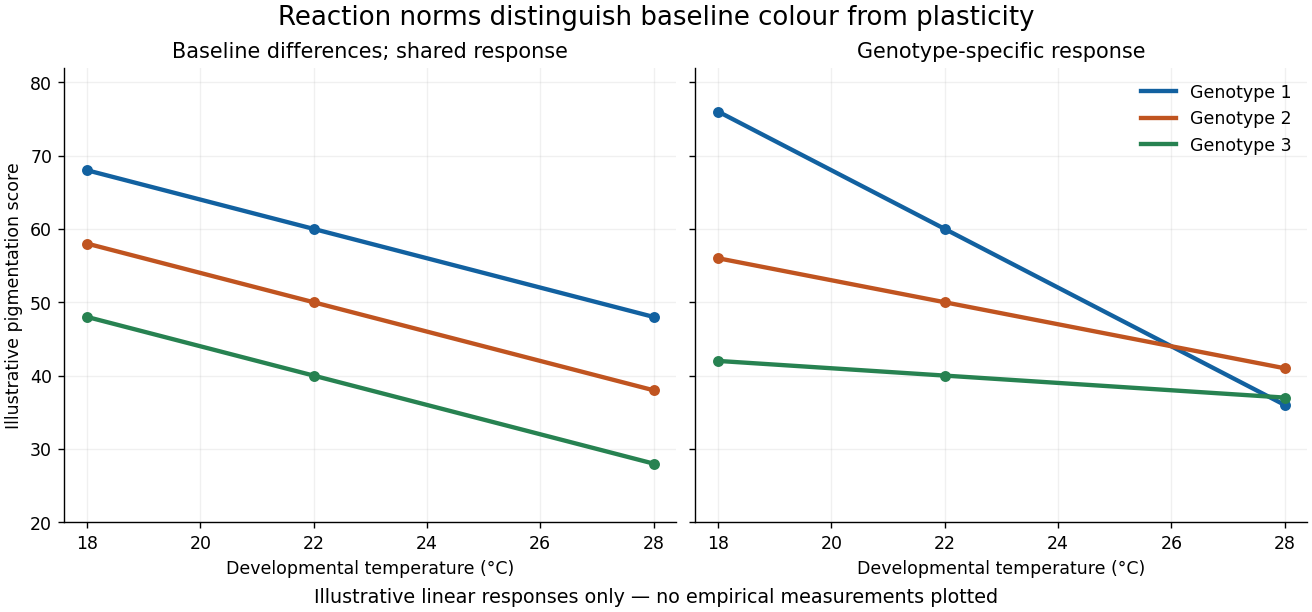
Illustrative pigmentation reaction norms separating baseline genetic differences from genotype-by-temperature interaction
. Details. 
Quantitative trait locus mapping in segregating crosses can locate loci affecting the temperature interaction. A genome-wide association study in a diverse panel can complement it, with controls for relatedness and population structure. Analyse the joint phenotype across temperatures, rather than comparing a significant association at one temperature with a nonsignificant association at another and calling the difference an interaction. Mapping resolution, power and multiple-testing correction determine how many candidate regions can be distinguished.
Follow candidates with staged expression measurements, chromatin assays and functional perturbations. A coding change might alter enzyme temperature sensitivity; a cis-regulatory change might alter where or when the enzyme is produced; a trans-acting chromatin or hormonal regulator could affect several pathways. Allele-specific expression in a shared trans environment can help distinguish cis from trans effects. Replacing an allele or rescuing a perturbation and then measuring the entire reaction norm tests causality more strongly than expression correlation alone.
The expectation is a context-dependent genetic network, potentially including pigmentation enzymes, developmental regulators and chromatin regulation. Jean-Michel Gibert and colleagues found temperature-sensitive regulation involving Abdominal-B, bric-à-brac and chromatin regulators in female abdominal pigmentation. That supports a distributed mechanism rather than a universal dedicated plasticity gene. It does not imply that the same causal variants explain every natural population or all body regions.[ref]
Phenotypic Plasticity in Drosophila Pigmentation Caused by Temperature Sensitivity of a Chromatin Regulator Network by Jean-Michel Gibert and others. Temperature, regional developmental regulation and pigmentation-enzyme expression
Thus one may find variants affecting baseline colour, slope or curvature, as well as environment-dependent dominance and epistasis. Some apparent interactions may disappear after controlling development stage or survival. Demonstrating heritable plasticity does not establish that it is adaptive: that further claim requires fitness comparisons in the relevant environments.
Past exam of the genetics course of the University of Cambridge 2024 Paper 4 2 Solution by Codex 0 2026-10-20
Codex 0 2026-10-20Take selection for darker coats as the premise of the hypothetical example, rather than an established prediction about polar bears. The course of an adaptive walk depends on the available variation, its inheritance, fitness effects and ecological context. Warming alone does not specify a pigmentation mechanism, the strength of selection or whether dark coloration would improve total reproductive success.
The initial response can use standing genetic variation. If darker phenotypes already segregate and have an additive heritable component, a response can begin without waiting for a new mutation. The breeder's equation describes a short-term one-trait expectation under its assumptions. Here is the difference between the mean phenotype of successful parents and the population mean, while is narrow-sense heritability in the relevant environment. Environmental darkening without inherited differences does not supply the same response.
If useful variants are absent, arrival can limit adaptation. In a diploid population with census size and per-haploid-genome beneficial mutation rate , the approximate number of new beneficial copies is per generation. Most rare variants are lost initially. In a suitable large-population, weak-selection model, an allele whose heterozygote has advantage has establishment probability of approximately ; this is not a general formula for every dominance relation or bottleneck. The mutation supply depends on actual reproductive numbers, while effective population size controls much of the drift and inheritance history. Long generation times can make a short walk in generations slow in calendar years.
The genetic architecture matters. A change in pigment production, hair structure or the spatial regulation of a developmental pathway can have different pleiotropic consequences. A large-effect allele may be hidden when recessive, constrained by costs in another trait, or beneficial only after a change at another locus. Under sign epistasis, the sign of a step depends on the starting genotype; under diminishing returns, later favourable steps tend to have smaller benefits on an already adapted background. One-step-at-a-time fixation is only an approximation for a sexual, potentially polygenic population.
Recombination can assemble favourable variants inherited from different parents, but can also break favourable combinations. Gene flow can introduce useful alleles or oppose local adaptation if migrants come from a differently selected population. Population bottlenecks can remove rare variants and strengthen drift. Spatial differences in substrate, prey, mate choice or thermal conditions can maintain more than one coat phenotype instead of producing uniform dark fixation.
Finally, the fitness landscape can move while the population responds. Selection on survival, reproduction, energetic balance and correlated traits must be considered jointly. If demographic decline is faster than adaptive change, the existence of an accessible darker phenotype does not guarantee evolutionary rescue. No particular number of substitutions, waiting time or final shade follows from the premise alone. One would need measurements of inherited variation, population structure, generation time and the fitness of alternative phenotypes in the changing environment.
Past exam of the genetics course of the University of Cambridge 2024 Paper 4 1 Solution by Codex 0 2026-10-20
Codex 0 2026-10-20Sequence divergence alone does not identify its cause. A difference can arise through mutation and spread through genetic drift, natural selection, or both. The useful comparison is with an explicit neutral expectation that accounts for shared ancestry, mutation rate and demographic history, rather than treating every conspicuous genomic difference as an adaptation.
First establish orthology, align homologous sequence accurately, and sample several individuals from each species. An apparent fixed difference in one pair of genomes may actually be segregating variation, an assembly error or comparison of paralogues. An outgroup can help polarize changes, although ancestral polymorphism and introgression can make different genomic regions have different histories. Estimate population size changes, migration and relatedness from many suitably chosen loci before interpreting an exceptional region.
For coding sequence, compare nonsynonymous and synonymous substitution rates per eligible site through the nonsynonymous-to-synonymous substitution rate ratio. A ratio greater than one in an appropriate branch or site model supports adaptive amino-acid substitution; a low average ratio indicates pervasive constraint but can hide positive selection at a few sites. A rise toward one can reflect relaxed purifying selection rather than adaptation. Synonymous sites are useful controls, not guaranteed neutral standards: codon usage, splicing regulation and mutation-context effects can matter.
Within-species polymorphism adds an independent timescale. In the McDonald-Kreitman test, let be nonsynonymous and synonymous fixed differences and their polymorphic counterparts. A simple neutral model predicts matching ratios. An excess is consistent with adaptive fixation, and the idealized estimatorestimates the adaptive fraction of nonsynonymous divergence. John H. McDonald and Martin Kreitman introduced this logic with the Drosophila Adh locus. Slightly deleterious variants inflate , demographic changes affect which variants persist, and low counts make the ratio unstable; the model and uncertainty must therefore be examined rather than interpreting every positive estimate literally.[ref]
Adaptive protein evolution at the Adh locus in Drosophila by John H. McDonald and Martin Kreitman. Polymorphism-divergence comparison and the Adh example
Other signatures are complementary. A recent selective sweep can reduce linked diversity and distort the site frequency spectrum and linkage disequilibrium. Excess differentiation measured by FST can suggest geographically divergent selection, but can also result from reduced within-population diversity or population history. Background selection can mimic some diversity reductions. Comparisons with matched recombination and mutation environments, demographic simulations and several independent populations help discriminate these explanations. Long-maintained variation can instead leave signatures of balancing selection.
Noncoding differences require their own functional tests. A conserved regulatory element with an accelerated lineage-specific substitution rate is a candidate for altered function, but altered mutation bias or GC-biased gene conversion can also produce rapid sequence change. Reporter assays, allele replacement and measurements of expression, phenotype and fitness connect a candidate to a mechanism. Demonstrating an effect on expression does not by itself establish an advantage in the historical environment.
The strongest inference combines an appropriate population-genetic null, agreement among independent signatures, and a functional explanation connected to reproductive success. Conversely, failure to reject neutrality means that the evidence does not discriminate the models at the available resolution; it does not prove that a difference has no effect.
Past exam of the genetics course of the University of Cambridge 2024 Paper 2 7 Solution by Codex 0 2026-10-20
Codex 0 2026-10-20genome defence is a persuasive ancestral function for major small-RNA silencing systems, but the claim is an evolutionary inference, not a demonstrated single origin of every regulatory RNA. Present-day pathways reuse sequence-guided recognition for antiviral responses, transposon control, chromatin organization and developmental regulation. Their shared logic coexists with substantial differences in precursor source, processing enzymes, effectors and target level.
The common principle is that a short nucleic-acid guide can recognize a longer target by complementary base pairing, supplying specificity to an effector protein. This is well suited to defence because a guide repertoire can change when new parasitic sequences appear without requiring a new protein-binding specificity for each invader. Genomic transposon fragments can serve as sources of guides against related active elements. The same programmable recognition can be co-opted to regulate host transcripts. The evolutionary argument is strengthened by widespread defence functions and related Argonaute machinery, but contemporary function alone does not establish the chronological order of origins. It also does not establish that the ancestral guide, target and biogenesis pathway were all RNA-based.
An informative bacterial example is Thermus thermophilus Argonaute, which acquires short DNA guides and restricts foreign DNA. Biochemical cleavage and plasmid experiments show a defence role for a related effector while directly distinguishing it from eukaryotic RNA-guided RNA silencing.[ref]
DNA-guided DNA interference by a prokaryotic Argonaute by Daan C. Swarts and others. 2014, Figures 1–4, guide identity, complementary DNA cleavage and plasmid restriction
This is evidence that sequence-guided defence is evolutionarily deep and chemically flexible. It does not prove that the bacterial system is the direct ancestor of a particular animal microRNA pathway. Comparative gene trees, domain relationships and distributions across species are needed to separate shared ancestry, duplication, loss and independent recruitment.siRNA pathways usually begin with a relatively long double-stranded RNA. Viral replication intermediates, inverted repeats, convergent transcription or pairing of sense and antisense RNAs can supply the duplex. Dicer cleavage generates short duplexes, commonly around 21–23 nucleotides in familiar animal examples, and one strand is retained as a guide by an Argonaute-containing RNA-induced silencing complex. With extensive complementarity and a catalytically competent Argonaute, target cleavage occurs opposite the region around guide nucleotides 10–11. Other effector contexts couple recognition to repression or chromatin changes. Introducing purified double-stranded versus single-stranded RNA into C. elegans demonstrated the high potency and sequence specificity of the double-stranded trigger, with effects in treated animals and descendants.[ref]
Potent and specific genetic interference by double-stranded RNA in Caenorhabditis elegans by Andrew Fire and others. 1998, pp. 806–811, strand-structure and delivery controls
The original experiment establishes a mechanism of interference, not proof that its physiological ancestral role was defence.In species possessing the appropriate RNA-dependent RNA polymerases, a primary recognition event can generate many secondary guide RNAs and spread or prolong silencing. This amplification is not a universal property of animal RNA interference: flies and mammals do not simply implement the nematode secondary-siRNA system. In some organisms, small RNAs also act in the nucleus. In fission yeast, Argonaute-containing RITS couples sequence recognition to heterochromatic silencing at repetitive regions; RNAi-factor mutants alter H3K9 methylation and silencing, while biochemical purification identifies the targeting complex.[ref]
Regulation of heterochromatic silencing and histone H3 lysine-9 methylation by RNAi by Thomas A. Volpe and others. 2002, pp. 1215–1219, RNAi-factor mutants and chromatin readouts
[ref]RNAi-mediated targeting of heterochromatin by the RITS complex by André Verdel and others. 2004, complex purification and sequence-associated heterochromatin targeting
Thus the ultimate target can be transcriptional competence at a genomic region rather than just the lifetime of an individual messenger RNA.In plants, RNA-directed DNA methylation provides a related but distinct nuclear output. In a canonical route, specialized RNA polymerase IV and RNA-dependent RNA polymerase activity produce precursors processed by DCL3 into roughly 24-nucleotide siRNAs; AGO4-associated guides recognize scaffold transcripts linked to RNA polymerase V and recruit de novo methylation machinery including DRM2. This is not the canonical animal microRNA pathway transported into a plant nucleus.[ref]
RNA polymerase IV directs silencing of endogenous DNA by A. J. Herr and others. 2005, pp. 118–120, polymerase mutants, RDR2/DCL3 and repeat silencing
Genetic identification of AGO4 showed effects on locus-specific small RNAs, non-CG DNA methylation and histone methylation, linking a small-RNA effector to genomic repression.[ref]ARGONAUTE4 control of locus-specific siRNA accumulation and DNA and histone methylation by Daniel Zilberman and others. 2003, pp. 716–719, ago4 mutant effects at SUPERMAN and AtSN1
Repeats are important targets, while co-option at host regulatory loci can affect development.microRNAs use selected endogenous hairpins and often regulate host developmental programmes. In the canonical animal pathway, a primary transcript is cleaved by nuclear Drosha with DGCR8, the precursor hairpin is exported by Exportin-5, and Dicer processing produces a short duplex for Argonaute loading. The guide commonly recognizes animal targets through seed pairing around positions 2–8 plus additional context-dependent interactions. It can recruit translational repression and deadenylation/decapping, leading to reduced protein production and RNA stability. Extensive complementarity and a suitable effector can instead support slicing; “all microRNAs only block translation” is therefore inaccurate. In plants, microRNAs use a different processing arrangement and often more extensive target complementarity, so the detailed animal scheme should not be treated as universal.
Developmental roles include the timing of cell-state transitions, stabilization of differentiation and suppression of inappropriate gene expression. The discovery that C. elegans lin-4 produces small noncoding RNAs complementary to the lin-14 3′ untranslated region directly connected a small RNA with developmental timing rather than foreign-sequence destruction.[ref]
The C. elegans heterochronic gene lin-4 encodes small RNAs with antisense complementarity to lin-14 by Rosalind C. Lee and others. 1993, pp. 843–854, rescue, RNA identification and target complementarity
Duplication and divergence of a hairpin can generate new regulatory interactions, and target-site evolution can incorporate existing guides into a host gene regulatory network. This makes defence-to-regulation co-option plausible without implying that each modern microRNA descended from a recognizable transposon sequence. Similar guide lengths alone are not evidence for that descent.piRNA pathways are especially important in the animal germline, where transposon damage can be inherited. In flies and mammals, typical piRNAs are longer than standard siRNAs, often approximately 24–31 nucleotides, and bind Piwi-family Argonautes. They are generated from single-stranded precursors by Dicer-independent mechanisms. Primary processing, including Zucchini-dependent cleavage in Drosophila, supplies guides that can initiate cytoplasmic target destruction or nuclear silencing. piRNA clusters containing transposon fragments provide a repertoire complementary to potentially active elements elsewhere. Piwi-family immunoprecipitation and small-RNA sequencing linked these loci to transposon-targeting guide populations.[ref]
Discrete small RNA-generating loci as master regulators of transposon activity in Drosophila by Julius Brennecke and others. 2007, pp. 1089–1103, clusters, Piwi-family associations and strand relationships
In the fly germline, Aubergine/AGO3-mediated reciprocal cleavage can produce ping-pong amplification: cleavage of a complementary RNA creates an end of a new guide, helping regenerate antisense and sense guide populations. A characteristic ten-nucleotide overlap of opposite-strand guide 5′ ends supports this mechanism. It is not a rule that every piRNA is made by ping-pong or that every Piwi protein has the same localization or catalytic activity. In particular, fly somatic ovarian follicle cells also use a piRNA system, including primary processing and nuclear Piwi-mediated transposon control, without simply duplicating the full germline amplification arrangement. This germline-versus-soma distinction is a strong biological bias, not an absolute partition of RNA classes.[ref]
Specialized piRNA Pathways Act in Germline and Somatic Tissues of the Drosophila Ovary by Colin D. Malone and others. 2009, pp. 522–535, pathway mutants, small-RNA populations and somatic versus germline Piwi activities
Maternal piRNAs can prepare the embryo and developing germline to recognize elements inherited through a cross. Reciprocal Drosophila crosses with comparable transposon inheritance can differ in fertility and target-directed piRNAs depending on maternal history, as shown in hybrid-dysgenesis studies.[ref]
An epigenetic role for maternally inherited piRNAs in transposon silencing by Julius Brennecke and others. 2008, pp. 1387–1392, reciprocal crosses and inherited piRNA populations
This is a mechanistic explanation of a parent-of-origin effect that ordinary zygotic genotype alone misses. It should not be confused with the claim that every maternal piRNA persists unchanged into adulthood: inherited guides can initiate later amplification and regulatory state establishment.In fetal male mouse germ cells, MILI and MIWI2 couple piRNA production to transposon control during establishment of DNA methylation. MILI-associated cytoplasmic processing and MIWI2 nuclear activity link post-transcriptional surveillance to a durable genomic output. The observation that piRNAs remain in methylation-defective mutants helps place piRNA production upstream of methylation rather than treating the two as mutually defining readouts.[ref]
A piRNA Pathway Primed by Individual Transposons Is Linked to De Novo DNA Methylation in Mice by Alexei A. Aravin and others. 2008, pp. 785–799, MILI/MIWI2, localization and methylation-pathway mutants
Somatic vertebrate development also relies heavily on microRNAs, but loss of all Dicer-dependent processing cannot be attributed to one microRNA or to transposon defence alone.Two exceptions expose the weakness of a rigid soma-miRNA/germline-piRNA division. Mouse oocytes produce endogenous siRNAs from naturally paired transcripts and inverted-repeat sources; Dicer/Ago perturbations and small-RNA sequencing support roles in regulating host transcripts as well as repeat-derived RNAs.[ref]
Endogenous siRNAs from naturally formed dsRNAs regulate transcripts in mouse oocytes by Toshiaki Watanabe and others. 2008, pp. 539–543, endogenous precursor sources and Dicer/Ago-dependent regulation
In C. elegans, PRG-1-associated 21U piRNAs are approximately twenty-one nucleotides long and can initiate secondary 22G-RNA production through RNA-dependent RNA polymerases. Nuclear Argonautes such as HRDE-1 participate in inherited repression. These nematode piRNAs are Dicer-independent but do not implement the same biogenesis and ping-pong architecture as fly germline piRNAs. Removing a piRNA trigger after establishment can leave silencing maintained for many generations by nuclear RNAi/chromatin machinery, experimentally separating initiation from memory.[ref]piRNAs Can Trigger a Multigenerational Epigenetic Memory in the Germline of C. elegans by Alyson Ashe and others. 2012, pp. 88–99, trigger removal and maintenance-factor mutants
A rigorous experimental comparison would therefore identify both the small RNA and the effector. Size-resolved small-RNA sequencing, strand and end-chemistry analysis, and Argonaute/Piwi immunoprecipitation would establish guide populations. Dicer/Drosha versus Piwi-pathway perturbations test biogenesis requirements; catalytic-dead rescue distinguishes slicing from a noncatalytic binding role. Matching target RNA, protein, nascent transcription, chromatin marks and new transposon insertions separates repression of expression from prevention of mobilization. Editing an endogenous guide-recognition site and rescuing it with a compensatory guide is stronger evidence for direct targeting than a seed match alone. Observed germline sterility requires measurements of DNA damage, cell survival and gametogenesis before it is assigned to one target mechanism. Reciprocal crosses, removal of the initiating trigger and continued sequencing of the locus distinguish maternal carryover, stable epigenetic propagation and DNA-sequence change.
The best-supported conclusion is diversification and repeated co-option of sequence-guided silencing machinery. Defence against mobile or foreign sequences supplies a strong functional rationale and clear modern examples; developmental host-gene regulation, distinct precursor pathways and lineage-specific nuclear outputs demonstrate subsequent specialization. Reconstructing the actual ancestral order requires comparative evidence beyond these functional similarities. The assertion is therefore useful as a tested evolutionary framework, provided it is not expanded into an unsupported claim of one unchanged pathway or one origin for every small RNA.
Past exam of the genetics course of the University of Cambridge 2024 Paper 2 6 Solution by Codex 0 2026-10-20
Codex 0 2026-10-20Hox genomic organization reflects both the history of duplication and rearrangement and selection on developmental regulation. Shared regulation can preserve a cluster, but positional Hox function does not universally require physical clustering. The central distinction is between conservation of the gene family, conservation of linkage, and conservation of spatial or temporal expression order.
Hox genes encode homeodomain transcription factors that contribute regional identity along the anterior–posterior axis and have additional tissue-specific deployments. They are a subset of homeobox-containing genes: neither the presence of a homeobox nor a developmental function alone identifies a gene as Hox. Related sequences and conserved genomic relationships imply that local duplication and divergence helped generate the ancestral family. Tandem duplication creates linked copies with shared regulatory surroundings; subsequent divergence can partition expression and target specificity. Comparing an anterior, a central and a posterior Hox class across multiple species is more informative about this history than comparing names alone, because lineage-specific duplication and loss can obscure one-to-one orthology.
An ancestral cluster is inferred from the distribution of related Hox genes and synteny across animals, not from a belief that the modern species with the simplest cluster is the ancestor. Modern amphioxus has a single Hox cluster and helps constrain the organization before vertebrate cluster multiplication. Comparative mapping established the value of that unduplicated organization for reconstructing chordate history.[ref]
Archetypal organization of the amphioxus Hox gene cluster by Jordi Garcia-Fernàndez and Peter W. H. Holland. 1994, pp. 563–566, genomic cluster organization and chordate comparison
Modern amphioxus has also evolved independently; its present complement is not a frozen ancestral genome.Early vertebrate large-scale duplications contributed to multiple Hox clusters, followed by extensive loss and divergence. Both humans and mice retain four clusters, conventionally HoxA–D, with thirty-nine genes distributed among thirteen paralogy groups, rather than thirteen genes retained in every cluster. The idealized arithmetic explains the opportunity created by two duplication rounds; the extant complement requires gene loss and retention as well. A duplicated Hox family alone would not establish whole-genome duplication: paralogous flanking regions and genome-wide synteny provide independent evidence. Teleost history includes further duplication and lineage-specific cluster/gene losses, so a universal “fish have eight complete clusters” rule would be wrong. Comparative pufferfish organization and expression show both retained duplicate deployments and divergence among ray-fin fish.[ref]
Developmental Roles of Pufferfish Hox Clusters and Genome Evolution in Ray-Fin Fish by Angel Amores and others. 2004, pp. 1–10, duplicated cluster organization, expression and lineage-specific retention
Duplication can permit subfunctionalization, in which copies divide ancestral expression domains, or neofunctionalization, in which a retained copy acquires a new deployment. Dosage constraints and overlapping functions can instead preserve similar copies. These possibilities predict different changes in enhancers, coding regions and expression. Total gene number is consequently not a simple scale of morphological complexity. A lineage can change body organization by altering Hox regulation without increasing its Hox count, or retain many duplicates while losing particular structures.
Three kinds of collinearity must be kept separate. In Hox spatial collinearity, genomic order corresponds to the ordered anterior expression limits of Hox genes along the body axis. In Hox temporal collinearity, genes are activated in a sequence corresponding to their order, typically with anterior-class genes near the 3′ end activated before more posterior-class genes nearer the 5′ end in vertebrate axial progenitors. Hox quantitative collinearity concerns expression levels or relative contributions in a domain. None implies that every Hox gene is expressed exclusively in one nonoverlapping segment. Overlapping domains and context-dependent posterior prevalence can implement regional identity through combinations and regulatory hierarchy.
A compact ordered cluster can facilitate sequential exposure to activating influences and coordinated changes in chromatin. Polycomb-associated repression helps maintain inactive domains, while activation changes accessibility and chromatin interactions. Signals such as retinoid, Wnt and FGF inputs can be interpreted by local enhancers and cluster-scale regulation. In an elongating embryo, a progenitor's time of activation and time of leaving the posterior zone can be converted into a position in the axis. In chick, manipulating Hoxb activity links activation order to mesodermal ingression behaviour, providing an experimental connection between a genomic schedule and morphogenesis.[ref]
Collinear activation of Hoxb genes during gastrulation is linked to mesoderm cell ingression by Tadahiro Iimura and Olivier Pourquié. 2006, pp. 568–571, expression timing and altered ingression
That connection is a mechanism to test, not a proof that all spatial Hox boundaries are produced by one clock.Cluster rearrangements are especially informative because an expression correlation alone cannot demonstrate why linkage matters. Mouse HoxD inversions that split the cluster, together with deletion and duplication alleles, alter early temporal regulation without equivalently determining every later axial expression pattern. These manipulations distinguish controls acting on early onset from subsequent spatial regulation.[ref]
Uncoupling time and space in the collinear regulation of Hox genes by Patrick Tschopp and others. 2009, e1000398, cluster-splitting inversion and deletion/duplication comparisons
They support selection on cluster integrity for particular coordinated regulatory tasks while rejecting the stronger assertion that timing and spatial order are inseparable properties.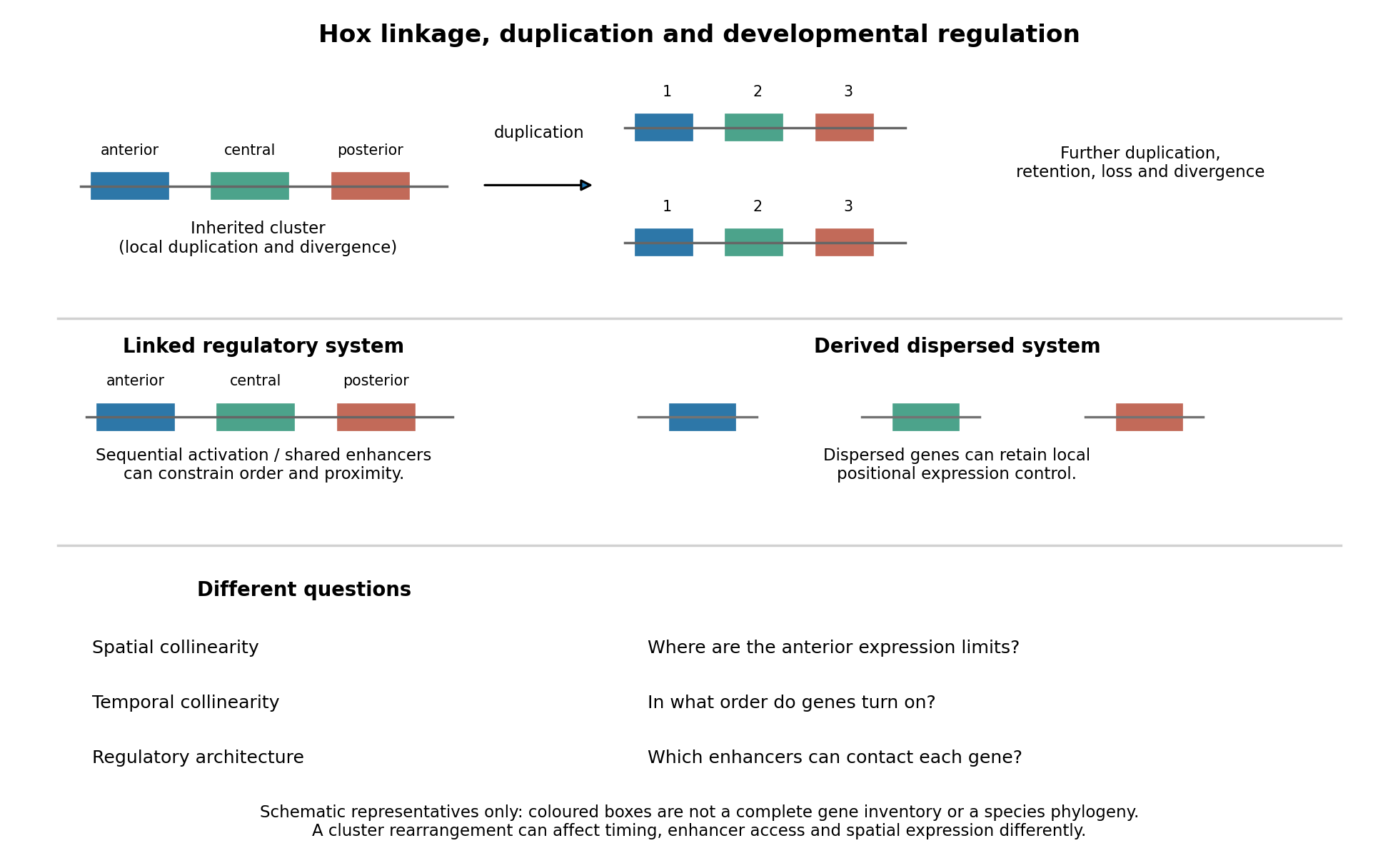
Duplication, shared regulation and dispersal impose different constraints on Hox genomic organization
. Details. 
Shared long-range enhancers can also constrain which genes remain together. Mouse HoxD is flanked by distinct regulatory landscapes used in different phases of limb development. Contact maps and perturbations show a switch between domains associated with proximal and distal limb expression, with centrally located genes able to engage different landscapes.[ref]
A switch between topological domains underlies HoxD genes collinearity in mouse limbs by Guillaume Andrey and others. 2013, article 1234167, flanking domains and developmental contact switch
Moving a gene or deleting a boundary can therefore change enhancer access even if its protein-coding sequence is unaltered. A contact map by itself remains a physical association assay; enhancer deletions, rearrangements and expression measurements establish regulatory consequences. This provides a plausible source of purifying selection on gene order, spacing and flanking noncoding sequence, alongside scope for new tissue-specific enhancer use.evolution also supplies counterexamples to obligatory clustering. Drosophila's Hox genes occur in separated Antennapedia and bithorax complexes, showing that splitting an ancestral arrangement need not eliminate axial patterning. More dramatically, the tunicate Oikopleura dioica has dispersed Hox genes, while their expression retains aspects of anteroposterior ordering in different tail tissues. Genomic analysis and in situ hybridization demonstrate the coexistence of dispersal and residual spatial order.[ref]
Hox cluster disintegration with persistent anteroposterior order of expression in Oikopleura dioica by Hee-Chan Seo and others. 2004, pp. 67–71, linkage and tissue-specific expression
This does not mean dispersion was harmless, or that all quantitative and temporal relationships were conserved. Rather, local regulatory modules can retain positional deployment where a shared cluster-wide control is no longer required or has been replaced.Genomic rearrangements, duplication and loss continually generate alternatives; developmental integration filters their consequences. A lineage relying heavily on coordinated sequential activation and shared enhancers may tolerate fewer breaks, whereas modularized regulation can relax that constraint. The association of a dispersed cluster with a particular mode of development is still an evolutionary hypothesis, not proof that developmental mode caused the rearrangement. An adequate test would compare independent evolutionary transitions, reconstruct ancestral linkage with outgroups, and assay homologous developmental stages and tissues. Engineering a rearrangement while preserving coding sequence, then measuring activation timing, spatial boundaries, chromatin contacts and phenotype, tests its developmental cost directly. Conserved clustering is best explained by inherited organization plus context-dependent regulatory constraints; surviving dispersal shows that those constraints can evolve.
Past exam of the genetics course of the University of Cambridge 2024 Paper 2 5 Solution by Codex 0 2026-10-20
Codex 0 2026-10-20gastrulation is coordinated at tissue scale but implemented through changes in individual cells: motility, adhesion, polarity and shape. “Individual” and “collective” describe different aspects of the mechanism, not mutually exclusive types of embryo. A cell can move relative to its neighbours while transmitting force or receiving directional information through those same neighbours. Conversely, nearby cells can share a trajectory because they are passively carried by a moving tissue.
The principal outcomes are internalization and rearrangement of germ-layer progenitors, establishment of their relative positions and elongation or spreading of the embryonic axis. Ingression internalizes individual cells, whereas invagination bends a connected epithelial sheet; involution rolls tissue across a margin. Convergent extension changes tissue proportions, while epiboly spreads a tissue over a larger surface. These geometrical descriptions should be distinguished from the force-generating mechanisms. For example, two embryos can both extend but use different mixtures of oriented intercalation, migration, shape change and growth.
Individual motility is especially apparent after cells leave an epithelium. In mouse, epiblast cells approach the primitive streak, reorganize junctions, cross a locally permissive basement membrane and undergo an epithelial-to-mesenchymal transition. Once internalized, mesodermal cells migrate between epiblast and endoderm. Protrusions, cytoskeletal force production and transient attachment to neighbouring cells or extracellular matrix produce movement. This allows descendants to disperse to distinct destinations and respond to local signals. Downregulation of stable epithelial adhesion can facilitate departure, but productive migration still requires regulated interactions: complete loss of coupling can prevent traction or integration.
FGFR1 illustrates the connection between regulatory state and cell behaviour. Its perturbation affects mesodermal gene expression as well as Snail/E-cadherin regulation and movement from the mouse streak.[ref]
FGF signaling regulates mesoderm cell fate specification and morphogenetic movement at the primitive streak by Brian Ciruna and Janet Rossant. 2001, pp. 37–49, separate differentiation and epithelial-to-mesenchymal-transition readouts
Therefore accumulation of cells at a streak cannot automatically be interpreted as a pure motility defect. I would determine whether they acquired the expected identity, whether they detached from the epithelium, and whether viable detached cells can migrate. A normal motility protein does not restore gastrulation if the progenitor population was never specified.Collective invagination coordinates local contractions through a mechanically continuous sheet. In the Drosophila ventral furrow, mesodermal cells constrict their apical surfaces and become wedge-shaped, bending the epithelium inward. Apical actomyosin contraction is transmitted to neighbours through adherens junctions; surrounding tissue and basal cell properties constrain the resulting deformation. Live imaging showed pulses of medial apical actin–myosin contraction rather than a universally continuous circumferential purse string. Stabilization between pulses produces a ratchet-like reduction in apical area; Snail and Twist perturbations separate contraction initiation from stabilization.[ref]
Pulsed contractions of an actin-myosin network drive apical constriction by Adam C. Martin and others. 2009, Figures 1–4, live myosin dynamics, apical-area changes and transcription-factor perturbations
Asynchronous pulses in individual cells can thus contribute to a coherent tissue fold. Collective behaviour does not require every cell to contract simultaneously, and a cell's change in shape need not equal its net translational displacement.Collective extension often requires cells to exchange neighbours rather than preserve one fixed group arrangement. During Xenopus dorsal mesoderm convergence and extension, cells polarize, make biased protrusions and intercalate mediolaterally. The tissue narrows across its width and extends along the body axis without requiring a corresponding increase in cell number or total volume. Coordinated planar cell polarity signalling coordinates this orientation. Dishevelled perturbation disrupts polarized behaviour and extension even when the relevant cell fates remain, supporting a role in morphogenesis separable from specification.[ref]
Dishevelled controls cell polarity during Xenopus gastrulation by John B. Wallingford and others. 2000, pp. 81–85, time-lapse imaging, polarity-defective perturbations and fate controls
Individual cells are active force-generators, but their useful orientations and contact rearrangements depend on tissue organization. Merely increasing cell speed would not necessarily restore directional intercalation.A kinematic check illustrates the distinction from growth. If a roughly rectangular tissue of constant thickness and area changes from width and length to and , it has undergone strong convergence and extension while preserving . Actual gastrulating tissues can also change thickness, proliferate and exchange cells, so this is an illustrative conservation argument rather than an assertion of strict area conservation. Quantifying all three dimensions and cell number is required before attributing axis elongation entirely to intercalation.
The zebrafish prechordal plate provides a particularly clear experiment distinguishing individual movement from collective guidance. Isolated prechordal cells remain polarized and motile but lose their normal directional migration toward the animal pole. Directionality returns when they contact the endogenous plate, with E-cadherin, Wnt/planar-cell-polarity components and Rac1 implicated in the response. Even an isolated group is not automatically oriented correctly.[ref]
Collective mesendoderm migration relies on an intrinsic directionality signal transmitted through cell contacts by Julien G. Dumortier and others. 2012, pp. 16945–16950, isolated-cell/group transplantation and contact-dependent orientation
Thus collective movement is more than the sum of many cells independently sensing the same external attractant. Nor does the experiment prove that the frontmost cell alone is a permanently designated leader. The informative observation is retention of motility but loss and restoration of directional information.epiboly demonstrates how an adjacent tissue can supply a substantial driving force. In zebrafish, the superficial enveloping layer spreads over the yolk while deeper populations rearrange. Here, radial intercalation helps thin and spread deep tissue. Contractile actomyosin in the yolk syncytial layer contributes pulling at the epithelial margin. Force and flow analysis showed that retrograde actomyosin flow can generate pulling through resistance, in addition to circumferential contraction; spreading can proceed when circumferential constriction alone would be unproductive.[ref]
Forces driving epithelial spreading in zebrafish gastrulation by Martin Behrndt and others. 2012, pp. 257–260, actomyosin flow, mechanical analysis and epithelial spreading
Observing a cell move vegetally therefore does not establish that its own crawling supplies the principal force. Collective morphogenesis can couple embryonic and extraembryonic compartments.The movement classes are related developmentally. A coherent epithelium can first bend, then release cells that migrate individually, which can later establish new collective arrangements. Partial retention of contacts can permit a mesenchymal population to remain coordinated. Such cell rearrangement changes exposure to inducing signals and the mechanical environment, so movement can influence fate as well as execute a prior fate decision. The comparison should therefore ask where force originates, how it is transmitted, what gives direction and which contacts persist, rather than assign one universal movement mode to gastrulation.
I would test these alternatives with simultaneous nuclear, membrane, junctional and actomyosin imaging. Trajectories should be measured relative to neighbouring cells and matrix landmarks to subtract tissue advection. Speed, directional persistence, neighbour exchange, cell shape and spatial velocity correlations answer different questions; a common external pull can correlate velocities without contact-mediated guidance. Sparse mosaics distinguish a cell-intrinsic motility defect from a surrounding-tissue defect. Isolated-cell versus group transplants test whether direction requires neighbours. Acute, local perturbation after fate specification, followed by rescue, reduces the ambiguity of early patterning mutants. Local laser severing and recoil can reveal prestress, but recoil also depends on dissipation and is not an absolute force measurement without a mechanical model. Matching viability, proliferation, adhesion and differentiation controls is essential. The strongest explanation connects an individual behaviour to a measurable tissue deformation and shows, by perturbation, which interactions make that behaviour productive.
There are unlisted articles, also show them or only show them.