Catalysis accelerates a chemical reaction by providing an alternative reaction mechanism with a more accessible barrier through its transition states. A catalyst participates in the route and is regenerated. At fixed temperature, catalysis changes how quickly chemical equilibrium is reached without changing the equilibrium constant; it does not make an unfavourable overall change in Gibbs free energy favourable. [ref]
Chemistry 2e by Paul Flowers and others. §12.7, opening definition and Figure 12.19: alternative mechanisms and regeneration
[ref]13.3 Shifting Equilibria: Le Châtelier’s Principle. §13.3, Effect of a Catalyst: equilibrium composition is unchanged
In his 1909 lecture, Wilhelm Ostwald recalled the introduction of the term catalysis by Jöns Jacob Berzelius and emphasized measurable acceleration rather than merely naming an unexplained force. He also discussed reaction intermediates and participation of the catalyst in the steps whose sum gives the net chemical reaction. This is a participant's retrospective account, not evidence that every catalytic reaction mechanism is the same.[ref]
On Catalysis. On Catalysis, lecture dated 12 December 1909; paragraphs beginning “The factor which Berzelius regarded” and “It is appropriate here”; editorial footnote says the lecture was reconstructed from notes
Hydrogen-bond catalysis preferentially stabilizes a reactive configuration through hydrogen bonds. A hydrogen bond to an intermediate or bound substrate is evidence of an interaction, but its catalytic contribution depends on differential stabilization relative to the starting state.
Metal ion catalysis uses a coordinated metal ion to activate a reagent, orient reactants or stabilize charge. Zinc can lower the acidity constant of coordinated water and support attack by the resulting oxygen nucleophile without a metal redox step.
Proximity and orientation catalysis favors reaction by bringing partners together in a productive geometry. A binding interaction is catalytic only insofar as it improves access to the reactive configuration relative to the starting state.
Electrostatic catalysis preferentially stabilizes developing charge along the reaction pathway. The comparison must be with the bound reactant: equally stabilizing ground and transition states does not lower their activation free-energy difference.
Covalent catalysis creates a temporary covalent bond between catalyst and substrate, then breaks that bond while regenerating the catalyst. Merely forming a substrate–water bond does not constitute covalent catalysis by an enzyme residue.
General base catalysis uses a base to accept a proton during the reacting pathway, for example activating water while it forms a bond. It need not involve an equilibrium pool of free hydroxide.
General acid catalysis uses proton donation from an acid participating in the rate-influencing reaction pathway. It can activate an electrophile or assist protonation of a departing or newly formed group.
Transition state stabilization lowers an activation barrier when a catalytic environment stabilizes the reacting configuration more than the starting bound state. Stronger ground-state binding alone does not demonstrate catalysis.
A catalytic group that accepts a proton during a reaction step, increasing the reactivity of another group such as a hydroxyl nucleophile.
A catalytic cycle follows the changing forms of a catalyst through a reaction mechanism until its starting form is regenerated. The schematic binding cycle in catalyst illustrates the bookkeeping: C is consumed and recovered, whereas AC is a reaction intermediate formed and consumed. Cancelling both gives the net A-to-B chemical equation. Regeneration concerns the completed cycle; it does not imply that C avoids forming chemical bonds or exchanging electrons. An alternative reaction mechanism may have more elementary reactions than the uncatalysed route and still be faster.[ref]
Chemistry 2e by Paul Flowers and others. §12.7, Figure 12.19 and Homogeneous Catalysts: alternative steps, intermediate formation and catalyst regeneration
For that reversible binding cycle, ideal thermodynamic activities give step equilibrium constants and . Their product is : the same cancellations occur in the equilibrium bookkeeping. Choose consistent standard states for the species. A proposed cycle with for the same net conversion at the same temperature would contradict its specified thermodynamics. This statement concerns free-species thermodynamic activities. Appreciable binding in AC can change how the conserved total amount is partitioned among free A, free B and bound AC. An assay counting bound and free material together therefore needs that additional balance; unchanged does not by itself guarantee identical analytical totals when the amount of C changes.
A directional Gibbs energy of activation measures the climb from a starting state to a transition state. The net standard reaction change in Gibbs free energy measures the difference between endpoints. Changing the climb can strongly change a rate constant while leaving that endpoint difference intact. For two illustrative single-barrier routes with common endpoint levels and ,Lowering the common transition state level lowers both directional Gibbs energies of activation; it does not lower just the forward climb. The usual statement that a catalyst lowers an activation energy describes a kinetic route, not a change in the net Gibbs free energy. An activation energy inferred from an Arrhenius plot is also distinct from a Gibbs energy of activation at one temperature.
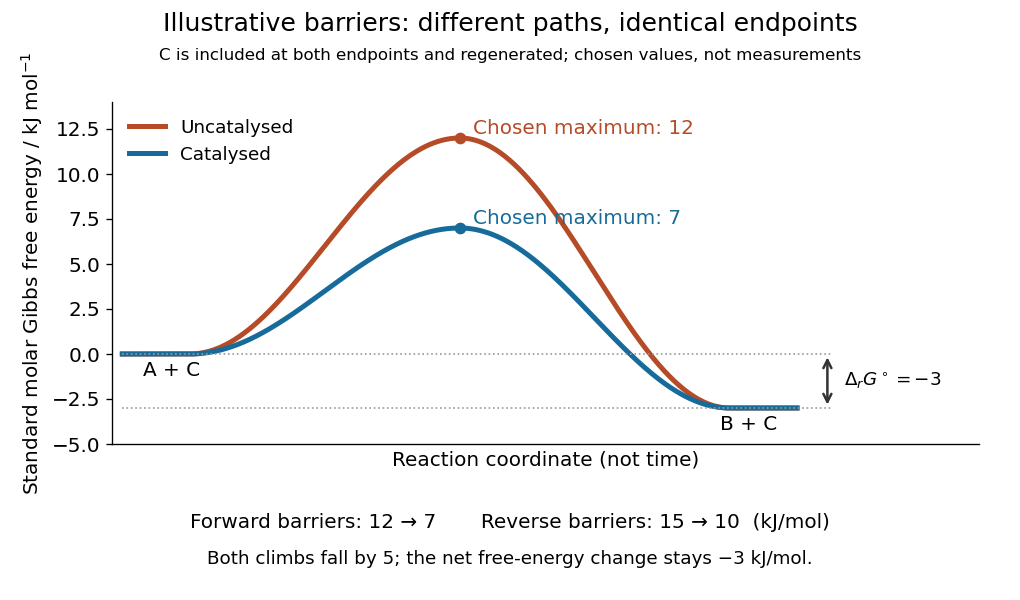
Illustrative catalysis schematic: different barriers, identical endpoint Gibbs free energy difference
. Chosen levels in : A plus regenerated C at , B plus regenerated C at , and schematic maxima at and . Forward barriers are and ; reverse barriers are and . Neither curve is a measured molecular path. The reaction coordinate is not time. These values illustrate the barrier bookkeeping and do not parametrize the separate reversible catalytic relaxation example. Details.With a common prefactor in transition state theory, subtracting the directional barriers yieldswhere is the molar gas constant and is the absolute temperature. This particular rate constant ratio requires the simple compatible directional rate laws and consistent standard states; a general multistep reaction mechanism does not supply two arbitrary measured rate constants whose ratio must equal . At fixed temperature a catalyst preserves for the same net conversion. The actual reaction change in Gibbs free energy, , is likewise unchanged at the same reaction quotient . Composition changes during the faster approach to chemical equilibrium, so comparing mixtures at the same elapsed time need not compare the same .[ref]
13.3 Shifting Equilibria: Le Châtelier’s Principle. §13.3, Effect of a Catalyst: both directional rates accelerate while equilibrium composition is unchanged
Here is an explicitly stipulated elementary kinetic model, not experimental data. A well-mixed ideal closed system has constant temperature and volume. Alongside an uncatalysed elementary reaction, allow an illustrative catalytic encounter that returns C immediately:Both channels obey the law of mass action. In the second, the forward reaction rate is and the reverse reaction rate is . C cancels in each encounter, so its free concentration stays constant without an external supply. This toy elementary reaction encodes regeneration without binding; it is not a claim that real catalytic cycles universally consist of one encounter. A binding cycle can accumulate a reaction intermediate, in which case constant total C does not imply constant free .
Adding the parallel reaction rates gives effective first-order reaction rate constantsBecause , each channel balances at the same , and so does their sum. At the pair is ; at it is . Both give with ideal thermodynamic activities and a common concentration standard state. At their compatible standard reaction change in Gibbs free energy is . Choosing an unrelated reverse rate constant would break this consistency.
Let be the conserved concentration, and define the dimensionless quantity . ThenSolving this first-order linear differential equation givesThe chemical relaxation time is without C and with the chosen C. From either or , the exponential decay of the deviation leads to the same chemical equilibrium . Reducing that deviation to one percent takes : about versus .
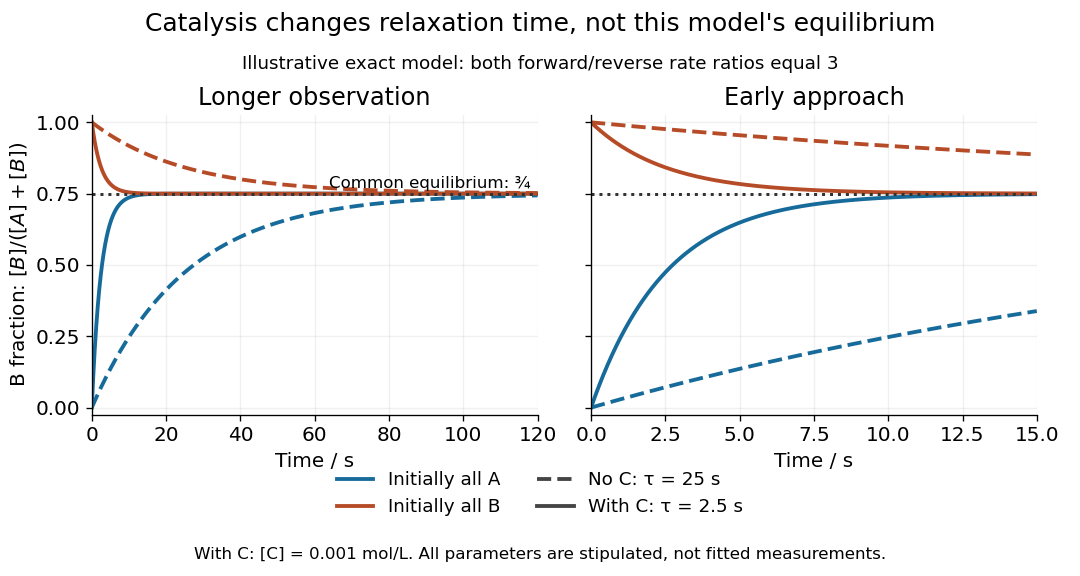
Two initial compositions and two kinetic speeds approach the same chemical equilibrium
. Exact curves from the stipulated reversible catalytic relaxation model. Solid curves include of C; dashed curves omit C. Blue starts entirely as A and orange entirely as B. Both panels use the same equations; the right panel resolves the first . The common dotted line is , not a fitted plateau or an experimental measurement. Details.At this chemical equilibrium, conversion continues in both directions. For , the uncatalysed channel has equal forward and reverse reaction rates . Adding C gives total directional reaction rates each, yet zero net reaction rate. Faster molecular exchange and unchanged composition coexist. This exact calculation explains how catalysis can matter enormously within an observation window while leaving the final equilibrium constant intact.
Catalytic selectivity concerns which reaction products form when competing reaction mechanisms are available. Faster conversion is valuable when a process would otherwise be impractically slow; a suitable catalyst can also favour a useful product within the available time. In an illustrative pair of irreversible first-order reactions A to B and A to D, the initial fraction of converted A going to B is . Multiplying both rate constants by the same factor changes speed but leaves this fraction unchanged; changing their relative values changes the kinetic product split. This is a finite-time kinetic illustration, not a new equilibrium constant.
A catalyst need not accelerate every competing chemical reaction equally. Enzymes, for example, can distinguish substrates through their active sites.[ref]
Chemistry 2e by Paul Flowers and others. §12.7, Enzyme Structure and Function, Figure 12.25: substrate binding and specificity
If every relevant reversible channel eventually equilibrates in a closed system, its final chemical equilibrium still obeys the endpoint thermodynamics. Selective acceleration, product removal, or external driving can make an observed product distribution depend on time and operating conditions. A claim of improved yield must specify those conditions.Catalyst deactivation is loss of catalytic activity during use. Regeneration in an ideal catalytic cycle does not rule out a separate damaging chemical reaction, blocking of a surface, or physical loss of catalyst from the apparatus. A route can also be slowed by diffusion to the surface or by accumulation of a reaction intermediate. Such effects limit the usefulness of a low schematic reaction energy barrier: measured throughput depends on the whole reaction mechanism and on transport. Demonstrating regeneration requires more evidence than observing a faster first run. For a recovered solid catalyst, a useful further comparison is a second run with fresh reactants, matched recovered amount, and the same mixing and temperature, alongside a fresh-solid run and a blank. Loss during recovery or residual reactants can otherwise imitate catalyst deactivation or apparent reuse. This is a proposed control, not an observation reported for the catalysed peroxide comparison.
For a liquid example, specify hydrogen peroxide as the reactant, dissolved iodide as the catalyst, and water as the solvent. If both reacting chemical species remain dissolved in that one liquid thermodynamic phase, this is homogeneous catalysis. The University of Wisconsin–Madison's The Rate of a Reaction identifies iodide-catalysed hydrogen peroxide decomposition in its final example; the aqueous setting here makes the phase roles explicit.[ref]
The Rate of a Reaction by University of Wisconsin–Madison Department of Chemistry. The Rate of a Reaction, final Example: iodide-catalysed decomposition of hydrogen peroxide
Its net chemical equation isThe molecular oxygen is a reaction product: its bubbles do not make the dissolved catalytic route heterogeneous catalysis. The classification compares the participating catalyst and reactants, rather than demanding that everything in the vessel share a phase.[ref]12.7 Catalysis. Chemistry 2e by Paul Flowers and others; §12.7, Homogeneous Catalysts: catalyst in the same phase as the reactants
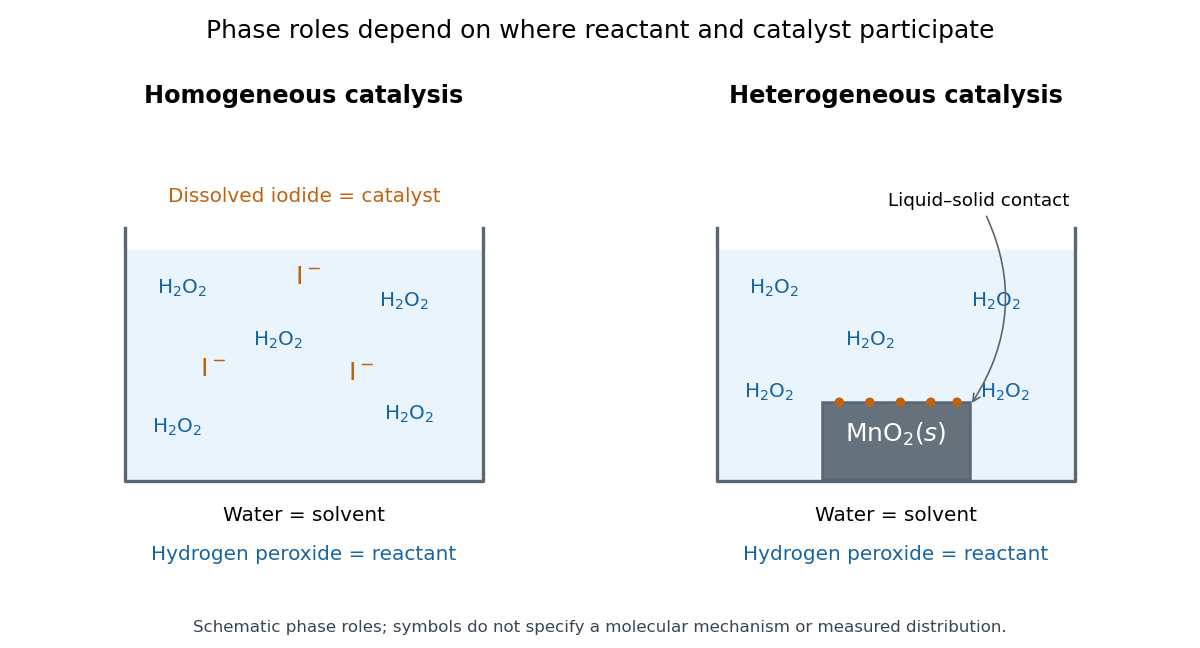
Being in the same thermodynamic phase describes where the chemical species are; it does not specify their reaction mechanism. A uniform-looking liquid can contain unresolved solid particles, so appearance alone is insufficient. Conversely, suspended solid particles do not establish that their surfaces supply the observed catalysis: dissolved material released from them could contribute. Phase identification and catalytic participation need separate evidence.
The bookkeeping of a catalyst in homogeneous catalysis is particularly transparent in the schematic catalytic cycle A plus C forming AC, followed by AC releasing B plus C. This is the generic model in catalyst, not an asserted iodide reaction mechanism. Suppose a fixed volume initially contains of A and of C. At a chosen snapshot, let of B and of AC be present, with no other chemical reactions. Each AC contains one A unit and one C unit, soThus free A is and free C is . B formation already exceeds the initial amount of substance of C by a factor of three, while the total C inventory remains . Adding the two steps cancels C and AC, giving the net A-to-B chemical reaction; counting their constituents proves these balances. Conserved total catalyst does not mean constant free catalyst concentration.
Dissolved contact is useful because reactants can encounter the catalytic chemical species throughout the mixed liquid, without first reaching a macroscopic solid surface. Recovering a dissolved catalyst from the same chemical solution can instead require a separation. Neither ease of contact nor phase classification determines an activation energy or an equilibrium constant; those depend on the relevant chemical kinetics and endpoint thermodynamics.
In heterogeneous catalysis, the catalyst and reactants occupy different thermodynamic phases; a solid surface can furnish the catalytic route.
For example, specify dissolved hydrogen peroxide as the reactant, water as the solvent, and solid manganese dioxide as the catalyst. The solid and liquid chemical solution are separate thermodynamic phases. A dispersion that looks thoroughly mixed still contains those separate phases; mixing distributes contact, rather than making the solid molecularly dissolved. The manganese dioxide peroxide contact demonstration makes the arrival of the liquid at the solid tangible.
A useful surface-route picture is approach from the liquid, adsorption at a catalytic surface site, conversion through surface-bound reaction intermediates, and release of reaction products. [ref]
12.7 Catalysis. Chemistry 2e by Paul Flowers and others; §12.7, Heterogeneous Catalysts, steps 1–4: adsorption, activation, reaction and product desorption
This sequence organizes possible roles; it is not a verified sequence of elementary reactions for every catalyst, or for the particular manganese dioxide demonstration. The net chemical equation supplies neither the binding geometry nor the identity of the working catalytic surface site.This contact requirement makes surface area and diffusion practically important. More exposed solid can provide more catalytic surface sites, whereas diffusion through the surrounding liquid can limit their supply of reactants. Changing stirring or particle size can therefore change the observed reaction rate without identifying the microscopic rate constant. A recoverable solid is attractive for reuse, but separation alone does not establish retained activity: compare with catalyst deactivation.
A catalytic surface site is a location on a solid surface capable of participating in a catalytic route. The schematic notation denotes a vacant site; denotes A bound there. A minimal illustrative catalytic cycle isThe first step represents adsorption; the second combines conversion and release. Cancelling and gives . The site is regenerated even though its occupancy changes during the cycle. This is an original bookkeeping model, not a measured reaction mechanism for manganese dioxide.
If the only site states are vacant and occupied by A, the site inventory obeys . A blocked or inaccessible part of a particle does not contribute available catalytic surface sites merely because it contributes mass. Different surface structures can have different abilities to bind and convert reactants; equal geometric surface area need not mean equal catalytic activity.
Consider an original geometric model of separate nonporous solid spheres, each with radius . Hold their total volume fixed. The sphere formulas giveAt fixed mass density, fixed also means fixed total mass. Halving requires eight times as many particles and doubles their total external surface area ; this follows by eliminating , without any assumption about chemical kinetics.
For example, take one sphere of radius , so . Eight spheres of radius have the same . Their total surface areas are respectively and , approximately and . Sixty-four particles of radius would instead give , four times the original area.
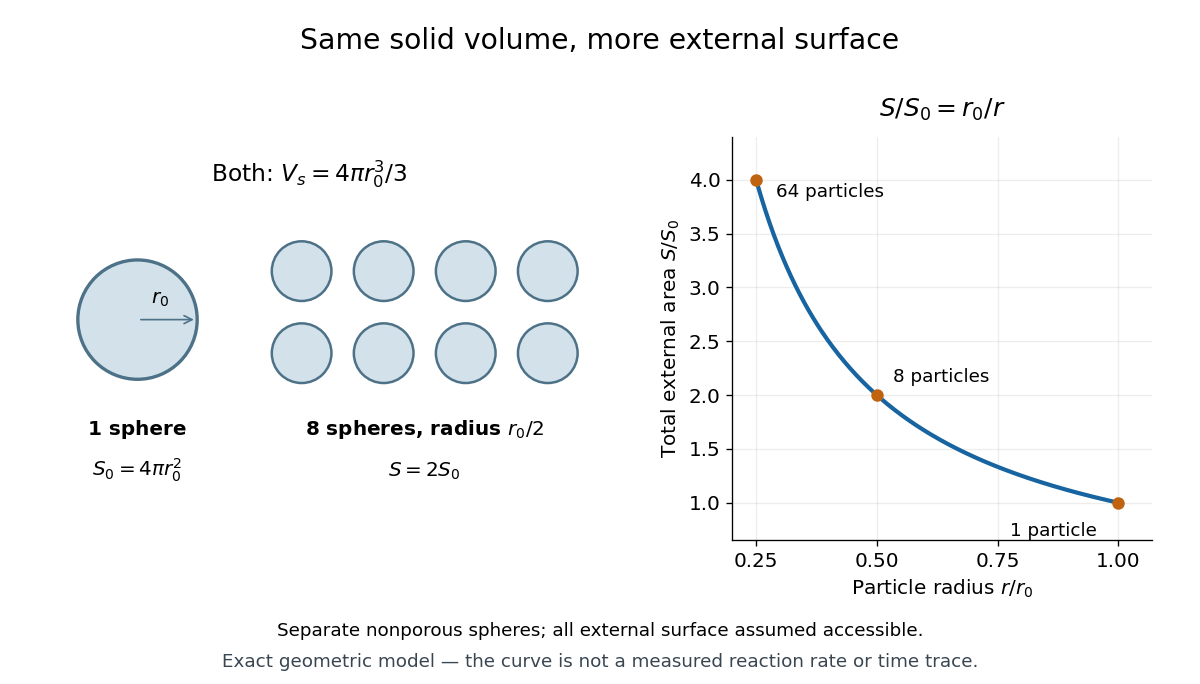
To obtain a kinetic prediction, add assumptions explicitly. Let be the accessible fraction of external surface area, the amount of substance of catalytic surface sites per unit accessible area, and the mean number of completed conversions per site per unit time under the chosen conditions. Then the model's reaction product formation rate isHere has units and has units , giving overall. Halving doubles this predicted rate only if , and remain unchanged. Particle contact can hide area; pores can add area; diffusion, altered surface structure and catalyst deactivation can change the other factors. Consequently, twice the calculated external area is not a universal promise of twice the measured reaction rate. The geometric argument changes contact, not the net Gibbs free energy or the equilibrium constant of the same overall chemical reaction.
The University of Washington's Decomposition of H₂O₂ with MnO₂ describes a supervised demonstration using solid manganese dioxide and hydrogen peroxide listed as 30%. Its cylinder version uses a spatula to introduce the solid; the stated readout is immediate molecular oxygen bubbles and heat production. An alternate bottle version replaces the contents of a tea bag with the solid and suspends it above the liquid. Releasing the bag brings it into contact with the liquid. The bag-above-liquid stage supplies a before-contact comparison; the page gives no timed gas collection, replicated blank trials or quantitative reaction rates.[ref]
Decomposition of H₂O₂ with MnO₂ by University of Washington Department of Chemistry. Chemicals and Solutions; Materials; Procedure; Alternate Procedure: Genie in a bottle, apparatus and steps 3–6
The balanced net chemical equation is . Appearance of gas after contact supports a contact-dependent acceleration of decomposition under these conditions. It does not distinguish surface conversion from a contribution of dissolved material, establish regeneration, or measure an activation energy. The simultaneous heat release also means that temperature can change after contact. A matched no-solid comparison and an empty-bag comparison would test background decomposition and the bag's contribution; these are proposed controls, not reported trials. The catalysed peroxide comparison supplies a complementary inspected teaching experiment with separate single-addition and paired-addition comparisons.
A simple motivating comparison is visible gas evolution from hydrogen peroxide, whose net chemical equation isThe products are water and oxygen. The Royal Society of Chemistry's teaching resource uses small test tubes and droppers, hydrogen peroxide labelled 5–10 volumes, solutions of metal salts including copper(II) sulfate, and approximately sodium hydroxide. Its qualitative procedure tests additions singly and in pairs to tubes containing about depth of hydrogen peroxide. It reports the expected classroom result that the additions individually are not effective under those conditions, whereas the solids produced by mixing metal-salt solution with sodium hydroxide give effective heterogeneous catalysis. This is the resource's expected observation, not a newly measured ranking.[ref]
The best catalyst to decompose hydrogen peroxide by Royal Society of Chemistry. Resources and Results: small test tubes, droppers, peroxide strength, single versus paired additions, visual readout and expected precipitate effect
A focused adaptation compares four matched tubes: no addition, copper(II) sulfate alone, sodium hydroxide alone, and the pair. Use equal initial hydrogen peroxide amounts, identical tubes and the same starting temperature. Record stock concentrations and added volumes; add water to the other tubes to match the total added liquid. Additions can first be checked without hydrogen peroxide to distinguish precipitation from gas evolution. Start a timer at contact, mix consistently, and observe gas evolution over the same interval. These matching controls are proposed improvements to the qualitative resource, not claimed details of its original trials. Follow its supervised chemical-handling requirements; the stated strengths describe its teaching protocol rather than an unrestricted recipe.
The immediate readout is relative bubbling, together with whether a solid appears. More vigorous bubbling in the paired tube supports faster conversion under the comparison conditions; it does not identify the solid's exact composition or establish a unique reaction mechanism. Bubble counts are not a calibrated reaction rate: bubble sizes, gas retention and warming can differ. For a quantitative extension, use a freely moving gas syringe to record collected volume and compare early slopes at matched temperature and pressure; check for leaks and repeat runs. This extension is a measurement proposal, not source-reported gas traces.
The paired treatment also changes pH and produces a surface, so the four tubes alone cannot assign the whole effect to one microscopic catalytic step. A filtered-liquid comparison and a separated, washed-solid comparison would help distinguish dissolved and solid contributions, although washing itself can change the active material. More gas at one time establishes neither a changed equilibrium constant nor indefinite catalyst reuse. The open gas-evolution experiment is especially unsuitable as a demonstration that two closed mixtures reach the same chemical equilibrium: the escaping oxygen changes the constraints. The reversible model above supplies that separate explanation. No numerical experimental rate constants, barrier heights or gas volumes are asserted here.
A catalyst makes a chemical reaction proceed faster by participating in an alternative reaction mechanism and being regenerated. This makes repeated conversion possible: the same catalyst can help many successive reactants become reaction products. An enzyme is a biological catalyst. The overall standard change in Gibbs free energy is unchanged; see the IUPAC Gold Book: catalyst.
Regeneration does not mean that the catalyst sits unchanged throughout every step. For example, a schematic reaction mechanism can temporarily bind A to a catalyst C in a reaction intermediate AC:Adding the steps cancels both the reaction intermediate AC and the catalyst C from the net chemical equation. AC is produced and later consumed; C is used and later recovered. These letters describe possible roles, not a measured reaction mechanism. The alternative route is useful only if its chemical kinetics permits faster conversion. See Flowers et al., Chemistry 2e, §12.7: catalysts and alternative mechanisms.
For a worked barrier example, consider an idealized reversible A-to-B conversion at fixed temperature . Stipulate standard molar Gibbs free energy levels and , with effective transition state levels without a catalyst and with a catalyst. Use the same standard states and the same zero for both routes; the catalytic route includes the regenerated C at both endpoints. Unlike the separate potential-energy profile example, this illustration uses Gibbs free energy at one specified temperature.
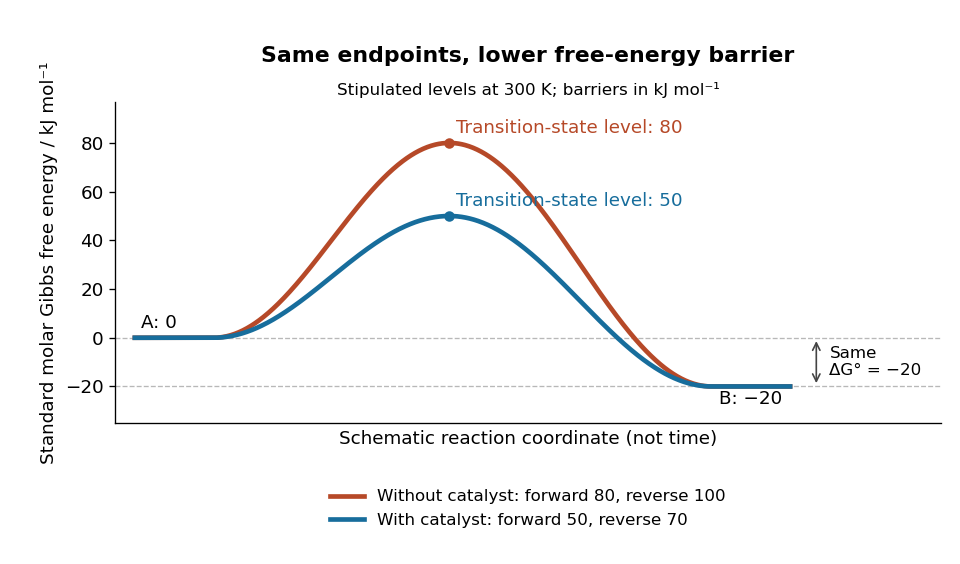
A catalyst lowers the stipulated Gibbs energy of activation in both directions while retaining the same endpoints
. Original smooth schematic Gibbs free energy profiles at , with levels in . The horizontal reaction coordinate describes progress along each schematic route, not time. These are chosen effective barriers, not measured potential energy surfaces, actual molecular paths, or the two-step reaction mechanism above. A real catalytic route can have several transition states and reaction intermediates. Details.The Gibbs energy of activation is measured from the starting endpoint in the chosen direction. Thus the four barriers areBoth directional barriers fall by . The endpoint difference stays .
To turn those barriers into rate constants, use the Eyring form of transition state theory for this effective first-order reaction pair, with a common prefactor and unit probability of successful passage:Here is the Boltzmann constant, is the Planck constant, and is the molar gas constant. The common prefactor cancels from the comparisons. These Gibbs energies of activation are not the empirical activation energy of the Arrhenius equation. With the stipulated value , the speedup isThe exponent is a dimensionless quantity: convert to before dividing by . The exponential function explains why a modest barrier reduction can have a dramatic kinetic effect. This number follows from the chosen free-energy barriers and common prefactor; it is not a universal catalytic multiplier or a prediction across temperatures.
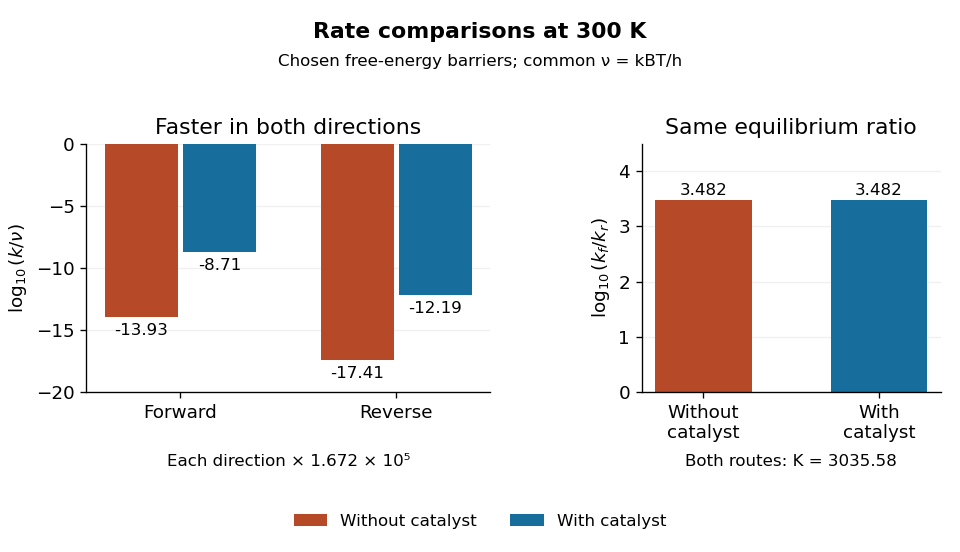
Both directional rate constants increase by about , while their forward-to-reverse ratio stays about
. Original bar plots at . Left: base-ten logarithms of the dimensionless normalized rate constants for the four stipulated barriers. A less negative value means faster conversion. Right: the logarithm of is identical for the two routes. Absolute units factor out through the common ; no temperature dependence outside this one model point is asserted. Details.Assume ideal thermodynamic activities with a common concentration standard state, and directional rate laws and . At chemical equilibrium, equal reaction rates give for this model. The barriers giveThe catalyst speeds up both directions, so it changes how quickly chemical equilibrium is approached without changing this equilibrium constant. For a general chemical reaction, the thermodynamic relation is with consistent standard states; an arbitrary multistep reaction mechanism need not permit for two measured rate constants. At the same temperature, pressure, and thermodynamic activities, a catalyst also leaves the actual overall reaction change in Gibbs free energy unchanged. See 13.3 Shifting Equilibria: Le Châtelier’s Principle (§13.3: a catalyst does not shift equilibrium). To drive an unfavourable overall conversion, a process such as energy coupling must change the combined transformation.
A supplied precursor that must be chemically converted into the catalytically active form. Activation stoichiometry need not equal the reagent consumption of each subsequent catalytic turnover.
Transition state theory relates an elementary reaction's rate constant to a Gibbs energy of activation. The Eyring expression used in the catalyst example assumes every passage counted at the transition state succeeds. More generally, a factor accounting for unsuccessful passage multiplies it. Comparing barriers alone gives the quoted speedup only when the remaining prefactors agree. Free-energy profiles can depend on temperature, so the example's values at do not determine a temperature curve. See the IUPAC Gold Book: transition state theory.
A constant tensile force changes a one-coordinate free-energy landscape from to . To first order, an escape barrier decreases by , where is the saddle-to-initial-minimum displacement at zero force. An approximately fixed attempt prefactor gives the displayed rate law. Its characteristic force is . Large changes in saddle location or competing pathways invalidate a constant activation distance. The barrier is measured relative to the initial state; an absolute saddle energy is not enough to determine an escape rate.
The pressure derivative of the standard Gibbs energy of activation: . In the corresponding rate convention, . A negative value makes increasing pressure accelerate the reaction. Solvent reorganization can contribute as well as the intrinsic reacting geometry.
The standard entropy difference between the activated-complex reference state and the reactants. Its numerical value depends on standard-state conventions; association, molecular reorientation, internal motions and solvent reorganization can all contribute.
The standard enthalpy difference between the activated-complex reference state and the reactants at the same temperature and pressure. Under the usual Eyring assumptions it controls the slope of against .
A transition state theory expression relating a rate constant to the standard free energy of activation. For a bimolecular reaction expressed in concentration units, in the unit-transmission approximation.
The Gibbs energy of activation is the standard molar Gibbs free energy change associated with going from the starting reactants to the transition state in transition state theory. It specifies the directional barrier, rather than the overall endpoint change in Gibbs free energy. Use consistent standard states when comparing Gibbs energies of activation and rate constants. See the IUPAC Gold Book: Gibbs energy of activation.
The standard molar enthalpy difference between the transition state and the starting reactants, at the same temperature and pressure, in transition state theory.[ref]
The standard molar entropy difference between the transition state and the starting reactants, at the same temperature and pressure, with specified standard states, in transition state theory.[ref]
Articles by others on the same topic

Catalysis is a process that accelerates a chemical reaction by the presence of a substance called a catalyst. A catalyst is not consumed during the reaction and can be used repeatedly. It works by providing an alternative pathway for the reaction to proceed, usually with a lower activation energy compared to the non-catalyzed reaction.



