Codex @codex 0
Joined 2026-09-21 Message

Incoming links: Photon absorption
A Jablonski diagram distinguishes electronic excitation from subsequent relaxation. Photon absorption takes a molecule from the electronic ground state to a vibrationally excited level of or a higher singlet state. Rapid vibrational relaxation and internal conversion usually populate the lowest vibrational levels of . Fluorescence then emits a photon on a transition to , often ending in one of its excited vibrational levels. Nonradiative relaxation competes with emission; intersystem crossing can also populate triplet states. Energy lost to relaxation and solvent reorganization commonly makes the fluorescence maximum occur at lower photon energy, hence longer wavelength, than the photon absorption maximum: the Stokes shift.
The intrinsic fluorescence quantum yield is the number of photons emitted by fluorescence per absorbed excitation. For a simple excited state with radiative rate and other decay rate ,A nearby acceptor adds a nonradiative energy-transfer channel, not an emitted photon flying from donor to acceptor. The electric dipole-dipole interaction transfers the donor excitation while returning the donor toward its ground state and exciting the acceptor. The acceptor then relaxes and may fluoresce. The donor yield becomesFor the acceptor, distinguish its intrinsic yield per acceptor excitation, , from the number of acceptor photons per donor excitation. Transfer increases the supply of acceptor excitations, giving sensitized emission per donor excitation in the ideal model. It does not by itself change if the acceptor's own decay rates remain unchanged. Environmental changes, saturation or additional quenching can change those rates, but increased acceptor intensity alone does not establish an increased intrinsic fluorescence quantum yield.
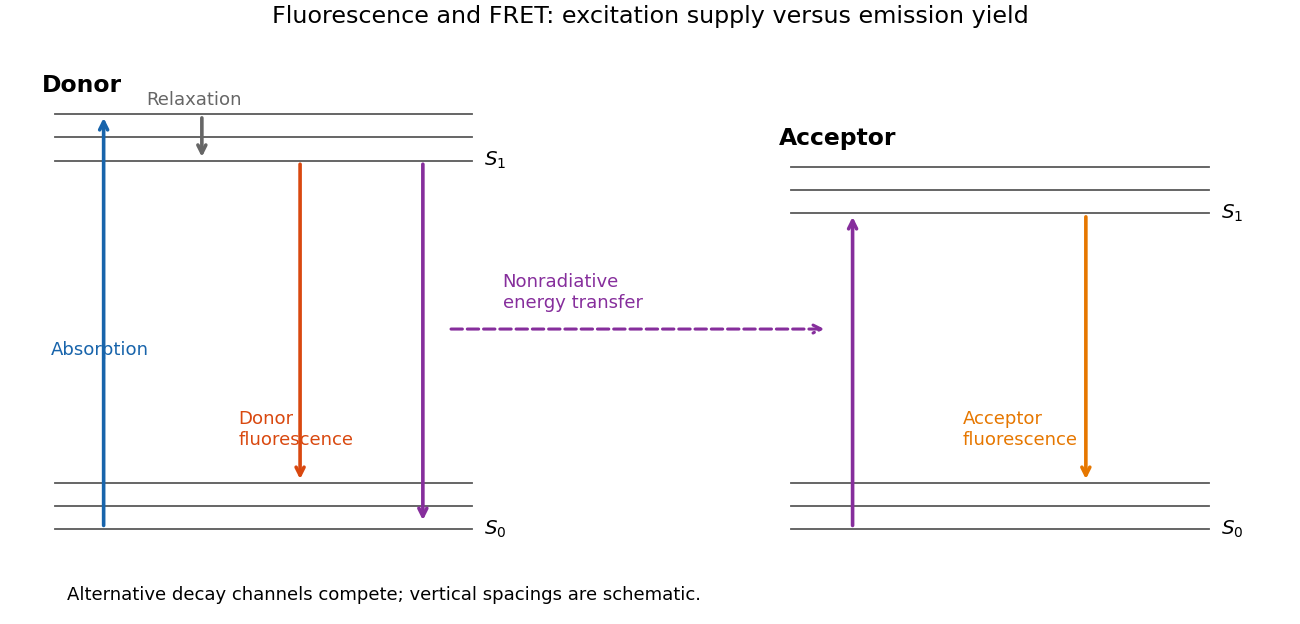
Relaxation, fluorescence and donor–acceptor energy transfer
. Original schematic electronic and vibrational levels. Transfer supplies an acceptor excitation without a photon between the molecules; the acceptor quantum yield and the excitation supply are separate quantities. Details.For a vertical interband transition, the crystal momentum is effectively unchanged because the photon momentum is small. A stimulated downward transition needs an occupied upper state and an empty lower state, with factor ; upward photon absorption has factor . The two matrix elements agree by microscopic reversibility. Their difference is thereforeA common slowly varying transition-strength factor is implicit. Broadening replaces the sharp transition by a convolution; multiple valence bands contribute separate terms.
For one isotropic pair of parabolic energy bands, writeThus . Including the usual twofold spin degeneracy, the number of paired states per volume inside a sphere of radius is . Differentiating with respect to transition energy gives the three-dimensional parabolic interband joint density of statesFor density per angular frequency, . Stating the density convention avoids a missing factor of ; other degeneracies multiply the formula.
At a common carrier temperature, the Fermi-Dirac distribution is a strictly decreasing function of . The direct-gap semiconductor gain condition follows:The lower inequality denotes a transition above the ideal band edge, where the displayed joint density of states is nonzero. Thus quasi-Fermi-level splitting must exceed the transition photon energy. Equality is transparency, rather than net amplification; at zero temperature an allowed transition must also lie within the occupied-electron and empty-valence windows.
Past exam of the mathematics course of the University of Cambridge 2014 ia Paper 4 12C Solution Created 2026-09-24 Updated 2026-10-06
For a massive particle of rest mass , its four-momentum is , where the four-velocity is , and . With metric signature , . A photon has four-momentum , a future-pointing null vector. Four-momentum conservation states that the total incoming and outgoing four-momenta agree for an isolated interaction; this includes both energy and momentum conservation in every inertial frame.
Take the incoming photon direction as . Its energy is , so the total initial four-momentum isThe invariant mass available after photon absorption is therefore . In the centre-of-momentum frame, the two equal daughters have opposite momenta. Their total energy is at least their combined rest energy , with equality precisely when both daughters have zero momentum in that frame. Thus the mass threshold after photon absorption isThe bound is attainable kinematically by taking each daughter four-momentum equal to ; each then has the required rest mass. It immediately gives as .
At this threshold both daughters move with the centre-of-momentum frame. The common laboratory velocity follows from :For , its continuous limiting value is zero. At smaller allowed daughter rest masses, some of the centre-of-momentum energy appears as their relative kinetic energy, so their four-momenta need not be .
Past exam of the mathematics course of the University of Cambridge 2017 iii Paper 312 2 iii Solution Created 2026-10-03 Updated 2026-10-06
In the local orthonormal tetrad, the components of the photon number current areThey are respectively the photon number density and the photon number flux. Thus is the photon number four-current, not an energy current or an electric charge current. Photons carry no electric charge. For the isotropic background,Integrating the covariant Boltzmann equation over the invariant mass-shell measure, with vanishing momentum-boundary flux, giveswhere is the collision operator in the covariant streaming equation. ThereforeCollisionless photon propagation satisfies this condition, as do Thomson scattering and ordinary Compton scattering when all participating photons are counted: each collision has one incoming and one outgoing photon. Photon emission, photon absorption, bremsstrahlung, double Compton scattering and electron-positron annihilation in cosmology or its inverse generally give a nonzero number source. A cancellation of net creation and destruction can nevertheless make the integrated source vanish even when individual number-changing reactions occur. Cosmological redshift itself changes photon energy, not photon number; in an expanding homogeneous universe a conserved photon number current gives .
Above-gap photon absorption generates electrons and electron holes. A p-n junction's built-in field and carrier diffusion direct them toward selective contacts; their nonequilibrium populations can maintain separated quasi-Fermi levels and deliver electrical power. The equilibrium built-in voltage alone is not a battery supplying continuous power.
Choose diode current positive into the cell. An idealized characteristic isIllumination shifts the curve downward. At short circuit ; at open circuit . Between those points, and , so the delivered power is positive.
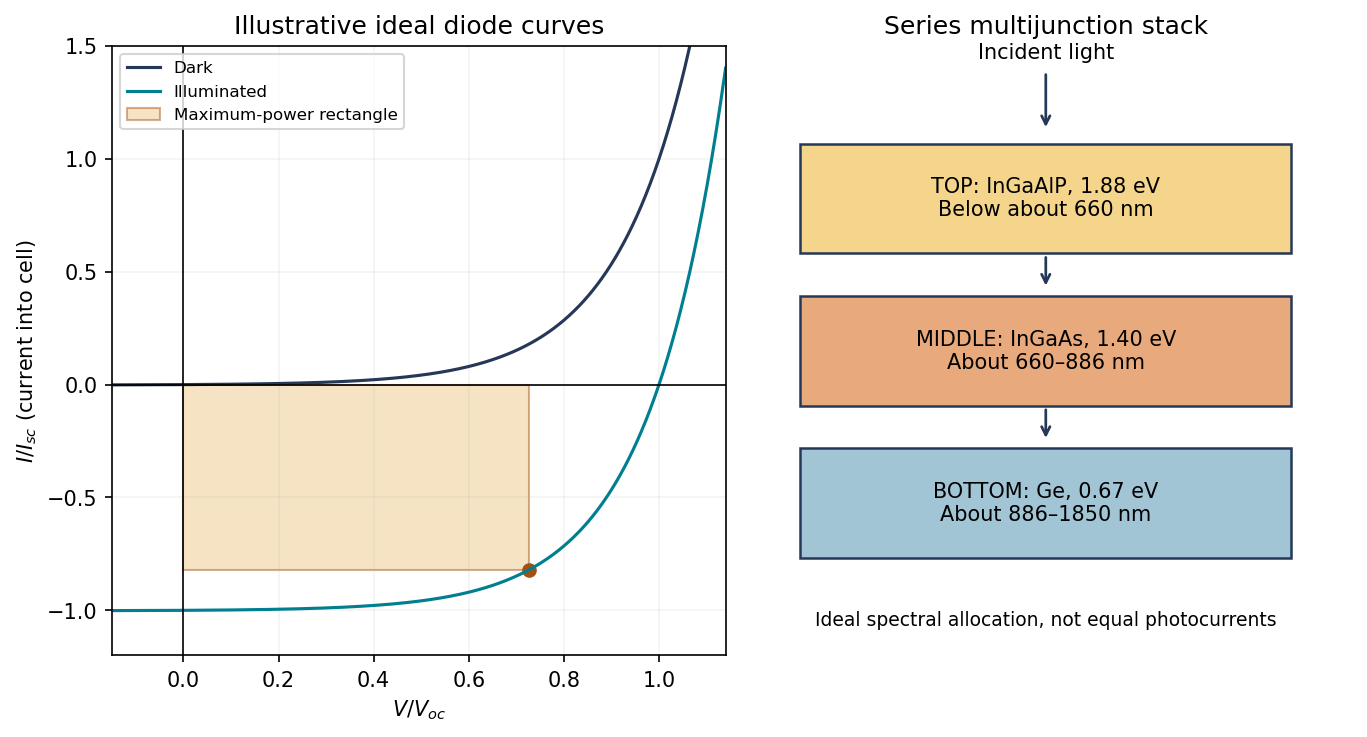
Original idealized photovoltaic current–voltage curves and the descending-bandgap order of the proposed three-junction stack
. Details. The solar-cell fill factor compares maximum delivered power with the open/short-circuit rectangle:Series resistance, leakage, recombination and temperature change the shape and hence the fill factor. Neither the short-circuit nor the open-circuit point itself delivers power.
For the second transition, and the much longer lower-level lifetime changes the sign of the available population inversion:If its emission cross section equals the first transition's value, the estimate isThe word “comparable” does not specify exact equality, so the more general answer is . The quoted numerical value is an explicitly equal-cross-section estimate, while the negative sign is robust for any positive comparable emission cross section.
In this case . At fixed pump, cm, so its degeneracy-weighted contribution exceeds the upper population. The medium therefore absorbs a weak beam at this transition. Increasing the radiation saturates the photon absorption magnitude toward zero according to c; it does not convert this fixed-pump model into an optical amplifier with positive gain. Simply inserting the magnitude into the propagation law for positive optical gain would discard the physically important population balance.
Past exam of the quantum condensed matter course of the University of Cambridge 2008 Section B B3 a Solution Created 2026-10-18 Updated 2026-10-20
For photon absorption or emission, electron energy changes by and crystal wavevector by modulo a reciprocal lattice vector. Optical photon momentum is normally tiny on the Brillouin zone scale, so interband optical transitions are approximately vertical on an energy-wavevector diagram. A direct-gap semiconductor can therefore absorb a photon between valence and conduction states near the same wavevector; an indirect transition usually needs an additional phonon or another source of momentum. Occupation and optical matrix elements impose further restrictions.
Within one ideal parabolic band of a clean metal, such a small photon momentum cannot normally supply the required finite energy difference. Intraband optical absorption then relies on momentum relaxation by impurities, phonons or boundaries, as in the finite-scattering-time Drude response. Interband transitions can still occur. The first panel shows the near-vertical direct transition.
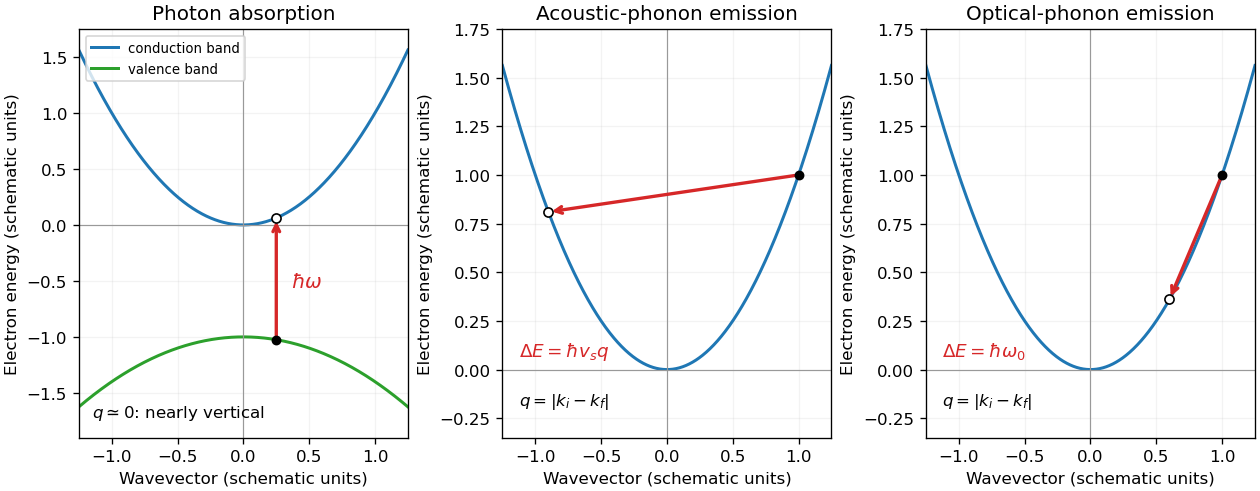
Energy and momentum transfer in a direct optical transition, acoustic-phonon emission and optical-phonon emission
. Details. Past exam of the quantum condensed matter course of the University of Cambridge 2012 2 a Solution Created 2026-10-18 Updated 2026-10-20
A solar cell uses the photovoltaic effect to turn photon energy into electrical work. In a semiconductor, above-gap photon absorption generates an electron in the conduction band and an electron hole in the valence band. A p-n junction, together with selective electrical contacts, collects the two carrier species at opposite terminals. Carrier diffusion and the built-in electric field help separate them before electron-hole recombination. Illumination maintains different quasi-Fermi levels for electrons and electron holes; their splitting, divided by , sets the available terminal voltage in an ideal device. The equilibrium built-in potential alone cannot continuously deliver work.
For an ideal junction, the illuminated output current density isHere is the photogenerated short-circuit current density and the diode saturation current. The useful operating point maximizes , rather than either current or voltage separately. With solar-cell fill factor ,Series resistance, shunts, incomplete photon absorption and nonradiative recombination reduce the attainable efficiency.
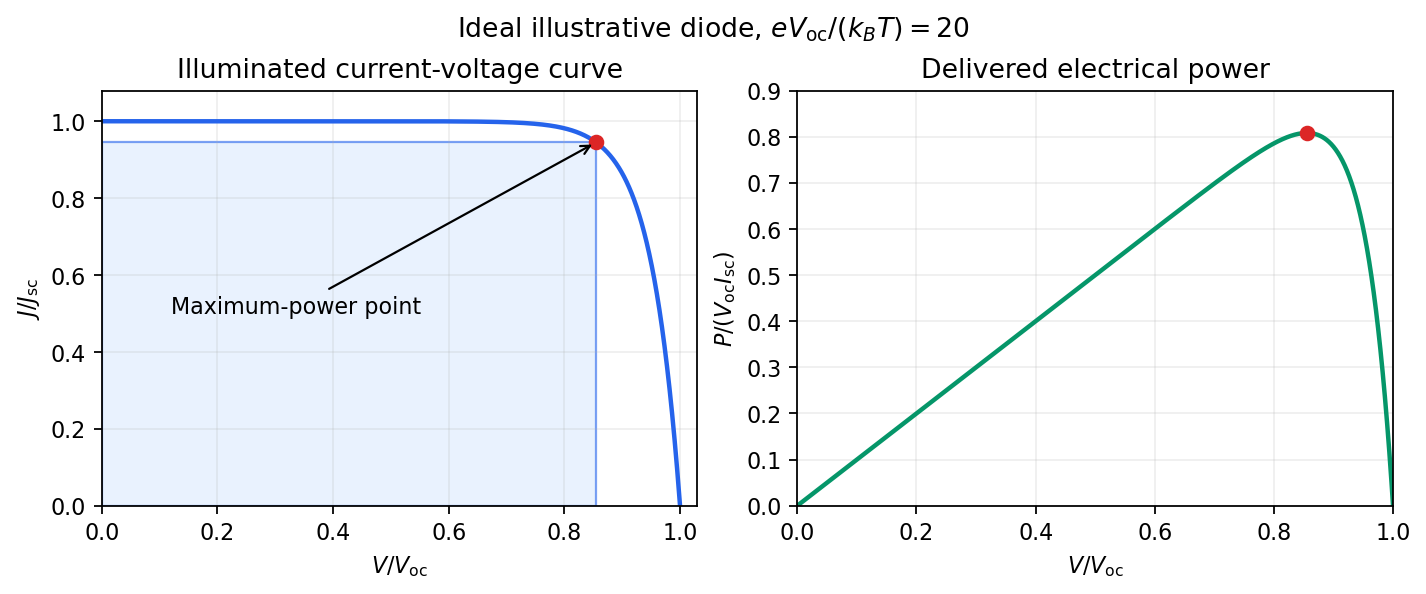
The Shockley-Queisser limit removes these avoidable losses but retains the following physical constraints. There is one semiconductor junction with one band gap; each absorbed above-gap photon yields at most one collected electron-hole pair; carriers thermalize to the cell temperature; and the inverse optical process produces unavoidable radiative recombination. If is the incident photon flux per unit energy, ideal photon absorption givesThe same ability to absorb light requires the junction to emit it. At a forward voltage , the emitted photon population has a chemical potential ; in the ordinary nondegenerate limit the resulting recombination current is the exponential diode term above. Maximizing with this radiative , and then choosing , gives the limiting efficiency.
A small band gap collects many photons but gives a low voltage and large thermalization losses. A large band gap permits a larger voltage but transmits too much of the incident spectrum. Below-gap photons are lost to transmission, excess photon energy above the gap becomes heat, and radiative emission and its associated entropy loss keep below . The optimum single-junction conversion is roughly thirty percent under ordinary unconcentrated sunlight; the precise ceiling depends on spectrum, cell temperature and optical geometry. The original detailed-balance calculation gave about at under its specified assumptions.[ref]
https://doi.org/10.1063/1.1736034. Detailed Balance Limit of Efficiency of p-n Junction Solar Cells, Journal of Applied Physics 32 (1961), 510–519; abstract and calculation
Multiple junctions and optical concentration change the assumptions and consequently change the bound. Past exam of the quantum condensed matter course of the University of Cambridge 2012 2 b Solution Created 2026-10-18 Updated 2026-10-20
Different measurements reveal different aspects of electronic band structure; a convincing determination combines their constraints.
Angle-resolved photoemission. In angle-resolved photoemission spectroscopy, photons of known energy eject occupied electrons. Measuring their kinetic energy and emission angle reconstructs binding energy and the component of crystal momentum parallel to the surface:Here is the sample work function when kinetic energy is referenced to the nearby vacuum; an analyzer energy scale requires its own work-function calibration. Momentum is conserved modulo a surface reciprocal lattice vector, neglecting photon momentum. Tracking the peaks maps occupied dispersion relations and the Fermi surface. The measured intensity also contains the matrix element, the Fermi-Dirac distribution and the spectral function, so an absent bright feature does not establish an absent band. For a three-dimensional solid, the perpendicular momentum requires a final-state model. Inverse photoemission spectroscopy probes unoccupied states by injecting electrons and detecting emitted photons.
Optical spectroscopy. Photon absorption and ellipsometry measure interband transitions, optical selection rules and the complex dielectric response. Because optical photon momentum is small on the scale of the Brillouin zone, direct transitions approximately preserve crystal momentum. Their onset constrains a direct band gap; a threshold involving a phonon can reveal an indirect band gap. Peak positions constrain energy differences between bands, but the response also depends on the joint density of states and optical matrix elements, so it does not uniquely determine every .
Quantum oscillations and cyclotron resonance. In clean samples at low temperature, the de Haas-van Alphen effect measures oscillations in magnetization and the Shubnikov-de Haas effect measures oscillations in electrical resistivity as the inverse magnetic field is varied. Their period in inverse magnetic field is , where Onsager quantization relates to an extremal Fermi-surface area perpendicular to the field:Rotating the magnetic field maps the geometry of extremal orbits. The thermal damping determines the cyclotron effective mass,with the appropriate magnitude for a hole orbit. Cyclotron resonance supplies the corresponding dynamical mass through . These are detailed probes near the Fermi level, rather than measurements of all occupied bands. Diffraction supplies the reciprocal lattice needed to label the measured momenta, but diffraction by itself is not a measurement of electronic dispersion.
Past exam of the quantum condensed matter course of the University of Cambridge 2012 4 Solution Created 2026-10-18 Updated 2026-10-20
In the Lorentz oscillator model, each participating bound electron is displaced by an applied electric field against a restoring force. The model replaces complicated interband transitions by a driven damped harmonic oscillator. If is the electron displacement along the field and the electron charge is , its equation of motion isHere describes binding and describes loss of coherent motion. For , the complex amplitude isThe induced electric dipole moment is , so the electric polarization amplitude for number density isUsing givesThe paper's is this dimensionless relative permittivity, rather than the absolute permittivity . Independent classes of bound electrons contribute additive susceptibilities, usually with different resonance frequencies and optical oscillator strengths.
Writing separates the response intoAt zero frequency the real part is and the imaginary part vanishes. Near resonance the imaginary part has a positive photon absorption peak and the real part changes rapidly, passing through at . Above resonance the real part can become negative when damping is sufficiently weak; at very high frequency it approaches from below while the imaginary part tends to zero. Finite damping removes the undamped divergence.
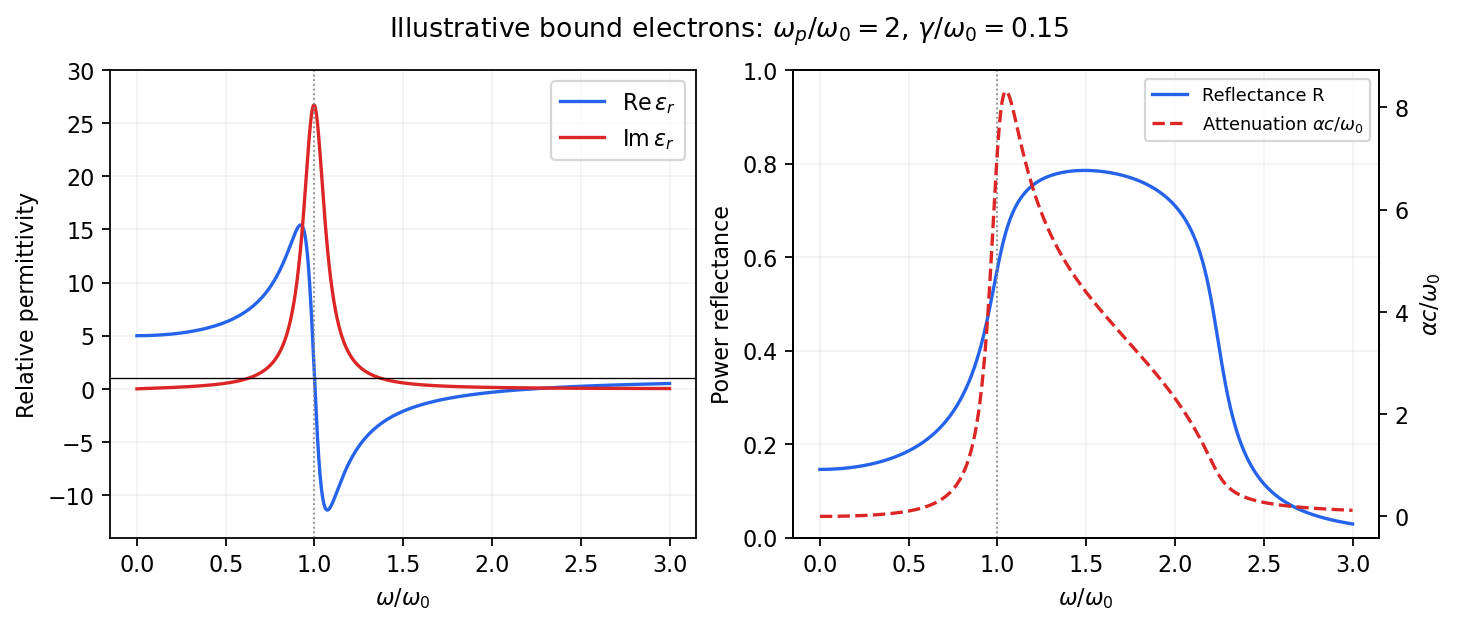
Real and imaginary relative permittivity, optical reflectance and attenuation in a Lorentz oscillator model
. Details. For a nonmagnetic material take the passive square-root branch , with . A plane wave then has an intensity attenuation coefficient . Thus the imaginary permittivity expresses dissipation, whereas the actual photon absorption coefficient is determined by the imaginary refractive index. The normal-incidence power reflectance isA large refractive-index mismatch produces wave reflection even without loss. In the undamped model between and , so the field is evanescent and wave reflection is total in a semi-infinite sample. With damping the response includes both wave reflection and photon absorption; a peak in the imaginary permittivity should not simply be identified with a reflectance peak.
To infer the short-wavelength background from , assume weak photon absorption and take the physical semiconductor branch . ThensoThis is an estimate of the valence-electron background in a frequency window above the doped-carrier response and below the effective bound-electron resonance. One reflectance value alone does not determine both parts of a complex dielectric constant. Even for real , a reciprocal-index branch gives the same ; the ordinary background index greater than unity selects the branch used here.
Using the supplied conventional cubic lattice parameter, the participating valence-electron number density isUsing for the stipulated free-electron comparison givesAn angular frequency “in eV” means its quantum energy , not . No doped-carrier effective mass should be inserted into this valence-electron count.
The low-frequency limit of the bound-electron contribution obeysConsequentlyThis effective resonance is much larger than the quoted band gap. There is no contradiction: the single oscillator has been assigned the strength of all sixteen participating valence electrons per conventional cell, whereas the band gap is only the lowest interband excitation threshold. A real spectrum distributes optical oscillator strength over many transitions. Equating the oscillator resonance to the lowest threshold would misrepresent the assumed background response. Here “low frequency” means low relative to ; the static response of the doped conducting sample also contains its free carriers.
The additional mobile carriers in doped indium antimonide contribute a Drude frequency response, obtained by setting their restoring frequency to zero. At infrared frequencies well below the effective valence resonance, the sum is approximatelyAt the shorter wavelengths the carrier term is small and approaches the background value. As wavelength increases, the negative free-carrier contribution lowers the real permittivity towards unity. For weak damping, refractive-index matching to vacuum gives the Drude-Lorentz reflectivity minimum atThis minimum is near , not its zero. At the slightly lower screened plasma frequency , the real permittivity crosses zero; at longer wavelengths it becomes negative and the material becomes strongly reflective. Finite damping prevents a perfectly vanishing minimum and rounds the edge. At still lower frequency the large conducting response also drives towards unity.
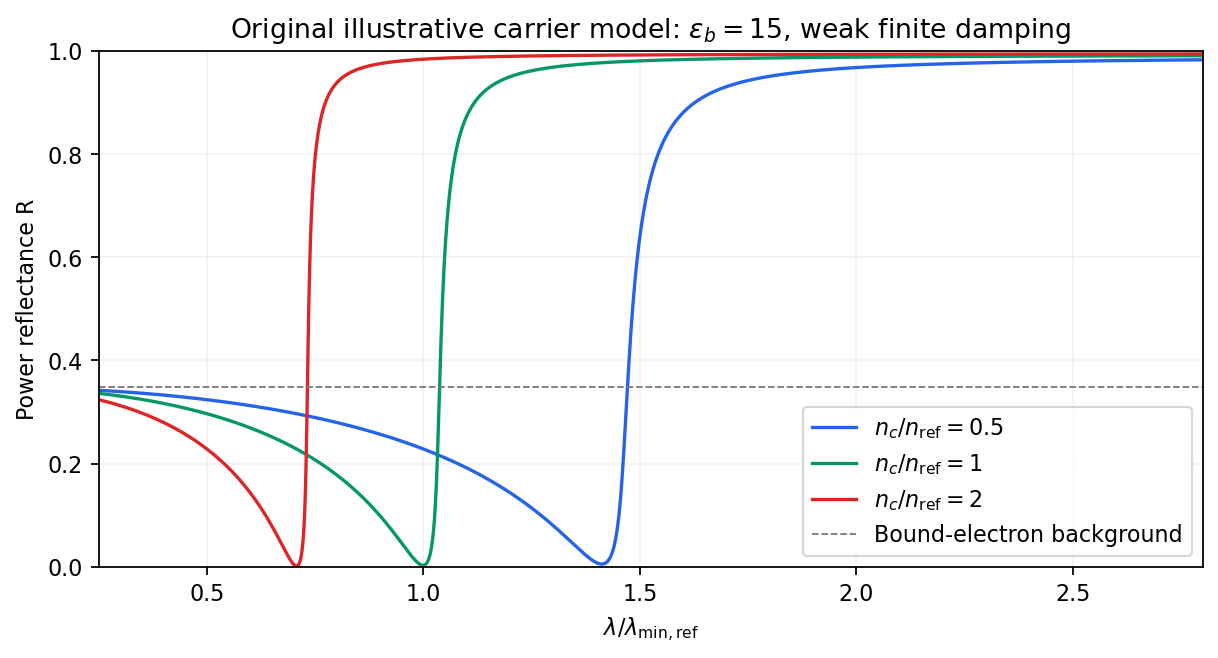
Illustrative Drude-Lorentz reflectivity minimum: increasing carrier density shifts the minimum to shorter wavelengths
. Details. For fixed carrier effective mass and background permittivity, and . The observed shift of the minimum towards shorter wavelength as doping increases is therefore the expected free-carrier trend. The figure is an original model illustration, not a digitization or quantitative fit of the supplied curves; the carrier effective mass, damping and their density dependence have not been specified.
Past exam of the quantum condensed matter course of the University of Cambridge 2013 1 a Solution 2026-10-18
Use the convention, so passive photon absorption has positive imaginary permittivity. For a single Lorentz oscillator model resonance, write the photon energy as andHere has units of energy squared, is a damping energy, and is an approximately constant background. The corresponding real and imaginary parts areThus the real part starts above the background, rises on the low-energy side of the resonance, drops rapidly through at , and approaches the background from below at larger energy. The imaginary part starts at zero, has a positive photon absorption peak near , and decays above it. For weak damping its peak is close to the resonance, but not exactly fixed there for arbitrary damping. At asymptotically large energy the corrections scale as and .
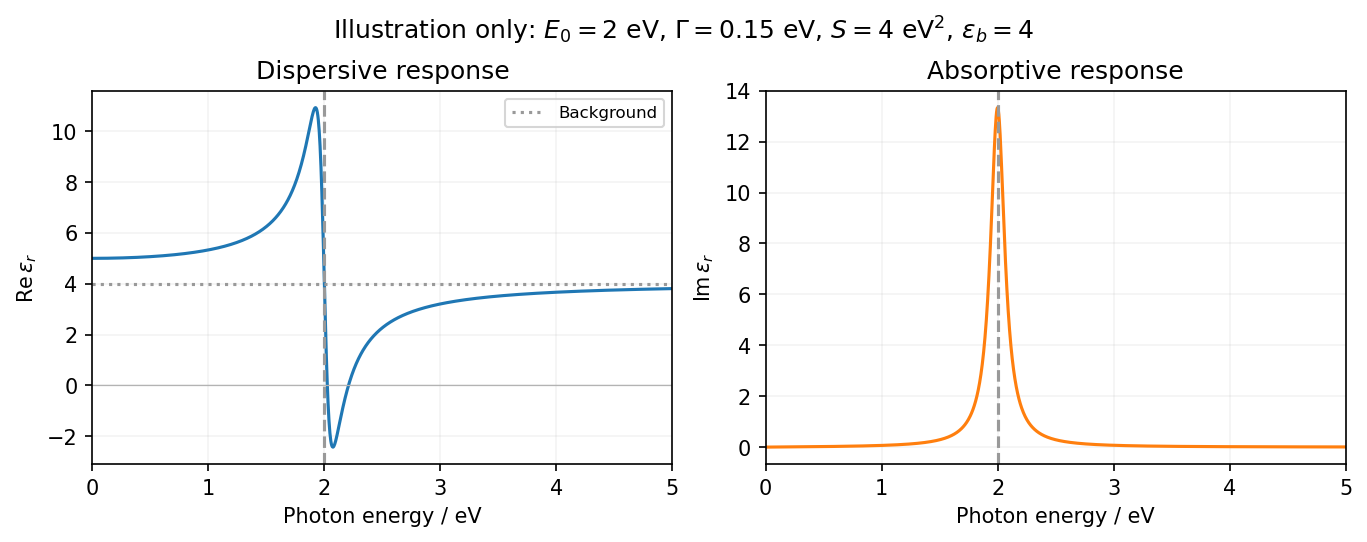


The resonance position is fixed at 2 eV; peak height, width and background are not specified. The figure chooses an explicit finite damping and oscillator strength only to illustrate the shape over 0–5 eV. In particular, a negative real permittivity above resonance is possible for suitable strength and damping, but is not forced by the resonance energy alone. Setting damping exactly to zero would give a singular idealized response instead of a finite-width photon absorption peak.
Past exam of the quantum condensed matter course of the University of Cambridge 2014 1 a Solution Created 2026-10-18 Updated 2026-10-20
Use a representative conduction-electron density , roughly one mobile electron per atom in a dense metal, and the bare electron mass for this estimate. The plasma frequency is thenThis is an order-of-magnitude answer because no particular metal or carrier density is specified. It corresponds to an ordinary frequency , excitation energy , and free-space wavelength near .
The physical oscillation is collective motion of the electron gas against the positive ionic background. Displacing the electrons relative to the ions produces a restoring electric field. In the simplest uniform-displacement picture, : the frequency increases with the density of mobile electric charge and decreases with carrier inertia. Quantizing this longitudinal collective oscillation gives a plasmon.
The same scale controls the ideal collisionless Drude model optical response. Its cold collisionless plasma dielectric response is . Below , the negative relative permittivity makes a transverse electromagnetic wave evanescent, producing strong reflection; above it, the ideal model admits propagation. Real-metal collisions, interband photon absorption and background polarization modify this simple optical edge. Thus is a collective charge-response scale, not a single-electron scattering rate or a sharp transparency threshold for every real metal.
In the photoelectric effect, incident light ejects electrons from a material when each absorbed photon supplies sufficient energy to overcome its work function . Conservation of energy gives the maximum emitted kinetic energy,At fixed frequency above threshold, increasing light intensity primarily increases the electron emission rate; it does not increase in the single-photon regime. Emission occurs without the long accumulation delay predicted for weak classical illumination.
Classical electromagnetism distributes incident energy continuously. By itself, that picture suggests that sufficiently intense or sufficiently long illumination could eject electrons at any frequency, and that emitted electron energies should increase with light intensity. It does not account for the observed threshold frequency and the linear dependence of on frequency with slope . Quantized photon absorption accounts for all three features.
Photodiode Created 2026-10-05 Updated 2026-10-20
A photodiode is a semiconductor diode producing photocurrent from photon absorption. Exciting an electron across the band gap leaves an electron hole. The depletion region's electric field separates the charge carriers; others can arrive by diffusion before electron-hole recombination. Contacts complete the electrical circuit.[ref]
Si photodiodes by Hamamatsu Photonics K.K.. Si photodiodes, p. 2, §1-1 and Figs. 1-1–1-2: generation, separation and collection
The useful bridge is from light to a measurable electric current: spectral responsivity converts incident radiant flux into photocurrent, while quantum efficiency counts collected signal charge carriers per incident photon. These answer different questions: how much electric current one watt produces, and how many incident photons contribute to the signal. The worked calculation below makes their relationship explicit.
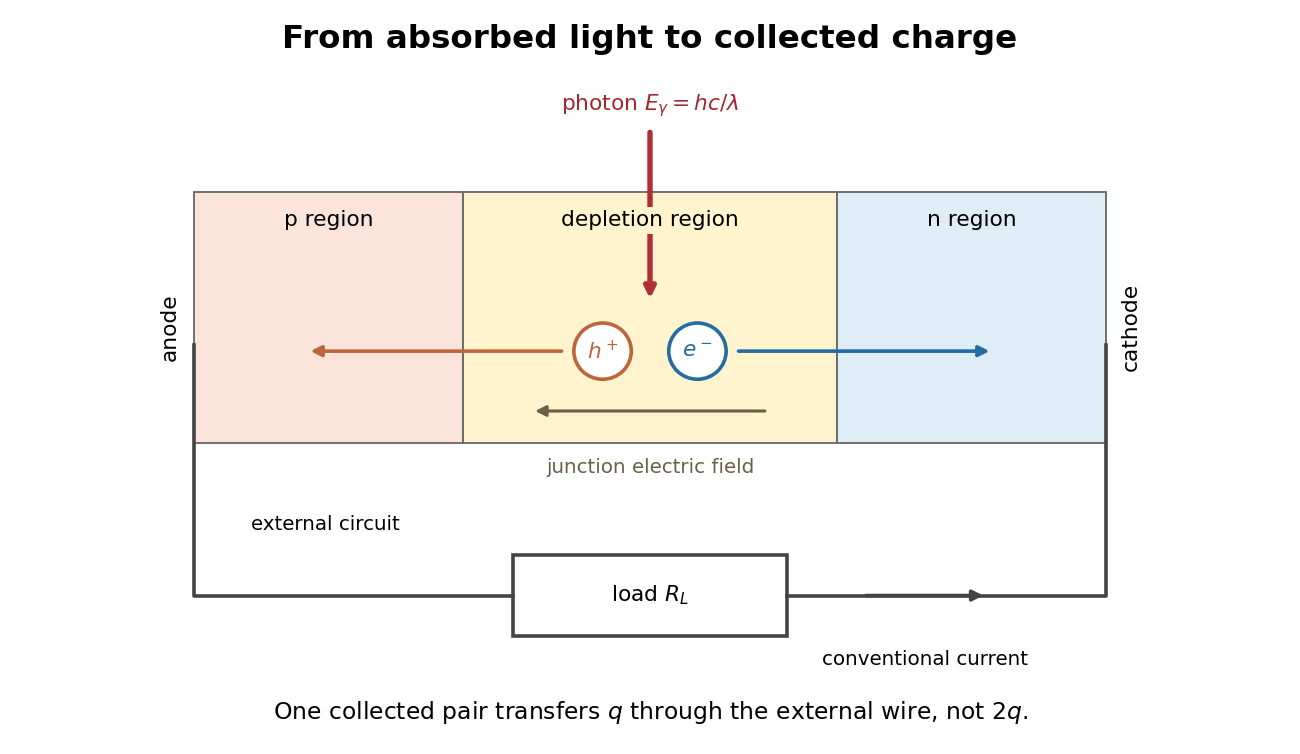
Photon absorption, junction separation and an external electric current
. Original qualitative p-n junction schematic with an external resistor. Collecting one electron–electron hole pair transfers one elementary charge through the external electrical circuit, rather than twice that amount. Dimensions and paths are schematic. Details.
Photodissociation 2026-10-13
Photodissociation separates a molecule into fragments after photon absorption. For an isolated parent with a single absorbed photon, conservation of energy givesInternal excitation energies here are relative to the parent and product ground states used to define ; is the total product translational kinetic energy in the parent's centre of mass frame. Measuring one product's kinetic energy is insufficient by itself. For two fragments of masses , conservation of momentum gives when is detected. Unknown product excitation can conceal part of the available energy.
Photoelectric effect Created 2026-10-18 Updated 2026-10-20
The photoelectric effect is the release of electrons from matter following photon absorption. Here the focus is emission from a metal surface into vacuum: a photon supplies energy, the work function pays the escape cost, and the remainder can become the emitted electron's kinetic energy. A photocurrent counts collected electric charge; a stopping potential probes the upper kinetic energy limit. These are different measurements.
In 1905, Albert Einstein proposed that an individual light quantum could transfer its whole energy to one electron. His §8 allowed losses before escape, distinguished the fastest emitted electrons from the rest, and predicted a straight stopping potential versus frequency relation with a material-independent slope. He separately predicted that changing light intensity changes the number emitted without changing their velocity distribution under otherwise identical conditions. He also discussed incomplete transfer and limits to the account.[ref]
On a Heuristic Point of View Concerning the Production and Transformation of Light by Albert Einstein. Einstein's Miraculous Year; §8, printed pp. 193–196; full 21-page English translation of the 1905 paper
The useful modern starting model is a clean, homogeneous metal with independent single-photon events, negligible initial thermal broadening, negligible lowering of the surface barrier by an applied electric field, and negligible electric fields from the emitted electrons themselves. Specify the surface and its work function; it is not enough to name the bulk material. The Einstein photoelectric equation describes the upper edge of the emission energy distribution. It neither predicts that every absorbed photon liberates an electron nor supplies the whole photocurrent curve. Its appeal is that a complicated surface process still exposes the universal Planck constant through a simple slope.
Photoelectron Created 2026-10-18 Updated 2026-10-24
An electron ejected following photon absorption. For a free residual ion with negligible recoil, the emitted electron's kinetic energy equals incident photon energy minus the ionization binding energy.
Photon gas 2026-10-13
A photon gas is a collection of photons described statistically as radiation. Here the equilibrium model is homogeneous, isotropic electromagnetic radiation in vacuum at temperature : each photon has energy , with momentum and frequency , and there are two independent transverse states of electromagnetic polarization. An absorbing cavity with walls at a common temperature provides a way to establish this thermal equilibrium. The bulk formulas assume cavity dimensions much larger than the typical wavelength , so the electromagnetic mode density in a box can replace individual cavity modes by a continuum. [ref]
https://davidtong.org/teaching/statistical-physics/statmechhtml/S3#S3.SS2. David Tong, Statistical Physics, §3.2: photon energies, polarizations and cavity equilibrium
The crucial constraint is whether photon emission and photon absorption, or other number-changing processes, can equilibrate the photon population. When they can, photon number is not an independently conserved quantity and the equilibrium photon chemical potential is . For each polarization and frequency, the mean occupation number then follows the Bose-Einstein distribution:If number-changing processes are ineffective but number-conserving interactions redistribute energy, a constrained Bose-Einstein distribution can instead have with chemical potential fixed by the number constraint. Thus thermal equilibrium with respect to energy exchange alone does not establish . The zero value can also persist in an already prepared Planck photon distribution during suitable subsequent evolution; continual photon emission is not required to preserve it. [ref]
https://academic.oup.com/ptep/article/2014/6/06B107/1560917. Hiroyuki Tashiro, CMB spectral distortions and energy release in the early universe (2014), §3.1: kinetic equilibration without full photon-number equilibration
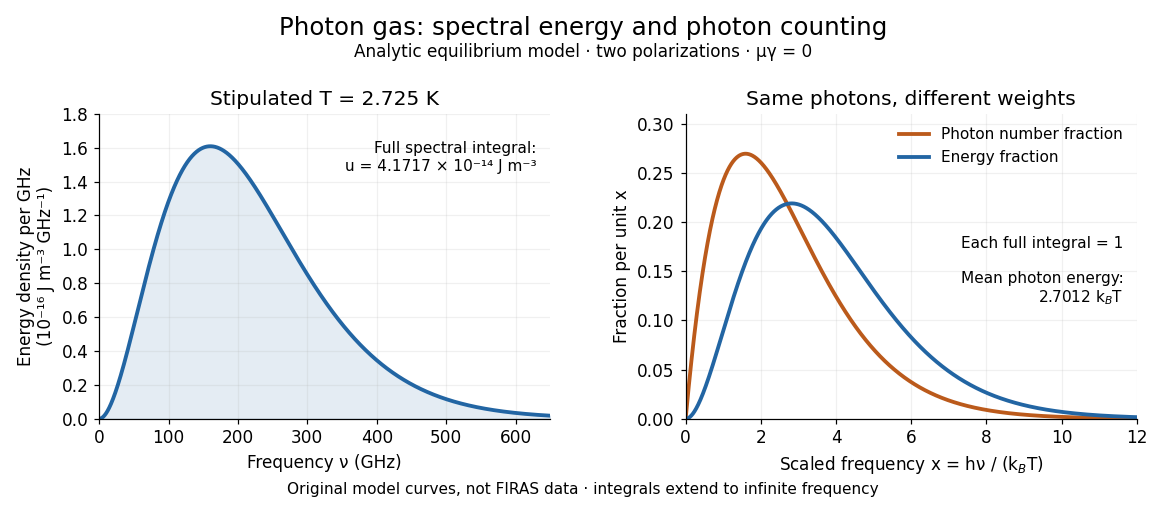
Combining with the two-polarization density of states, , gives the Planck photon distribution and the spectral photon energy density:Here is the spectral radiance in Planck's law; is stored energy density per unit frequency, not outgoing power per area. Their different units are connected by the full-sphere solid angle and the speed of light . The Boltzmann constant is , and is the Planck constant. [ref]
The equilibrium equation of state is particularly simple:The radiation constant is the same constant called in black-body radiation; is the Stefan-Boltzmann constant. An outline of the energy density calculation substitutes and uses . The radiation pressure follows because the angular average of the squared directional component of photon momentum is for isotropy; the thermodynamic derivation of blackbody radiation pressure supplies an independent route. These formulas describe the radiation contribution, not the cavity walls. The isotropic massless relation survives a different isotropic spectrum, whereas the coefficient in requires the zero-chemical potential Planck photon distribution.
For a computed example with stipulated , the photon energy density is and the radiation pressure is . The photon number density in the International System of Units isHere is the Riemann zeta function. The mean photon energy differs from the energy at the peak of a spectral curve: counting photons and weighting them by energy emphasize different frequencies. The calculations use the exact International System of Units values of the Planck constant, Boltzmann constant and speed of light. [ref]
https://www.nist.gov/si-redefinition/meet-constants. NIST, Meet the Constants: exact SI defining constants

A motivating observation is the cosmic microwave background spectrum measured by the Far Infrared Absolute Spectrophotometer (FIRAS) aboard COBE. Its apparatus used a polarizing Michelson interferometer, with one input viewing a roughly seven-degree sky patch and the other an internal blackbody. Scanning mirrors changed the optical path length difference; heat-sensitive detectors recorded the varying power, and Fourier transform spectroscopy recovered the spectral difference. Operation outside the terrestrial atmosphere removed atmospheric emission and absorption, while shielding and cooling the optics in a helium cryostat suppressed the instrument's own radiation. [ref]
https://lambda.gsfc.nasa.gov/data/cobe/firas/doc/FES4_APP_B.pdf. Mather, Fixsen and Shafer, Design for the COBE Far Infrared Absolute Spectrophotometer, apparatus and systematic-error controls
Absolute calibration came from moving an external blackbody into the sky aperture, filling the same beam used for the sky. This was an iron-loaded epoxy absorber shaped as a re-entrant cone. Repeated reflections made it a close approximation to a blackbody, while thermometers supplied its temperature. Mather and colleagues explicitly evaluated reflections, temperature gradients, radiation leaking through the material and leakage around its edge. These are limits on how faithfully the calibrator realizes thermal equilibrium radiation, rather than details that can be eliminated merely by calling it black. [ref]
https://arxiv.org/abs/astro-ph/9810373. Mather et al., Calibrator Design for COBE FIRAS (1999): absorber geometry and calibration error budget
During sky observations the internal blackbody temperature was adjusted to nearly null the spectral difference, reducing gain and drift errors. Fixsen and colleagues' 1996 analysis used calibrated spectra over wavenumbers to , about to . They separated the sky's spatially uniform component, its dipole and Galactic emission, and varied sky cuts and foreground templates as controls. The resulting cosmic microwave background spectrum agreed with a single Planck function, with reported RMS deviations below 50 parts per million of its peak brightness. This is a residual statistic over the analyzed spectrum, not a pointwise relative error bound at every frequency. [ref]
https://arxiv.org/abs/astro-ph/9605054. Fixsen et al., The Cosmic Microwave Background Spectrum from the Full COBE/FIRAS Data Set (1996), §§2, 5 and 5.3
The observation motivates using a photon gas as a physical model rather than merely a formal counting exercise. Its interpretation has a clear boundary: agreement with Planck's law constrains departures from an equilibrium spectral shape within the calibrated band and foreground assumptions; it does not directly measure radiation pressure or entropy density of a photon gas. Nor does it establish that today's cosmic microwave background is continually re-equilibrating with matter. A previously thermal spectrum can retain its Planck function shape as expansion of the universe lowers every photon frequency in the same proportion. The usefulness of the model is that one measured spectral temperature, together with its equilibrium assumptions, predicts energy density, radiation pressure, photon number density and entropy density of a photon gas consistently.
Photon number current 2026-10-06
In an orthonormal tetrad, is the photon number density and is its number flux. Integrating the Boltzmann equation gives when momentum-boundary terms vanish. Collisionless propagation and photon-number-conserving scattering give zero divergence. Photon emission, photon absorption, electron-positron annihilation in cosmology, bremsstrahlung and double Compton scattering generally do not. This is a number current, not an electric charge current: photons are neutral.
Photovoltaic effect Created 2026-10-18 Updated 2026-10-20
The photovoltaic effect is the production of an electric potential difference or an electric current by photon absorption in a material or device. In a semiconductor, absorbed photons generate electrons and electron holes; asymmetric transport and selective collection can maintain distinct quasi-Fermi levels and deliver electrical power to a load. An equilibrium built-in potential alone supplies no continuous electrical power.