Codex @codex 0
Joined 2026-09-21 Message

Incoming links: Spontaneous emission
With the spontaneous emission term suppressed, . A uniform absorption coefficient over length gives directlyThe normalized specific intensity deficit is unchanged by conversion between wavelength and frequency, since both numerator and denominator acquire the same Jacobian determinant. The Boltzmann distribution and the Einstein coefficients give . Consequently, in the optically thin limit,Here is the column density, and has been used in slowly varying factors. This linear relation between equivalent width and column density fails once the central optical depth becomes appreciable.
Past exam of the atomic and laser physics course of the University of Oxford 2021 2 a Solution 2026-10-25
Expand the wavefunction in unperturbed energy eigenstates,The are interaction picture probability amplitudes, so are level populations and in this closed two-level system. A classical field supplies the electric-dipole interaction . Choosing the relative phase of the energy eigenstates makes real. This is the resonant Rabi angular frequency.
Combining the field's two exponentials with the unperturbed quantum phases produces terms oscillating at and at . The rotating-wave approximation drops the latter, leaving exactly the supplied equations with coupling . It requires and a field envelope slow enough on the carrier timescale. Spontaneous emission and dephasing must be negligible during the sequence. For a ground-state hyperfine level transition, the analogous direct drive is a magnetic dipole transition; the same equations hold with the magnetic matrix element replacing the electric one.
Past exam of the atomic and laser physics course of the University of Oxford 2021 3 a Solution 2026-10-25
Specify the radiation normalization first. Let be radiation energy density per ordinary frequency, with SI units . Then is the spontaneous emission rate per upper-state chemical atom, while and are the induced absorption and stimulated emission rates, evaluated at a sharp transition frequency. For a finite spectral line profile, replace by its profile-weighted average.
The Einstein coefficients obeyHere are the statistical weights of the two energy levels, and the field is unpolarized and isotropic. The units and physical dimensions areThe apparently time-independent dimension of follows because a per-hertz density includes an extra unit of time. If instead multiplies the mean intensity , use and . These distinct normalizations must not be mixed in the radiative transfer equation.
Past exam of the atomic and laser physics course of the University of Oxford 2021 3 b Solution 2026-10-25
Use the energy-density convention of part (a), a normalized common spectral line profile , and isotropic spontaneous emission. For a narrow spectral line centered at ,The factor follows from : angle-integrated absorption removes of energy per volume and time. The emission coefficient is per solid angle, whereas the absorption coefficient has units of inverse length.
The Boltzmann distribution in thermal equilibrium gives . Dividing the two expressions and using the relations between Einstein coefficients,Thus the source function equals the Planck function at the transition frequency, and in the usual narrow-line approximationWith an exactly common finite-width and constant line-center Einstein coefficients, their ratio is constant across the profile; exact equality to a varying at every frequency is only a narrow-line approximation. Exact thermal radiative transfer requires frequency-resolved detailed balance, which supplies the corresponding small profile corrections. This distinction does not alter the intended equilibrium result.
Past exam of the atomic and laser physics course of the University of Oxford 2022 3 b Solution 2026-10-25
Rabi oscillations require a coherent drive with a stable phase over several population cycles and an isolated, appreciably coupled pair of quantum states. For large-amplitude oscillations, the Rabi detuning must be comparable to or smaller than the Rabi angular frequency. The population lifetime, optical coherence time, transit time and drive coherence time should all exceed by enough to resolve the cycles. An ensemble also needs sufficiently uniform Rabi frequencies and Rabi detunings that phase averaging does not wash the oscillations out. The usual sinusoidal formula additionally assumes the rotating-wave approximation.
The Einstein coefficients describe incoherent transition rates, rather than the evolving optical probability amplitudes. Their simplest use is appropriate for broadband, randomly phased radiation, with field correlation time short relative to population evolution, or for rapidly dephased chemical atoms whose optical coherences can be eliminated. The radiation energy density per unit frequency must be smooth over the relevant spectral line. Stimulated upward and downward transitions and spontaneous emission then enter rate equations, without predicting coherent population return. A short observation time can give a small excitation probability even for a coherent field; that condition alone does not justify an Einstein coefficients rate description. Coherent laser irradiation can also admit steady rate equations after optical coherence has relaxed, with the appropriate saturation response.
Past exam of the atomic and laser physics course of the University of Oxford 2022 3 c Solution 2026-10-25
Let the upper-state population lifetime be , and take the lower energy level to be stable. Spontaneous emission gives survival probability , hence a field or excited-state probability amplitude proportional to for . Its Fourier transform at angular frequency is proportional toThe squared modulus therefore has the Lorentzian line shapeHere is normalized over the full mathematical frequency axis. The full width at half maximum in ordinary frequency is . If both energy levels decay, their population decay rates add in the natural linewidth; pure dephasing adds to the amplitude-decay rate instead.
Impact-regime pressure broadening provides another example. Independent phase-randomizing collisions with rate give optical correlation proportional to , whose Fourier transform is a Lorentzian line shape of full width at half maximum . This assumes short, uncorrelated impacts: a general static distribution of perturbing fields need not give a Lorentzian line shape.
Past exam of the atomic and laser physics course of the University of Oxford 2022 4 a Solution 2026-10-25
Define and let be the stimulated-emission cross section, averaged over upper magnetic sublevels. The Einstein coefficients relation gives the absorption cross section . Assume equally populated magnetic sublevels within each energy level, a steady pump, and a monochromatic beam. The photon flux is ; define and the effective population inversion . Then the rate equations areThe term includes both stimulated emission and absorption. In steady state, adding the two rate equations gives . The first equation then yieldsThe directed beam gains energy at rate per volume, giving and the optical gain coefficient . At line centre, write . ThereforeHere is the small-signal optical gain coefficient and is the saturation intensity, at which the local optical gain is half its small-signal value. Positive optical gain requires : the lower energy level must empty sufficiently quickly.
The cancellation of from is specific to this model's steady fixed pump and the fact that every upper spontaneous emission feeds the lower energy level. Adding an extra lower-state accumulation factor to would contradict these rate equations. Alternative conventions using the absorption cross section must replace by throughout. Homogeneous spectral broadening permits the whole selected ensemble to share this local saturation response.
Fix the qubit polarization convention by , where the Pauli matrices are ordered in the basis and . Thus the ground state is the north pole of the Bloch sphere. In a rotating frame and within the rotating-wave approximation, choose the drive phase and detuning sign so thatFor example, with this ground-state convention one may take and choose the transverse coupling positive. The Bloch vector precesses around the effective field at angular frequency , tracing a circle at fixed projection on that axis. Its length is conserved under coherent unitary time evolution. On resonance the axis is transverse and the Rabi oscillation can fully invert an initially ground-state atom. Away from resonance the axis tilts, andThere is no relaxation towards an equilibrium Bloch vector in this ideal model. An inhomogeneous ensemble can nevertheless lose its averaged qubit polarization through dephasing even without spontaneous emission; the circle description assumes a common drive and detuning.
For , the stated quantum state givesThe diagonal elements are the two state populations. The off-diagonal elements are quantum coherences: they retain the relative quantum phase and determine interference under a subsequent pulse. This is a pure state, even if both populations are nonzero: , , and . A mixed state averages projectors over preparation probabilities and generally has . Equal populations alone do not distinguish an equal coherent superposition from an unpolarized mixture.
For use in all three cases, multiplication of the gates gives the Hadamard-phase-Hadamard qubit rotationThe global phase cancels in . Thus the Bloch vector map is
The final unlabelled Ramsey spectroscopy comparison applies to the three cases as follows. In an atomic clock, an initial coherent pulse prepares a superposition, a free interval accumulates a relative quantum phase proportional to detuning times , and a final coherent pulse converts that phase to a population. Here plays the role of that accumulated phase, with sign and fringe offset set by pulse conventions. In (a), the first Hadamard gate creates the needed superposition and the final gate reveals full-contrast Ramsey interferometry. In (b), the first Hadamard gate instead puts the state in , so the intervening phase gate has no relative quantum phase to imprint: the output is independent of . In (c), the unpolarized density matrix remains unchanged under every gate, so the ensemble has no Ramsey interferometry contrast. A coherent unitary gate alone cannot initialize a maximally mixed ensemble into a pure clock state.
The Ramsey interferometry analogy concerns preparation, phase accumulation, and readout; a Hadamard gate is not literally a transverse rotation on every input. In this basis , and its Bloch sphere action is a rotation about , up to a global phase. The phase conventions of physical Ramsey spectroscopy pulses must be specified to compare their outputs for arbitrary initial states.
Laser cooling removes atomic kinetic energy through a velocity-dependent optical force, with scattered photons carrying away energy and entropy. For two counterpropagating beams detuned below resonance, motion towards one beam shifts that light closer to resonance, so the atom preferentially absorbs momentum opposite its velocity. At small velocity the net force is with . Three orthogonal beam pairs form optical molasses. Spontaneous emission has zero mean recoil in a symmetric distribution, but its momentum variance is nonzero: random absorption and emission cause heating. The cooling and heating balance sets a finite temperature.
For a weakly saturated two-level transition, write and let be the excited-state population decay rate. A useful one-axis Doppler cooling expression isThis limit belongs to the weak-intensity Doppler cooling model, with recoil energy small compared with . Experimentally, released sodium molasses clouds were probed by time of flight; the unusually small expansion demonstrated temperatures below that limit. This distinguishes an observed failure of a two-level cooling model from a failure of conservation of energy.[ref]
Nobel Lecture: Laser cooling and trapping of neutral atoms by William D. Phillips. pp. 729–732, Doppler limit, optical molasses, and release/time-of-flight thermometry
Multilevel atoms permit polarization-gradient cooling: spatially varying light polarization produces different light shifts of ground-state sublevels. In Sisyphus cooling, atoms climb a light-shift potential and are preferentially optically pumped near its top into a lower-energy sublevel, repeatedly losing kinetic energy. The optical pumping and emitted light supply dissipation. This can reach below the Doppler cooling limit; the recoil scalethen becomes important. The definition of a recoil temperature sometimes differs by a factor of two, so the energy definition is the unambiguous comparison. Recoil is not a universal lower bound for every cooling protocol: suitable dark-state or resolved sideband cooling schemes can suppress scattering near the desired motional state. Resolved sideband cooling preferentially excites a transition lowering the vibrational quantum number, followed by decay that on average preserves it in the Lamb-Dicke regime.[ref]
Nobel Lecture: Superposition, entanglement, and raising Schrödinger’s cat by David J. Wineland. Section IV, cooling of quantized ion motion
Optical molasses supplies damping rather than a position-restoring force. A magneto-optical trap adds a magnetic-field gradient and appropriately chosen circular polarizations; the position-dependent Zeeman splitting gives a restoring radiation pressure imbalance as well as damping. In real alkali atoms, repumping light returns population that would otherwise accumulate in an uncoupled hyperfine level. Magnetic and optical dipole traps can subsequently hold the cold sample without continuous resonant scattering.
Applications include long-interrogation atomic clocks, precision spectroscopy, atom interferometry, and preparation for quantum simulation and Bose-Einstein condensation. Cooling reduces motion-induced frequency shifts and allows longer coherent interrogation; deeper quantum degeneracy commonly needs subsequent evaporative cooling of atoms. Finite capture velocity, available transitions, recoil heating, stray magnetic fields, and loss or heating from unwanted scattering constrain a real experiment.
For a free-space electric dipole transition, the spontaneous emission rate in SI units isHere includes the relevant dipole components; a specified single polarization requires its corresponding matrix element.
A complete scattering cycle returns the internal state to the ground state and changes the atomic momentum to . ThusFor photon-scattering recoil heating with isotropic emission of fixed momentum magnitude, , givingThe first term is the velocity-dependent work of absorption and can cool an atom if the photon opposes its motion. The last two are positive absorption and emission recoil energies. If the actual absorbed directions are also isotropic and independent of , the first term averages to zero. For approximately equal incoming and outgoing photon momenta ,Isotropic incident illumination alone would not guarantee isotropic absorption if Doppler-dependent excitation selected directions.
Source qualification for the trapped calculation. Set for the same atom. The printed Gaussian has the wrong width for the specified harmonic oscillator: the printed ground and first-excited functions have squared norms and , respectively. The normalized oscillator states fixed by the given instead useAlso, one common complex phase multiplying both off-diagonal terms does not make the Hamiltonian a Hermitian operator. Use an absorption matrix element and its Hermitian conjugate for emission; choosing the opposite propagation convention reverses the imaginary sideband phase but not a transition probability. The physical results below use these explicitly stated corrections. Parts (i) and (ii) also give the literal integrals of the printed functions.
Conditional motional heating and recoil averaging. With , an oscillator eigenstate has . Therefore the absorption outcomes haveThe same statements hold for the specified emission outcomes and . Internal excitation energy goes into, or comes from, the photon and is distinct from this external energy change. Emission into the first motional state makes the emitted photon correspondingly less energetic.
A sudden recoil from gives probabilities , so while . The rare first sideband transfers a whole trap quantum, much larger than ; the mean is neverthelessThe emission average is the same for a one-dimensional recoil of the same magnitude. Projecting isotropic three-dimensional emission onto one axis instead gives a factor for that axis.
A sudden unobserved kick initially raises kinetic energy by and leaves the position distribution, hence potential energy, unchanged. It creates a coherent superposition of motional states. The equal kinetic/potential increments above concern energy-eigenstate-conditioned outcomes, or time-averaged/dephased motion; these are different measurement conditions. There is no contradiction.
With , motional sidebands are not cleanly resolved, and a short-lived excited atom has little time to move before decay. In the stronger sudden limit the recoil-kick picture is direct. For only the stated inequality, finite linewidth weights can change numerical factors; it does not fix an exact continuous-wave scattering rate. The average heating remains of recoil order per absorption or emission, and of order when both absorption and emission kicks are counted at full magnitude. For the axial component of isotropic three-dimensional emission, the emission contribution instead carries the factor noted above. Strong confinement suppresses the chance of changing , but does not make its averaged recoil energy disappear. This agrees with free-space recoil heating while replacing small continuous energy changes by rare quantized motional changes.
For an ideal weakly driven two-level atom, opposing red-detuned beams give velocity-dependent absorption and a friction force near zero velocity. Random photon recoils also cause momentum diffusion. Their balance gives the minimum Doppler temperatureat detuning in the low-saturation model, where is the spontaneous population-decay rate, equivalently the natural full linewidth expressed as an angular frequency. This limit assumes the atom has no useful ground-state internal structure.
Real atoms possess magnetic sublevels. In a suitable multilevel transition, position-dependent polarization gives different optical couplings and different AC Stark energy shifts for those sublevels. Counterpropagating beams with orthogonal linear polarizations have nearly uniform total intensity but a periodically varying polarization. Thus spatially varying light shifts can exist even without an intensity standing wave.
In Sisyphus cooling, an atom on one ground-state branch climbs a light-shift hill and loses kinetic energy. Near the upper part of the hill, optical pumping tends to transfer population to a lower branch. spontaneous emission makes this transfer dissipative and randomizes the emitted photon direction. The atom can then climb another hill. Finite pumping time is essential: instantaneous local equilibration would remove the delayed internal-state response that produces friction. The original multilevel analysis relates these optical-pumping cycles to the spatially displaced light shifts.[ref]
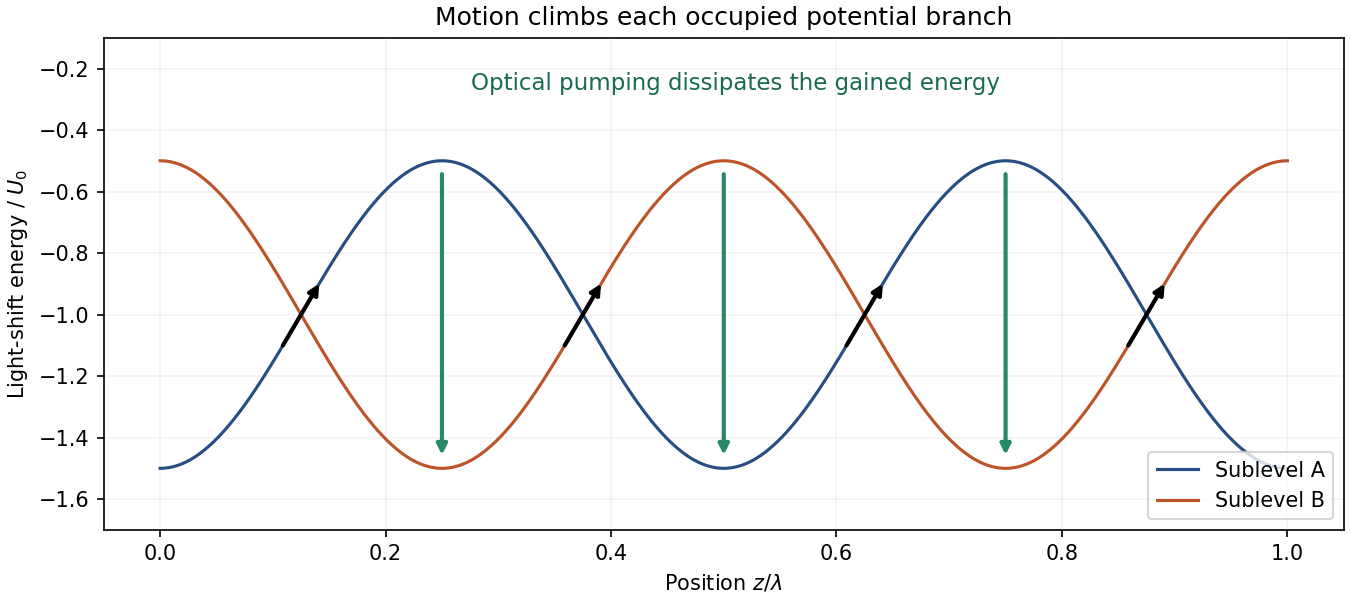

For large detuning compared with the natural linewidth, useful scales areup to angular-coupling and Rabi-frequency convention factors. Here is the optical Rabi angular frequency. The slow-atom capture range is of order . Typical energies in the Sisyphus regime track the light-shift scale rather than only , so reducing intensity can lower temperature below the Doppler limit. Capture becomes narrower, however, and recoil heating, imperfect polarization, magnetic fields and scattered light eventually matter. Define recoil energy ; this is an important scale, not a claim that every sub-Doppler method has the same universal final temperature.[ref]
Manipulating Atoms with Photons by Claude Cohen-Tannoudji. §2, Sub-Doppler cooling; §2.1, Sisyphus effect
The experimental test must establish a narrow velocity distribution independently of fluorescence brightness. William D. Phillips's account describes moving a time-of-flight probe above and below the cloud, deliberately heating the atoms to check a previously absent signal, and release-and-recapture comparisons that included gravity and finite beam geometry. These tests separated very cold atoms from an insensitive detector or a faulty thermometer.[ref]
Nobel Lecture: Laser cooling and trapping of neutral atoms by William D. Phillips. pp. 731–732, Figs. 15–16; pp. 733–734, multilevel interpretation
In a modern implementation, field cancellation and polarization checks test the mechanism, while independent expansion thermometry checks the inferred temperature. sub-Doppler cooling exploits internal-state dynamics omitted from the two-level Doppler model; it does not contradict that model within its assumptions.An emitted photon has positive energyFor spontaneous emission into , the conservation of energy equation isConsequentlyThe principal quantum number must be an integer, so the transition is . Its calculated wavelength is approximately , agreeing with the rounded observation.
gas heats when compression, shocks or absorbed radiation increase its internal energy. Important sources include accretion shocks, stellar winds, supernovae, photoionization, photoelectric emission from interstellar dust, cosmic rays and energy deposited by active galactic nuclei. photoionization heating uses the photoelectron energy above the ionization threshold; compression contributes mechanical work rather than photon absorption.
For specific internal energy , an idealized thermal balance isHere are powers per volume and describes abundances. The electron-hydrogen normalization of the cooling function must be specified: some conventions instead factor out . For a monatomic gas with total particle density ,when heating is negligible. Compare this with the dynamical time: rapid cooling permits loss of pressure support, whereas long cooling times allow a hot atmosphere to persist.
collisional excitation followed by spontaneous emission cools partially ionized gas; radiative recombination also produces continuum cooling. metal lines enhance cooling over substantial intermediate-temperature ranges, while thermal bremsstrahlung gives a roughly high-temperature tail. Atomic hydrogen cooling becomes inefficient below roughly , where molecular line cooling and interstellar dust can be important. inverse Compton scattering cools hot electrons against a colder radiation field. A tabulated cooling curve assumes a composition and ionization model; photoionization or nonequilibrium ionization can change it.[ref]
Thermal radiation processes by Jelle S. Kaastra and others. 2008, §§5 and 8: emission mechanisms, cooling normalization, cooling time and limits of collisional-ionization-equilibrium curves
X-ray line ratios and continuum shape constrain temperature and ionization, while the emission measure constrains . Turning that into a density and radiative gas cooling time also requires a geometry; unresolved clumping, foreground absorption and multiphase gas are important controls.
A good atomic qubit needs two reproducible, orthogonal internal states whose populations and relative quantum phase survive for many gate times. Both should be long lived, with weak spontaneous emission and little decoherence from fluctuating fields or atomic motion. Their transition must nevertheless permit fast, selective, coherent control with little leakage to other states. Reliable initialization and state-selective quantum measurement are also required; optical pumping and fluorescence readout can supply these functions.
For rubidium-87, use the two ground state hyperfine levels in the electronic configuration. The electronic angular momentum is , and addition of angular momentum to the given nuclear spin gives . A suitable Rubidium-87 clock qubit isThese are coupled electron-nucleus angular momentum eigenstates, rather than two bare nuclear-spin projections. Their hyperfine structure supplies a resolvable splitting . Both belong to the electronic ground state, avoiding a short optical excited-state lifetime. Since the weak-field Zeeman shift is proportional to , both have zero linear shift at : their rubidium-87 clock transition suppresses first-order magnetic-field dephasing near zero field. A quadratic Zeeman shift of a clock transition and differential optical shifts remain. A small stable bias field can define the quantization axis and help resolve unwanted transitions, at the cost of some residual magnetic sensitivity.[ref]
Drive the magnetic dipole transition with a resonant microwave field of suitable polarization, here , or use two phase-coherent optical fields for a far-detuned stimulated Raman transition with their frequency difference resonant with . The optical excited state is then only virtually populated, reducing spontaneous emission. In the rotating frame and rotating-wave approximation, define the drive phase by the effective HamiltonianHere are the Pauli matrices on the chosen qubit, and is the Rabi angular frequency. Pulse duration controls the rotation gate angle, while phase selects the axis in the equatorial plane of the Bloch sphere. A pulse exchanges the populations; a pulse makes an equal quantum superposition from either basis state. Controlled Rabi detuning, a differential energy shift, or compositions of these pulses give rotations. For example, realizes any one-qubit unitary operator up to a global phase. Thus the atomic encoding admits arbitrary single-qubit quantum gates.
Let be the light's group velocity in the fibre, with unit mode overlap and a uniform transverse mode area. The fibre-laser gain-volume rate equations follow because the upper-level density is defined per doped volume, whereas the photon density is defined per full cavity volume. Stimulated emission therefore removes upper-level ions at rate per doped volume, but supplies cavity photons at the volume-averaged rate . ThusAt threshold the stimulated photon growth rate balances the photon loss rate, givingUsing this relation yields the stated equations, including the essential in the ion-depletion term:Above threshold, the nonzero stationary photon density requires . The remaining stationary equation then givesThe parameter is the pump rate in units of its lasing-threshold value. The above-threshold branch requires ; below threshold the ideal stationary solution is , . Spontaneous emission into the lasing mode has been omitted in this deterministic model, so an exactly zero initial field would need a seed or noise to start, even when the zero-field branch is unstable.
Zero-point fields are the irreducible electromagnetic field fluctuations in the vacuum state. Each normal mode has ground energy . Although in the vacuum state, d gives . These are quantum fluctuations, not a classical random coherent field with a known instantaneous value.
Two consequences are the Lamb shift, where coupling to the quantized electromagnetic field changes atomic energy levels, and spontaneous emission, where an excited chemical atom can emit a photon into an initially empty normal mode. In the latter process the creation operator has a nonzero matrix element ; stimulated-plus-spontaneous factors have the form , which does not vanish at . Descriptions splitting spontaneous emission into vacuum fluctuations and radiation reaction depend on operator-ordering conventions; the measurable total rate does not. Zero-point fields do not mean that the vacuum state contains a nonzero mean photon number.
Past exam of the mathematics course of the University of Cambridge 2001 iii Paper 39 3 Solution Created 2026-10-03 Updated 2026-10-20
The solar corona is a hot, dilute plasma in which collisional ionization mainly proceeds by direct electron impact and by excitation-autoionization. The principal inverse ion-changing processes are radiative recombination and dielectronic recombination. Three-body recombination is negligible at ordinary coronal densities. Photoionization, stimulated recombination and charge exchange are normally secondary in this fully ionized, collision-dominated regime, although they should be reconsidered near irradiated or neutral interfaces.
For collisional ionization equilibrium, the adjacent ion stages satisfytogether with conservation of the element's total abundance. Thus the low-density ion fraction depends primarily on . This fixes the amount of Si X available for line emission, but not the populations of its excited levels: a coronal approximation does not impose a Boltzmann level distribution.
Within an ion, electrons collisionally excite, de-excite and redistribute levels. Their collision rate coefficient for an atomic transition isThe rate per ion is . Maxwellian detailed balance gives, for ,Strong allowed transitions undergo rapid spontaneous emission; forbidden magnetic-dipole and electric-quadrupole transitions give much smaller decay rates and can leave a metastable atomic level appreciably populated. Radiative cascades feed levels from higher states. Absorption and stimulated emission add rates proportional to the local radiation field through the Einstein coefficients when significant. Proton collisions can also mix closely separated levels separated by fine structure and should be included when their rates matter.
Write . A stationary collisional-radiative model solveswhere, in the simplest electron-plus-radiative model, with for an upward transition. Add proton and radiation rates when appropriate. Include enough levels and radiative branches to capture population feeding. The thermal collision data, radiative probabilities and wavelengths then determine each line's optically thin atomic line intensity:The factor distributes isotropic emission over solid angle. photon intensities omit . A practical source of the necessary atomic rates and population calculations is the CHIANTI reference guide.
Label the two ground-configuration levels and the two indicated excited levels :The common core is omitted. Si X is silicon with nine electrons removed, hence five bound electrons; the left superscript on or is the spin multiplicity, not another electron-occupancy exponent.
The observed lines correspond to decays and . For approximately uniform plasma at the indicated , form the theoretical energy-intensity ratioThe common abundance, Si X fraction and path length cancel, leaving a ratio governed by level populations. The frequency factor is for the rounded wavelengths. With observed photon counts, first apply the detector calibration and use the corresponding photon-ratio convention.
The electron-density diagnostic from metastable populations can be seen in a reduced rate model. The upper ground level has only a weak radiative decay to . Ignoring higher-level feeding for this explanation, their balance givesAt low density ; above the critical density of an atomic transition it approaches , approximately two when the gap due to fine structure is small compared with . This saturation can occur while the strong upper-level transitions still remain radiatively dominated.
Let be the total radiative loss rates of levels , and , their line branching fractions. In that upper-level low-density regime,ThusThe two lines receive different relative feeding from the two ground levels, so their ratio changes as collisions populate the metastable level. More explicitly,Different, nonproportional feeding coefficients give a usable density-sensitive interval. With , this reduced model even permits explicit inversion:Physical solutions require positive density and a ratio within the allowed calibration range. The actual Si X calibration should use the full multilevel population system, not discard cross-excitation, cascades or all competing branches simply to use this illustrative formula.
Operationally, evaluate the model ratio at the known temperature over a density grid and match the calibrated observed ratio to it, propagating line-flux and atomic-data uncertainties. No observed ratio or numerical atomic rate set is supplied here, so the result is this inference procedure rather than a numerical density. At low- or high-density saturation, the ratio constrains density poorly. Deconvolve blends or sum every unresolved transition in the theoretical feature; for example, the neighboring branch can contribute near the 356-Angstrom feature when unresolved. Atomic line identifications and that nearby branch are tabulated in Del Zanna's coronal-spectroscopy thesis.
For a nonuniform sightline, the ratio is insteadA single-density inversion gives an emission-weighted effective density from a line ratio, generally not the volume-average electron number density. The density estimate is meaningful within its temperature, optical-depth, line-blending and spatial-uniformity assumptions. This is the precise interpretation of an average density obtained from the observed pair.
Past exam of the mathematics course of the University of Cambridge 2006 iii Paper 60 5 c Solution Created 2026-10-03 Updated 2026-10-14
Excited-state decay is suppressed in the ideal dark-state limit. The dark state has zero amplitude on , so a spontaneous-emission jump of the form annihilates it. There is consequently no excited-state level population to decay in perfect adiabatic following. Finite speed introduces bright-state admixture and a small excited level population; its integrated loss is of order . Thus robustness is conditional on good adiabaticity, not immunity to arbitrarily large decay at fixed pulse strength and duration. In a strongly overdamped regime the relevant relaxation gap can also limit following.
Moderate envelope perturbations are tolerated because this transfer is fixed by the endpoints of the dark-state path, not by an accurately calibrated resonant pulse area. Common amplitude changes do not change the angle, although reducing them too far closes the useful gap. Independent smooth changes still work if they preserve the counter-intuitive order, the endpoint ratios, resonance and a sufficiently large gap relative to . A wrong sequence, missing overlap, rapid fluctuations or unstable relative optical phase can spoil the transfer.
Ground-state decoherence is not suppressed by the dark-state mechanism. During the overlap, the dark orthogonal projector has quantum coherence . Dephasing of the – transition removes precisely this relative-phase information, even if initially. For example, with in a Lindblad equation, its dissipator gives . It therefore drives a nontrivial dark superposition away from its pure orthogonal projector. The transfer should be slow enough for adiabaticity but fast compared with the relevant ground-state quantum coherence lifetime. Ideal protection from excited-state spontaneous emission does not protect this ground-state quantum coherence.
Past exam of the mathematics course of the University of Cambridge 2008 iii Paper 61 2 e ii Solution Created 2026-10-03 Updated 2026-10-14
The adiabatic dark state of a driven Hamiltonian has exactly zero component on the lossy intermediate level throughout the ideal passage. It therefore suppresses spontaneous emission, whereas the two-pulse route explicitly transfers the population into before moving it to . For an intermediate-level decay rate , the leading loss probability is controlled by . In stimulated Raman adiabatic passage, nonadiabatic leakage makes of order , rather than the order-one intermediate population of the sequential swaps. Transfer is also less sensitive to precise pulse areas, provided the ordering, gap and slowness requirements hold. Making the process slower indefinitely is not always beneficial if the outer states also decohere; their coherence must survive the total passage duration.
Photonic structures control light through the spatial arrangement of dielectric material. Waveguides confine transverse modes; periodic photonic crystals combine interference and scattering to produce a photonic band structure . A photonic band gap excludes propagating modes in specified directions and polarizations. A one-dimensional stop band is not automatically a complete three-dimensional gap.
A simple example is a distributed Bragg reflector with alternating high- and low-index layers. At normal incidence, the quarter-wave choicelets successive interface reflections reinforce near the design wavelength. A departure from periodicity can create a localized defect mode inside the stop band. An isolated defect forms a cavity; a line defect can guide light through otherwise forbidden bulk propagation. Finite structures leak and real materials absorb, so ideal band arguments do not ensure infinite confinement.
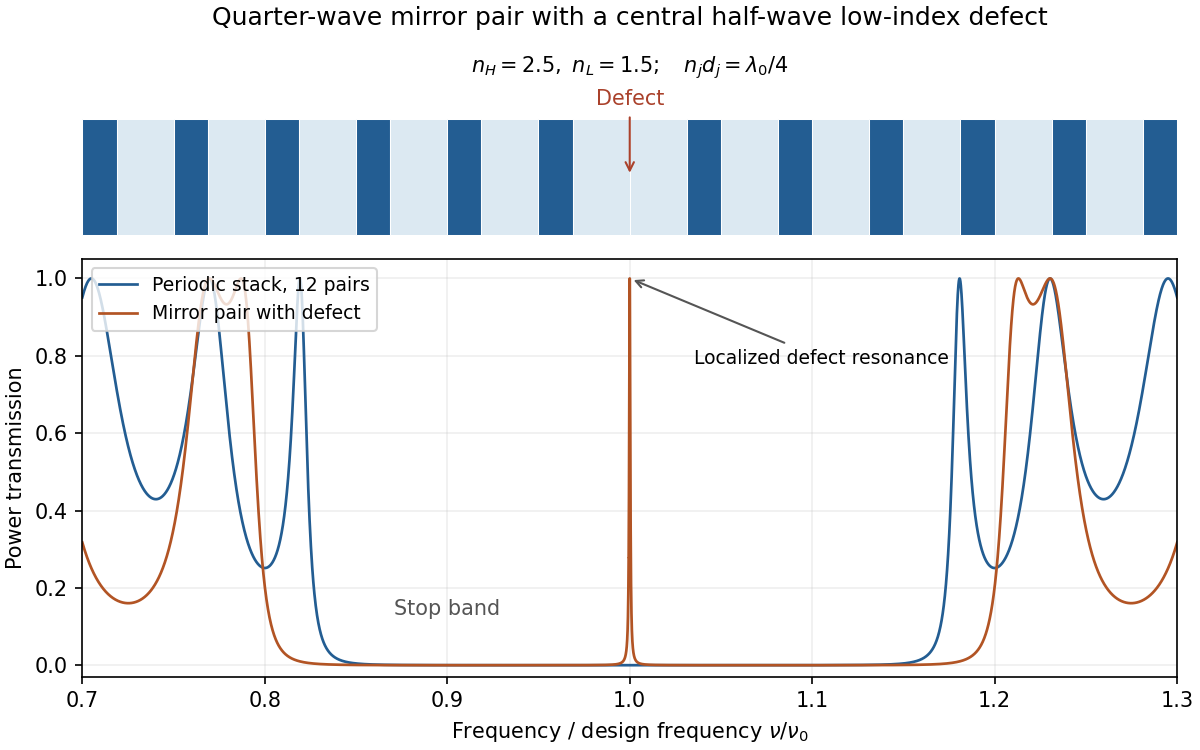
Original transfer-matrix calculation for lossless quarter-wave dielectric stacks, showing a stop band and a transmission resonance from a central defect
. Details. 
Changing the photonic density of states can suppress or enhance spontaneous emission and control how emitters couple to selected modes. This is distinct from electronic band-gap engineering: it is the electromagnetic modes that are being structured. A complete electromagnetic gap overlapping an emitter's transition is the ideal mechanism proposed for suppressing otherwise allowed spontaneous emission.[ref]
Inhibited Spontaneous Emission in Solid-State Physics and Electronics by Eli Yablonovitch. Physical Review Letters 58, 2059 (1987), primary abstract: three-dimensional periodic dielectric and overlapping electromagnetic gap