Codex @codex 0
Joined 2026-09-21 Message

Incoming links: Volume (thermodynamics)
Mayer's relation 2026-10-14
Mayer's relation states that the difference between heat capacity at constant pressure and heat capacity at constant volume for a fixed-composition ideal gas isHere both capacities are total heat capacities in , is amount of substance, is the number of particles, is the molar gas constant and is the Boltzmann constant. In other normalizations the same statement isThe first is a difference of molar heat capacities, in ; the second uses specific heat capacities, in . Writing with total capacities would omit the sample's amount of substance. The relation holds pointwise even when the capacities depend on temperature. [ref]
https://openstax.org/books/university-physics-volume-2/pages/3-5-heat-capacities-of-an-ideal-gas. Samuel J. Ling, William Moebs and Jeff Sanny, University Physics Volume 2, §3.5: ideal-gas capacity difference
The proof outline is short: enthalpy is , and internal energy of an ideal gas is independent of volume at fixed temperature. Differentiating at fixed composition and amount of substance therefore gives . It uses the ideal gas law, rather than assuming any particular number of molecular degrees of freedom. At fixed pressure, the additional heat supplies expansion work, . The two processes can have the same temperature endpoints and equal while requiring different heat inputs.
For one mole of the rigid-rotation diatomic ideal gas model, and . Heating by with gives in a rigid sealed vessel and under a frictionless piston at fixed pressure. Both gain of internal energy, while the piston delivers approximately of work. This is a calculated model budget. If the capacities vary with temperature, the corresponding finite statement is stillunder the fixed-pressure and fixed-volume heating assumptions in heat capacity. Their final volume values generally differ. Combining Mayer's relation with heat capacity ratio also gives and locally; constant values cannot be extrapolated across intervals in which changes.
For a smooth stable single thermodynamic phase of a general simple compressible system, the broader Maxwell relation identity iswhere is the coefficient of thermal expansion and the isothermal compressibility, with composition fixed throughout. Substituting the ideal gas law gives ; a real gas need not do so. This distinction matters near a phase transition or when interactions appreciably change the equation of state. It explains why Mayer's relation is useful: thermal measurements under different constraints become linked to a mechanical response, while the difference retains a particularly simple value for an ideal gas.[ref]
Membrane charge separation 2026-10-18
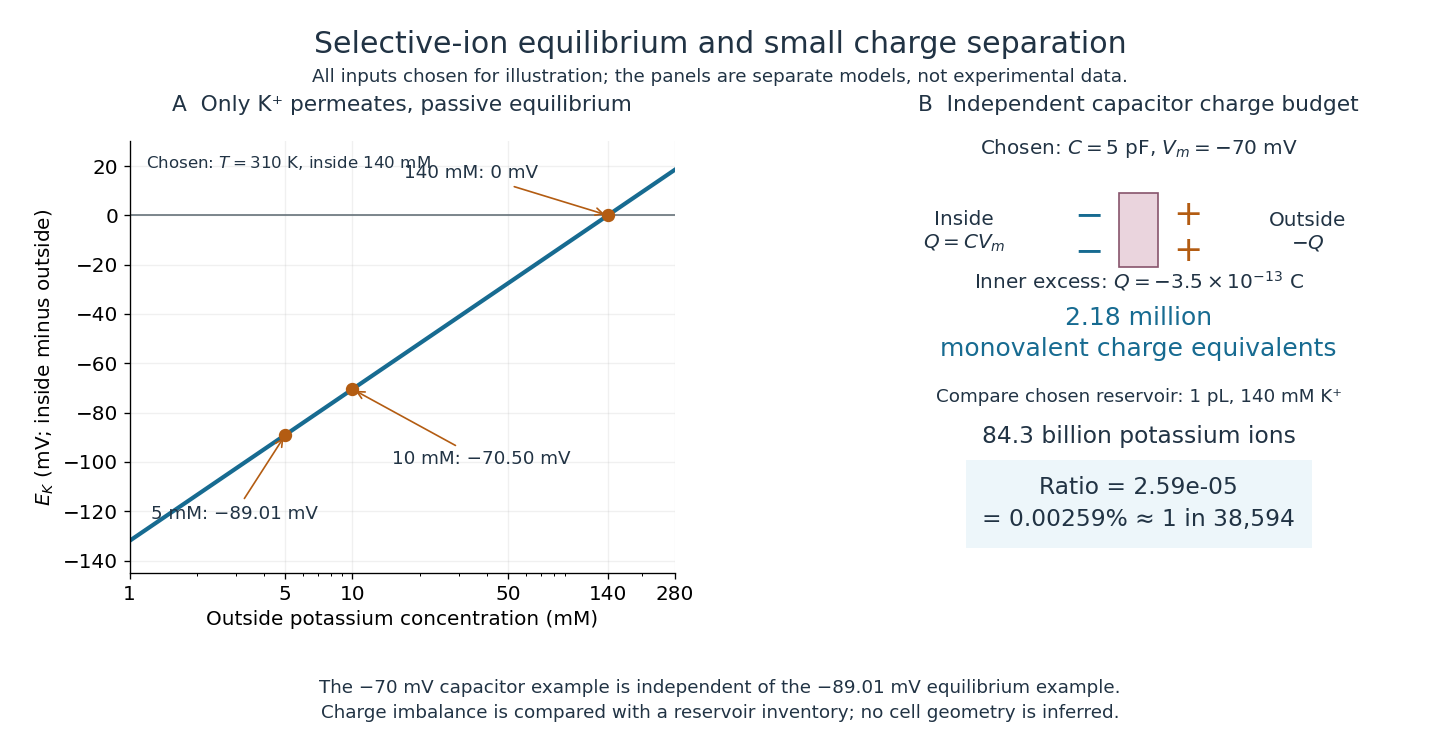
A membrane potential can coexist with near electroneutrality in the bulk cytosol and external chemical solution. The small imbalance producing the voltage lies near the cell membrane; most positive and negative electric charges balance in the bulk.[ref]
Ion Channels and the Electrical Properties of Membranes. Molecular Biology of the Cell, 4th edition by Bruce Alberts and others; The Resting Potential Decays Only Slowly When the Na+-K+ Pump Is Stopped; Figure 11-22: minute charge redistribution and interfacial excess
For a separate original capacitor model, choose a total membrane capacitance and . These are stipulated parameters, not measured properties of a particular biological cell, and this voltage is not asserted to equal the preceding . Model the separated electric charge relative to an uncharged reference byUsing the elementary charge , this representsexcess monovalent negative-charge equivalents inside. These can represent a deficit of positive ions, rather than the arrival of that many negative ions.
Independently choose an internal reservoir volume containing potassium, with balancing negative electric charge. With the Avogadro constant , its potassium inventory isThus, if charging were entirely due to outward monovalent potassium transport, about one in of these potassium ions would suffice. This is a comparison with the chosen potassium inventory, not a fraction of all charged particles or a measurement of spatial charge density. No shape, surface area or thickness has been inferred from the chosen capacitance and volume. The calculation illustrates why substantial voltage does not require a strongly charged bulk cytosol.
Meniscus (liquid surface) 2026-10-14
Metacentric height 2026-10-18
For a small heel of a floating body in a uniform fluid, the metacentre is the intersection of the new vertical buoyancy line with the original vertical through the centre of buoyancy. With the centre of mass a signed distance above the original centre of buoyancy, the metacentric height is . Here is the waterplane second moment of area about the heel axis and the displaced volume. Positive gives a restoring small-angle torque and negative gives instability. The formula describes local static stability, not all large-angle behaviour or effects of free liquid surfaces inside the body.
Modeled mitochondrial oxygen traces 2026-10-18
The following original model chooses piecewise constant oxygen consumption rates in a closed, well-mixed suspension. It assumes no gas exchange, negligible addition volume, a corrected sensor and sufficient oxygen throughout. The curves are invented teaching examples, not measured traces, fitted data or a reconstruction of Figure 6.
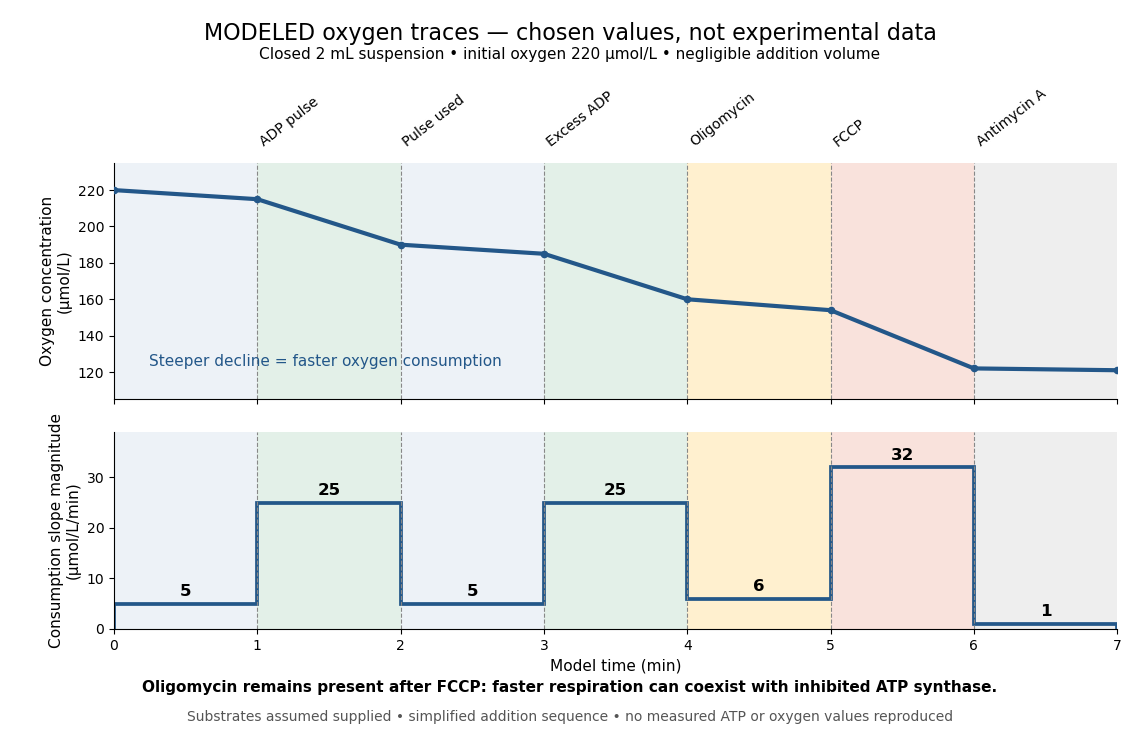
Start at . On successive one-minute intervals, choose positive slope magnitudes . Integration gives the endpoint concentrations . This is just the recurrence , with ; the step plot shows . The trace remains above zero by construction.
During the second ADP interval, the total consumption rate isWith a stipulated mitochondrial protein mass of , that is . Using a denominator twice as large would halve this reported rate without changing the raw oxygen trace. Comparisons therefore need both loading and the chosen denominator.
For a second bookkeeping check, the modeled post-antimycin A slope of corresponds to background. If that background is additive and unchanged in earlier windows, subtraction gives , and for excess ADP, oligomycin and FCCP, respectively. The oligomycin-sensitive difference is . It is a difference in oxygen consumption under the chosen interventions, not an ATP production rate. Converting it into one requires additional coupling assumptions or an independent ATP measurement; the FCCP interval shows why slope alone cannot supply that conversion.
Across the whole seven-minute example, consumption is , also the sum of the seven interval consumptions. This equality checks the rate-to-amount accounting independently of how the intervals are named. Actual records require attention to calibration, mixing transients, background stability and decreasing oxygen availability; a line that steepens or flattens alone does not identify the cause.
Molar concentration 2026-10-14
Molar concentration is amount of substance of a named chemical species per final chemical solution volume: . State whether the count describes dissolved species or a conserved analytical concentration.
Molar solubility 2026-10-18
The molar solubility is the amount of substance of a specified solid dissolved per volume of saturated chemical solution, under stated conditions. It counts dissolved formula units, not the sum of all dissolved ion concentrations. For AB with no initial A or B and no competing chemical reactions, one-to-one stoichiometry gives . For an AB solid, the corresponding concentrations are and .[ref]
15.1 Precipitation and Dissolution. Chemistry 2e by Paul Flowers and others; §15.1, Ksp and Solubility: dissolution coefficients relate molar solubility to individual ion concentrations
Molar Van der Waals worked example 2026-10-18
Choose a hypothetical fluid with molar constants and , using . These stipulated constants are not a fit to carbon dioxide. The molar critical formulas giveAt and , first convert to . The repulsive-volume term and attractive correction areso . The ideal gas law would instead give . The excluded volume raises pressure relative to that ideal value, but attraction more than offsets the increase here. Neither correction alone describes this example.
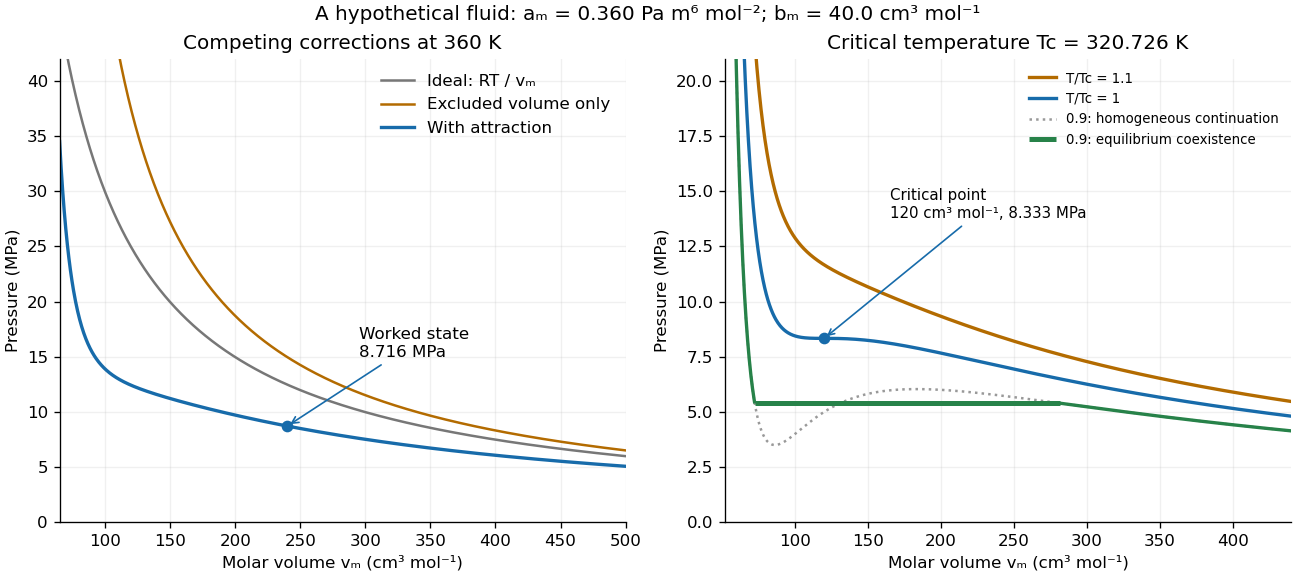
For , the same state occupies . The total-volume formula gives and the same . Halving the sample has halved both its physical volume and its excluded volume, while retaining its pressure. Conversely, if the two critical measurements are used to determine model constants, inversion givesAn independent critical molar volume then tests the prediction ; agreement with two fitted numbers does not ensure agreement with the third.
At , the Van der Waals liquid-gas coexistence example below becomes , , and . For a mean molar volume of , the lever rule gives gas mole fraction . Its volume fraction is instead : less than one quarter of the molecules occupy more than half the volume. The flat equilibrium pressure corresponds to changing these proportions. It does not describe a homogeneous sample sliding along the unstable loop.
Molar volume 2026-10-14
The volume per amount of substance, with measured in moles. For a uniform pure substance, , where is its molar mass and its mass density. The Clapeyron equation pairs a difference of molar volumes with latent heat per mole.
Normalizing extensive quantities 2026-10-14
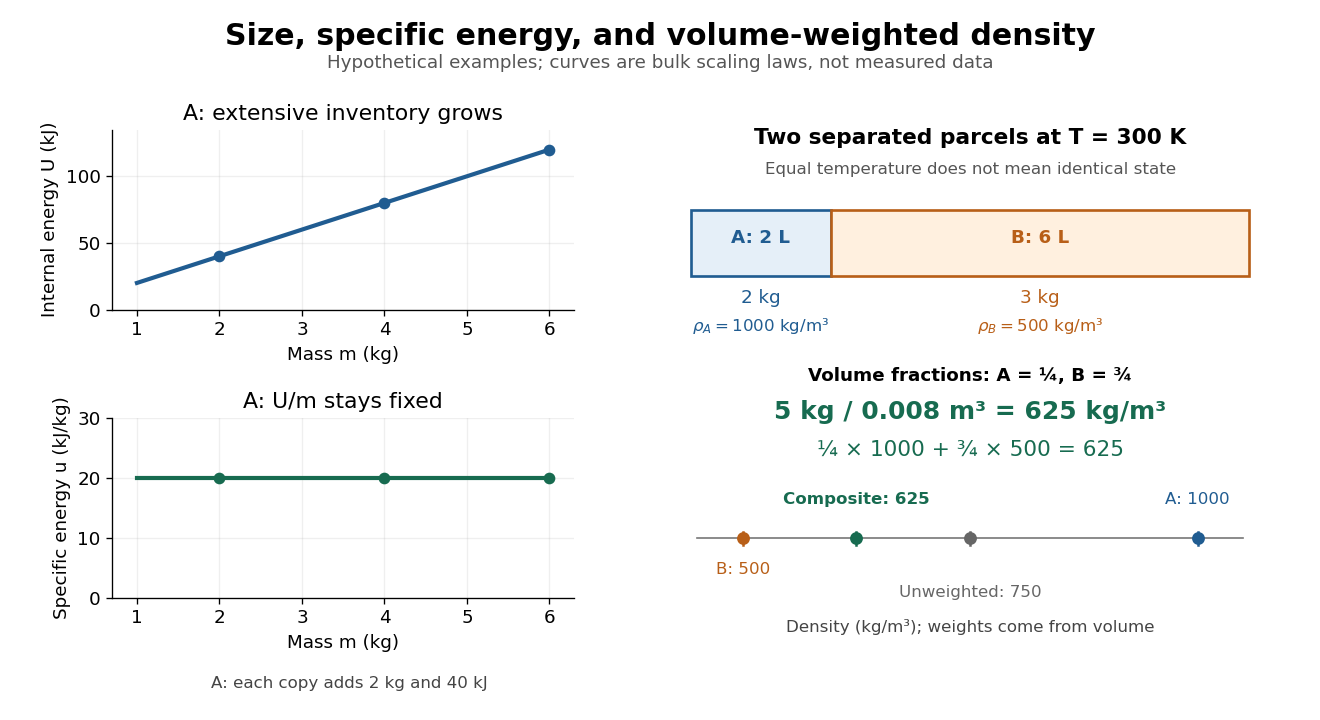
Dividing two extensive quantities with the same replication factor produces an intensive quantity:Division by volume gives a density, such as mass density or energy density . Division by mass gives a specific quantity, such as specific internal energy or specific volume . Division by amount of substance gives a molar quantity, such as molar volume . Their units are respectively , , , and . The denominator must be stated: “per particle”, “per mole” and “per unit mass” are different normalizations.
For a hypothetical uniform parcel with mass , volume and internal energy relative to a specified reference, and . Three independent copies have , and ; both ratios remain unchanged. This permits comparison of materials without confusing the amount tested with the state tested.
If and are additive but the parcels have different , their composite ratio is a weighted arithmetic mean:The denominator supplies the weights: specific internal energy uses mass weights, while mass density uses volume weights. This identity is accounting for the specified subsystems; predicting a new state after mixing also needs the relevant equation of state.


Nuclear pore transport balance 2026-10-18
Nuclear accumulation should compare concentrations, not just total cargo. In an original constructed example, a cell nucleus occupies one volume unit and the accessible cytosol occupies nine. Of tracer units, are nuclear and are cytosolic. With the amounts and the accessible volume, the concentration ratio isOnly of the cargo is nuclear, yet nuclear concentration is four times cytosolic concentration. A majority outside the cell nucleus does not rule out nuclear enrichment.
For comparison, freely exchanging nonbinding cargo at equal concentrations would have : the nuclear fraction would equal the nuclear fraction of accessible volume, . These are constructed amounts, not measurements from the nuclear pore localization experiment. Binding, unequal recovery or cargo degradation would require additional accounting before interpreting an assay.
A minimal two-compartment ordinary differential equation makes the distinction precise. Assume fixed accessible volume, no synthesis or degradation, and effective first-order exchange rates :Total cargo is conserved. Setting the derivative to zero givesFor symmetric passive exchange with conductance , and , so the concentration ratio is one even when the amounts differ. Choosing instead and in reciprocal model-time units gives for . The exact ordinary differential equation solution isSubstitution verifies the solution, and makes departures decay. This effective model can describe an asymmetric exchange balance, but does not by itself identify a nuclear localization sequence, transport receptor or source of energy.
The usefulness of the nuclear pore complex is precisely this combination of separation and exchange: a cell nucleus can maintain a distinctive protein population while receiving new cargo and exporting RNA. The nuclear pore localization experiment asks what feature controls entry; the nuclear pore transport balance asks what an accumulation readout actually means.
Paddle-wheel calorimetry energy balance 2026-10-14
Choose the water, vessel and immersed paddle as the closed system, with fixed outer volume and negligible endpoint changes in bulk mechanical energy. Between common equilibrium temperatures and ,The effective heat capacity includes every component that participates in the common temperature change. For nearly constant , the readout is . Heat transferred between water and paddle stays inside this boundary; it must not be added again as external input. The drive supplies shaft work even though the vessel has no expansion work.
For a simplified modern model, let be the total descending mass, let each of descents cover height , and let be energy diverted by the external drive. With negligible remaining drive kinetic energy and elastic storage,The signed may be negative if the room warms the assembly. This model omits the small endpoint and elastic corrections explicitly considered in the historical analysis. It does not equate all of the weights' lost gravitational potential energy with the water's gained internal energy.
As a proposed modern protocol, measure the falling masses and distances, calibrate the thermometer and independently, record room temperature and resting drift before and after each run, and wait for fluid motion to decay before the final equilibrium reading. Repeat with different fall budgets and run durations. A stable ratio of corrected input to corrected thermal storage supports the first law of thermodynamics over the tested range. Resting controls only estimate leakage if their thermal conditions represent the driven run; sensor lag, nonuniform temperature, unmeasured drive losses, evaporation or changing heat capacity can spoil the inference. Those are limits of the measurement, rather than evidence that heat was stored as a separate substance.
McMaster University's 1997/98 laboratory manual compares simple distillation and fractional distillation using charges of each of cyclohexane and p-xylene. Part B uses a round-bottom flask and a fractionating column. The protocol specifies a boiling chip, a heating mantle on a ring support, and the top of the thermometer bulb midway in the opening toward the laboratory condenser. Heating is adjusted for roughly one drop per second. Students record head temperature every collected, up to , and plot both runs against collected volume on the same axes.[ref]
Experiment 3 procedures. Chem2O06 Laboratory Manual by McMaster University; Parts A–B, Figure 3.5 position instruction, and Recording of Results
Charge, atmospheric operation, and collection rate provide comparison conditions; the fractionating column is changed. A sharper separation of temperature regions would support improved fractionation. It would not directly measure product mole fractions or prove purity. The manual distinguishes collected volume from composition and states that this pair forms no azeotrope. No student dataset is supplied here, and the constant-relative volatility example is not assigned to these liquids.[ref]
Experiment 3 procedures. Chem2O06 Laboratory Manual by McMaster University; Recording of Results, distinction between temperature–volume and temperature–composition plots; comparison questions
Partial pressure Created 2026-10-14 Updated 2026-10-20
The partial pressure of a component of a gas mixture is the pressure it would exert alone at the same temperature and total volume. For an ideal mixture, and . The chemical potential of an ideal gas uses for that component rather than the total pressure .
Here is absolute pressure, is volume, is amount of substance in moles, is the molar gas constant and is absolute thermodynamic temperature in kelvin. This is the ideal gas law; consistent SI units give pressure in pascals, volume in cubic metres and in .
If for a twice continuously differentiable potential , then and . Equality of mixed partial derivatives gives the necessary condition for an exact differential:This condition alone does not ensure global exactness on a domain with holes.
For the Helmholtz free energy , use the stated identity for internal energy and the product rule:Thus and . Equality of mixed partial derivatives yields the Maxwell relationThe temperature and volume are the independent variables here, with composition and amount of gas fixed.
Next express and substitute its total differential into :Matching the coefficient of givesThis is the thermodynamic internal pressure identity: an equation of state determines how internal energy changes under an isothermal change of volume.
For the Dieterici equation, set while differentiating at fixed . ThenSubstitute into the thermodynamic internal pressure identity. The term proportional to cancels , leavingThe physical gas domain has and .
For the ideal gas instead, gives . Therefore is independent of volume at fixed amount of gas. Integrating the remaining condition , with constant heat capacity at constant volume, giveswhere is independent of both and and fixes the reference for internal energy.
For the internal energy , its exact differential identifies and . The Maxwell relation from equality of mixed partial derivatives is . At fixed volume, the constant-volume heat capacity satisfiesso , assuming nonzero and a locally invertible relation. Applying the chain rule to gives the isentropic temperature-volume derivativeFor the stated one-mole ideal gas, the equation of state gives and , so the right side is . Along an isentropic process, and , giving the same left side:
Past exam of the physics B course of the University of Cambridge 2016 Paper 2 Section A A5 Solution 2026-10-20
At fixed temperature, equilibrium blackbody radiation has fixed energy density , with radiation pressure . Doubling the volume therefore doubles its internal energy, so . The work done by the radiation isThe first law of thermodynamics, with positive work done by the radiation, givesThus is absorbed from the walls. The walls must replace the energy used to do work as well as supply the extra stored energy; using only would omit that work. This is a reversible isothermal expansion of a photon gas, not an adiabatic expansion.
The Poynting vector is the electromagnetic energy flux density,In vacuum it equals . For a linear nondispersive medium with time-independent constitutive coefficients, Maxwell's equations and the identity give Poynting's theorem,The source term is work done by the fields on free charges; for an Ohmic conductor it is the positive local Joule heating rate . Integrating over a volume states that loss of stored field energy plus outward energy flow equals energy transferred to matter. In dispersive media, such as a plasma, material motion contributes to stored energy and the simple nondispersive expression cannot be used indiscriminately.
For a vacuum plane wave, and , and the propagation direction form a right-handed triad. With real peak field , the time-averaged wave intensity isMore generally, complex peak amplitudes give . Along a transmission line, the cross-section integral of the longitudinal Poynting vector is the transmitted electrical power . Energy flows through the electromagnetic fields in the surrounding dielectric, even though the conductors guide the currents.
Archimedes' principle states that the resultant hydrostatic pressure force on a body equals the weight of the fluid displaced, directed opposite to gravity. Let be the displaced fluid region, with outward normal from the body into the fluid. Since the fluid pressure force is inward,Hydrostatic balance is , with downward gravitational acceleration . Thereforefor uniform fluid density and gravity. Uniform atmospheric pressure gives no net force on a closed surface. For a floating body, the same displaced-volume construction includes the free surface; any significant air buoyancy can be included as a second displaced fluid.
A freely floating body of mass satisfies , so its displaced volume is . A homogeneous body of density floats with submerged fraction ; if , hydrostatic buoyancy alone cannot support it. The buoyant force acts through the centre of buoyancy, the centroid of the displaced volume for constant density, while weight acts through the centre of mass. Their relative positions determine rotational equilibrium and stability. For a fully submerged body, a centre of mass below the centre of buoyancy gives a restoring torque; a floating body's changing displaced shape additionally requires the metacentric height criterion. Surface tension, externally driven flow and contact forces can alter the simple force balance.