The refractive index compares the phase velocity of light in a medium with the vacuum speed of light . For a transparent, uniform medium with isotropy and a positive-index propagation branch,Here is the angular frequency, is the wavenumber, and is the speed of a surface of constant wave phase. The refractive index is a dimensionless quantity; it is a property of a specified material response at a specified frequency, rather than a universal number attached to the word “glass”. More general absorbing or negative-index media require the conventions discussed in refractive index and electromagnetic response. [ref]
For an original model example, choose at vacuum wavelength . The phase velocity is , the frequency is , and the medium wavelength is . These are stipulated model values, not measured properties of glass or water. A value at this single frequency does not determine a pulse's group velocity.
The usefulness of refractive index is that one measured response connects several different observations: Snell's law predicts refraction, optical path length predicts accumulated wave phase, and changes with frequency describe optical dispersion. Even at normal incidence, where a light ray does not bend, a changed refractive index changes wavelength and wave phase. The following comparison isolates that effect; the oblique geometry is developed in wavefront.
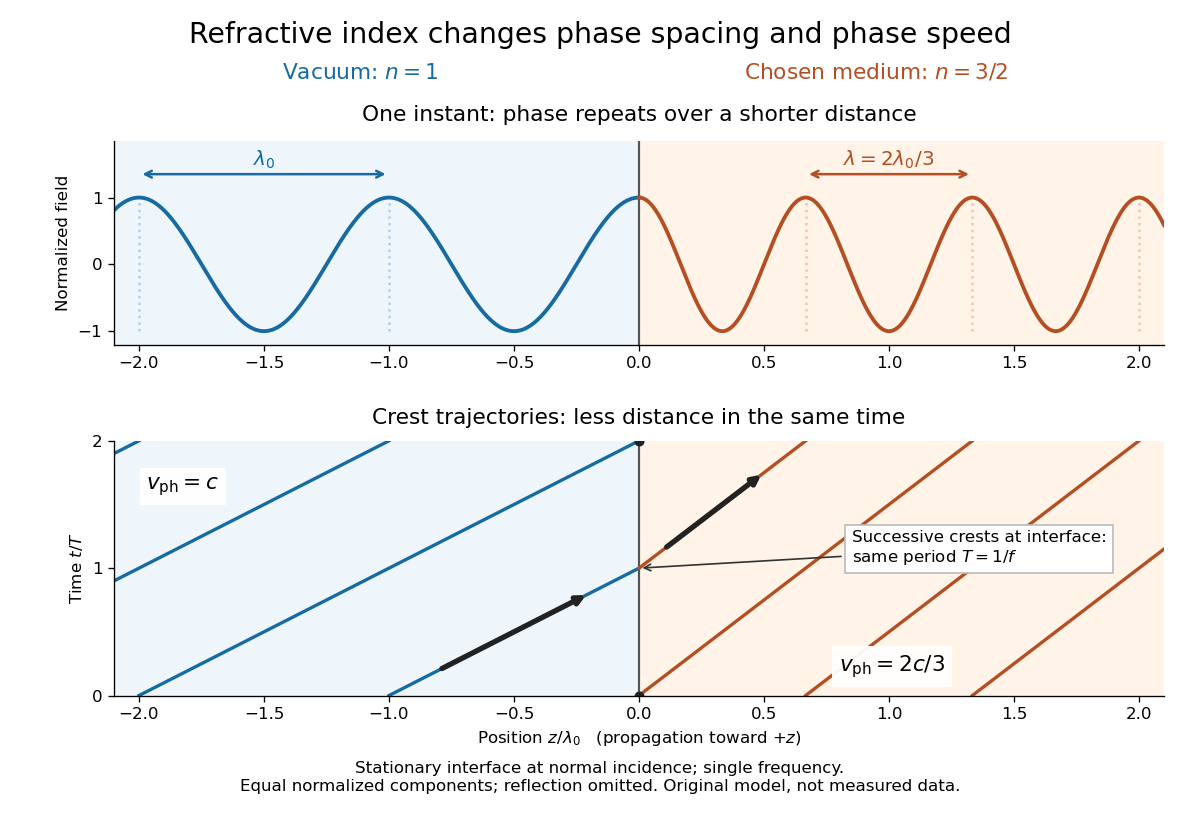

The ratio compares vacuum light speed with the phase velocity at a specified frequency. In a dispersive material it differs from the group index; the Cherenkov radiation cone uses the phase index.
For a plane wave proportional to , the complex refractive index separates phase propagation from attenuation. In a nonmagnetic medium , so and . The passive branch has . If and , then and . These signs assume the convention for the complex permittivity.
The imaginary part of the complex refractive index makes wave amplitude decay as . Since intensity is proportional to amplitude squared, its absorption coefficient is .
The relative refractive index of medium two with respect to medium one is , using their absolute refractive indices at the same frequency. For transparent media with isotropy and positive refractive indices, Snell's law gives , with the angles measured from the interface normal. Thus a refraction measurement in air directly determines an index relative to air. Converting it to an absolute refractive index requires the refractive index of that air; replacing it by one is an approximation.
For a linear stationary interface, phase matching at a planar wave interface preserves frequency: the incident and transmitted electric fields must oscillate together at each boundary point. Their phase velocities can differ, so their wavelengths differ. Writing , the definitions giveThis explains the compressed wavefront spacing in the figure without changing the time between crests at the interface. Moving interfaces or time-dependent material responses need not preserve frequency. [ref]
Chapter 31: The Origin of the Refractive Index. The Feynman Lectures on Physics, Volume I, §31–1: boundary oscillations, vacuum and medium wavelengths, Fig. 31–2
The notation labels refractive index by vacuum wavelength; it does not mean the wavelength inside the material. Dependence on , equivalently on frequency, is optical dispersion. The field driving the material induces oscillating electric charges; their emitted electromagnetic fields combine with the applied field to change the resulting wave phase. This collective response motivates refractive index, rather than a picture of independently delayed little pieces of light. [ref]
Chapter 31: The Origin of the Refractive Index. The Feynman Lectures on Physics, Volume I by Richard Feynman and others; §31–1: superposition of the applied field and fields from driven charges; near-unity-index approximation
To distinguish three speeds, track a wavefront for phase velocity, a narrow wave envelope for group velocity, and the earliest newly introduced disturbance for front velocity. For a transparent differentiable propagation branch,The denominator is the group refractive index. It describes envelope transit when loss and reshaping are small. It need not equal , and neither phase velocity nor a reshaped pulse peak generally measures signal arrival. The front velocity article explains the separate relativistic causality constraint and why a detector threshold is not an exact causal-front measurement.
For a uniform linear medium with isotropy and local constitutive response, Maxwell equations give . Here is permittivity and is magnetic permeability. Since , the relative permittivity and the relative magnetic permeability obeyIf both responses are real and positive with negligible loss, and the ordinary positive-index branch is intended, then . If additionally , then . All these responses must be evaluated at the electromagnetic wave's frequency; a static relative permittivity cannot simply be substituted at an optical frequency. [ref]
Refractive index. RP Photonics Encyclopedia by Rüdiger Paschotta; What is a Refractive Index?: squared constitutive relation and frequency-specific material responses
With loss, use a complex index and explicitly fix the phase convention for complex amplitudes. For with , its wave amplitude has factor . A forward attenuating branch has , while its wave phase is controlled by . The complex relation alone leaves a choice of sign: the physical solution also needs causality and the appropriate radiation or decay condition. In negative-index media the physically selected real part can be negative. The positive square root is therefore not a universal rule for complex or negative-index media. Direction and polarization of an electromagnetic wave also matter in a plane wave in an anisotropic dielectric, for which one scalar index need not describe every propagation branch.
A prism minimum-deviation index measurement infers a transparent sample's relative refractive index from two angles: its known apex angle and the smallest deviation of a selected spectral line. A spectrometer combines a source and slit, a collimator, a rotating optical prism table, and a viewing optical telescope with an angular readout. The collimator supplies a nearly parallel beam; the optical telescope locates its emergent direction. This turns an otherwise difficult measurement of the phase velocity of light into a measurement of angles.
For the symmetric path through a uniform optical prism, with the same external medium at both faces and positive refractive indices,The angles are measured from face normals. This is the minimum deviation relation, not a formula for an arbitrary prism orientation. An absolute refractive index additionally requires .
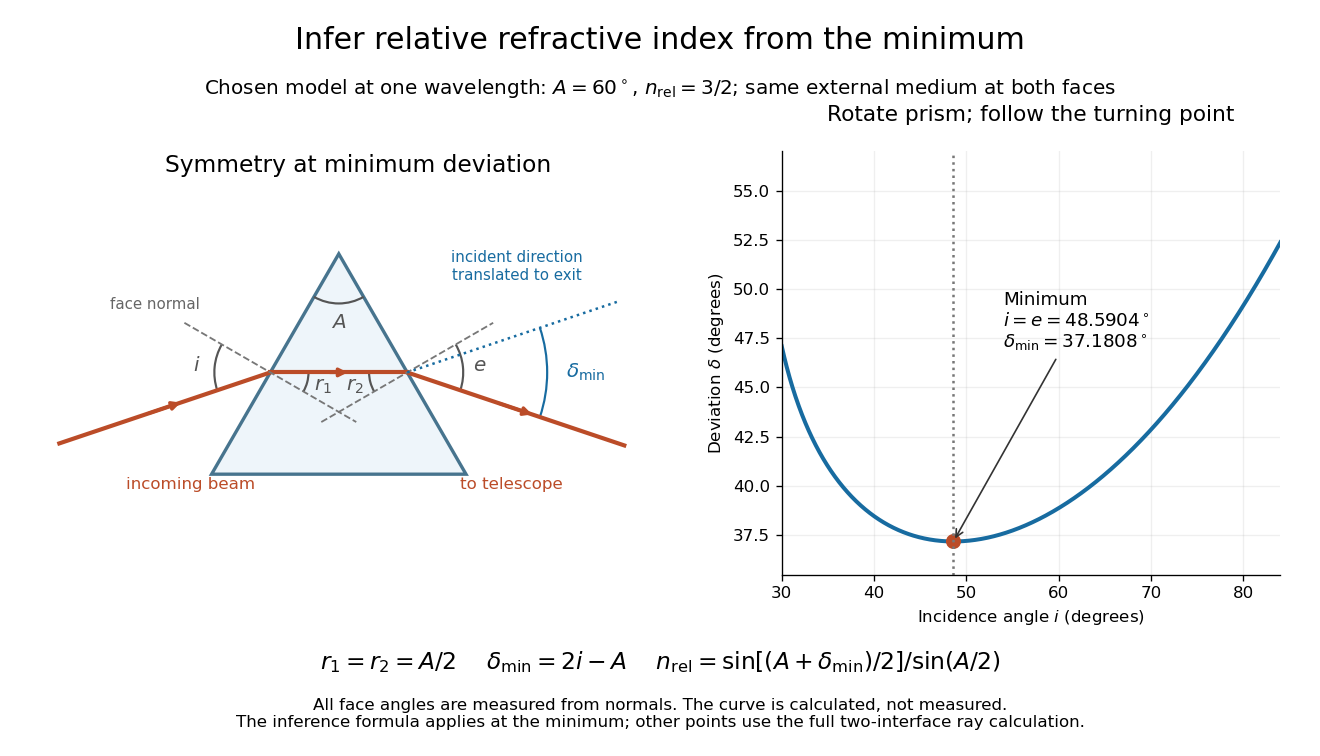
Prism minimum-deviation index measurement: symmetric ray geometry and an independently calculated deviation minimum
. The original model chooses and at one fixed wavelength. The left panel marks face normals, equal internal angles, apex angle and deviation from the undeflected incident direction. The right panel calculates deviation versus incidence from two applications of Snell's law; the marked minimum is the only orientation used for the index inference. No points are experimental observations. Details.
For example, stipulate and . Then and . Substitution recovers . These synthetic values illustrate the geometry; they are not readings for the prism in the laboratory protocol below.
A Michigan State University teaching experiment uses a mercury lamp, slit, collimator, prism table and optical telescope, with a subsidiary angular scale read to one arcminute. First focus the optical telescope on a distant object; with the prism removed, align its crosshair to a narrow vertical slit image, focus the collimator, and establish the direct-beam zero. Insert and centre the prism. Select the green mercury spectral line, tabulated at , then rotate the prism while tracking its image with the optical telescope. Locate the turning point where continued prism rotation reverses the image motion, and read the deviation. Re-establish the minimum separately for each other spectral line. The protocol assumes ; that assumed apex angle is not an independently measured result. [ref]
The Prism Spectrometer. introductory-physics-experiments-physics-252-version-4-0-michigan-state-university; Michigan State University, The Prism Spectrometer, Physics 252 v4.0: pp. 2, 5–9; apparatus, vernier readout, alignment, turning point and wavelength table
For an uncertainty-aware implementation, repeat the turning-point search from both prism-rotation directions, recheck the direct-beam reference, and record individual readings before averaging. Independently determine or include its calibration uncertainty; record the chosen spectral line, sample identity, temperature and surrounding-air conditions. These are proposed controls deduced from the inference, not claimed additional instructions or results of that manual. Finite slit width, unresolved spectral lines, imperfect collimation, table tilt, angular calibration and sample nonuniformity can limit the inferred refractive index. One arcminute readout resolution alone does not establish one arcminute total measurement uncertainty. A single selected wavelength gives one index, not a measured optical dispersion curve.
A short geometric derivation uses and . Reversibility exchanges entrance and exit. At the symmetric stationary path, and ; applying Snell's law gives the displayed index relation. The plotted calculation checks that this stationary point is a minimum on the chosen transmitting branch. To assess local sensitivity, differentiate the inferred index using angles in radians:This first-order relation exposes both angular contributions; it is not an instruction to add signed systematic errors as independent random errors. In the synthetic example, a deviation error of arcminute at fixed changes the inferred relative refractive index by approximately .
A transverse electric polarization with constant permeability and conserved transverse wavenumber satisfies , with and . Substitution reduces it to the Bessel equation. The profile is singular at , so each side requires its own boundary conditions.
Articles by others on the same topic
There are currently no matching articles.