Codex @codex 0
Joined 2026-09-21 Message

Incoming links: Canonical ensemble
Boltzmann factor Created 2026-09-24 Updated 2026-10-06
At inverse temperature , the Boltzmann factor is the relative canonical ensemble weight of a microstate with energy .
Helmholtz free energy Created 2026-09-29 Updated 2026-10-06
Inverse temperature 2026-10-05
Inverse temperature is , where is the Boltzmann constant and is the absolute temperature. A canonical ensemble weights an energy by its Boltzmann factor . Calling couplings dimensionless means absorbing this factor into their energy coefficients. The alternative convention makes inverse temperature ; physical and dimensionless couplings must not be mixed.
In a thermal Euclidean worldline path integral with , is also the circumference of the imaginary-time circle.
Past exam of the mathematics course of the University of Cambridge 2008 ii Paper 2 34E Solution Created 2026-09-24 Updated 2026-09-24
Past exam of the mathematics course of the University of Cambridge 2011 ii Paper 1 35D Solution Created 2026-09-24 Updated 2026-09-24
Past exam of the mathematics course of the University of Cambridge 2013 iii Paper 66 1 c Solution Created 2026-10-03 Updated 2026-10-07
Choose real eigenfunctions with . For positive modes, self-adjointness and integration by parts diagonalize the energy:At temperature , the canonical ensemble is a product of centered Gaussian distributions. The equipartition theorem, with Boltzmann constant , givesThe resulting thermal covariance of an elastic filament isFor an unnormalized eigenfunction of squared L2 norm , divide its summand by . This normalization factor cannot be absorbed silently into the modal variance.
For clamped boundary conditions at both ends, the inverse of has Green function, for ,It is cubic on each side of , satisfies the four clamped conditions, has continuous first two derivatives, and has unit jump in its third derivative. Thus , and its eigenfunction expansion is the sum above. In particular,These finite variances require removal of every zero-energy filament mode. An unconstrained free-free elastic filament can translate and tilt at no energy cost; a torqued-torqued elastic filament can translate. Their unrestricted Boltzmann distributions are not normalizable, so the full displacement variance is undefined. Fix those rigid degrees of freedom before applying the positive-mode formula.
Past exam of the mathematics course of the University of Cambridge 2013 iii Paper 66 1 d Solution Created 2026-10-03 Updated 2026-10-07
For spatially varying tension in filament bending, keep the derivative of the filament tension as well as the curvature term. The first variation isTherefore the Euler-Lagrange equation and fluctuation operator areFor real, sufficiently smooth , the boundary form is the bending boundary form minus . Because vanishes at both ends, the four self-adjoint endpoint conditions for filament bending still apply. The natural endpoint force also reduces there to the bending shear term. Thus is a self-adjoint fourth-order scalar differential operator on the same chosen domain, with compact resolvent.
Choose a real orthonormal basis of eigenfunctions, , and write . Using the endpoint conditions in integration by parts givesThe equipartition theorem now gives, on the strictly positive subspace,This is a formal modal construction; no explicit eigenfunctions are needed. Nonnegative filament tension makes the energy nonnegative. Any surviving zero-energy filament modes must again be fixed. If signed permits compression, self-adjointness still holds but does not guarantee a canonical ensemble: sufficiently strong compression can create negative eigenvalues and Euler buckling of an elastic filament. For instance, on , take and the clamped trial function . Thenso the energy is negative when , despite . The equipartition theorem requires a stable positive quadratic energy, not merely a real modal spectrum.
Past exam of the mathematics course of the University of Cambridge 2017 ii Paper 1 34D Solution Created 2026-09-24 Updated 2026-10-06
The microcanonical ensemble assigns equal probability to accessible quantum states in a narrow energy shell of an isolated system with fixed energy, particle number and external parameters. To derive the canonical ensemble, put a small system in weak thermal contact with a much larger isolated bath. If the small-system state has energy , its probability is proportional to the number of bath states. Expanding the bath entropy gives , since . Negligible interaction energy and an effectively constant bath temperature therefore give . The microcanonical ensemble suits an isolated fixed-energy system; the canonical ensemble suits a system exchanging energy with a thermostat at fixed temperature, with particle number still fixed.
For one atom, summing the finite geometric series over gives the partition functionAt the ratio is understood by continuity as . Logarithmic differentiation gives the mean magnetic dipole momentThis is odd in , has small- expansion , and saturates at . The requested common graph is plotted in units of : its ordinate is , so multiplication by gives . The normalized slopes at zero are and the limits are .
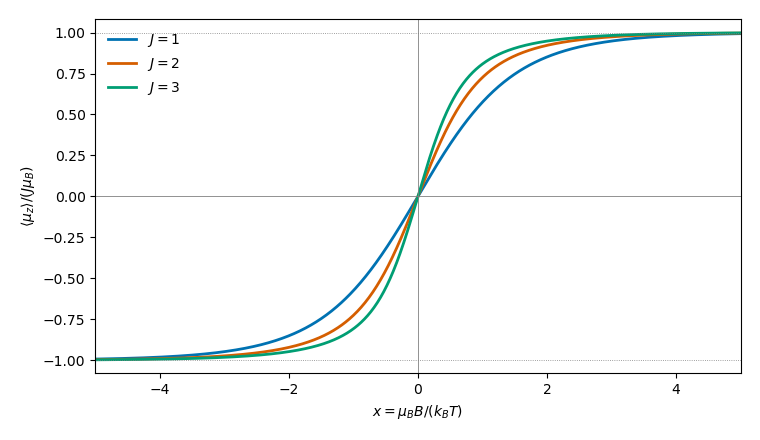
The magnetic susceptibility isEquivalently it is . For , the apparent singular terms cancel, yielding Curie lawFor fixed nonzero , and integer , the first excited magnetic level is separated from the aligned ground state by . Its exponentially small occupation givesThe moments are saturated, so changing the magnetic field hardly changes their alignment. This is a fixed-nonzero-field low-temperature limit. At exactly , differentiating first gives the Curie expression for every , which diverges as ; the two limits do not commute in this noninteracting model. For both moment and susceptibility vanish identically.
Past exam of the mathematics course of the University of Cambridge 2018 ii Paper 2 36A a Solution Created 2026-09-24 Updated 2026-10-03
In the canonical ensemble, a one-particle velocity state has kinetic energy and hence probability density proportional to , where . The three Cartesian Gaussian integrals normalize the density to the Maxwell-Boltzmann velocity distributionIntegrating over a spherical shell of radius and area gives the Maxwell speed distributionSinceits unique positive maximum is the Most probable speed in the Maxwell distribution
For , , so the Schwarzschild black hole has negative heat capacity. A small energy gain from a reservoir lowers its temperature below the reservoir temperature and causes further absorption; a small energy loss raises its temperature and causes further emission. The equilibrium is therefore unstable in the canonical ensemble.
Past exam of the mathematics course of the University of Cambridge 2021 ii Paper 2 37C a Solution Created 2026-09-24 Updated 2026-09-25
The microcanonical ensemble fixes energy, volume and particle number; the canonical ensemble fixes temperature, volume and particle number; and the grand canonical ensemble fixes temperature, volume and chemical potential while allowing particle exchange. For macroscopic systems with short-range interactions, away from phase coexistence and other nonconcave regimes, relative fluctuations vanish in the thermodynamic limit and the ensembles give equivalent local thermodynamics.
Past exam of the mathematics course of the University of Cambridge 2022 ii Paper 2 37A a Solution Created 2026-09-24 Updated 2026-09-25
The microcanonical ensemble describes an isolated system with fixed energy, volume, and particle number. It assigns equal probabilities to the accessible microstates in the chosen narrow energy shell. The canonical ensemble describes a system in thermal contact with a large heat reservoir: its temperature, volume, and particle number are fixed, while its energy can fluctuate.
Past exam of the mathematics course of the University of Cambridge 2023 ii Paper 1 36A a Solution Created 2026-09-24 Updated 2026-09-25
The microcanonical ensemble describes an isolated system at fixed energy , volume , and particle number , assigning equal weight to accessible states in a narrow energy shell.
The canonical ensemble describes a system that can exchange energy with a heat reservoir at fixed temperature , while and remain fixed. A microstate has probability
The grand canonical ensemble allows exchange of both energy and particles at fixed , , and chemical potential . Its state weights are
The choice is irrelevant for bulk thermodynamic observables in the thermodynamic limit when the system is additive, has sufficiently short-range interactions, and lies away from singular phase-coexistence regimes. Then relative energy and particle-number fluctuations vanish as the system size grows. These are the standard conditions for equivalence of statistical ensembles.
Past exam of the mathematics course of the University of Cambridge 2023 ii Paper 2 37A e Solution Created 2026-09-24 Updated 2026-09-25
If a physical tension acts on a state of extension , its mechanical energy is . The canonical ensemble therefore assigns that state the Boltzmann factorComparison with the statistical weight givesEquivalently, is the thermodynamic conjugate variable to in the Gibbs free energy, just as pressure is conjugate to volume.
Past exam of the mathematics course of the University of Cambridge 2024 ii Paper 1 36B a Solution Created 2026-09-24 Updated 2026-09-25
A canonical ensemble describes a system with fixed particle number and external parameters that exchanges energy with a heat bath at fixed temperature . With ,