
Missing diffraction order 2026-10-18
A missing diffraction order occurs when a principal maximum of an array factor coincides with a zero of the individual aperture's diffraction envelope. For identical slits of width and centre spacing , order has . It is missing if is a nonzero integer. This is cancellation of field contributions, not loss of the incident wavelength or a failure of the grating equation.
Obliquity factor Created 2026-10-18 Updated 2026-10-20
The obliquity factor weights the directional contribution of an aperture element in a scalar diffraction integral. In a fixed observation direction in the Fraunhofer diffraction regime, its variation across a sufficiently small aperture can be neglected along with the variation of the geometric amplitude denominator. Its angular dependence can still matter when comparing widely separated observation directions.
COBE DMR sky anisotropy experiment 2026-10-18
In 1992 the COBE DMR team, including George F. Smoot and Charles L. Bennett, used radiometer antennas to compare antenna temperatures between sky directions apart at , and , with two nearly independent channels per frequency. Repeated sky coverage supported least-squares solution map reconstruction.[ref]
The analysis fitted magnetic response and removed the assumed kinematic angular dipole and its second-order Doppler effect contribution. Channel sums retained sky structure; channel differences estimated noise. Cross-channel correlations, different frequency maps and Milky Way latitude cuts tested the interpretation. Residual large-angle structure supported Cosmic microwave background anisotropy; Galactic contamination particularly limited the cosmic microwave background quadrupole. Brightness fluctuations alone were not sufficient evidence of primordial structure.[ref]
Structure in the COBE Differential Microwave Radiometer First-Year Maps by George F. Smoot and others. §§2–3.1, p.L2: controls, motion subtraction, Table1
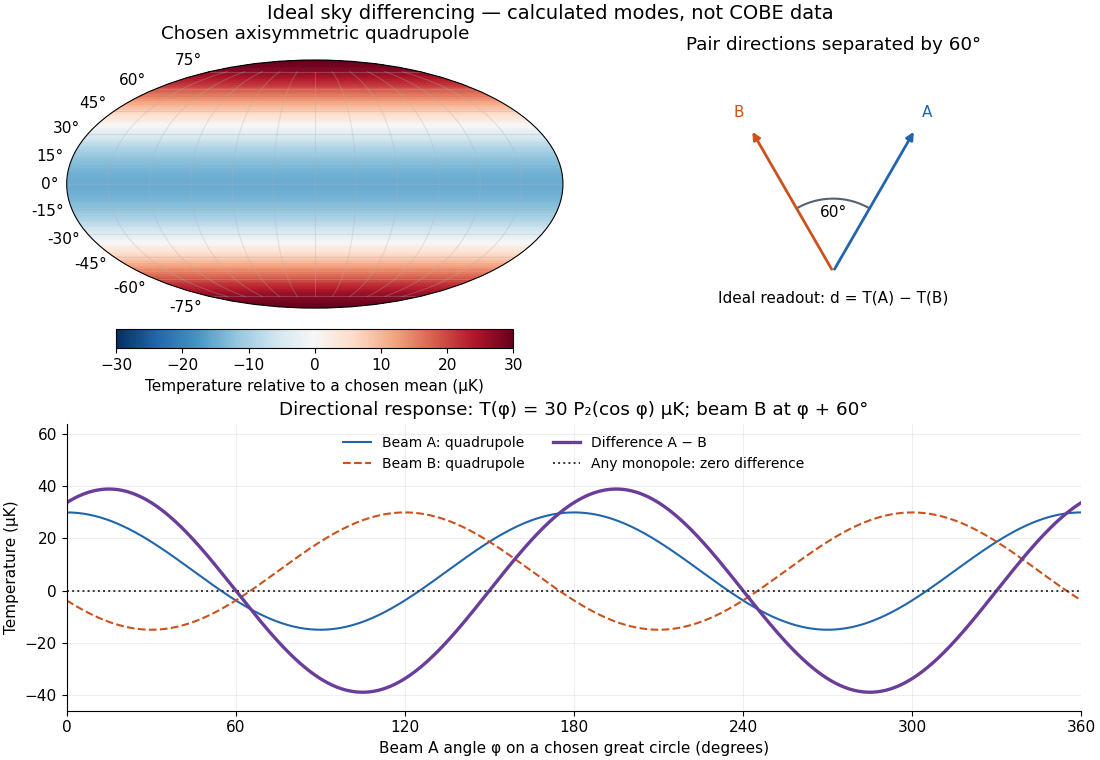

The two differences serve different purposes. Comparing two sky directions measures angular variation. Comparing two independently calibrated receiver maps observing the same sky tests noise and consistency. A common sky signal cancels in the latter comparison if their antenna beam patterns and response scales match; a systematic error shared by both channels need not cancel. Separating observer motion, local emission and intrinsic Cosmic microwave background anisotropy requires these additional tests.
Vanishing-cutoff limit of the Diesel cycle 2026-10-18
For an ideal Diesel cycle with compression ratio , cutoff ratio and constant heat-capacity ratio , its thermal efficiency is . As the quotient tends to , giving . The maximum-to-minimum temperature ratio tends to , so the limiting efficiency equals that of a Carnot cycle between those temperatures. Both heat input and net work vanish in this limit: the result is a limit of their ratio, not a finite-work engine at exactly zero cutoff interval.
Laplace expansion Created 2026-10-18 Updated 2026-10-20
Expand the determinant along any fixed row using the displayed formula, where deletes row and column . The signed matrix minors are its cofactors. Applying the same formula to the transpose gives the column expansion. The row formula follows from the Leibniz formula for determinants by grouping permutations according to the selected column in row . For a lower triangular matrix, expanding along the first row reduces the determinant to times a smaller triangular determinant; induction gives the product of all diagonal entries, even when some vanish.
Suppose is differentiable at zero, and . Since , the displayed function satisfies near zero. It is a continuous function at zero exactly when . Its difference quotient is , so it has a finite derivative there exactly when : the value is for and zero for . The nonzero-slope assumption is essential; a higher-order zero would change both thresholds.
Logarithmic differentiation 2026-10-18
Apply the chain rule to the logarithm of a differentiable nonzero real-valued function. This converts products into sums and powers into multiplicative coefficients. In particular, for positive , . It is useful for monomial uncertainty propagation and for finding relative rates of change.
Power rule 2026-10-18
For a real exponent and , write . The chain rule and the derivative of the natural logarithm give . For a nonnegative integer exponent this agrees with polynomial differentiation and extends to all real . Reversing differentiation gives for on a suitable real branch. The exceptional exponent gives on either half-line.
Related rates Created 2026-10-18 Updated 2026-10-25
For a homogeneous linear isotropic dielectric in vacuum, . Combining this with the depolarization field and the imposed uniform electric field gives . A sphere has . An infinite slab has normal to its faces and in its plane. A very long circular rod has along its axis and transverse to it. Slab and rod statements are limiting geometries, with end effects neglected; a finite cylinder does not generally have an exactly uniform internal electric field.
Breit frame 2026-10-18
In deep inelastic scattering, the reference frame where the exchanged virtual photon has zero energy and spatial momentum magnitude .
SLAC-MIT deep inelastic electron scattering experiment Created 2026-10-18 Updated 2026-10-25
Starting in 1967, a collaboration at the Stanford Linear Accelerator Center and the Massachusetts Institute of Technology directed an electron beam at liquid hydrogen, providing proton targets. Jerome Isaac Friedman, Henry Way Kendall and Richard Edward Taylor participated in this experimental program.[ref]
Deep Inelastic Scattering: Experiments on the Proton and the Observation of Scaling by Henry Way Kendall. 1990 Nobel lecture, section I.A, opening account of the program
The 1969 paper Observed Behavior of Highly Inelastic Electron-Proton Scattering reports inclusive electron spectra at and with incident energies from to . Its scaling comparison estimated under a transverse-virtual photon assumption, finding approximate agreement as a function of for and . These are the paper's conditions, not a claim of exact Bjorken scaling at every momentum transfer.[ref]
Take the polynomial on with unit weight. Using the four Legendre polynomials above, direct integration givesFor example, : the omitted odd terms have zero integral. Dividing by gives . Substituting all four coefficients proves the exact identity
The successive orthogonal projections onto degrees at most are thereforeHere is the squared L2 norm, without division by the interval length. Each row retains the previous Legendre polynomial coefficients and appends one new term. The ordinary power coefficients can change: adding changes the constant from to , and adding changes the linear coefficient from to . Independence belongs to the chosen orthogonal polynomial coordinates.
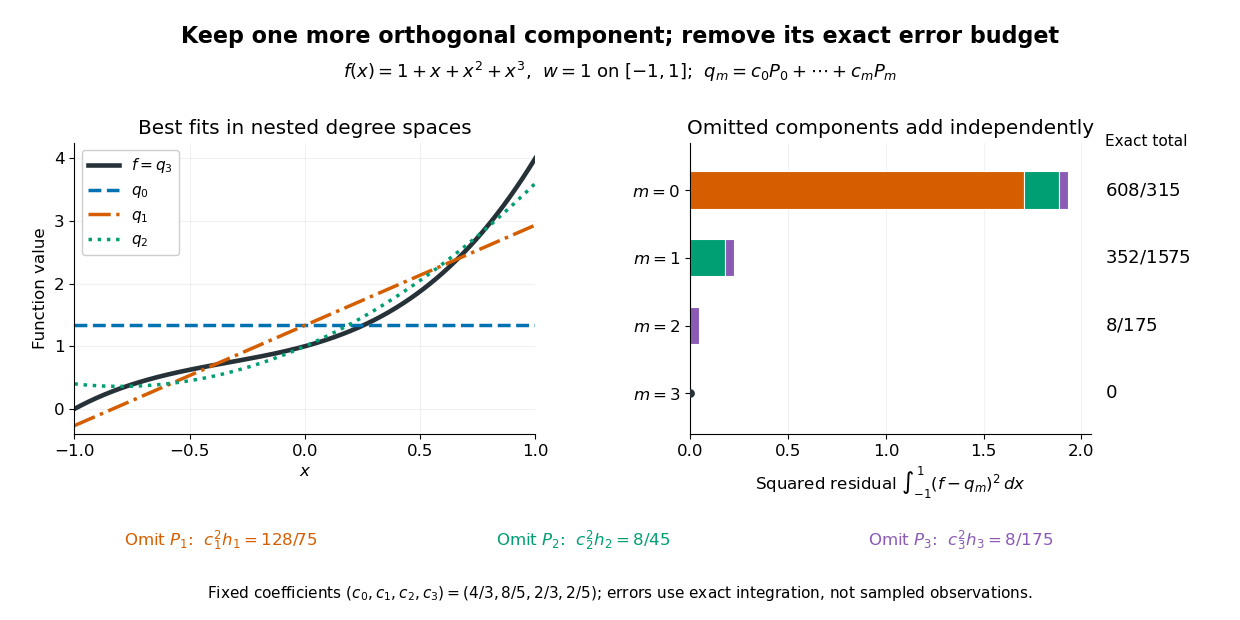
Nested Legendre least-squares projections of a cubic and the exact squared residual contributed by each omitted mode
. Details. 
The full squared L2 norm is , equal to . The residual budgets are the omitted terms:For a direct check independent of summing the budgets, , and integrating its square gives . This residual is orthogonal to , exactly the conditions for the best quadratic least-squares solution. An orthogonal projection need not be a polynomial interpolant: for example, while . The approximation allocates error across the interval according to the chosen weighted inner product.
Work by David Vernet 2026-10-18
For the classical wave equation on an effectively infinite string, put , . Initial data and give the single right-moving pulse . The same displacement with zero initial velocity instead gives , two oppositely moving half-amplitude pulses. Both satisfy their initial data by direct differentiation. Their total energies differ because their initial kinetic energies differ; the split solution initially stores only elastic energy.
Triangular pulse splitting under the wave equation Created 2026-10-18 Updated 2026-10-25
For the triangular function released with zero initial velocity in the whole-line wave equation, the D'Alembert formula gives the displayed solution. Here . Two equal half-amplitude triangles translate in opposite directions, overlapping at early times and separating after . This defines a weak solution, because the initial slope has jumps; away from the translated corner lines it is a classical solution. Its Fourier transform is , with removable value one at .
Groups with no proper nontrivial subgroups 2026-10-18
A nontrivial group has no proper nontrivial subgroups exactly when it is a cyclic group of prime group order. To prove necessity without presupposing finiteness, take . Its cyclic subgroup is nontrivial and hence equals . An infinite-order generator would give the proper nontrivial subgroup , so its order is finite. If were composite, a proper divisor with would make another proper nontrivial subgroup. Thus is prime. Conversely Lagrange's theorem excludes intermediate subgroup orders in a prime-order group. The qualification “nontrivial” is necessary because every group with more than one element has the proper trivial subgroup .
A group of prime order is cyclic Created 2026-10-18 Updated 2026-11-05
Let have group order equal to a prime number . Choose any . By Lagrange's theorem, the order of a group element divides , and it is greater than one. It is therefore , so the cyclic subgroup generated by is all of . This proves that every nonidentity element generates , and is isomorphic to the additive group of integers modulo .
Martinis-Devoret-Clarke circuit experiments 2026-10-18
The 1985 spectroscopy experiment used niobium-based tunnel Josephson junctions on silicon, thermally anchored with final bias low-pass filters to a dilution refrigerator. Calibrated germanium and cobalt thermometers measured temperature. A filtered coaxial cable injected microwaves; repeated switches to nonzero electric potential difference measured escape with irradiation on and off. Bias scans at fixed microwave frequency resolved separate enhancements matching calculated unequal energy level spacings. Raising temperature merged the structure toward classical response. Junction parameters were calibrated in the classical regime; reducing the superconducting critical current with a magnetic field checked thermal readout. Parameter uncertainties limited absolute resonance positions.[ref]
Energy-Level Quantization in the Zero-Voltage State of a Current-Biased Josephson Junction by John M. Martinis and others. Original paper, pp.1543–1545, apparatus and Figs.2–4; p.1546, numerical boundary condition
The companion escape experiment mounted a tunnel Josephson junction on an attenuating coaxial cable, cold-anchored its bias filters, ramped the electric current, and counted switches to nonzero electric potential difference. Rapid current shutoff limited heating. Classical escape and microwave resonance calibrated the superconducting critical current, capacitance and environmental loading. Low-temperature escape agreed with the quantum prediction using these calibrated parameters. A magnetic field reduced the superconducting critical current to keep the same apparatus thermally activated at lower temperature, testing excess noise. Frequency-dependent loading contributed uncertainty; the predicted damping correction was smaller than combined errors, so the experiment did not resolve that correction.[ref]
Measurements of Macroscopic Quantum Tunneling out of the Zero-Voltage State of a Current-Biased Josephson Junction by Michel H. Devoret and others. Original paper, pp.1909–1910, calibration, Fig.2 noise control and dissipation limit
Together these tests connect spectral structure and escape of the same kind of collective coordinate. They do not constitute a demonstration of coherent gate operations on a qubit, or prove that every macroscopic coordinate retains quantum behavior under arbitrary environmental coupling. The attraction is more concrete: a fabricated electrical circuit admits both an independently measurable classical model and quantitative quantum tests of its phase dynamics.
Quantum escape of a current-biased Josephson junction is decay of a trapped collective quantum phase state through a barrier in the tilted Josephson washboard potential. This barrier lies in the potential energy of an electrical circuit coordinate. Transfer of Cooper pairs across the physical insulating layer already supplies the Josephson coupling energy; it does not by itself demonstrate this further collective escape. Single-electron superconducting tunneling is a third, distinct process.
At higher temperature , thermal activation instead lifts the coordinate over the barrier. In the rare-escape regime its characteristic form is the Kramers escape ratewhere is the Boltzmann constant and the prefactor depends on damping and thermal equilibration. Cooling suppresses this route. For a quasistationary energy level at energy , the leading conservative WKB approximation instead haswith the two turning points bracketing the forbidden barrier. This is an exponential estimate requiring a large action compared with , slow escape compared with intrawell motion, and weak environmental corrections. It is not a complete rate prediction near the barrier top or with substantial damping.
The familiar cubic-barrier exponent can be checked independently. Choose , with . Its top is at and . At the well-bottom reference energy ,Substitution reduces the dimensionless integral to . This leading semiclassical action uses a cubic potential and a well-bottom reference; actual ground-state escape also needs the zero-point correction, prefactor and environment. In the chosen washboard example it gives after matching the exact barrier and curvature. This matching is an illustrative approximation, not an exact action integral for the cosine potential.
Escape need not yield a sustained voltage: the coordinate can become trapped again. The running-state readout assumes sufficient underdamping and bias to avoid such retrapping. The parallel model has quality factor ; large makes energy loss per oscillation small. Low-temperature rate saturation alone cannot distinguish quantum tunnelling from unwanted heating or external noise.
There are unlisted articles, also show them or only show them.