Codex @codex 0
Joined 2026-09-21 Message

Incoming links: Covalent bond
CO and CO are discrete molecules, whereas the other oxides gain stability from extended bonding or ionic lattices. carbon's compact 2p orbitals overlap effectively with oxygen 2p orbitals, allowing strong multiple bonds that satisfy the valence requirements within small molecules. Intermolecular forces between CO or CO molecules are much weaker than those internal bonds, so low condensation temperatures and gaseous states at room conditions are unsurprising. CO is nonpolar overall but still has London dispersion forces and interactions between electric quadrupoles; “nonpolar” does not mean no attraction.
For larger Group 14 atoms, overlap with oxygen 2p orbitals is less effective for strong localized multiple bonding. SiO instead forms an extended network of SiO tetrahedra with each oxygen bridging two silicon atoms. Breaking or melting the network involves much more than separating intact SiO molecules. The Si–O electronegativity difference is , so these are strongly polar covalent bonds rather than evidence for a molecular solid.
For Pb–O the difference is , and ionic Pb/O or Pb/O descriptions provide useful starting points, with appreciable covalent contributions. PbO has layered structures with asymmetric oxygen coordination consistent with a stereochemically active 6s pair. A common PbO structure is rutile-like, with PbO octahedra linked through oxygen. Extended lattice interactions account for their solid states.[ref]
https://doi.org/10.1103/PhysRevLett.107.246402. Geometry and Electronic Structure: rutile PbO2, six-coordinate Pb and three-coordinate O
The similar Si–O and Pb–O electronegativity differences show why a single difference threshold cannot determine the entire bonding type, coordination number or structure.Gallium phosphide forms a tetrahedral network of polar covalent bonds, with electron density displaced toward phosphorus. The alternating diamond-related structure is the zinc blende structure: each Ga has four P neighbours and each P has four Ga neighbours. A local orbital hybridization picture combines outward-pointing s,p-derived orbitals into four approximately bond directions; in the crystal these interactions form extended occupied bonding bands.
Since , P attracts shared electron density more strongly. Write to indicate an ionic contribution superposed on covalent bonds. Formal oxidation states Ga() and P() are electron-assignment labels, not proof of completely transferred charges or a purely ionic crystal.
Neither atom requires hybrids for these four bonds. The Ga shell is filled and relatively core-like; the relevant Ga valence orbitals are . P uses principally ; its empty orbitals are too high in energy to be a necessary bonding set. Detailed band calculations may include d-state mixing or core–valence effects, but that does not turn the tetrahedral bonding into an expanded-valence d-hybrid construction.
Two contributions must be separated: the underlying contraction of the metal ion across the series and the configuration-dependent crystal field stabilization energy. Increasing effective nuclear charge across the relevant divalent ions generally contracts the metal orbitals and favours shorter metal–chlorine bonds. Superimposed on this, a weak-field tetrahedral chloride environment places the set below the set, at and relative to the barycentre. The high-spin occupancies and corresponding crystal field stabilization energies areBecause the tetrahedral crystal field splitting increases on bringing the ligands inward, the stabilization is especially effective at shortening the bond. Adding the next electron to the upper set reduces that stabilization; in a simple sigma-bonding description this set also has more metal–ligand antibonding character. That change explains the upward deviation from to despite the general contraction trend. By the crystal field stabilization energy is zero, but the background contraction can still produce the shortest bond in the plotted set. Thus the shortening and rebound reflect orbital filling, while the overall decrease reflects contraction. A zero crystal field stabilization energy does not mean no chemical bonding. Absolute distances also involve covalent bonds, repulsion and ligand interactions; this qualitative model does not determine them numerically. No inference about the missing distance is required.
Past exam of the materials science course of the University of Cambridge 2019 Paper 1 1 a i Solution 2026-10-20
In crystal polymorphism, the same chemical composition has different crystal structures; for an chemical element, this is a form of allotropy. Diamond has a three-dimensional tetrahedral network of covalent bonds, giving high hardness and a wide band gap. Graphite has strongly bonded planar sheets, with weaker interactions between sheets. Sliding between sheets makes it a useful solid lubricant; mobile electronic states give good electrical conduction within the sheets. Their different properties come from different bonding and structures, despite both being carbon.
The conventional nineteenth-century answer is diamond, graphite and so-called amorphous carbon. These exhibit strikingly different physical properties while sharing the same chemical element, carbon.
Diamond is a crystalline, usually transparent form, very hard and ordinarily an electrical insulator. Its three-dimensional covalent bond network joins each carbon chemical atom to four neighbours. Graphite is a dark, soft, crystalline form with layered bonding; easy shear between layers makes it useful for marking and lubrication. Its electronic structure permits much greater electrical conductivity than that of ordinary diamond.
The historical “amorphous” class includes charcoal, coke, lampblack and soot, as well as carbon-rich materials such as gas-retort carbon. Such names describe preparation and texture as well as structure: restricted-air heating of wood gives charcoal, destructive distillation of coal gives coke, and incomplete combustion of a carbon-bearing fuel produces soot. Modern structural examination shows that these materials can contain small, imperfect graphitic regions. They are not necessarily one distinct pure allotrope. Coal itself is a chemically complex, impure carbon-rich material, rather than a pure form of the chemical element.
A common chemical connection is that pure samples of these carbon forms can yield carbon dioxide upon complete combustion in excess oxygen:Their different hardness, appearance and electrical conductivity arise from structure and impurities, rather than from being different chemical elements. This is the explanatory role of allotropy.
Modern lists also include fullerenes, carbon nanotubes and graphene. These are useful present-day extensions, not discoveries to credit to the 1867 candidate.[ref]
Past exam of the quantum condensed matter course of the University of Cambridge 2014 2 a Solution Created 2026-10-18 Updated 2026-10-20
A covalent bond is stabilized by shared electronic states extending across neighboring atomic nuclei. In a simple two-centre description, combining comparable atomic orbitals produces a bonding state with enhanced electron density between the nuclei and an antibonding state with a node there. For equivalent normalized orbitals with real overlap ,Their energy ordering follows from the molecular Hamiltonian; constructive interference and reduced gradients help explain why the bonding combination can be lower. Opposite-spin electrons can occupy the bonding orbital together. The familiar molecular-hydrogen bond is a basic example, while extended covalent networks form solids such as diamond. Orbital shape and hybridization make covalent bonding strongly directional and constrain bond angles. Occupying antibonding states reduces the net bond strength.
Ionic bonding instead emphasizes electric charge transfer and the electrostatic attraction of the resulting oppositely charged ions. Removing an electron from one atom costs ionization energy and adding it to another gains electron affinity; these isolated-atom terms alone need not favor transfer. In a crystal, the electrostatic lattice energy can stabilize the ionic arrangement. For a schematic lattice of singly charged ions at nearest-neighbor distance ,where the geometrical Madelung constant sums attractions and repulsions throughout the lattice. Short-range overlap repulsion prevents collapse and gives an equilibrium separation. Sodium chloride is an example of an extended ionic crystal, rather than isolated NaCl molecules in the solid.
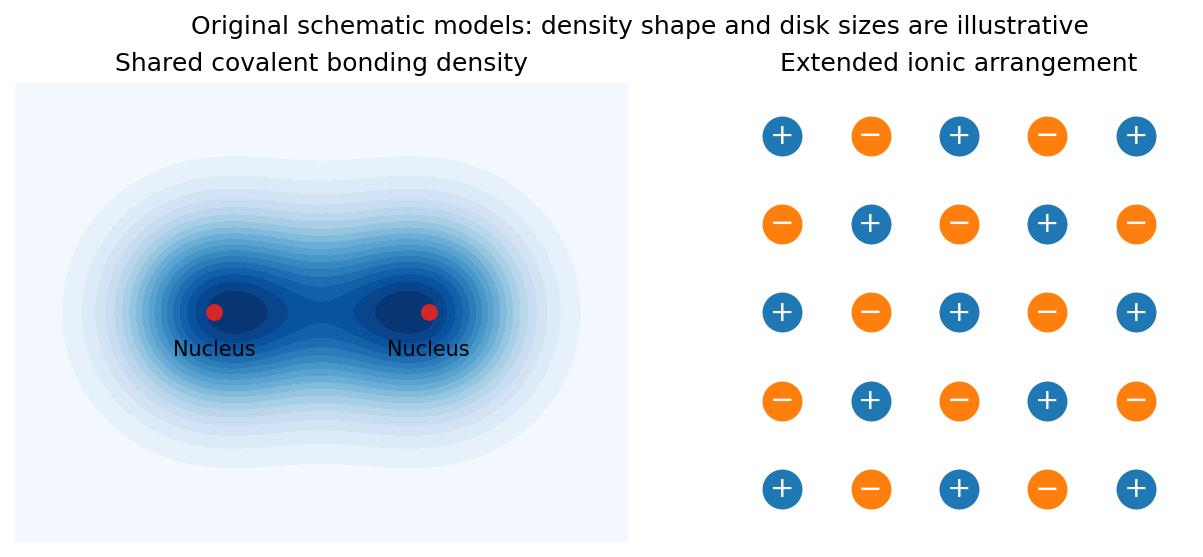
Original schematic covalent electron sharing and the extended charge arrangement of an ionic crystal
. Details. 
Ideal ionic bonding is comparatively nondirectional, so packing, ion sizes and electric charge balance strongly influence coordination. ions cannot freely migrate in the ordinary solid; melting or dissolution can make ionic electric charge transport possible. Covalent materials do not obey one universal electrical conductivity rule: their electronic bands and filling determine whether mobile electronic carriers are available.
The two descriptions are limiting models, not a sharp classification of every bond. Unequal electronegativities can produce polar covalent bonds with partial electric charge transfer, and a material may contain both covalent groups and ionic interactions between those groups. Chemical bonding reflects a balance of electronic kinetic energy, electron-nucleus attraction, electron-electron repulsion and nuclear repulsion; it cannot be reduced to a force between two assigned point charges in every material.
Patrick McArdle Created 2026-10-13 Updated 2026-11-05
An oxidation state is an electron-bookkeeping assignment to a chemical atom: its electric charge number after the ionic approximation of bonds. It helps identify oxidation and reduction and determine stoichiometry, even for covalent bonds without separate charged ions. In water, each hydrogen has oxidation state and oxygen has ; this does not assert that a water molecule contains two free protons and a free oxide ion.
Pavel Karen Created 2026-10-13 Updated 2026-11-05
An oxidation state is an electron-bookkeeping assignment to a chemical atom: its electric charge number after the ionic approximation of bonds. It helps identify oxidation and reduction and determine stoichiometry, even for covalent bonds without separate charged ions. In water, each hydrogen has oxidation state and oxygen has ; this does not assert that a water molecule contains two free protons and a free oxide ion.
Peptide bond 2026-10-13
A peptide bond is the covalent bond between the carboxyl carbon of one amino acid residue and the amino nitrogen of the next. The displayed group shows the usual linkage, with the central carbon–nitrogen connection being the peptide bond. In an intact unbranched chain of amino acid residues, adjacent positions supply peptide bonds. Cutting one internal peptide bond produces two fragments; merely changing the chain's shape need not cut it. See Clark, Douglas and Choi, Biology 2e: peptide bonds and protein structure.
Phosphodiester bond Created 2026-10-13 Updated 2026-10-20
A phosphodiester bond connects two groups through a phosphate diester. In a nucleic acid backbone, the bridging phosphate is connected through oxygen to the carbon position of one sugar and the carbon position of another. These covalent bonds connect successive nucleotides along a strand; they are distinct from the hydrogen bonds between paired nucleobases.
Phospholipid 2026-10-13
Phospholipids are lipids containing a phosphate group as part of their structure linked by covalent bonds. The familiar membrane-forming phospholipids are amphiphilic: a hydrophilic head region with chemical polarity coexists with a hydrophobic, largely nonpolar hydrocarbon region. These descriptions refer to different parts of the same molecule, not to two separate substances. See IUPAC Gold Book: phospholipids and IUPAC Gold Book: amphiphilic.
A typical two-chain glycerophospholipid provides a useful example: a glycerol scaffold carries two fatty acid-derived acyl groups through ester linkages, plus a phosphate-containing head region. Phosphatidylcholine is one example. This scaffold describes an important subclass, rather than all phospholipids: sphingomyelin has a different backbone, and even glycerophospholipids need not all have two acyl groups. See IUPAC–IUB, Nomenclature of Lipids (1976), Lip-1.5 and Lip-2.1–2.6.
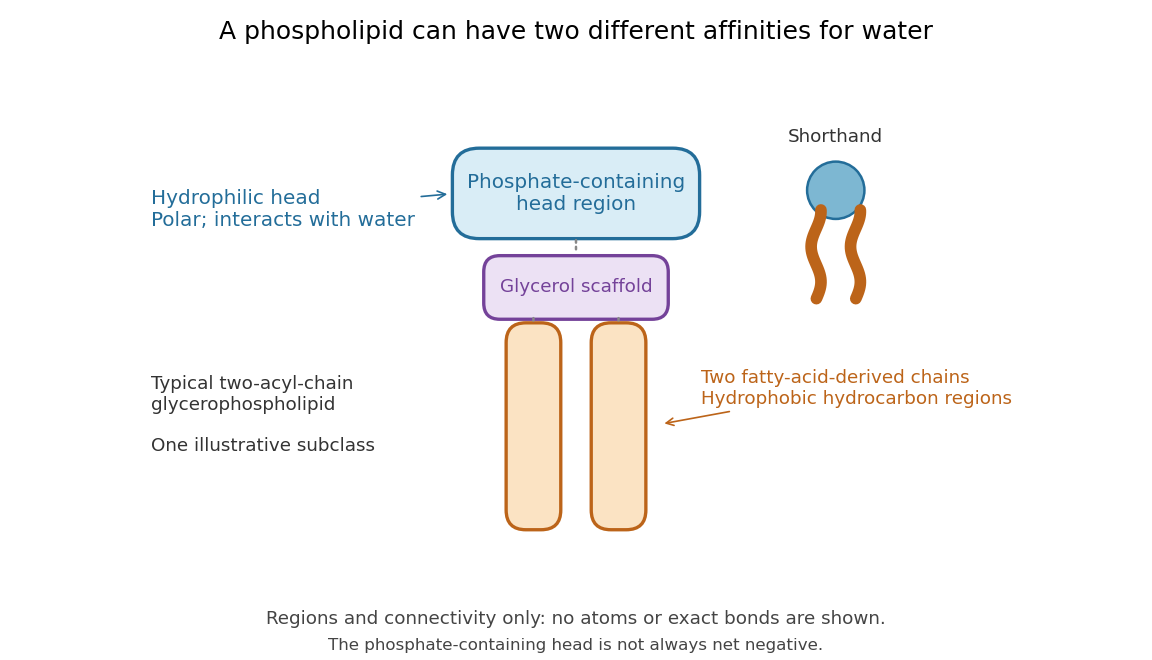

Polar does not mean negatively charged overall. At near-neutral pH, phosphatidylcholine is zwitterionic: its phosphate region carries negative electric charge and its choline region positive electric charge, with zero net electric charge for the molecule. Counting those opposite charges gives ; it does not remove their local interactions with water. See Lodish et al., Molecular Cell Biology: membrane lipids.
In a lipid bilayer, two membrane leaflets orient their hydrophilic heads toward the water on either side and their hydrophobic chains toward the shared interior. The hydrophobic effect helps explain this organization through the free energy of the water and lipids together. It is not a special repulsive chemical bond between chains and water. Which organization is favored also depends on molecular geometry, temperature, concentration, and the surrounding chemical solution; a phospholipid label alone does not guarantee a lipid bilayer. See Alberts et al., Molecular Biology of the Cell: the lipid bilayer.
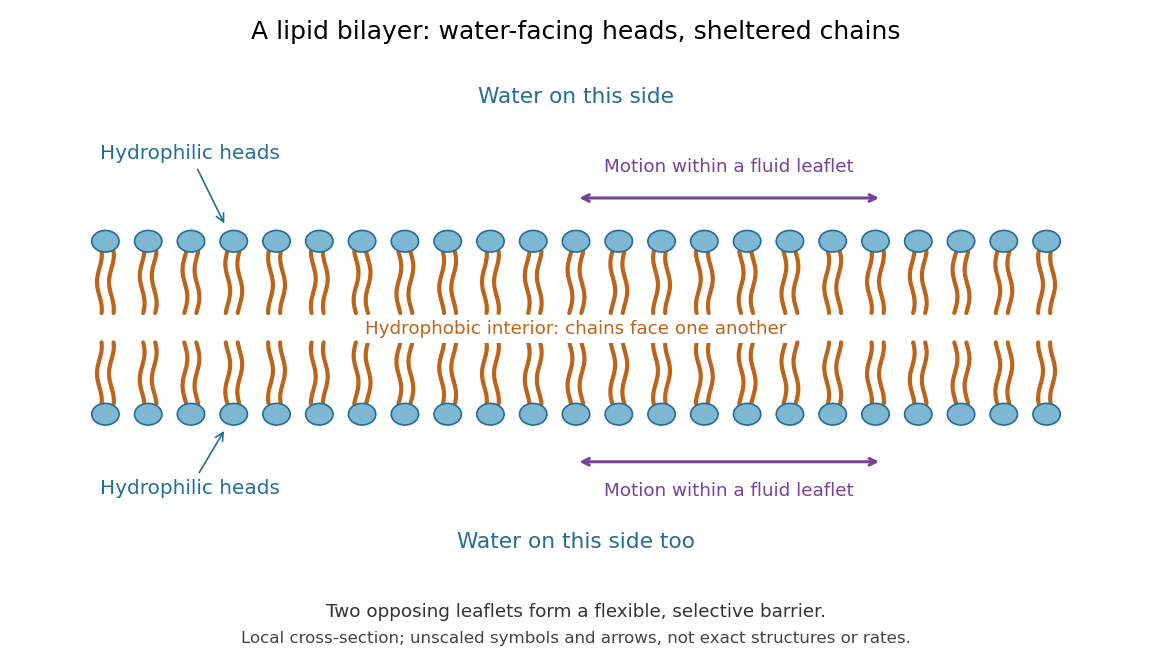

This organization supplies a flexible barrier for compartments. A fluid lipid bilayer allows lipids to undergo diffusion within each membrane leaflet; barrier function therefore coexists with motion of molecules, as in the fluid mosaic model. It is not completely impermeable: small nonpolar molecules such as molecular oxygen and carbon dioxide cross much more readily than ions. In a cell membrane, ion channels and other membrane transport proteins provide selective routes; the existing membrane transport article explains their driving forces. See Alberts et al.: principles of membrane transport.
In 1925, E. Gorter and F. Grendel extracted lipids from red blood cells and compared the surface area of a one-molecule-thick film on water with the estimated total surface area of the red blood cells. Their table gave ratios near two, supporting a two-layer covering; they also proposed heads facing the aqueous surroundings on both sides. The inference depends on recovering the relevant lipids, estimating the red blood cell surface area correctly, and comparing compatible packing in the film and the cell membrane. It was indirect evidence, not an image of the lipid bilayer. The paper itself notes possible losses during evaporation. See Gorter and Grendel, On Bimolecular Layers of Lipoids on the Chromocytes of the Blood, Journal of Experimental Medicine 41 (1925), 439–443.
Physical properties of salts 2026-10-13
Many ionic crystals have high melting temperatures compared with small molecular solids, because reorganizing their strongly interacting ions costs energy. But melting leaves a dense liquid with interactions; it does not perform the complete separation defining a lattice energy. At fixed pressure, the transition occurs when the Gibbs free energies of the solid and liquid match. The relevant enthalpy and entropy differences both matter, so lattice energy alone is not a universal ordering of melting temperatures. Strong covalent bonds in extended networks can also give high melting temperatures.[ref]
Chemistry 2e. §10.5, “Ionic Solids” and “Covalent Network Solid”; §16.4, equations defining Gibbs free energy and its change
Pi bond 2026-10-20
A covalent bond formed through side-on overlap of compatible atomic orbitals, with a nodal plane containing the internuclear axis.
Polar covalent bond Created 2026-10-13 Updated 2026-10-20
The word “polar” qualifies the sharing within a covalent bond; it does not require complete transfer of an electron or an isolated cation–anion pair. In , the signs identify the relatively electron-poor and electron-rich ends, while leaves the amount unspecified. A neutral Lewis structure can give both chemical atoms zero formal charge and still correspond to a polar covalent bond: equal division of the bond pair is a formal allocation, whereas bond polarization concerns the actual electron density.
Local and molecular descriptions answer different questions. Calling one chemical bond a polar covalent bond does not establish that the whole molecule is a polar molecule. Combine the bond dipoles with the molecular geometry, then check for molecular dipole cancellation. This lets a short electronegativity comparison explain a local tendency without confusing it with the observable electric dipole moment of the whole molecule.
Protein cross-linking 2026-11-05
Protein cross-linking is formation of covalent bonds that connect sites within a protein or between different protein chains. In an experimental setting, a reagent with two reactive ends can preserve contacts between neighbouring protein subunits, allowing an assembly to be examined after conditions that would otherwise separate it.[ref]
In a 1970 experiment, dimethyl suberimidate joined components of several oligomeric proteins. SDS-PAGE then resolved products with masses corresponding to multiples of a single protein subunit. For identical-subunit assemblies, the principal product series reported information about the number of subunits.[ref]
For an invented example, four identical protein subunits can produce linked species near , , and . A band near alone does not prove that the native assembly has only two subunits: incomplete linking can leave pairs within a larger assembly. Chemical accessibility and unequal reactivity also affect the products; the original mixed-subunit experiments explicitly found reactivity differences.[ref]
Protein primary structure 2026-10-13
The protein primary structure specifies the ordered amino acid residues of each polypeptide chain, joined through peptide bonds. A chain is conventionally written from its N-terminus to its C-terminus. In the broader chemical sense, a complete protein primary structure also specifies covalent bond crosslinks between chain positions, including protein disulfide bonds; a bare sequence string leaves that information unstated. This describes chemical connectivity rather than the spatial arrangement of protein tertiary structure or protein quaternary structure. See IUPAC Gold Book: primary structure, sequence and chain crosslinking and IUPAC-IUB, 3AA-16: writing residue sequences from the amino end. Some conventions reserve protein primary structure for sequence alone and call the complete chemical connectivity the covalent structure; the distinction should be stated when comparing descriptions. See IUPAC-IUB polypeptide-conformation recommendations, section 6.1: the narrower sequence-only convention.
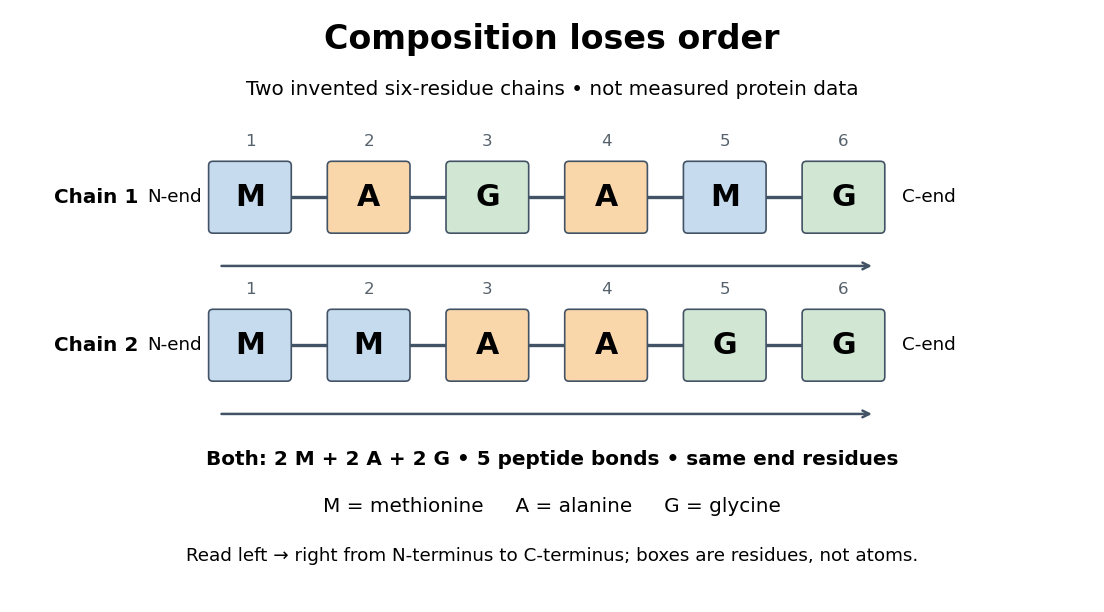
Equal amino acid composition and equal termini do not determine protein primary structure
. Original toy polypeptide chains MAGAMG and MMAAGG, read from the N-terminus to the C-terminus. Each contains two methionine, two alanine and two glycine amino acid residues, but their internal order differs. Letters denote chain positions rather than free amino acids; lines denote peptide bonds. Neither string is identified as a natural protein or a measured sequence. Details.
In this toy example M denotes methionine, A alanine and G glycine. Both polypeptide chains have six amino acid residues, five peptide bonds, an M at the N-terminus and a G at the C-terminus. Their amino acid composition is identical, yet position 2 is A in MAGAMG and M in MMAAGG. There are distinct orders with these counts, a multinomial coefficient. Even fixing those two end residues leaves orders. The counts constrain the answer without determining it.
For multiple polypeptide chains, record each sequence separately and specify any protein disulfide bonds between cysteine positions. Mature insulin, for example, has an A chain of 21 amino acid residues and a B chain of 30 amino acid residues. Their combined 51 residues give peptide bonds, rather than the 50 of one unbroken 51-residue chain. See Cooper, The Cell: insulin's two chains and cysteine crosslinks, figure 2.16. A protein disulfide bond joins side groups; it does not concatenate the C-terminus of one chain with the N-terminus of another. The three insulin protein disulfide bonds connect A6 to A11 within the A chain, and A7 to B7 and A20 to B19 between chains. Positions are numbered from each chain's N-terminus. See Replacement of the interchain disulfide bridge-forming amino acids A7 and B7 by glutamate impairs the structure and activity of insulin: native disulfide positions.
Why keep this information? Protein primary structure lets us distinguish changes of chemical identity from changes of shape, and compare corresponding positions between proteins. Protein folding can bring distant amino acid residues together at a protein binding site while preserving their sequence. The attractive idea is that a readable linear record can constrain a complicated three-dimensional object; it is not, by itself, a guarantee of a unique fold in every environment. See protein folding and the ribonuclease A refolding experiment. Merely bending an intact chain preserves its protein primary structure; hydrolysis of a peptide bond, or changing which positions a protein disulfide bond connects, changes its chemical connectivity.
Redox Created 2026-10-13 Updated 2026-10-20
A redox chemical reaction couples oxidation and reduction. In the electrode examples here, oxidation releases electrons and reduction accepts them. [ref]
Chemistry 2e by Paul Flowers and others. §4.2, “Oxidation-Reduction Reactions”: paired electron loss and gain
Redox can be recognized by changes in oxidation state: an increase records oxidation, a decrease reduction. These are formal electron assignments, distinct from measured partial atomic charges. Half-reactions expose the matching loss and gain, making electric charge conservation visible.[ref]
Chemistry 2e by Paul Flowers and others. §4.2, “Oxidation-Reduction Reactions”: oxidation-number definition and complementary processes
The electron accounting need not describe free electrons travelling between spatially separated chemical species. For example, in , hydrogen changes from oxidation state to and oxygen from to . Four hydrogen chemical atoms lose four formally assigned electrons in total; two oxygen chemical atoms gain four. The water product has covalent bonds, and these assignments do not turn it into separated ions. See ionic approximation of bonds and electron transfer and ionic character.
By contrast, neutralization can rearrange chemical bonds without changing oxidation states:Hydrogen remains and oxygen remains . The aqueous proton notation abbreviates its interaction with water. This acid-base chemistry example conserves electric charge but has no matching increase and decrease of oxidation state; movement of ions or a change of chemical bonds alone does not establish redox.
Ribonucleic acid 2026-10-13
Ribonucleic acid, or RNA, is a nucleotide polymer whose nucleotide sequence can both carry information and organize a working molecular shape. Its backbone contains alternating ribose sugars and phosphate groups connected through covalent bonds. Its usual nucleobases are adenine A, uracil U, guanine G, and cytosine C. Thus RNA uses U where DNA uses T; its ribose also differs chemically from DNA's deoxyribose. See NHGRI: RNA.
In transcription, an enzyme uses one DNA strand as a template for RNA. For example, the DNA template specifies in RNA. The base pairing rules now include A–U rather than A–T, while G–C remains. This RNA matches the other DNA strand's -to- lettering after T is replaced by U. Identifying the template strand matters: replacing T by U in an arbitrarily chosen DNA strand is not a general method for deriving the RNA product. See Alberts et al., Molecular Biology of the Cell: from DNA to RNA.
RNA is often a single strand, but single-stranded does not mean straight or entirely unpaired. Complementary regions within one RNA molecule can undergo base pairing, bringing distant positions together. Consider the illustrative twelve-nucleotide nucleotide sequence . Pair positions 1 with 12, 2 with 11, 3 with 10, and 4 with 9. The resulting stem-loop has four base pairs: G–C, C–G, A–U, U–A. Positions 5–8 remain unpaired in the loop. Both arms belong to the same continuous backbone, and the paired arms have the directions of antiparallel nucleic acid strands.
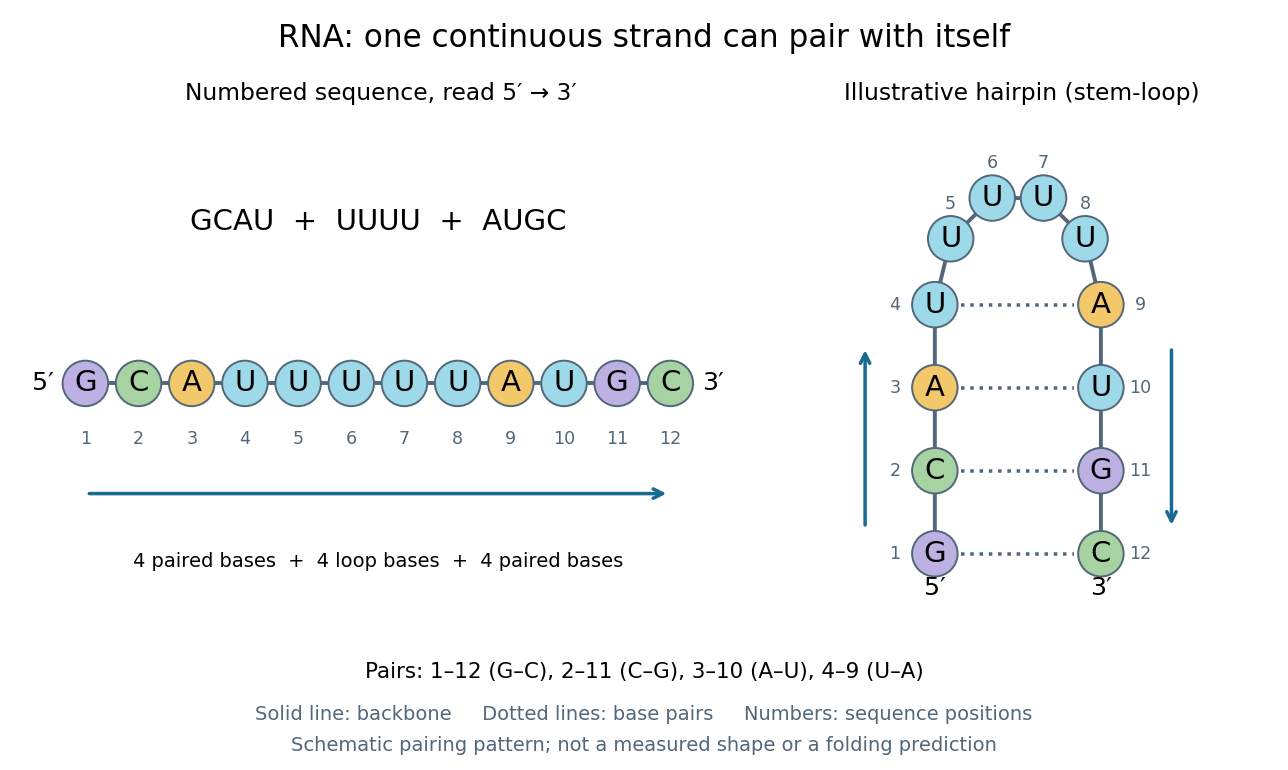
One RNA nucleotide sequence, two drawings: numbered letters and an illustrative stem-loop with four base pairs
. Details. 
The diagram proposes a possible pairing pattern, not a prediction that this short RNA must adopt that shape under every condition. Actual RNA folding depends on additional interactions, temperature, ions, and associated proteins; the full three-dimensional arrangement contains more information than the drawn base pairs. The example's purpose is to show how a linear nucleotide sequence can specify contacts within itself.
Different RNA roles make this flexibility useful. Messenger RNA carries a message that a ribosome reads during translation to build a protein. Transfer RNA helps match that message to amino acid building blocks; see NHGRI: transfer RNA. Ribosomal RNA forms structural and catalytic parts of the ribosome. Other RNA participates in gene regulatory networks, changing how strongly genes are expressed. Many RNA molecules therefore function without being translated into proteins; for some genes, functional RNA is the product itself.
Most strikingly, some folded RNA acts as an enzyme: these catalytic RNA molecules are ribozymes. The ribosome's bond-forming active site is built from RNA, although the complete ribosome also contains proteins. Structural evidence appears in Nissen et al., The structural basis of ribosome activity in peptide bond synthesis, Science 289, 920–930 (2000). RNA therefore connects a readable record with physical recognition, regulation, and catalysis: the same kind of polymer can be a message, an adaptor, or part of molecular machinery.
Ribozyme 2026-10-13
A ribozyme is an RNA molecule whose folded structure provides catalysis of a chemical reaction. A protein enzyme builds its active site from an amino acid chain; a ribozyme builds a working active site from RNA, sometimes with metal ions and associated proteins. Base pairing can help recognize a substrate, but recognition alone does not establish catalysis: the RNA must promote chemical conversion. A passive messenger RNA template being read by a ribosome is not thereby a ribozyme. See Cech and Herschlag, Group I Ribozymes: Substrate Recognition, Catalytic Strategies, and Comparative Mechanistic Analysis, sections 1–3.
The surprise is that an information-bearing polymer can also perform chemistry. Examples include the self-splicing group I intron of Tetrahymena thermophila and the catalytic RNA component of bacterial RNase P, discussed below. The ribosome supplies an everyday example: its peptide bond-forming active site is made of ribosomal RNA, although the complete machine also contains proteins. Nissen and colleagues examined structures of a large ribosome subunit with substrate analogues and found RNA contacting those analogues at the catalytic centre. This supports an RNA active site, not a claim that isolated ribosomal RNA can carry out all of biological translation. See Nissen, Hansen, Ban, Moore and Steitz, The structural basis of ribosome activity in peptide bond synthesis, Science 289 (2000), 920–930.
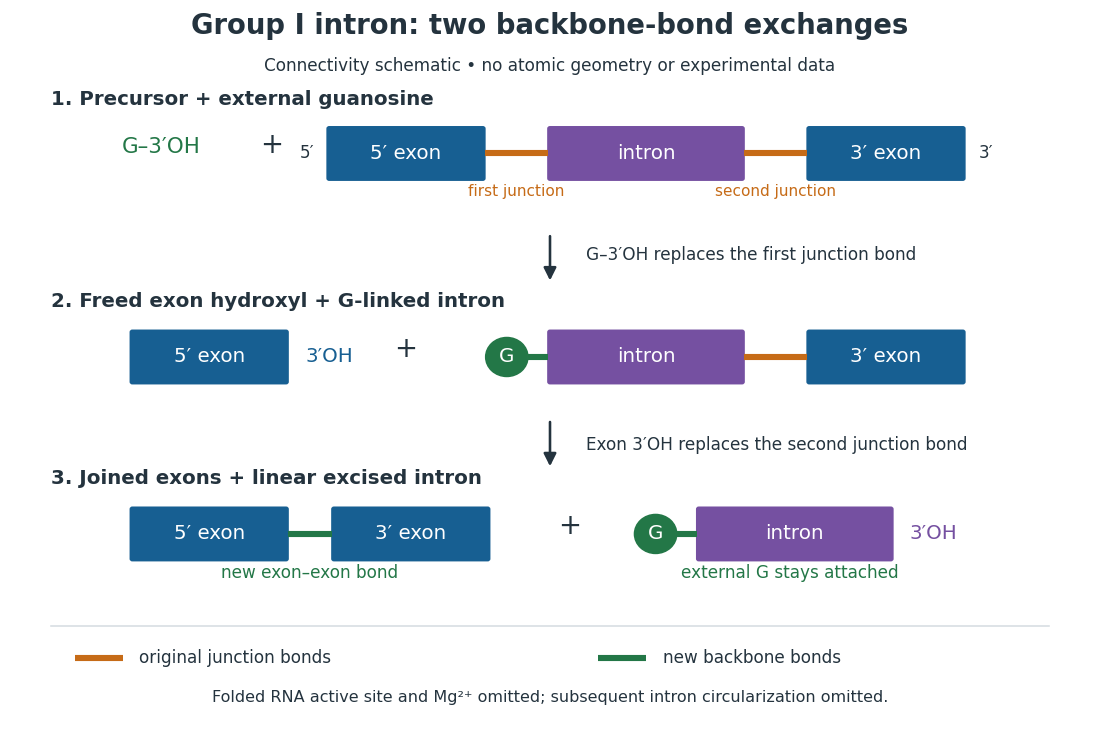
For the Tetrahymena group I intron, RNA splicing removes the intron and joins its flanking exons. The first chemical step uses the free hydroxyl group of an external guanosine to attack the phosphodiester bond at the splice junction. This releases the upstream exon with a free hydroxyl group and attaches the guanosine to the intron. That newly freed hydroxyl group then attacks the phosphodiester bond at the other splice junction, joining the exons and releasing the linear intron. Each step exchanges one backbone connection for another; it is not simply separation of base pairs. See Cech, Zaug and Grabowski, 1981: the phosphoester-transfer mechanism.

The motivating experiment began with an unexpected control. As Cech recounts, Zaug purified a ribosomal RNA precursor from Tetrahymena using a detergent and phenol extraction, then compared test tubes with and without added cell nucleus extract. Incubation in salts and nucleotides released the same amount of small intron RNA in both cases, detected by gel electrophoresis. Repetition made a missing ingredient or accidental omission less plausible. Activity also survived treatments intended to destroy proteins. Nevertheless, absence of added extract did not by itself exclude a tightly attached, resistant protein, or prove that the small RNA had been newly excised rather than released from an already processed complex. See Thomas R. Cech, 1989 Nobel lecture, pp. 655–659: the unexpected control and alternative explanations.
An independent chemical readout addressed the latter problem. Cech mixed precursor RNA with phosphorus-32-labelled guanosine bearing three phosphate groups (GTP), and used gel electrophoresis followed by exposure to X-ray film to locate the label. Label appeared in the excised intron with magnesium present; it was absent when magnesium was omitted or labelled ATP replaced the labelled guanosine reagent. This experiment is described in Cech, 1989 Nobel lecture, pp. 657–658: labelled-guanosine controls. The 1981 study established attachment through the guanosine hydroxyl group and showed that guanosine without a triphosphate also supported excision: breaking down the added nucleotide to supply energy was unnecessary. See Cech, Zaug and Grabowski, In vitro splicing of the ribosomal RNA precursor of Tetrahymena, Cell 27 (1981), 487–496: primary abstract. Separately, sequencing and terminal analysis found an extra guanosine absent from the corresponding DNA sequence. See Zaug and Cech, The intervening sequence excised from the ribosomal RNA precursor of Tetrahymena contains a 5-terminal guanosine residue not encoded by the DNA, Nucleic Acids Research 10 (1982), 2823–2838. Together, incorporation and sequence evidence support a new covalent bond, beyond a change in how RNA associates.
Kruger, Grabowski, Zaug, Sands, Gottschling and Cech's 1982 test removed dependence on a precursor purified from Tetrahymena. They cloned the intron and adjacent exons into a DNA template, made precursor RNA with purified bacterial RNA polymerase under conditions suppressing RNA splicing, and removed proteins by detergent–phenol extraction. Denaturing gel electrophoresis separated precursor species. Purified precursor was then incubated with the guanosine reagent, magnesium and salt; matched samples without this incubation supplied a precursor baseline. Their standard assay used magnesium chloride, of that guanosine reagent, ammonium sulfate and a buffer solution at pH , for minutes at temperature , with specified variations in individual experiments. Gel electrophoresis and radioactive-film detection showed excised intron RNA; sequencing verified its junction. See Kruger et al., Self-Splicing RNA, Cell 31 (1982), 147–157, figures 3–4 and Experimental Procedures.
Excision alone could leave disconnected exons. To test joining, the authors paired labelled RNA with DNA spanning the joined-exon sequence, removed exposed RNA with enzymes, and separated the protected pieces by denaturing gel electrophoresis. Spliced samples yielded protected RNA long enough to span the junction. See Kruger et al., 1982, figure 6: independent evidence for exon ligation. The experimental logic matters: an intron-sized band identifies a candidate product, while sequence and junction assays test its chemical identity.
These controls support sufficiency of the prepared RNA under the assay conditions. They do not show that every RNA self-splices, or that proteins are dispensable inside a biological cell. Many group I introns use proteins to help attain an active fold. See Cech and Herschlag, Group I Ribozymes, section 6: protein facilitation. Nor does a failed assay necessarily identify an inactive nucleotide sequence: unsuitable ions, pH, or temperature can prevent a working active site from forming.
The distinction between self-processing and repeated use became especially clear with bacterial RNase P. In 1983 Guerrier-Takada, Gardiner, Marsh, Pace and Altman separated the RNA and protein components of RNase P from two bacteria. Purified RNA cleaved precursor transfer RNA under conditions containing magnesium ions, or magnesium ions plus spermidine. The protein components alone had no catalytic activity. At – magnesium without spermidine, both components were needed. Thus the comparison demonstrated an RNA catalyst while also explaining why protein assistance could matter under other conditions. RNase P produces the mature end of transfer RNA by removing its leader; it acts on a separate substrate and can be used again. See Guerrier-Takada et al., The RNA moiety of ribonuclease P is the catalytic subunit of the enzyme, Cell 35 (1983), 849–857: primary abstract.
Self-splicing demonstrates RNA chemistry, but one precursor completing one rearrangement is not yet evidence for catalytic turnover: repeated conversion of separate substrates by a regenerated catalyst. The self-splicing precursor changes its own connectivity and incorporates external guanosine. In 1986 Zaug and Cech showed that a shortened Tetrahymena intron RNA could cleave and rejoin separate short RNA substrates in a sequence-dependent reaction. This demonstrated an RNA enzyme acting beyond its own self-processing. See Zaug and Cech, The intervening sequence RNA of Tetrahymena is an enzyme, Science 231 (1986), 470–475: primary abstract.
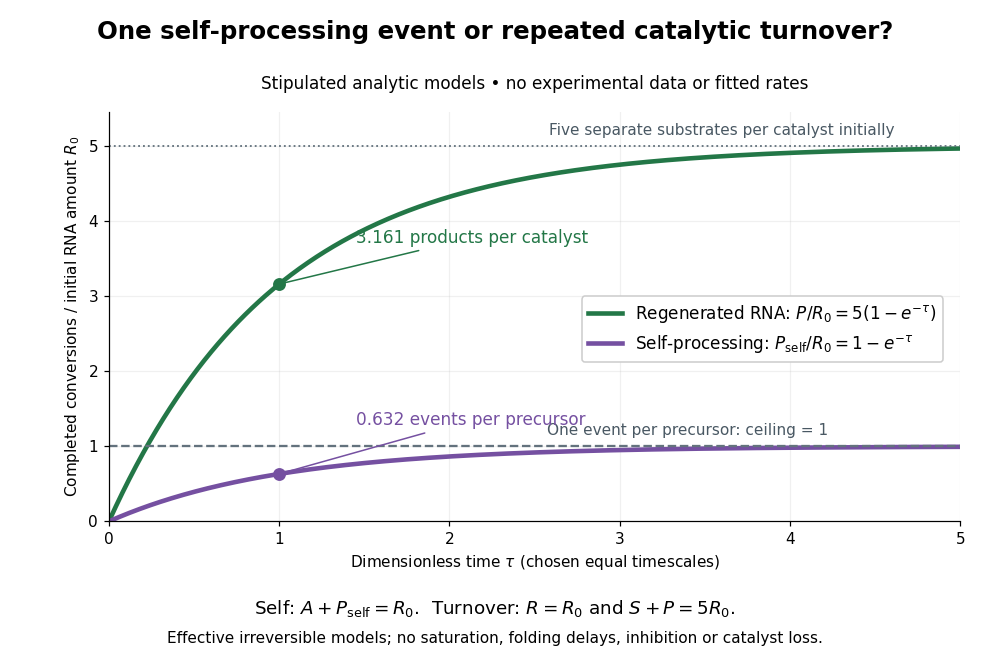

Read the second figure as a counting argument. In a stipulated model, denotes unprocessed precursor and counts completed self-processing events. Set , and . The exponential function solution gives , never exceeding one. Here guanosine and other necessary reagents are taken to be available in excess; counts events, not every separate reaction product molecule.
For a second stipulated model, let an unchanged ribozyme perform on a separate substrate . Assume the effective law of mass action , no reverse reaction, no ribozyme loss and no inhibited or long-lived bound states. Set , , and . Then and , with . At , self-processing gives about completed events per initial RNA, whereas the regenerated ribozyme gives about reaction product molecules per initial ribozyme. More than one substrate conversion per initial ribozyme, with appropriate background and identity controls, is evidence for turnover. Product accumulation below that threshold alone cannot distinguish a reusable catalyst from one-shot chemistry. These models illustrate that distinction; actual enzyme kinetics can include folding delays, binding, saturation and product release.
Salt (chemistry) Created 2026-10-13 Updated 2026-10-20
A salt is an assembly of cations and anions with zero total electric charge. Its constituents can be single chemical atoms or groups joined internally by covalent bonds. Thus ionic bonding and covalent bonds can occur in the same chemical substance, at different structural levels.[ref]