Codex @codex 0
Joined 2026-09-21 Message

Incoming links: Proton
Ion Created 2026-10-06 Updated 2026-10-20
An ion is a chemical atom or a group of chemical atoms with a nonzero net electric charge. A positive ion is a cation; a negative ion is an anion. The whole entity carries the electric charge: a hydronium ion is a group of four chemical atoms with net charge . This definition agrees with [ref].
For an ordinary ion containing only atomic nuclei and electrons, let count all its protons and all its electrons. Each proton contributes the elementary charge , each electron contributes , and neutrons contribute zero. ThereforeThe signed integer is the net electric charge number. Removing an electron increases by one; adding an electron decreases by one. Changing the electron count leaves the atomic number, and therefore the identity of the chemical element, unchanged.
For example, a neutral sodium chemical atom has protons and electrons. Its cation still has protons, but only electrons, so . A neutral chlorine chemical atom has protons and electrons; its anion has protons and electrons, so . These are particle inventories, not pictures of atomic orbitals. See 2.6 Ionic and Molecular Compounds (§2.6: ions and ionic compounds).
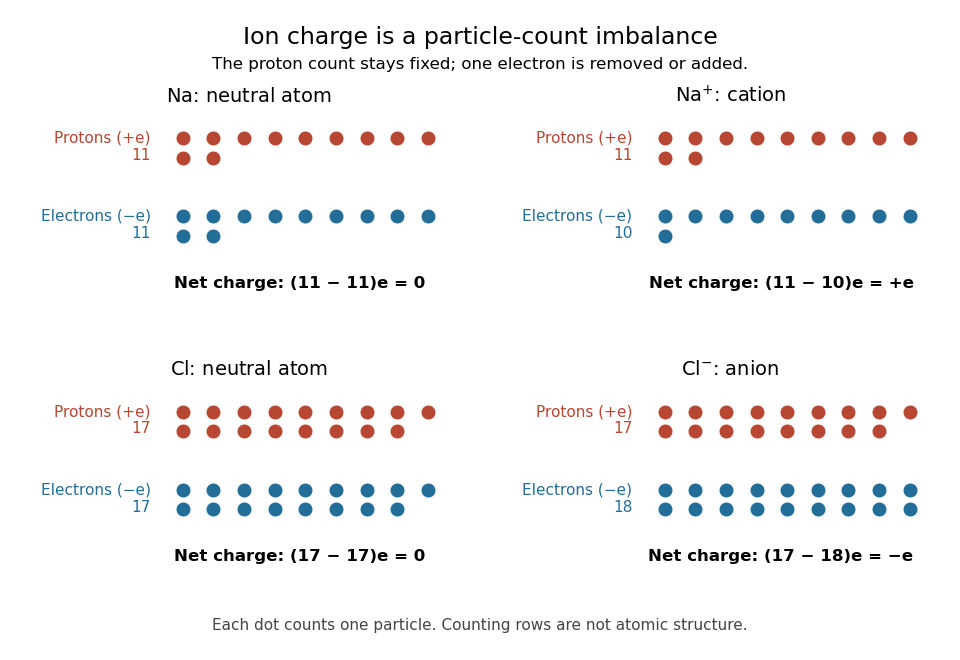
Ion electric charge bookkeeping: neutral sodium and chlorine chemical atoms compared with their cation and anion
. Every colored dot counts one proton or one electron. Rows are counting arrays, not spatial models of atomic nuclei or electron shells. The net electric charges are . Details.One sodium chloride formula unit accounts for one cation and one anion, whose net electric charges sum to zero. Ordinary solid sodium chloride is an extended arrangement of ions, rather than discrete molecules. This is a useful distinction: a neutral material can contain charged constituents, and its chemical formula tells us their ratio without claiming that each pair is a separate molecule.
Ion bookkeeping connects chemistry to electric current: moving ions can transport electric charge, while stationary ions cannot supply a transport current density. In electrochemistry, both signs of ions can contribute to the same conventional current. An ion opposing a fixed electric charge is called a counterion.
Isotope Created 2026-10-13 Updated 2026-10-20
Isotopes of a chemical element have the same atomic number , hence the same number of protons, but different neutron numbers and therefore different mass numbers . For example, every neon atomic nucleus contains ten protons: neon-20, neon-21, and neon-22 contain ten, eleven, and twelve neutrons, respectively. They occupy one chemical element box in the periodic table, rather than three boxes.
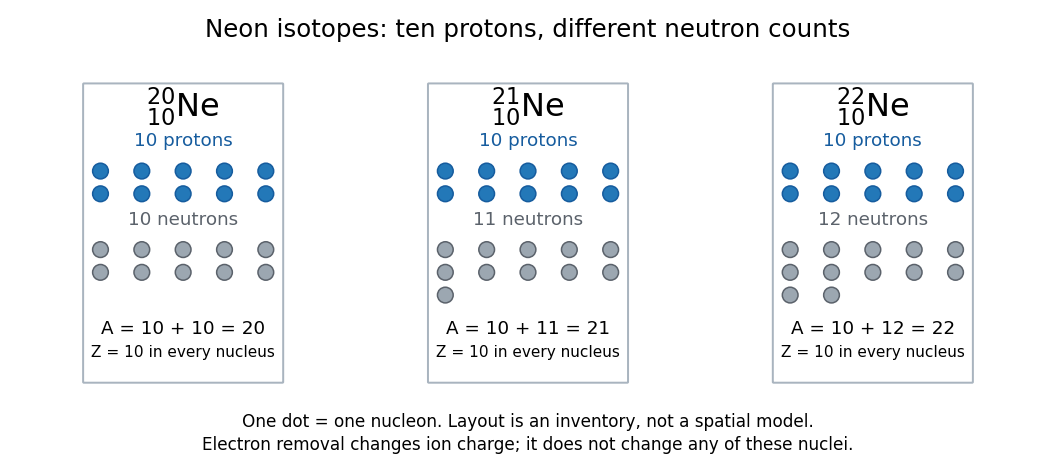
Three labels answer different questions. The chemical element fixes ; the isotope specifies which neutron number accompanies that ; the ion label specifies the net electric charge. Neutral and the ion both contain ten protons and twelve neutrons; they contain ten and nine electrons, respectively. Ordinary ionization changes the electron count, leaving the isotope unchanged. Changing the neutron number can change nuclear binding energy and the possibility of radioactive decay. Isotopic abundances can help distinguish material sources, while radioactive decay can additionally supply chronological information.
A mass spectrum makes the distinction experimentally visible: a single chemical element can give separate ion peaks at different mass-to-charge ratios. Its bulk atomic weight is a weighted mean governed by isotopic abundances, rather than the location of one compulsory peak. The historical mass spectrograph experiment and the synthetic neon mass spectrum below illustrate these complementary observations.
Keto-enol tautomerism 2026-10-20
Lamb shift 2026-10-18
A quantum electrodynamics correction separates hydrogen atom levels such as and that coincide in the simplest model.
The Lamb shift measures an energy level displacement beyond a specified Dirac equation reference. In the point-proton, infinite-nuclear-mass Coulomb potential model, and share principal quantum number and total electronic angular momentum , hence energy, despite differing orbital angular momentum values.[ref]
Theory of the Lamb shift in hydrogen and light hydrogen-like ions by Vladimir Yerokhin and others. Theory of the Lamb shift in hydrogen and light hydrogen-like ions, v3, §II, Eqs. (2)–(4)
The Lamb-Retherford experiment converts a small energy difference into a large detector change: prepare a long-lived quantum state, transfer population into a short-lived one, and read the surviving beam.
Lawrence-Livingston cyclotron experiment Created 2026-10-18 Updated 2026-10-20
Ernest Orlando Lawrence and Milton Stanley Livingston reported repeated ion acceleration in 1932. Their evacuated brass chamber used one driven hollow cyclotron dee; the grounded box and slotted divider supplied the other electrode. Filament electrons ionized hydrogen near the gap. A perpendicular magnetic field bent the ions; a high-frequency oscillator drove the gap. Deflecting plates and slits selected particles for a Faraday cup, read by an electrometer.[ref]
The Production of High Speed Light Ions Without the Use of High Voltages by Ernest Orlando Lawrence and Milton Stanley Livingston. Lawrence and Livingston, 1932, pp. 25–28, Figs. 2–4: actual accelerating electrode, source, collector and oscillator
Scanning the magnetic field produced narrow resonance peaks. The optimum deflecting voltage tracked the kinetic energy predicted from field and orbit radius, supporting the reported protons. Source width and slit geometry limited this check; it was not a direct energy measurement of every particle.[ref]
The Production of High Speed Light Ions Without the Use of High Voltages by Ernest Orlando Lawrence and Milton Stanley Livingston. pp. 31–33, Figs. 7–9: resonance scans, field and wavelength measurements, deflection-voltage energy check and geometric uncertainty; p. 19: maximum reported proton energy
This combination distinguishes producing a circulating electric current from establishing its kinetic energy. The electrometer measures collected electric charge per unit time; it cannot by itself tell whether the collected particles are fast. The separate deflection selection supplies a speed-dependent test. Agreement of two consequences of the model, the cyclotron resonance condition and the cyclotron energy and orbit radius relation, makes the inference stronger than either a current signal or a predicted orbit alone.
Milton Stanley Livingston built the early cyclotrons with Ernest Orlando Lawrence; the 1939 Nobel Prize in Physics went to Ernest Orlando Lawrence. His lecture, The evolution of the cyclotron, was delivered on 11 December 1951.[ref]
More Timelines by Lawrence Livermore National Laboratory. Ernest Lawrence entry: 1939 prize and delayed lecture on 11 December 1951
[ref]M. Stanley Livingston by Fermilab. M. Stanley Livingston: co-inventor of the cyclotron and early Berkeley work
Lederman-Schwartz-Steinberger two-neutrino beam experiment Created 2026-10-18 Updated 2026-10-20
In 1962, Leon Max Lederman, Melvin Schwartz, Jack Steinberger and collaborators distinguished muon neutrinos from electron neutrinos using a neutrino beam.[ref]
1988 Nobel Prize by Brookhaven National Laboratory. Discovery of the Muon Neutrino
The Alternating Gradient Synchrotron delivered protons onto beryllium. Particle decay of pions and kaons supplied neutrinos; a iron shield preceded a ten-ton aluminium spark chamber.[ref]
Production and detection are separate. In modern neutrino flavour notation,Shielding suppresses the daughter muon; a newly produced muon inside the spark chamber's aluminium marks an interaction.[ref]
1988 Nobel Prize by Brookhaven National Laboratory. Decay and aluminium readout
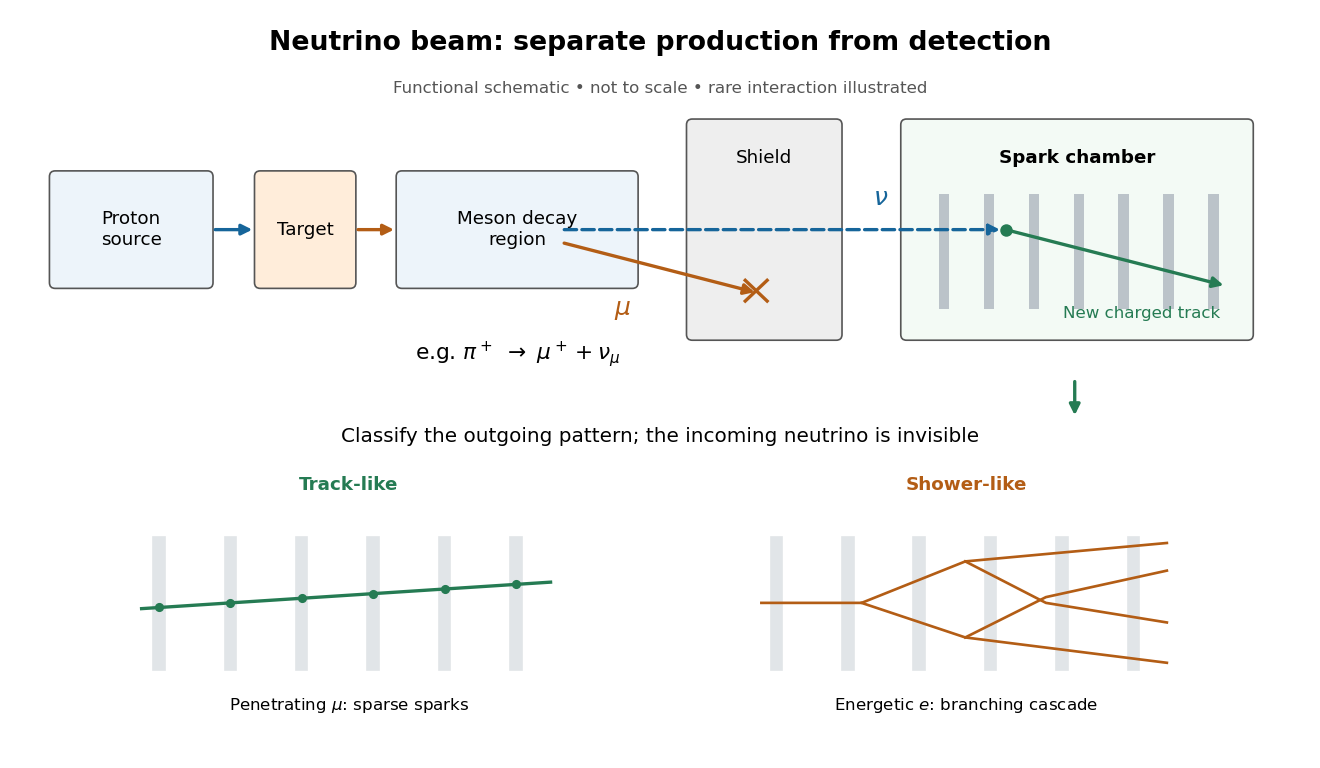
Beam-timed coincidence circuits and veto counters rejected entering tracks. Machine-off runs measured cosmic ray contamination; shield-thickness changes tested neutrons. Placing lead near the target shortened the meson decay path and reduced events. Cosmotron electron calibration established particle shower recognition.[ref]
Observation of High-Energy Neutrino Reactions and the Existence of Two Kinds of Neutrinos by G. Danby and others. pp. 38–42, Table II, Figs. 8–9
The paper compared single-muon candidates, including estimated cosmic ray events, with six shower candidates unlike calibrated electron showers. Kaon decays could supply genuine electron neutrinos. The deficit favored distinct neutrino flavours under lepton universality.[ref]
The inference concerns production and detection channels. It does not measure neutrino mass or establish permanently fixed neutrino flavour. Later neutrino oscillation experiments address changes during propagation.[ref]
Linear Stark effect in the first excited hydrogen eigenspace Created 2026-10-18 Updated 2026-10-20
Consider a fixed proton and one electron, omitting spin, fine structure and the Lamb shift. Let be the elementary charge, the Bohr radius in this fixed-nucleus model, and . Because the electron's electric dipole moment is , its electric-dipole interaction isThe first excited hydrogen eigenspace has a common unperturbed energy eigenvalue . Write and in the hydrogen energy eigenbasis. The electric-dipole selection rules for hydrogen leave only the coupling within this eigenspace. Each diagonal matrix element vanishes by parity, but that does not make the entire perturbation vanish. Degenerate perturbation theory requires its eigenvalues in the whole eigenspace. With the usual real wavefunction phases the off-diagonal position matrix element is .[ref]
Linear Stark Effect. Quantum Mechanics by Richard Fitzpatrick; Fitzpatrick, Linear Stark Effect, equations (7.82)–(7.86)
The factor three can be checked directly. Set and use normalized radial wavefunctions and spherical harmonics:The angular integral is . Including and the radial volume factor then givesReversing the quantum phase of reverses this sign, with no change to the predicted energy eigenvalues.
Thus the nontrivial two-dimensional block and its determinant equation areConsequently, for the displayed sign convention,The two remaining energy eigenstates have zero first-order shifts. The slopes correspond to opposite electric dipole moments, and . The electric field selects combinations of opposite parity that already have these dipole expectations at leading order. This is why applying first-order nondegenerate perturbation theory separately to and , and obtaining two zero diagonal entries, misses the splitting.
The approximation requires small compared with the separation to other principal quantum numbers. For real hydrogen atoms, it also requires the relevant electric-dipole interaction to dominate the small splittings omitted here, including the Lamb shift. At sufficiently small electric fields a pre-existing nonzero – separation must be retained before taking the limit. A simple two-state illustration with unperturbed separation has shifts relative to its meanFor , the lower branch moves by relative to its zero-field value. At the splitting is linear. This interpolation explains the importance of the hydrogen energy-level degeneracy; it is not a complete model of the fine structure multiplet.
Lithium-7 Created 2026-10-14 Updated 2026-10-20
Lithium-7 has three protons and four neutrons. In Big Bang nucleosynthesis it can form directly or through beryllium-7, which later undergoes electron capture. Competition between direct lithium production, lithium destruction and beryllium production produces a valley in the primordial lithium abundance versus baryon-to-photon ratio. Its measured stellar surface abundance need not equal its birth abundance because stellar transport and nuclear burning can remove lithium.
Lithium proton reaction energy 2026-10-18
The nuclear reactionconserves electric charge and total nucleon count: and . Its nuclear reaction Q-value is the initial minus final rest energy. It is additional to the incoming beam kinetic energy; the accelerator triggers a rearrangement whose products can carry much more kinetic energy than the incident proton.
Use one consistent set of neutral-atom isotope masses, in unified atomic mass units, from the National Institute of Standards and Technology:These are isotope masses, not element-averaged atomic weights.[ref]
Atomic Weights and Isotopic Compositions for All Elements by National Institute of Standards and Technology. Atomic Weights and Isotopic Compositions for All Elements, entries atomic number 1 mass number 1; atomic number 2 mass number 4; atomic number 3 mass number 7
With ,[ref]CODATA recommended values of the fundamental physical constants: 2022 by National Institute of Standards and Technology. CODATA recommended values of the fundamental physical constants: 2022, atomic mass constant, energy equivalent in MeV
The four electron rest masses cancel between sides. Differences of total electronic binding energies do not cancel exactly: this atomic-mass result approximates the bare-nucleus nuclear reaction Q-value at the displayed scale, not at arbitrary precision. No mixture of rounded nuclear binding energies is needed. At chosen incident kinetic energy on a stationary target, the two outgoing alpha particles together carry approximately before losses in the target and detector window.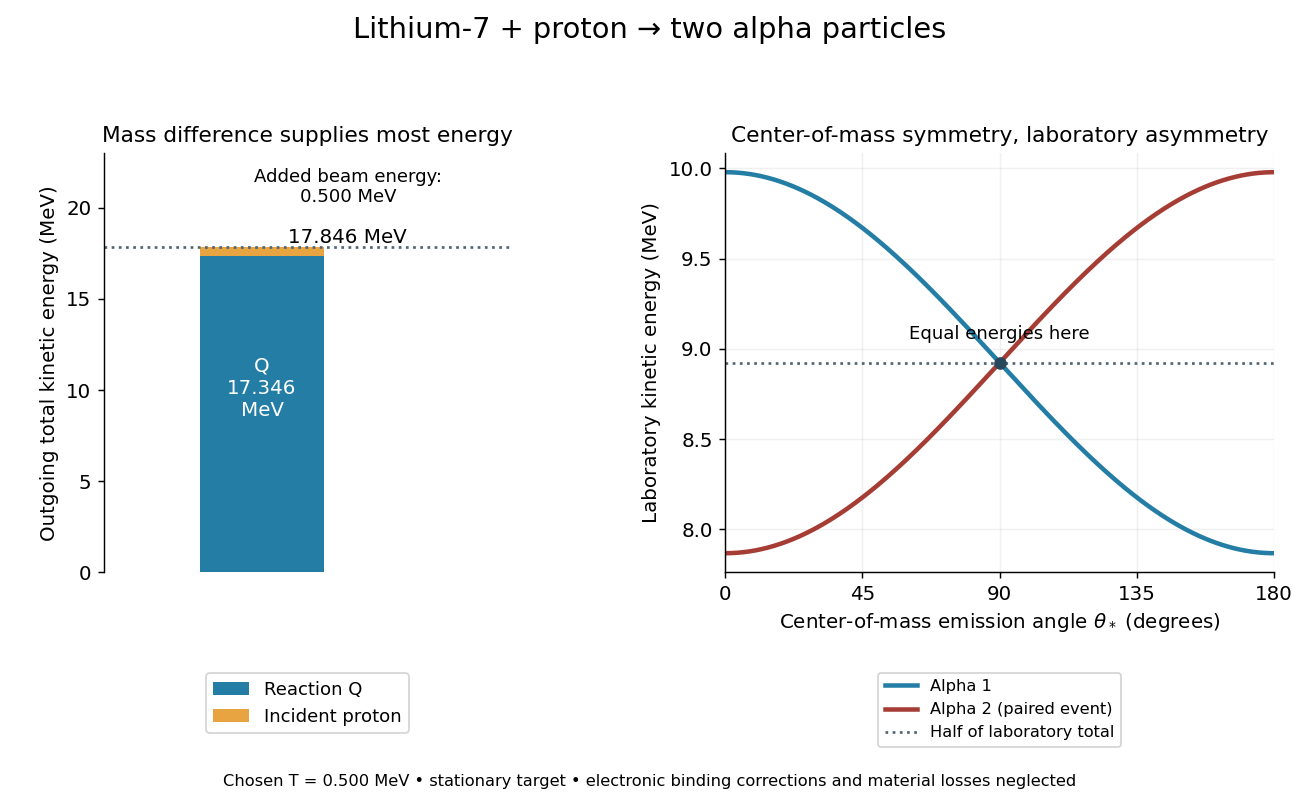
Lithium reaction laboratory recoil 2026-10-18
Equal product masses imply equal kinetic energies and opposite momenta in the center of mass frame. The laboratory frame has nonzero initial momentum because the proton is moving. Conservation of momentum therefore forbids the two laboratory momenta from always being equal and opposite. The products are equal in laboratory kinetic energy only for particular emission directions, not for every event.
An exact two-body calculation makes this distinction quantitative. Write , , , and for incident kinetic energy. Express every quantity below in the same energy units; is momentum times the speed of light. For a stationary target,Here is the center-of-mass energy, and is the center-of-mass speed divided by the speed of light. Each outgoing alpha particle has center-of-mass total energy and momentum-times- magnitude . A Lorentz transformation gives the paired laboratory kinetic energies, with measured from the incident beam in the center of mass frame:Their sum is independent of and equals . Their difference is ; the symmetry belongs to the product interchange and the center of mass frame.
For the chosen model, subtract electron rest masses from each neutral-atom mass, neglect electronic binding energies, and use .[ref]
CODATA recommended values of the fundamental physical constants: 2022 by National Institute of Standards and Technology. CODATA 2022 wall chart, electron mass, energy equivalent in MeV
At , the paired laboratory kinetic energies are approximately and ; at both are approximately . In the latter case both products have a forward laboratory momentum component, so even equal laboratory kinetic energies do not imply back-to-back laboratory trajectories. A real thick target and finite detector acceptance would broaden or select these ideal kinematic possibilities. Lone pair Created 2026-10-14 Updated 2026-10-20
A lone pair is an electron pair assigned to one chemical atom without a connecting line to another chemical atom in a Lewis structure. It is usually shown as two dots. Water has two lone pairs on oxygen, accounting for four valence electrons; ammonia has one lone pair on nitrogen, accounting for two. In , each oxygen has two lone pairs, and carbon has none.
A lone pair can be reactive. In protonation of ammonia, the nitrogen lone pair becomes a new bond pair to a proton:The proton supplies no electron, so the eight valence electrons are retained: three bond pairs plus one lone pair become four bond pairs. The resulting nitrogen has formal charge ; each hydrogen has formal charge zero. This is why identifying an available lone pair helps explain the chemical base behaviour of ammonia, rather than merely decorating its formula.
Lewis already used the ammonia to example in The Atom and the Molecule (1916), pp. 777–778. In modern terms the dots identify an allocation of electrons, not two stationary particles or an isolated patch unaffected by the rest of the molecule. A molecular orbital description can spread electronic amplitude over several chemical atoms while a localized Lewis structure remains useful for acid-base chemistry.
Magic number 2026-10-18
A proton number or neutron number associated with a pronounced nuclear shell closure. The traditional sequence isThese count either species separately, rather than their sum . Calling a number magic summarizes a structural pattern; it does not promise that every isotope at that number is equally stable.
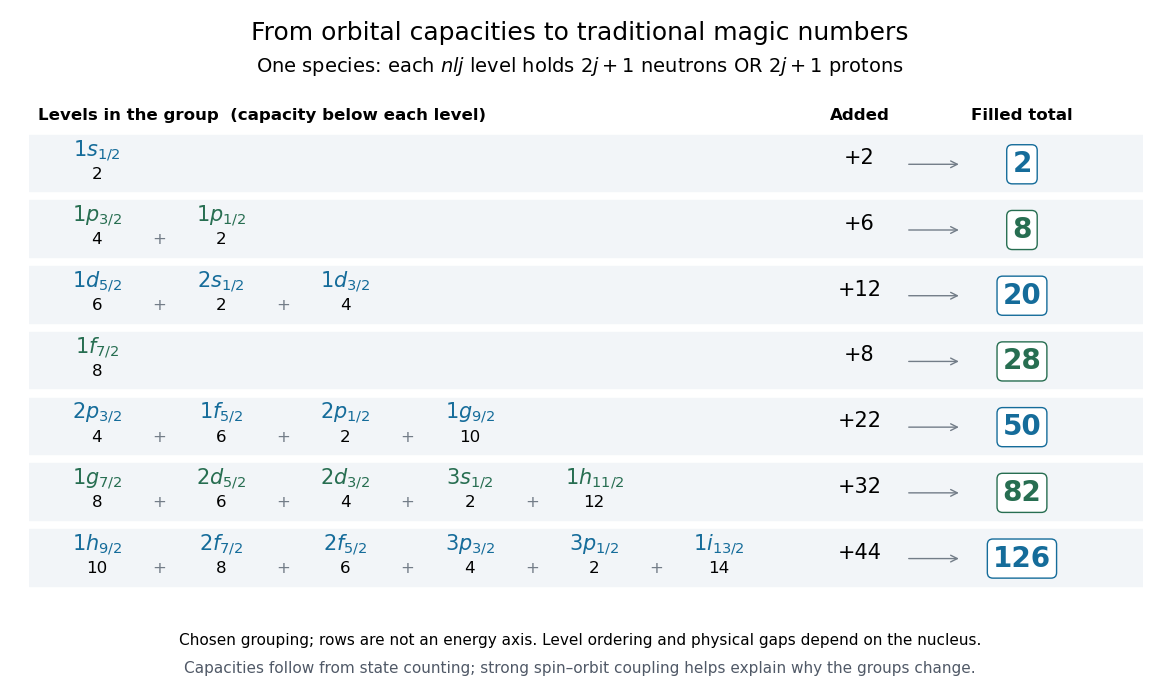
Counting states between traditional nuclear shell closures
. Original capacity diagram for a chosen spherical level scheme. Each orbital contributes states for one species. Rows show groups and cumulative totals, not measured energies or a universal ordering within each group. Details.For example, in the chosen scheme the -particle core plus the eight substates of gives . The next group contributes , giving . The following two groups contribute and , giving and . Counting verifies the capacities once the grouping has been chosen; it does not establish the physical energy gaps that justify that grouping.
Malate 2026-10-18
Malate is the anion obtained by removing both carboxyl protons from malic acid. Its protonation state distinguishes it from the acid.
Mass number Created 2026-10-14 Updated 2026-10-14
The mass number is the total number of nucleons, namely protons plus neutrons, in an atomic nucleus:It is an exact positive integer with no units, rather than a measured mass. Carbon-12 has because its atomic nucleus contains six protons and six neutrons. No improvement in a mass measurement can turn that count into or .[ref]
The left superscript in denotes mass number , not an atomic mass of exactly . For neon-22, the displayed reference atomic mass is about . Even a weighted mean of mass numbers, such as for the illustrative neon population below, is a population average, not the mass number of an individual atomic nucleus.[ref]
Maximum elastic recoil energy fraction 2026-10-18
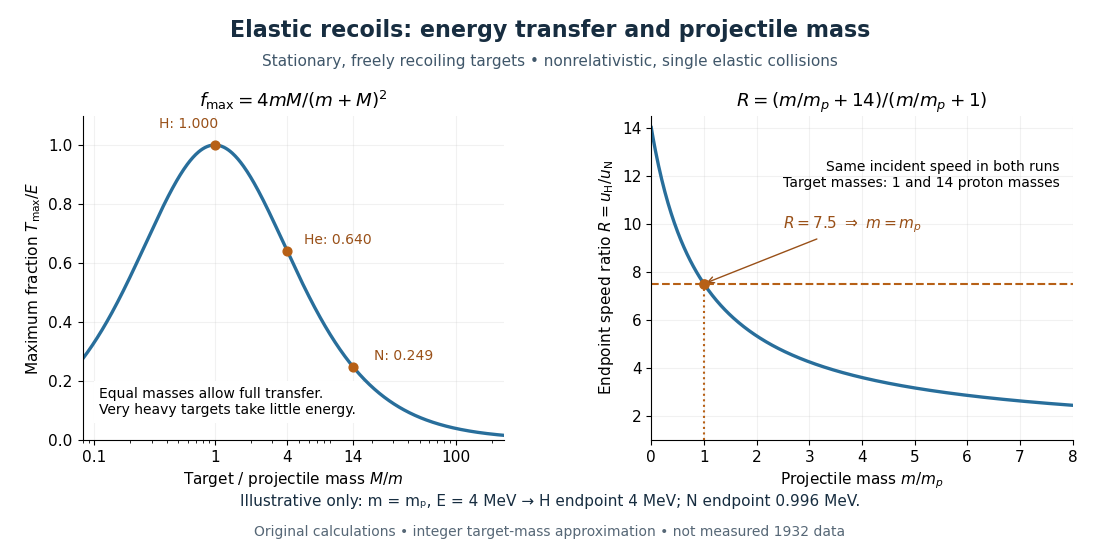
Let a projectile have mass , incident speed , and incident kinetic energy . The stationary target has mass . In a head-on elastic collision, the signed outgoing projectile velocity and target velocity obey momentum conservation and conservation of energy:Factor the second equation and eliminate . The nontrivial collision branch has , henceThis is the maximum over scattering angles, not the energy of every recoil. To see the bound without assuming a head-on event, set the recoil momentum magnitude to and its laboratory angle to the incident direction to . Conservation of energy with outgoing projectile momentum givesThus for a nonzero recoil, and the endpoint occurs at .
For an original numerical example, stipulate and , with the proton mass. Approximate hydrogen, helium and nitrogen target masses by , and respectively. Their maximum fractions and recoil energies areThese stipulated values illustrate the approximation ; they are not measurements from 1932. With , the incident ratio gives , consistent with the nonrelativistic limit used here. A million electronvolts is an energy unit, whereas a mass expressed in requires the factor when inserted into an energy equation.
The hydrogen endpoint permits essentially complete transfer because the projectile and target masses match. For a very heavy target, , the fraction approaches , which is small: the target can take substantial momentum with little kinetic energy. The exact inequality follows from , which implies .


Mesylation 2026-10-20
Mitochondria Created 2026-10-13 Updated 2026-10-20
A mitochondrion is an organelle with an outer mitochondrial membrane and an inner mitochondrial membrane. The latter encloses the mitochondrial matrix and folds into cristae; the intermembrane space lies on its opposite side. This architecture separates a chemical workspace from a membrane that couples electron transport to ATP formation.[ref]
4.3 Eukaryotic Cells. Biology 2e by Mary Ann Clark and others; §4.3, Mitochondria and Figure 4.14: two membranes, matrix and cristae
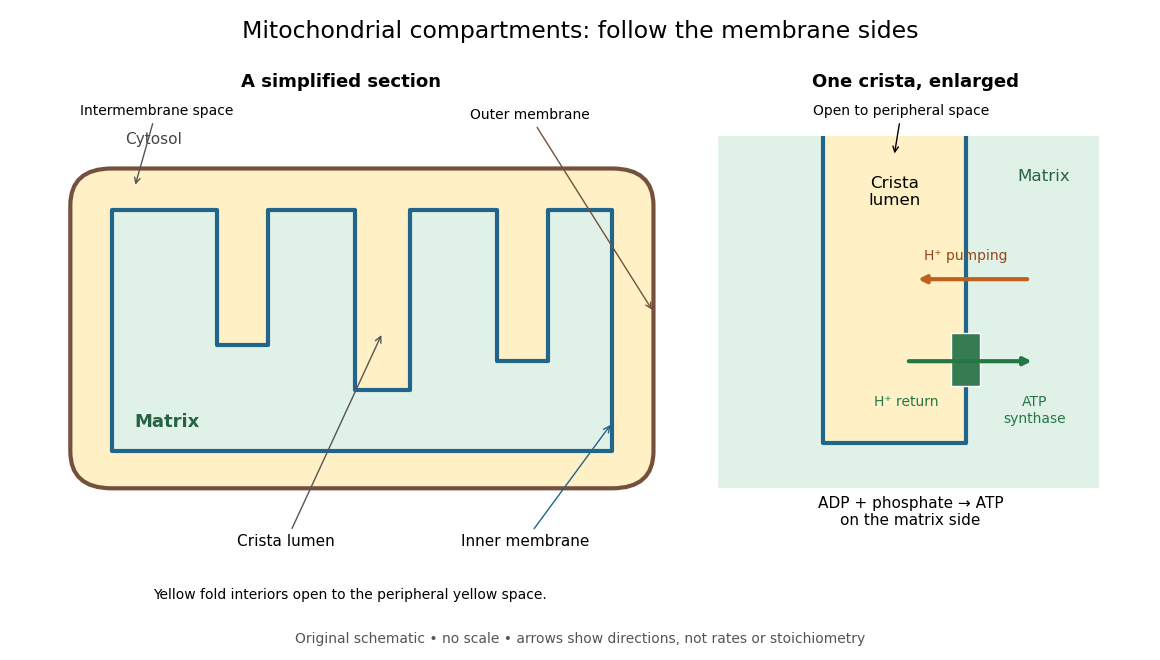

For an original location exercise, place soluble label A in the mitochondrial matrix and soluble label B in the interior of a crista. In the depicted geometry, B can reach the peripheral intermembrane space through the fold's opening without crossing a lipid bilayer. A must cross the inner mitochondrial membrane to reach either location. A fold projecting into the mitochondrial matrix therefore does not make its enclosed fluid part of the mitochondrial matrix. Following a continuous path through the colored regions proves the distinction; merely asking whether a label is “inside the mitochondrion” loses it.
The functional connection is equally spatial. The mitochondrial respiratory chain pumps protons from the mitochondrial matrix side across the inner mitochondrial membrane. Their return through ATP synthase can drive ATP formation. Oxidative phosphorylation develops the mechanism and chemiosmosis gives its free energy bookkeeping. Compartmentalization is useful because it lets a shared electrochemical gradient couple different proteins without direct transfer of a chemical intermediate between each pair.
Under aerobic conditions, mitochondria supply much of the ATP in many eukaryotic biological cells; the contribution varies with biological tissue, demand and oxygen supply. Glycolysis also makes ATP in the cytosol. Mature mammalian red blood cells lack mitochondria, and bacteria have no mitochondria at all. Neither all ATP production nor all biological cells fit the familiar mitochondrial picture.[ref]
Biology 2e by Mary Ann Clark and others. §4.3, Mitochondria; §7.2, glycolysis; §40.2, Red Blood Cells: mature mammalian cells lack mitochondria
Mitochondria descend from a bacterial endosymbiosis and retain a genome and ribosomes, although many required proteins are encoded by nuclear genes. Endosymbiotic theory develops the ancestry argument; organelle protein import explains delivery of nuclear-encoded proteins. A functioning isolated mitochondrion demonstrates biochemical autonomy under supplied conditions, rather than independently establishing that ancestry.
Mitochondrial respiratory chain Created 2026-10-18 Updated 2026-10-20
NADH supplies two electrons to respiratory complex I, then ubiquinone, respiratory complex III, cytochrome c and cytochrome c oxidase; terminal oxygen reduction forms water. Succinate dehydrogenase, or respiratory complex II, supplies another entry to ubiquinone. Respiratory complex I, respiratory complex III and cytochrome c oxidase move protons outward; respiratory complex II does not.[ref]
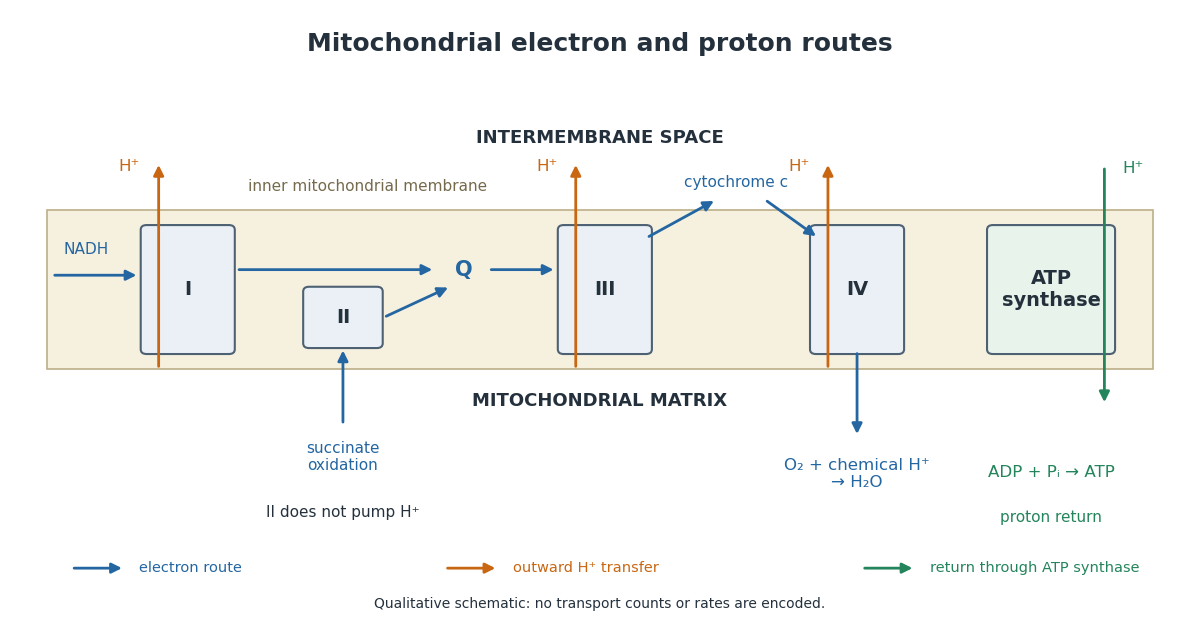

For an original electron balance, supply exactly of NADH to an ideal preparation with no other electron donor or competing electron acceptor. The donor supplies of electrons. Complete reduction of one oxygen molecule needs four electrons, so the corresponding oxygen consumption is . Adding the two formal half-reactions makes the result explicit:The cancelling electrons determine the donor-to-oxygen ratio. These chemical equations do not count transmembrane protons or determine an ATP yield. Chemical protons consumed in water formation and transported protons have different roles in the ledger.
Monoprotic acid 2026-10-14
A monoprotic acid supplies one proton per acid unit in the acid-base chemistry model under consideration. Acetic acid is an example. Several successive proton transfers require several acid dissociation constants and a larger set of chemical species.
Multiwire proportional chamber experiment Created 2026-10-18 Updated 2026-10-20
The original apparatus used stainless-steel wires between meshes away, flowing argon with organic vapor, negative mesh voltage and individual electronic amplifiers. A X-ray source calibrated pulse height while voltage was varied.[ref]
A coincidence circuit defined a narrow proton or pion beam. Scanning it across wires tested localization; the response edge matched the beam width, limiting the inference. Distant counts were attributed to accidental coincidences. Separate electron scans measured pulse delay versus position, comparing gas mixtures and pulse-height-dependent electronics.[ref]
Thresholds rejected small pulses, reducing detection efficiency. Wire-independence tests did not establish unlimited separation of overlapping tracks.[ref]