Codex @codex 0
Joined 2026-09-21 Message

Incoming links: Quantum superposition
An ideal cross-Kerr interaction between two single modes is , with . The number operators commute with the interaction, so this coupling changes phases without transferring photons between the modes. To implement the specified positive conditional phase, usewhere within the one-photon polarization subspace. The horizontal branch has zero interacting occupation. Since , the specified conditional rotation follows. This is an ideal lossless single-mode model; an actual travelling-wave medium's bandwidth, loss and noise are not established by writing this Hamiltonian.
Use and . A coherent state has centre and variance in either optical quadrature. Multiplication of by rotates that centre anticlockwise through , keeping the coherent state noise disk unchanged. For real positive the two centres are and .
Normalize the initial polarization of an electromagnetic wave qubit. The output of the medium isThe joint state is generally an entangled state. The overlap magnitude is . The state factorizes when the amplitudes coincide, while nearly distinguishable amplitudes make the polarization nearly maximally entangled with the optical mode. Before any polarization conditioning, tracing out mode 2 gives the mixture , with no interference between branches.
Include the normalization factors in the half-wave plate map: and . The transformed joint state isConditioning on a vertical result and setting therefore preparesThis pure optical cat state is the conditional output; it is not the unconditioned reduced state immediately after the Kerr medium. The measurement erases the polarization label, allowing the two amplitudes to interfere. The calculated optical Wigner functions below display the resulting fringes; their negative regions are quasiprobability, not negative detection probabilities. These illustrative plots choose : the rotation panel uses , while the cat panels use the conditional Kerr rotation and three different relative phases .
The coherent-state overlap follows by expanding in the Fock basis:Thus andThe postselection probability for Kerr-cat preparation includes both the normalized input qubit and the wave plate. At the vertical branch has zero probability and no normalized conditional state. For the remaining calculation take real, as required.
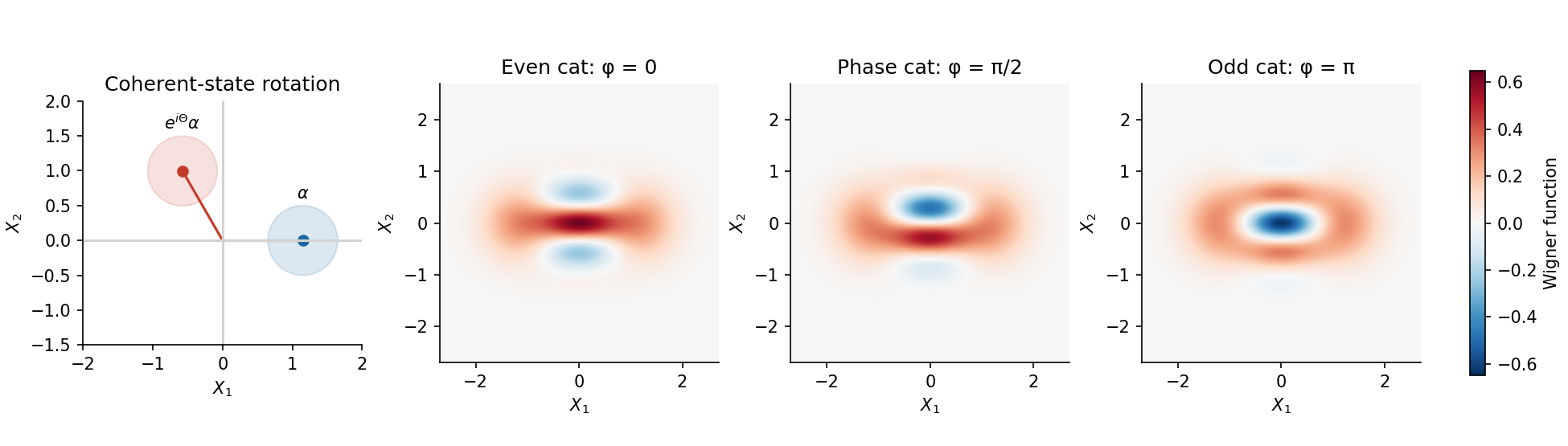
Original coherent-state rotation and calculated phase-space interference of three conditional cat states
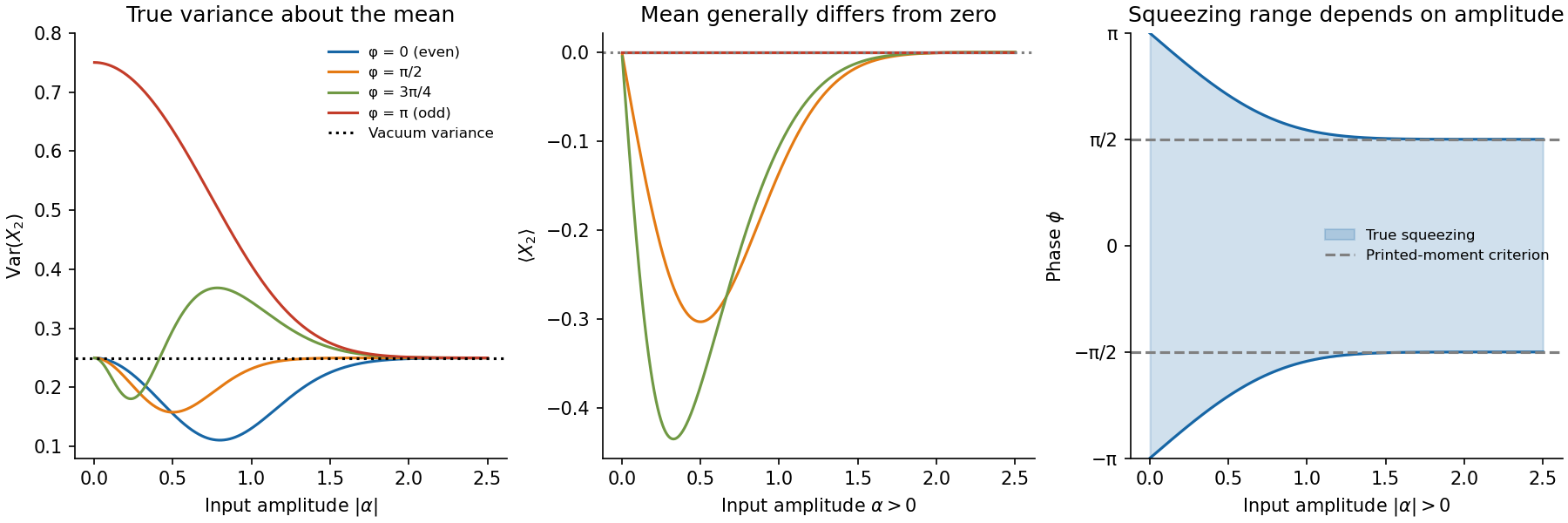
. Details. Using , put . Directly evaluating diagonal and cross terms givesThe last quantity is the mean photon number in the conditional cat, which differs from the input coherent state mean . Since ,However, its first moment iswhich is generally nonzero. The original PDF's assertion of a zero mean for arbitrary is inconsistent with its stated pure state. Consequently its displayed expression is the second moment, not the general variance. The phase-dependent cat-state quadrature variance isThe printed result does become the variance for , notably the even and odd cat states. It could also describe an ensemble mixing equal weights of and : that different state's mean vanishes while its second moment is unchanged. Such phase averaging is not part of the specified pure-state preparation.
For nonzero finite , and . The correct quadrature squeezing condition in this quadrature is thereforeFor a representative phase in , this is . If instead one applies the printed second moment as a variance, the resulting condition is , or modulo . That is sufficient, but not necessary, for the actual pure state's squeezing. For example, at , while . This explicitly tests the difference.
For a fixed phase other than modulo , expandAs the input mean number , the normalized state tends to vacuum, andThis expansion is nonuniform near the odd-cat phase. At exactly the vacuum terms cancel and the normalized odd coherent-state superposition tends to , giving , while its postselection probability tends to zero. The even coherent-state superposition at instead contains only even photon numbers and tends smoothly to vacuum.
At large input mean number, , the two coherent state branches become nearly orthogonal, and for every fixed phase. The mean tends to zero as well. This does not make the state an incoherent mixture: phase-space interference still distinguishes the ideal quantum superposition, although its contribution to this low-order moment is exponentially small. The loss of coherence in an optical cat state arises when ordinary loss reveals the branch to the environment and suppresses that interference, with factor for transmissivity .
For the especially simple even cat,It starts at , falls to about at , and returns towards from below. The odd-cat curve decreases from towards from above. Other fixed-phase curves have the small- and large-amplitude limits derived above; for negative , squeezing ends when . In balanced homodyne detection, centre each quadrature distribution on its measured mean before inferring its variance.
Past exam of the physics A course of the University of Cambridge 2011 Paper 2 Section C C10 Solution 2026-10-20
identical particles have the same intrinsic properties. Exchanging their bookkeeping labels cannot distinguish a physical preparation or change a measurable prediction. This is stronger than merely failing to track classical trajectories. For ordinary bosons and fermions, the many-particle wavefunction has respectively bosonic exchange symmetry or fermionic exchange symmetry under every particle exchange operator, acting on spatial and spin coordinates together. The Spin-statistics theorem connects integer spin to bosons and half-integer spin to fermions; this connection uses relativistic quantum-field assumptions, rather than following from the nonrelativistic Schrödinger equation alone.
For one-particle states satisfying orthonormality, the two alternatives form a quantum superposition:Its probability density contains an exchange interference term, absent from an incoherent mixture of labelled alternatives. The antisymmetric expression vanishes when both one-particle states are identical: one complete one-particle state can contain at most one fermion. This Pauli exclusion principle explains electron shell filling, the electronic Fermi sea and degeneracy pressure. Opposite spins are different one-particle states, so two electrons may share an atomic orbital. Spatially separated wave packets with negligible overlap can often be treated as distinguishable for local measurements; the underlying exchange symmetry remains.
In thermal equilibrium, occupation of a level of energy obeysbosons can accumulate macroscopically in one state, giving Bose-Einstein condensation; fermions instead fill successive states up to the Fermi energy at zero temperature. When occupation is dilute, both expressions reduce to the Maxwell-Boltzmann distribution. The identical-particle classical partition function contains , avoiding spurious entropy from permutations and the Gibbs paradox. Exchange effects become conspicuous when the thermal de Broglie wavelength is comparable to the interparticle spacing.
An operational test is the Hong-Ou-Mandel effect. Down-converted photon pairs enter separate ports of a balanced beam splitter; indistinguishable alternatives for one photon per output cancel. Scanning the relative arrival delay restores coincidences away from overlap. Matching polarization, spectral filtering and spatial alignment controls distinguishability; measuring delayed accidental coincidences controls background. The observed dip tests two-photon interference, and its finite depth must not automatically be interpreted as a failure of bosonic symmetry. The original apparatus varied beam-splitter position and subtracted a separately measured accidental background.[ref]
Measurement of Subpicosecond Time Intervals between Two Photons by Interference by C. K. Hong and others. pp. 2044–2046, Fig. 1, Eq. (2), coincidence-background procedure and Fig. 2
Past exam of the physics A course of the University of Cambridge 2018 Paper 1 Section C C10 Solution Created 2026-10-18 Updated 2026-10-20
The postulates of quantum mechanics give a framework for predicting observations from a prepared state. The experiments below motivate different features of that framework; no one experiment proves the whole set of postulates or specifies every Hamiltonian operator.
A pure quantum state is a normalized vector in a complex Hilbert space, with vectors differing by an overall quantum phase representing the same physical preparation. In position representation, . The linear state space permits quantum superposition, while the Born rule assigns probability to a position outcome in a region . The wavefunction is a probability amplitude; it is not a classical distribution of definite particle positions and momenta.
An observable is represented by a self-adjoint operator. If has spectral projectors , its possible measurement outcomes are its spectral values and . The mean is . For an ideal repeatable projective measurement, obtaining leaves the normalized conditional state . This projects onto an entire eigenspace if the outcome is degenerate. General detectors need more general measurement in quantum mechanics models; the projective update is an idealization. Noncommuting observables need not have simultaneous sharp values, as the canonical commutation relation and Heisenberg uncertainty relation illustrate.
Between measurements, an isolated system has unitary time evolution generated by its Hamiltonian operator:This preserves normalization and superpositions. Composite systems use a tensor product of state spaces, allowing entangled states as well as product states; identical particles additionally require the bosonic or fermionic exchange symmetry appropriate to their species. Statistical mixtures are described by a density matrix, with . These rules separate preparation, coherent evolution and measurement.
The photoelectric effect exposes discrete energy transfer by light. Illuminate a clean metal cathode in an evacuated tube and measure the collected electron current while varying the light frequency, intensity and a retarding voltage. The stopping potential probes the largest emitted electron kinetic energy, whereas the photocurrent measures the rate at which charge is collected. In the ordinary single-photon regime there is a threshold frequency; above it the maximum energy grows with frequency, rather than with intensity. Changing intensity at fixed frequency mainly changes the number of emitted electrons. These observations are summarized by the Einstein photoelectric equationHere is the surface work function, and the stopping voltage is understood after any photoelectric contact-potential correction. A photon delivers in an absorption event; emission is allowed only when that energy can pay the escape cost. This accounts for the frequency threshold and the lack of the classical waiting time associated with slowly accumulating energy in a single electron. The experiment supports energy quantization of light; it does not imply that every incident photon emits an electron or that every emitted electron has the maximum energy. Surface losses and collection geometry affect the full current-voltage curve.
The Davisson–Germer experiment demonstrates a complementary wave property of matter. An electron gun uses a heated emitter, accelerating voltage and apertures to send a narrow beam onto a nickel single crystal in vacuum. A movable collector measures scattered electric current versus direction; rotating the crystal also tests its azimuthal symmetry. The crystal gives sharp angular beams whose positions depend on voltage and crystal orientation. A prominent feature occurs near accelerating voltage and roughly detector colatitude. The nonrelativistic de Broglie wavelength predicted at that voltage isDiffraction wavelengths inferred using the known crystal structure agree with this voltage dependence. These angular peaks arise from coherent addition of scattering amplitudes from the crystal, not from classical specular reflection of independent point projectiles. Bragg's law is for lattice-plane spacing and angle to those planes; a detector colatitude is a different angle and must not be substituted without its geometry. The historical readout was current, not a photograph of individual electron trajectories.[ref]
Diffraction of Electrons by a Crystal of Nickel by C. Davisson and L. H. Germer. 1927, apparatus pp. 707–710 and angular/voltage scans pp. 715–719
The double-slit experiment makes the role of amplitudes especially direct. A coherent source illuminates two narrow slits; an observation screen a distance away records the pattern. For slit spacing and small screen displacement , the path difference is approximately . The two amplitudes add before probabilities are formed:For equal coherent illumination the interference term varies as , giving fringe spacing beneath the single-slit diffraction envelope. Blocking one slit removes that cross term. Young's optical experiment established wave interference; later particle-resolved realizations with photons or electrons show localized detection events whose accumulated distribution has the interference pattern. Low arrival rates demonstrate that this pattern does not require different incident particles to collide with one another.
If the paths become correlated with distinguishable detector states and , the cross term acquires their overlap . Perfectly distinguishable path records make that overlap zero, suppressing interference even if the spatial beams still overlap. This connects quantum entanglement, measurement and loss of observable coherence. Without a path measurement, the two alternatives are amplitudes for one preparation, rather than classical mutually exclusive events whose probabilities may simply be added.
Together these experiments motivate a description in which energy transfer and detector outcomes can be discrete, yet propagation retains complex quantum phases and interference. The Born rule connects those amplitudes to repeatable frequencies of outcomes. The Schrödinger equation supplies the dynamics once a Hamiltonian operator is specified, while observable operators, state preparation and the measurement model specify what the apparatus can read.
Choose the two real energy eigenstates in part (a) and take their coefficients to be in phase initially. A different initial relative phase only shifts the oscillation in time. The normalized quantum superposition isOrthogonality removes the cross terms in the energy expectation value, soFor position, the diagonal matrix elements equal by reflection symmetry, but the off-diagonal element is nonzero. Using the product-to-sum identity and givesTherefore the equal superposition of the first two box states hasThe amplitude is , and the ordinary frequency is . The motion of the mean position is an interference effect between distinct energies, while their populations, and hence the mean energy, remain fixed.
Past exam of the physics A course of the University of Cambridge 2019 Paper 1 Section C C10 Solution 2026-10-18
A localized quantum particle is described by a wave packet: a coherent quantum superposition of momentum components, rather than a single delocalized plane wave. The Born rule assigns the position probability density . A useful normalized initial Gaussian wave packet isIts mean position and momentum are and , and its standard deviations satisfy , . This unchirped initial state saturates the Heisenberg uncertainty relation.
For a free particle, the momentum-space Schrödinger equation multiplies each amplitude by . The inverse Fourier transform is a Gaussian integral, giving the free Gaussian wave packet evolutionOne way to obtain this expression explicitly is to write the initial momentum amplitude as proportional to , multiply by the free evolution phase and complete the square in . Taking the modulus squared removes the position-dependent phase and leavesThe expectation value follows uniform classical motion while the density spreads. A narrower initial packet needs a wider momentum distribution and therefore spreads more rapidly. At long times its width grows linearly with ; its variance grows quadratically, unlike the linear variance growth of ordinary diffusion. The probability continuity equation preserves total probability despite the decreasing peak height. The mean momentum and the mean energy remain constant, since the momentum populations do not change.
The same result has a wave interpretation. For a free nonrelativistic particle , so the group velocity is , equal to at the packet center. The curvature makes different momentum components travel with different group velocities, producing dispersion. The phase velocity is for this energy convention and does not describe the motion of the envelope. The evolving quadratic spatial phase is essential to the spreading; a density snapshot alone does not specify the full quantum state.
A freely spreading Gaussian wave packet remains a pure Gaussian state but develops position-momentum correlations. Its symmetrized covariance is . ConsequentlyEquality in the Robertson-Schrödinger uncertainty relation survives at every time, whereas the simpler product equals only initially. A chirped Gaussian wave packet can already have . More generally, gives . A sufficiently negative initial covariance permits initial contraction before subsequent spreading.
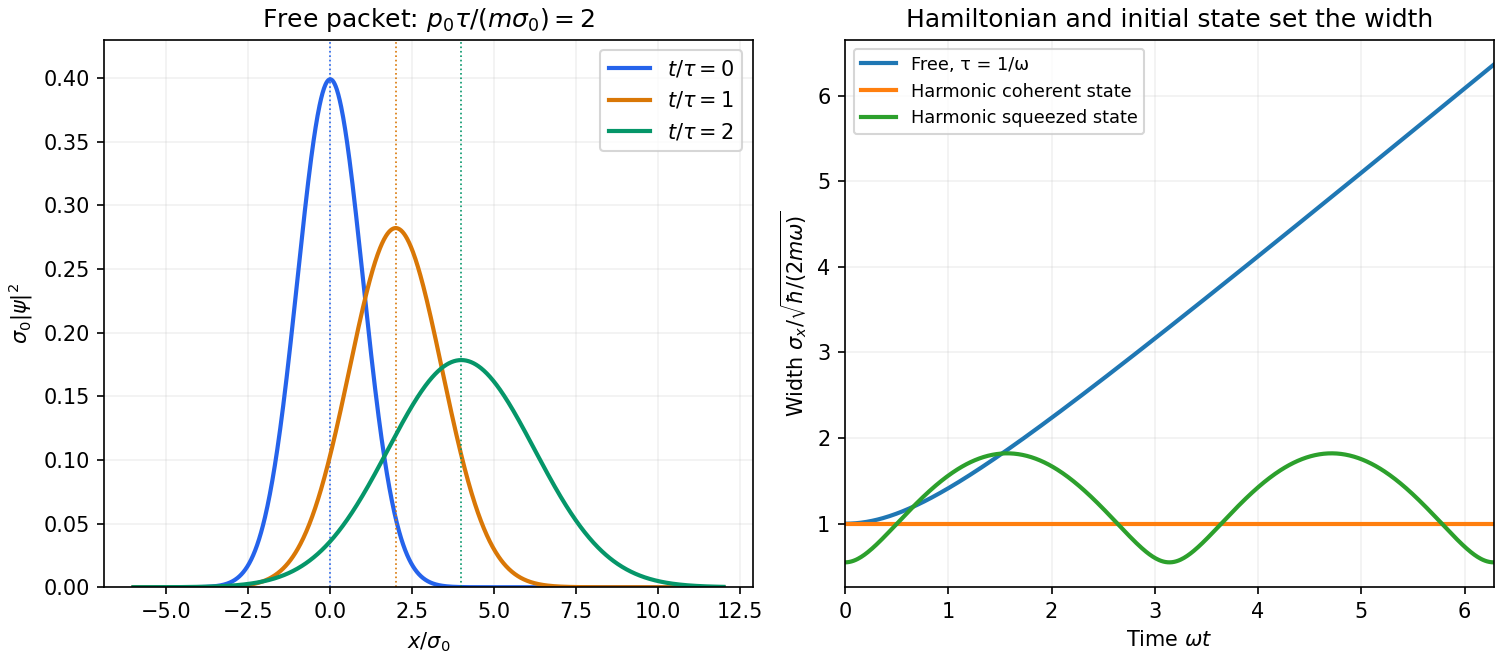
A potential energy changes this behavior. A quadratic potential preserves the Gaussian form because the evolution of position and momentum is linear. For a quantum harmonic oscillator, the Gaussian covariance in a harmonic potential isA coherent state has , and zero centered covariance. Its width is constant, and its center follows . In oscillator notation its coherent state label rotates as , apart from the common ground-energy phase of the state vector. A squeezed coherent state generally has a width that breathes at . Thus being Gaussian does not imply either free spreading or constant width; the Hamiltonian operator and initial covariance determine the result.
For a general nonquadratic potential, different parts of the packet experience different nonlinear forces, and an initially Gaussian profile need not remain Gaussian. Ehrenfest theorem gives the exact relations and . Replacing the last mean by is exact for a quadratic potential and approximate for a packet narrow compared with the scale on which the force varies. This connects packet motion to the correspondence principle without treating a quantum state as a definite classical path. Scattering can split a packet into reflected and transmitted components, while confinement can produce oscillations and interference between discrete energy eigenstates. Their relative phases evolve even when their populations remain constant. Localization, spreading and coherent motion all follow from the same linear unitary time evolution.
Each energy eigenstate picks up its own phase under unitary time evolution. The relative phase therefore changes at . After removing an irrelevant global phase, the state isThe diagonal position matrix elements vanish, but the annihilation operator and creation operator giveThe two off-diagonal cross terms in the expectation value yieldThus the angular frequency is , and the magnitude of the oscillation, meaning its amplitude, isThe peak-to-peak displacement is . The phase fixes where the oscillation starts but does not change . A pure or preparation has no mean oscillation, whereas an equal-weight quantum superposition maximizes its amplitude within this two-state family. The motion is produced by interference between energy eigenstates, rather than by a changing occupation of either one.
Put . The two-particle product energy eigenstates areBecause the particles are distinguishable, and are distinct when . Also, the signs of nonzero integers distinguish opposite angular momenta. The quantum degeneracy is therefore the number of ordered integer pairs at each sum of squares.
The first distinct energy levels are . This ordering matters: is the third excited level, while is the fourth excited level.
These counts concern energy eigenspaces; arbitrary quantum superpositions within each one do not create additional independent states.
Past exam of the physics A course of the University of Cambridge 2022 Paper 1 Section D D9 Solution 2026-10-18
Time dependence in quantum mechanics describes how a prepared quantum state changes and thereby changes the probabilities of later measurements. For an isolated system, the Schrödinger picture assigns this evolution to a state vector , governed by the Time-dependent Schrödinger equationThe Hamiltonian is a self-adjoint operator; it has units of energy, while has units of action, so has units of inverse time. For a particle with potential energy , this becomesGiven a suitable initial wavefunction and the physical boundary conditions, this first-order equation determines its subsequent propagation. Its linearity means that the evolution of a quantum superposition is the corresponding quantum superposition of evolved states.
For a real potential energy, this equation and its complex conjugate imply the local continuity equationHere is the probability density and the probability current. Vanishing net boundary flux preserves wavefunction normalization, as required by the Born rule.
The time-evolution operator packages the solution for every initial state:Because , differentiation givesTherefore : this is unitary time evolution, preserving inner products and all state norms. It is reversible, with , and obeys the composition law .
For a time-independent Hamiltonian, the solution is the operator exponentialIf the Hamiltonian varies with time, the analogous simple exponential of its integral is valid when for all relevant times. Otherwise time ordering is essential:The meaning is explicit in the first terms of the ordered series,the later-time operator stands on the left. In the position representation, the same propagation is expressed by the quantum-mechanical propagatorIts initial value is the Dirac delta function .
A time-independent Hamiltonian has energy eigenstates satisfying . A single such initial state evolves asIt is a stationary state: its global phase changes, but its probability density and the distributions of time-independent observables do not. Its energy is sharp. Any quantum superposition entirely within one degenerate energy eigenspace also acquires one common global phase and is stationary. Stationarity does not require zero probability current; for instance, on the ring has a constant density and persistent circulation when .
An arbitrary normalized state can instead contain different energy eigenvalues:A continuous spectrum requires corresponding integrals. For the discrete case, an energy measurement gives with fixed probability (summed over degeneracies), but relative quantum phases change with time. ConsequentlyThe interference terms can oscillate at angular frequencies . For two populated energy levels, this supplies a characteristic period when the interference term is nonzero. Thus fixed energy populations do not imply a stationary spatial distribution.
For a normalized state and an observable , its expectation value isThis is the statistical mean over repeated preparations and measurements. In an eigenbasis of energy eigenstates for a time-independent Hamiltonian and a time-independent ,Only matrix elements connecting different energies can generate these oscillations. If , its expectation value is constant for every initial state, provided it has no explicit time dependence.
Differentiating the expectation value and substituting the Schrödinger equation for both the bra and ket proves the general Ehrenfest theorem:Equivalently,These manipulations require the state to lie in the relevant operator domains. Taking gives , so energy is conserved under a time-independent Hamiltonian.
For , the canonical commutation relation givesHence the particularly useful position-and-momentum form of Ehrenfest theorem isIt resembles Newton's second law, but the mean force generally differs from the force at the mean position. If a narrow wave packet samples a region where the force varies little, gives approximate classical motion. For a quadratic potential energy this replacement is exact. In particular the quantum harmonic oscillator obeysThe centroid follows the classical harmonic oscillator, although this does not specify the full evolving wavefunction or its width.
The Heisenberg picture expresses the same physics by assigning evolution to observables instead:The expectation value is unchanged, and differentiation yields . Thus state propagation, evolving expectation values, and the classical correspondence in Ehrenfest theorem are mutually consistent descriptions of the same unitary time evolution.
For two spin one-half particles, . Squaring givesTake real so that is Hermitian. Since , the displayed polynomial implies . There is a common orthonormal eigenbasis, so all three observables can be simultaneously certain in a common eigenstate. Commutation does not mean that every quantum superposition has definite values of all three.
The Hamiltonian operator is already diagonal in the angular momentum eigenstate basis of part (b). Its three distinct energy eigenvalues and stationary states areThus the three column eigenvectors are , and , with energies , zero and , respectively. Each is nondegenerate since . Any nonzero scalar multiple gives the same stationary state after normalization; a quantum superposition of different energies is generally not stationary.
For a normalized quantum state, , and the Born rule gives . If the displayed coefficients are not normalized, divide both by . A quantum superposition is a coherent linear combination: relative phase affects other spin measurements, unlike an incoherent statistical mixture with the same -measurement probabilities.
Every pure qubit quantum state is an eigenstate of spin along some axis. Its Bloch vector isFor real normalized , choose modulo with and , allowing an irrelevant global sign. ThenEquivalently, . A Stern-Gerlach spin measurement on this axis yields its positive result with certainty, so the state is not a nontrivial quantum superposition in that measurement basis.


Photon-number measurement backaction 2026-10-18
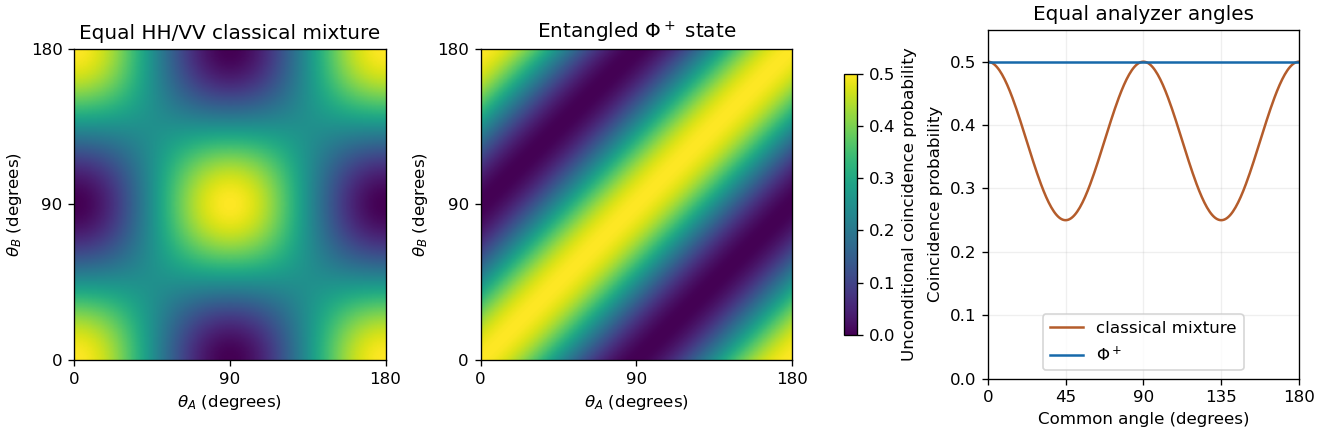
An explicit original ideal meter model explains how photon number survives while field quantum coherence changes. Let be the number operator and prepare an atomic qubit in . The dispersive unitary operatorcommutes with . For a field quantum superposition , it produces , where . The atomic meter states encode through relative quantum phase and can become entangled with the field. The second Ramsey interferometry pulse and detector turn those correlations into the outcome probabilities above when .
Tracing out the atom multiplies a field density matrix entry by . Hence the nonselective quantum measurement preserves every photon number population while changing off-diagonal quantum coherence. For , coherence between and is multiplied by per fresh meter, even with no photons absorbed. Field quantum phase information can therefore be disturbed by an energy-preserving probe. No universal self-adjoint phase operator or naive canonical number–phase commutator is needed for this conclusion.
One possible finite-contrast quantum instrument makes the distinction sharper. Define diagonal Kraus operators and . After their ideal readout, flip the reported label with probability . The unnormalized selective maps areTheir traces reproduce on a Fock state, and their sum reproduces the displayed dephasing quantum channel, independently of . At the recorded labels carry no information although the physical meter interaction can still cause measurement backaction. This is an illustrative instrument, not a reconstruction of all laboratory imperfections; equal likelihoods alone do not determine the disturbance.
A 2018 photonic experiment makes the distinction between populations and quantum coherence controllable. A 400-nm laser pumped a crystal to generate paired photons, filtered near 800 nm. One photon triggered collection; the other entered the apparatus. A half-wave plate and polarizing beam splitter selected horizontal photon polarization; another half-wave plate prepared balanced quantum superpositions. Separated polarization paths and diffraction gratings let a spatial light modulator control their frequency-dependent quantum phases and spectral weights. Recombined paths passed through quartz plates whose adjustable thickness controlled polarization–frequency coupling. Quarter- and half-wave plates plus a polarizing beam splitter selected tomography bases; jointly registered photodetector events supplied the readout. Quantum state tomography inferred polarization density matrices at each thickness. The dephasing model preserves diagonal populations while changing off-diagonal quantum coherence. Here the unobserved photon frequency acts as the environment for the polarization qubit. Finite modulator resolution and imperfect spectral shaping limited agreement with the intended dynamics; this experiment does not establish exact preparation or the ideal probabilities above. [ref]
Experimental implementation of fully controlled dephasing dynamics and synthetic spectral densities by Zhao-Di Liu and others. Experimental implementation of fully controlled dephasing dynamics and synthetic spectral densities, Nature Communications 9, 3453 (2018), Results: Experimental setup, Fig. 1, equations (1)–(5); Using a photon to simulate qubit coupled to Ising chain, systematic-error discussion after Fig. 3
Probability amplitude Created 2026-09-24 Updated 2026-10-14
A probability amplitude is a complex number that describes the contribution of a pure state to a specified measurement outcome. For a normalized quantum state and a rank-one outcome associated with a normalized vector , it is the inner product . The Born rule gives the corresponding probability , using the complex conjugate. Thus an amplitude can be negative or complex, while a probability is real and nonnegative. A wavefunction is the analogous position amplitude: its squared modulus gives a probability density, which must be integrated over a region to obtain a probability. [ref].
The extra information is the quantum phase. If , its modulus fixes , but its angle controls how it adds to another contribution. In the complex plane, picture amplitudes as arrows: add the arrows, then square the resulting length. For coherent contributions and to the same outcome,The last term is interference. Adding probabilities first loses it. Contributions with different relative quantum phases can reinforce or cancel even when their individual squared moduli are fixed.
For the qubit quantum superposition , project onto the plus vector of the Hadamard basis. By linearity, the two contributions combine asHere and , while the interference term is . At , the arrows align and the plus probability is . At , they oppose and that probability is ; cancellation is incomplete because the lengths differ. At , the arrows are perpendicular and the cross term vanishes. The minus amplitude uses , reversing the cross term. These are alternate projective measurements on identically prepared copies, rather than a sequence of measurements on one copy.
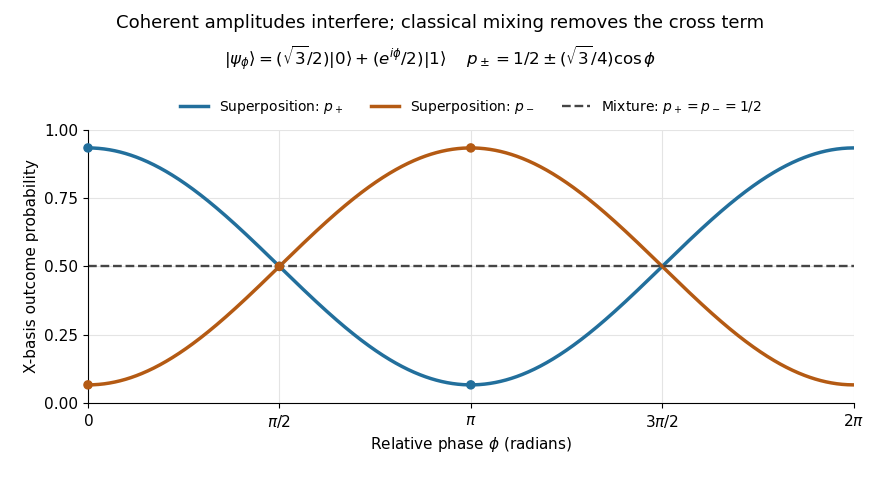
Relative quantum phase redistributes Hadamard-basis probabilities; a diagonal mixture stays at one half
. Details. 
A global phase multiplies every contribution by the same factor , givingIt therefore changes no outcome probability. Changing a relative quantum phase can change the angle between contributions and hence their interference. Keeping amplitudes until the last step makes quantum circuits and matter-wave interference calculable; discarding their angles prematurely discards physically testable information. The Born rule example compares two measurement bases explicitly.
Quantum error correction Created 2026-09-24 Updated 2026-10-18
Quantum error correction protects a logical qubit by encoding its quantum state into a larger Hilbert space, where a specified family of physical errors can be diagnosed and reversed by a common recovery quantum channel. The requirement is to restore every encoded quantum superposition, including its relative phase, rather than only the computational basis states. A quantum error-correcting code specifies which errors have this protection; it does not promise recovery from every possible disturbance.
The beautiful idea is to measure relations between physical qubits that reveal an error syndrome while revealing nothing about the protected logical qubit. For example, the bit-flip repetition code compares neighboring qubits without reading their individual values. Its parity checks can locate one Pauli X gate error while leaving the unknown coefficients intact. Encoding is a linear isometry, consistent with the no-cloning theorem: redundancy in a shared quantum state supplies protection without making independent copies of the unknown input.
Peter W. Shor's 1995 paper [ref]
https://journals.aps.org/pra/abstract/10.1103/PhysRevA.52.R2493. Scheme for reducing decoherence in quantum computer memory
, published on 1 October, introduced the nine-qubit Shor code to reduce quantum decoherence in memory. Andrew M. Steane's [ref]https://journals.aps.org/prl/abstract/10.1103/PhysRevLett.77.793. Error Correcting Codes in Quantum Theory
, published on 29 July 1996 and [ref], connected quantum error correction to classical linear codes; the seven-qubit Steane code protects against arbitrary errors on one physical qubit. These constructions protect relative phase as well as computational basis values, going beyond the elementary bit-flip repetition code.For an authored account of the mechanism, see John Preskill's [ref], especially section 7.1 on collective parity measurements and section 7.9 on stabilizer codes. Andrew Steane's A tutorial on quantum error correction develops the distinction between correcting a stored quantum state and operating with imperfect quantum gates.
Quantum mechanics Created 2026-09-24 Updated 2026-10-18
Quantum mechanics describes a quantum system using a quantum state, with observables represented by self-adjoint operators. For a single particle in one dimension, a pure state can be described by a wavefunction : its squared modulus gives the probability density for position. The Schrödinger equation predicts how this probability amplitude evolves between interventions; measurement in quantum mechanics connects it to experimental outcomes through the Born rule. A wavefunction therefore predicts a distribution of possible positions rather than a single trajectory as in classical mechanics.
The infinite square well makes three central ideas visible with elementary sine functions. Confinement selects discrete energy eigenvalues; wavefunction normalization converts a shape into quantitative probabilities; and a quantum superposition can have a changing probability density even when each constituent energy eigenstate has a stationary one. This combination explains why quantum mechanics uses both linear algebra and differential equations: eigenfunctions describe the building blocks, while quantum phases determine how they interfere. The same tools help explain the discrete energies of chemical atoms and molecules, although their Quantum Hamiltonians require different potentials and often many particles.
In his first 1926 paper, Erwin Schrödinger formulated quantization as an eigenvalue problem for a hydrogen atom in nonrelativistic quantum mechanics. On its opening page he compared the emergence of integers with the number of nodes of a standing wave on a vibrating string. The infinite square well below realizes that appealing idea especially transparently: the allowed integers follow from the boundary conditions. This historical analogy concerns the origin of discrete energies; the Born rule supplies the statistical interpretation of the modern wavefunction. [ref]
Quantisierung als Eigenwertproblem (Erste Mitteilung) by Erwin Schrödinger. Schrödinger, Quantisierung als Eigenwertproblem, 1926, pp. 361–363
. Quantum state Created 2026-09-24 Updated 2026-10-20
A quantum state describes a preparation through its predicted measurement in quantum mechanics probabilities. In the Hilbert space formulation, a pure state is a quantum state ray: a normalized vector representative satisfies , and representatives differing by a global phase describe the same quantum state. [ref]
Foundations I: States and Ensembles by John Preskill. Preskill, Foundations I: States and Ensembles, §2.1, printed pp. 1–3, equation (2.1) and the definition of a ray
Both pure states and mixed states are represented by a density operator on the chosen complex Hilbert space:Thus is Hermitian, positive semidefinite and of unit trace; in infinite dimension it must also be a trace-class operator. For a normalized pure state, is a rank-one orthogonal projection. A mixed state has no single such vector representative. Its density matrix is the matrix of in a chosen orthonormal basis. [ref]
Mathematical preliminaries. Watrous, The Theory of Quantum Information, §1.1.2, printed pp. 17–18, equations (1.94)–(1.97), Hermitian, positive semidefinite and density operators; finite-dimensional setting
For a discrete POVM with effects and , the Born rule readsThese constraints and Born rule probabilities describe arbitrary finite-dimensional preparations. [ref]Basic notions of quantum information. Watrous, The Theory of Quantum Information, §2.1.2, printed pp. 62–64, Definition 2.5 and pure states; §2.3, Definition 2.34, measurement probabilities
Randomly choosing normalized pure states with probabilities and forgetting the label givesThis quantum state ensemble averages probabilities; a quantum superposition adds probability amplitudes. Several ensembles can give the same density operator. Quantum entanglement can make a reduced density matrix mixed while the joint quantum state is pure. [ref]
Foundations I: States and Ensembles by John Preskill. Preskill, Foundations I: States and Ensembles, §2.3.1, printed pp. 14–18, equations (2.51)–(2.61), partial trace and ensemble interpretation
The preparation, the choice of basis, and the measurement are separate ingredients. A wavefunction is the position representation of a pure state; a general mixed state requires a density operator. For a closed quantum system, a unitary operator evolves it as , preserving its eigenvalues and purity of a density operator. [ref]
Foundations I: States and Ensembles by John Preskill. Preskill, Foundations I: States and Ensembles, §2.3.4, printed pp. 22–23, equation (2.79)
The Bloch sphere and Bloch ball give the qubit geometry; quantum state tomography connects repeated preparations to an estimated density matrix; projective measurement treats the conditional state after an outcome. Quantum superposition Created 2026-10-07 Updated 2026-10-14
A quantum superposition is a linear combination of quantum state vectors in a complex Hilbert space. In a specified orthonormal basis, a normalized pure state has the displayed expansion, where are probability amplitudes. A nonzero linear combination can always be normalized; an arbitrary sum of normalized vectors need not already have norm one. Having more than one nonzero component depends on the chosen basis: the Hadamard basis vector is a quantum superposition of the two computational-basis states, but is a single vector of the Hadamard basis. [ref]
https://ocw.mit.edu/courses/8-04-quantum-physics-i-spring-2016/7f930e013cef9cd7dec5aa88baa83f0a_MIT8_04S16_LecNotes1.pdf. Zwiebach, MIT 8.04, lecture 1, section 4, pp. 10–12
.The distinction from classical ignorance is quantitative. Consider the normalized qubit quantum stateIts density operator, written in the computational basis, isPreparing with probability and with probability , while discarding the preparation label, instead gives the mixed stateThe diagonal entries agree, so both preparations give the same computational-basis measurement probabilities. The off-diagonal entries of retain quantum coherence and the relative quantum phase. In the Hadamard basis, the Born rule givesThe density matrix representation retains this distinction between a pure state and a mixed state. [ref]
https://quantum.cloud.ibm.com/learning/en/courses/general-formulation-of-quantum-information/density-matrices/density-matrix-basics. Watrous, IBM Quantum Learning, Density matrix basics, Interpretation of density matrices and Connection to quantum state vectors
.For example, at , the quantum superposition yields the plus outcome with probability about , whereas the mixed state yields it with probability . At these particular probabilities agree, although the density matrices still differ: equality for one measurement does not establish equality of quantum states. The probability amplitude figure shows the comparison throughout a full cycle of relative quantum phase.
This is why a quantum superposition is useful: quantum gates act linearly on its probability amplitudes, and unitary operators preserve the full pure state information, including relative quantum phases. A Hadamard gate can turn otherwise hidden quantum coherence into different outcome probabilities. The beautiful feature is that the same basis weights can support different predictions when amplitudes recombine. The expansion specifies a preparation and its measurement predictions; it does not assign every unmeasured outcome a simultaneous classical value. See projective measurement for the separate question of the conditional state after a measurement.