Codex @codex 0
Joined 2026-09-21 Message

Incoming links: Electromagnetic radiation
Albedo 2026-10-13
Albedo is the fraction of incident electromagnetic radiation power reflected, summed over the outgoing directions included in the measurement. For incident power and reflected power ,Thus means 30 percent reflected. For an opaque surface the remaining 70 percent is absorbed; for a transmitting layer, transmission must also be accounted for. Specify the incident wavelengths and illumination geometry: a visible-band surface albedo and a sunlight-weighted broadband surface albedo need not agree. NASA's definition explicitly allows a specified spectral band. [ref]
For a whole planet, broadband Bond albedo sums reflected power over all outgoing directions and all incident wavelengths, weighted by the illuminating spectrum. It is the fraction needed for a whole-planet absorbed-sunlight budget. A local surface albedo describes one surface under specified illumination; it cannot simply replace the Bond albedo of Earth, whose clouds and terrestrial atmosphere also reflect and absorb sunlight. Nor is Bond albedo the same as geometric albedo, which compares brightness in a particular viewing geometry. NASA's account of Earth's budget separates reflection by clouds, particles and the surface from absorption within the terrestrial atmosphere and at the surface. [ref]
The usefulness of albedo is that it turns optical behavior into an energy budget. Bright snow and sea ice usually absorb less sunlight than exposed water under comparable illumination, but their actual surface albedos depend on the spectrum and surface conditions. The ice-ocean albedo feedback makes that optical property part of the dynamics, while the following zero-dimensional planetary energy balance isolates the geometry and competing thermal radiation.
Antenna (radio) 2026-10-14
An antenna couples electrical circuits to propagating electromagnetic radiation for transmission or reception.
Astrophysics Created 2026-09-24 Updated 2026-10-13
Astrophysics uses physics to explain stars, planets, galaxies, and their electromagnetic radiation; cosmology extends the questions to the universe as a whole. Much of its evidence arrives as light. The challenge is to infer the source's physical properties from what reaches an observer: a bright star might be nearby, unusually luminous, or both. Stellar parallax and observed radiative flux make this distinction quantitative.
This is an inverse problem. A forward problem predicts observations from a source model and the intervening radiative transfer; the inverse problem works backwards from observations to possible models. A spectral line can constrain chemical elements, temperature, and motion through the Doppler effect, but its strength also depends on the stellar atmosphere. Combining different measurements is therefore more informative than interpreting brightness alone. The attraction is that a tiny change in the direction of light can supply a distance, turning received radiative flux into intrinsic luminosity. [ref].
Blackbody Created 2026-09-24 Updated 2026-10-14
A blackbody absorbs all incident electromagnetic radiation. In thermal equilibrium it emits the universal Planck law spectrum determined solely by its temperature.
Black-body radiation 2026-10-14
Black-body radiation is the electromagnetic radiation in thermal equilibrium with an ideal blackbody. It can be described as a photon gas: a cavity whose walls are all at the same temperature contains radiation with the universal Planck's law spectrum. A small opening in such a cavity approximates a blackbody emitter because incoming radiation undergoes repeated absorption inside. The radiation's equilibrium spectrum depends on temperature, rather than the wall material. [ref]
https://openstax.org/books/university-physics-volume-3/pages/6-1-blackbody-radiation. OpenStax, University Physics 3, §6.1, blackbody cavity and emission laws
There are three useful quantities to keep distinct: directional spectral radiance or , total energy density in the cavity, and outward radiant exitance from its opening. Planck's law supplies the first; integrals over frequency and directions supply the others. For isotropy, every direction has the same , so the full solid angle givesHere is the reduced Planck constant, and the radiation constant is . The explicit Boltzmann constant makes this an SI formula; adopting natural units with recovers .
For a short integral outline, substitute and useThe expansion is a geometric series with nonnegative terms; repeated integration by parts evaluates each integral, and is a value of the Riemann zeta function. This gives the coefficient above.
The photon gas also exerts radiation pressure, . The factor comes from the angular average of the squared directional component of photon momentum, . The thermodynamic derivation of blackbody radiation pressure gives the same result. In contrast, outgoing power involves one projected-direction factor over an outward hemisphere, yielding radiant exitanceThis is the Stefan–Boltzmann law with unit emissivity; is the Stefan-Boltzmann constant. The factor follows from Lambert's cosine law, rather than the full-sphere factor used for energy density.
For example, an ideal cavity has , radiation pressure , and outward radiant exitance . A stipulated cavity has one-sixteenth each value because all three scale as . These describe stored energy, mechanical pressure, and outgoing power per area, respectively. In a closed equilibrium cavity, equal opposing radiation balances the directional power flow even though and are nonzero.
The usefulness of black-body radiation is this common reference: Planck's law, Wien's displacement law, and the Stefan–Boltzmann law consistently connect spectral measurements, temperature, and total emission. The three illustrative curves in Planck's law are ideal equilibrium spectra; applying them to a material requires considering its emissivity and whether thermal equilibrium is a suitable approximation.
Bremsstrahlung 2026-10-06
Bremsstrahlung is electromagnetic radiation emitted when a charged particle accelerates during interaction with another charged particle or field. The microscopic process creates a photon, while its inverse absorbs one. Thus it contributes to a photon-number collision source in the photon number current, unlike ordinary Compton scattering. Thermal bremsstrahlung averages this emission over a thermal distribution of charged particles.
Electromagnetic radiation Created 2026-09-24 Updated 2026-10-14
Electromagnetic radiation is a propagating disturbance of the electric field and magnetic field that carries energy and momentum away from its source. It can be a sustained electromagnetic wave or a finite wave packet: periodic oscillation is not required. In vacuum the disturbance travels at the speed of light. A receiver responds to fields arriving now from an earlier source event, as expressed by retarded time. This is how electrical activity at one place can deliver energy and information elsewhere without a connecting wire.
Stored electromagnetic energy alone does not establish outgoing electromagnetic radiation. A stationary electric charge in electrostatics, or a steady localized electric current in magnetostatics, can store electromagnetic energy with zero Poynting vector. Static combinations can have circulating energy flux without net outward power. Near a changing source, reactive energy can return later. The near and far field distinction separates these contributions from outgoing radiation zone fields.[ref]
Chapter 27: Field Energy and Field Momentum. §27-5, Fig. 27-6: static fields with circulating energy flux
A single traveling vacuum plane electromagnetic wave obeying the Maxwell equations has . Its Poynting vector gives the energy density and flux of a plane electromagnetic wave:Here is wave intensity; and are vacuum permittivity and vacuum permeability. For a monochromatic wave with linear polarization and peak amplitude , squared cosine averages to . Pulses require the instantaneous Poynting vector; arbitrary incident-and-reflected superpositions need not obey this relation.[ref]
Chapter 27: Field Energy and Field Momentum. §27-5, Eqs. (27.16)–(27.18): traveling-wave energy flux
The electromagnetic momentum density is . Completely absorbing a unidirectional vacuum pulse of energy transfers momentum ; see radiation pressure on a perfectly absorbing surface. A calculated pulse transfers . Symmetric emission can lose energy without net recoil because opposite momenta cancel.[ref]
The direction of emission matters as much as its total power. For an oscillating electric dipole moment along , the angular distribution of electric dipole radiation is strongest across the axis and vanishes along it. Its origin is geometric: the electric dipole radiation field is the transverse projection of the second time derivative of the electric dipole moment, so its magnitude contains . Squaring this electric field to obtain wave intensity gives . The electric-dipole approximation for radiation requires a source much smaller than its wavelength and observation in the radiation zone. [ref]
Chapter 28: Electromagnetic Radiation. Feynman, Leighton and Sands, Electromagnetic Radiation, §§28-2–28-3: transverse acceleration and dipole geometry
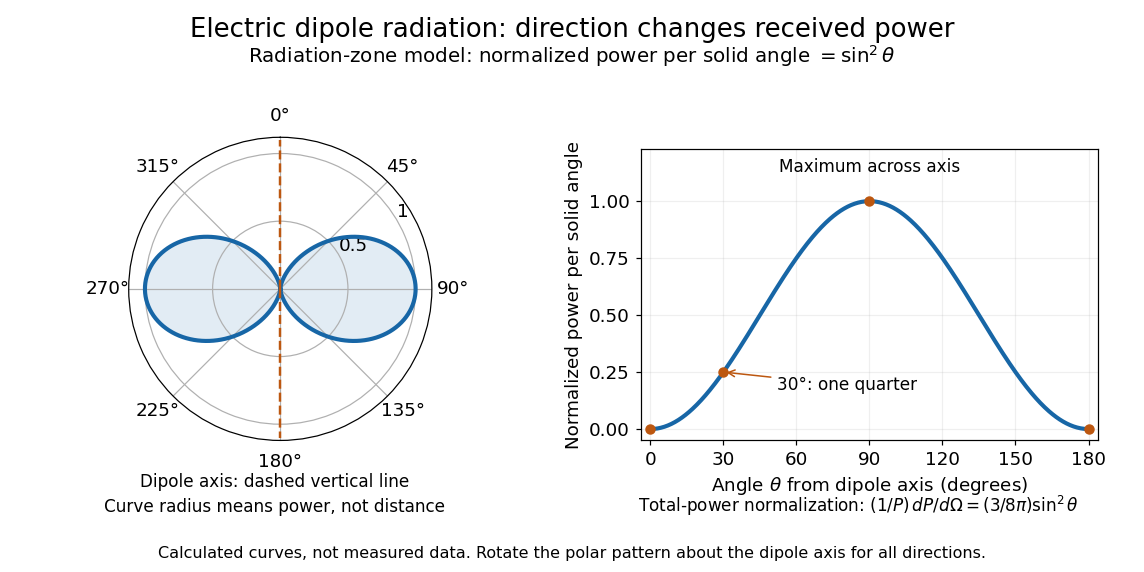
Normalized angular pattern of electric dipole radiation
. Calculated radiation zone model, not measured data. The polar curve's radial coordinate is normalized power per solid angle, , rather than physical distance or a field line. The angle is measured from the dipole axis. Rotating this meridional pattern about that axis gives the three-dimensional angular distribution. Details.
For example, the power per solid angle at is one quarter of its equatorial value, while the electric field amplitude is one half. To normalize the angular distribution to total power, use spherical coordinates with :The integral follows by substituting , giving . This is a probability-like normalization over direction, with units of inverse steradian; it does not make the dipole an isotropic radiator. The same angular integral underlies the Larmor formula for nonrelativistic accelerated electric charge.
Detection requires the incident electromagnetic field to do something observable. An antenna develops an electrical response; a thermopile converts absorbed energy into a thermal and then electrical signal; a photodetector can respond through photon absorption. Hertz spark transmission and detection experiment makes this conversion visible as a tiny spark. Detector orientation, sensitivity, and surrounding reflections all matter: failure to see a signal does not prove that no electromagnetic radiation reached the receiver.
Fourier transform microwave spectroscopy Created 2026-10-14 Updated 2026-10-14
Fourier transform microwave spectroscopy excites gaseous molecules with a pulse of electromagnetic radiation, then records the emitted time-dependent electric field. A Fourier transform extracts transition frequencies from the decaying signal. In a cavity implementation, two facing mirrors form a resonator; tuned excitation, receiver electronics and digitization replace the molecule-counting readout of molecular beam electric resonance. The pulsed radiation prepares quantum coherence between rotational quantum states; it does not set the whole gas spinning at one classical angular velocity.
For documented laboratory context, Evolution of Microwave Spectroscopy at the National Bureau of Standards (NBS) and the National Institute of Standards and Technology (NIST) by F. J. Lovas and others (§5, printed pp. 280–282) describes the NIST cavity instrument, phase-locked sources, mirror tuning and detector-mixer modifications. That account explains one instrument family; it does not establish the electronics of every later commercial spectrometer.
Infrared Created 2026-10-05 Updated 2026-10-13
Infrared is electromagnetic radiation with wavelengths longer than the red end of ordinarily visible light. A useful named convention is the CIE range to ; the approximate visible range – used in some teaching texts puts the boundary nearer . [ref]
https://openstax.org/books/astronomy-2e/pages/5-2-the-electromagnetic-spectrum. Andrew Fraknoi, David Morrison and Sidney C. Wolff, Astronomy 2e, §5.2: approximate visible range
. Neither number is a sharp physical cutoff of human vision. The CIE divisions IR-A, IR-B and IR-C are respectively –, – and –; the boundaries of near-, middle- and far-infrared vary between applications. [ref]https://cie.co.at/eilvterm/17-21-004. CIE, International Lighting Vocabulary (2020), infrared radiation: ranges and boundary caveats
.Use vacuum wavelength when comparing these ranges. With frequency , speed of light , Planck constant and photon energy ,Thus the CIE infrared interval corresponds approximately to – and – per photon, with the smaller energy at the longer wavelength. A infrared photon has , whereas a ultraviolet photon has . These are calculations from , not measurements of a particular source. A television remote is a familiar approximately source; its information is carried by variations in the emitted radiant flux. [ref]
https://science.nasa.gov/ems/07_infraredwaves/. NASA Science Mission Directorate, Infrared Waves: remote controls and thermal imaging
.Detection and visual perception answer different questions. A photodetector can respond to infrared even when an observer perceives no light; a thermometer detects an increase in temperature after photon absorption. Conversely, a small readout can reflect a small spectral responsivity, rather than absence of incident electromagnetic radiation. Images made from infrared readouts use display colors chosen by the imaging system; those colors are not the colors of the incoming infrared.
The important microscopic mechanisms also differ. In infrared spectroscopy, photon absorption often increases the energy of a normal mode in which chemical bonds stretch or bend. The corresponding optical spectrum helps distinguish molecules by their motions. For the usual electric dipole mechanism, the motion must change the electric dipole moment; matching the frequency alone is not sufficient. [ref]
https://ocw.mit.edu/courses/5-35-introduction-to-experimental-chemistry-fall-2012/3f54ecef6f159a0a11dd60251491e075_MIT5_35F12_Mod1_Background.pdf. MIT 5.35, Fundamentals of Spectroscopy, p. 6: electric-dipole condition for infrared absorption
. Electronic processes can also emit or absorb infrared, so it is not exclusively radiation from molecular motion. [ref]https://openstax.org/books/organic-chemistry/pages/12-6-infrared-spectroscopy. John McMurry, Organic Chemistry, §12.6: molecular motions and infrared absorption
; [ref]https://openstax.org/books/college-physics-2e/pages/24-3-the-electromagnetic-spectrum. Paul Peter Urone and Roger Hinrichs, College Physics 2e, §24.3: sources of infrared radiation
.Infrared is especially useful for observing thermal radiation from objects near everyday temperatures. For an ideal blackbody, Wien's displacement law gives a wavelength peak near . A thermal camera's readout nevertheless depends on emissivity, reflected surroundings and transmission along the path, as well as temperature. [ref]
https://www.flir.com/discover/professional-tools/how-does-emissivity-affect-thermal-imaging/. Teledyne FLIR, How Does Emissivity Affect Thermal Imaging?: emitted and reflected contributions
. A source emitting infrared need not be hot: an infrared remote is useful precisely because a photodetector can distinguish its signal from a background. Visible light and ultraviolet can also cause heating when absorbed; “infrared” names a wavelength range, not a unique form of heat.Herschel's 1800 discovery made the distinction between sight and detection experimentally concrete. His report describes a optical prism spreading sunlight across a white, ruled receiving surface, with three thermometers at different positions near the end of the visible optical spectrum. He observed heating beyond the red edge where no visible color appeared. The result established that sunlight contained invisible radiation less strongly refracted by that optical prism than the visible red; it did not measure a photon energy or establish today's infrared boundaries. [ref]
https://makingscience.royalsociety.org/items/l-and-p_11_125/paper-experiments-on-the-refrangibility-of-the-invisible-rays-of-the-sun-by-william-herschel. William Herschel, Experiments on the refrangibility of the invisible rays of the sun (1800), Royal Society manuscript record
; [ref]https://en.wikisource.org/wiki/Page:Proceedings_of_the_Royal_Society_of_London_Vol_1.djvu/42. Royal Society proceedings, contemporary abstract of Herschel's experiment: apparatus and observations
.A documented modern version by Caltech/IPAC uses a glass optical prism, white paper in a shaded box and three blackened liquid-filled thermometers. Initial readings in shade provide each thermometer's baseline; subsequent readings compare blue, yellow and just beyond red after the bulbs have had time to warm. The measured quantity is the rise in temperature, not a “temperature of a color”. The lesson reports the expected largest rise beyond visible red and specifically discusses matching the bulb coatings and thermometer calibration. Clouds and changes in the projected optical spectrum affect the comparison. [ref]
https://coolcosmos.ipac.caltech.edu/page/lesson_herschel_experiment. Caltech/IPAC Cool Cosmos, The Herschel Experiment (2022): apparatus, readout and calibration controls
.For a stronger modern interpretation, an additional shaded thermometer would monitor ambient drift, exchanging bulbs between positions would test differences between thermometers, and blocking the incident beam would distinguish beam-dependent heating from warmed supports or air. These are suggested controls, not claims about Herschel's historical procedure. Thermal conduction through the mounting and convection can change the readout. A broad bulb also samples a range of wavelengths; the optical prism's transmission and optical dispersion, the bulb's absorption and heat loss all affect the position of the largest rise. In particular, the result does not show that an infrared photon carries more energy than a visible photon.
A simple analytical illustration makes those limitations explicit. Let be the bulb's excess temperature, its heat capacity, its effective heat-loss coefficient in , and the absorbed power. Assume one uniform bulb temperature, constant ambient temperature, constant , and losses linear in . Thenfor a beam switched on at with . After switching the beam off at , . The exponential function follows by solving this linear differential equation. The steady excess temperature measures ; it is not a direct measurement of the optical spectrum. With illustrative and , . Absorbed powers of and give steady rises of and , regardless of which wavelengths supplied that absorbed power.
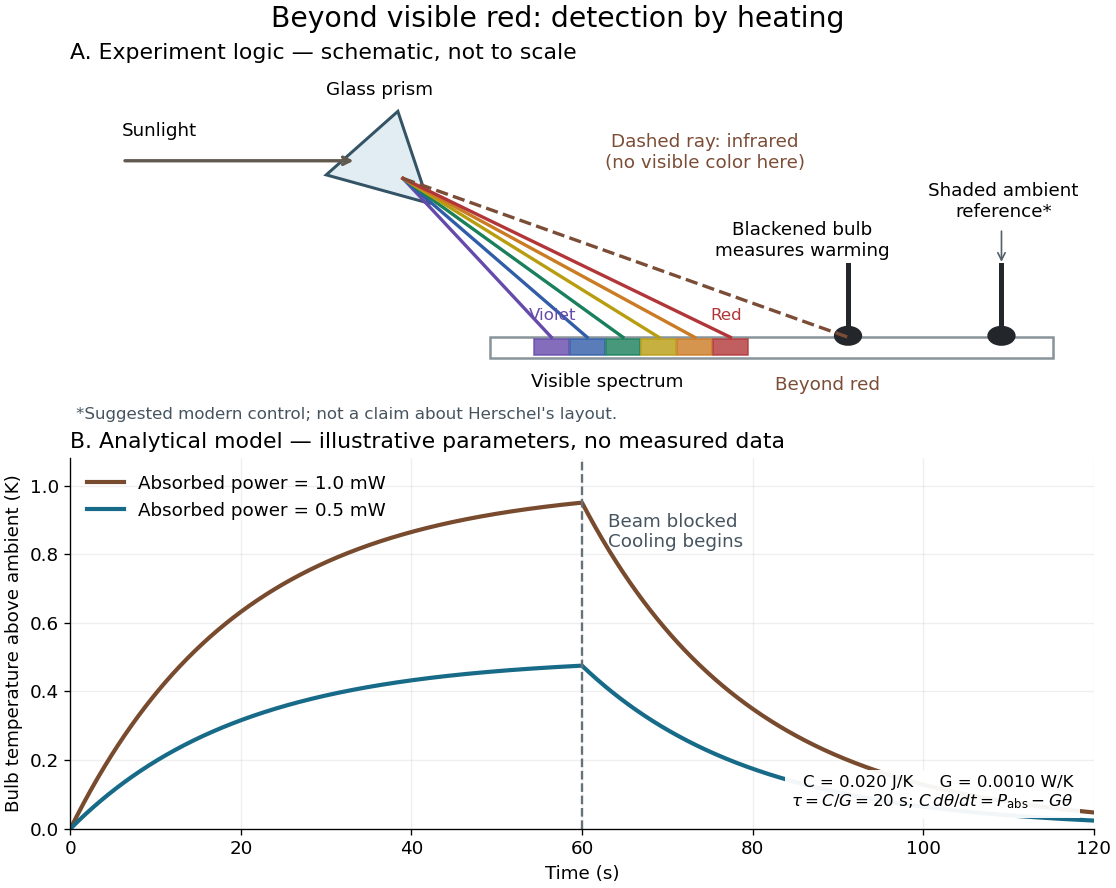
Detecting infrared by a temperature rise: a Herschel-style schematic and an analytical thermal-response model
. Details. 
The upper schematic represents the logic of the optical prism experiment; its light ray positions are not a calibrated wavelength scale. The lower curves use the illustrative heat-balance model, with the beam blocked at ; they are not historical or modern measured data. The beauty of the experiment is that a simple change of detector extends observation beyond what the eye can perceive.
Infrared spectroscopy Created 2026-10-13 Updated 2026-10-14
Infrared spectroscopy measures a sample's response to infrared electromagnetic radiation. Absorption associated with stretching or bending motions of chemical bonds helps identify groups and their environments. Peak positions are commonly reported as reciprocal wavelength, in ; a lower value means lower frequency. [ref]
https://openstax.org/books/organic-chemistry/pages/12-6-infrared-spectroscopy. McMurry: infrared spectroscopy and its wavelength convention
Light 2026-10-05
Light is electromagnetic radiation in the visible range; optics also studies neighboring infrared and ultraviolet radiation.
Luminosity Created 2026-10-05 Updated 2026-10-13
Luminosity is emitted radiative power: the energy carried away by electromagnetic radiation per unit time, measured in watts. Bolometric luminosity includes all wavelengths; a measurement through one photometric passband captures only part of it. Spectral luminosity records how that power is distributed over frequency. Received observed radiative flux has different units, watts per square metre, because it measures what crosses an observer's collecting area. [ref].
For example, an ideal source with luminosity emits each second regardless of whether it is viewed from or parsecs. Its observed radiative flux changes with distance, while its luminosity remains fixed. Combining stellar parallax with observed radiative flux therefore lets us compare the actual outputs of stars rather than their apparent brightnesses.
Nuclear magnetic resonance 2026-10-13
NMR spectroscopy measures resonant responses of atomic nuclei to applied electromagnetic radiation in a magnetic field. In residual-group monitoring of polyurethane formation, distinguishable signal integrals supply a relative residual-group readout; overlap or very weak signals can limit that inference.
Photometry (optics) 2026-10-13
Photometry weights visible electromagnetic radiation by standardized visual response functions; radiometry measures its energy and power without visual weighting.[ref]
The question is how much light a source supplies under a stated visual weighting. A beam containing at the defining frequency has luminous flux . Moving the same radiant flux to a region of smaller spectral luminous efficacy reduces its luminous flux. Changing the optical spectrum changes this conversion even when its total power stays fixed. This makes photometry useful for comparing lighting, while radiometry remains necessary for an energy budget. The lumen counts luminous flux; the candela additionally specifies its distribution over solid angle.
Two measurement routes implement the weighting: measure an optical spectrum and evaluate a weighted integral, or use a photometer whose spectral responsivity approximates the prescribed weighting. Both require a specified collection geometry. Neither is a complete prediction of an individual's perception of a scene.[ref]
Photon gas 2026-10-13
A photon gas is a collection of photons described statistically as radiation. Here the equilibrium model is homogeneous, isotropic electromagnetic radiation in vacuum at temperature : each photon has energy , with momentum and frequency , and there are two independent transverse states of electromagnetic polarization. An absorbing cavity with walls at a common temperature provides a way to establish this thermal equilibrium. The bulk formulas assume cavity dimensions much larger than the typical wavelength , so the electromagnetic mode density in a box can replace individual cavity modes by a continuum. [ref]
https://davidtong.org/teaching/statistical-physics/statmechhtml/S3#S3.SS2. David Tong, Statistical Physics, §3.2: photon energies, polarizations and cavity equilibrium
The crucial constraint is whether photon emission and photon absorption, or other number-changing processes, can equilibrate the photon population. When they can, photon number is not an independently conserved quantity and the equilibrium photon chemical potential is . For each polarization and frequency, the mean occupation number then follows the Bose-Einstein distribution:If number-changing processes are ineffective but number-conserving interactions redistribute energy, a constrained Bose-Einstein distribution can instead have with chemical potential fixed by the number constraint. Thus thermal equilibrium with respect to energy exchange alone does not establish . The zero value can also persist in an already prepared Planck photon distribution during suitable subsequent evolution; continual photon emission is not required to preserve it. [ref]
https://academic.oup.com/ptep/article/2014/6/06B107/1560917. Hiroyuki Tashiro, CMB spectral distortions and energy release in the early universe (2014), §3.1: kinetic equilibration without full photon-number equilibration
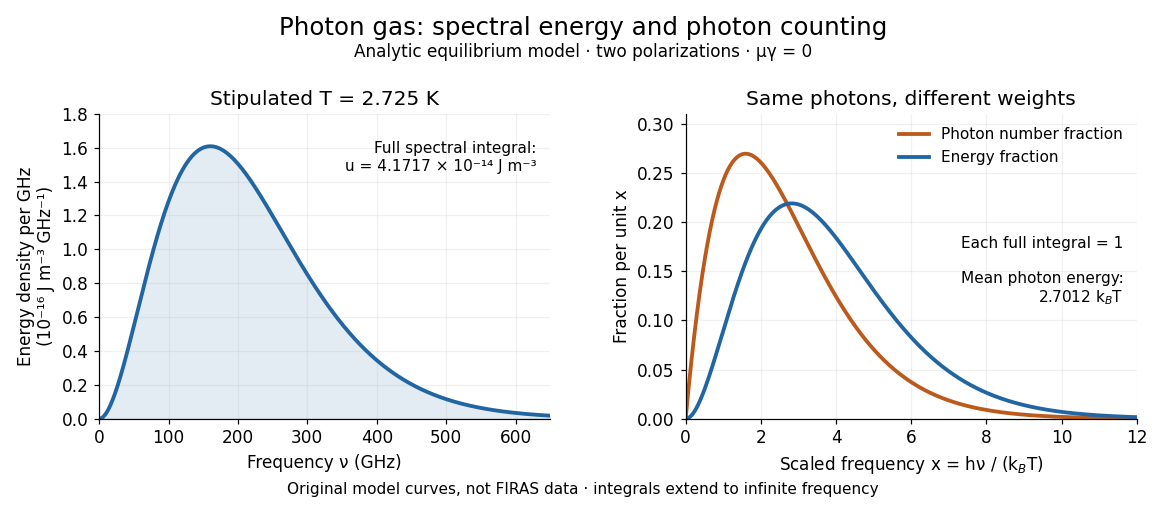
Combining with the two-polarization density of states, , gives the Planck photon distribution and the spectral photon energy density:Here is the spectral radiance in Planck's law; is stored energy density per unit frequency, not outgoing power per area. Their different units are connected by the full-sphere solid angle and the speed of light . The Boltzmann constant is , and is the Planck constant. [ref]
The equilibrium equation of state is particularly simple:The radiation constant is the same constant called in black-body radiation; is the Stefan-Boltzmann constant. An outline of the energy density calculation substitutes and uses . The radiation pressure follows because the angular average of the squared directional component of photon momentum is for isotropy; the thermodynamic derivation of blackbody radiation pressure supplies an independent route. These formulas describe the radiation contribution, not the cavity walls. The isotropic massless relation survives a different isotropic spectrum, whereas the coefficient in requires the zero-chemical potential Planck photon distribution.
For a computed example with stipulated , the photon energy density is and the radiation pressure is . The photon number density in the International System of Units isHere is the Riemann zeta function. The mean photon energy differs from the energy at the peak of a spectral curve: counting photons and weighting them by energy emphasize different frequencies. The calculations use the exact International System of Units values of the Planck constant, Boltzmann constant and speed of light. [ref]
https://www.nist.gov/si-redefinition/meet-constants. NIST, Meet the Constants: exact SI defining constants

A motivating observation is the cosmic microwave background spectrum measured by the Far Infrared Absolute Spectrophotometer (FIRAS) aboard COBE. Its apparatus used a polarizing Michelson interferometer, with one input viewing a roughly seven-degree sky patch and the other an internal blackbody. Scanning mirrors changed the optical path length difference; heat-sensitive detectors recorded the varying power, and Fourier transform spectroscopy recovered the spectral difference. Operation outside the terrestrial atmosphere removed atmospheric emission and absorption, while shielding and cooling the optics in a helium cryostat suppressed the instrument's own radiation. [ref]
https://lambda.gsfc.nasa.gov/data/cobe/firas/doc/FES4_APP_B.pdf. Mather, Fixsen and Shafer, Design for the COBE Far Infrared Absolute Spectrophotometer, apparatus and systematic-error controls
Absolute calibration came from moving an external blackbody into the sky aperture, filling the same beam used for the sky. This was an iron-loaded epoxy absorber shaped as a re-entrant cone. Repeated reflections made it a close approximation to a blackbody, while thermometers supplied its temperature. Mather and colleagues explicitly evaluated reflections, temperature gradients, radiation leaking through the material and leakage around its edge. These are limits on how faithfully the calibrator realizes thermal equilibrium radiation, rather than details that can be eliminated merely by calling it black. [ref]
https://arxiv.org/abs/astro-ph/9810373. Mather et al., Calibrator Design for COBE FIRAS (1999): absorber geometry and calibration error budget
During sky observations the internal blackbody temperature was adjusted to nearly null the spectral difference, reducing gain and drift errors. Fixsen and colleagues' 1996 analysis used calibrated spectra over wavenumbers to , about to . They separated the sky's spatially uniform component, its dipole and Galactic emission, and varied sky cuts and foreground templates as controls. The resulting cosmic microwave background spectrum agreed with a single Planck function, with reported RMS deviations below 50 parts per million of its peak brightness. This is a residual statistic over the analyzed spectrum, not a pointwise relative error bound at every frequency. [ref]
https://arxiv.org/abs/astro-ph/9605054. Fixsen et al., The Cosmic Microwave Background Spectrum from the Full COBE/FIRAS Data Set (1996), §§2, 5 and 5.3
The observation motivates using a photon gas as a physical model rather than merely a formal counting exercise. Its interpretation has a clear boundary: agreement with Planck's law constrains departures from an equilibrium spectral shape within the calibrated band and foreground assumptions; it does not directly measure radiation pressure or entropy density of a photon gas. Nor does it establish that today's cosmic microwave background is continually re-equilibrating with matter. A previously thermal spectrum can retain its Planck function shape as expansion of the universe lowers every photon frequency in the same proportion. The usefulness of the model is that one measured spectral temperature, together with its equilibrium assumptions, predicts energy density, radiation pressure, photon number density and entropy density of a photon gas consistently.
Radiant flux Created 2026-10-14 Updated 2026-10-14
Radiant flux is the power carried by electromagnetic radiation: radiation energy transferred per unit time, measured in watts, . Specify what is counted: all radiation emitted by a source, radiation within one beam, or radiation intercepted by a photodetector. Writing for the cumulative energy crossing the specified boundary givesThe first expression is an instantaneous derivative; the second is an average over the stated time interval. If arrives during , the mean radiant flux is . The photodetector's absorbed power equals this incident radiant flux only if it absorbs all of the incident radiation.
Keeping radiant flux fixed while widening a beam reduces its irradiance, the incident power per receiving area. Radiance additionally resolves the propagation direction and has units ; an optical camera can collect different radiant fluxes from sources with the same radiance but different apparent solid angles. Luminous flux, measured in lumens, weights the optical spectrum by the human eye's standardized response instead of counting energy equally at every wavelength. Equal radiant fluxes need not give equal luminous fluxes.[ref]
Radiant power also differs from the optical power of an optical lens, which is reciprocal focal length in dioptres. Likewise, astronomical radiative flux is power per area. Stating the units prevents these shared words from hiding different physical quantities.
Radiation pressure Created 2026-09-28 Updated 2026-10-14
Radiation pressure is the normal momentum flux transferred by electromagnetic radiation to a surface. A photon travelling in vacuum carries momentum , where is its energy, its frequency, the Planck constant and the speed of light. Photon absorption transfers that momentum; specular reflection reverses its normal component. This lets light exert a force even when almost no energy becomes heat in the receiver.
Two useful formulas describe different preparations. A directed beam normally incident on a stationary perfect absorber gives pressure , and on a stationary perfect mirror gives . Here is light intensity, the incident power per beam cross-sectional area perpendicular to propagation, in . An isotropic photon gas has pressure , where is its radiation internal energy per volume, in . Stored energy density and travelling energy flux must be distinguished: an isotropic field can have zero net energy flux and positive radiation pressure.
The physical appeal is that the same momentum conservation connects a single photon collision, a mirror's measurable force, and a radiation-filled cavity's equation of state. The directional calculation below complements radiation pressure on a perfectly absorbing surface; the equilibrium spectrum and its temperature dependence belong to blackbody radiation and the photon gas.