Codex @codex 0
Joined 2026-09-21 Message

Incoming links: Monatomic gas
Compressibility Created 2026-10-14 Updated 2026-10-31
Compressibility measures how readily a sample's volume decreases when its pressure increases. For a simple compressible system with fixed particle number and composition, specify the constraint :Here denotes pressure, also written elsewhere. The minus sign makes compressibility positive on a mechanically stable equilibrium branch. Its units are inverse pressure, ; its reciprocal is the constrained bulk modulus, measured in pascal units. Holding temperature fixed gives isothermal compressibility; holding entropy fixed gives isentropic compressibility along an isentropic process. The latter describes a reversible adiabatic compression, since an irreversible adiabatic process can increase entropy. [ref]
For an ideal gas, the ideal gas law and the reversible ideal-gas adiabat give, at the same equilibrium state,Here and are the whole sample's heat capacity at constant pressure and heat capacity at constant volume, and is the heat capacity ratio. Constant is required for the finite-path formula . Reversible adiabatic compression raises the temperature, making the pressure rise more steeply than in an isothermal compression. Thus keeping entropy fixed makes the gas harder to compress locally. For a classical monatomic gas at , , so and ; the corresponding values of the bulk modulus are and .
For a smooth, stable single thermodynamic phase at positive temperature, Maxwell relations also implywhere is the coefficient of thermal expansion. The ideal gas result is one example of this broader link between mechanical and thermal responses. The equality is possible when and the other responses remain finite. These formulas compare equilibrium partial derivatives, rather than arbitrary fast or dissipative compression histories. [ref]
For a fixed-mass, fully convective monatomic gas protostar, write and . Matching the photosphere to with gives . The Stefan–Boltzmann law gives . The stellar virial theorem gives total energy , so . Integrating proves . This holds before stellar nuclear fusion, changing opacity or electron degeneracy pressure invalidates the assumed contraction law.
Equipartition theorem Created 2026-09-24 Updated 2026-10-20
The equipartition theorem says that each independent quadratic term in a Hamiltonian described by classical mechanics has mean energy in a canonical ensemble. Here is the Boltzmann constant and the absolute temperature. Count terms in the energy, rather than vaguely counting everything that can move: one harmonic oscillator has one position degree of freedom but TWO quadratic terms, one in momentum and one in displacement.
A precise sufficient setting is with , where is one of the canonical variables, denotes all remaining variables, and the phase space integration measure factors as . The range of is the whole real line, independently of ; there is no constraint coupling its allowed values to other variables. The partition function must be finite, and the relevant expected values must exist. The Boltzmann factor then givesThe probability density function is a normal distribution with variance . A larger coefficient narrows the fluctuations enough to cancel its greater energy cost. This is why the mean contribution is independent of mass or spring constant.[ref]
For a proof outline, the one-variable Gaussian integral is , so . More generally, integration by parts in a canonical variable gives when its boundary term vanishes and the integrals converge. For this is twice its mean energy. At a finite hard boundary the boundary term need not vanish; hard-wall correction to harmonic equipartition illustrates the resulting departure. A constraint, a nonquadratic potential energy, or a noncanonical integration measure therefore requires its own calculation. The theorem is an ensemble average, not equality of instantaneous energies, and applying it to a recorded trajectory requires equilibration and sufficient sampling.
For a classical one-dimensional harmonic oscillator, with positive mass and spring constant ,The origin is the equilibrium position. Its heat capacity is at fixed , not . Although the two mean energies agree, their measured amplitudes do not: and . In a harmonic optical trap, the position measurement observes the potential energy contribution; it does not measure both contributions by observing alone.[ref]
For particles in a three-dimensional classical monatomic gas, neglect interactions and thermally accessible internal excitations. Its three translational momentum terms give internal energy , heat capacity at constant volume , and heat capacity at constant pressure . Per mole, replace by the molar gas constant . For example, using stipulated , the molar heat capacity at fixed volume is . These results assume a dilute, nonrelativistic ideal gas with classical translational statistics, rather than a quantum degeneracy regime.
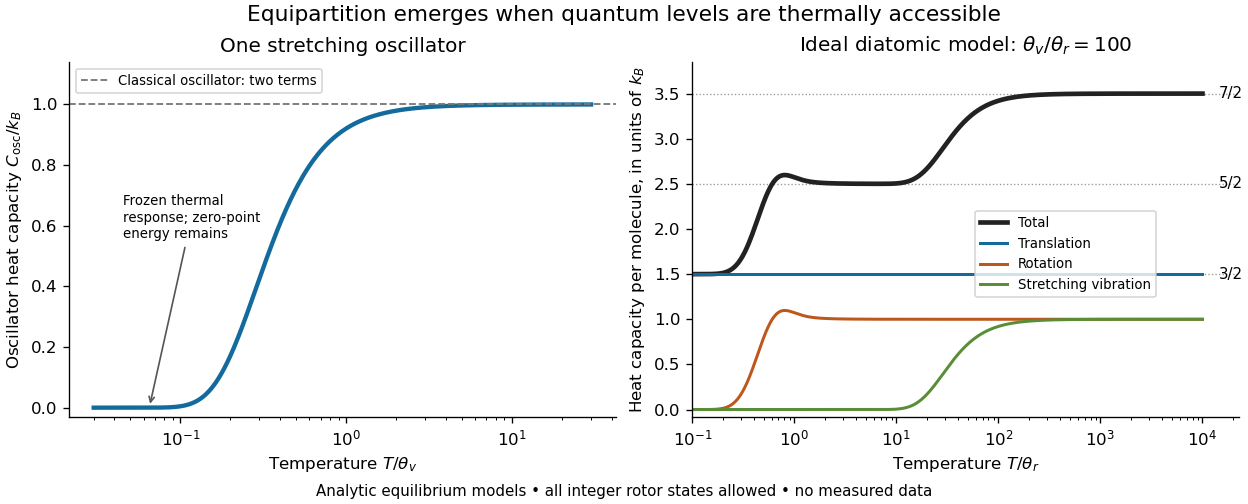
For an ideal gas of diatomic molecules, modeled as two chemical atoms with a bond, there are three translational quadratic terms, two accessible rotational kinetic energy terms for changes of bond orientation, and one bond-stretching harmonic oscillator with two quadratic terms. Rotation about the bond axis is not an additional active mode in this linear-molecule model. The three familiar limits of heat capacity at constant volume areCorresponding molar heat capacities are , and . Counting the stretching harmonic oscillator only once as would give the wrong last value.[ref]
The frozen regimes require quantum mechanics. In the simple molecular rotation model, with state degeneracy , , and moment of inertia . For the bond-stretching quantum harmonic oscillator, with angular frequency and from the Planck constant. When , the three limits above correspond to , , and , provided translational motion remains classical. They are smooth crossovers, not abrupt switches. Real molecules can have different allowed rotational populations; at high temperature, thermal dissociation, internal excitations and nonharmonic bond motion can invalidate the fixed-molecule model before its last limit is reached.[ref]
3 Quantum Gases. §3.4
For a quantum harmonic oscillator with fixed , put . Its exact mean energy and heat capacity areAt , the mean energy approaches and approaches . At , thermal excitation is exponentially suppressed and tends to zero, although the zero-point energy survives. Frozen thus means little thermal response, not zero motion or zero energy.[ref]
A motivating measurement is thermal calibration of an optical trap. A focused laser through a microscope objective confines a bead in water; imaging or a quadrant photodetector records a position time series. Gieseler and colleagues describe a polystyrene bead of radius at , a trapping laser, and photodetector acquisition at . Their recorded bead continues undergoing Brownian motion; higher trapping power produces a narrower equilibrium position distribution. Infer the centered variance, not a squared distance from an arbitrary camera origin:The normal distribution position histogram and agreement with dynamical calibration methods support the local harmonic optical trap interpretation. For a stipulated example, and imply . This calculated scale is not an experimental reading.[ref]
Position calibration is essential: if detector output has conversion , its physical variance is . An unknown scale cannot be determined together with from that one variance. A complementary calibration demonstrated by Tolić-Nørrelykke and colleagues combines the power spectrum of thermal motion with the bead response to known sinusoidal motion of a translation stage. The driven response supplies an additional length scale, and their method does not require bead size, liquid dynamic viscosity or wall distance as inputs. It still uses a thermal dynamical model; agreement between methods is a consistency check, not a theory-free proof of equipartition theorem.[ref]
The readout itself can hide fluctuations. Wong and Halvorsen used a optical trap and adjustable-exposure CCD imaging of a bead in water. They varied exposure and trapping power, held the bead away from the nearest wall, adjusted illumination to maintain comparable images, and measured tracking noise using a stuck bead. The measured variance fell as exposure increased; corrected results agreed with their time-averaging model. For a stationary overdamped harmonic optical trap, with optical trap relaxation time , an exposure of length measures . Its ideal noise-free variance isFor , : using the blurred variance in the uncorrected formula overestimates by . At , the calculated factor is . Additive tracking noise instead raises the measured variance and biases the inferred downward if left uncorrected.[ref]
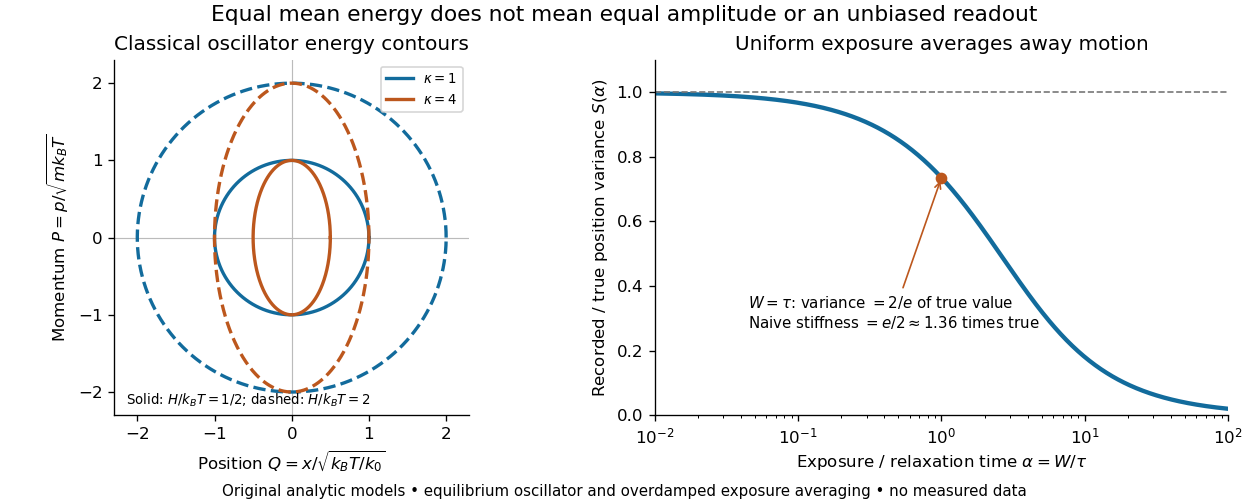
Useful controls are to record over many optical trap relaxation times, compare blocks for drift, calibrate the position scale, measure fixed-bead noise, vary exposure, and check the position histogram for departures from a normal distribution. A sparse sequence of accurate instantaneous positions can estimate an equilibrium variance; a long exposure averages away motion even if many frames are collected. Flow, appreciable laser heating, escape from the harmonic region or nonconservative forces can break the assumed thermal equilibrium. Inferring by imposing equipartition theorem is a calibration, whereas testing the relation requires an independently established stiffness and position scale. The beautiful practical connection is that microscopic randomness can set a force scale: once calibrated, a small constant applied force displaces the mean by . The same quadratic-term counting predicts macroscopic heat capacity and makes microscopic fluctuations useful measurements.
Eric Allin Cornell Created 2026-10-24 Updated 2026-10-31
A physicist who studied ultracold monatomic gases at JILA.[ref]
Professional profile of Eric A. Cornell. Independent professional identity

Portrait of Eric Allin Cornell
. Betsythedevine; 2 June 2015; existing Commons crop by Wabbuh. CC BY-SA 4.0, via Wikimedia Commons. Source.For a monatomic gas obeying the ideal gas law, the specific internal energy is . With no stellar nuclear fusion heating, the first law of thermodynamics makes the effective stellar energy-generation rate , with the derivatives taken at fixed enclosed mass. Differentiating gives . In a fixed-mass stellar homology Kelvin-Helmholtz contraction, and at each mass label. Hence when . This includes internal energy storage as well as pressure work; using the gravitational potential-energy decrease alone would overestimate the outgoing luminosity.
In a thin ideal-gas grey atmosphere with , constant enclosed mass and luminosity , and , divide the stellar hydrostatic equation by radiative diffusion in a star. This gives . Integrating from , , yieldsLogarithmic derivative gives . For a monatomic gas gas, the Schwarzschild criterion reaches equality at , hence . The purely radiative profile cannot be continued past this point as a convectively stable model.
Match an efficient, monatomic gas, fully convective star to the grey-atmosphere convection onset with thirteenth-power opacity. Its convective relation is . At the matching temperature , the stellar atmosphere gives using the Stefan–Boltzmann law. The ideal-gas relation converts this to with . The polytropic mass-radius relation at index gives , hence . Equating the two expressions proves , or . The entropy coefficient is constant throughout the convective envelope, but can change between models.
Heat capacity Created 2026-09-24 Updated 2026-10-14
Heat capacity measures the heat supplied per small temperature increase along a specified process:The subscript records the constraint, such as fixed volume or fixed pressure. The units are . The symbol emphasizes that heat is a transfer along a path, rather than a state function with a differential . Consequently, an unspecified heat capacity does not determine the required heat.
For a closed system of fixed composition undergoing a quasistatic process, assume that only pressure-volume work occurs, with no friction and no change in bulk kinetic energy or potential energy. The first law of thermodynamics and , where is internal energy and is enthalpy, then giveThese partial derivatives define heat capacity at constant volume and heat capacity at constant pressure, with the amount and composition also held fixed. Integrating along the selected constraint gives within a single thermodynamic phase; requires constant . [ref]
For a computed example, take a monatomic gas in the classical ideal gas regime, with amount of substance and stipulated molar gas constant . The equipartition theorem gives , and the ideal gas law gives . ThusFor the same temperature increase , the two processes requireHere work done by the gas is positive. At fixed pressure, the extra heat supplies expansion work; the internal energy increase is the same because internal energy of an ideal gas depends only on temperature. Their final volume values differ. [ref]
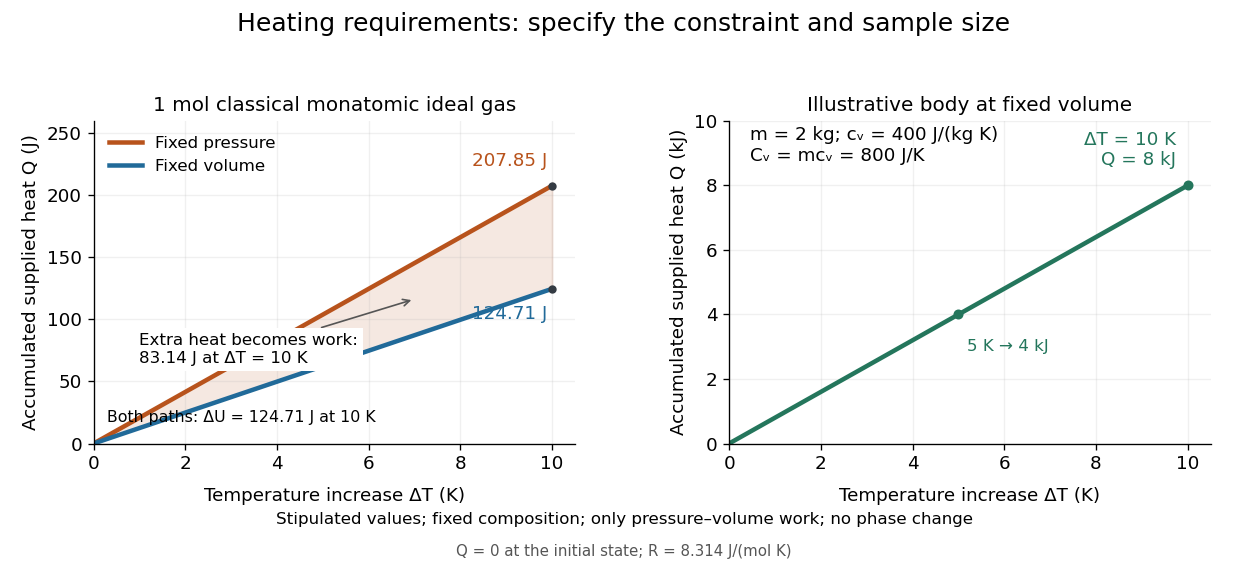
Required heat depends on the constraint and the amount of material
. Left: one mole of classical monatomic gas with the stipulated molar gas constant above; the shaded difference is expansion work at fixed pressure. Right: the illustrative fixed-volume body from specific heat capacity, with mass and . Each curve starts at zero accumulated heat, rather than zero absolute internal energy. Details.The practical value of heat capacity is that a measured heat input and temperature response can determine it. Once its constraint and temperature dependence are known, it predicts heating requirements and supplies entropy changes through entropy from heat capacity. [ref]
1 The Fundamentals of Statistical Mechanics. Tong, Statistical Physics, heat capacity as a measurable response
Heat capacity ratio 2026-10-14
The heat capacity ratio compares heat capacity at constant pressure with heat capacity at constant volume at the same equilibrium state and fixed composition:Here refer to the whole sample, in ; molar heat capacities and are per mole; specific heat capacities and are per unit mass. The amount of substance or mass cancels only when both capacities use the same normalization. Thus heat capacity ratio is dimensionless and independent of sample size. For a fixed-composition ideal gas with positive finite , Mayer's relation giveswhere is the molar gas constant. More ways to store internal energy make a given temperature increase require more heat, bringing heat capacity ratio closer to unity. [ref]
https://web.mit.edu/16.unified/www/FALL/thermodynamics/notes/node18.html. MIT Unified Engineering, Specific heats: definitions and ideal-gas relations
The equipartition theorem predicts when independent quadratic terms in molecular energy are thermally active and their number stays fixed; consequently . A classical monatomic gas with no appreciable electronic excitation has , giving and . For an ideal gas of diatomic molecules with three translational and two rotational terms active, but its vibrational normal mode effectively frozen, gives and . A fully classical harmonic vibration adds both kinetic energy and potential energy, giving and . These are model regimes, not universal constants of every gas: rotational freezing, electronic excitation, and changing composition invalidate the simple count.[ref]
The mechanical significance of heat capacity ratio follows from the first law of thermodynamics. For a fixed amount of ideal gas in a reversible adiabatic process, . Combining this with the ideal gas law gives the local relationThe partial derivative holds at fixed entropy and composition even when heat capacity ratio varies with temperature. The finite-path formulas and require the additional approximation of constant heat capacity ratio. A rapid compression also needs internal equilibration to approximate this path; rapid motion alone does not ensure reversibility. The same local response gives isentropic compressibility and, for small sound disturbances in this ideal gas regime, speed of sound , where is mass density. Thus thermal storage controls mechanical stiffness, sound propagation and the measurements in Rüchardt experiment and Clément-Desormes experiment.
Ideal gas Created 2026-09-24 Updated 2026-10-14
An ideal gas is a model of a dilute gas whose particle centres move according to classical mechanics and occupy negligible volume compared with their container. Treating the particles as point masses removes the molecular-size correction; neglecting interactions between separated particles removes the intermolecular contribution to potential energy. The usual kinetic theory model retains brief elastic collisions with the walls and, optionally, with other particles: these transfer momentum while conserving the total kinetic energy of the colliding bodies. There is no appreciable interaction energy stored between collisions. These assumptions lead to the ideal gas law, . [ref]
2.1 Molecular Model of an Ideal Gas. OpenStax University Physics Volume 2, section 2.1: molecular model and ideal gas law
[ref]https://openstax.org/books/university-physics-volume-2/pages/2-2-pressure-temperature-and-rms-speed. OpenStax University Physics Volume 2, section 2.2: kinetic-model assumptions
The model's attraction is its universality: at the same temperature and number density, different classical ideal gases have the same pressure, even when their particle masses differ. In ideal gas pressure from wall collisions, heavier particles move more slowly at a given temperature, and the two effects cancel. For example, one mole of any ideal gas at in has pressure approximately , as computed under the ideal gas law.
The ideal gas law describes the translational contribution to pressure; it does not specify all of the internal energy or the heat capacity. A monatomic gas has three classical translational degrees of freedom, whereas a gas of molecules can also store rotational kinetic energy and energy in vibrational normal modes. An equation of state alone therefore does not determine how much heat a chosen temperature increase requires. It also does not select a process: isothermal expansion and adiabatic expansion need different additional constraints. [ref]
A real gas departs from this approximation when particle size or interactions become important, especially at high number density or low temperature near a phase transition. The Van der Waals equation adds such corrections. Independently, at sufficiently low temperature or high number density, quantum statistics can become essential: even particles with negligible interactions need not obey the classical ideal gas law. The classical statistical assumption is the nondegenerate gas regime, which is distinct from neglecting interactions. [ref]
2.1 Molecular Model of an Ideal Gas. OpenStax University Physics Volume 2, section 2.1: departures from ideal-gas behavior
[ref] Internal energy Created 2026-09-24 Updated 2026-10-18
Internal energy is the energy stored in the microscopic degrees of freedom of a thermodynamic system: random molecular kinetic energy, internal molecular excitations, and interaction potential energy. Its value requires a specified system and an energy reference. In thermodynamic equilibrium, internal energy is a state function; it records the present state, without remembering whether a previous change came from stirring, compression or heat transfer. This makes internal energy the common accounting quantity connecting mechanical experiments to thermal ones.[ref]
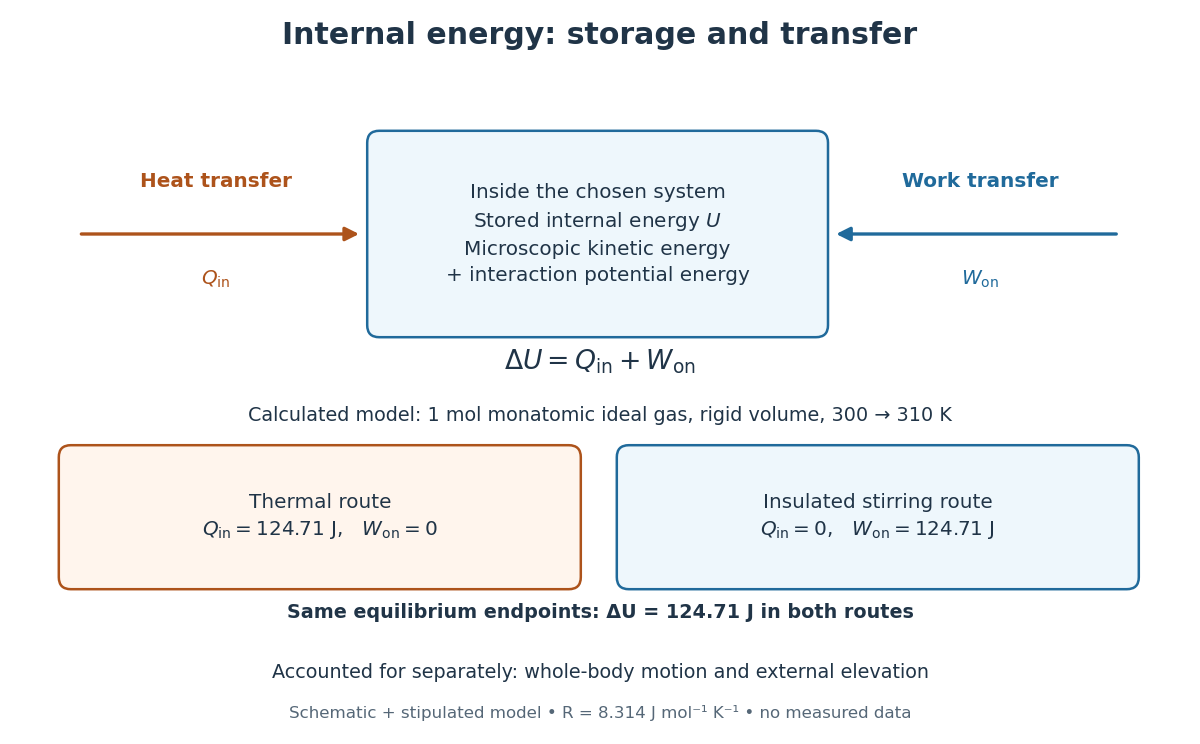
Heat and work describe energy crossing the system boundary during a process. They are not separately stored contents of the system. For a closed system whose bulk kinetic energy and external potential energy have unchanged endpoint values, the first law of thermodynamics givesHere is positive for incoming heat, and is positive for net work done on the system. Two routes between the same equilibrium states have the same , although their heat and work can differ. The infinitesimal notation distinguishes a state function change from path-dependent transfers.[ref]
For a calculated example, take one mole of a classical monatomic gas in the ideal gas regime, at fixed volume, from to . With stipulated molar gas constant , its internal energy change is . A purely thermal route supplies with . An ideal insulated stirring route supplies with , measured between equilibrium endpoints after the motion dies away. The same stored increment has two different transfer histories; neither history defines a separate kind of stored energy.
The familiar internal energy of an ideal gas is a useful special case. Neglect intermolecular interactions, hold the amount of substance and composition fixed, and suppose that independent quadratic terms per particle obey the classical equipartition theorem. Choosing the constant reference contribution as zero givesHere is absolute temperature, is the molar gas constant, and is the whole sample's heat capacity at constant volume. A monatomic gas has translational terms. A rigid diatomic molecule has when its two rotational terms are active and vibration is frozen; activating one harmonic oscillator vibration adds two terms, one kinetic energy and one potential energy, giving . The counting is of quadratic contributions, so a vibrational coordinate is not just one contribution.[ref]
This constant- formula applies only over a regime with those same active terms, classical translational statistics, nonrelativistic motion and unchanged composition. Quantum freezing, quantum degeneracy, chemical reactions or appreciable intermolecular interactions invalidate that simple counting. More generally, at fixed amount and composition an ideal gas can still have with varying heat capacity at constant volume, so use . A nonzero constant reference adds to without altering .
Isothermal compressibility Created 2026-10-14 Updated 2026-10-20
Isothermal compressibility is the compressibility measured at fixed temperature, particle number and composition. A slowly compressed sealed piston in contact with a thermal reservoir can approach this constraint. For an ideal gas, differentiating at fixed temperature gives , hence . A small pressure increase therefore gives . For a finite change, use the whole isothermal process curve instead.
Take one mole of classical monatomic gas, with stipulated molar gas constant , initially at and . The initial volume is . Compressing to givesThe isothermal compression releases heat to the thermal reservoir; the reversible adiabatic compression retains the input work as internal energy. Reversing either curve gives the corresponding expansion, with adiabatic expansion cooling the gas.
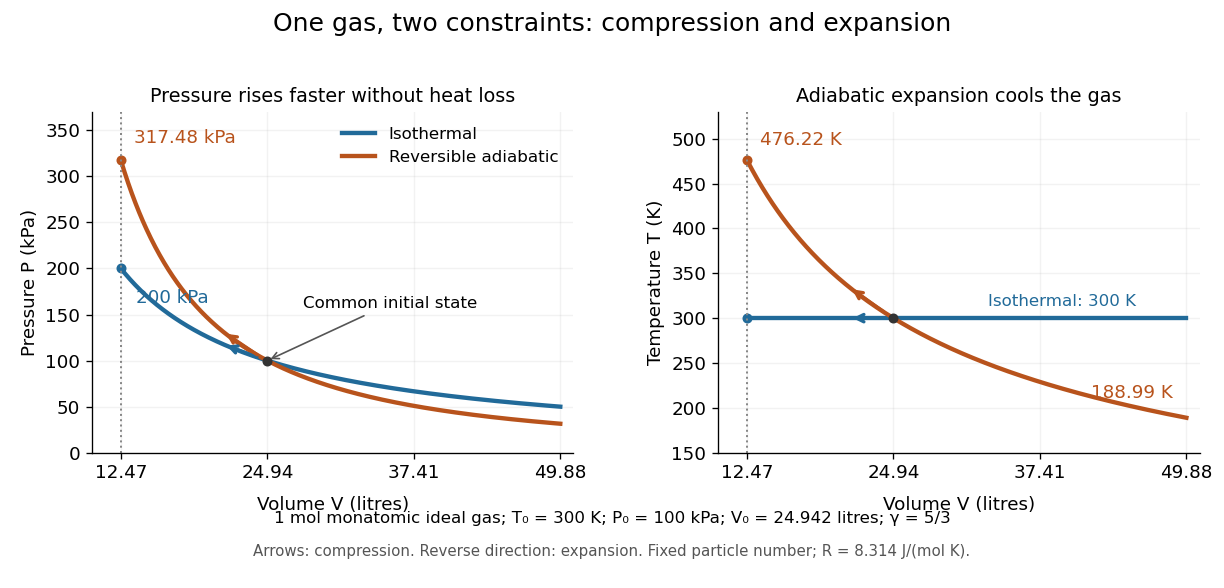
The equilibrium curvature of Gibbs free energy provides another measurement of isothermal compressibility:This follows from , with denoting Gibbs free energy. Within a stable single thermodynamic phase, increasing pressure reduces volume and makes this curvature negative. At phase coexistence, changing the phase fraction can change the volume at constant temperature and pressure; the usual finite single-phase isothermal compressibility then need not exist. Near a critical point, it can diverge. [ref]
https://www.feynmanlectures.caltech.edu/I_45.html#Ch45-S3. Feynman, Leighton and Sands, section 45-3: compression and phase coexistence
Maxwell relations 2026-10-14
Maxwell relations turn pressure, volume and temperature measurements into information about entropy. For example, the pressure rise when heating a rigid sealed vessel determines the entropy change when expanding the same sample isothermally:The quantities on the two sides describe different experiments, yet both are mixed partial derivatives of one Helmholtz free energy. This is the useful surprise: a mechanical measurement can reveal a thermal property. Similarly, the coefficient of thermal expansion gives . [ref]
For a simple compressible system, hold particle number and composition fixed, and allow only pressure-volume work. Write for internal energy, for enthalpy, for Helmholtz free energy, and for Gibbs free energy. Their natural-variable differentials areThus the first partial derivatives, with the subscript recording the variables kept fixed, areThe symmetry of second derivatives produces all four standard Maxwell relations, including their signs:For a brief derivation of the relation, differentiate with respect to and with respect to : . Each other row follows in the same way. Assume continuous second partial derivatives of the relevant thermodynamic potential in the region considered. At a phase transition, the equilibrium potential may lose this smoothness; apply the identities within each smooth thermodynamic phase, and handle latent heat and phase coexistence separately. If particle numbers vary, the potential differentials acquire chemical potential terms, so the fixed- constraints must remain explicit. [ref]
For an ideal gas with fixed , the ideal gas law gives . At fixed volume, heating changes the pressure at rate . Consequently an isothermal expansion at positive temperature hasFor one mole with and , this is . At , a reversible isothermal expansion absorbs and performs equal work, since its internal energy is unchanged. The entropy difference is a state function difference: the same equilibrium endpoints give the same in an insulated free expansion, although there and the process is irreversible.
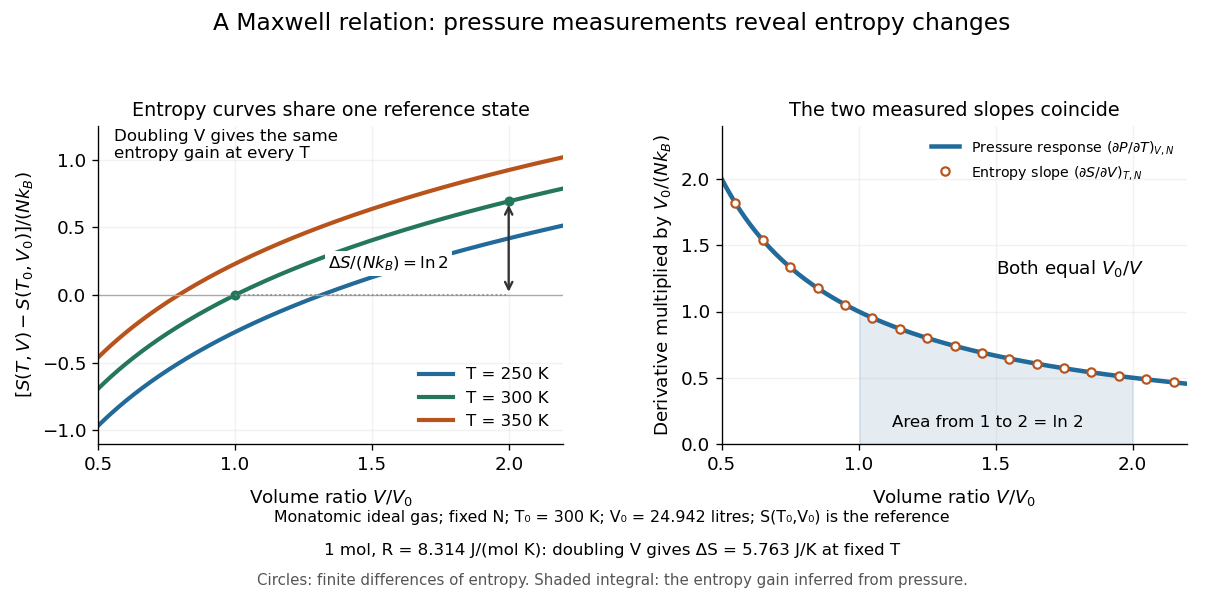
The same Maxwell relations let thermal measurements determine the difference between constant-pressure and constant-volume heat capacities. In a smooth single thermodynamic phase,using heat capacity at constant volume, heat capacity at constant pressure, coefficient of thermal expansion and isothermal compressibility. Along fixed pressure, , soThus measured expansion and compression responses determine a heat capacity difference without measuring both heat capacities separately. They do not determine the absolute heat capacities or absolute entropy by themselves; an independent thermal measurement supplies that missing information. For an ideal gas, and reduce the result to , which is Mayer's relation.
When the necessary higher partial derivatives exist and commute, differentiating the Maxwell relations once more also givesIntegrating these slopes determines how a heat capacity changes with volume or pressure at fixed temperature. For an ideal gas, both right-hand sides vanish because the ideal gas law is linear in temperature at either fixed volume or fixed pressure. Consequently and depend only on temperature at fixed , although they need not be constant in temperature. [ref]
https://davidtong.org/teaching/statistical-physics/statmechhtml/S4#S4.SS4.SSS2. Tong, section 4.4.2: heat-capacity changes from thermal pressure and volume curves
Historically, James Clerk Maxwell's Theory of Heat, first published in 1871, presents these connections using the geometry of isothermal processes and reversible adiabatic processes. His fourth edition, page 167, explicitly relates expansion on heating at fixed pressure to heat emitted during an isothermal compression: the modern relation gives . This explains why a substance with positive coefficient of thermal expansion emits heat when compressed isothermally, whereas one with negative coefficient absorbs it. [ref]
https://www.cambridge.org/core/books/theory-of-heat/7052E2DAA4CD862126D5105ABBFFAD0F/listing. Maxwell, Theory of Heat, publication record and chapter IX
[ref]https://en.wikisource.org/wiki/Page:Theory_of_Heat,_James_Clerk_Maxwell,_Fourth_Edition.djvu/183. Maxwell, Theory of Heat, fourth edition, page 167
Molar heat capacity Created 2026-10-14 Updated 2026-10-18
Molar heat capacity is heat capacity divided by amount of substance , with units . Its constraint must still be specified: and . For the classical monatomic gas example in heat capacity, these are and , where is the molar gas constant. Some textbooks use and for these per-mole quantities; the convention here reserves them for the whole sample.
Interstellar shocks arise when relative flow is supersonic: stellar winds, supernova ejecta, colliding clouds and gas moving through strong disturbances can drive them. Neighboring compressive characteristics steepen or a fast flow encounters material it cannot decelerate through upstream sound communication. A thin dissipative front then converts directed kinetic energy into thermal energy and increases entropy.
Integrate mass, normal momentum and total energy conservation through a planar steady shock in its rest frame. With no mass source, negligible external impulse across the thin layer and no radiative energy loss, their normal fluxes are respectivelyFor a perfect gas of constant adiabatic index, . Equality of the fluxes on the two sides yields the three Rankine-Hugoniot conditions in the question. Adiabatic means no energy escapes this control volume; it does not make the shock isentropic.
In the strong-shock limit, let and neglect . Momentum conservation gives . Substitution into energy conservation givesThe nontrivial compressive root isThe root describes no shock. A monatomic gas has the familiar compression four.
For identical colliding clouds in their center-of-momentum frame, reflection symmetry fixes the contact plane and the uniform compressed material on either side at rest. The unshocked clouds still approach at speeds ; their supersonic upstream flow has not received a smooth pressure adjustment ahead of the shock. Let the right shock move to the right at speed . In its own frame the upstream and downstream normal speed magnitudes are and . The same shock compression ratio therefore givesThis is the shock speed in a symmetric cloud collision. For , the shocks move outward at , not at the upstream speed or the relative cloud speed . As a check, the post-shock pressure is ; in the monatomic case , giving specific internal energy , exactly the initial bulk kinetic energy per unit cloud mass when brought to rest.
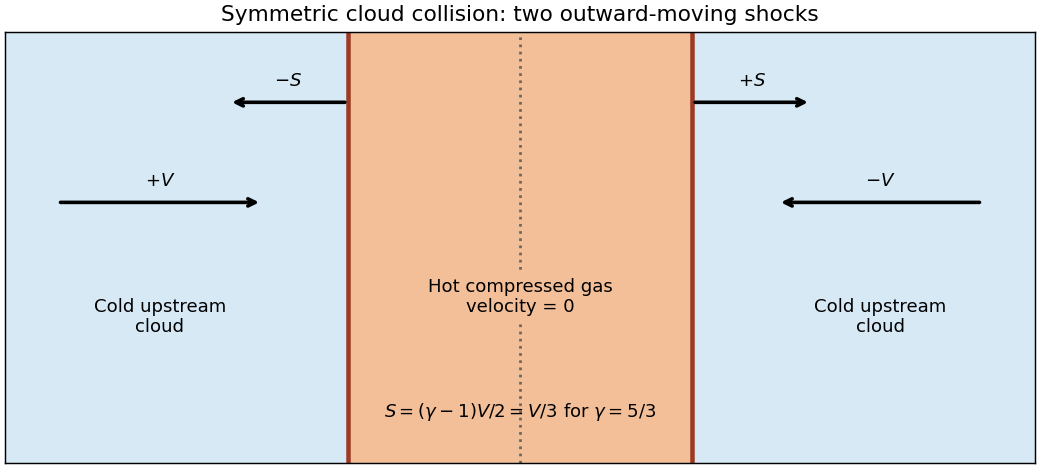


When a shock reaches a cloud's rear boundary, its supply of cold upstream gas ends. If the surrounding pressure is low, the hot compressed gas expands outward and a rarefaction travels back into it, converting thermal energy into motion and cooling the gas. A sustained uniform stationary shocked region is no longer the solution. Interaction with an appreciable exterior medium can instead drive another outward disturbance; the boundary pressure determines that part of the evolution. The stated adiabatic model provides no radiative mechanism that would keep a permanently cold dense sheet at the contact.
Immediately upstream, free fall from rest at infinity gives . Treat the surface shock as locally planar and stationary, with negligible upstream pressure. The Strong-shock Rankine-Hugoniot conditions for a monatomic gas, , give and . momentum conservation then givesUse the source's gas-constant convention . The immediate postshock temperature isHere adiabatic means that the jump does not lose appreciable heat to the surroundings; the shock is nevertheless irreversible and raises entropy. The gas still has velocity immediately downstream, so setting all upstream kinetic energy equal to downstream internal energy would give the wrong coefficient. Later settling, radiative cooling or changing ionization can alter the temperature; they are outside this immediate, fixed-composition perfect-gas jump.
A finite-amplitude compression can steepen because different parts of the wave travel at different characteristic speeds. For a right-moving simple wave in a perfect gas, one may write in terms of the local velocity perturbation . Faster compressive characteristics catch slower ones. When the smooth inviscid description would become multivalued, a physical compression shock replaces it. A rarefaction normally spreads rather than forming an entropy-violating expansion shock.[ref]
Lecture notes: Astrophysical fluid dynamics by Gordon I. Ogilvie. §§6.1.3–6.2, simple-wave reduction and characteristic crossing
Across a locally planar shock, use velocities relative to its moving front. The Rankine-Hugoniot conditions for a perfect gas conserve mass, momentum and total energy flux:where is the specific enthalpy. For upstream normal Mach number ,Thus a normal compression shock increases pressure, density and temperature, reduces the normal velocity, and changes a supersonic upstream flow to subsonic downstream flow in the shock frame. In the strong-shock limit, compression approaches , which is four for a monatomic gas. A shock conserves total energy but generates entropy; an adiabatic shock is not an isentropic compression. For a calorically perfect gas, stagnation temperature is conserved while stagnation pressure falls.[ref]
Normal Shock Wave Equations by NASA Glenn Research Center. normal-shock property ratios, total-temperature conservation and total-pressure loss
Real dissipative processes resolve the narrow front; the jump conditions do not require its detailed internal profile. In a continuum-gas experiment a shock tube can produce a moving shock by releasing a pressure discontinuity. pressure probes separated along the tube measure arrival speed and the pressure jump; distinguishing the shock from the following contact surface is essential. A contact surface can have a density/entropy jump with continuous pressure and normal velocity, whereas a shock carries nonzero mass flux through its front.
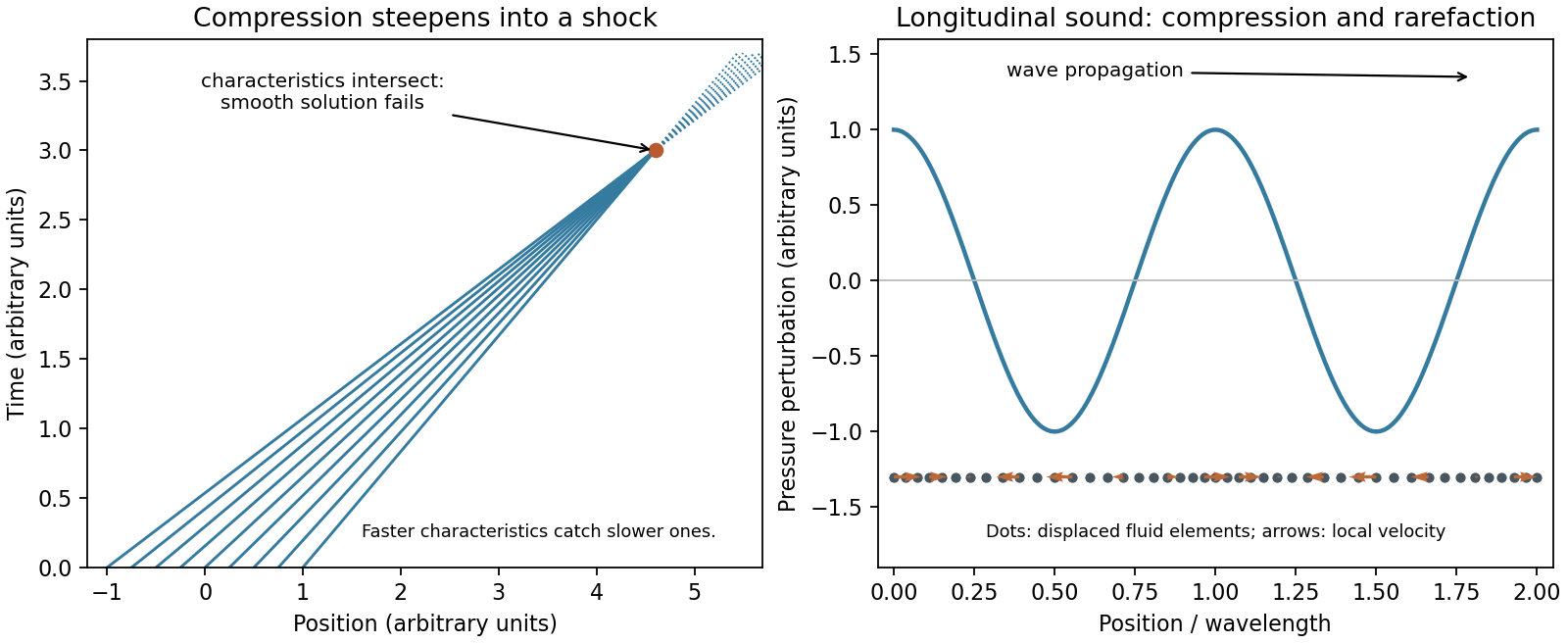
Original characteristic-crossing and longitudinal acoustic wave diagrams
. Details. 
Supersonic communication. A point source moving at speed outruns its small acoustic waves. After a time , the source has moved , while a disturbance emitted at its old position has radius . The envelope of these spherical wavefronts is the Mach cone, with half-angle satisfyingInformation is restricted to the downstream cone, so upstream gas cannot smoothly anticipate a supersonic obstacle. Finite compressions can also steepen because their characteristics converge. Such disturbances form a shock wave, across which the fluid variables change rapidly. A perfectly uniform supersonic flow need not contain a shock: the cone expresses the communication constraint, while a disturbance or compression supplies the reason for a discontinuity.
Conserved fluxes. Work in the shock frame, take velocities normal to the front, and integrate the conservation laws through a thin steady control volume of unit area. Mass conservation gives constant flux , soThe normal momentum flux is the advected part plus the pressure stress . With negligible body-force impulse across the thin front,For an ideal gas with constant adiabatic index , the specific internal energy is . The energy flux iswhere is the specific enthalpy. No radiation or other heat flux escapes in this adiabatic shock model. Conservation of the energy flux, divided by the nonzero mass flux, givesThese are the Rankine-Hugoniot conditions for a perfect gas. The shock is adiabatic but irreversible: its entropy increases, so an isentropic relation cannot be imposed across the discontinuity.
Strong-shock compression. Put and neglect and the upstream enthalpy compared with and . Momentum conservation gives . Substitute this into energy conservation:ThusThe root describes no shock. The compressive branch of the Strong-shock Rankine-Hugoniot conditions isIt also gives . A monatomic gas has , hence .
The finite slab in its initial rest frame. Denote the shock's lab speed by . The upstream gas is initially stationary, so and the downstream shock-frame speed is . Transforming to the initial slab frame givesThis is planar shock compression of a finite slab. In the uniform post-shock approximation, breakout occurs at . The original front face has then moved , while the shock reaches the originally stationary far face at , leaving thickness . Equivalently, the fixed mass per area becomes . The result assumes a maintained approximately constant shock speed and no important boundary rarefaction during the crossing; an unconfined finite cloud need not remain uniformly compressed.
Escape estimate and the sound-speed convention. Let be the slab mass, its binding-energy magnitude in the star's field, and its initial internal energy. Treat the potential as nearly uniform across the slab. For the bulk-ballistic escape estimate, requireThe Mach-number convention in shock unbinding estimates matters here. With the usual upstream adiabatic sound speed, , define . ThenIf instead the shock speed is normalized by the isothermal sound speed, , then andThe original PDF's “around five” is consistent with the latter convention or an order-of-magnitude sound-speed estimate. It is not the exact coefficient obtained with the conventional adiabatic Mach number and the stated bulk kinetic-energy criterion. Here if the potential is zero at infinity; using negative gravitational energy directly on the right would be incorrect. Subsequent conversion of shock-generated internal energy to expansion, external pressure, or radiative losses would change the physical escape threshold, so this numerical factor is not universal.
Assume an isolated, bound, nonrotating Newtonian gas cloud, negligible surface pressure, negligible magnetic and radiation stresses, no persistent bulk flow, and a stationary or time-averaged virialized state. The stellar virial theorem then reduces towhere is the total gravitational potential energy. Define the volume-averaged pressure and average gravitational energy density . HenceEquivalently, for a nonrelativistic monatomic gas, the thermal internal energy obeys . This second derivation must not count the thermal motions again as a separate bulk kinetic energy. If the external pressure is , the correct result is ; non-negligible bulk motion adds to the virial theorem. The initial sharp-edged profile need not survive virialization; maintaining that profile hydrostatically to its edge would generally require a surface term.
For a gas-pressure-supported stellar core of fixed mass and composition, neglect boundary terms for the illustrative whole-core estimate. The virial theorem gives , and the monatomic gas gives . Thus the effective heat capacity along the equilibrium sequence isThis negative heat capacity of a virialized gravitational system means that net energy loss makes a self-gravitating core contract and heat. It is different from the positive local material specific heat capacity. On the main sequence, hydrogen burning supplies most of the radiated energy, so rapid contraction is arrested. Hydrogen depletion increases the mean molecular weight; slow structural readjustment usually raises the central temperature rather than making it fall.
After core hydrogen exhaustion, a massive stellar core contracts and heats more rapidly until a later nuclear fuel ignites. There is no general reversal to cooling simply upon leaving the main sequence. If radiation pressure becomes dominant, the internal energy becomes with . The virial theorem therefore gives ; the radiation-dominated limit is marginally bound and its effective adiabatic index approaches .
Quasistatic contraction can still maintain virial equilibrium. It fails dynamically only when sufficient support is lost, for example if pair creation reduces the effective adiabatic index below , or when an iron core undergoes electron capture and photodisintegration. A fixed-composition gas-dominated contracting core with is already a counterexample to any assertion that leaving the main sequence alone reverses the heating or destroys virial equilibrium.