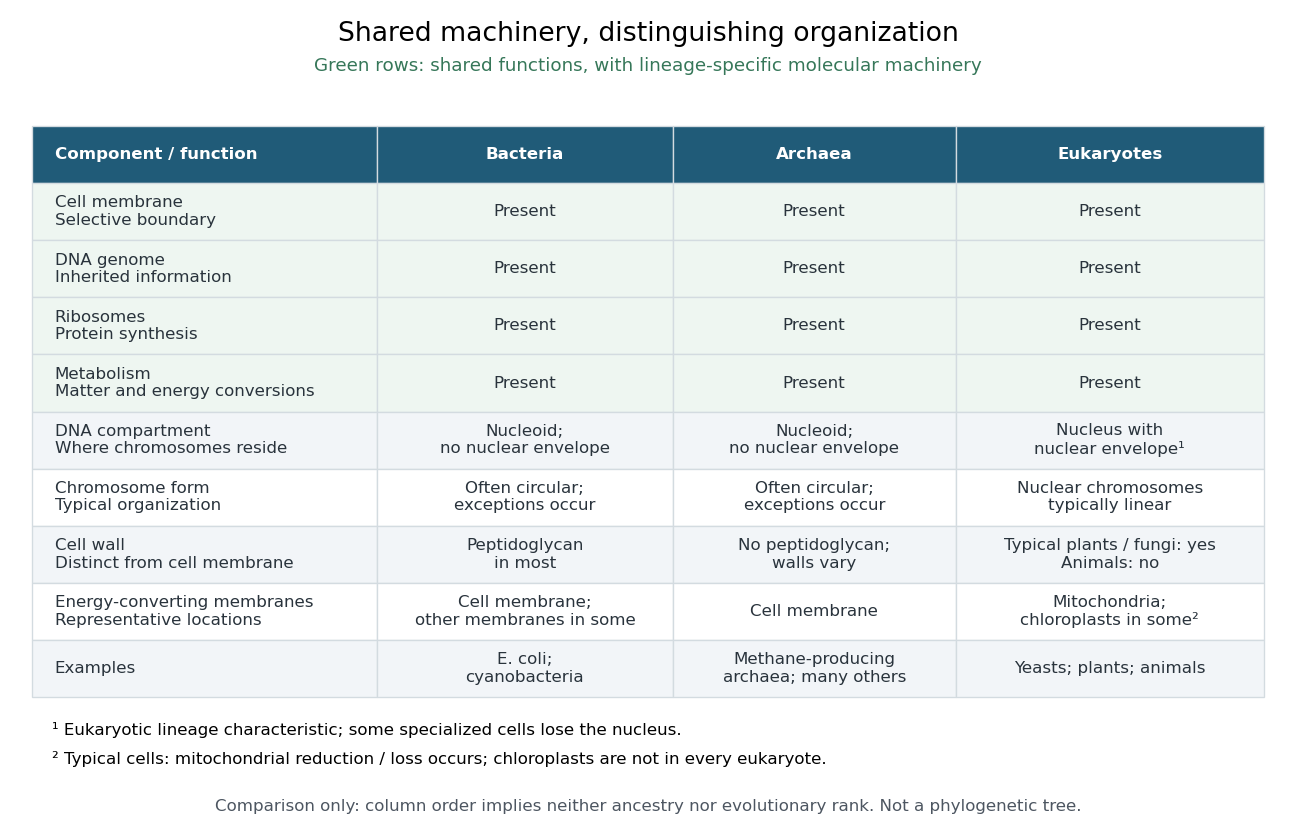
A eukaryote is an organism belonging to the lineage characterized by a membrane-bounded cell nucleus and extensive cellular compartmentalization. A nuclear envelope surrounds the nuclear genome; nuclear chromosomes are typically linear. Ribosomes perform biological translation outside the cell nucleus. See OpenStax Microbiology, 3.4: nuclear organization and protein synthesis. Specialized biological cells can lose their cell nucleus, as mature mammalian red blood cells do, while remaining parts of eukaryotic organisms; see OpenStax Biology 2e, 40.2: mature red blood cells.
Yeasts, plants and animals are all eukaryotes. Typical cells in these groups have mitochondria, but chloroplasts belong to photosynthetic plant and algae lineages, not to every eukaryote. A cell wall occurs in typical plant and fungus cells but is absent from animal cells. These are comparisons of representative cells, not a checklist every specialized cell must satisfy. See OpenStax Biology 2e, 4.3: nucleus, organelles and representative cells.
The interesting feature is controlled separation: cell membranes and organelle membranes let different cellular processes occupy distinct compartments while membrane transport connects them. The evolution of eukaryotes also involved partnership: mitochondria descend from a bacterial endosymbiosis. Modern phylogenetics supports an archaeal ancestry for the nuclear lineage, alongside this bacterial contribution; see two-domain system. Thus the history of a whole eukaryote cannot be read as the history of just one of its genes.
A member of the ciliate lineage, characterized in typical examples by cilia and distinct germline and somatic nuclear systems. Sexual and nuclear-development details differ across species.
The separation of germline and somatic nuclear functions in distinct nuclei. In ciliates, a micronucleus preserves germline inheritance while a macronucleus supports vegetative expression.
The somatic nuclear compartment of a ciliate, often highly polyploid. Development can involve DNA elimination and amplification, and vegetative inheritance can involve amitotic division.
The germline nuclear compartment of a ciliate. It contributes meiotic and zygotic inheritance, rather than supplying most vegetative transcription.
A ciliate genus used to study nuclear dimorphism, conjugation, autogamy and epigenetic inheritance. Nuclear-cycle details and mating-type mechanisms differ between species.
A model ciliate in which small-RNA-guided developmental DNA elimination contributes to mating-type inheritance, including regulation of the mtA promoter.
A model ciliate with seven mating types and developmentally programmed somatic genome rearrangement. Compatible cells exchange pronuclei during conjugation; population increase occurs separately through fission.
Camelina sativa is an oilseed plant used to investigate engineered accumulation of long-chain omega-3 fatty acids. Agronomic productivity and the percentage of a target in seed oil are distinct measurements.
A dinoflagellate belongs to a eukaryotic lineage notable for unusual nuclear chromosome organization. Many species have persistently condensed DNA with low bulk histone abundance, while retained histones and alternative nucleoproteins caution against a universal histone-free description.
A fungus is a eukaryote that obtains nutrients by absorption rather than photosynthesis. Fungi include unicellular yeasts and multicellular forms. Their cell walls differ from bacterial peptidoglycan walls; having a cell wall does not make a fungus a plant. See OpenStax Biology 2e, 24.1: fungal nutrition and organization.
Candida is a name applied to a group of yeasts including Candida albicans. Its medically important members can occur on host surfaces as well as cause candidiasis. Historical genus membership does not by itself establish identical physiology or pathogenicity among all species.
Candida albicans is a fungus capable of growth in yeast and filamentous forms. It can inhabit host-associated environments and can cause candidiasis; finding the organism and establishing its role in a tissue lesion are distinct questions.
A fungus adapted to infect keratinised tissues. Malassezia associated with pityriasis versicolor is not thereby a dermatophyte.
A genus of dermatophytes; it should not be inferred from the nineteenth-century name Microsporon furfur used for pityriasis versicolor.
Trichophyton schoenleinii is a fungus associated with infection of keratinized host structures, classically the scalp disease favus. It illustrates how fungal identification and the affected anatomical site jointly inform interpretation of an infection.
An arthroconidium is an asexual fungal propagule formed by fragmentation of a hypha. Formation by splitting an existing filament distinguishes it from propagules produced by budding or at the end of a specialized stalk.
A hypha is a filament of a fungus, usually growing by extension near its tip. Branching filaments can explore a substrate and absorb materials over a distributed surface. A filament may contain internal partitions without being divided into wholly independent organisms.
Yeasts are fungi whose growth is predominantly unicellular, commonly through budding or division into two cells. The word describes a growth form across different fungal lineages, rather than one species or an exclusive clade; some fungi can switch between unicellular and filamentous growth. Thus Saccharomyces cerevisiae is a yeast, but yeast is not another name for that one species. See Kurtzman, Fell and Boekhout, The Yeasts, chapter 1 (2011): definition and classification.
A yeast cell has eukaryotic organization, including a cell nucleus, mitochondria and a cell wall. Small size and a unicellular lifestyle do not make it a member of bacteria. These compartments let an experimentally accessible biological cell retain much of the organization shared with other eukaryotes. See Clark, Douglas and Choi, Biology 2e, 24.1: fungal cells and yeast growth.
A motivating experiment: can fermentation continue without intact yeast cells? In 1897, Eduard Buchner ground brewers' yeast with quartz sand and diatomite, added water, and pressed out a liquid extract. Adding concentrated cane sugar produced carbon dioxide after 15–60 minutes. A cell-retaining filter still yielded an active filtrate: with sterilized cane sugar in an icebox, fermentation began after about a day. Saturated lactose gave no observed fermentation. These are reported observations, not invented control results. See Buchner, Alcoholic fermentation without yeast cells (1897), translated excerpt hosted by Carmen Giunta.
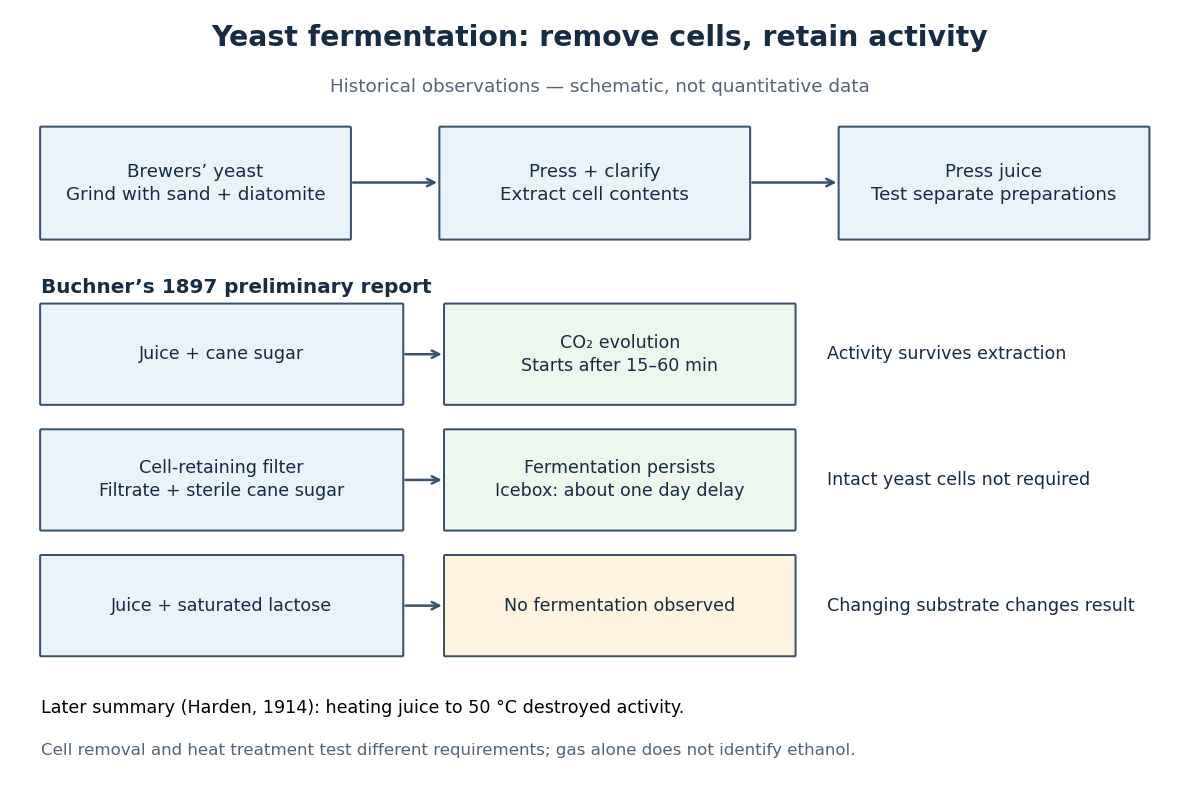
The filtration comparison addresses the objection that surviving intact yeast cells caused the activity. The lactose comparison tests substrate dependence; it is not a no-sugar blank, nor a comparison at matched sugar concentrations. A proposed modern follow-up would also compare the same extract with and without added sugar, accounting for material already in the extract. That is an experimental suggestion, not a result attributed to Buchner. His report specifies brewers' yeast; it does not identify the preparation here as a pure Saccharomyces cerevisiae strain.
Heat treatment asks a different question: does destroying activity in the extract stop fermentation? Buchner's preliminary report described weak or absent activity after heating and filtration, rather than one clean universal threshold. Harden's 1914 account of the subsequent work summarized loss of activity on heating the juice to . Harden also described requirements for both enzymes and coenzymes. Cell-free therefore means neither chemical-free nor a preparation containing one purified enzyme. See Arthur Harden, Alcoholic Fermentation (1914), chapters II and VI: cell-free activity and the fermenting complex.
The inference is that extracted cellular machinery can sustain these chemical reactions without an intact living biological cell. This does not show that the extract reproduces, grows or maintains itself like a yeast. Moreover, gas evolution alone does not identify ethanol: cellular respiration can also release carbon dioxide. Product identification is a separate measurement; Harden's account describes both ethanol and carbon dioxide as products of cell-free alcoholic fermentation. The beautiful separation is between the organism that produces and maintains the machinery and the machinery that catalyzes a particular transformation.
Yeasts that grow a daughter biological cell as a bud from a mother. Bud emergence, daughter-cell growth and successful completion of division are distinct endpoints.
Formation and growth of a daughter-cell bud. A visible bud is evidence of initial polarized cell growth but does not establish normal cytokinesis or long-term proliferative capacity.
Schizosaccharomyces pombe is a yeast species used as a model organism. It supplies the candidate genes in the yeast cross-species complementation experiment; the recipient remains Saccharomyces cerevisiae.
Saccharomyces cerevisiae is a particular species of yeast, used in baking, brewing and laboratory research. During ordinary vegetative growth it reproduces by budding: a smaller daughter grows from the mother before separation. Laboratory strains can be maintained as either haploid or diploid biological cells. This makes it possible to investigate genes in a single eukaryote, then use controlled crosses and meiosis to connect a genotype to a phenotype. See Burgess, Powers and Mell, Budding Yeast Saccharomyces cerevisiae as a Model Genetic Organism (2017), pp. 1–2.
The practical value of Saccharomyces cerevisiae as a model organism is the combination of easy laboratory cultivation, accessible genetics, and cellular functions shared with other eukaryotes. A haploid strain has one set of chromosomes, so a changed allele is not accompanied by a second copy at that genetic locus. But a mutation need not produce an observable phenotype under every condition. The yeast is also a whole organism, not a miniature human: transferring a result requires evidence that the relevant function is shared in the target system. See Duina, Miller and Keeney, Budding Yeast for Budding Geneticists (2014): cultivation, genetic tools and conserved functions.
For a concrete example, Hartwell, Culotti and Reid's 1970 work followed temperature-sensitive Saccharomyces cerevisiae strains with successive microscope photographs. Failure to complete a particular part of the cell cycle helped identify required gene functions. Their distinction between when a function is required and where a cell finally stops is especially instructive: the visible endpoint need not be the time of the underlying defect. See Hartwell, Culotti and Reid, Genetic control of the cell-division cycle in yeast. I. Detection of mutants (1970): primary abstract. This is a useful way to turn an observable change in a biological cell into a question about genes and causal order.
In alcoholic fermentation, Saccharomyces cerevisiae converts sugars into ethanol and carbon dioxide. The carbon dioxide helps dough rise; the ethanol is useful in alcoholic drinks. The metabolism also supports production of ATP, a usable cellular energy carrier. This is one metabolic ability of one species, not the definition of every yeast. See Clark, Douglas and Choi, Biology 2e, 7.5: alcohol fermentation and the Burgess, Powers and Mell account above.
For glucose, the ideal net stoichiometry isOne molecule of glucose supplies six carbon chemical atoms: four end up in the two ethanol molecules and two in the two carbon dioxide molecules. The twelve hydrogen and six oxygen chemical atoms also balance. This is a net material balance across several enzyme-catalyzed steps, not a single chemical reaction step or the complete bookkeeping for cellular energy carriers. The standard pathway accounting yields a net two ATP per glucose: the initial breakdown produces the ATP, while the later conversion to ethanol regenerates a coenzyme needed to keep the breakdown going. See Clark, Douglas and Choi, Biology 2e, 7.2: net ATP accounting and the section 7.5 cited above.
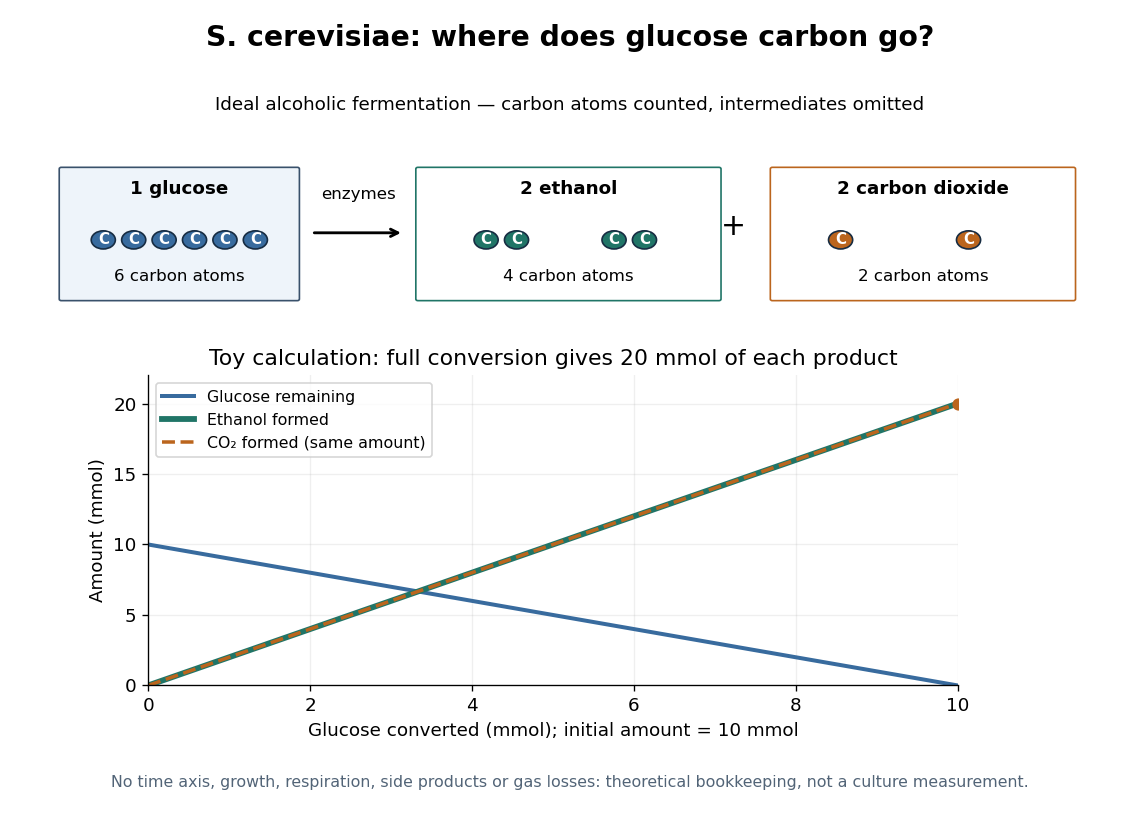
At complete conversion, this toy gives of ethanol and of carbon dioxide. The carbon balance is of carbon chemical atoms. A real culture also builds cellular material, can use other metabolic routes, and may retain dissolved carbon dioxide; the toy is a reference balance rather than a prediction of collected gas or beverage yield.
Although alcoholic fermentation does not require molecular oxygen as a reactant, the presence of molecular oxygen does not force Saccharomyces cerevisiae to stop fermenting. De Deken's 1966 experiments reported predominantly fermentative glucose use during exponential growth in air. Consequently, bubbles do not establish either absence of molecular oxygen or an exclusively fermentative metabolism. See De Deken, The Crabtree Effect: A Regulatory System in Yeast (1966): primary abstract.
Plants are eukaryotes. A typical photosynthetic leaf cell has a cell nucleus, mitochondria, chloroplasts, and a cell wall outside its cell membrane. A root cell need not have chloroplasts; the plant's parts specialize for different functions. Plants perform cellular respiration as well as photosynthesis. See OpenStax Biology 2e, 4.3: plant cell organization.
Cotton denotes plants of the taxonomic genus Gossypium, grown especially for the long fibres associated with their seeds. The plant, an individual fibre and a textile made from many fibres are different levels of organization.[ref]
Gossypium in Plants of the World Online. Accepted Gossypium genus record and classification
A cotton fibre is a striking cell elongation example: one cell grows outward from the seed coat plant epidermis. A 2001 study described fibres reaching about – in approximately 16 days after flowering. These long cells provide a way to study growth without mistaking an increase in cell number for elongation of one cell.[ref]
The experiment followed a fluorescent tracer from the seed coat into growing fibres with confocal microscopy. Access through intercellular connections involving a plasmodesma changed during development: tracer entry was seen early, blocked around day 10 and seen again around day 16. Transporter expression and turgor pressure measurements supplied complementary information about solute entry and growth.[ref]
The control of single-celled cotton fiber elongation by developmentally reversible gating of plasmodesmata and coordinated expression of sucrose and K+ transporters and expansin by Y. L. Ruan and others. Abstract and Figure1: reversible tracer access and coordinated physiological changes
For an original calculation, a fibre that adds over 16 days has an average extension rate of per day. That quotient is not an instantaneous rate and does not imply uniform growth throughout development. Measuring fibre length at several ages distinguishes a mean rate from a changing growth trajectory.
Gossypium is the taxonomic genus of cotton plants, placed in Malvaceae. The genus name denotes a group of related species, while cotton can also refer to their harvested fibres or the resulting material. A taxonomic name and a material name consequently do not identify the same kind of object.[ref]
The fibres make a striking connection between plant diversity and cell mechanics. In the studied cultivated cotton, an individual fibre is an elongated cell growing from the seed coat plant epidermis. A 2001 study followed fluorescent tracer movement into these growing cells and related changing intercellular access to developmental stage.[ref]
The control of single-celled cotton fiber elongation by developmentally reversible gating of plasmodesmata and coordinated expression of sucrose and K+ transporters and expansin by Y. L. Ruan and others. Abstract and Figure1: single-cell fibres and changing tracer access
For an original classification example, a record might identify a specimen's taxonomic genus, measure the length of 100 sampled fibres and record how much material was harvested. Those are three distinct observations. A genus assignment does not fix every fibre's length, and a fibre measurement alone does not identify a species.
Comparisons within Gossypium should therefore keep taxonomic identity, developmental stage and measurement conditions explicit. The common word cotton does not guarantee that two samples have the same ancestry or cellular properties.
A parasitic plant obtains resources directly from another living plant, its host, through a specialized connection called a haustorium. This differs from an epiphyte using another plant merely as a physical support. Some parasitic plants retain photosynthesis, so green color alone does not establish nutritional independence.[ref]
Biology 2e by Mary Ann Clark and others. Section31.3, Nutritional Adaptations of Plants: parasitic plants and haustorial connections
Chemical cues can be important before the connection forms. In 1966, investigators isolated the crystalline germination stimulant strigol from cotton root exudates and tested its activity on a root-parasitic Striga. This connected a soluble substance released by roots with a developmental response in another plant.[ref]
Germination of Witchweed (Striga lutea Lour.): Isolation and Properties of a Potent Stimulant by C. E. Cook and others. Primary abstract: isolation, chemical characterization and germination activity
A positive germination assay is not itself proof of successful parasitism. A seed can respond to a chemical without subsequently reaching a suitable host, forming a haustorium or acquiring enough resources to complete its life cycle. These are successive biological questions, requiring different observations.
For an original comparison, place a green plant on a branch and ask separately whether it photosynthesizes, where it gets water, and whether its tissues connect directly to a living host. Neither the place it grows nor a single metabolic ability is an adequate substitute for observing the resource-acquisition relationship.
Phtheirospermum japonicum is a facultatively parasitic plant used to investigate how a plant establishes a connection to a host. “Facultative” means that host attachment is not required for every part of its existence: it can grow without parasitizing a host, while retaining the capacity to form a haustorium when appropriate interactions occur.[ref]
Local Auxin Biosynthesis Mediated by a YUCCA Flavin Monooxygenase Regulates Haustorium Development in the Parasitic Plant Phtheirospermum japonicum by Juliane K. Ishida and others. Abstract and Introduction: facultative parasite and haustorial development
Its experimental value is that investigators can separate signals, developmental changes and established attachment. A 2016 study identified the auxin-biosynthesis gene Phtheirospermum japonicum YUC3 as active near the developing host-contact region. Reducing its expression by RNA interference decreased haustorium formation, while expression in other root-epidermal positions promoted haustorium-like structures.[ref]
Local Auxin Biosynthesis Mediated by a YUCCA Flavin Monooxygenase Regulates Haustorium Development in the Parasitic Plant Phtheirospermum japonicum by Juliane K. Ishida and others. Abstract: localized YUC3 expression, knockdown and ectopic-expression comparisons
For an original interpretation exercise, suppose one treatment increases the number of root swellings but not the number of established host connections. It has affected an early visible response without demonstrating improved parasitic resource acquisition. Scoring those outcomes separately avoids calling every induced structure a functioning haustorium.
The species is therefore a useful model of developmental control at an interface between two plants. Results about one local gene expression pattern should not be generalized to every parasitic plant without comparable evidence.
Striga, commonly called witchweed, is a taxonomic genus of root-parasitic plants. Its dependence on another plant involves a sequence of events: germination, contact with a suitable host and formation of a haustorium. A chemical response at the first stage does not establish success at every later stage.[ref]
Striga in Plants of the World Online. Accepted Striga genus record
The chemical connection was demonstrated in a 1966 experiment. Investigators isolated the potent germination stimulant strigol from cotton root exudates and tested it on the parasite named Striga lutea in the original paper. Chemical isolation and a germination assay linked an environmental cue to a developmental response.[ref]
For an original conditional-probability example, suppose 40 of 100 viable seeds germinate in one test and 10 of those 40 subsequently establish a host connection. The germination fraction is 40 percent, the connection fraction among germinated seeds is 25 percent, and the overall connection fraction is 10 percent. These invented counts explain why a germination assay and an assay of established parasitism need different denominators.
This distinction also prevents calling every stimulant-producing plant a proven compatible host. Finding a cue, reaching a root and building a functioning haustorium are different biological tests.
In a parasitic plant, a haustorium is a specialized multicellular organ that attaches to and penetrates host tissue, establishing the connection through which the parasite obtains resources. It is more than a root placed beside another plant: development must organize a physical interface between living tissues.[ref]
Local Auxin Biosynthesis Mediated by a YUCCA Flavin Monooxygenase Regulates Haustorium Development in the Parasitic Plant Phtheirospermum japonicum by Juliane K. Ishida and others. Introduction: attachment, penetration and later vascular development
An experiment in Phtheirospermum japonicum connected formation of that organ with local auxin production. Researchers found an auxin-biosynthesis gene expressed near the host-contact site. RNA interference reducing its expression decreased the frequency of haustorium formation; expression in other root-epidermal positions induced haustorium-like structures.[ref]
Local Auxin Biosynthesis Mediated by a YUCCA Flavin Monooxygenase Regulates Haustorium Development in the Parasitic Plant Phtheirospermum japonicum by Juliane K. Ishida and others. Abstract: YUC3 expression pattern, knockdown and ectopic-expression comparisons
The complementary perturbations ask different questions: reducing a contribution tests whether normal development depends on it, while changing where it is expressed tests whether it can promote a related structure elsewhere. The label “haustorium-like” matters: an induced swelling does not automatically prove host penetration or functioning resource transfer.
An original experiment-design sequence would score three endpoints separately: a visible swelling, tissue penetration in sections, and movement of a suitable tracer from host to parasite. Positive results at the first endpoint cannot substitute for the other two. Keeping these observations separate explains why initiation of a haustorium and establishment of successful parasitism are related but distinct events.
A trichome is an outgrowth of the plant epidermis, often appearing as a hair or scale. Its cellular construction and function depend on the plant. The specialized epidermal cells on Arabidopsis thaliana leaves and the elaborate surface scales of Tillandsia usneoides illustrate why one shape or one role should not define every trichome.
A 1994 genetic study isolated more than 70 trichome mutants representing 21 genes in Arabidopsis thaliana. Comparing their cellular phenotypes separated contributions to morphogenesis, rather than treating the mature cell's architecture as one indivisible property.[ref]
Genetic dissection of trichome cell development in Arabidopsis by M. Hülskamp and others. Primary abstract: mutant collection, genes and developmental analysis
A different experimental question concerns function. In Tillandsia usneoides, intact flexible trichome wings supported surface water spreading more effectively than preparations without those wings. Fluorescent imaging and deformation observations connected the wing array with propagation of a water film.[ref]
Domino-like water transport on Tillandsia through flexible trichome wings by Nami Ha and others. Results and Figure3: intact/removed wings and surface flow
These examples separate the formation of a structure from what it does. A mutation changing a cell's form can identify a developmental contribution; removing or altering a surface feature while measuring water movement tests a mechanical contribution. Neither result requires every hairy plant surface to use the same genetic program or solve the same ecological problem.
A trichome wing is the outward-spreading part of a specialized trichome, especially evident in the surface scales of Tillandsia usneoides. Its flexible geometry contributes to how a water film moves over the plant surface. The term describes part of a trichome, rather than an aerial locomotion organ.
A 2021 experiment compared water movement on shoots with intact trichome wings and preparations without those wings. Fluorescence revealed the spreading liquid, while X-ray observations linked water movement with sequential deformation of flexible wings. Neighboring structures therefore form an interacting transport surface, rather than a collection of independent hairs.[ref]
Domino-like water transport on Tillandsia through flexible trichome wings by Nami Ha and others. Results: external water transport and sequential deformation; Figure3: intact/removed-wing fluorescence comparison
For an original measurement example, suppose a fluorescent front travels4 millimetres in2 seconds with one preparation and the same distance in4 seconds with another. The corresponding average surface speeds are2 and 1 millimetres per second. These invented values describe spreading along the surface; they do not measure how much water entered living cells.
A controlled comparison should therefore distinguish surface propagation, subsequent uptake and damage caused by removing a structure. The wing-removal experiment helps test a mechanical contribution to transport, while the fluorescence readout makes the spatial movement visible.
An epiphyte is a plant growing on another plant as a physical support, without obtaining its food by drawing from that support plant as a parasitic plant does. The support can place the epiphyte above the ground, but it does not eliminate requirements for water, mineral nutrients and, in a photosynthetic epiphyte, light. Tillandsia usneoides is a familiar epiphyte in Bromeliaceae.[ref]
Physical support and water supply are separate problems. In Tillandsia usneoides, surface trichomes help collect and distribute water rather than relying on a conventional ground-rooted supply. A study compared water movement across shoots with intact trichome wings and shoots without those wings, using fluorescent droplets to reveal surface spreading.[ref]
Domino-like water transport on Tillandsia through flexible trichome wings by Nami Ha and others. Results and Figure3: external water transport with/without wings
For an illustrative classification exercise, record three facts independently: what supports a plant, where its water comes from, and whether it draws nutrients directly from another living plant. Growing on a branch answers only the first. Nor does a shared epiphytic habit place two plants in the same taxonomic family; habitat and ancestry are different kinds of biological information.
A storage shoot with a short stem and fleshy leaves or leaf bases; it is anatomically distinct from a root.
Secondary xylem produced by the vascular cambium.
Sawdust consists of small particles of wood produced by cutting or abrasion. Relative to an intact piece of wood, its larger exposed surface affects exchange with the surroundings and access by decomposing microorganisms.
The inner, generally nonconducting portion of a woody stem, distinguished from the more recently formed sapwood.
Cork, or phellem, is a protective plant tissue produced by the cork cambium. Mature cork consists largely of dead biological cells whose cell walls contain suberin, a material that limits passage of water. Cork forms part of the outer protective covering of mature plant stems and the root; it is not a name for every component of bark.
Commercial cork comes from the especially thick outer bark of Quercus suber. Comparing actively forming cork with other plant tissues connects its useful barrier properties to gene expression involved in suberin production. Such comparisons have identified candidate pathways in cork differentiation rather than treating the material simply as inert packing.[ref]
A Genomic Approach to Suberin Biosynthesis and Cork Differentiation by Marçal Soler and others. Plant Physiology 144, pp. 419–431; cork tissue and expression comparisons
Arabis alpina is a perennial flowering plant used to investigate repeated seasonal flowering. Experiments on its PEP1 regulatory system connect responses to winter conditions with the maintenance of a perennial life cycle.[ref]
Bread wheat is the cereal plant Triticum aestivum. Its genome, shaped by polyploidy, contains related chromosome sets from different ancestral lineages, making it a useful example of the interaction between hybridization and polyploidy.
Rice refers to cereal plants cultivated for their edible grain, especially Oryza sativa, and to the grain itself. In biological discussion, the species, cultivated population and harvested seed should be distinguished.
The tomato is the flowering plant Solanum lycopersicum and its fleshy fruit. It is useful for investigating fruit growth and ripening because changes in tissue structure, pigmentation and chemistry can be related across biological development.
The African oil palm, Elaeis guineensis, is a tropical plant cultivated for oils from its fruits and seeds. Clonal propagation makes it an important example of the difference between matching genetic sequence and maintaining a normal developmental state.[ref]
A plant persisting for multiple years; repeated reproductive episodes and vegetative renewal create different allocation requirements from those of annual crops.
A plant completing its life cycle within one growing year; this does not imply that all varieties have identical flowering requirements.
Mimulus is a genus name used in the monkeyflower literature. Some species historically placed in it are now treated in other genera, including Mimulus guttatus. Comparing experiments therefore requires tracking both the species identity and the name used by a source.
Mimulus guttatus is a yellow-flowered plant widely used in research on adaptation, hybridization and speciation. Kew treats it under the accepted name Erythranthe guttata, so the two names can refer to the same experimental species.[ref]
Milkweed is a common name especially associated with flowering plants of the genus Asclepias. These plants are important hosts for monarch butterfly larvae, connecting plant chemistry, feeding specialization and interactions among species.
Capacity to survive substantial drying and recover function after rehydration. It differs from avoiding water loss. Recovery of one physiological signal does not establish successful growth and reproduction.
An anchoring structure on relevant plant bodies. It may contribute to water or nutrient uptake, but is not anatomically identical to a root.
A land plant with the specialized conducting tissues xylem and phloem. An independent, usually conspicuous sporophyte supports transport and growth; the ecological requirements of the gametophyte still matter for completing reproduction.
A plant lineage reproducing through seeds, including gymnosperms and angiosperms. Reduction and retention of gametophytes and male delivery through pollen distinguish their reproductive ecology from a typical free-living fern gametophyte.
A member of a seed-plant lineage whose ovules are not enclosed in angiosperm carpels. Conifers contribute extensively to forest carbon pools, but the lineage includes different growth forms and reproductive arrangements.
A gymnosperm genus used in comparisons of reproductive regulatory genes.[ref]
On the origin of class B floral homeotic genes: functional substitution and dominant inhibition in Arabidopsis by expression of an orthologue from the gymnosperm Gnetum by Kai-Uwe Winter and others. Heterologous expression of a B-class-related regulator
A member of a vascular-plant lineage generally reproducing through spores rather than seeds. Most familiar fern bodies are sporophytes; their gametophytes can have different environmental requirements. heterospory and other life-cycle differences prevent treating every fern as one identical model.
A member of the land-plant lineages comprising mosses, liverworts and hornworts. Their persistent gametophytes support attached sporophytes; physiological independence should not be inferred merely from a green sporophyte.
A hornwort is a bryophyte with a photosynthetic gametophyte and an elongated horn-like sporophyte. The two generations differ in structure and dependence; the visible horn is not the whole life cycle.
A liverwort is a bryophyte whose dominant free-living generation is the gametophyte. Some forms are flattened, while others bear small leaf-like structures. This diversity makes external appearance alone an unreliable definition of the group.
A moss is a bryophyte with a prominent gametophyte and a dependent spore-producing sporophyte. The familiar LEAFY shoot and the capsule-bearing stalk represent different generations of the same life cycle.
The pea, Pisum sativum, is a flowering plant producing seeds within a legume. Its contrasting inherited traits were central to the experiments underlying Mendelian segregation. The edible seed and its enclosing fruit are distinct structures.
A flower is an angiosperm's reproductive structure. Stamens produce pollen; carpels enclose ovules. Petals and sepals surround these organs in a complete flower, but some flowers lack one or more groups, including either reproductive group.[ref]
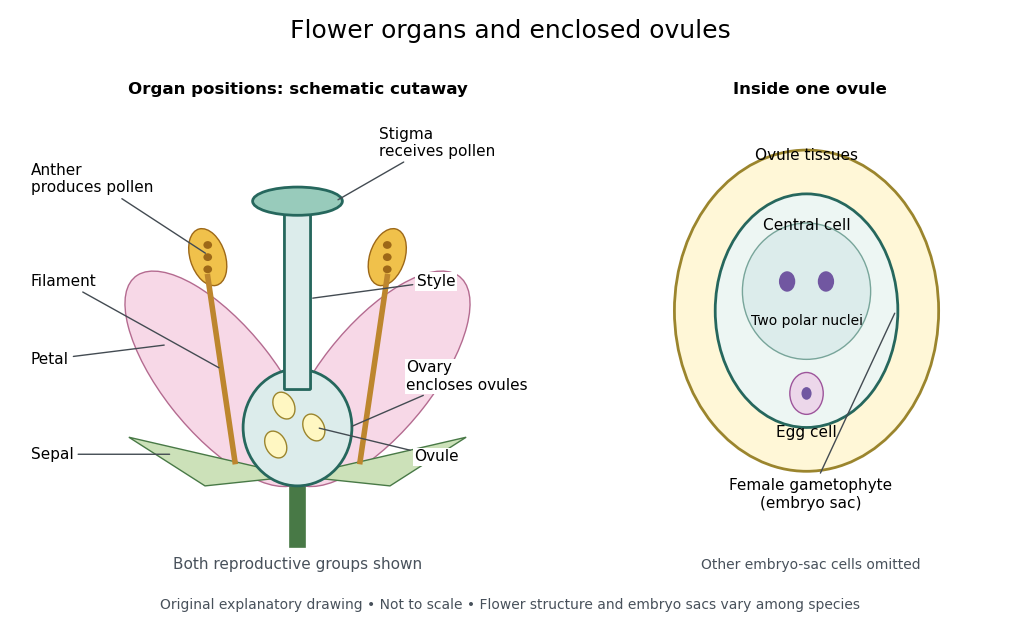
Read the drawing from outside inward, then trace two routes: where pollen is released, and where an ovule is enclosed. This reveals why catching pollen and forming a seed require different structures. A detached petal cannot substitute for a stigma simply because both belong to the same flower.
A receptacle is the end of the floral plant stem on which the parts of a flower are borne. It can be a small platform or an enlarged structure. Its position explains the distinction from an ovary: the receptacle supports the floral organs, while an ovary encloses ovules within a carpel.[ref]
The strawberry makes the distinction visible. Its enlarged fleshy receptacle carries many small achenes on the outside; each achene is a dry fruit containing a seed. Thus the red flesh and the individual seed-bearing fruits develop from different parts of the flower. In a rose, the small dry fruits instead lie inside the enlarged hypanthium of the rose hip.[ref]
For a simple dissection, follow a flower's stalk upward and identify where sepals, petals, stamens and carpels attach. Comparing this arrangement before and after fruit development helps trace a mature structure back to its origin. A receptacle can contribute to an accessory fruit, but it is not itself a synonym for every fleshy fruit.
A disc floret is a small tubular flower within a flower head of Asteraceae. Its corolla usually ends in approximately equal lobes. In a radiating daisy-like head, disc florets occupy the central region, surrounded by ray florets; other heads can contain only tubular flowers. The word disc describes the collective arrangement, not a flat disc-shaped individual flower.[ref]
Asteraceae in the New South Wales Flora Online. Description: corolla forms and combinations within a head
A hand-lens comparison makes the unit clear. Lift one central disc floret from a common daisy head and follow its narrow corolla down toward the ovary. Then compare an outer ray floret with its extended strap-like corolla. Both are whole flowers, even though the outer one resembles a single petal of a larger blossom.
An illustrative count of twenty central disc florets and ten peripheral ray florets describes thirty constituent flowers, not thirty petals of one flower. Whether each unit is fertile must be checked from its reproductive structures and the species, rather than inferred just from its position.
A ray floret is a flower whose corolla has a conspicuous extended, strap-like limb, typically projecting from the edge of an Asteraceae flower head. The apparent petal around a daisy-like head is therefore part of a whole floret. It is not a single petal belonging to one giant central flower. Depending on the species, ray florets may be female or sterile; their appearance alone does not establish fertility.[ref]
Asteraceae in the New South Wales Flora Online. Description: ray-corolla form and reproductive variation
Compare an intact head with a dissection: trace one outer ray to its own base, then inspect a central disc floret. The contrast is between two floral forms assembled into one inflorescence. Counting rays around the edge does not count the full complement of constituent flowers, because it misses the central units.
Shape, position and function answer different questions. A long corolla limb can contribute to the visual display of the flower head, while reproductive organs determine whether that particular floret can produce pollen or a fruit.
Temporal separation of male and female reproductive function. It can reduce self-fertilization without requiring separate male and female flowers.
Spatial separation of male and female reproductive organs that can reduce self-pollen transfer while retaining them within one flower.
The floral structures surrounding the reproductive organs, often differentiated into sepals and petals. Protection and pollinator attraction can be combined in a shared display.
A flower containing both male and female reproductive organs, stamens and carpels. It differs from monoecy, in which male and female structures occur separately on the same individual.
The organization of symmetry in a flower. Whole-flower symmetry, individual organ shape and developmental identity are distinct characters; similar outlines can arise through different molecular mechanisms.
A floral arrangement with one principal symmetry plane. Differential deployment of dorsal regulators can contribute, but a shared appearance does not establish one universal developmental mechanism.
A floral arrangement with multiple planes of symmetry around the reproductive axis. Its developmental basis can differ among lineages, so a derived radial flower need not restore the ancestral organ identities.
A stamen is a flower's male reproductive organ, typically an anther supported by a stamen filament. The anther produces and releases pollen.[ref]
Biology 2e by Mary Ann Clark and others. Biology 2e, §32.1 Flower Structure and Male Gametophyte (The Pollen Grain), Figures 32.3 and 32.6
The stalk supporting an anther.
The stigma is the carpel's pollen-receiving region. Compatible pollen may form a pollen tube that grows toward an ovule; arrival alone does not establish fertilization.[ref]
32.2 Pollination and Fertilization. Biology 2e, §32.2 Incompatibility Genes in Flowers and Double Fertilization
A useful diagnostic question is what was actually observed: pollen on a stigma, a growing pollen tube, or a new plant embryo? Each observation tests a different stage. A pollen tube germination assay isolates the middle process for direct viewing.
A female reproductive unit of a flower, comprising a stigma, a style and an ovary. A flower may have several carpels, including fused ones.[ref]
Biology 2e by Mary Ann Clark and others. Biology 2e, §32.1 Flower Structure: individual carpel and one or multiple carpels
The structure containing the angiosperm female gametophyte; a fertilized ovule can develop into a seed.
The gametophyte inside an angiosperm's ovule, containing an ovum and, in the common arrangement, a central biological cell with two polar cell nuclei.[ref]
Biology 2e by Mary Ann Clark and others. Biology 2e, §32.1 Female Gametophyte (The Embryo Sac), Figure 32.8; species variation is explicitly noted
A seed packages a plant embryo, a seed food reserve and a protective seed coat. It is a living starting point for a new plant, not merely stored food. In a mature pea seed, the large cotyledons hold reserves; other seeds retain substantial endosperm. These are alternative arrangements, not successive germination stages.[ref]
Biology 2e by Mary Ann Clark and others. Biology 2e, §32.2 Development of the Seed, Figure 32.20 and the paragraph on pea cotyledons
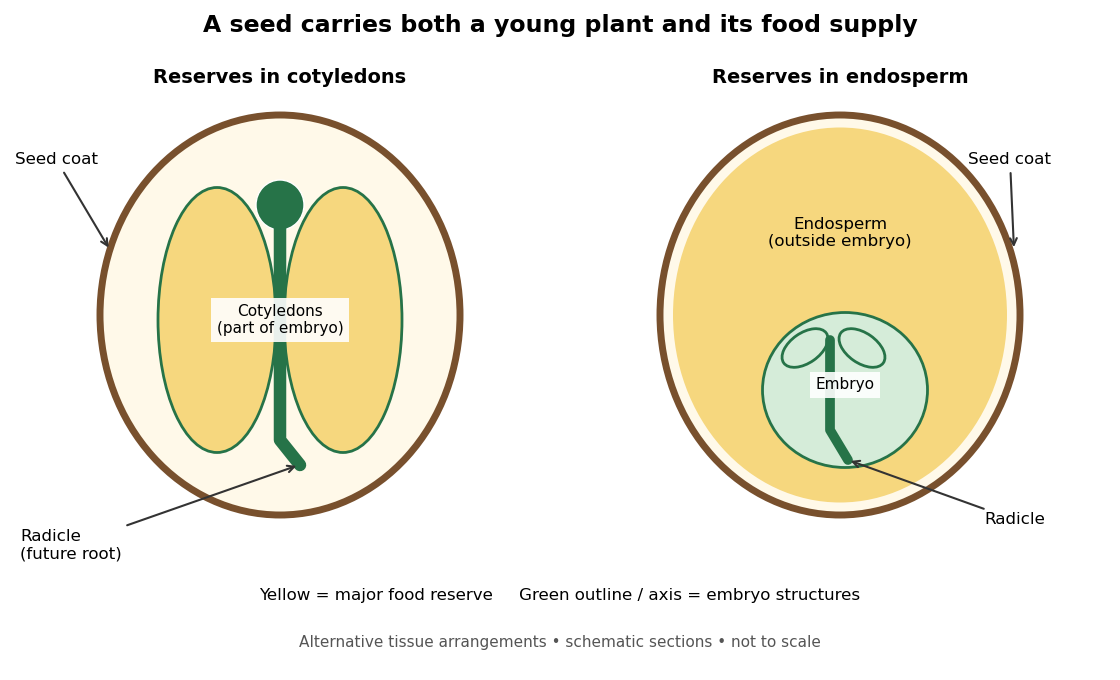
A useful reading exercise is to identify both the future plant and its initial food supply in each drawing. The large yellow area has the same role in both pictures, but it belongs to different plant tissues. Thus location and function alone do not establish tissue identity.
The capacity of a seed lot to germinate and establish under specified conditions, distinguished from viability alone.
The protective covering of a seed, formed from maternal plant tissues surrounding the developing plant embryo.
Stored material supporting early seedling growth, located in cotyledons, endosperm or other plant tissues depending on the plant.
Articles were limited to the first 100 out of 587 total.



